Get help with Mathematics, Grade 8
Most tutoring makes you sit through material you already know. MapleMind flips that: pick the exact skill that's causing trouble — any of the 34 below — and the tutor teaches just that one, step by step, as many times as it takes. Ask questions in plain words, any time of day, in English, French, or 12 other languages.
The official Newfoundland and Labrador Mathematics, Grade 8 curriculum
Newfoundland and Labrador defines Mathematics, Grade 8 by strands and outcomes. MapleMind teaches the same curriculum reorganized for one-skill-at-a-time tutoring — the table shows exactly where every official strand lands, and the ministry's own wording is quoted under each unit below.
Official source Newfoundland and Labrador's official curriculumRead it on the government site — gov.nl.ca ↗| Official strand | Outcomes | Where MapleMind teaches it |
|---|---|---|
| Strand N | 17 | Percent, Ratio, Rate, and Squares · Operations with Fractions, Integers, and Percents |
| PAR | 3 | Linear Relations · Linear Equations |
| SAS | 11 | Pythagoras, Surface Area, and Volume · Nets, Tessellations, and Views |
| SAP | 3 | Choosing and Critiquing Graphs · Probability |
Every skill below, taught one on one.
 Try the first session free
How MapleMind teaches Mathematics, Grade 8 — every unit, lesson, and skill
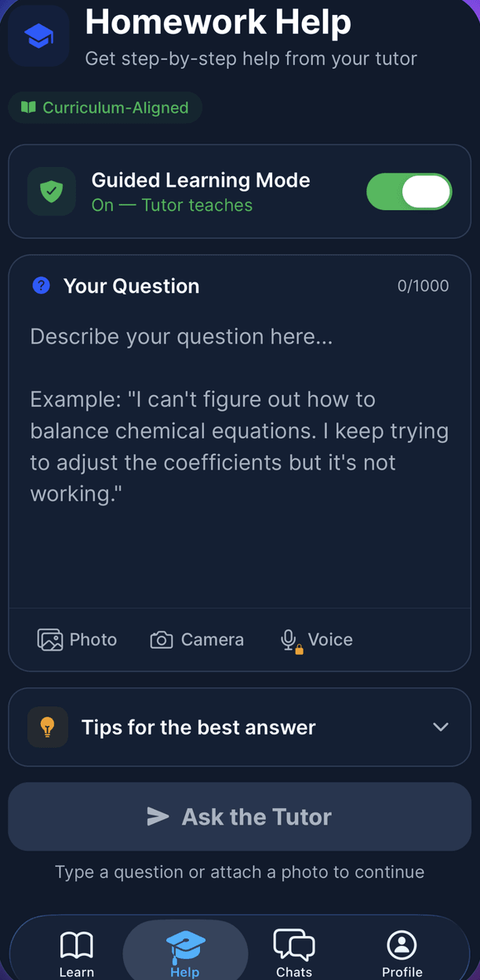
Every skill below runs as a short session: a plain-words lesson, a worked example, solving it together, then a five-question skill check that earns up to three stars. Guided Mode keeps it teaching instead of answer-handing — turning it off needs a parent's password.
Unit 1Percent, Ratio, Rate, and SquaresOfficial strand · Strand N
Percents beyond 100, ratios and rates, and perfect squares.
Percent Beyond 100
- Representing percents beyond 100N.3.2 — Represent fractional percents and percents greater than 100 on grid paper, and determine and record the percent shown as a decimal, fraction, and percent.
- Converting among percent, decimal, and fractionN.3.5 — Express a percent in decimal or fractional form, a decimal in percent or fractional form, and a fraction in decimal or percent form.
Ratios and Rates
- Two- and three-term ratiosN.3.8 — Express two- and three-term ratios from a context, express a part-to-part ratio as a part-to-whole fraction and as a percent, and identify ratios in real life.
- Rates in contextN.3.16 — Express a rate using words or symbols, explain a ratio or rate in context, identify rates in real life, and explain why a rate cannot be a percent.
Perfect Squares
- Perfect squares and square rootsN.3.19 — Represent a perfect square as a square region and determine whether a number is a perfect square using materials or prime factorization, explaining the reasoning.
- Squares and square roots of perfect squaresN.5.2 — Determine the factors and square root of a perfect square recording symbolically, explain why one factor is the square root, and determine the square of a number.
The official wording — 6 outcomes in this unit
- N.3.2
Represent a given fractional percent using grid paper
- N.3.5
Express a given percent in decimal or fractional form
- N.3.8
Express a two-term ratio from a given context in the forms 3:5 or 3 to 5
- N.3.16
Express a given rate using words or symbols, e.g., 20L per 100 km or 20 L/100 km
- N.3.19
Represent a perfect square as a square region using materials, such as grid paper or square shapes
- N.5.2
Determine the square root of a given perfect square and record it symbolically
Unit 2Operations with Fractions, Integers, and PercentsOfficial strand · Strand N
Percent problems, multiplying and dividing fractions and integers, and estimating square roots.
Percent Problems
- Solving percent problemsN.6.1 — Solve problems involving percents, combined percents, and finding the percent of a percent.
Multiplying and Dividing Fractions
- Multiplying fractionsN.6.5 — Model multiplication of a fraction by a whole number and by a fraction using an area model, give a context, and generalize and apply the rule for multiplying fractions and mixed numbers.
- Estimating products of fractionsN.6.7 — Estimate the product of two positive proper fractions to decide if the product is closer to 0, one half, or 1.
- Dividing fractionsN.6.12 — Model division of a whole number and a fraction, and of a fraction by a fraction, give a context, and generalize and apply the rule for dividing proper fractions.
- Dividing mixed numbers and estimating quotientsN.6.13 — Model, generalize, and apply rules for dividing fractions with mixed numbers, and estimate the quotient of two fractions against whole-number benchmarks.
- Solving fraction problemsN.6.16 — Identify the operation needed for a fraction problem and solve it, respecting the order of operations, with positive solutions.
Multiplying and Dividing Integers
- Multiplying integersN.6.18 — Model multiplication of two integers, generalize and apply the sign rule for products, give a context, and solve problems involving integer multiplication.
- Dividing integersN.6.22 — Model division of integers, generalize and apply the sign rule for quotients, give a context, and solve integer division problems with and without technology.
- Order of operations with integersN.6.27 — Identify the operation required to solve a problem involving integers, and solve a problem involving integers respecting the order of operations.
- Solving ratio and rate problemsN.6.28 — Solve problems involving ratios and problems involving rates.
Estimating Square Roots
- Estimating square rootsN.6.30 — Estimate a square root using perfect-square benchmarks, identify a whole number whose square root lies between two numbers, and approximate with technology, explaining why it is an approximation.
The official wording — 11 outcomes in this unit
- N.6.1
Solve a given problem involving percents
- N.6.5
Model multiplication of a positive fraction by a positive fraction concretely or pictorially using an area model and record the process
- N.6.7
Estimate the product of two given positive proper fractions to determine if the product will be closer to 0
- N.6.12
Generalize and apply rules for dividing positive proper fractions
- N.6.13
Model, generalize and apply rules for dividing fractions with mixed numbers
- N.6.16
Solve a given problem involving positive fractions taking into consideration order of operations
- N.6.18
Generalize and apply a rule for determining the sign of the product of integers
- N.6.22
Generalize and apply a rule for determining the sign of the quotient of integers
- N.6.27
Solve a given problem involving integers taking into consideration order of operations
- N.6.28
Solve a given problem involving ratio
- N.6.30
Estimate, or approximate, a square root of a given number that is not a perfect square using the roots of perfect squares as benchmarks
Unit 3Linear RelationsOfficial strand · PAR
Graphing a linear relation from its equation.
Graphing Linear Relations
- Tables and graphs of a linear relationPAR.7.2 — Describe the relationship between the variables in a graph, create a table of values from an equation, find a missing value in an ordered pair, and construct a graph from an equation.
The official wording — 1 outcome in this unit
- PAR.7.2
Create a table of values by substituting values for a variable in the equation of a given linear relation
Unit 4Linear EquationsOfficial strand · PAR
Modelling and solving linear equations, including the distributive property.
Solving Linear Equations
- Modelling and solving linear equationsPAR.8.1 — Model a problem with a linear equation and solve using concrete models, draw and record the solution steps, verify the solution, and solve symbolically.
- Equations with the distributive propertyPAR.8.5 — Apply the distributive property to solve equations of the form a(x + b) = c, identify and correct an error in a solution, and solve problems recording the process.
The official wording — 2 outcomes in this unit
- PAR.8.1
Model a given problem with a linear equation and solve the equation using concrete models
- PAR.8.5
Apply the distributive property to solve a given linear equation of the form a( x + b) = c
Unit 5Pythagoras, Surface Area, and VolumeOfficial strand · SAS
The Pythagorean theorem and the surface area and volume of prisms and cylinders.
The Pythagorean Theorem
- Modelling the Pythagorean theoremSAS.9.1 — Model and explain the Pythagorean theorem concretely, pictorially, or with technology, and explain with examples that it applies only to right triangles.
- Applying the Pythagorean theoremSAS.9.12 — Determine the third side of a right triangle to solve problems, decide whether a triangle is right using the theorem, and solve problems involving Pythagorean triples.
Surface Area and Volume
- Surface area of prismsSAS.9.4 — Explain the link between the area of a 2-D shape and the surface area of a 3-D object, and describe and apply strategies for the surface area of right rectangular and triangular prisms.
- Surface area of cylindersSAS.9.6 — Describe and apply strategies for determining the surface area of a right cylinder.
- Volume of prisms and cylindersSAS.9.9 — Determine the volume of a right prism from the base area, explain the base-area connection, generalize the rule for cylinders, and solve volume problems.
The official wording — 5 outcomes in this unit
- SAS.9.1
Model and explain the Pythagorean theorem concretely, pictorially or using technology
- SAS.9.12
Determine the measure of the third side of a right triangle, given the measures of the other two sides, to solve a given problem
- SAS.9.4
Describe and apply strategies for determining the surface area of a given right rectangular or right triangular prism
- SAS.9.6
Describe and apply strategies for determining the surface area of a given right cylinder
- SAS.9.9
Generalize and apply a rule for determining the volume of right cylinders
Unit 6Nets, Tessellations, and ViewsOfficial strand · SAS
Nets of 3-D objects, tessellations, and top, front, and side views.
Nets and 3-D Objects
- Matching nets to 3-D objectsSAS.10.1 — Match a net to the 3-D object it represents, predict and verify the object a net makes, and identify the faces of a prism.
- Drawing and building netsSAS.10.11 — Draw nets for a right cylinder and a right rectangular prism and verify by constructing the objects, and construct a 3-D object from a net.
Tessellations
- Which shapes tessellateSAS.10.4 — Identify which regular and irregular polygons tessellate using angle measurements to justify choices, and identify tessellations in the environment.
- Creating tessellationsSAS.10.13 — Identify the transformations in a tessellation, create a tessellation from one or more shapes, and transform a tile to make a new tessellating shape, describing it by transformations and conservation of area.
Views of 3-D Objects
- Drawing views of a 3-D objectSAS.10.15 — Draw and label the top, front, and side views of a 3-D object, and compare different views of an object to the object.
- Views from rotation and building from viewsSAS.10.16 — Predict and draw the views that result from a rotation limited to multiples of 90 degrees, and build a 3-D block object given its top, front, and side views.
The official wording — 6 outcomes in this unit
- SAS.10.1
Match a given net to the 3-D object it represents
- SAS.10.11
Draw nets for a given right circular cylinder, right rectangular prism, and verify by constructing the 3-D objects from the nets
- SAS.10.4
Identify, in a given set of regular polygons, those shapes and combinations of shapes that will tessellate, and use angle measurements to justify choices
- SAS.10.13
Create a tessellation using one or more 2-D shapes, and describe the tessellation in terms of transformations and conservation of area
- SAS.10.15
Draw and label the top, front and side views for a given 3-D object on isometric dot paper
- SAS.10.16
Draw and label the top, front and side views that result from a described rotation (limited to multiples of 90 degrees)
Unit 7Choosing and Critiquing GraphsOfficial strand · SAP
Comparing graph types and spotting misleading graphs.
Choosing a Graph
- Comparing and choosing graphsSAP.11.1 — Compare the information different graphs provide for the same data, identify their advantages and disadvantages, and justify a graph choice for a situation.
- Misleading graphsSAP.11.4 — Explain how a graph's format can mislead, how a formatting choice can misrepresent data, and identify conclusions inconsistent with the data.
The official wording — 2 outcomes in this unit
- SAP.11.1
Compare the information that is provided for the same data set by a given set of graphs
- SAP.11.4
Explain how the format of a given graph, such as the size of the intervals, the width of bars and the visual representation, may lead to misinterpretation of the data
Unit 8ProbabilityOfficial strand · SAP
Determining and applying the probability of independent events.
Independent Events
- Probability of independent eventsSAP.12.3 — Determine the probability of two independent events and verify with a different strategy, and generalize and apply a rule to solve problems.
The official wording — 1 outcome in this unit
- SAP.12.3
Generalize and apply a rule for determining the probability of independent events
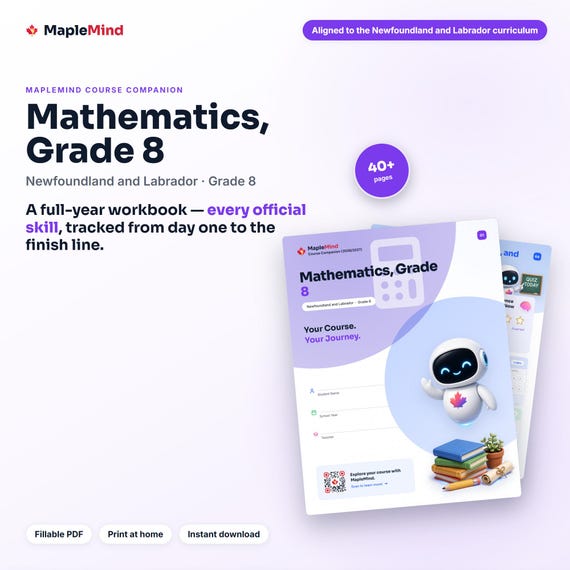
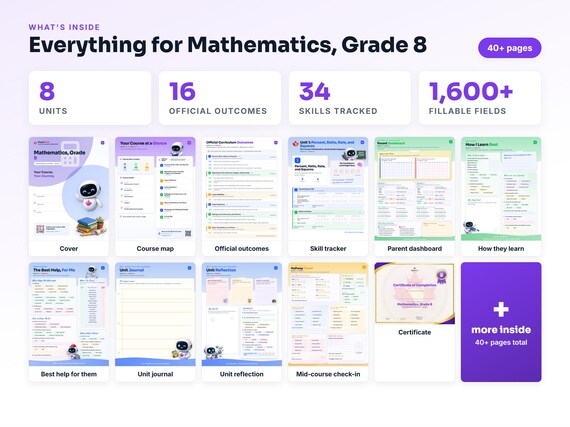
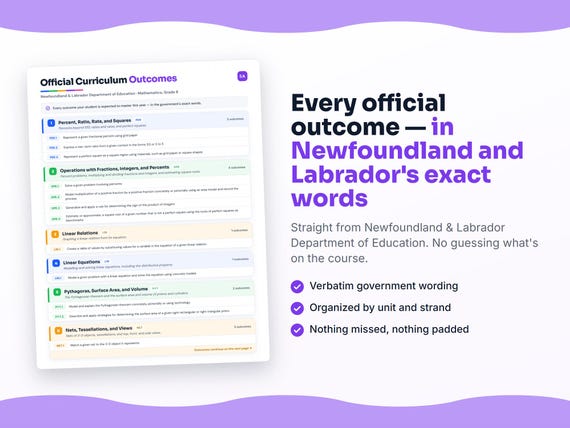

Printable workbook · A keepsake of the year
A Mathematics, Grade 8 workbook worth keeping
Built from the same official curriculum as this page. Before and after each skill above, your student colours in how sure they feel — so the two of you can see, on one page, what's clicking and what needs another look. It's a quiet way to follow how the year is really going.
By June it's full of their own handwriting: units worked through, confidence grown, a mid-year check-in, notes from parent-teacher night, and a certificate at the end. Less a worksheet, more a record of the year worth keeping on the shelf.
Instant download · see every page, reviews and the full description · five or more workbooks are $2.99 each
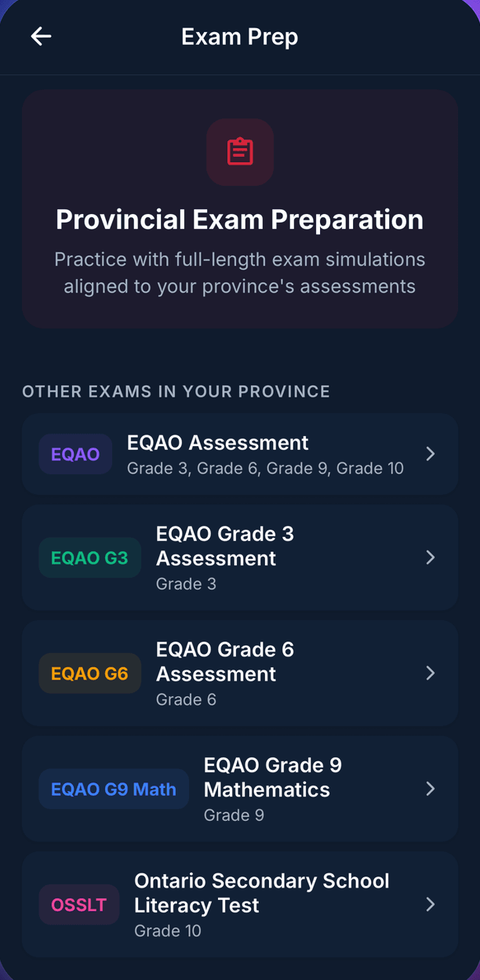
What it looks like in the app

Common questions
Can MapleMind help me with Mathematics, Grade 8?
Yes. MapleMind's AI tutor covers all 34 skills in Newfoundland and Labrador's Mathematics, Grade 8 — you pick the exact skill, and the tutor teaches it step by step: a short lesson, a worked example, solving together, then a skill check to show it stuck.
Is MapleMind aligned to Newfoundland and Labrador's official curriculum?
Yes. Every skill in this course maps to an official outcome code from Newfoundland and Labrador's Grade 8 Mathematics curriculum, and the ministry's own wording is quoted under each unit on this page — with the official government source linked so you can check it yourself.
What does MapleMind cost?
It's free to start — 5 tutoring chats and a practice quiz every day, no credit card. A Pro subscription ($9.99/month or $49.99/year CAD, 7-day free trial) unlocks unlimited tutoring, practice, and exam simulations.
What if I'm stuck on just one topic?
That's the point of skill-level tutoring: open Mathematics, Grade 8 in the app, tap the exact skill from the list on this page, and the tutor teaches just that — no wading through lessons you don't need.
Does MapleMind work in French or other languages?
Yes — 14 languages, including French. Both the app and the tutor's explanations switch to the language you choose.
Where can I see the official Newfoundland and Labrador curriculum for Mathematics, Grade 8?
The official source is linked on this page — Newfoundland and Labrador's official curriculum. The outline here follows it: every MapleMind skill carries its official outcome code, and the ministry's own wording is quoted under each unit.
Keep exploring
Ready when you are
Pick a skill from this page and see it taught properly — free, in the browser, in under a minute.