Newfoundland & Labrador · For parents

What your child learns in Grade 8 in Newfoundland & Labrador

Every subject, unit by unit, from Newfoundland & Labrador’s curriculum: 151 skills in plain words.

Subjects
5
Skills
151
Provincial exams
None
Official curriculum
gov.nl.ca

Math in Grade 8

Mathematics, Grade 8

8 units · 34 skills

  1. Unit 1

    Percent, Ratio, Rate, and Squares

    A percent can be more than 100 or a fraction of a percent.

    • Representing percents beyond 100
    • Converting among percent, decimal, and fraction
    • Two- and three-term ratios
    3 more skills
    • Rates in context
    • Perfect squares and square roots
    • Squares and square roots of perfect squares
  2. Unit 2

    Operations with Fractions, Integers, and Percents

    Combined percents are applied one after another.

    • Solving percent problems
    • Multiplying fractions
    • Estimating products of fractions
    8 more skills
    • Dividing fractions
    • Dividing mixed numbers and estimating quotients
    • Solving fraction problems
    • Multiplying integers
    • Dividing integers
    • Order of operations with integers
    • Solving ratio and rate problems
    • Estimating square roots
  3. Unit 3

    Linear Relations

    Substituting values builds the table.

    • Tables and graphs of a linear relation
  4. Unit 4

    Linear Equations

    Tiles model an equation before we solve it.

    • Modelling and solving linear equations
    • Equations with the distributive property
  5. Unit 5

    Pythagoras, Surface Area, and Volume

    In a right triangle, the squares on the legs add to the square on the hypotenuse.

    • Modelling the Pythagorean theorem
    • Applying the Pythagorean theorem
    • Surface area of prisms
    2 more skills
    • Surface area of cylinders
    • Volume of prisms and cylinders
  6. Unit 6

    Nets, Tessellations, and Views

    A net is the flattened faces of a 3-D object.

    • Matching nets to 3-D objects
    • Drawing and building nets
    • Which shapes tessellate
    3 more skills
    • Creating tessellations
    • Drawing views of a 3-D object
    • Views from rotation and building from views
  7. Unit 7

    Choosing and Critiquing Graphs

    Each graph type shows data in a different way.

    • Comparing and choosing graphs
    • Misleading graphs
  8. Unit 8

    Probability

    Independent events do not affect each other.

    • Probability of independent events

Science in Grade 8

Science, Grade 8

4 units · 29 skills

  1. Unit 1

    Earth/Space Science: Water Systems on Earth's Surface

    The hydrosphere is Earth's water, the lithosphere is its rock and land, and the atmosphere is its air.

    • How Earth's spheres interact
    • Glaciers and climate change
    • Life in oceans and fresh water
    6 more skills
    • Abiotic factors and aquatic life
    • Ocean basins and drainage systems
    • Ocean currents, winds, and climate
    • Waves and tides
    • Shaping shorelines
    • Coastal landforms
  2. Unit 2

    Physical Science: Fluids

    Viscosity is a liquid's resistance to flowing — how thick or runny it is.

    • Viscosity
    • Density and the Particle Theory
    • Temperature and density
    6 more skills
    • Density in everyday life
    • Balanced and unbalanced forces
    • Mass and weight
    • Buoyancy — sinking and floating
    • Force, area, and pressure
    • Pressure, volume, and temperature
  3. Unit 3

    Physical Science: Optics

    Visible light is the light our eyes can see.

    • Properties of visible light
    • The electromagnetic spectrum
    • The law of reflection
    1 more skill
    • Refraction
  4. Unit 4

    Life Science: Cells, Tissues, Organs and Systems

    A cell is the smallest living unit of a living thing.

    • The cell as a living system
    • Plant and animal cells
    • Cell division, growth, and reproduction
    4 more skills
    • Cells, tissues, organs, and systems
    • Cells and the whole organism
    • What affects body systems
    • Systems working together

English in Grade 8

English Language Arts, Grade 8

3 units · 39 skills

  1. Unit 1

    Speaking and Listening

    Reflecting means thinking back on how each contribution moved the discussion.

    • Reflecting on others' contributions to discussion
    • Asking questions for clarification
    • Responding with accuracy, relevancy, and validity
    9 more skills
    • Expressing a point of view with evidence from sources
    • Listening to interpret main ideas and relevancy
    • Applying strategies for effective talk
    • Assessing when to clarify or elaborate
    • Using effective speaking strategies
    • Demonstrating active speaking and listening
    • Expressing ideas with sensitivity and respect
    • Recognizing bias and attitudes in oral language
    • Examining how oral language influences and manipulates
  2. Unit 2

    Reading and Viewing

    Purposeful readers select texts to fit a need or an interest.

    • Selecting texts for needs and interests
    • Explaining how authors use text features
    • Using reading and viewing strategies
    13 more skills
    • Assessing personal reading strategies
    • Identifying topics for inquiry
    • Evaluating the reliability of information
    • Comparing information from sources
    • Using effective inquiry strategies
    • Explaining personal responses with support
    • Explaining points of view with evidence
    • Recognizing that texts can be biased
    • Questioning a text's language, form, and genre
    • Recognizing the tools text creators use
    • Describing how form and structure affect meaning
    • Awareness that values influence critical response
    • Describing the portrayal of culture and reality
  3. Unit 3

    Writing and Representing

    Language learners keep experimenting with strategies for writing and representing.

    • Experimenting with strategies as a language learner
    • Writing to reflect on ideas, values, and attitudes
    • Assessing strategies and describing growth
    8 more skills
    • Integrating stylistic effects to create interest
    • Creating a range of texts
    • Experimenting with forms and styles for purpose and audience
    • Assessing feedback to inform future work
    • Choosing strategies to create varied texts
    • Using the conventions of written language
    • Using technologies for varied purposes and audiences
    • Committing to the process of creating texts

French in Grade 8

Core French, Grade 8

3 units · 29 skills

  1. Unit 1

    Communication

    A directed conversation has a set task or goal to reach.

    • Directed short conversations
    • Asking and answering questions
    • Discussing activities with some detail
    10 more skills
    • Present tense with occasional past
    • Global comprehension of texts
    • Extracting specific information
    • Analyzing media messages
    • Recounting events in time and place
    • Reading aloud familiar texts
    • Reading for information and pleasure
    • Creating and publishing texts (50-55 words)
    • Representing the meaning of a creative work
    • Responding creatively to art
  2. Unit 2

    Culture

    Canada has two official languages: French and English.

    • Canada is officially bilingual
    • Personal and local celebrations
    • Francophone celebrations and customs
    2 more skills
    • Francophone cultures in Canada and Saint Pierre et Miquelon
    • Contributions of prominent francophones
  3. Unit 3

    General Language Education

    Visual cues: images, layout, bold words.

    • Decoding with cues
    • Predicting with contextual clues
    • Using advance organizers
    8 more skills
    • Gathering and organizing information
    • Applying language patterns
    • Using reference materials
    • Using a model
    • Checking for errors
    • Using the writing process
    • Oral presentation strategies
    • Applying print-text features

Social studies in Grade 8

Social Studies, Grade 8

5 units · 20 skills

  1. Unit 1

    History - 1. Citizenship, Power, and Governance

    In the 19th century Newfoundland and Labrador moved toward governing itself.

    • Political context and challenges of the 19th century
    • The impact of the political events of the 1930s
    • Entering Confederation with Canada
  2. Unit 2

    History - 2. Culture and Diversity

    The 19th-century Indigenous peoples of Newfoundland and Labrador included the Innu, Inuit, Labrador Metis, and Mi'kmaq.

    • The Indigenous peoples of Newfoundland and Labrador
    • The history of the Beothuk
    • Lifestyles of 19th-century peoples
  3. Unit 3

    History - 3. Individuals, Societies, and Economic Decisions

    The 19th-century economy centred on the fishery.

    • The economic context of 19th-century lifestyles
    • The growth of a land-based economy
    • Economic changes after Confederation up to 1971
    2 more skills
    • Social changes after Confederation
    • Economic developments at the close of the 20th century
  4. Unit 4

    History - 4. People, Place, and Environment

    Various groups settled in Newfoundland and Labrador in the 19th century.

    • Groups who settled and why
    • Patterns of settlement
    • Social changes and issues at the close of the 20th century
  5. Unit 5

    History - 5. Time, Continuity, and Change

    History is the study of the past.

    • Understanding and appreciating history
    • How to find out about the past
    • Newfoundland and Labrador in World War I
    3 more skills
    • The impact of World War II on Newfoundland and Labrador
    • Coping with crises and disasters
    • How history shapes our present

MapleMind

See Grade 8 in MapleMind

Real screens from the app your child would use.

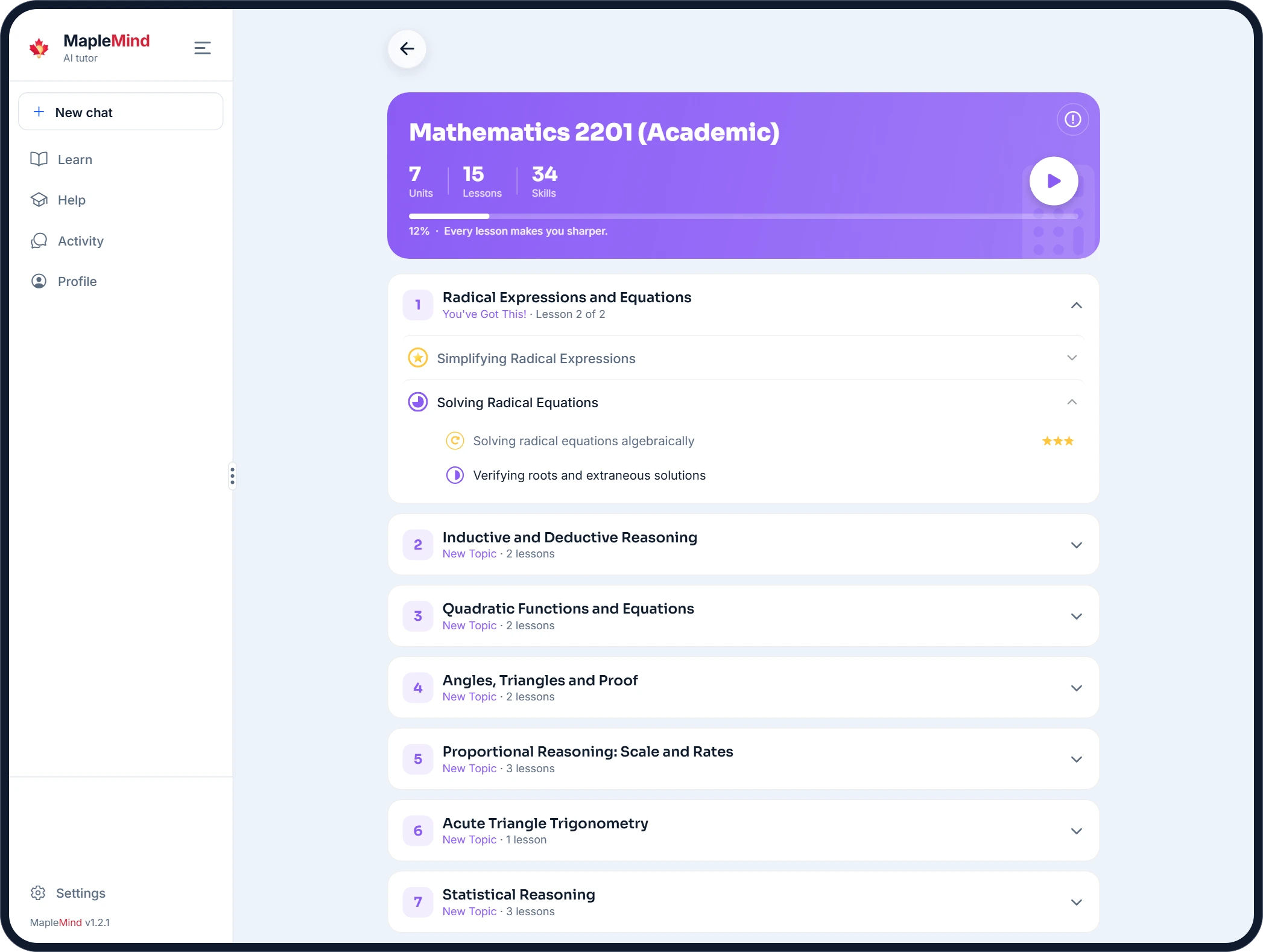
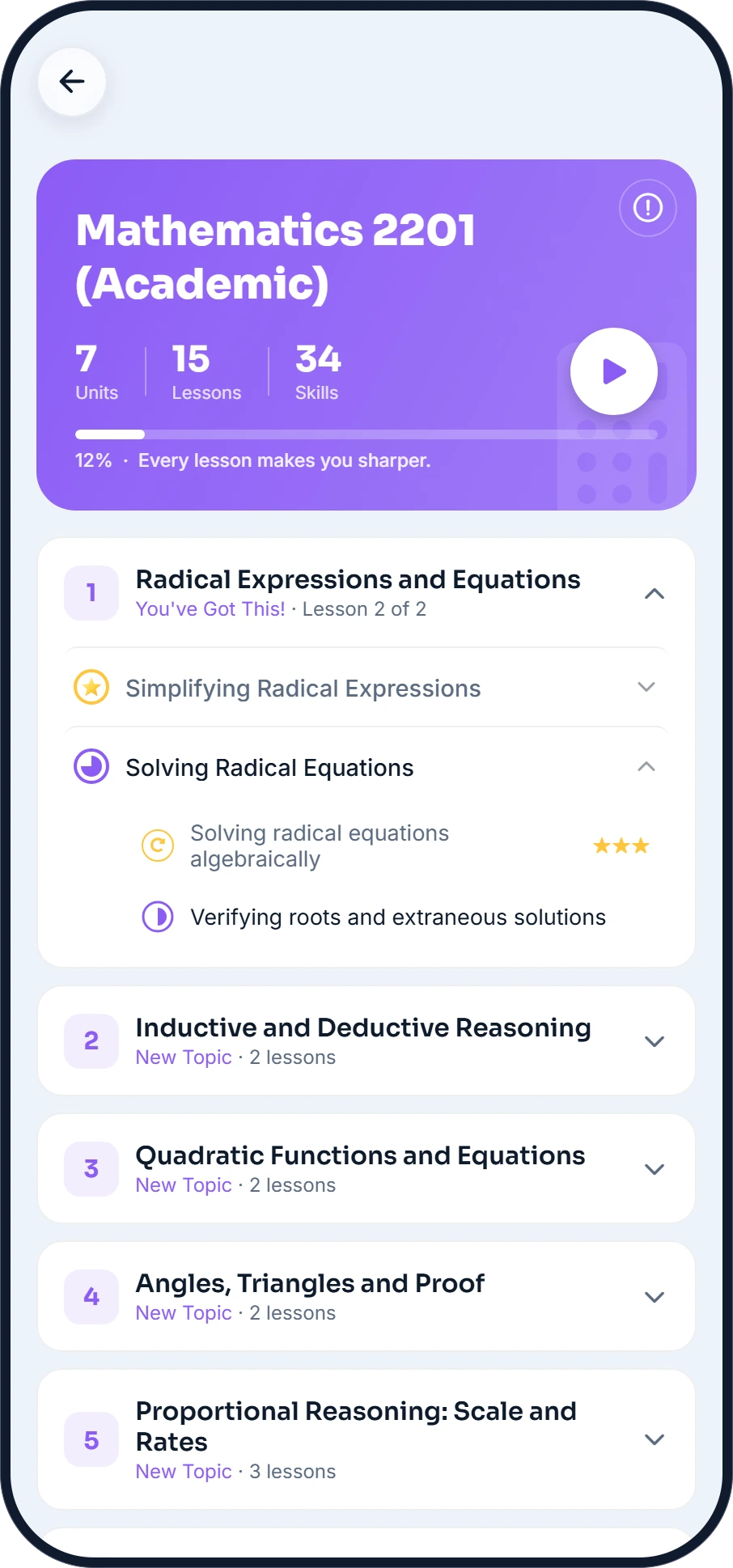
Mathematics 2201 (Academic) in MapleMind on a tablet: its units and lessons in order, a student partway through.Mathematics 2201 (Academic) in MapleMind on a phone: its units and lessons in order, a student partway through.
Their course, unit by unit, the way Newfoundland & Labrador teaches it.Shown: Mathematics 2201 (Academic)
Homework Help on a tablet: a photo of a worksheet, the tutor’s worked example of a two-step equation, and a question back to the student.Homework Help on a phone: a photo of a worksheet, the tutor’s worked example of a two-step equation, and a question back to the student.
Homework Help: they take a photo of the question, and the tutor works through it with them.
The Parent Dashboard on a tablet: a student’s days studied, streak, lessons, quiz average and recent activity.The Parent Dashboard on a phone: a student’s days studied, streak, lessons, quiz average and recent activity.
The Parent Dashboard: how each child’s week went, in lessons, quizzes and days studied.
A Grade 9 provincial mathematics exam on a tablet: a readiness score, the exam’s time and its next sitting.A Grade 9 provincial mathematics exam on a phone: a readiness score, the exam’s time and its next sitting.
A provincial exam: a practice sitting under the real time, and how ready they are.
The Learn tab on a tablet: a four-day streak, the week’s days, Homework Help, the next lesson and a review.The Learn tab on a phone: a four-day streak, the week’s days, Homework Help, the next lesson and a review.
The Learn tab: their week so far, and the next thing to do.

Help at home

Questions parents ask

What will my child learn in Grade 8 in Newfoundland & Labrador?

Math: Mathematics, Grade 8. Science: Science, Grade 8. English: English Language Arts, Grade 8. French: Core French, Grade 8. Social studies: Social Studies, Grade 8. That’s 151 skills in all, from Newfoundland & Labrador’s curriculum.

Does my child write a provincial exam in Grade 8?

No. Newfoundland & Labrador has no provincial exam in Grade 8.

Where does this list come from?

From Newfoundland & Labrador’s official curriculum, the documents its education ministry publishes for each course. Each skill here is one of their expectations, written in plain words.

Can MapleMind help my child in Grade 8?

Yes. Every course on this page is in MapleMind, with lessons, practice and a tutor that works through each step with them. A free account gets 30 messages and 4 activities a day.

Help with Grade 8, one skill at a time.

Every course on this page is in MapleMind, free with daily limits.