Get help with New Media 11
Most tutoring makes you sit through material you already know. MapleMind flips that: pick the exact skill that's causing trouble — any of the 45 below — and the tutor teaches just that one, step by step, as many times as it takes. Ask questions in plain words, any time of day, in English, French, or 12 other languages.
The official British Columbia New Media 11 curriculum
British Columbia defines New Media 11 by strands and outcomes. MapleMind teaches the same curriculum reorganized for one-skill-at-a-time tutoring — the table shows exactly where every official strand lands, and the ministry's own wording is quoted under each unit below.
Official source BC's official English language arts curriculumRead it on the government site — curriculum.gov.bc.ca ↗| Official strand | Outcomes | Where MapleMind teaches it |
|---|---|---|
| Big Idea: Language shapes ideas and influences others. | 23 | New Media Forms & Genres · Creating & Presenting Digital/Multimedia Texts |
| Big Idea: People understand text differently depending on their worldviews and perspectives. | 12 | Reading & Comprehending Multimodal Texts |
| Big Idea: Digital citizenship requires both knowledge of digital technology and awareness of its impact on individuals and society. | 6 | Digital Citizenship & Media Literacy |
| Big Idea: Texts are socially, culturally, geographically, and historically constructed. | 4 | New Media Functions |
Every skill below, taught one on one.
 Try the first session free
How MapleMind teaches New Media 11 — every unit, lesson, and skill
Every skill below runs as a short session: a plain-words lesson, a worked example, solving it together, then a five-question skill check that earns up to three stars. Guided Mode keeps it teaching instead of answer-handing — turning it off needs a parent's password.
Unit 1New Media Forms & GenresOfficial strand · Big Idea: Language shapes ideas and influences others.
The nm11-distinctive forms cluster: naming a multimedia text's form, function, and genre; tracing how technology shapes what a text can be; reading the visual grammar of graphic texts; treating interactivity as a structural design choice; and the style/device/analysis competencies that explain how a text's form reflects its purpose, audience, and message.
The Form of a Multimedia Text
- Form of a multimedia text — the shape it takes11.FORM.1 — Identify the form a multimedia or other text takes — the shape a creator chooses within a type of communication (video essay, podcast, infographic, interactive story, social media post, meme) — and name what makes that form recognizable.
The Function of a Multimedia Text
- Function of a multimedia text — its intended purpose11.FUNC.1 — Identify the function of a multimedia text — its intended purpose for its audience (to persuade, inform, entertain, reflect, sell, connect) — and distinguish that purpose from the form the text happens to take.
The Genre of a Multimedia Text
- Genre of a multimedia text — literary and thematic categories11.GENRE.1 — Classify a multimedia or other text by genre — the literary or thematic category it belongs to (adventure, fantasy, mystery, science fiction, biography, essay, journalism, memoir, personal narrative, speech, and more) — and use the genre's conventions to explain what an audience expects from it.
How Technology Shapes Form
- Relationships between form, function, and technology11.TECH.1 — Explain how the technology available to a creator — a phone camera, an editing app, a website builder, a platform's upload limits — shapes the form a text can take and what it can be used to do.
Reading Visual and Graphic Texts
- Elements of visual and graphic texts11.VIS.1 — Read the visual grammar of graphic and visual texts — layout, colour, typography, panel or frame composition, image-text relationship — to explain how design choices build meaning for a viewer.
Interactivity as a Design Choice
- Interactivity11.INTER.1 — Analyze interactivity — clicking, choosing, scrolling, commenting, branching a story's path — as a deliberate structural feature that changes how a user experiences and makes meaning from a text, not a cosmetic add-on.
Style, Literary Devices, and Analyzing Purpose
- Elements of style11.STYLE.1 — Identify the elements of style — diction, vocabulary, sentence structure, and tone — that make a creator's work distinguishable from others', across written and digital texts.
- Literary elements and devices, including figurative language11.DEV.1 — Recognize literary elements and devices — including figurative language — and explain how a text uses them according to its purpose and audience.
- How forms, formats, structures, and features of texts reflect purpose, audience, and message11.ANLZ.1 — Recognize and appreciate how the forms, formats, structures, and features a creator chooses reflect a variety of purposes, audiences, and messages — connecting the form back to why it was built that way.
The official wording — 9 outcomes in this unit
- 11.FORM.1
form, function, and genre of multimedia and other texts
- 11.FUNC.1
function: the intended purpose of a text
- 11.GENRE.1
form, function, and genre of multimedia and other texts
- 11.TECH.1
relationships between form, function, and technology
- 11.VIS.1
elements of visual/graphic texts
- 11.INTER.1
interactivity
- 11.STYLE.1
elements of style
- 11.DEV.1
literary elements and devices
- 11.ANLZ.1
Recognize and appreciate how various forms, formats, structures, and features of texts reflect a variety of purposes, audiences, and messages
Unit 2Reading & Comprehending Multimodal TextsOfficial strand · Big Idea: People understand text differently depending on their worldviews and perspectives.
The receptive strand applied to multimodal and digital texts: First Peoples narrative structures and ownership protocols, reading and multimodal-reading strategies, monitoring your own comprehension, distinguishing literal from inferential meaning, and comprehending texts across every mode to guide inquiry — plus the TEACH'd First Peoples competencies of oral tradition and the influence of land and place.
Narrative Structures in First Peoples Texts
- Narrative structures found in First Peoples texts11.FP.1 — Recognize narrative structures found in First Peoples texts — cyclical rather than strictly linear plots, connection to land and place, the role of the storyteller — and how these structures carry meaning differently than conventional Western plot shapes.
First Peoples Oral Tradition and the Influence of Land and Place
- The role of story, narrative, and oral tradition in First Peoples texts11.FPTRAD.1 — Recognize and understand the role that story, narrative, and oral tradition play in expressing First Peoples perspectives, values, beliefs, and points of view — including in digital retellings and adaptations of oral texts.
- The influence of land and place in First Peoples and other Canadian texts11.FPLAND.1 — Recognize the influence of land and place in First Peoples and other Canadian texts — how a specific place named in a story is part of its meaning, not just its setting.
Reading Strategies — Predicting, Inferring, Questioning
- Reading strategies — predicting, inferring, questioning11.READ.1 — Use the forward-looking reading strategies — predicting what a new media text will do next, inferring meaning that is implied but not stated, and questioning a text as you go — to actively engage with video, audio, and interactive texts rather than consuming them passively.
Reading Strategies — Paraphrasing, Summarizing, Big Ideas
- Reading strategies — paraphrasing, summarizing, identifying big ideas11.READ.2 — Use the meaning-condensing reading strategies — paraphrasing a claim in your own words, summarizing a long video or article, and identifying the big ideas beneath the surface detail — to pull the core message out of a dense or fast-moving new media text.
Reading Strategies — Context Clues and Text Features
- Reading strategies — using context clues and text features to unpack text11.READ.3 — Use context clues (surrounding words, images, and situation) and text features (titles, captions, on-screen labels, thumbnails, chapter markers) to unpack the meaning of an unfamiliar or ambiguous new media text.
Reading Strategies — Connecting, Visualizing, Synthesizing, Reflecting
- Reading strategies — making connections, visualizing, synthesizing, reflecting11.READ.4 — Use the extending reading strategies — making connections to other texts and your own experience, visualizing, synthesizing information from several sources, and reflecting on what you read — to build deeper understanding across new media texts.
Monitoring Your Own Thinking
- Metacognitive strategies11.META.1 — Monitor your own comprehension while engaging with a complex or multimodal text, notice the point where understanding breaks down or a claim feels off, and apply a fix-up or fact-checking strategy to repair it.
Multimodal Reading and Literal vs. Inferential Meaning
- Multimodal reading strategies11.MMREAD.1 — Apply reading strategies suited to multimodal texts that combine written words, images, sound, and interaction, tracking how each mode contributes to the overall meaning.
- Literal and inferential meaning in multimedia texts11.MEAN.1 — Distinguish literal meaning (what a text states outright) from inferential meaning (what a text implies but never says) across written, visual, and digital texts.
Comprehending Written, Oral, Visual, and Multimodal Texts
- Comprehending written, oral, visual, and multimodal texts11.COMP.1 — Apply appropriate strategies in a variety of contexts to comprehend written, oral, visual, and multimodal texts, using comprehension to guide inquiry and extend thinking about new media.
The official wording — 12 outcomes in this unit
- 11.FP.1
narrative structures found in First Peoples texts
- 11.FP.2
protocols related to the ownership of First Peoples oral texts
- 11.FPTRAD.1
Recognize and understand the role of story, narrative, and oral tradition in expressing First Peoples perspectives, values, beliefs, and points of view
- 11.FPLAND.1
Recognize the influence of land/place in First Peoples and other Canadian texts
- 11.READ.1
reading strategies
- 11.READ.2
reading strategies
- 11.READ.3
reading strategies
- 11.READ.4
reading strategies
- 11.META.1
metacognitive strategies
- 11.MMREAD.1
multimodal reading strategies
- 11.MEAN.1
literal and inferential meaning
- 11.COMP.1
Apply appropriate strategies in a variety of contexts to comprehend written, oral, visual, and multimodal texts, to guide inquiry and to extend thinking
Unit 3Digital Citizenship & Media LiteracyOfficial strand · Big Idea: Digital citizenship requires both knowledge of digital technology and awareness of its impact on individuals and society.
The course-defining fifth Big Idea: evaluating the relevance, accuracy, and reliability of digital sources; recognizing the complexities of digital citizenship; thinking critically, creatively, and reflectively about media; evaluating how new-media techniques and devices serve purpose and audience; and identifying bias, contradictions, distortions, and omissions.
Evaluating the Relevance, Accuracy, and Reliability of Sources
- Evaluating the relevance, accuracy, and reliability of digital sources11.RELY.1 — Access information for diverse purposes and from a variety of sources, and evaluate its relevance, accuracy, and reliability — checking credibility, currency, point of view, bias, and whose voices might be left out.
The Complexities of Digital Citizenship
- Recognizing the complexities of digital citizenship11.DIGCIT.1 — Recognize the complexities of digital citizenship — taking personal responsibility and behaving ethically and cautiously when using technology, and understanding that online actions carry real consequences for yourself and others.
Thinking Critically, Creatively, and Reflectively About Media
- Thinking critically, creatively, and reflectively about texts11.THINK.1 — Think critically, creatively, and reflectively to explore ideas within, between, and beyond new media texts, rather than accepting a text's surface message at face value.
Evaluating New Media Techniques and Devices
- Evaluating how new media techniques and devices reflect purpose and audience11.MEDANLZ.1 — Evaluate how literary elements and new media techniques and devices — editing choices, framing, pacing, sound design — reflect different purposes and audiences.
Identifying Bias, Contradictions, Distortions, and Omissions
- Identifying bias, contradictions, distortions, and omissions11.BIAS.1 — Identify bias, contradictions, distortions, and omissions in a media text — noticing what a source leaves out or shapes as much as what it includes.
Expressing and Supporting an Opinion with Evidence
- Express and support an opinion with evidence11.ARG.1 — Express and support an opinion with evidence — build a defensible claim about a media issue, back it with specific evidence and reasoning, and answer the obvious counter-argument, rather than just stating what you feel or reacting to a text.
The official wording — 6 outcomes in this unit
- 11.RELY.1
Access information for diverse purposes and from a variety of sources and evaluate its relevance, accuracy, and reliability
- 11.DIGCIT.1
Recognize the complexities of digital citizenship
- 11.THINK.1
Think critically, creatively, and reflectively to explore ideas within, between, and beyond texts
- 11.MEDANLZ.1
Evaluate how literary elements and new media techniques and devices reflect different purposes and audiences
- 11.BIAS.1
Identify bias, contradictions, distortions, and omissions
- 11.ARG.1
Express and support an opinion with evidence
Unit 4New Media FunctionsOfficial strand · Big Idea: Texts are socially, culturally, geographically, and historically constructed.
Four distinct, nm11-distinctive jobs new media is built to do: advocating for a cause, building community, spreading propaganda, and manipulating an audience — recognizing each as a deliberate function a digital text can be constructed to serve.
Advocacy as a Function of New Media
- Advocacy11.ADV.1 — Recognize advocacy as a function of new media — texts built to campaign for a cause, change minds, or drive an audience to act, such as a petition video or an awareness campaign.
Community Building as a Function of New Media
- Community building11.COMM.1 — Recognize community building as a function of new media — texts built to connect people around a shared identity, interest, or experience, such as a fan forum, a hashtag movement, or a group chat culture.
Propaganda as a Function of New Media
- Propaganda11.PROP.1 — Recognize propaganda as a function of new media — texts built to promote a particular political or ideological viewpoint, often by appealing to emotion over evidence.
Manipulation as a Function of New Media
- Manipulation11.MANIP.1 — Recognize manipulation as a function of new media — texts built to mislead an audience through selective editing, staged footage, deepfakes, or deceptive framing.
The official wording — 4 outcomes in this unit
- 11.ADV.1
advocacy
- 11.COMM.1
community building
- 11.PROP.1
propaganda
- 11.MANIP.1
manipulation
Unit 5Creating & Presenting Digital/Multimedia TextsOfficial strand · Big Idea: Language shapes ideas and influences others.
The productive strand contextualized to digital creation: oral, writing, multimodal-writing, and presentation processes; usage and conventions; citation and intellectual-property rights; selecting media and oral formats for a purpose; using digital and multimedia processes to create original texts; and refining and transforming a text for real impact.
Oral Strategies for Discussing and Pitching Media
- Oral language strategies11.ORAL.1 — Apply oral language strategies — organizing a pitch or critique before speaking, active listening in a feedback circle, adjusting tone and pace for a recorded voiceover or live presentation — when discussing or presenting new media work.
Formal Speaking and Presentation Delivery
- Demonstrate speaking and listening skills in formal and informal contexts11.PRESENT.1 — Demonstrate formal speaking and listening delivery across a range of contexts — a debate, a speech, a presentation, an interview, a performance — using conscious control of emotion, volume, pace, pause, inflection, and emphasis, plus receptive listening skills like eye contact and body language.
Writing and Multimodal Writing Processes
- Writing processes11.WPROC.1 — Move a script, voiceover, caption set, or written component of a new media project through the writing process — planning, drafting, revising, and editing — to produce a polished final piece.
- Multimodal writing strategies11.MMWRITE.1 — Apply writing strategies suited to composing across multiple modes at once — pairing a script with visuals, timing captions to audio, sequencing an interactive path — so the modes work together rather than repeating each other.
Multimedia Presentation Processes
- Multimedia presentation processes11.PRES.1 — Move a visual or interactive project through a presentation process — sketching or storyboarding, prototyping, gathering feedback, and refining — before presenting a finished new media piece to a real audience.
Usage and Conventions
- Usage — avoiding double negatives, mixed metaphors, malapropisms, word misuse11.CONV.1 — Avoid common usage errors in your writing — double negatives, mixed metaphors, malapropisms, and word misuse — that undercut a text's clarity and credibility.
- Conventions — standard punctuation, capitalization, quoting, Canadian spelling11.CONV.2 — Apply the common conventions of standard punctuation, capitalization, quoting, and Canadian spelling correctly and consistently across written and digital texts.
Citation Techniques
- Citation techniques for acknowledging sources11.CITE.1 — Apply citation techniques to acknowledge the sources you draw on in a new media project — text, image, audio, or video — so your audience can trace where borrowed material came from.
Selecting Media and Oral Formats for a Purpose
- Selecting media appropriate to purpose, audience, and context11.MEDSEL.1 — Select and use a variety of media appropriate to purpose, audience, and context — choosing whether a project is best told as video, podcast, infographic, or interactive piece.
- Selecting an appropriate oral language format for a purpose11.ORALFMT.1 — Select and apply an appropriate oral language format for an intended purpose — a recorded voiceover, a live pitch, a podcast interview — matching the format to what the moment calls for.
Digital and Multimedia Creation
- Using digital and multimedia processes to create engaging, meaningful texts11.DIGCREATE.1 — Use digital and multimedia writing and design processes to plan, develop, and create engaging and meaningful literary, imaginative, and informational texts for a variety of purposes and audiences.
Refining and Transforming Texts
- Refining texts for clarity, effectiveness, and impact11.REFINE.1 — Reflect on, assess, and refine your new media texts to improve clarity, effectiveness, and impact according to purpose, audience, and message.
- Transforming ideas into original texts across genres and forms11.TRANS.1 — Transform ideas and information into original new media texts, using a variety of genres, forms, structures, and styles to make an idea your own.
Acknowledgements and Intellectual Property Rights
- Acknowledgements and citations — avoiding plagiarism, respecting IP rights11.IP.1 — Use acknowledgements and citations to recognize intellectual property rights — avoiding plagiarism and respecting the ownership of images, music, video, and text you did not create yourself.
The official wording — 14 outcomes in this unit
- 11.ORAL.1
oral language strategies
- 11.PRESENT.1
Demonstrate speaking and listening skills in a variety of formal and informal contexts for a range of purposes
- 11.WPROC.1
writing processes
- 11.MMWRITE.1
multimodal writing strategies
- 11.PRES.1
multimedia presentation processes
- 11.CONV.1
usage and conventions
- 11.CONV.2
usage and conventions
- 11.CITE.1
citation techniques
- 11.MEDSEL.1
Select and use a variety of media appropriate to purpose, audience, and context
- 11.ORALFMT.1
Select and apply an appropriate oral language format for an intended purpose
- 11.DIGCREATE.1
Use digital and multimedia writing and design processes to plan, develop, and create engaging and meaningful literary, imaginative, and informational texts for a variety of purposes and audiences
- 11.REFINE.1
Reflect on, assess, and refine texts to improve clarity, effectiveness, and impact according to purpose, audience, and message
- 11.TRANS.1
Transform ideas and information to create original texts, using various genres, forms, structures, and styles
- 11.IP.1
Use acknowledgements and citations to recognize intellectual property rights
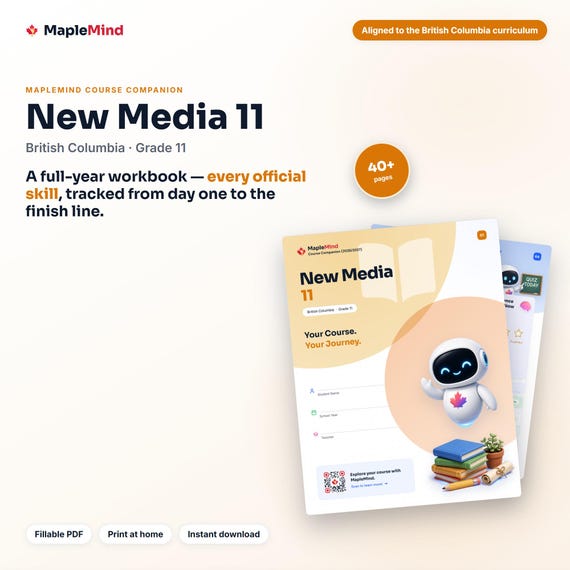
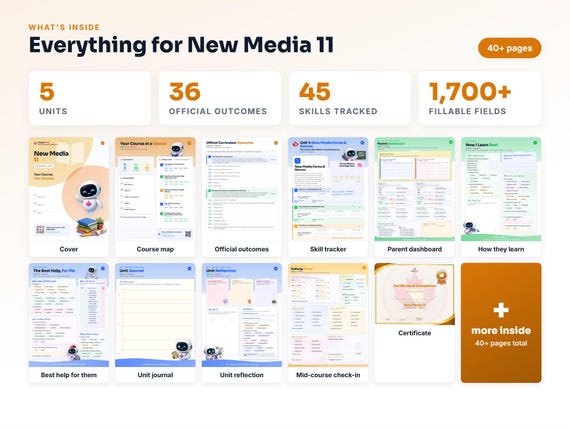
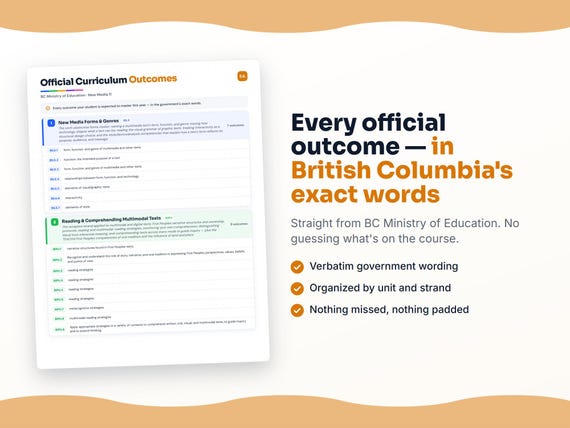
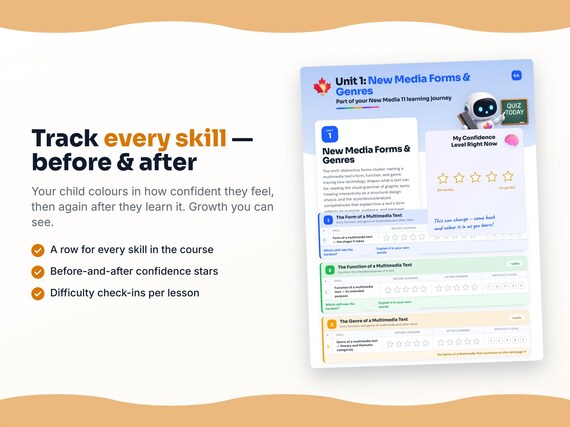
Printable workbook · A keepsake of the year
A New Media 11 workbook worth keeping
Built from the same official curriculum as this page. Before and after each skill above, your student colours in how sure they feel — so the two of you can see, on one page, what's clicking and what needs another look. It's a quiet way to follow how the year is really going.
By June it's full of their own handwriting: units worked through, confidence grown, a mid-year check-in, notes from parent-teacher night, and a certificate at the end. Less a worksheet, more a record of the year worth keeping on the shelf.
Instant download · see every page, reviews and the full description · five or more workbooks are $2.99 each
What it looks like in the app



Common questions
Can MapleMind help me with New Media 11?
Yes. MapleMind's AI tutor covers all 45 skills in British Columbia's New Media 11 — you pick the exact skill, and the tutor teaches it step by step: a short lesson, a worked example, solving together, then a skill check to show it stuck.
Is MapleMind aligned to British Columbia's official curriculum?
Yes. Every skill in this course maps to an official outcome code from British Columbia's Grade 11 English Language Arts curriculum, and the ministry's own wording is quoted under each unit on this page — with the official government source linked so you can check it yourself.
What does MapleMind cost?
It's free to start — 5 tutoring chats and a practice quiz every day, no credit card. A Pro subscription ($9.99/month or $49.99/year CAD, 7-day free trial) unlocks unlimited tutoring, practice, and exam simulations.
What if I'm stuck on just one topic?
That's the point of skill-level tutoring: open New Media 11 in the app, tap the exact skill from the list on this page, and the tutor teaches just that — no wading through lessons you don't need.
Does MapleMind work in French or other languages?
Yes — 14 languages, including French. Both the app and the tutor's explanations switch to the language you choose.
Where can I see the official British Columbia curriculum for New Media 11?
The official source is linked on this page — BC's official English language arts curriculum. The outline here follows it: every MapleMind skill carries its official outcome code, and the ministry's own wording is quoted under each unit.
Keep exploring
Ready when you are
Pick a skill from this page and see it taught properly — free, in the browser, in under a minute.