Get help with Creative Writing 12
Most tutoring makes you sit through material you already know. MapleMind flips that: pick the exact skill that's causing trouble — any of the 29 below — and the tutor teaches just that one, step by step, as many times as it takes. Ask questions in plain words, any time of day, in English, French, or 12 other languages.
The official British Columbia Creative Writing 12 curriculum
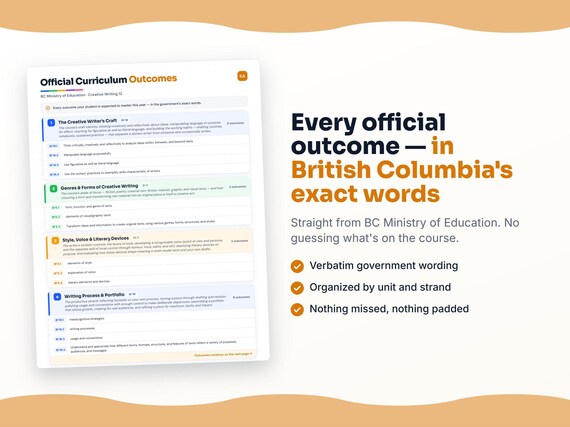
British Columbia defines Creative Writing 12 by strands and outcomes. MapleMind teaches the same curriculum reorganized for one-skill-at-a-time tutoring — the table shows exactly where every official strand lands, and the ministry's own wording is quoted under each unit below.
Official source BC's official English language arts curriculumRead it on the government site — curriculum.gov.bc.ca ↗| Official strand | Outcomes | Where MapleMind teaches it |
|---|---|---|
| Big Ideas: 'Creative writers take risks and persevere.' / 'Creative writers are observant of the world.' | 4 | The Creative Writer's Craft |
| Big Idea: 'The exploration of text and story deepens our understanding of diverse, complex ideas about identity, others, and the world.' | 3 | Genres & Forms of Creative Writing |
| Big Idea: 'Language shapes ideas and influences others.' | 5 | Style, Voice & Literary Devices |
| Big Idea: 'Writers write for authentic audiences and real-world purposes.' | 7 | Writing Process & Portfolio |
| Big Idea: 'Texts are socially, culturally, geographically, and historically constructed' (receptive/sharing counterpart). | 10 | Reading, Responding & Sharing |
Every skill below, taught one on one.
 Try the first session free
How MapleMind teaches Creative Writing 12 — every unit, lesson, and skill
Every skill below runs as a short session: a plain-words lesson, a worked example, solving it together, then a five-question skill check that earns up to three stars. Guided Mode keeps it teaching instead of answer-handing — turning it off needs a parent's password.
Unit 1The Creative Writer's CraftOfficial strand · Big Ideas: 'Creative writers take risks and persevere.' / 'Creative writers are observant of the world.'
The course's craft identity: thinking creatively and reflectively about ideas, manipulating language on purpose for effect, reaching for figurative as well as literal language, and building the working habits — drafting routines, notebooks, sustained practice — that separate a serious writer from someone who occasionally writes.
Analyzing Ideas Creatively and Reflectively
- Thinking Like a Creative Writer, Not Just a Reader12.THINK.1 — Think critically, creatively, and reflectively about ideas within, between, and beyond texts — noticing an image, a question, or a tension in something read or observed, and turning it into original creative material rather than just summarizing it.
Manipulating Language on Purpose
- Bending Language for a Reason12.MANIP.1 — Manipulate language purposefully — bending syntax, diction, rhythm, repetition, or punctuation away from the "default" way of saying something — to produce a specific effect on the reader, not as an accident of style.
Figurative as Well as Literal Language
- Reaching for Metaphor, Not Just the Literal Word12.FIG.1 — Use figurative language — metaphor, simile, symbol, imagery — as well as literal language in creative work, choosing deliberately between the two depending on which will land harder for the reader.
A Working Writer's Practices
- Building the Habits of a Working Writer12.PRAC.1 — Use the writers' practices to exemplify skills characteristic of writers — keeping a notebook, freewriting without judgment, setting a regular drafting routine, seeking feedback, revising with distance — the discipline behind a body of work, not just individual pieces.
The official wording — 4 outcomes in this unit
- 12.THINK.1
Think critically, creatively, and reflectively to analyze ideas within, between, and beyond texts
- 12.MANIP.1
Manipulate language purposefully
- 12.FIG.1
Use figurative as well as literal language
- 12.PRAC.1
Use the writers’ practices to exemplify skills characteristic of writers
Unit 2Genres & Forms of Creative WritingOfficial strand · Big Idea: 'The exploration of text and story deepens our understanding of diverse, complex ideas about identity, others, and the world.'
The course's areas of focus — fiction, poetry, creative non-fiction, memoir, graphic and visual texts — and how choosing a form and transforming raw material into an original piece is itself a creative act.
Form, Function, and Genre
- Choosing the Right Form for the Job12.FORM.1 — Recognize how a text's form (short story, poem, script, personal essay, graphic narrative) and its function (to move, to persuade, to entertain, to unsettle) shape each other, and choose forms deliberately across genres like fiction, poetry, creative non-fiction, and memoir to match a creative purpose.
Reading and Making Visual Texts
- How Images Carry Story12.VIS.1 — Analyze how visual/graphic texts — panels, layout, white space, image-text interplay in graphic novels, illustrated poetry, or zines — carry narrative and emotional meaning alongside or instead of words.
Transforming Ideas Into Original Texts
- Turning Raw Material Into a Finished Piece12.TRANS.1 — Transform ideas and information — a memory, a news story, an overheard conversation, a research fact — into original creative texts, using various genres, forms, structures, and styles rather than reporting the material unchanged.
The official wording — 3 outcomes in this unit
- 12.FORM.1
form, function, and genre of texts
- 12.VIS.1
elements of visual/graphic texts
- 12.TRANS.1
Transform ideas and information to create original texts, using various genres, forms, structures, and styles
Unit 3Style, Voice & Literary DevicesOfficial strand · Big Idea: 'Language shapes ideas and influences others.'
The writer's stylistic controls: the levers of style, developing a recognizable voice (point of view and persona, and the separate skill of tonal control through humour, irony, satire, and wit), deploying literary devices on purpose, and evaluating how those devices shape meaning in both model texts and your own drafts.
The Levers of Style
- Style as a Set of Deliberate Choices12.STYLE.1 — Identify and deliberately use elements of style — diction, vocabulary, sentence structure, tone — as levers a writer pulls to create a specific effect, the choices that make one writer distinguishable from another.
Developing Voice: Point of View and Persona
- Building a Consistent Narrative Stance12.VOICE.1 — Develop a consistent voice through point of view and persona — the narrative stance a piece is told from and the character or self a writer projects onto the page — so a reader can recognize the same writer across different pieces.
- Controlling Tone Through Humour, Irony, Satire, and Wit12.VOICE.2 — Control tone as part of voice by using humour, irony, satire, and wit deliberately — landing a joke, an understatement, or a pointed jab on purpose rather than by accident.
Literary Devices in Your Own Work
- Deploying Craft Techniques on Purpose12.DEV.1 — Identify and deliberately deploy literary elements and devices — characterization, setting, symbolism, irony, metaphor, foreshadowing, pacing — including figurative language, as intentional tools in original creative writing.
- Judging Whether a Device Is Earning Its Place12.DEVANLZ.1 — Evaluate how text structures, literary elements, techniques, and devices enhance and shape meaning and impact — in model texts and in your own drafts — to decide whether a device is doing real work or just decorating the page.
The official wording — 5 outcomes in this unit
- 12.STYLE.1
elements of style
- 12.VOICE.1
exploration of voice
- 12.VOICE.2
exploration of voice
- 12.DEV.1
literary elements and devices
- 12.DEVANLZ.1
Evaluate how text structures, literary elements, techniques, and devices enhance and shape meaning and impact
Unit 4Writing Process & PortfolioOfficial strand · Big Idea: 'Writers write for authentic audiences and real-world purposes.'
The productive strand: reflecting honestly on your own process, moving a piece through drafting and revision, polishing usage and conventions with enough control to make deliberate departures, assembling a portfolio that shows growth, creating for real audiences, and refining a piece for maximum clarity and impact.
Thinking About Your Own Writing Process
- Reflecting on How You Write12.META.1 — Use metacognitive strategies — reflecting on what drafting choices worked, naming which craft techniques felt natural versus effortful, tracking growth across a portfolio — to become a more deliberate, self-aware writer.
Drafting, Feedback, and Revision
- Moving a Piece from Draft to Finished12.WPROC.1 — Apply the stages of the writing process — generating ideas, drafting without over-editing, seeking and using peer/instructor feedback, revising for structure and craft, and polishing a final piece.
Usage and Conventions as Craft Choices
- Usage: Catching the Errors That Undercut a Piece12.CONV.1 — Recognize and avoid common usage errors — double negatives, mixed metaphors, malapropisms, and word misuse — that undercut an otherwise strong piece of creative writing.
- Conventions: Punctuation, Capitalization, and Canadian Spelling12.CONV.2 — Apply standard conventions — punctuation, capitalization, quoting, and Canadian spelling — with enough control that a deliberate departure (a fragment for effect, unconventional punctuation in a poem) reads as a choice rather than a mistake.
Reading Models and Building a Portfolio
- Showing Growth Across a Body of Work12.PORT.1 — Read a diverse selection of sample works as a framework for your own writing goals, and develop a digital, print, or multimodal portfolio that demonstrates the breadth of your body of work and growth as a writer.
Creating for Authentic Audiences
- Writing for a Real Reader, Not Just an Assignment12.CREATE.1 — Use writing and design processes to plan, develop, and create engaging and meaningful texts for real-world purposes and audiences — a piece meant to be actually read, published, or performed, not just handed in.
Refining for Clarity and Impact
- The Last Pass: Cutting What Doesn't Earn Its Place12.REFINE.1 — Assess and refine texts to improve clarity, effectiveness, and impact — writing in complex, controlled styles, cutting what does not earn its place, and sharpening what does.
The official wording — 7 outcomes in this unit
- 12.META.1
metacognitive strategies
- 12.WPROC.1
writing processes
- 12.CONV.1
usage and conventions
- 12.CONV.2
usage and conventions
- 12.PORT.1
Understand and appreciate how different forms, formats, structures, and features of texts reflect a variety of purposes, audiences, and messages
- 12.CREATE.1
Use writing and design processes to plan, develop, and create engaging and meaningful texts for a variety of purposes and audiences
- 12.REFINE.1
Assess and refine texts to improve clarity, effectiveness, and impact
Unit 5Reading, Responding & SharingOfficial strand · Big Idea: 'Texts are socially, culturally, geographically, and historically constructed' (receptive/sharing counterpart).
The receptive and sharing strand: reading model works closely for craft, distinguishing literal from inferential meaning, understanding First Peoples narrative structures and protocols of ownership, evaluating the reliability of sources, choosing how to perform or share a piece aloud, and citing sources honestly.
Narrative Structures in First Peoples Texts
- How First Peoples Stories Are Built12.FP.1 — Recognize narrative structures found in First Peoples texts — for example circular, iterative, cyclical — as distinct storytelling traditions, not deviations from a Western linear norm.
Ownership and Protocols for Oral Texts
- Whose Story Is It to Tell12.FP.2 — Understand the protocols related to the ownership of First Peoples oral texts — that specific stories often belong to specific Nations, families, or individuals, with protocols for when, where, and by whom they can be shared.
Reading Like a Writer
- Strategies for Reading Closely12.READ.1 — Apply reading strategies — annotating for craft choices, tracking recurring images or motifs, reading a passage twice for surface then subtext — to study how published writers achieve their effects, so those techniques can be borrowed and adapted.
What the Text Says vs. What It Means
- Reading for Subtext12.MEAN.1 — Distinguish literal meaning (what a passage states outright) from inferential meaning (what it implies through suggestion, subtext, symbol, or gap), and read for both when analyzing a text's craft.
Reading Your Work Aloud
- Performing and Presenting Your Writing12.ORAL.1 — Use oral language strategies — pacing, pause, emphasis, tone of voice — to read or perform original creative writing aloud in a way that serves the piece's intended effect.
Story, Narrative, and Oral Tradition in First Peoples Texts
- Story as a Way of Carrying Perspective12.FPTRAD.1 — Understand and appreciate the role of story, narrative, and oral tradition in expressing First Peoples perspectives, values, beliefs, and points of view.
The Influence of Land and Place
- How Place Shapes a Story12.FPLAND.1 — Understand the influence of land and place in First Peoples and other Canadian texts — how a specific landscape shapes identity, memory, and meaning in a piece of writing.
Evaluating Source Reliability
- Is This Source Worth Building On12.RELY.1 — Evaluate the relevance, accuracy, and reliability of source texts and material before using them to inform or inspire original creative work.
Choosing a Spoken Format for Sharing
Acknowledgements, Citations, and IP Rights
- Giving Credit Where a Piece Draws on Someone Else's Work12.IP.1 — Use acknowledgements and citations to recognize intellectual property rights — avoiding plagiarism and respecting the ownership of source material, research, and First Peoples oral texts drawn on in original creative work.
The official wording — 10 outcomes in this unit
- 12.FP.1
narrative structures found in First Peoples texts
- 12.FP.2
protocols related to the ownership of First Peoples oral texts
- 12.READ.1
reading strategies
- 12.MEAN.1
literal and inferential meaning
- 12.ORAL.1
oral language strategies
- 12.FPTRAD.1
Understand and appreciate the role of story, narrative, and oral tradition in expressing First Peoples perspectives, values, beliefs, and points of view
- 12.FPLAND.1
Understand the influence of land/place in First Peoples and other Canadian texts
- 12.RELY.1
Evaluate the relevance, accuracy, and reliability of texts
- 12.SPKFMT.1
Select and apply an appropriate spoken language format for an intended purpose
- 12.IP.1
Use acknowledgements and citations to recognize intellectual property rights
Printable workbook · A keepsake of the year
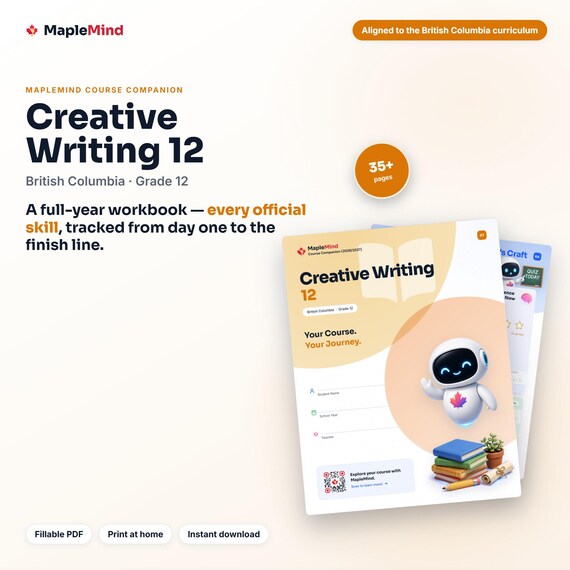
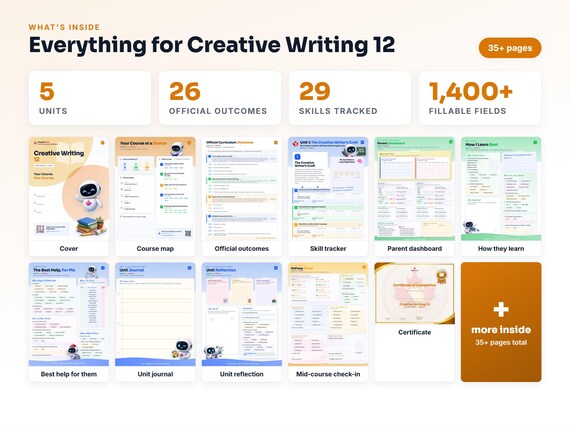
A Creative Writing 12 workbook worth keeping
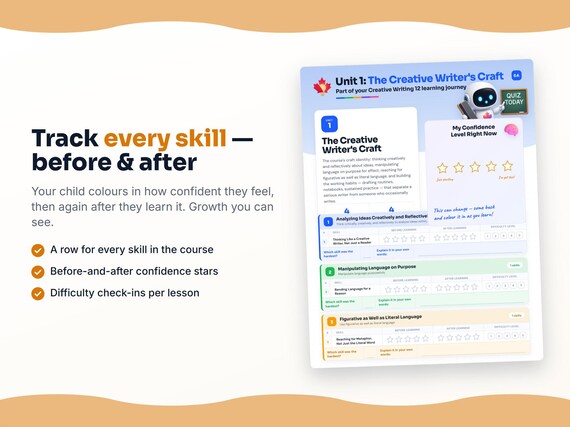
Built from the same official curriculum as this page. Before and after each skill above, your student colours in how sure they feel — so the two of you can see, on one page, what's clicking and what needs another look. It's a quiet way to follow how the year is really going.
By June it's full of their own handwriting: units worked through, confidence grown, a mid-year check-in, notes from parent-teacher night, and a certificate at the end. Less a worksheet, more a record of the year worth keeping on the shelf.
Instant download · see every page, reviews and the full description · five or more workbooks are $2.99 each
What it looks like in the app



Preparing for the Grade 12 Literacy Assessment?
BC's Grade 12 Literacy Assessment is a graduation requirement. MapleMind builds reading and written-response practice from this course.
Common questions
Can MapleMind help me with Creative Writing 12?
Yes. MapleMind's AI tutor covers all 29 skills in British Columbia's Creative Writing 12 — you pick the exact skill, and the tutor teaches it step by step: a short lesson, a worked example, solving together, then a skill check to show it stuck.
Is MapleMind aligned to British Columbia's official curriculum?
Yes. Every skill in this course maps to an official outcome code from British Columbia's Grade 12 English Language Arts curriculum, and the ministry's own wording is quoted under each unit on this page — with the official government source linked so you can check it yourself.
What does MapleMind cost?
It's free to start — 5 tutoring chats and a practice quiz every day, no credit card. A Pro subscription ($9.99/month or $49.99/year CAD, 7-day free trial) unlocks unlimited tutoring, practice, and exam simulations.
What if I'm stuck on just one topic?
That's the point of skill-level tutoring: open Creative Writing 12 in the app, tap the exact skill from the list on this page, and the tutor teaches just that — no wading through lessons you don't need.
Does MapleMind work in French or other languages?
Yes — 14 languages, including French. Both the app and the tutor's explanations switch to the language you choose.
Where can I see the official British Columbia curriculum for Creative Writing 12?
The official source is linked on this page — BC's official English language arts curriculum. The outline here follows it: every MapleMind skill carries its official outcome code, and the ministry's own wording is quoted under each unit.
Does MapleMind help with the Grade 12 Literacy Assessment?
Yes. BC's Grade 12 Literacy Assessment is a graduation requirement. MapleMind builds reading and written-response practice from this course.
Keep exploring
Ready when you are
Pick a skill from this page and see it taught properly — free, in the browser, in under a minute.