Get help with English Studies 12
Most tutoring makes you sit through material you already know. MapleMind flips that: pick the exact skill that's causing trouble — any of the 13 below — and the tutor teaches just that one, step by step, as many times as it takes. Ask questions in plain words, any time of day, in English, French, or 12 other languages.
The official British Columbia English Studies 12 curriculum
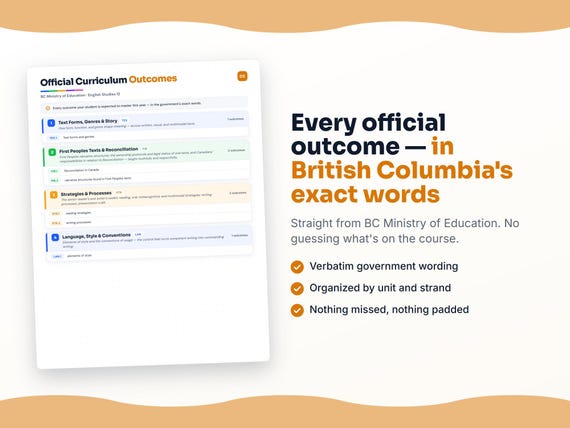
British Columbia defines English Studies 12 by strands and outcomes. MapleMind teaches the same curriculum reorganized for one-skill-at-a-time tutoring — the table shows exactly where every official strand lands, and the ministry's own wording is quoted under each unit below.
Official source BC's official English language arts curriculumRead it on the government site — curriculum.gov.bc.ca ↗| Official strand | Outcomes | Where MapleMind teaches it |
|---|---|---|
| Strand TF | 3 | Text Forms, Genres & Story |
| Strand FP | 3 | First Peoples Texts & Reconciliation |
| Strand SP | 5 | Strategies & Processes |
| Strand LS | 2 | Language, Style & Conventions |
Every skill below, taught one on one.
 Try the first session free
How MapleMind teaches English Studies 12 — every unit, lesson, and skill
Every skill below runs as a short session: a plain-words lesson, a worked example, solving it together, then a five-question skill check that earns up to three stars. Guided Mode keeps it teaching instead of answer-handing — turning it off needs a parent's password.
Unit 1Text Forms, Genres & StoryOfficial strand · Strand TF
How form, function, and genre shape meaning — across written, visual, and multimodal texts.
Form, Function & Genre
- Text forms and genres across modesengstudies12.12.C.1 — Analyze a range of text forms and genres across written, oral, visual, and digital modes, and how each shapes meaning.
- How form and structure construct meaningengstudies12.12.C.3 — Analyze how the form, function, and genre of specific texts serve purpose, audience, and message.
- Elements of visual and graphic textsengstudies12.12.C.4 — Analyze the elements of visual and graphic texts: composition, colour, typography, framing, and image-text interaction.
The official wording — 3 outcomes in this unit
- engstudies12.12.C.1
Text forms and genres
- engstudies12.12.C.3
form, function, and genre of texts
- engstudies12.12.C.4
elements of visual/graphic texts
Unit 2First Peoples Texts & ReconciliationOfficial strand · Strand FP
First Peoples narrative structures, the ownership protocols and legal status of oral texts, and Canadians' responsibilities in relation to Reconciliation — taught truthfully and respectfully.
Reconciliation in Canada
- Reconciliation and the reader's responsibilitiesengstudies12.12.C.2 — Understand Reconciliation in Canada — its origins in the residential school system, the TRC, and Canadians' ongoing responsibilities — through the study of texts by First Peoples authors.
First Peoples Narrative Structures & Oral Texts
- Narrative structures in First Peoples textsengstudies12.12.C.5 — Recognize and analyze narrative structures found in First Peoples texts, including circular and layered structures and the roles of story in oral tradition.
- Ownership protocols and the legal status of oral traditionengstudies12.12.C.6 — Understand protocols related to the ownership of First Peoples oral texts and the legal status of First Peoples oral tradition in Canada.
The official wording — 3 outcomes in this unit
- engstudies12.12.C.2
Reconciliation in Canada
- engstudies12.12.C.5
narrative structures found in First Peoples texts
- engstudies12.12.C.6
protocols related to the ownership of First Peoples oral texts
Unit 3Strategies & ProcessesOfficial strand · Strand SP
The senior reader's and writer's toolkit: reading, oral, metacognitive, and multimodal strategies; writing processes; presentation craft.
Reading, Multimodal & Metacognitive Strategies
- Reading strategies for complex textsengstudies12.12.C.8 — Select and apply reading strategies for complex written texts: annotating, questioning, tracking argument, and rereading with purpose.
- Multimodal reading and metacognitionengstudies12.12.C.13 — Apply multimodal reading strategies to image-text-sound texts and use metacognitive strategies to monitor and adjust comprehension.
- Oral language strategies and discussionengstudies12.12.C.9 — Apply oral language strategies for formal and informal contexts: discussion, active listening, and building on others' ideas.
Writing Processes & Presentation Techniques
- Writing processes at the senior levelengstudies12.12.C.11 — Use writing and design processes — planning, drafting, revising, refining — to create texts for a range of purposes and audiences.
- Presentation techniquesengstudies12.12.C.12 — Apply presentation techniques — structure, delivery, visuals, and audience engagement — in formal and informal contexts.
The official wording — 5 outcomes in this unit
- engstudies12.12.C.8
reading strategies
- engstudies12.12.C.13
multimodal reading strategies
- engstudies12.12.C.9
oral language strategies
- engstudies12.12.C.11
writing processes
- engstudies12.12.C.12
presentation techniques
Unit 4Language, Style & ConventionsOfficial strand · Strand LS
Elements of style and the conventions of usage — the control that turns competent writing into commanding writing.
Elements of Style, Usage & Conventions
- Elements of styleengstudies12.12.C.14 — Analyze and apply elements of style: diction, syntax, tone, rhythm, and figurative choices, in one's own and others' texts.
- Usage and conventionsengstudies12.12.C.15 — Use Canadian spelling, grammar, and punctuation conventions proficiently and rhetorically, including citation of sources.
The official wording — 2 outcomes in this unit
- engstudies12.12.C.14
elements of style
- engstudies12.12.C.15
usage and conventions
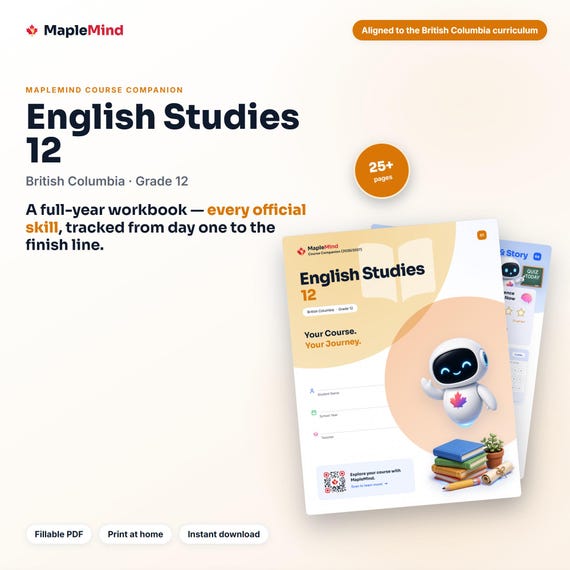
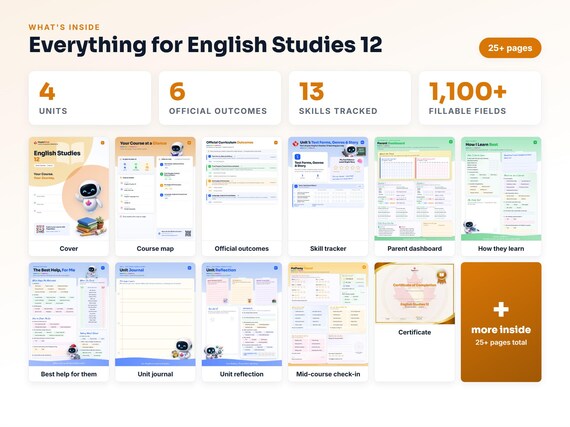
Printable workbook · A keepsake of the year
A English Studies 12 workbook worth keeping
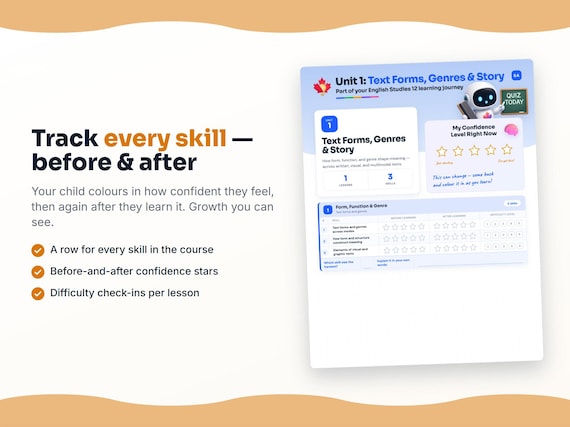
Built from the same official curriculum as this page. Before and after each skill above, your student colours in how sure they feel — so the two of you can see, on one page, what's clicking and what needs another look. It's a quiet way to follow how the year is really going.
By June it's full of their own handwriting: units worked through, confidence grown, a mid-year check-in, notes from parent-teacher night, and a certificate at the end. Less a worksheet, more a record of the year worth keeping on the shelf.
Instant download · see every page, reviews and the full description · five or more workbooks are $2.99 each
What it looks like in the app



Preparing for the Grade 12 Literacy Assessment?
BC's Grade 12 Literacy Assessment is a graduation requirement. MapleMind builds reading and written-response practice from this course.
Common questions
Can MapleMind help me with English Studies 12?
Yes. MapleMind's AI tutor covers all 13 skills in British Columbia's English Studies 12 — you pick the exact skill, and the tutor teaches it step by step: a short lesson, a worked example, solving together, then a skill check to show it stuck.
Is MapleMind aligned to British Columbia's official curriculum?
Yes. Every skill in this course maps to an official outcome code from British Columbia's Grade 12 English Language Arts curriculum, and the ministry's own wording is quoted under each unit on this page — with the official government source linked so you can check it yourself.
What does MapleMind cost?
It's free to start — 5 tutoring chats and a practice quiz every day, no credit card. A Pro subscription ($9.99/month or $49.99/year CAD, 7-day free trial) unlocks unlimited tutoring, practice, and exam simulations.
What if I'm stuck on just one topic?
That's the point of skill-level tutoring: open English Studies 12 in the app, tap the exact skill from the list on this page, and the tutor teaches just that — no wading through lessons you don't need.
Does MapleMind work in French or other languages?
Yes — 14 languages, including French. Both the app and the tutor's explanations switch to the language you choose.
Where can I see the official British Columbia curriculum for English Studies 12?
The official source is linked on this page — BC's official English language arts curriculum. The outline here follows it: every MapleMind skill carries its official outcome code, and the ministry's own wording is quoted under each unit.
Does MapleMind help with the Grade 12 Literacy Assessment?
Yes. BC's Grade 12 Literacy Assessment is a graduation requirement. MapleMind builds reading and written-response practice from this course.
Keep exploring
Ready when you are
Pick a skill from this page and see it taught properly — free, in the browser, in under a minute.