Get help with Literary Studies 12
Most tutoring makes you sit through material you already know. MapleMind flips that: pick the exact skill that's causing trouble — any of the 32 below — and the tutor teaches just that one, step by step, as many times as it takes. Ask questions in plain words, any time of day, in English, French, or 12 other languages.
The official British Columbia Literary Studies 12 curriculum
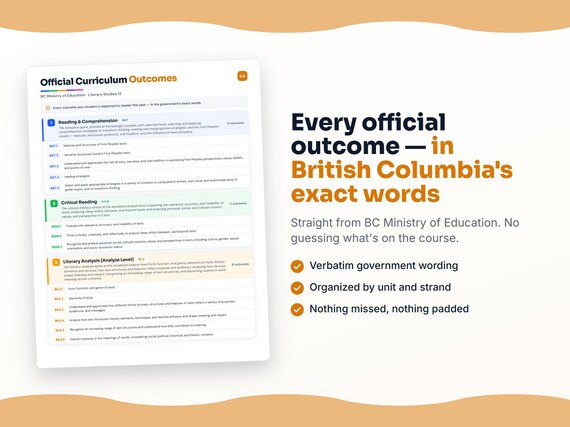
British Columbia defines Literary Studies 12 by strands and outcomes. MapleMind teaches the same curriculum reorganized for one-skill-at-a-time tutoring — the table shows exactly where every official strand lands, and the ministry's own wording is quoted under each unit below.
Official source BC's official English language arts curriculumRead it on the government site — curriculum.gov.bc.ca ↗| Official strand | Outcomes | Where MapleMind teaches it |
|---|---|---|
| Big Idea: The exploration of text and story deepens our understanding of diverse, complex ideas about identity, others, and the world. / People understand text differently depending on their worldviews and perspectives. | 8 | Reading & Comprehension |
| Big Idea: Questioning what we hear, read, and view contributes to our ability to be educated and engaged citizens. | 3 | Critical Reading |
| Big Idea: Language shapes ideas and influences others. | 7 | Literary Analysis (Analyze Level) |
| Big Idea: Texts are socially, culturally, geographically, and historically constructed. | 11 | Composing & Responding |
| Content thread unique to Literary Studies 12 (no Literary Studies 11 equivalent): Appropriation and reclamation of voice; The evolution of language. | 3 | Voice, Appropriation & the Evolution of Language |
Every skill below, taught one on one.
 Try the first session free
How MapleMind teaches Literary Studies 12 — every unit, lesson, and skill
Every skill below runs as a short session: a plain-words lesson, a worked example, solving it together, then a five-question skill check that earns up to three stars. Guided Mode keeps it teaching instead of answer-handing — turning it off needs a parent's password.
Unit 1Reading & ComprehensionOfficial strand · Big Idea: The exploration of text and story deepens our understanding of diverse, complex ideas about identity, others, and the world. / People understand text differently depending on their worldviews and perspectives.
The receptive spine, pitched at increasingly complex, self-selected texts: selecting and applying comprehension strategies to transform thinking, reading and metacognitive strategies, and the First Peoples cluster — features, structures, protocols, oral tradition, and the influence of land and place.
Features and Structures of First Peoples Texts
- Features and structures of First Peoples texts12.FPFEAT.1 — Analyze the features and structures of First Peoples texts — recurring motifs, connection to land and place, the role of orality, community-specific conventions of telling — as deliberate literary architecture, not a deviation from a Western default.
Narrative Structures and Ownership of First Peoples Texts
- Narrative structures in First Peoples texts (circular, iterative, cyclical)12.FP.1 — Analyze the narrative structures found in First Peoples texts — circular, iterative, and cyclical structure rather than linear time — and read them on their own terms as a deliberate structural choice, not a departure from a default.
- Protocols for the ownership of First Peoples oral texts12.FP.2 — Understand the protocols related to the ownership of First Peoples oral texts — that a story, song, or teaching can belong to a specific family, clan, or Nation, and that studying, quoting, or retelling it carries real permissions and responsibilities, not just academic citation.
Oral Tradition and the Influence of Land and Place
- The role of story, narrative, and oral tradition in First Peoples texts12.FPTRAD.1 — Understand and appreciate the role of story, narrative, and oral tradition in expressing First Peoples perspectives, values, beliefs, and points of view — reading oral tradition as a living, authoritative way of knowing, not folklore freely retold by anyone.
- The influence of land and place in First Peoples and Canadian texts12.FPLAND.1 — Understand the influence of land and place in First Peoples and other Canadian texts — how a specific landscape shapes memory, history, culture, and identity within a text, and why setting in these texts is rarely just backdrop.
Reading and Metacognitive Strategies
- Reading strategies for increasingly complex texts12.READ.1 — Select and apply reading strategies — close reading, annotating for pattern and nuance, cross-referencing across a text or body of work, questioning an author's choices, reading against the grain — to comprehend increasingly complex, appropriately challenging literary texts and guide independent inquiry.
- Metacognitive strategies — thinking about your own thinking12.META.1 — Use metacognitive strategies — naming what a text is doing to your understanding, recognizing when a first impression needs revision, tracking how your interpretation changes across a rereading or a discussion — to monitor and deepen your own comprehension.
Comprehension Strategies That Transform Thinking
- Selecting and applying strategies to comprehend texts and transform thinking12.COMP.1 — Select and apply appropriate strategies in a variety of contexts to comprehend written, oral, visual, and multimodal texts, to guide inquiry, and to transform your thinking — an escalation over simply "applying" a strategy: you choose which strategy fits the text and let the encounter genuinely change your thinking.
The official wording — 8 outcomes in this unit
- 12.FPFEAT.1
features and structures of First Peoples texts
- 12.FP.1
narrative structures found in First Peoples texts
- 12.FP.2
protocols related to the ownership of First Peoples oral texts
- 12.FPTRAD.1
Understand and appreciate the role of story, narrative, and oral tradition in expressing First Peoples perspectives, values, beliefs, and points of view
- 12.FPLAND.1
Understand the influence of land/place in First Peoples and other Canadian texts
- 12.READ.1
reading strategies
- 12.META.1
metacognitive strategies
- 12.COMP.1
Select and apply appropriate strategies in a variety of contexts to comprehend written, oral, visual, and multimodal texts, to guide inquiry, and to transform thinking
Unit 2Critical ReadingOfficial strand · Big Idea: Questioning what we hear, read, and view contributes to our ability to be educated and engaged citizens.
The critical-literacy strand at the escalated analyze level: evaluating the relevance, accuracy, and reliability of texts; analyzing ideas within, between, and beyond texts; and analyzing personal, social, and cultural context, values, and perspective in a text.
Evaluating Relevance, Accuracy, and Reliability
- Evaluating the relevance, accuracy, and reliability of a source12.RELY.1 — Evaluate the relevance, accuracy, and reliability of texts — weighing credibility, currency, and significance for a purpose, and identifying point of view, bias, propaganda, and whose voices have been left out, omitted, or misrepresented.
Analyzing Ideas Within, Between, and Beyond Texts
- Analyzing ideas within, between, and beyond texts12.THINK.1 — Think critically, creatively, and reflectively to analyze ideas within a single text, between two or more texts in conversation, and beyond the text into the wider world — an analyze-level demand above simply exploring or noticing connections.
Analyzing Context, Values, and Perspectives
The official wording — 3 outcomes in this unit
- 12.RELY.1
Evaluate the relevance, accuracy, and reliability of texts
- 12.THINK.1
Think critically, creatively, and reflectively to analyze ideas within, between, and beyond texts
- 12.CTX.1
Recognize and analyze personal, social, cultural contexts, values, and perspectives in texts, including culture, gender, sexual orientation, and socio-economic status
Unit 3Literary Analysis (Analyze Level)Official strand · Big Idea: Language shapes ideas and influences others.
The literary-analysis spine at the escalated analyze level: form, function, and genre; elements of style; literary elements and devices; how text structures and features reflect purpose and audience; analyzing how devices shape meaning and impact; recognizing an increasing range of text structures; and discerning nuance in word meaning across contexts.
Form, Function, and Genre
- Form, function, and genre of literary texts12.FORM.1 — Analyze the form, function, and genre of a text — the conventions readers expect from a genre (poetry, short story, novel, drama, graphic novel, world or diasporic literature, a canonical era), how a writer's choice of form serves a purpose, and what it means when a text deliberately breaks genre expectations.
Elements of Style and Literary Devices
- Elements of style — diction, vocabulary, sentence structure, tone12.STYLE.1 — Analyze elements of style — diction, vocabulary, sentence structure, and tone, and how a writer sustains or shifts them across a text — as evidence for an interpretive claim about meaning and effect.
- Literary elements and devices, including figurative language12.DEV.1 — Identify and analyze literary elements and devices, including figurative language — symbolism, imagery, irony, structure, characterization, motif — and argue how a specific device shapes meaning and impact in a specific text, with textual evidence.
How Text Structure Reflects Purpose, Audience, and Message
- How text forms and structures reflect purpose, audience, and message12.STRUCT.1 — Understand and appreciate how different forms, formats, structures, and features of texts reflect a variety of purposes, audiences, and messages — reading structural choices (a fragmented timeline, an epistolary form, a graphic novel's panel layout) as decisions that serve the text's aim.
Analyzing How Devices Shape Meaning and Impact
- Analyzing how literary elements and devices shape meaning and impact12.DEVANLZ.1 — Analyze how text structures, literary elements, techniques, and devices enhance and shape meaning and impact — the escalated analyze-level demand: build a sustained argument for HOW a specific device produces a specific effect, not just identify that the device is present.
An Increasing Range of Text Structures
- Recognizing an increasing range of text structures and their contribution to meaning12.RANGE.1 — Recognize an increasing range of text structures and understand how they contribute to meaning — moving beyond the familiar structures met earlier in the Literary Studies stream into less common, more demanding organizational choices (nested narratives, non-linear timelines, hybrid genres) and explaining what each contributes.
Discerning Nuance in Word Meaning
- Discerning nuances in word meanings across contexts12.NUANCE.1 — Discern nuances in the meanings of words, considering social, political, historical, and literary contexts — recognizing that the same word can carry different weight, connotation, or charge depending on when, where, and by whom it is used.
The official wording — 7 outcomes in this unit
- 12.FORM.1
form, function, and genre of texts
- 12.STYLE.1
elements of style
- 12.DEV.1
literary elements and devices
- 12.STRUCT.1
Understand and appreciate how different forms, formats, structures, and features of texts reflect a variety of purposes, audiences, and messages
- 12.DEVANLZ.1
Analyze how text structures, literary elements, techniques, and devices enhance and shape meaning and impact
- 12.RANGE.1
Recognize an increasing range of text structures and understand how they contribute to meaning
- 12.NUANCE.1
Discern nuances in the meanings of words, considering social, political, historical, and literary contexts
Unit 4Composing & RespondingOfficial strand · Big Idea: Texts are socially, culturally, geographically, and historically constructed.
The productive strand: multimodal writing strategies, senior-level writing processes, oral language strategies, usage and conventions, citation, composing original texts for real purposes and audiences, refining texts for clarity and impact, using citations to recognize intellectual property rights, and transforming ideas into original texts across genres.
Multimodal Writing Strategies and the Writing Process
- Multimodal writing strategies for combining media12.MMWRITE.1 — Use multimodal writing strategies — combining written text with image, layout, sound, or digital interactivity — to plan and create texts whose meaning depends on more than words alone, making deliberate choices about how each mode contributes.
- Writing processes — from gathering ideas to editing12.WPROC.1 — Move through the writing process with independence — planning an argument or creative piece, drafting, seeking and using feedback, revising for clarity of meaning and impact, editing for correctness, publishing — treating each stage as distinct, purposeful work.
Oral Language Strategies for Discussing Literature
- Oral language strategies for discussing literature12.ORAL.1 — Apply oral language strategies — organizing a defensible argument before speaking, adjusting register and pace for a seminar versus a formal presentation, listening actively enough to build on or respectfully challenge a peer's reading, asking questions that move a discussion forward — across formal and informal contexts.
Usage and Conventions
- Usage — avoiding double negatives, mixed metaphors, malapropisms, word misuse12.CONV.1 — Recognize and correct common usage errors — double negatives, mixed metaphors, malapropisms, and general word misuse — that distract a reader from an otherwise strong argument or narrative.
- Conventions — standard punctuation, capitalization, quoting, Canadian spelling12.CONV.2 — Apply the conventions of Canadian spelling, grammar, sentence construction, and punctuation proficiently and appropriately to context — including correctly punctuating and formatting quoted material — so that a reader is never distracted from the argument or story a text is making.
Citation and Intellectual Property
- Citation techniques for acknowledging sources12.CITE.1 — Use acknowledgements and citation techniques — in-text citation, a works-cited or bibliography list, quoting versus paraphrasing correctly — to give credit for ideas, language, and texts that are not your own, including the protocols that guide use of First Peoples oral texts and other knowledge.
- Acknowledgements and citations — avoiding plagiarism, respecting IP rights12.IP.1 — Use acknowledgements and citations to recognize intellectual property rights — treating a source's words, images, or knowledge as belonging to someone, and citing them not merely to avoid a plagiarism penalty but out of respect for that ownership.
Building and Defending an Evidence-Based Argument
- Building and defending an evidence-based opinion to achieve a purpose12.ARGUE.1 — Express and support an opinion with evidence to achieve a purpose — build a defensible thesis or claim about a text, marshal specific textual evidence for it, warrant why that evidence supports the claim, and shape the whole to serve a purpose and audience, rather than asserting an opinion and stopping.
Composing and Refining Original Texts
- Composing meaningful texts for real purposes and audiences12.CREATE.1 — Use writing and design processes to plan, develop, and create engaging and meaningful texts for a variety of purposes and audiences — determining audience and purpose, generating and drafting ideas, and selecting a format and layout that serves the piece, for audiences ranging from peers to globally connected digital conversations.
- Revising and refining writing for clarity, effectiveness, and impact12.REFINE.1 — Reflect on, assess, and refine texts to improve clarity, effectiveness, and impact — creatively and critically manipulating language for a desired effect, making intentional stylistic choices such as sentence fragments or inverted syntax for emphasis, and using techniques like adjusted diction, repetition, parallelism, and varied sentence types.
- Transforming ideas into original texts across genres and forms12.TRANS.1 — Transform ideas and information to create original texts, using various genres, forms, structures, and styles — taking an idea encountered in one form (a news article, an oral history, a poem) and reshaping it into a genuinely different original text.
The official wording — 11 outcomes in this unit
- 12.MMWRITE.1
multimodal writing strategies
- 12.WPROC.1
writing processes
- 12.ORAL.1
oral language strategies
- 12.CONV.1
usage and conventions
- 12.CONV.2
usage and conventions
- 12.CITE.1
citation techniques
- 12.IP.1
Use acknowledgements and citations to recognize intellectual property rights
- 12.ARGUE.1
Express and support an opinion with evidence to achieve purpose
- 12.CREATE.1
Use writing and design processes to plan, develop, and create engaging and meaningful texts for a variety of purposes and audiences
- 12.REFINE.1
Reflect on, assess, and refine texts to improve clarity, effectiveness, and impact
- 12.TRANS.1
Transform ideas and information to create original texts, using various genres, forms, structures, and styles
Unit 5Voice, Appropriation & the Evolution of LanguageOfficial strand · Content thread unique to Literary Studies 12 (no Literary Studies 11 equivalent): Appropriation and reclamation of voice; The evolution of language.
The two Content standards unique to Grade 12 in this stream — the concrete escalation over Literary Studies 11: the ethics of using another's voice, the power of marginalized peoples reclaiming theirs, and how language itself shifts over time.
Appropriation and Reclamation of Voice
- Appropriation of voice — using the voice of another person or group12.APPROP.1 — Understand appropriation of voice in literature — a writer using the voice of another person or group, drawn from taking a cultural motif, theme, image, knowledge, story, song, or drama and using it for one's own purpose — and evaluate when this crosses into misrepresenting the real experience of the people whose voice is used.
- Reclamation of voice — marginalized peoples asserting their voices12.APPROP.2 — Understand reclamation of voice — the act of marginalized peoples asserting their voices within a literary domain from which they have been excluded — as a distinct, powerful literary act, not simply the reverse or mirror of appropriation.
The Evolution of Language
- The evolution of language — how words and structures shift over time12.EVOL.1 — Understand that language is dynamic and changes over time — that social and technological change, and the impact of other languages, shift the ways words and language structures are used, and trace how this evolution shows up inside literary texts themselves.
The official wording — 3 outcomes in this unit
- 12.APPROP.1
Appropriation and reclamation of voice
- 12.APPROP.2
Appropriation and reclamation of voice
- 12.EVOL.1
The evolution of language
Printable workbook · A keepsake of the year
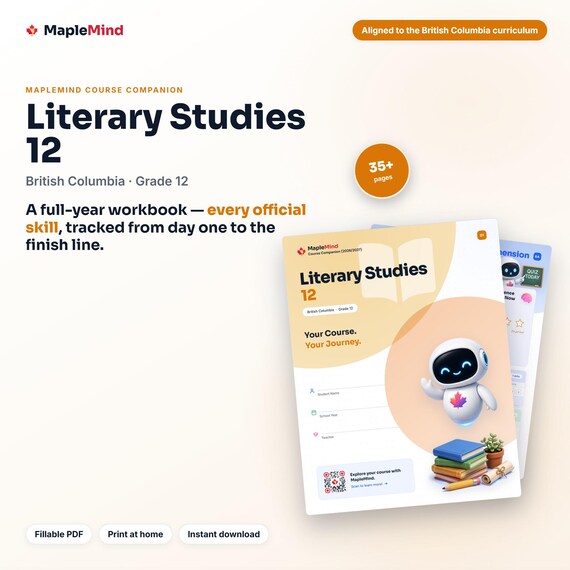
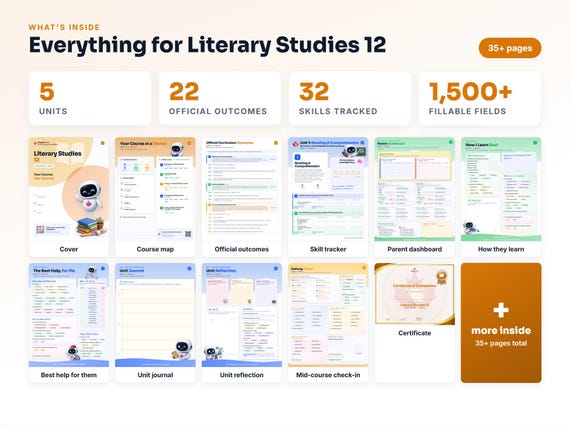
A Literary Studies 12 workbook worth keeping
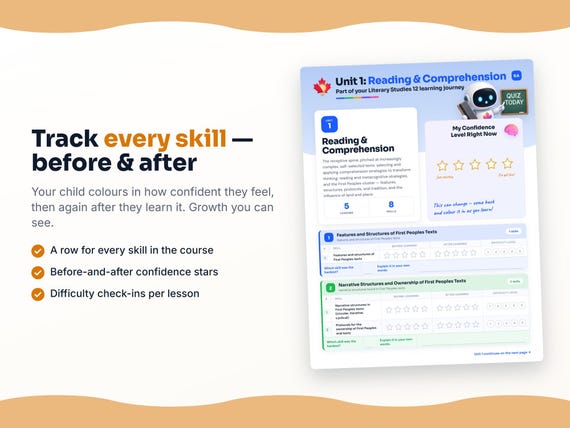
Built from the same official curriculum as this page. Before and after each skill above, your student colours in how sure they feel — so the two of you can see, on one page, what's clicking and what needs another look. It's a quiet way to follow how the year is really going.
By June it's full of their own handwriting: units worked through, confidence grown, a mid-year check-in, notes from parent-teacher night, and a certificate at the end. Less a worksheet, more a record of the year worth keeping on the shelf.
Instant download · see every page, reviews and the full description · five or more workbooks are $2.99 each
What it looks like in the app



Preparing for the Grade 12 Literacy Assessment?
BC's Grade 12 Literacy Assessment is a graduation requirement. MapleMind builds reading and written-response practice from this course.
Common questions
Can MapleMind help me with Literary Studies 12?
Yes. MapleMind's AI tutor covers all 32 skills in British Columbia's Literary Studies 12 — you pick the exact skill, and the tutor teaches it step by step: a short lesson, a worked example, solving together, then a skill check to show it stuck.
Is MapleMind aligned to British Columbia's official curriculum?
Yes. Every skill in this course maps to an official outcome code from British Columbia's Grade 12 English Language Arts curriculum, and the ministry's own wording is quoted under each unit on this page — with the official government source linked so you can check it yourself.
What does MapleMind cost?
It's free to start — 5 tutoring chats and a practice quiz every day, no credit card. A Pro subscription ($9.99/month or $49.99/year CAD, 7-day free trial) unlocks unlimited tutoring, practice, and exam simulations.
What if I'm stuck on just one topic?
That's the point of skill-level tutoring: open Literary Studies 12 in the app, tap the exact skill from the list on this page, and the tutor teaches just that — no wading through lessons you don't need.
Does MapleMind work in French or other languages?
Yes — 14 languages, including French. Both the app and the tutor's explanations switch to the language you choose.
Where can I see the official British Columbia curriculum for Literary Studies 12?
The official source is linked on this page — BC's official English language arts curriculum. The outline here follows it: every MapleMind skill carries its official outcome code, and the ministry's own wording is quoted under each unit.
Does MapleMind help with the Grade 12 Literacy Assessment?
Yes. BC's Grade 12 Literacy Assessment is a graduation requirement. MapleMind builds reading and written-response practice from this course.
Keep exploring
Ready when you are
Pick a skill from this page and see it taught properly — free, in the browser, in under a minute.