Get help with Mathematics, Grade 9
Most tutoring makes you sit through material you already know. MapleMind flips that: pick the exact skill that's causing trouble — any of the 31 below — and the tutor teaches just that one, step by step, as many times as it takes. Ask questions in plain words, any time of day, in English, French, or 12 other languages.
The official Nova Scotia Mathematics, Grade 9 curriculum
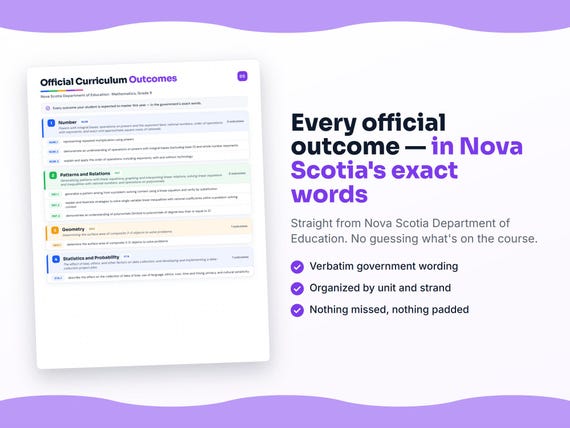
Nova Scotia defines Mathematics, Grade 9 by strands and outcomes. MapleMind teaches the same curriculum reorganized for one-skill-at-a-time tutoring — the table shows exactly where every official strand lands, and the ministry's own wording is quoted under each unit below.
Official source Nova Scotia's official curriculumRead it on the government site — curriculum.novascotia.ca ↗| Official strand | Outcomes | Where MapleMind teaches it |
|---|---|---|
| Strand N | 6 | Number |
| Strand PR | 7 | Patterns and Relations |
| Strand G | 1 | Geometry |
| Strand SP | 2 | Statistics and Probability |
Every skill below, taught one on one.
 Try the first session free
How MapleMind teaches Mathematics, Grade 9 — every unit, lesson, and skill
Every skill below runs as a short session: a plain-words lesson, a worked example, solving it together, then a five-question skill check that earns up to three stars. Guided Mode keeps it teaching instead of answer-handing — turning it off needs a parent's password.
Unit 1NumberOfficial strand · Strand N
Powers with integral bases, operations on powers and the exponent laws, rational numbers, order of operations with exponents, and exact and approximate square roots of rationals.
Powers and exponents
- Powers as repeated multiplicationN01 — Represent repeated multiplication using powers, distinguishing base from exponent and explaining the role of parentheses.
- The zero exponentN01 — Use patterns to demonstrate that a power with an exponent of zero equals one for a non-zero base.
- Solving problems with powersN01 — Solve problems involving powers, evaluating powers with integral bases (excluding base 0) and whole-number exponents.
Exponent laws and rational numbers
- The exponent lawsN02 — Explain and apply the exponent laws for powers with integral bases and whole-number exponents.
- Sum and difference of powersN02 — Determine the sum and difference of powers and identify errors in a simplification involving powers.
- Comparing and ordering rational numbersN03 — Compare and order rational numbers in fraction and decimal form by placing them on a number line, including negatives.
- Operations on rational numbersN03 — Solve problems involving the four operations on rational numbers in fraction or decimal form.
Order of operations and square roots
- Order of operations with exponentsN04 — Explain and apply the order of operations, including exponents, with and without technology, and identify errors.
- Exact square roots of rationalsN05 — Determine the exact square root of positive rational numbers that are perfect squares.
- Approximate square roots of rationalsN06 — Determine an approximate square root of positive rational numbers that are not perfect squares, using benchmarks and technology.
The official wording — 6 outcomes in this unit
- N01
representing repeated multiplication using powers
- N02
demonstrate an understanding of operations on powers with integral bases (excluding base 0) and whole number exponents
- N03
demonstrate an understanding of rational numbers by comparing and ordering rational numbers
- N04
explain and apply the order of operations, including exponents, with and without technology
- N05
determine the exact square root of positive rational numbers
- N06
determine an approximate square root of positive rational numbers
Unit 2Patterns and RelationsOfficial strand · Strand PR
Generalizing patterns with linear equations, graphing and interpreting linear relations, solving linear equations and inequalities with rational numbers, and operations on polynomials.
Linear equations and relations
- Generalizing a pattern with a linear equationPR01 — Generalize a pattern from a problem-solving context using a linear equation and verify it by substitution.
- Graphing and analyzing a linear relationPR02 — Graph a linear relation, including horizontal and vertical lines, and match equations to their graphs.
- Interpolating and extrapolatingPR02 — Interpolate and extrapolate from a linear graph to determine the value of an unknown element and solve problems.
- Solving linear equations symbolicallyPR03 — Solve linear equations with rational-number coefficients symbolically and verify solutions by substitution, correcting errors.
- Modelling problems with linear equationsPR03 — Represent a problem with a linear equation and solve it, using concrete and pictorial representations recorded symbolically.
Linear inequalities
- Translating and testing inequalitiesPR04 — Translate a problem into a single-variable linear inequality using ≥, >, <, or ≤ and determine whether a value is a solution.
- Solving inequalities by adding and subtractingPR04 — Apply the rule for adding or subtracting a number to solve a linear inequality, where the inequality symbol is preserved.
- Multiplying or dividing an inequality by a negativePR04 — Apply the rule for multiplying or dividing a linear inequality by a number, reversing the inequality symbol when the number is negative.
- Graphing and solving inequality problemsPR04 — Graph the solution of a linear inequality on a number line and solve a problem involving a single-variable inequality.
Polynomials
- Modelling and identifying polynomialsPR05 — Model a polynomial expression and identify its variables, degree, number of terms, coefficients, and constant term (degree ≤ 2).
- Equivalent polynomial expressionsPR05 — Match equivalent polynomial expressions in simplified form and describe a situation for a first-degree polynomial.
- Adding polynomialsPR06 — Model and record the addition of polynomial expressions, combining like terms (degree ≤ 2).
- Subtracting polynomialsPR06 — Model and record the subtraction of polynomial expressions, identifying like terms and errors (degree ≤ 2).
- Multiplying a polynomial by a monomialPR07 — Model and record the multiplication of a polynomial expression by a monomial (degree ≤ 2).
- Dividing a polynomial by a monomialPR07 — Model and record the division of a polynomial expression by a monomial (degree ≤ 2).
The official wording — 7 outcomes in this unit
- PR01
generalize a pattern arising from a problem-solving context using a linear equation and verify by substitution
- PR02
graph a linear relation, analyze the graph
- PR03
model and solve problems, where a, b, c, d, e, and f are rational numbers, using linear equations of the form
- PR04
explain and illustrate strategies to solve single variable linear inequalities with rational coefficients within a problem-solving context
- PR05
demonstrate an understanding of polynomials (limited to polynomials of degree less than or equal to 2)
- PR06
model, record, and explain the operations of addition and subtraction of polynomial expressions, concretely, pictorially, and symbolically
- PR07
model, record, and explain the operations of multiplication and division of polynomial expressions (limited to polynomials of degree less than or equal to 2) by monomials, concretely, pictorially, and symbolically
Unit 3GeometryOfficial strand · Strand G
Determining the surface area of composite 3-D objects to solve problems.
Surface area of composite objects
- Surface area and overlap of composite objectsG01 — Determine the area of overlap in a composite 3-D object and its effect on the surface area (right cylinders, rectangular prisms, triangular prisms).
- Solving composite surface-area problemsG01 — Determine the surface area of a composite 3-D object and solve problems (right cylinders, rectangular prisms, triangular prisms).
The official wording — 1 outcome in this unit
- G01
determine the surface area of composite 3-D objects to solve problems
Unit 4Statistics and ProbabilityOfficial strand · Strand SP
The effect of bias, ethics, and other factors on data collection, and developing and implementing a data-collection project plan.
Data collection and a project plan
- Factors affecting data collectionSP01 — Describe the effect on data collection of bias, use of language, ethics, cost, time and timing, privacy, and cultural sensitivity.
- Formulating a question and choosing a methodSP03 — Formulate a question for investigation and choose a data-collection method that includes social considerations.
- Selecting a sample and collecting dataSP03 — Select a population or a sample and collect the data according to the plan.
- Displaying data and drawing conclusionsSP03 — Display the collected data in an appropriate manner and draw conclusions to answer the investigation question.
The official wording — 2 outcomes in this unit
- SP01
describe the effect on the collection of data of bias, use of language, ethics, cost, time and timing, privacy, and cultural sensitivity
- SP03
formulating a question for investigation o choosing a data collection method that includes social considerations
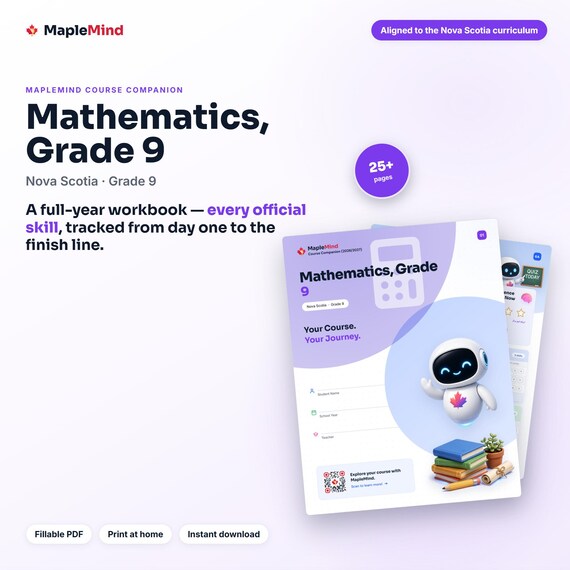
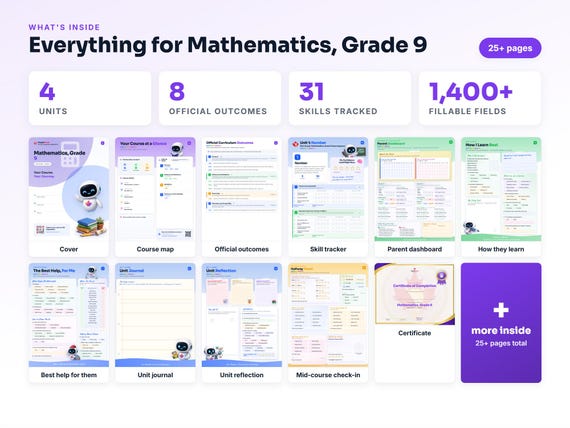

Printable workbook · A keepsake of the year
A Mathematics, Grade 9 workbook worth keeping
Built from the same official curriculum as this page. Before and after each skill above, your student colours in how sure they feel — so the two of you can see, on one page, what's clicking and what needs another look. It's a quiet way to follow how the year is really going.
By June it's full of their own handwriting: units worked through, confidence grown, a mid-year check-in, notes from parent-teacher night, and a certificate at the end. Less a worksheet, more a record of the year worth keeping on the shelf.
Instant download · see every page, reviews and the full description · five or more workbooks are $2.99 each
What it looks like in the app



Common questions
Can MapleMind help me with Mathematics, Grade 9?
Yes. MapleMind's AI tutor covers all 31 skills in Nova Scotia's Mathematics, Grade 9 — you pick the exact skill, and the tutor teaches it step by step: a short lesson, a worked example, solving together, then a skill check to show it stuck.
Is MapleMind aligned to Nova Scotia's official curriculum?
Yes. Every skill in this course maps to an official outcome code from Nova Scotia's Grade 9 Mathematics curriculum, and the ministry's own wording is quoted under each unit on this page — with the official government source linked so you can check it yourself.
What does MapleMind cost?
It's free to start — 5 tutoring chats and a practice quiz every day, no credit card. A Pro subscription ($9.99/month or $49.99/year CAD, 7-day free trial) unlocks unlimited tutoring, practice, and exam simulations.
What if I'm stuck on just one topic?
That's the point of skill-level tutoring: open Mathematics, Grade 9 in the app, tap the exact skill from the list on this page, and the tutor teaches just that — no wading through lessons you don't need.
Does MapleMind work in French or other languages?
Yes — 14 languages, including French. Both the app and the tutor's explanations switch to the language you choose.
Where can I see the official Nova Scotia curriculum for Mathematics, Grade 9?
The official source is linked on this page — Nova Scotia's official curriculum. The outline here follows it: every MapleMind skill carries its official outcome code, and the ministry's own wording is quoted under each unit.
Keep exploring
Ready when you are
Pick a skill from this page and see it taught properly — free, in the browser, in under a minute.