Get help with Mathematics, Grade 8
Most tutoring makes you sit through material you already know. MapleMind flips that: pick the exact skill that's causing trouble — any of the 23 below — and the tutor teaches just that one, step by step, as many times as it takes. Ask questions in plain words, any time of day, in English, French, or 12 other languages.
The official Nova Scotia Mathematics, Grade 8 curriculum
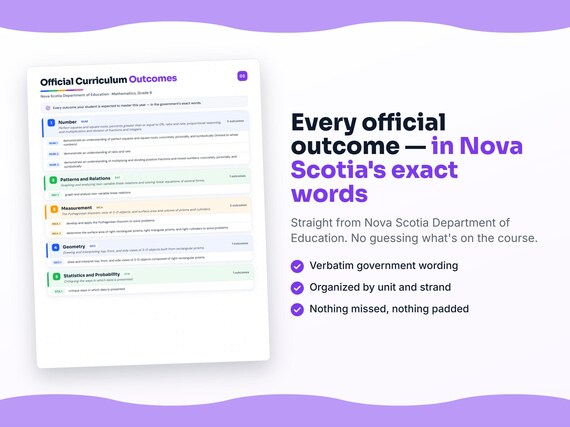
Nova Scotia defines Mathematics, Grade 8 by strands and outcomes. MapleMind teaches the same curriculum reorganized for one-skill-at-a-time tutoring — the table shows exactly where every official strand lands, and the ministry's own wording is quoted under each unit below.
Official source Nova Scotia's official curriculumRead it on the government site — curriculum.novascotia.ca ↗| Official strand | Outcomes | Where MapleMind teaches it |
|---|---|---|
| Strand N | 7 | Number |
| Strand PR | 2 | Patterns and Relations |
| Strand M | 4 | Measurement |
| Strand G | 1 | Geometry |
| Strand SP | 1 | Statistics and Probability |
Every skill below, taught one on one.
 Try the first session free
How MapleMind teaches Mathematics, Grade 8 — every unit, lesson, and skill
Every skill below runs as a short session: a plain-words lesson, a worked example, solving it together, then a five-question skill check that earns up to three stars. Guided Mode keeps it teaching instead of answer-handing — turning it off needs a parent's password.
Unit 1NumberOfficial strand · Strand N
Perfect squares and square roots, percents greater than or equal to 0%, ratio and rate, proportional reasoning, and multiplication and division of fractions and integers.
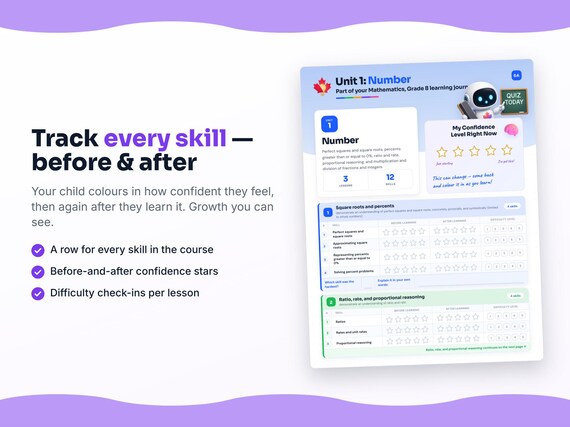
Square roots and percents
- Perfect squares and square rootsN01 — Demonstrate an understanding of perfect squares and square roots concretely, pictorially, and symbolically (whole numbers).
- Approximating square rootsN02 — Determine the approximate square root of numbers that are not perfect squares, using benchmarks and technology.
- Representing percents greater than or equal to 0%N03 — Represent percents that are fractional, between 0% and 1%, or greater than 100%, and convert among percent, decimal, and fraction forms.
- Solving percent problemsN03 — Solve problems involving percents greater than or equal to 0%, including finding the percent of a percent.
Ratio, rate, and proportional reasoning
- RatiosN04 — Represent two- and three-term ratios from context and express a part-to-part ratio as a part-to-whole fraction.
- Rates and unit ratesN04 — Identify and express rates and unit rates from real-life examples and explain why a rate cannot be represented as a percent.
- Proportional reasoningN05 — Differentiate proportional from non-proportional contexts and use multiplicative relationships to compare and predict quantities.
- Solving proportionsN05 — Solve proportions and problems involving rate, ratio, and percent using multiple methods and estimation to check.
Multiplying and dividing fractions and integers
- Multiplying fractionsN06 — Multiply positive fractions and mixed numbers concretely, pictorially, and symbolically, using an area model.
- Dividing fractionsN06 — Divide positive fractions and mixed numbers concretely, pictorially, and symbolically, and apply the rules taking order of operations into account.
- Multiplying integers and the sign rulesN07 — Model the multiplication of integers concretely and pictorially and generalize the rule for the sign of a product.
- Dividing integersN07 — Model the division of integers and generalize the rule for the sign of a quotient, solving problems with and without technology.
The official wording — 7 outcomes in this unit
- N01
demonstrate an understanding of perfect squares and square roots, concretely, pictorially, and symbolically (limited to whole numbers)
- N02
determine the approximate square root of numbers that are not perfect squares (limited to whole numbers)
- N03
demonstrate an understanding of and solve problems involving percents greater than or equal to 0%
- N04
demonstrate an understanding of ratio and rate
- N05
solve problems that involve rates, ratios, and proportional reasoning
- N06
demonstrate an understanding of multiplying and dividing positive fractions and mixed numbers, concretely, pictorially, and symbolically
- N07
demonstrate an understanding of multiplication and division of integers, concretely, pictorially, and symbolically
Unit 2Patterns and RelationsOfficial strand · Strand PR
Graphing and analyzing two-variable linear relations and solving linear equations of several forms.
Linear relations and equations
- Graphing two-variable linear relationsPR01 — Graph and analyze two-variable linear relations, building a table from an equation and describing the relationship.
- Solving linear equationsPR02 — Model and solve linear equations of the forms ax = b, x/a = b, ax + b = c, and x/a + b = c, where a, b, and c are integers, and verify solutions.
- Equations with the distributive propertyPR02 — Apply the distributive property to solve linear equations of the form a(x + b) = c and identify and correct errors in a given solution.
The official wording — 2 outcomes in this unit
- PR01
graph and analyze two-variable linear relations
- PR02
model and solve problems, concretely, pictorially, and symbolically, where a, b, and c are integers, using linear equations of the form ax = b; x/a = b, a ≠ 0; ax + b = c; x/a + b = c, a ≠ 0
Unit 3MeasurementOfficial strand · Strand M
The Pythagorean theorem, nets of 3-D objects, and surface area and volume of prisms and cylinders.
The Pythagorean theorem and nets
- Understanding the Pythagorean theoremM01 — Model and explain the Pythagorean theorem and determine whether a triangle is a right triangle.
- Applying the Pythagorean theoremM01 — Determine the measure of the third side of a right triangle from the other two and solve problems, including Pythagorean triples.
- Nets for 3-D objectsM02 — Draw and construct nets for 3-D objects, matching nets to objects and verifying by construction.
Surface area and volume
- Surface area of prismsM03 — Determine the surface area of right rectangular and right triangular prisms by summing the areas of their faces.
- Surface area of cylindersM03 — Determine the surface area of a right cylinder, including the curved surface and the two circular ends.
- Volume of prisms and cylindersM04 — Develop and apply formulas for the volume of right rectangular prisms, right triangular prisms, and right cylinders from the area of the base.
The official wording — 4 outcomes in this unit
- M01
develop and apply the Pythagorean theorem to solve problems
- M02
draw and construct nets for 3-D objects
- M03
determine the surface area of right rectangular prisms, right triangular prisms, and right cylinders to solve problems
- M04
develop and apply formulas for determining the volume of right rectangular prisms, right triangular prisms, and right cylinders
Unit 4GeometryOfficial strand · Strand G
Drawing and interpreting top, front, and side views of 3-D objects built from rectangular prisms.
Views of 3-D objects
- Top, front, and side viewsG01 — Draw and interpret the top, front, and side views of 3-D objects composed of right rectangular prisms, including after a rotation.
The official wording — 1 outcome in this unit
- G01
draw and interpret top, front, and side views of 3-D objects composed of right rectangular prisms
Unit 5Statistics and ProbabilityOfficial strand · Strand SP
Critiquing the ways in which data is presented.
Critiquing data displays
- Critiquing data presentationSP01 — Critique ways in which data is presented, comparing graph types and identifying formatting choices that could misrepresent data.
The official wording — 1 outcome in this unit
- SP01
critique ways in which data is presented
Printable workbook · A keepsake of the year
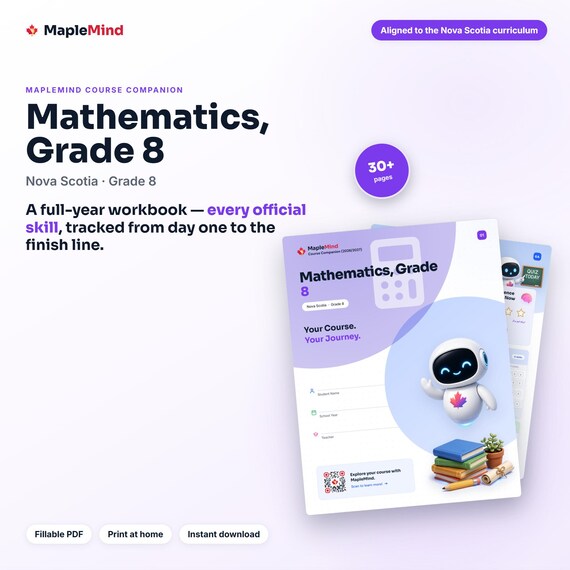
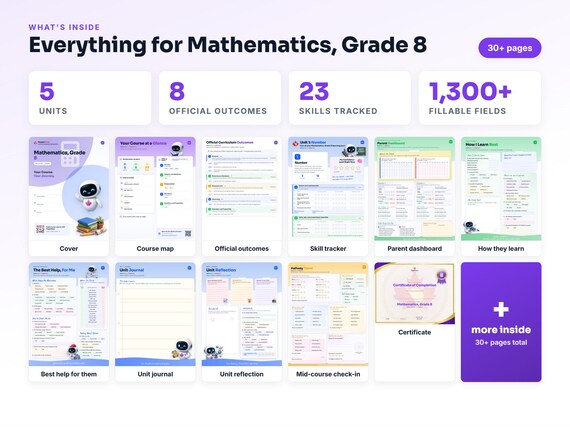
A Mathematics, Grade 8 workbook worth keeping
Built from the same official curriculum as this page. Before and after each skill above, your student colours in how sure they feel — so the two of you can see, on one page, what's clicking and what needs another look. It's a quiet way to follow how the year is really going.
By June it's full of their own handwriting: units worked through, confidence grown, a mid-year check-in, notes from parent-teacher night, and a certificate at the end. Less a worksheet, more a record of the year worth keeping on the shelf.
Instant download · see every page, reviews and the full description · five or more workbooks are $2.99 each
What it looks like in the app



Common questions
Can MapleMind help me with Mathematics, Grade 8?
Yes. MapleMind's AI tutor covers all 23 skills in Nova Scotia's Mathematics, Grade 8 — you pick the exact skill, and the tutor teaches it step by step: a short lesson, a worked example, solving together, then a skill check to show it stuck.
Is MapleMind aligned to Nova Scotia's official curriculum?
Yes. Every skill in this course maps to an official outcome code from Nova Scotia's Grade 8 Mathematics curriculum, and the ministry's own wording is quoted under each unit on this page — with the official government source linked so you can check it yourself.
What does MapleMind cost?
It's free to start — 5 tutoring chats and a practice quiz every day, no credit card. A Pro subscription ($9.99/month or $49.99/year CAD, 7-day free trial) unlocks unlimited tutoring, practice, and exam simulations.
What if I'm stuck on just one topic?
That's the point of skill-level tutoring: open Mathematics, Grade 8 in the app, tap the exact skill from the list on this page, and the tutor teaches just that — no wading through lessons you don't need.
Does MapleMind work in French or other languages?
Yes — 14 languages, including French. Both the app and the tutor's explanations switch to the language you choose.
Where can I see the official Nova Scotia curriculum for Mathematics, Grade 8?
The official source is linked on this page — Nova Scotia's official curriculum. The outline here follows it: every MapleMind skill carries its official outcome code, and the ministry's own wording is quoted under each unit.
Keep exploring
Ready when you are
Pick a skill from this page and see it taught properly — free, in the browser, in under a minute.