Provincial assessment · Nova Scotia
Nova Scotia Assessment: Reading, Writing, and Mathematics/Mathématiques in Grade 8
Nova Scotia Assessment: Reading, Writing, and Mathematics/Mathématiques in Grade 8 (RWM8-EN / RWM8-IM)
- Grade 8
Dates and details can change. We do our best to keep this page up to date, but check the official sources before relying on it.
- Total time
- 5 h
- Marked questions
- 128
- Parts
- 4
- Calculator
- In some parts
- Format
- On a computer
Nova Scotia Grade 8 Assessment practice test
The whole exam or the parts you choose, in its own format, on the clock.
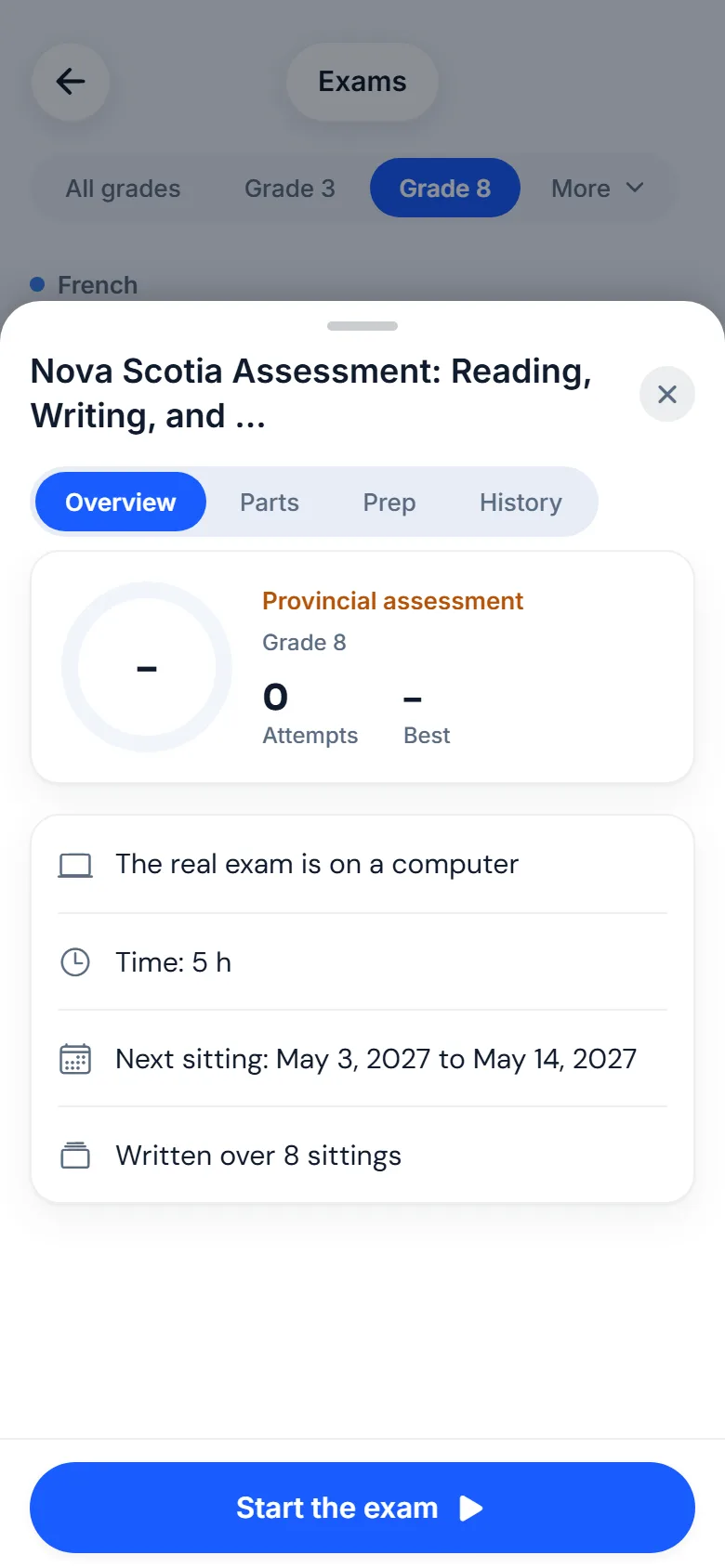 The exam in the app
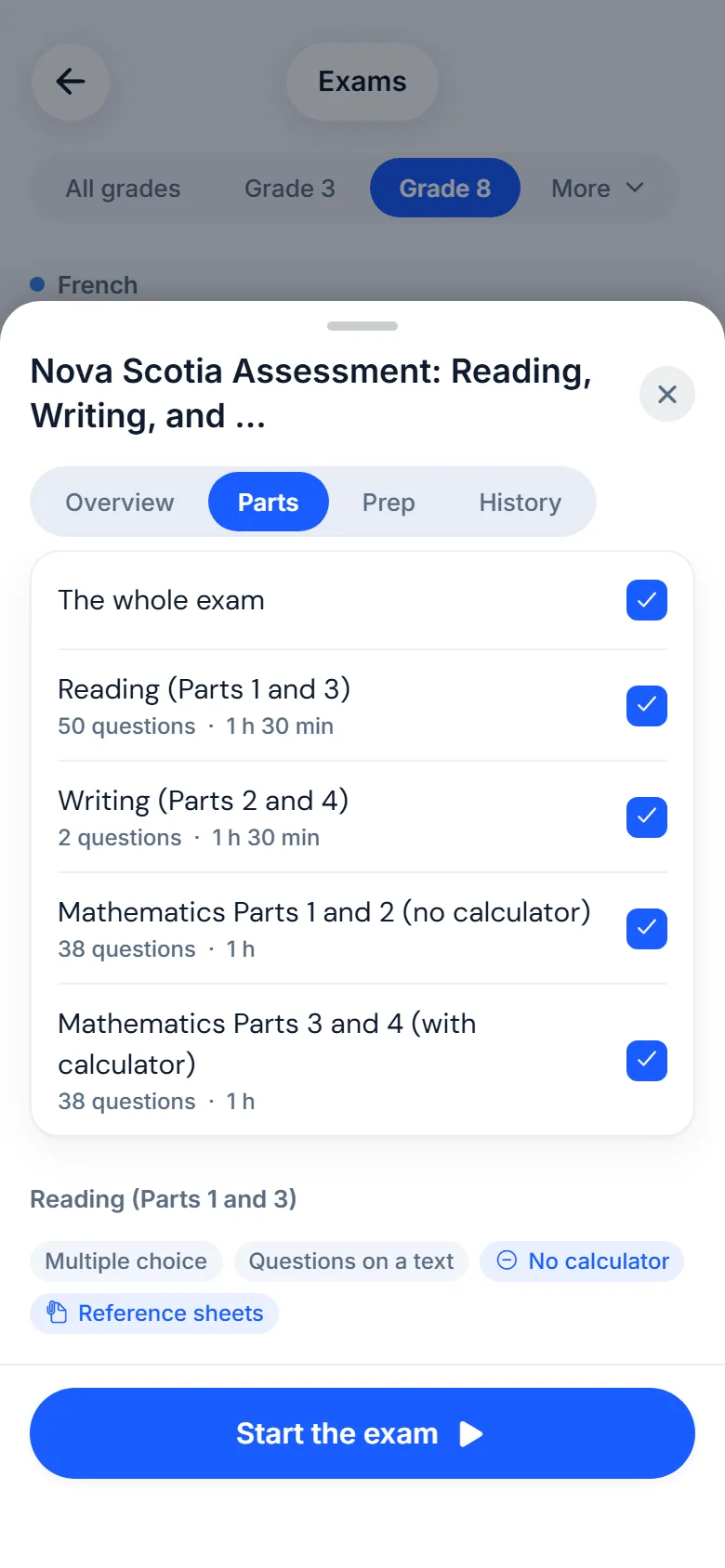 Its parts, and what you can use in each
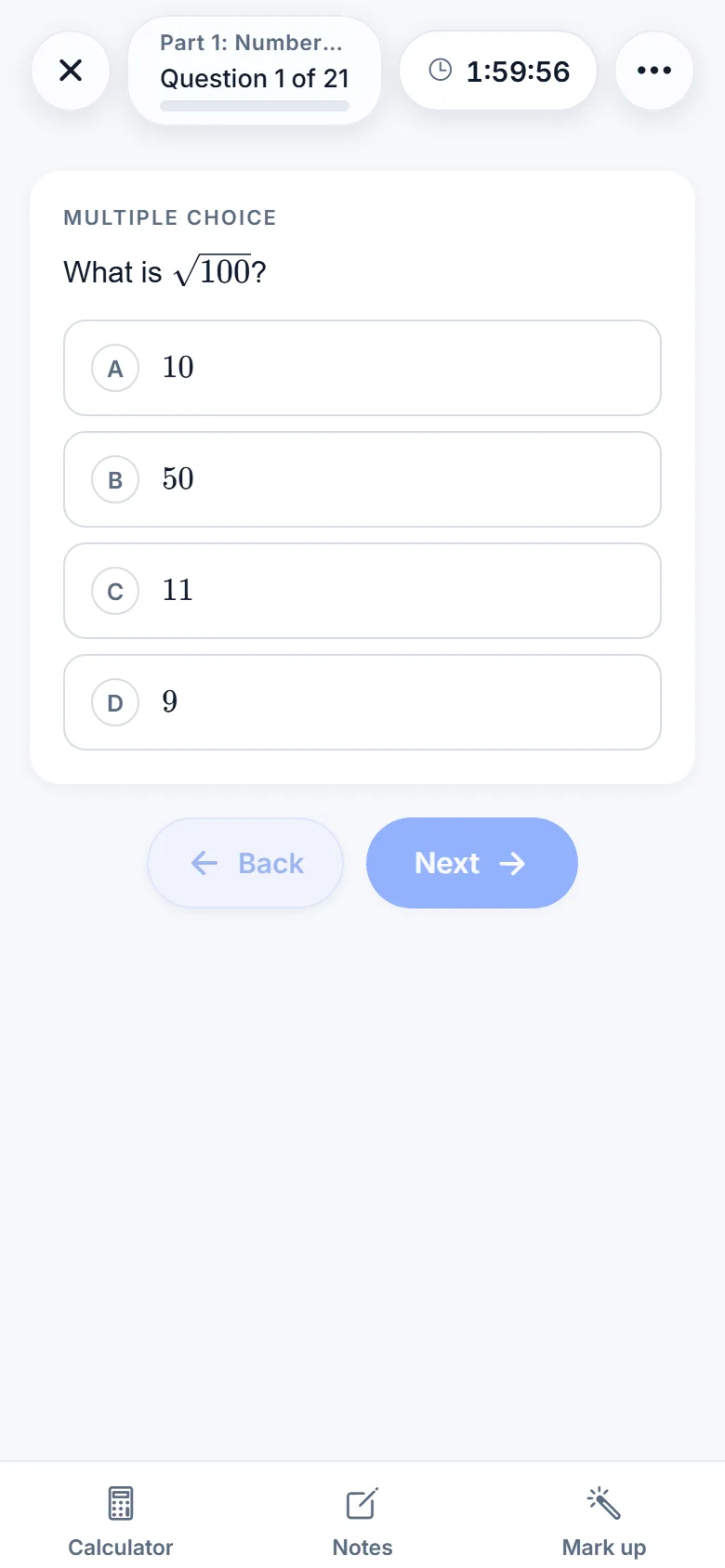 A question, timed, with the exam’s tools
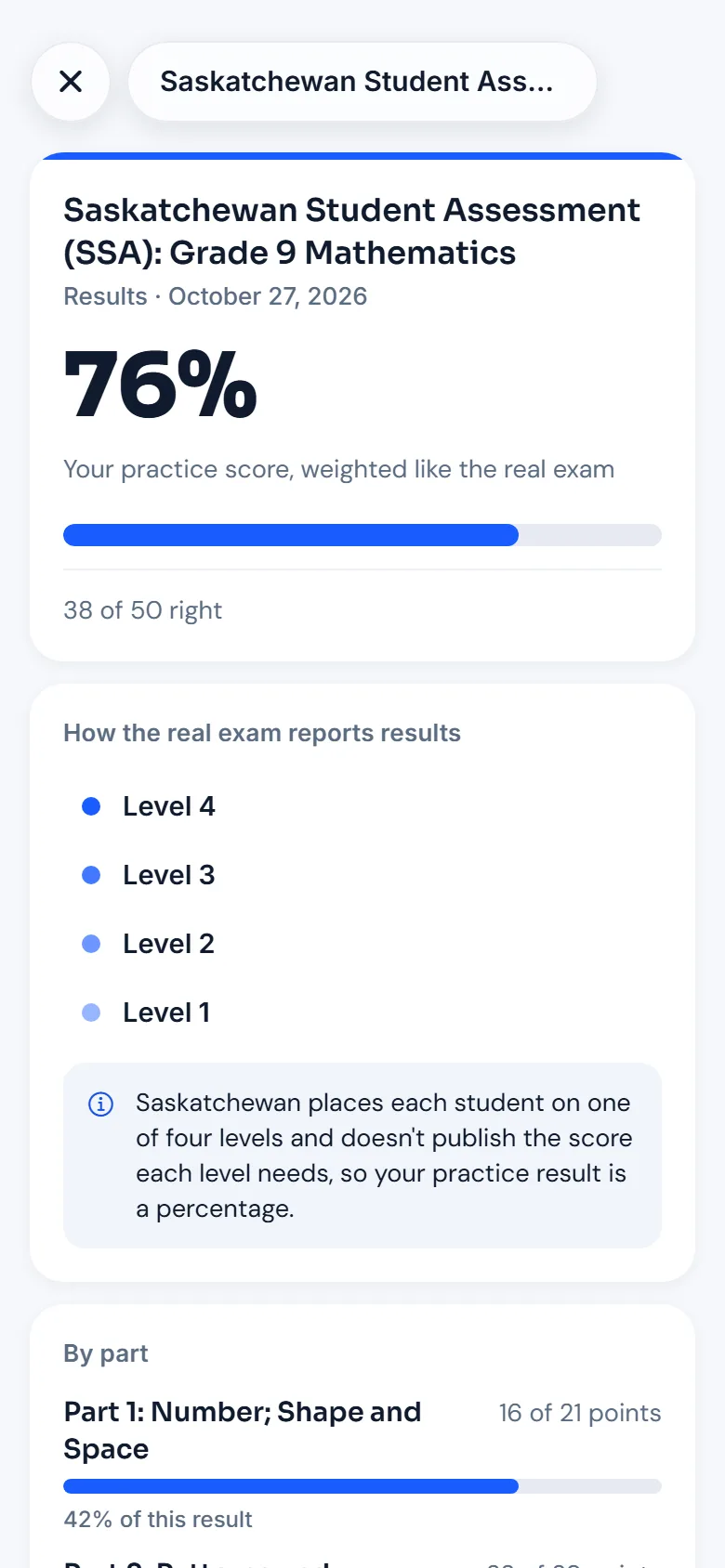 The marked result, part by part
A practice run of Saskatchewan’s Grade 9 math assessment.
Free with a MapleMind account
When
2 sessions this school year: Sample assessment window and Assessment window.
Sample assessment window
- May 3 to May 14, 2027One or two class periods per subject · Sample assessments (in class, on the platform)
Assessment window
- May 17 to June 8, 202745-minute and 30-minute parts · Reading and writing (4 parts) and mathematics (4 parts), scheduled by the school
The dates are Nova Scotia’s own, read on September 28, 2026. See the official schedule (plans.ednet.ns.ca)
What’s on it
- ReadingReported on its own (levels)
Writing
- Transactional50%An essay
- Narrative50%A story
Mathematics
- Number30–40%
- Patterns and Relations15–20%
- Measurement15–20%
- Geometry10–15%
- Statistics and Probability15–20%
The skills it tests · 58 skills
- Analysing how forms influence comprehension
- Analysing publishing and sharing
- Applying active listening strategies
- Applying conventions
- Applying revision, editing, and proof-reading
- Applying the Pythagorean theorem
- Applying writing, design, and research processes
- Approximating square roots
- Choosing data-collection methods
- Choosing the most appropriate measure
- Choosing valid information
- Combining transformations on a shape
- Comparing accuracy across sources
- Comparing experimental results with theory
- Comparing organizational structures and devices
- Constructing and comparing triangles
- Constructing and interpreting circle graphs
- Creating and interpreting line graphs
- Critiquing data presentation
- Designs and tessellations
- Developing ideas when creating
- Dividing fractions
- Dividing integers
- Equations with the distributive property
- Evaluating communication strategies
- Graphing two-variable linear relations
- Investigating bias and validity in communication
- Investigating bias in the message
- Investigating how language impacts communication
- Investigating reading and viewing strategies
- Investigating source credibility
- Listing outcomes of a probability experiment
- Mean, median, mode, and range
- Multiplying fractions
- Multiplying integers and the sign rules
- Nets for 3-D objects
- Perfect squares and square roots
- Plotting in four quadrants
- Plotting points in the first quadrant
- Probability as ratios, fractions, and percents
- Probability of two independent events
- Proportional reasoning
- Rates and unit rates
- Ratios
- Reflecting on perspective and comprehension
- Representing percents greater than or equal to 0%
- Selecting a form for an audience and purpose
- Selecting reliable sources
- Solving linear equations
- Solving percent problems
- Solving proportions
- Surface area of cylinders
- Surface area of prisms
- The effect of outliers
- Theoretical and experimental probability
- Transforming a shape on the grid
- Understanding the Pythagorean theorem
- Volume of prisms and cylinders
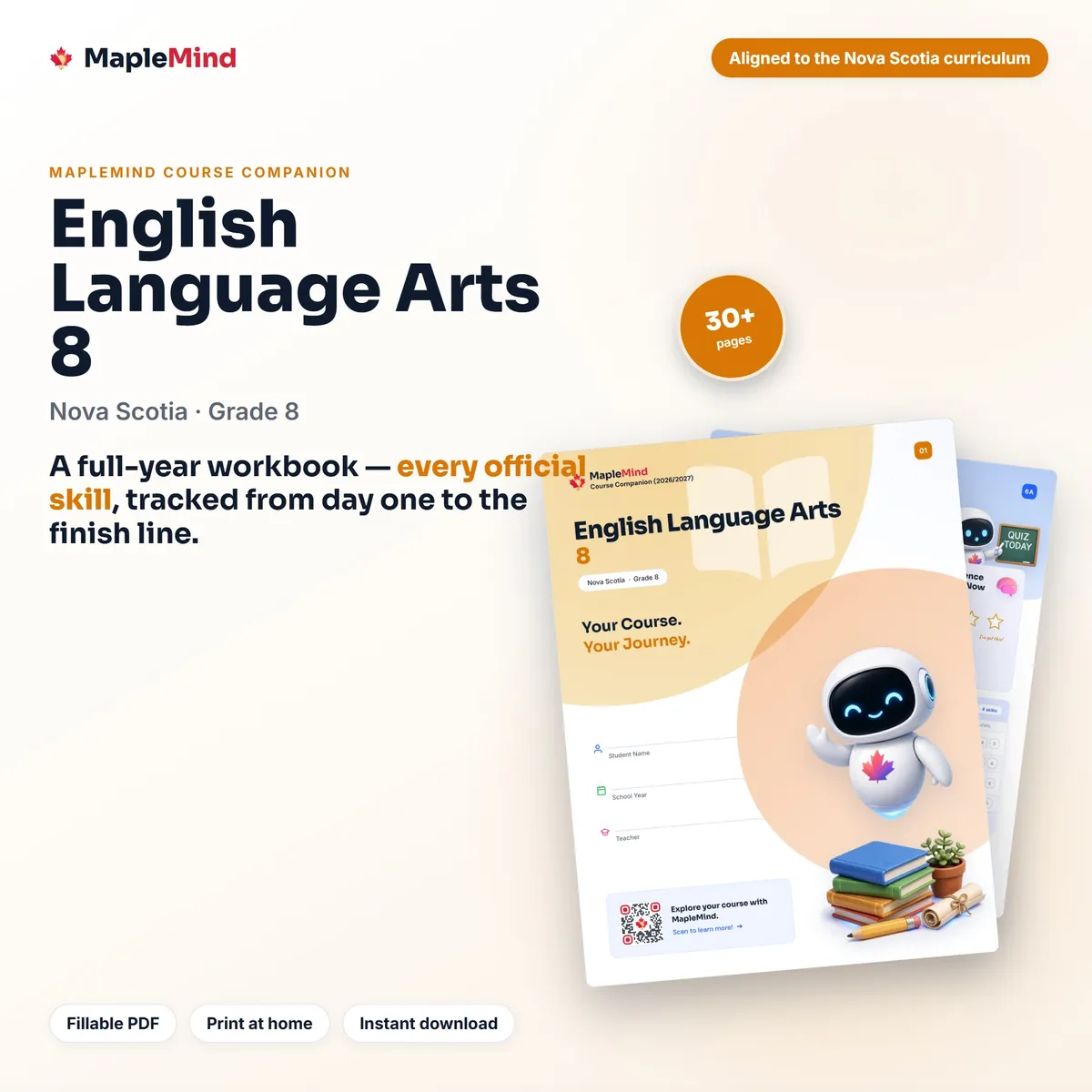 Its Course CompanionEnglish Language Arts 8From the courseMathematics, Grade 8
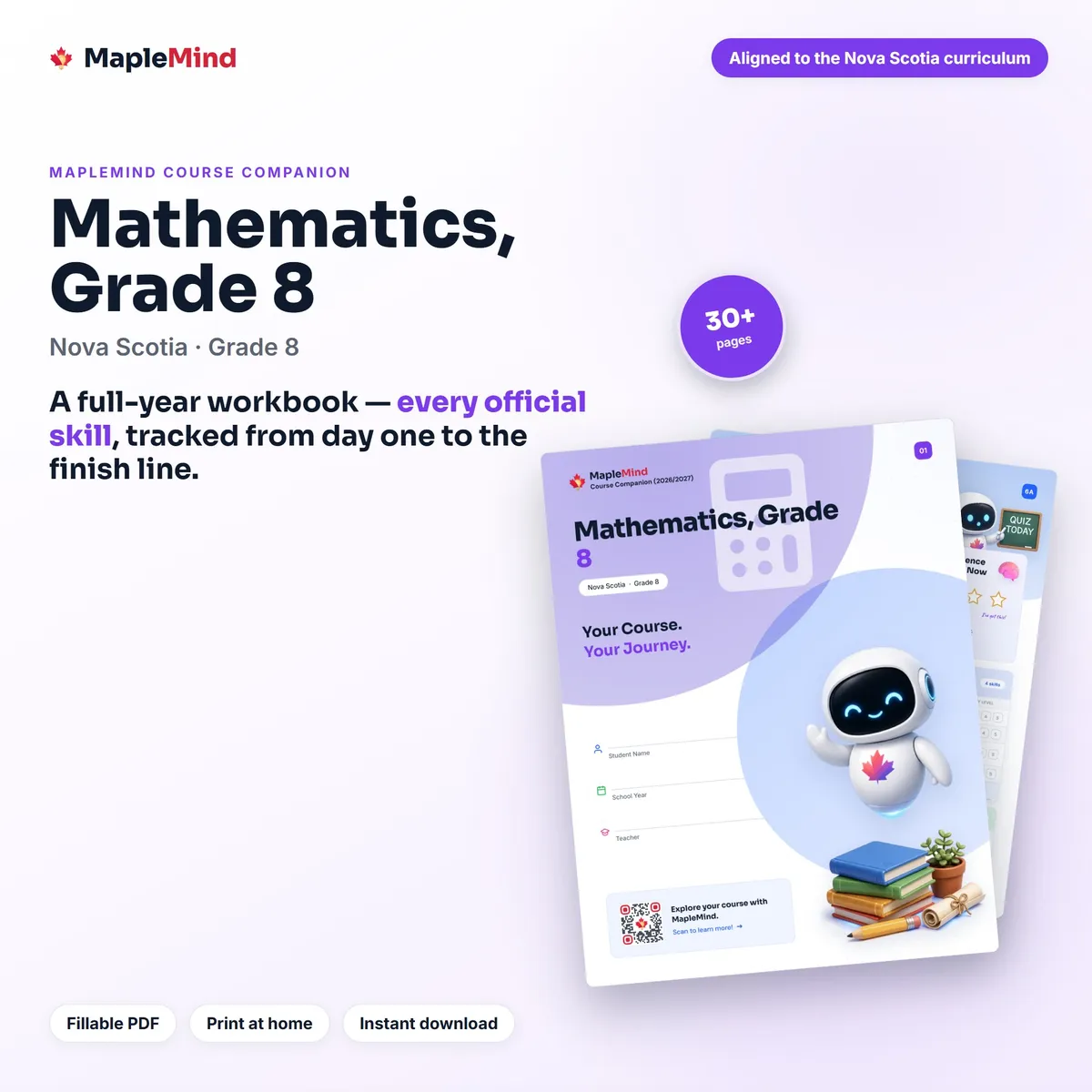 Its Course CompanionMathematics, Grade 8From the courseMathematics, Grade 7
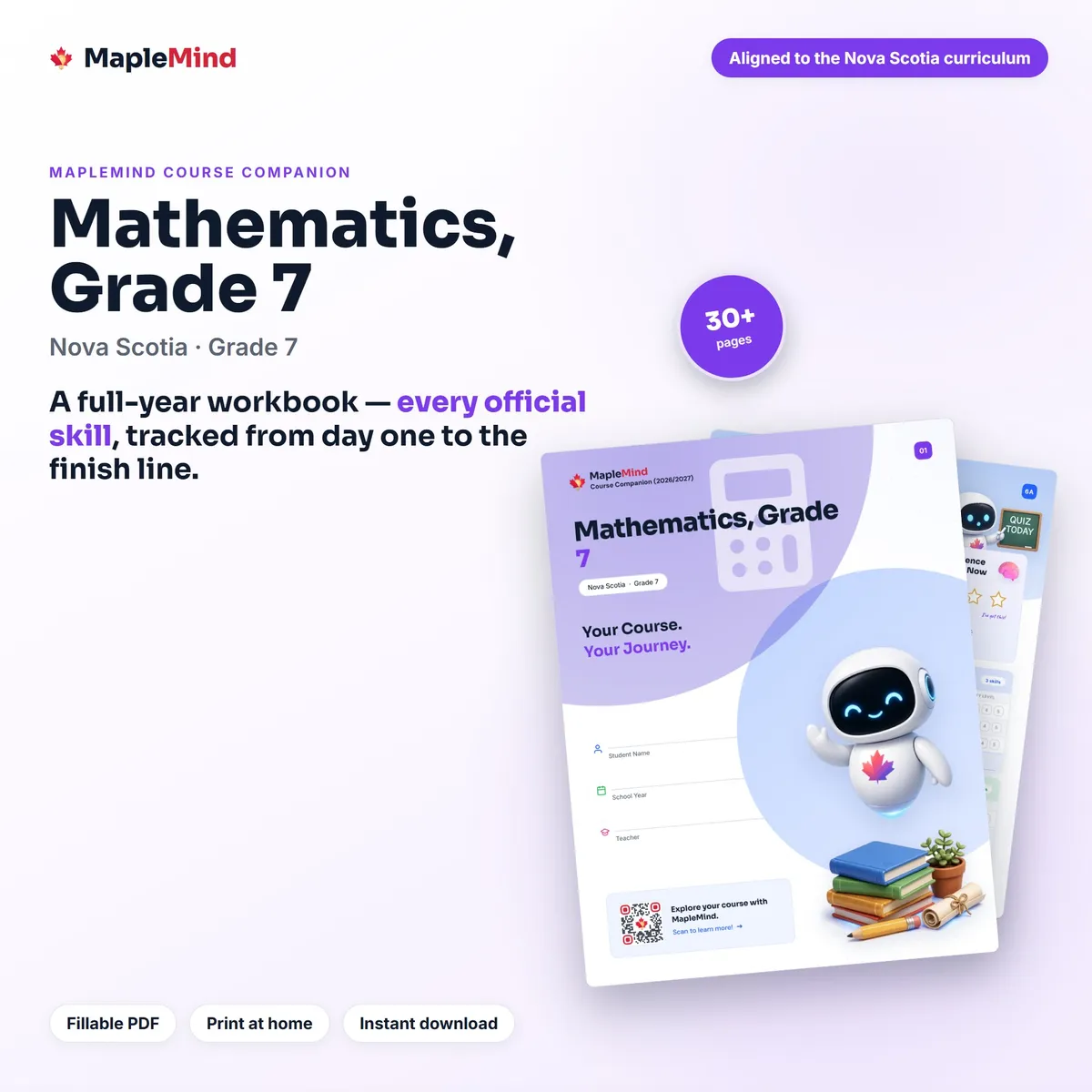 Its Course CompanionMathematics, Grade 7From the courseMathematics, Grade 6
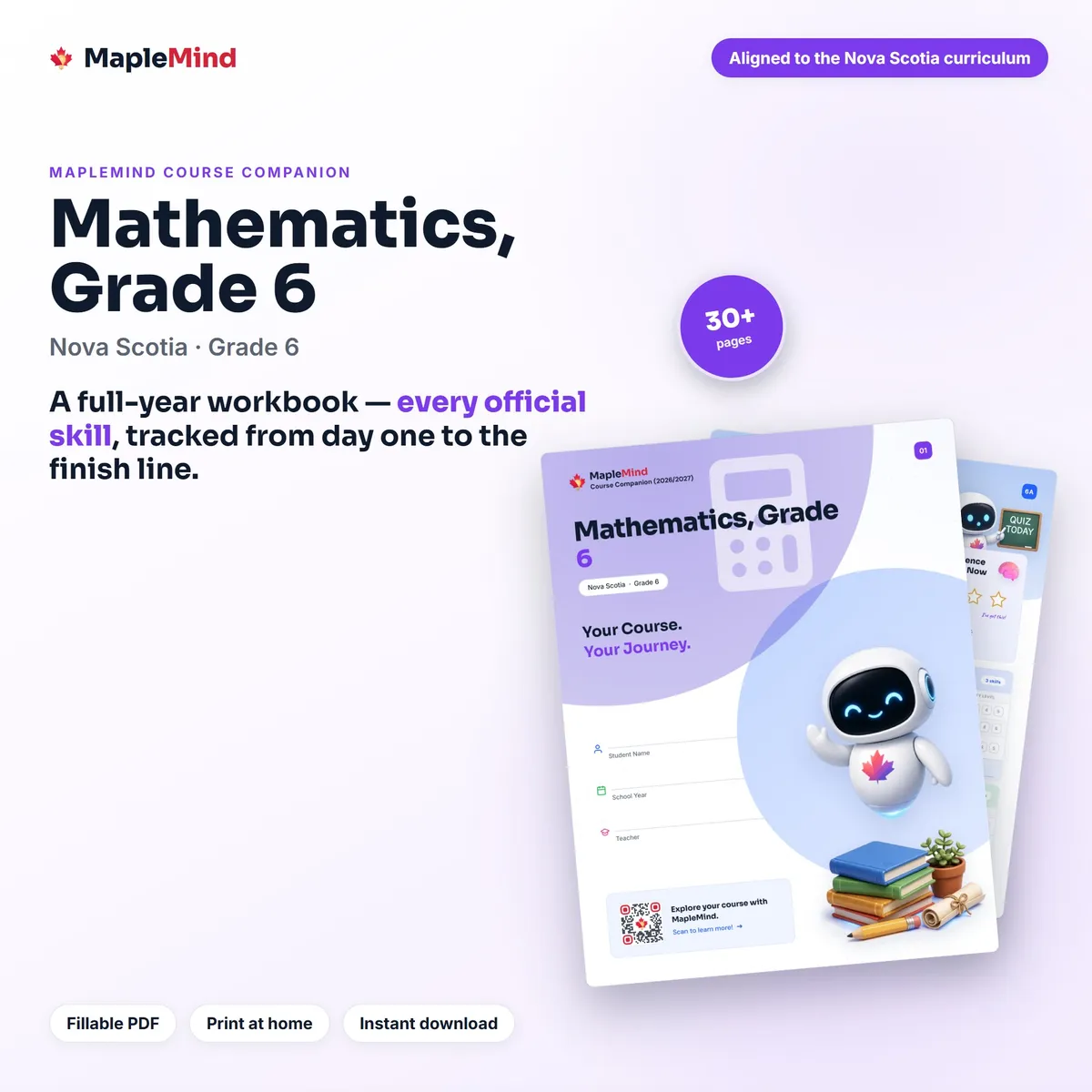 Its Course CompanionMathematics, Grade 6
How it’s built
Multiple-choice questions, questions in sets and an essay.
- Reading (Parts 1 and 3)
- Time
- 90 min
- Questions
- 50
- Marks
- 50
- Of the marks
- 33%
- Multiple choice
- Questions in sets
Two reading parts of about 45 minutes: read stories, information texts, poems or songs, and visual texts, and answer multiple-choice questions.
- Writing (Parts 2 and 4)
- Time
- 90 min
- Questions
- 2
- Marks
- 32
- Of the marks
- 33%
- Essay
Two writing tasks, one in each writing part: an essay and a story, each with a choice of topics.
- Mathematics Parts 1 and 2 (no calculator)
- Time
- 60 min
- Questions
- 38
- Marks
- 38
- Of the marks
- 17%
- Multiple choice
Two math parts of about 30 minutes without a calculator: multiple choice, often in a real-life setting, some needing mental math.
- Mathematics Parts 3 and 4 (with calculator)
- Time
- 60 min
- Questions
- 38
- Marks
- 38
- Of the marks
- 17%
- Multiple choice
Two more math parts of about 30 minutes, with the calculator: multiple choice, some needing a calculator.
How it’s marked
- Level 1
- Level 2
- Level 3
- Level 4
A computer marks the multiple-choice answers, and Nova Scotia teachers mark your writing. There's no pass mark: you get a level from 1 to 4 in reading, writing and math, and the results don't count on your report card.
On the day
- Provided
- Mathematics in Grade 8 – Formula Sheet
- FirstSample questions in class, on the platform, over one or two class periods per subject.
- Then, on days your school setsReading and writing in four 45-minute parts, and math in four 30-minute parts.
Online, in shorter parts. A thesaurus is allowed in reading and writing, and you get scrap paper and pencils for math. Math Parts 1 and 2 have no calculator; Parts 3 and 4 have one on screen, or you may bring your own. Everyone may take up to 15 extra minutes on each part.
Getting ready
3 official documents to practise with, and 4 tips.
Official practice
Tips from the people who write it
- You don't need to study ahead: what you learn in class prepares you.
- Your class tries the sample assessments on the platform first.
- Practise mental math: the first two math parts have no calculator.
- A formula sheet with measurement conversions and formulas is provided.
After the exam
- Results
Each student gets an Individual Student Report, available to families through PowerSchool once results are analyzed.
- Marks
Results aren’t used for report card grades or decisions about a student’s grade placement.
- If you miss it
A student with an Individual Program Plan takes part if their planning team, parents included, agrees.
From Program of Learning Assessment for Nova Scotia (PLANS): Grade 3, Grade 6 and Grade 8 (plans.ednet.ns.ca), read on October 27, 2026.
More for you
Students
Start with the topics worth the most marks, then write full practice exams under the real time limit.
Practise itParents
Put the dates on the family calendar. The Parent Dashboard shows each practice exam’s result and the skills that need another look.
See the Parent DashboardEducators
The topic weights and the official practice above make a review plan. Students can practise each skill on its own in MapleMind, free with daily limits.
For schools
Questions about this exam
When is the Nova Scotia Assessment: Reading, Writing, and Mathematics/Mathématiques in Grade 8 in 2026–27?
The next sitting is May 3 to May 14, 2027. This school year it’s written in Sample assessment window and Assessment window.
How long is the Nova Scotia Assessment: Reading, Writing, and Mathematics/Mathématiques in Grade 8?
It takes 5 hours in all, over 4 parts.
How many questions are on the Nova Scotia Assessment: Reading, Writing, and Mathematics/Mathématiques in Grade 8?
It has 128 marked questions: 50 in Reading (Parts 1 and 3), 2 in Writing (Parts 2 and 4), 38 in Mathematics Parts 1 and 2 (no calculator) and 38 in Mathematics Parts 3 and 4 (with calculator).
Can you use a calculator on the Nova Scotia Assessment: Reading, Writing, and Mathematics/Mathématiques in Grade 8?
In some parts only: Mathematics Parts 3 and 4 (with calculator).
How are Nova Scotia Assessment: Reading, Writing, and Mathematics/Mathématiques in Grade 8 results reported?
At 4 levels: Level 1, Level 2, Level 3 and Level 4.
Where can I find practice tests for the Nova Scotia Assessment: Reading, Writing, and Mathematics/Mathématiques in Grade 8?
Nova Scotia publishes Public online sample assessments, Grade 8 (reading, writing, mathematics; English and French). MapleMind also builds a full practice exam in its format, free with an account.

Practise for the Nova Scotia Assessment: Reading, Writing, and Mathematics/Mathématiques in Grade 8
Every skill on the Nova Scotia Assessment: Reading, Writing, and Mathematics/Mathématiques in Grade 8, taught one at a time, then practised on questions written like the real ones.