Get help with Mathematics, Grade 6
Most tutoring makes your child sit through material your child already knows. MapleMind flips that: pick the exact skill that's causing trouble — any of the 36 below — and the tutor teaches just that one, step by step, as many times as it takes. Ask questions in plain words, any time of day, in English, French, or 12 other languages.
The official Nova Scotia Mathematics, Grade 6 curriculum
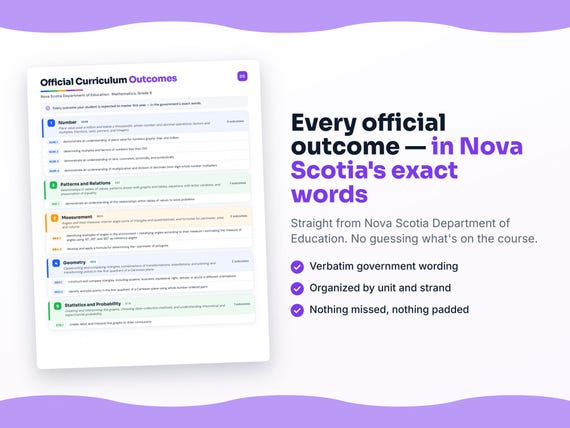
Nova Scotia defines Mathematics, Grade 6 by strands and outcomes. MapleMind teaches the same curriculum reorganized for one-skill-at-a-time tutoring — the table shows exactly where every official strand lands, and the ministry's own wording is quoted under each unit below.
Official source Nova Scotia's official curriculumRead it on the government site — curriculum.novascotia.ca ↗| Official strand | Outcomes | Where MapleMind teaches it |
|---|---|---|
| Strand N | 9 | Number |
| Strand PR | 4 | Patterns and Relations |
| Strand M | 3 | Measurement |
| Strand G | 5 | Geometry |
| Strand SP | 3 | Statistics and Probability |
Every skill below, taught one on one.
 Try the first session free
How MapleMind teaches Mathematics, Grade 6 — every unit, lesson, and skill
Every skill below runs as a short session: a plain-words lesson, a worked example, solving it together, then a five-question skill check that earns up to three stars. Guided Mode keeps it teaching instead of answer-handing — turning it off needs a parent's password.
Unit 1NumberOfficial strand · Strand N
Place value past a million and below a thousandth, whole-number and decimal operations, factors and multiples, fractions, ratio, percent, and integers.
Place value and problem solving
- Place value for numbers greater than one millionN01 — Read, write, and explain the place value of digits in numbers greater than one million, using the repeating pattern of the place-value system.
- Place value for numbers less than one-thousandthN01 — Read, write, and explain the place value of digits in decimal numbers less than one-thousandth, using decimal and expanded notation.
- Solving problems with whole numbers and decimalsN02 — Choose an appropriate method — technology, mental mathematics, or paper-and-pencil — to solve problems involving whole numbers and decimal numbers, and judge whether the answer is reasonable.
Factors, multiples, and fractions
- Determining multiples and factors under 100N03 — Determine the multiples and the factors of numbers less than 100, using arrays and strategies such as factor trees.
- Prime and composite numbersN03 — Identify prime and composite numbers and explain why 0 and 1 are neither.
- Solving problems with factors and multiplesN03 — Solve problems that use multiples and factors, such as finding common multiples or common factors in real situations.
- Improper fractions and mixed numbersN04 — Relate improper fractions to mixed numbers and back, using models and a number line.
Ratio, percent, and integers
- Representing ratiosN05 — Represent a ratio concretely, pictorially, and symbolically, recording it in forms such as 3:5, 3 to 5, or a fraction.
- Part-part, part-whole, and equivalent ratiosN05 — Explain the part-part and part-whole ratios of a set and verify whether two ratios are equivalent.
- Representing percent as parts of 100N06 — Represent percent (whole numbers) concretely and pictorially, and express a percent as an equivalent fraction and decimal.
- Solving percent problems with benchmarksN06 — Solve percent problems in real contexts using the benchmarks of 25%, 50%, 75%, and 100%.
- Representing and ordering integersN07 — Represent integers on a number line in real contexts and order them in ascending or descending order.
- Comparing integers with symbolsN07 — Compare two integers and represent the relationship using <, >, and =, verifying with a number line.
Decimal operations and order of operations
- Multiplying decimals with estimationN08 — Multiply decimals by one-digit whole numbers, using estimation to place the decimal point and check the product.
- Dividing decimals with estimationN08 — Divide decimals by one-digit whole-number divisors, using estimation to place the decimal point and check the quotient.
- Order of operations with whole numbersN09 — Explain and apply the order of operations, excluding exponents, to solve multi-step whole-number problems with and without technology.
The official wording — 9 outcomes in this unit
- N01
demonstrate an understanding of place value for numbers greater than one million
- N02
solve problems involving whole numbers and decimal numbers
- N03
determining multiples and factors of numbers less than 100
- N04
relate improper fractions to mixed numbers and mixed numbers to improper fractions
- N05
demonstrate an understanding of ratio, concretely, pictorially, and symbolically
- N06
demonstrate an understanding of percent (limited to whole numbers) concretely, pictorially, and symbolically
- N07
demonstrate an understanding of integers contextually, concretely, pictorially, and symbolically
- N08
demonstrate an understanding of multiplication and division of decimals (one-digit whole number multipliers
- N09
explain and apply the order of operations, excluding exponents, with and without technology (limited to whole numbers)
Unit 2Patterns and RelationsOfficial strand · Strand PR
Relationships in tables of values, patterns shown with graphs and tables, equations with letter variables, and preservation of equality.
Patterns, tables, and graphs
- Relationships in tables of valuesPR01 — Use the relationship shown in a table of values to state a rule, predict unknown terms, and solve problems.
- Representing patterns with graphs and tablesPR02 — Translate a pattern into a table of values and a graph (linear graphs with discrete elements) and describe the relationship in everyday language.
- Equations with letter variablesPR03 — Represent generalizations from number relationships using equations with letter variables, such as perimeter and area formulas and the commutative property.
- Preservation of equalityPR04 — Demonstrate and explain preservation of equality concretely, pictorially, and symbolically using a balance model.
The official wording — 4 outcomes in this unit
- PR01
demonstrate an understanding of the relationships within tables of values to solve problems
- PR02
represent and describe patterns and relationships, using graphs and tables
- PR03
represent generalizations arising from number relationships using equations with letter variables
- PR04
demonstrate and explain the meaning of preservation of equality concretely, pictorially, and symbolically
Unit 3MeasurementOfficial strand · Strand M
Angles and their measure, interior angle sums of triangles and quadrilaterals, and formulas for perimeter, area, and volume.
Angles and their measure
- Classifying and estimating anglesM01 — Identify angles in the environment, classify them by measure, and estimate their size using 45°, 90°, and 180° as reference angles.
- Measuring and drawing angles with a protractorM01 — Measure angles in degrees with a protractor and draw and label an angle of a specified measure.
- Interior angle sums of triangles and quadrilateralsM02 — Demonstrate that the interior angles of any triangle sum to 180° and of any quadrilateral to 360°.
Perimeter, area, and volume formulas
- Perimeter of polygonsM03 — Develop and apply a formula for the perimeter of polygons.
- Area of rectanglesM03 — Develop and apply a formula for the area of rectangles.
- Volume of right rectangular prismsM03 — Develop and apply a formula for the volume of right rectangular prisms.
The official wording — 3 outcomes in this unit
- M01
identifying examples of angles in the environment ▪ classifying angles according to their measure ▪ estimating the measure of angles using 45°, 90°, and 180° as reference angles
- M02
demonstrate that the sum of interior angles is 180° in a triangle and 360° in a quadrilateral
- M03
develop and apply a formula for determining the ▪ perimeter of polygons
Unit 4GeometryOfficial strand · Strand G
Constructing and comparing triangles, combinations of transformations, tessellations, and plotting and transforming points in the first quadrant of a Cartesian plane.
Triangles and transformations
- Constructing and comparing trianglesG01 — Construct and compare triangles — scalene, isosceles, equilateral, right, obtuse, and acute — in different orientations.
- Combining transformations on a shapeG03 — Perform a combination of translations, rotations, and reflections on a single 2-D shape and draw and describe the image.
- Designs and tessellationsG04 — Perform successive transformations of 2-D shapes to create a design or tessellation, and identify and describe the transformations used.
The first quadrant of the Cartesian plane
- Plotting points in the first quadrantG05 — Identify and plot points in the first quadrant of a Cartesian plane using whole-number ordered pairs.
- Transforming a shape on the gridG06 — Perform and describe single transformations of a 2-D shape in the first quadrant, identifying the coordinates of the image's vertices.
The official wording — 5 outcomes in this unit
- G01
construct and compare triangles, including scalene, isosceles, equilateral, right, obtuse, or acute in different orientations
- G03
perform a combination of translation(s), rotation(s), and/or reflection(s) on a single 2-D shape, with and without technology, and draw and describe the image
- G04
perform a combination of successive transformations of 2-D shapes to create a design and identify and describe the transformations
- G05
identify and plot points in the first quadrant of a Cartesian plane using whole number ordered pairs
- G06
perform and describe single transformations of a 2-D shape in the first quadrant of a Cartesian plane (limited to whole number vertices)
Unit 5Statistics and ProbabilityOfficial strand · Strand SP
Creating and interpreting line graphs, choosing data-collection methods, and understanding theoretical and experimental probability.
Data and probability
- Creating and interpreting line graphsSP01 — Create, label, and interpret line graphs to draw conclusions, distinguishing continuous data suited to a line graph.
- Choosing data-collection methodsSP02 — Select, justify, and use appropriate methods of collecting data — questionnaires, experiments, databases, and electronic media.
- Listing outcomes of a probability experimentSP04 — Identify all the possible outcomes of a probability experiment, such as tossing a coin or rolling a die.
- Theoretical and experimental probabilitySP04 — Differentiate between experimental and theoretical probability and determine each for a probability experiment.
- Comparing experimental results with theorySP04 — Conduct a probability experiment and compare the experimental results with the theoretical probability, explaining how more trials bring them closer.
The official wording — 3 outcomes in this unit
- SP01
create, label, and interpret line graphs to draw conclusions
- SP02
select, justify, and use appropriate methods of collecting data, including questionnaires, experiments, databases, and electronic media
- SP04
identifying all possible outcomes of a probability experiment
Printable workbook · A keepsake of the year
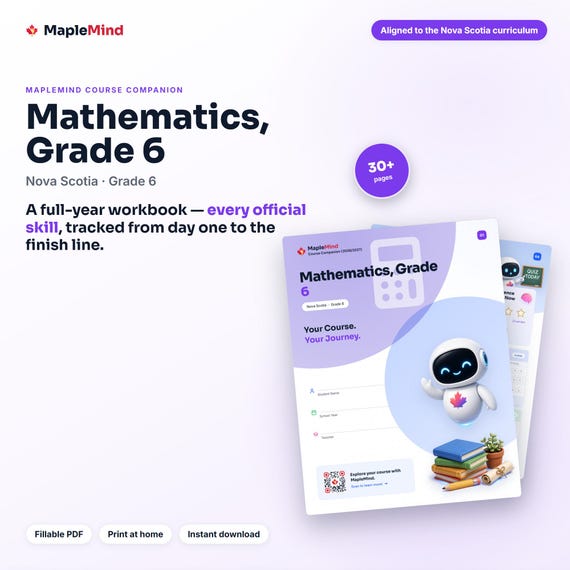
A Mathematics, Grade 6 workbook worth keeping
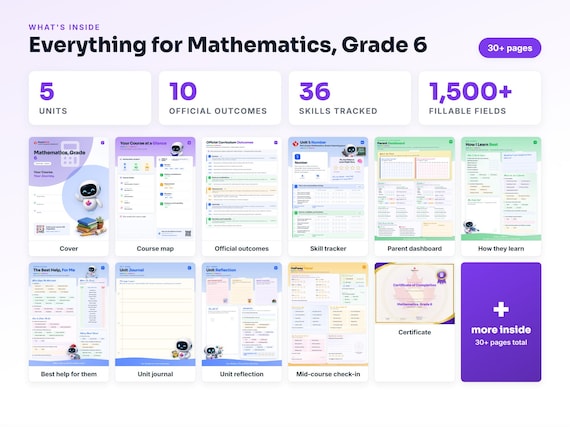
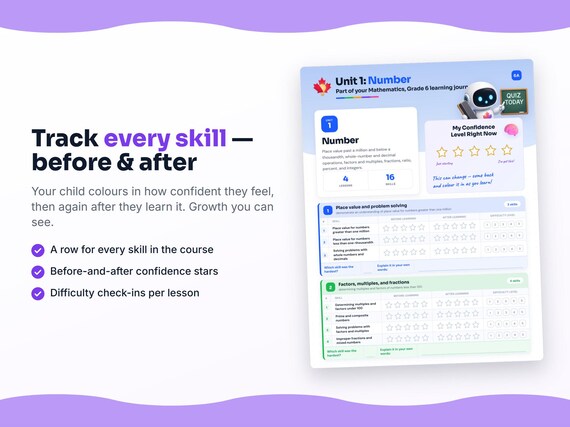
Built from the same official curriculum as this page. Before and after each skill above, your student colours in how sure they feel — so the two of you can see, on one page, what's clicking and what needs another look. It's a quiet way to follow how the year is really going.
By June it's full of their own handwriting: units worked through, confidence grown, a mid-year check-in, notes from parent-teacher night, and a certificate at the end. Less a worksheet, more a record of the year worth keeping on the shelf.
Instant download · see every page, reviews and the full description · five or more workbooks are $2.99 each
What it looks like in the app



Common questions
Can MapleMind help my child with Mathematics, Grade 6?
Yes. MapleMind's AI tutor covers all 36 skills in Nova Scotia's Mathematics, Grade 6 — your child picks the exact skill, and the tutor teaches it step by step: a short lesson, a worked example, solving together, then a skill check to show it stuck.
Is MapleMind aligned to Nova Scotia's official curriculum?
Yes. Every skill in this course maps to an official outcome code from Nova Scotia's Grade 6 Mathematics curriculum, and the ministry's own wording is quoted under each unit on this page — with the official government source linked so you can check it yourself.
What does MapleMind cost?
It's free to start — 5 tutoring chats and a practice quiz every day, no credit card. A Pro subscription ($9.99/month or $49.99/year CAD, 7-day free trial) unlocks unlimited tutoring, practice, and exam simulations.
What if my child is stuck on just one topic?
That's the point of skill-level tutoring: open Mathematics, Grade 6 in the app, tap the exact skill from the list on this page, and the tutor teaches just that — no wading through lessons your child doesn't need.
Does MapleMind work in French or other languages?
Yes — 14 languages, including French. Both the app and the tutor's explanations switch to the language your child chooses.
Where can I see the official Nova Scotia curriculum for Mathematics, Grade 6?
The official source is linked on this page — Nova Scotia's official curriculum. The outline here follows it: every MapleMind skill carries its official outcome code, and the ministry's own wording is quoted under each unit.
Keep exploring
Ready when you are
Pick a skill from this page and see it taught properly — free, in the browser, in under a minute.