Get help with Mathematics 2202
Most tutoring makes you sit through material you already know. MapleMind flips that: pick the exact skill that's causing trouble — any of the 28 below — and the tutor teaches just that one, step by step, as many times as it takes. Ask questions in plain words, any time of day, in English, French, or 12 other languages.
The official Newfoundland and Labrador Mathematics 2202 curriculum
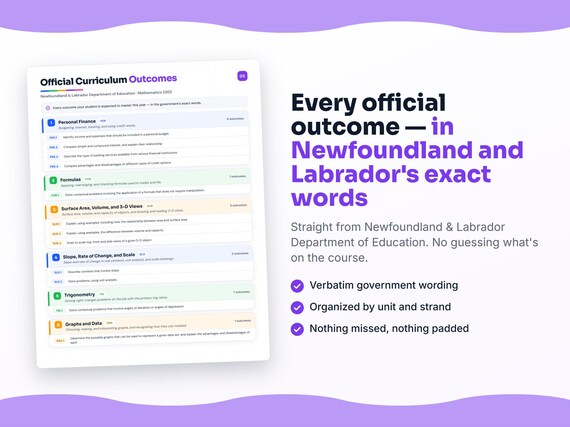
Newfoundland and Labrador defines Mathematics 2202 by strands and outcomes. MapleMind teaches the same curriculum reorganized for one-skill-at-a-time tutoring — the table shows exactly where every official strand lands, and the ministry's own wording is quoted under each unit below.
Official source Newfoundland and Labrador's official curriculumRead it on the government site — gov.nl.ca ↗| Official strand | Outcomes | Where MapleMind teaches it |
|---|---|---|
| Strand N | 9 | Personal Finance |
| PAR | 2 | Formulas |
| SAS | 15 | Surface Area, Volume, and 3-D Views · Slope, Rate of Change, and Scale · Trigonometry |
| SAP | 2 | Graphs and Data |
Every skill below, taught one on one.
 Try the first session free
How MapleMind teaches Mathematics 2202 — every unit, lesson, and skill
Every skill below runs as a short session: a plain-words lesson, a worked example, solving it together, then a five-question skill check that earns up to three stars. Guided Mode keeps it teaching instead of answer-handing — turning it off needs a parent's password.
Unit 1Personal FinanceOfficial strand · Strand N
Budgeting, interest, banking, and using credit wisely.
Building a Personal Budget
- Income, expenses, and a budgetN.1.1 — Identify the income and expenses in a personal budget, explain considerations such as prioritizing and unexpected costs, and create a budget from given income and expense data.
- Adjusting a budget for goalsN.1.4 — Collect real income and expense data to create a budget, modify it to reach personal goals, and analyze what-if questions about the budget.
Simple and Compound Interest
- Simple and compound interestN.1.8 — Compare simple and compound interest and explain their relationship, and solve simple-interest problems using the interest formula.
- Compounding periodsN.1.9 — Solve compound-interest problems using a formula, and explain the effect of different compounding periods on the interest earned.
Banking Services
- Accounts and banking servicesN.1.11 — Describe the banking services and account types available from financial institutions, and identify the account that best meets a given set of criteria.
- Fees, debit, and securityN.1.15 — Explain ATM service charges and the advantages and disadvantages of online banking and debit purchases, and describe ways to keep personal and financial information secure.
Using Credit
- Comparing credit optionsN.1.18 — Compare the advantages and disadvantages of credit options such as credit cards, personal loans, lines of credit, and overdraft, and compare credit cards across institutions.
- Smart credit strategiesN.1.19 — Make and explain informed decisions about using credit, and describe strategies to use credit effectively such as negotiating rates and reducing debt.
- Credit-card and loan problemsN.1.22 — Solve contextual problems that involve credit cards, loans, and credit linked to sales promotions.
The official wording — 9 outcomes in this unit
- N.1.1
Identify income and expenses that should be included in a personal budget
- N.1.4
Collect income and expense data, and create a budget
- N.1.8
Compare simple and compound interest, and explain their relationship
- N.1.9
Solve, using a formula, a contextual problem that involves compound interest
- N.1.11
Describe the type of banking services available from various financial institutions
- N.1.15
Identify and explain various automated teller machine (ATM) service charges
- N.1.18
Compare advantages and disadvantages of different types of credit options
- N.1.19
Make informed decisions and plans related to the use of credit
- N.1.22
Solve contextual problems that involve credit cards or loans
Unit 2FormulasOfficial strand · PAR
Applying, rearranging, and checking formulas used in trades and life.
Using and Rearranging Formulas
- Applying a formulaPAR.2.1 — Solve contextual problems by applying a formula, both when it needs no rearranging and when it must be manipulated, and describe how a formula is used in a trade.
- Checking and equivalent formulasPAR.2.4 — Create and solve problems that involve a formula, identify and correct errors in a formula solution, and verify why different forms of the same formula are equivalent.
The official wording — 2 outcomes in this unit
- PAR.2.1
Solve contextual problems involving the application of a formula that does not require manipulation
- PAR.2.4
Create and solve contextual problems that involve a formula
Unit 3Surface Area, Volume, and 3-D ViewsOfficial strand · SAS
Surface area, volume, and capacity of objects, and drawing and reading 3-D views.
Surface Area
- Surface area of 3-D objectsSAS.3.1 — Explain the relationship between area and surface area using nets and referents, and solve problems for the surface area of 3-D objects including pyramids and spheres.
- Surface area with formula workSAS.3.4 — Solve contextual surface-area problems that require manipulating formulas, and illustrate the effect of dimensional changes on surface area.
Volume and Capacity
- Volume vs capacity and referentsSAS.3.6 — Explain the difference between volume and capacity, compare SI and imperial referents and units, estimate a volume or capacity using a referent, and identify a situation for a given unit.
- Converting cubic unitsSAS.3.10 — Convert a volume or capacity measurement from one SI cubic unit to another, and from one imperial cubic unit to another.
- Calculating volume and capacitySAS.3.12 — Determine the volume and capacity of prisms, cones, cylinders, pyramids, spheres, and composite objects using measuring tools, and relate the volumes of cones-to-cylinders and pyramids-to-prisms with the same base and height.
- Volume problems and scalingSAS.3.16 — Solve contextual problems involving the volume or capacity of composite objects and containers, and illustrate the effect of dimensional changes on volume.
Drawing and Reading 3-D Views
- Top, front, and side viewsSAS.3.18 — Draw to scale and interpret the top, front, and side views of a 3-D object, build or draw an object from its views, and judge whether given views represent an object.
- Isometric and perspective viewsSAS.3.22 — Draw an object on isometric dot paper, and draw and identify a one-point perspective view of a 3-D object.
- Exploded viewsSAS.3.25 — Draw and sketch the components of an exploded view of a 3-D object, draw components to scale, and explain their relationship to the original object.
The official wording — 9 outcomes in this unit
- SAS.3.1
Explain, using examples, including nets, the relationship between area and surface area
- SAS.3.4
Solve contextual problems that involve the surface area of 3-D objects and that require the manipulation of formulas
- SAS.3.6
Explain, using examples, the difference between volume and capacity
- SAS.3.10
Write a given volume or capacity measurement expressed in one SI unit cubed in another SI unit cubed
- SAS.3.12
Determine the volume of prisms, cones, cylinders, pyramids, spheres and composite 3-D objects
- SAS.3.16
Solve contextual problems that involve the volume of a 3-D object, including composite 3-D objects, or the capacity of a container
- SAS.3.18
Draw to scale top, front and side views of a given 3-D object
- SAS.3.22
Draw, using isometric dot paper, a given 3-D object
- SAS.3.25
Draw the components of a given exploded diagram, and explain their relationship to the original 3-D object
Unit 4Slope, Rate of Change, and ScaleOfficial strand · SAS
Slope and rate of change in real contexts, unit analysis, and scale drawings.
Slope in Context
- Slope as rise over runSAS.4.1 — Describe contexts that involve slope, explain slope as rise over run and the difference between two slopes, and describe when a slope is zero or undefined.
- Slope, angle, and rate of changeSAS.4.6 — Relate slope to angle of elevation, verify that an object's slope is constant, explain slope as a rate of change, and solve contextual slope and rate-of-change problems considering safety.
Unit Analysis and Scale
- Unit analysis and proportionsSAS.4.10 — Solve problems using unit analysis and proportional reasoning within and between measurement systems, and identify and correct errors in a unit-analysis solution.
- Scale drawings and modelsSAS.4.14 — Use proportional reasoning to find real dimensions from a scale drawing or model, build a model to scale, draw a scale diagram, and solve contextual scale problems.
The official wording — 4 outcomes in this unit
- SAS.4.1
Describe contexts that involve slope
- SAS.4.6
Explain, using illustrations, the relationship between slope and angle of elevation
- SAS.4.10
Solve problems, using unit analysis
- SAS.4.14
Determine, using proportional reasoning, the dimensions of an object from a given scale drawing or model
Unit 5TrigonometryOfficial strand · SAS
Solving right-triangle problems on the job with the primary trig ratios.
Right-Triangle Trigonometry
- Angles of elevation and depressionSAS.5.1 — Solve contextual problems involving angles of elevation and depression, identify the right triangles in an illustration, and judge whether a triangle solution is reasonable.
- Two-right-triangle problemsSAS.5.2 — Solve contextual problems that involve two right triangles using the primary trigonometric ratios.
The official wording — 2 outcomes in this unit
- SAS.5.1
Solve contextual problems that involve angles of elevation or angles of depression
- SAS.5.2
Solve contextual problems that involve two right triangles, using the primary trigonometric ratios
Unit 6Graphs and DataOfficial strand · SAP
Choosing, making, and interpreting graphs, and recognizing how they can mislead.
Choosing and Reading Graphs
- Choosing and making a graphSAP.6.1 — Determine which graphs can represent a data set and their advantages and disadvantages, create a histogram, and interpret and describe trends in a graph.
- Interpreting and questioning graphsSAP.6.3 — Solve problems by interpreting a graph, interpolate and extrapolate values, and explain how the same graph or different representations can support more than one conclusion or point of view.
The official wording — 2 outcomes in this unit
- SAP.6.1
Determine the possible graphs that can be used to represent a given data set, and explain the advantages and disadvantages of each
- SAP.6.3
Solve contextual problems that involve the interpretation of a graph
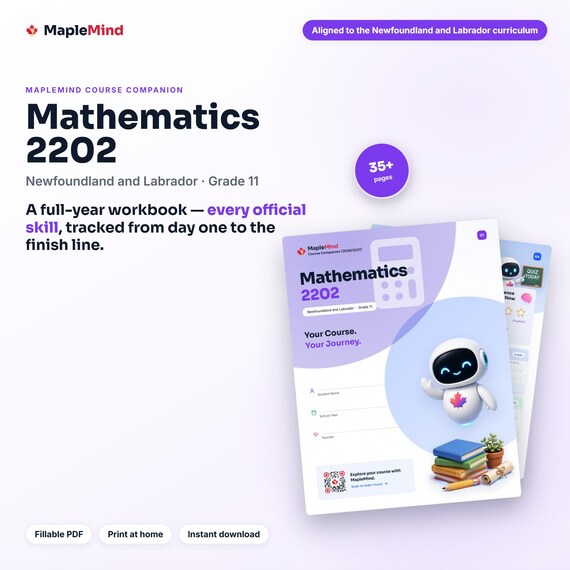
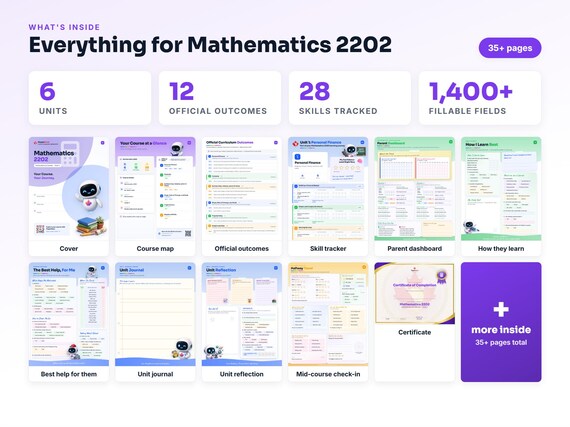

Printable workbook · A keepsake of the year
A Mathematics 2202 workbook worth keeping
Built from the same official curriculum as this page. Before and after each skill above, your student colours in how sure they feel — so the two of you can see, on one page, what's clicking and what needs another look. It's a quiet way to follow how the year is really going.
By June it's full of their own handwriting: units worked through, confidence grown, a mid-year check-in, notes from parent-teacher night, and a certificate at the end. Less a worksheet, more a record of the year worth keeping on the shelf.
Instant download · see every page, reviews and the full description · five or more workbooks are $2.99 each
What it looks like in the app



Common questions
Can MapleMind help me with Mathematics 2202?
Yes. MapleMind's AI tutor covers all 28 skills in Newfoundland and Labrador's Mathematics 2202 — you pick the exact skill, and the tutor teaches it step by step: a short lesson, a worked example, solving together, then a skill check to show it stuck.
Is MapleMind aligned to Newfoundland and Labrador's official curriculum?
Yes. Every skill in this course maps to an official outcome code from Newfoundland and Labrador's Grade 11 Mathematics curriculum, and the ministry's own wording is quoted under each unit on this page — with the official government source linked so you can check it yourself.
What does MapleMind cost?
It's free to start — 5 tutoring chats and a practice quiz every day, no credit card. A Pro subscription ($9.99/month or $49.99/year CAD, 7-day free trial) unlocks unlimited tutoring, practice, and exam simulations.
What if I'm stuck on just one topic?
That's the point of skill-level tutoring: open Mathematics 2202 in the app, tap the exact skill from the list on this page, and the tutor teaches just that — no wading through lessons you don't need.
Does MapleMind work in French or other languages?
Yes — 14 languages, including French. Both the app and the tutor's explanations switch to the language you choose.
Where can I see the official Newfoundland and Labrador curriculum for Mathematics 2202?
The official source is linked on this page — Newfoundland and Labrador's official curriculum. The outline here follows it: every MapleMind skill carries its official outcome code, and the ministry's own wording is quoted under each unit.
Keep exploring
Ready when you are
Pick a skill from this page and see it taught properly — free, in the browser, in under a minute.