Get help with Mathematics 2201 (Academic)
Most tutoring makes you sit through material you already know. MapleMind flips that: pick the exact skill that's causing trouble — any of the 34 below — and the tutor teaches just that one, step by step, as many times as it takes. Ask questions in plain words, any time of day, in English, French, or 12 other languages.
The official Newfoundland and Labrador Mathematics 2201 (Academic) curriculum
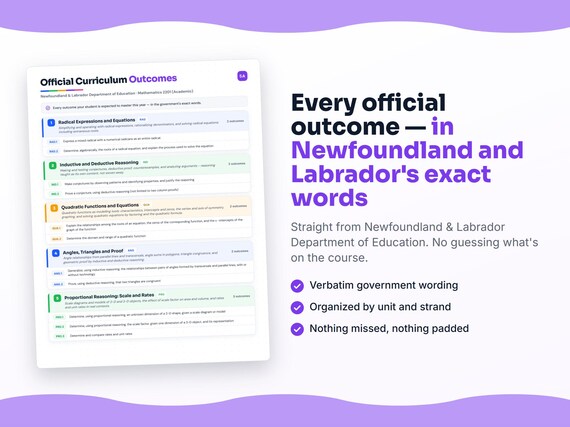
Newfoundland and Labrador defines Mathematics 2201 (Academic) by strands and outcomes. MapleMind teaches the same curriculum reorganized for one-skill-at-a-time tutoring — the table shows exactly where every official strand lands, and the ministry's own wording is quoted under each unit below.
Official source Newfoundland and Labrador's official curriculumRead it on the government site — gov.nl.ca ↗| Official strand | Outcomes | Where MapleMind teaches it |
|---|---|---|
| Strand N | 9 | Radical Expressions and Equations · Inductive and Deductive Reasoning |
| PAR | 6 | Quadratic Functions and Equations |
| SAS | 13 | Angles, Triangles and Proof · Proportional Reasoning: Scale and Rates · Acute Triangle Trigonometry |
| SAP | 6 | Statistical Reasoning |
Every skill below, taught one on one.
 Try the first session free
How MapleMind teaches Mathematics 2201 (Academic) — every unit, lesson, and skill
Every skill below runs as a short session: a plain-words lesson, a worked example, solving it together, then a five-question skill check that earns up to three stars. Guided Mode keeps it teaching instead of answer-handing — turning it off needs a parent's password.
Unit 1Radical Expressions and EquationsOfficial strand · Strand N
Simplifying and operating with radical expressions, rationalizing denominators, and solving radical equations including extraneous roots.
Simplifying Radical Expressions
- Mixed and entire radicalsN.1.1 — Express a mixed radical with a numerical radicand as an entire radical and an entire radical (numerical or variable radicand) as a mixed radical, and identify the values of a variable for which a radical expression is defined.
- Comparing and operating with radicalsN.1.6 — Compare and order radical expressions with numerical radicands and perform one or more operations to simplify radical expressions with numerical or variable radicands.
- Rationalizing a denominatorN.1.7 — Rationalize the monomial denominator of a radical expression so that no radical remains in the denominator.
Solving Radical Equations
- Solving radical equations algebraicallyN.1.9 — Determine any restrictions on the variable in a radical equation and determine algebraically the roots of a radical equation, explaining the process.
- Verifying roots and extraneous solutionsN.1.10 — Verify by substitution that values found in solving a radical equation are roots, explain why some roots are extraneous, and solve problems by modelling a situation with a radical equation.
The official wording — 5 outcomes in this unit
- N.1.1
Express a mixed radical with a numerical radicans as an entire radical.
- N.1.6
Perform one or more operations to simplify radical expressions with numerical or variable radicands
- N.1.7
Rationalize the monomial denominator of a radical expression
- N.1.9
Determine, algebraically, the roots of a radical equation, and explain the process used to solve the equation
- N.1.10
Verify, by substitution, that the values determined in solving a radical equation are roots of the equation
Unit 2Inductive and Deductive ReasoningOfficial strand · Strand N
Making and testing conjectures, deductive proof, counterexamples, and analyzing arguments - reasoning taught as its own content, not woven away.
Conjectures and Counterexamples
- Making conjectures inductivelyN.2.1 — Make conjectures by observing patterns and identifying properties, justify the reasoning, and explain why inductive reasoning may lead to a false conjecture.
- CounterexamplesN.2.4 — Provide and explain a counterexample to disprove a conjecture, and determine whether a given argument is valid, justifying the reasoning.
Deductive Proof
- Proving with deductive reasoningN.2.5 — Prove a conjecture using deductive reasoning (not limited to two-column proofs) and prove algebraic and number relationships such as divisibility rules, number properties, mental-mathematics strategies, or algebraic number tricks.
- Comparing reasoning and finding proof errorsN.2.7 — Compare inductive and deductive reasoning using examples, identify errors in a given proof such as one that ends with 2 = 1, and solve a contextual problem that involves inductive or deductive reasoning.
The official wording — 4 outcomes in this unit
- N.2.1
Make conjectures by observing patterns and identifying properties, and justify the reasoning
- N.2.4
Provide and explain a counterexample to disprove a given conjecture
- N.2.5
Prove a conjecture, using deductive reasoning (not limited to two column proofs)
- N.2.7
Compare, using examples, inductive and deductive reasoning
Unit 3Quadratic Functions and EquationsOfficial strand · PAR
Quadratic functions as modelling tools: characteristics, intercepts and zeros, the vertex and axis of symmetry, graphing, and solving quadratic equations by factoring and the quadratic formula.
Quadratic Equations and Their Roots
- Roots, zeros and interceptsPAR.4.6 — Explain the relationships among the roots of a quadratic equation, the zeros of the function, and the x-intercepts of the graph, and explain why a quadratic may have zero, one, or two x-intercepts.
- Solving quadratics by factoringPAR.4.8 — Determine the roots of a quadratic equation by factoring and verify by substitution, and express a quadratic equation in factored form given its zeros or the x-intercepts of its graph.
- Solving with the quadratic formulaPAR.4.9 — Determine the roots of a quadratic equation using the quadratic formula, and solve contextual problems by modelling a situation with a quadratic equation.
Graphs of Quadratic Functions
- Characteristics of a quadratic functionPAR.4.1 — Determine the domain and range of a quadratic function, determine its intercepts with or without technology, and solve a contextual problem involving the characteristics of a quadratic function.
- Vertex and axis of symmetryPAR.4.11 — Determine the coordinates of the vertex of a quadratic graph with or without technology, determine the axis of symmetry from the x-intercepts, and decide whether the vertex is a maximum or a minimum.
- Sketching from standard and vertex formPAR.4.10 — Determine the characteristics of a quadratic function in standard form (y = ax^2 + bx + c) through the parameters a, b, and c and in vertex form (y = a(x - h)^2 + k) through h and k, sketch the graph, and determine the function from characteristics of its graph.
The official wording — 6 outcomes in this unit
- PAR.4.6
Explain the relationships among the roots of an equation, the zeros of the corresponding function, and the x -intercepts of the graph of the function
- PAR.4.8
Determine, by factoring, the roots of a quadratic equation, and verify by substitution
- PAR.4.9
Determine, using the quadratic formula, the roots of a quadratic equation
- PAR.4.1
Determine the domain and range of a quadratic function
- PAR.4.11
Determine, with or without technology, the coordinates of the vertex of the graph of a quadratic function
- PAR.4.10
Determine the characteristics of a quadratic function
Unit 4Angles, Triangles and ProofOfficial strand · SAS
Angle relationships from parallel lines and transversals, angle sums in polygons, triangle congruence, and geometric proof by inductive and deductive reasoning.
Parallel Lines and Angle Relationships
- Angle relationships from transversalsSAS.5.1 — Generalize, using inductive reasoning, the relationships between pairs of angles formed by transversals and parallel lines, and verify with examples that if lines are not parallel the angle properties do not apply.
- Proving angle propertiesSAS.5.3 — Prove, using deductive reasoning, properties of angles formed by transversals and parallel lines including the sum of the angles in a triangle, generalize the interior-angle-sum rule for a polygon, and identify and correct errors in an angle proof.
Congruence and Angle Problems
- Proving triangles congruentSAS.5.6 — Prove, using deductive reasoning, that two triangles are congruent, and construct parallel lines with a compass or protractor, explaining the strategy.
- Solving angle problems and checking solutionsSAS.5.8 — Determine the measures of angles in a diagram with parallel lines, angles, and triangles and justify the reasoning; decide whether lines are parallel from angle measures; identify and correct errors and solve contextual angle problems.
The official wording — 4 outcomes in this unit
- SAS.5.1
Generalize, using inductive reasoning, the relationships between pairs of angles formed by transversals and parallel lines, with or without technology
- SAS.5.3
Prove, using deductive reasoning, properties of angles formed by transversals and parallel lines, including the sum of the angles in a triangle
- SAS.5.6
Prove, using deductive reasoning, that two triangles are congruent
- SAS.5.8
Determine the measures of angles in a diagram that includes parallel lines, angles and triangles, and justify the reasoning
Unit 5Proportional Reasoning: Scale and RatesOfficial strand · SAS
Scale diagrams and models of 2-D and 3-D objects, the effect of scale factor on area and volume, and rates and unit rates in real contexts.
Scale Diagrams of 2-D Shapes
- Scale factor and 2-D dimensionsSAS.6.2 — Explain how scale diagrams model a 2-D shape, determine an unknown dimension using proportional reasoning, determine the scale factor from a dimension and its representation, and draw a scale diagram to a specified scale factor.
- Scale factor and areaSAS.6.5 — Explain, using examples, the effect of a change in scale factor on the area of a 2-D shape, determine the area from a scale diagram, and justify the reasonableness of the result.
Scale and 3-D Objects
- Scale diagrams of 3-D objectsSAS.6.8 — Explain how scale diagrams model a 3-D object, determine the scale factor from a dimension and its representation, and determine an unknown dimension of a 3-D object using proportional reasoning.
- Scale factor, surface area and volumeSAS.6.10 — Explain the effect of a change in scale factor on the surface area and volume of a 3-D object, determine surface area and volume from a scale diagram, and solve problems involving the relationships among scale factors, areas, and volumes.
Rates and Unit Rates
- Interpreting and comparing ratesSAS.6.16 — Interpret rates in a given context, determine and compare rates and unit rates, and make and justify a decision using rates.
- Graphing rates and slopeSAS.6.18 — Draw a graph to represent a rate, explain the relationship between the slope of a graph and a rate, describe a context for a given rate, and identify factors that influence a rate.
- Solving rate problemsSAS.6.22 — Solve a contextual problem that involves rates or unit rates, including a rate problem that requires the isolation of a variable.
The official wording — 7 outcomes in this unit
- SAS.6.2
Determine, using proportional reasoning, an unknown dimension of a 2-D shape, given a scale diagram or model
- SAS.6.5
Explain, using examples, the effect of a change in the scale factor on the area of a 2-D shape
- SAS.6.8
Determine, using proportional reasoning, the scale factor, given one dimension of a 3-D object, and its representation
- SAS.6.10
Explain, using examples, the effect of a change in the scale factor on the surface area and volume of a 3-D object
- SAS.6.16
Determine and compare rates and unit rates
- SAS.6.18
Draw a graph to represent a rate
- SAS.6.22
Solve a contextual problem that involves rates or unit rates
Unit 6Acute Triangle TrigonometryOfficial strand · SAS
The sine law and the cosine law used to solve non-right (acute) triangles and multi-triangle measurement problems.
The Sine Law and the Cosine Law
- Applying the sine and cosine lawsSAS.7.2 — Draw a diagram for a problem involving the sine law or the cosine law and solve a contextual problem using the sine law (excluding the ambiguous case) or the cosine law, explaining the reasoning.
- Problems with more than one triangleSAS.7.3 — Solve a contextual problem that involves more than one triangle, chaining the sine and cosine laws across shared sides or angles.
The official wording — 2 outcomes in this unit
- SAS.7.2
Solve a contextual problem that requires the use of the sine law (excluding the ambiguous case) or the cosine law, and explain the reasoning
- SAS.7.3
Solve a contextual problem that involves more than one triangle
Unit 7Statistical ReasoningOfficial strand · SAP
Collecting and assessing data, standard deviation and dispersion, the normal distribution and z-scores, and confidence intervals and margin of error in a research project.
Data Collection and Dispersion
- Collecting and assessing dataSAP.8.2 — Collect primary or secondary data on a topic and assess its accuracy, reliability, and relevance by identifying bias, describing collection methods, and checking consistency with other sources; interpret data using statistical methods and present multiple sides of controversial issues.
- Standard deviation and dispersionSAP.8.8 — Use dispersion to describe the differences between two data sets, create frequency tables and graphs, explain the meaning of standard deviation, calculate the population standard deviation using technology, and solve problems interpreting it.
The Normal Distribution
- Properties of the normal curveSAP.8.11 — Explain the properties of a normal curve including the mean, median, mode, standard deviation, symmetry, and area under the curve, determine whether a data set approximates a normal distribution, and compare two or more normally distributed data sets.
- z-scores and normal problemsSAP.8.15 — Determine and explain the z-score for a value in a normally distributed data set with or without technology, solve contextual problems involving the normal distribution, and explain the application of standard deviation in decisions such as warranties or insurance.
Confidence Intervals and Margin of Error
- Confidence intervals and margin of errorSAP.8.17 — Explain the significance of a confidence interval, margin of error, and confidence level, explain how they vary with sample size, and make inferences about a population from sample data using confidence intervals.
- Statistics in the mediaSAP.8.21 — Interpret and explain confidence intervals and margin of error using examples from print or electronic media, provide examples where they support a position, and support a position by analyzing statistical data in the media.
The official wording — 6 outcomes in this unit
- SAP.8.2
Assess the accuracy, reliability and relevance of the primary or secondary data collected by: identifying examples of bias and points of view identifying and describing the data collection methods determining if the data is relevant determining if the data is consistent with information obtained from other sources on the same topic
- SAP.8.8
Explain, using examples, the meaning of standard deviation
- SAP.8.11
Explain, using examples, the properties of a normal curve, including the mean, median, mode, standard deviation, symmetry and area under the curve
- SAP.8.15
Determine, with or without technology, and explain the z -score for a given value in a normally distributed data set
- SAP.8.17
Explain, using examples, the significance of a confidence interval, margin of error or confidence level
- SAP.8.21
Interpret and explain confidence intervals and margin of error, using examples found in print or electronic media
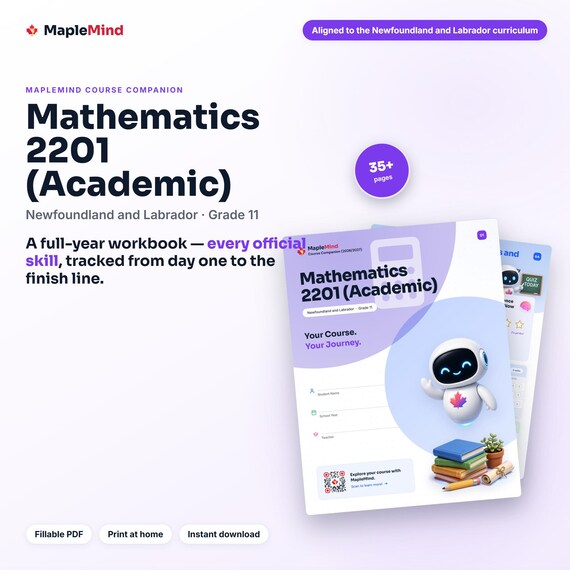
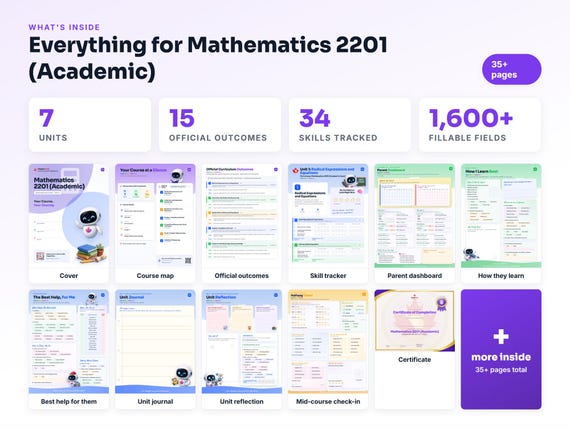

Printable workbook · A keepsake of the year
A Mathematics 2201 (Academic) workbook worth keeping
Built from the same official curriculum as this page. Before and after each skill above, your student colours in how sure they feel — so the two of you can see, on one page, what's clicking and what needs another look. It's a quiet way to follow how the year is really going.
By June it's full of their own handwriting: units worked through, confidence grown, a mid-year check-in, notes from parent-teacher night, and a certificate at the end. Less a worksheet, more a record of the year worth keeping on the shelf.
Instant download · see every page, reviews and the full description · five or more workbooks are $2.99 each
What it looks like in the app



Common questions
Can MapleMind help me with Mathematics 2201 (Academic)?
Yes. MapleMind's AI tutor covers all 34 skills in Newfoundland and Labrador's Mathematics 2201 (Academic) — you pick the exact skill, and the tutor teaches it step by step: a short lesson, a worked example, solving together, then a skill check to show it stuck.
Is MapleMind aligned to Newfoundland and Labrador's official curriculum?
Yes. Every skill in this course maps to an official outcome code from Newfoundland and Labrador's Grade 11 Mathematics curriculum, and the ministry's own wording is quoted under each unit on this page — with the official government source linked so you can check it yourself.
What does MapleMind cost?
It's free to start — 5 tutoring chats and a practice quiz every day, no credit card. A Pro subscription ($9.99/month or $49.99/year CAD, 7-day free trial) unlocks unlimited tutoring, practice, and exam simulations.
What if I'm stuck on just one topic?
That's the point of skill-level tutoring: open Mathematics 2201 (Academic) in the app, tap the exact skill from the list on this page, and the tutor teaches just that — no wading through lessons you don't need.
Does MapleMind work in French or other languages?
Yes — 14 languages, including French. Both the app and the tutor's explanations switch to the language you choose.
Where can I see the official Newfoundland and Labrador curriculum for Mathematics 2201 (Academic)?
The official source is linked on this page — Newfoundland and Labrador's official curriculum. The outline here follows it: every MapleMind skill carries its official outcome code, and the ministry's own wording is quoted under each unit.
Keep exploring
Ready when you are
Pick a skill from this page and see it taught properly — free, in the browser, in under a minute.