British Columbia · For parents

What your child learns in Grade 4 in British Columbia

Every subject, unit by unit, from British Columbia’s curriculum: 86 skills in plain words.

Subjects
4
Skills
86
Provincial exams
1
Official curriculum
curriculum.gov.bc.ca

Math in Grade 4

Mathematics 4

6 units · 18 skills

  1. Unit 1

    Number

    In a number like 4,672, each digit's place tells its value: 4 thousands, 6 hundreds, 7 tens, 2 ones.

    • Understanding numbers to 10 000
    • What decimals to hundredths mean
    • Which fraction is bigger?
  2. Unit 2

    Computational Fluency

    Line up numbers by place value (thousands under thousands, ones under ones) before adding or subtracting.

    • Adding and subtracting big numbers
    • Multiplying and dividing by a one-digit number
    • Adding and subtracting decimals
    2 more skills
    • Fast and sure with facts to 20
    • Strategies for facts to 100
  3. Unit 3

    Patterns and Algebra

    A pattern rule describes how each term changes from the one before it (like 'add 2 each time' or 'subtract 3 each time').

    • Reading patterns in tables and charts
    • Connecting two changing quantities
    • Finding the missing number
  4. Unit 4

    Measurement

    On an analog clock, the short hand shows the hour and the long hand shows the minutes, counting by 5s around the face.

    • Reading clocks both ways
    • Measuring around a shape
  5. Unit 5

    Geometry

    A regular polygon has ALL sides the same length AND all angles the same size (like a square or a stop sign's octagon).

    • Sorting regular and irregular polygons
    • Finding lines of symmetry
  6. Unit 6

    Data, Probability, and Financial Literacy

    In a one-to-one graph, each bar unit or picture symbol equals exactly 1 item.

    • When one picture stands for more than one thing
    • Trying chance experiments and recording results
    • Making change and simple money decisions
Science in Grade 4

Science 4

4 units · 11 skills

  1. Unit 1

    Living Things

    Humans sense the world through five senses: sight, hearing, smell, taste, and touch.

    • Sensing and responding in humans
    • Sensing and responding in other animals
    • Sensing and responding in plants
    1 more skill
    • Biomes as large regions with shared features
  2. Unit 2

    Matter

    Matter exists in three main phases: solid (keeps its own shape), liquid (takes the shape of its container but keeps its volume), and gas (spreads out to fill any space).

    • The phases of matter
    • How temperature changes particle movement
  3. Unit 3

    Energy

    Energy can be described in many forms: the energy of motion (kinetic), light, sound, thermal (heat), elastic, nuclear, chemical, magnetic, gravitational, and electrical.

    • Energy has various forms
    • Energy is conserved
    • Devices that transform energy
  4. Unit 4

    Earth and Space

    Earth's rotation (spinning on its tilted axis once a day) causes day and night — animals adapt to this cycle, with some being nocturnal (active at night) and others diurnal (active during the day).

    • Local changes from Earth's axis, rotation, and orbit
    • Effects of sun, moon, and Earth positions
See the course: Science 4

English in Grade 4

English Language Arts 4

3 units · 47 skills

  1. Unit 1

    Story and Text

    The FORM of a text is the shape it comes in — a letter, an article, a story, an advertisement, a poem.

    • Forms of text
    • Functions of text
    • Genres of text
    10 more skills
    • Using text features
    • Theme
    • Character
    • Setting
    • Plot
    • Conflict
    • Purpose
    • Sensory detail
    • Figurative language
    • Using evidence
  2. Unit 2

    Strategies and Processes

    The sentences AROUND a hard word often hint at its meaning — look at what's happening nearby.

    • Using contextual clues
    • Using phonics and word structure
    • Visualizing
    19 more skills
    • Questioning (reading)
    • Predicting
    • Previewing text
    • Summarizing
    • Making inferences
    • Focusing on the speaker
    • Asking questions to clarify
    • Listening for specifics
    • Expressing opinions
    • Speaking with expression
    • Staying on topic
    • Taking turns
    • Reflecting
    • Questioning your own thinking
    • Goal setting
    • Self-evaluating
    • Revising
    • Editing
    • Considering audience
  3. Unit 3

    Language Features, Structure, and Conventions

    Tone is the FEELING in a speaker's voice — cheerful, serious, sarcastic — and it can change what the same words actually mean.

    • Tone
    • Volume
    • Inflection
    9 more skills
    • Pace
    • Gestures
    • Topic sentence
    • Supporting details
    • Sentence structure
    • Parts of speech
    • Past, present, and future tenses
    • Subject-verb agreement
    • Punctuation

Social studies in Grade 4

Social Studies 4

5 units · 10 skills

  1. Unit 1

    First Contact and the Fur Trade

    European explorers like Cabot, Frobisher, Hudson, Cartier, and Champlain — and later Cook and Vancouver on the west coast — met First Peoples who had lived on this land for thousands of years.

    • Contact, trade, co-operation, and conflict
    • The fur trade in early Canada and BC
  2. Unit 2

    A Colony Takes Shape

    New diseases brought by Europeans, which First Peoples had no immunity to, caused devastating population loss in many First Peoples communities.

    • How BC's population changed
    • Economic factors in BC's colonization
    • Political factors and BC's entry into Confederation
  3. Unit 3

    The Impact of Colonization

    New diseases and hard conditions caused huge population loss in many First Peoples communities (disease and demographics).

    • Broad impacts of colonization
    • Government laws and policies affecting First Peoples
  4. Unit 4

    Our Local Community

    Local archives and museums hold records, photos, and objects that reveal who lived in a community first and how it has changed over time.

    • The history of our local community
  5. Unit 5

    Canada's Land and Resources

    Physiographic features are the major physical landforms of a country — Canada's include mountain ranges (like the Rockies and Coast Mountains), the flat interior plains, long coastlines on three oceans, and vast forest regions.

    • Canada's physiographic features
    • Canada's natural resources

Provincial exams in Grade 4

MapleMind

See Grade 4 in MapleMind

Real screens from the app your child would use.

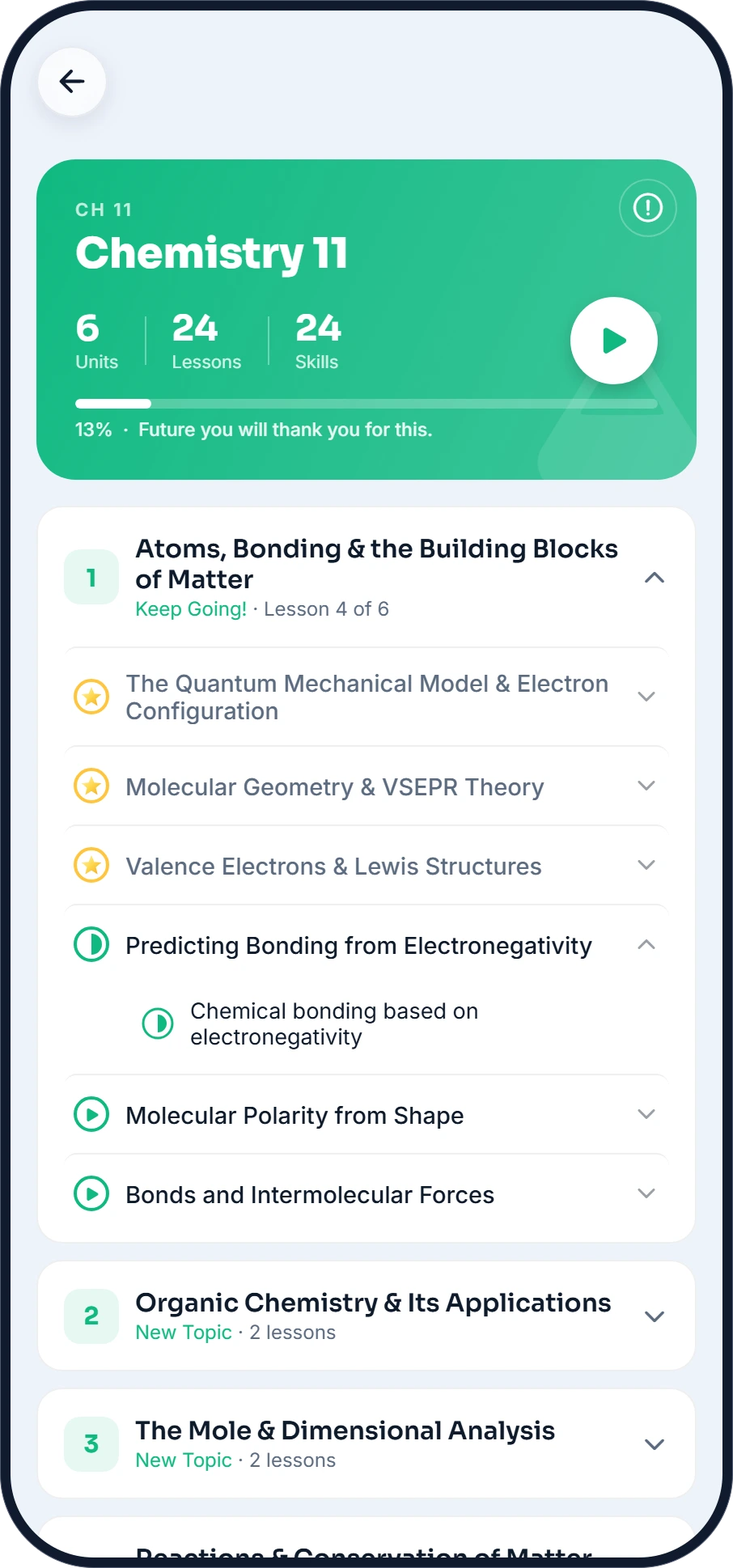
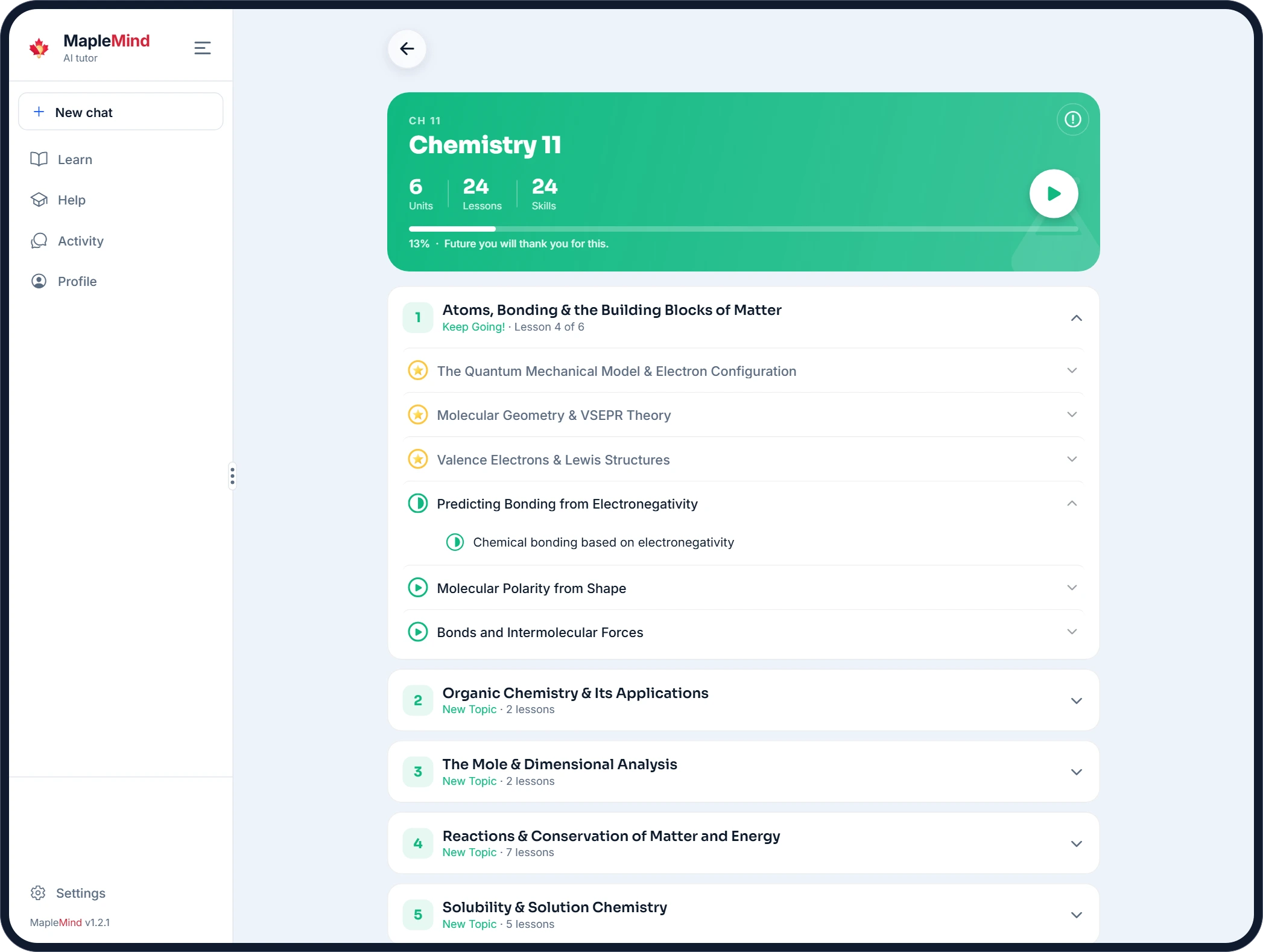
Chemistry 11 in MapleMind on a tablet: its units and lessons in order, a student partway through.Chemistry 11 in MapleMind on a phone: its units and lessons in order, a student partway through.
Their course, unit by unit, the way British Columbia teaches it.Shown: Chemistry 11
Homework Help on a tablet: a photo of a worksheet, the tutor’s worked example of a two-step equation, and a question back to the student.Homework Help on a phone: a photo of a worksheet, the tutor’s worked example of a two-step equation, and a question back to the student.
Homework Help: they take a photo of the question, and the tutor works through it with them.
The Parent Dashboard on a tablet: a student’s days studied, streak, lessons, quiz average and recent activity.The Parent Dashboard on a phone: a student’s days studied, streak, lessons, quiz average and recent activity.
The Parent Dashboard: how each child’s week went, in lessons, quizzes and days studied.
A Grade 9 provincial mathematics exam on a tablet: a readiness score, the exam’s time and its next sitting.A Grade 9 provincial mathematics exam on a phone: a readiness score, the exam’s time and its next sitting.
A provincial exam: a practice sitting under the real time, and how ready they are.
The Learn tab on a tablet: a four-day streak, the week’s days, Homework Help, the next lesson and a review.The Learn tab on a phone: a four-day streak, the week’s days, Homework Help, the next lesson and a review.
The Learn tab: their week so far, and the next thing to do.

Help at home

Questions parents ask

What will my child learn in Grade 4 in British Columbia?

Math: Mathematics 4. Science: Science 4. English: English Language Arts 4. Social studies: Social Studies 4. That’s 86 skills in all, from British Columbia’s curriculum.

When is the Foundation Skills Assessment, Grade 4?

It’s written September 28, 2026 to November 6, 2026.

Where does this list come from?

From British Columbia’s official curriculum, the documents its education ministry publishes for each course. Each skill here is one of their expectations, written in plain words.

Can MapleMind help my child in Grade 4?

Yes. Every course on this page is in MapleMind, with lessons, practice and a tutor that works through each step with them. A free account gets 30 messages and 4 activities a day.

Help with Grade 4, one skill at a time.

Every course on this page is in MapleMind, free with daily limits.