Get help with Mathematics 4
Most tutoring makes your child sit through material your child already knows. MapleMind flips that: pick the exact skill that's causing trouble — any of the 18 below — and the tutor teaches just that one, step by step, as many times as it takes. Ask questions in plain words, any time of day, in English, French, or 12 other languages.
The official British Columbia Mathematics 4 curriculum
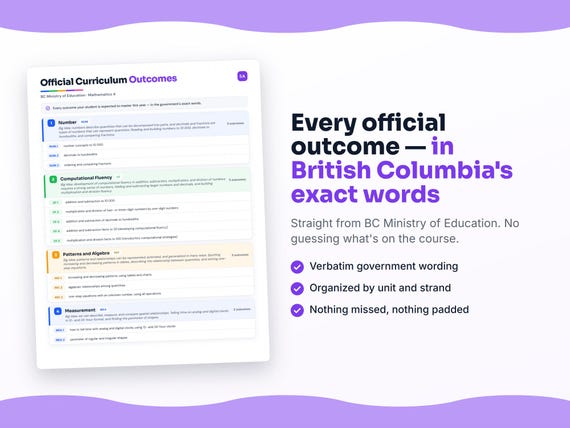
British Columbia defines Mathematics 4 by strands and outcomes. MapleMind teaches the same curriculum reorganized for one-skill-at-a-time tutoring — the table shows exactly where every official strand lands, and the ministry's own wording is quoted under each unit below.
Official source BC's official mathematics curriculumRead it on the government site — curriculum.gov.bc.ca ↗| Official strand | Outcomes | Where MapleMind teaches it |
|---|---|---|
| Number | 3 | Number |
| Computational Fluency | 5 | Computational Fluency |
| Patterning | 3 | Patterns and Algebra |
| Measurement | 2 | Measurement |
| Geometry | 2 | Geometry |
| Data and Probability | 3 | Data, Probability, and Financial Literacy |
Every skill below, taught one on one.
 Try the first session free
How MapleMind teaches Mathematics 4 — every unit, lesson, and skill
Every skill below runs as a short session: a plain-words lesson, a worked example, solving it together, then a five-question skill check that earns up to three stars. Guided Mode keeps it teaching instead of answer-handing — turning it off needs a parent's password.
Unit 1NumberOfficial strand · Number
Big Idea: numbers describe quantities that can be decomposed into parts, and decimals and fractions are types of numbers that can represent quantities. Reading and building numbers to 10 000, decimals to hundredths, and comparing fractions.
Numbers to 10 000
- Understanding numbers to 10 0004.C.1 — Read, write, build, and compare numbers up to 10 000, understanding what each digit is worth by its place — thousands, hundreds, tens, and ones.
Decimals to Hundredths
- What decimals to hundredths mean4.C.2 — Read, write, and model decimal numbers to hundredths (like 3.45), understanding tenths and hundredths as parts of a whole, and connect decimals to money and grids.
Ordering and Comparing Fractions
- Which fraction is bigger?4.C.3 — Order and compare fractions with the same or different denominators using models, number lines, and benchmarks like 0, one-half, and 1.
The official wording — 3 outcomes in this unit
- 4.C.1
number concepts to 10 000
- 4.C.2
decimals to hundredths
- 4.C.3
ordering and comparing fractions
Unit 2Computational FluencyOfficial strand · Computational Fluency
Big Idea: development of computational fluency in addition, subtraction, multiplication, and division of numbers requires a strong sense of numbers. Adding and subtracting larger numbers and decimals, and building multiplication and division fluency.
Adding and Subtracting to 10 000
- Adding and subtracting big numbers4.C.4 — Add and subtract whole numbers up to 10 000 using strategies like regrouping, breaking numbers apart, and estimating to check the answer makes sense.
Multiplying and Dividing Bigger Numbers
- Multiplying and dividing by a one-digit number4.C.5 — Multiply and divide two- or three-digit numbers by one-digit numbers using strategies such as breaking numbers into place-value parts, arrays, and repeated grouping.
Adding and Subtracting Decimals
- Adding and subtracting decimals4.C.6 — Add and subtract decimal numbers to hundredths, lining up the decimal point and place values, using money and grid models to check reasonableness.
Quick Facts: Adding and Subtracting to 20
- Fast and sure with facts to 204.C.7 — Build speed and confidence recalling addition and subtraction facts to 20, using known facts and patterns rather than counting one by one.
Quick Strategies: Multiplying and Dividing to 100
- Strategies for facts to 1004.C.8 — Use introductory strategies (skip-counting, doubling, arrays, known facts) to work out multiplication and division facts to 100.
The official wording — 5 outcomes in this unit
- 4.C.4
addition and subtraction to 10 000
- 4.C.5
multiplication and division of two- or three-digit numbers by one-digit numbers
- 4.C.6
addition and subtraction of decimals to hundredths
- 4.C.7
addition and subtraction facts to 20 (developing computational fluency)
- 4.C.8
multiplication and division facts to 100 (introductory computational strategies)
Unit 3Patterns and AlgebraOfficial strand · Patterning
Big Idea: patterns and relationships can be represented, extended, and generalized in many ways. Spotting increasing and decreasing patterns in tables, describing the relationship between quantities, and solving one-step equations.
Growing and Shrinking Patterns
- Reading patterns in tables and charts4.C.9 — Identify, extend, and describe increasing and decreasing patterns shown in tables and charts, explaining the rule that connects one term to the next.
How Quantities Are Related
- Connecting two changing quantities4.C.10 — Explore and describe algebraic relationships among quantities, such as how the total changes as the number of groups changes, using words, tables, or diagrams.
Solving One-Step Equations
- Finding the missing number4.C.11 — Solve one-step equations with an unknown number using addition, subtraction, multiplication, or division, such as finding the missing number in 8 + ? = 15.
The official wording — 3 outcomes in this unit
- 4.C.9
increasing and decreasing patterns, using tables and charts
- 4.C.10
algebraic relationships among quantities
- 4.C.11
one-step equations with an unknown number, using all operations
Unit 4MeasurementOfficial strand · Measurement
Big Idea: we can describe, measure, and compare spatial relationships. Telling time on analog and digital clocks in 12- and 24-hour format, and finding the perimeter of shapes.
Telling Time, 12-Hour and 24-Hour
- Reading clocks both ways4.C.12 — Tell time to the minute on analog and digital clocks, and convert between 12-hour time (like 3:00 pm) and 24-hour time (like 15:00).
Perimeter of Shapes
- Measuring around a shape4.C.14 — Find the perimeter of regular and irregular shapes by measuring or adding the lengths of all the sides around the outside.
The official wording — 2 outcomes in this unit
- 4.C.12
how to tell time with analog and digital clocks, using 12- and 24-hour clocks
- 4.C.14
perimeter of regular and irregular shapes
Unit 5GeometryOfficial strand · Geometry
Big Idea: we can describe, measure, and compare spatial relationships. Sorting and naming polygons as regular (all sides and angles equal) or irregular, and finding lines of symmetry.
Regular and Irregular Polygons
- Sorting regular and irregular polygons4.C.13 — Identify and classify polygons as regular (all sides and all angles equal) or irregular (sides and/or angles not all equal), such as a square versus a rectangle.
Line Symmetry
- Finding lines of symmetry4.C.15 — Identify whether a shape has line symmetry, and find its line(s) of symmetry — a fold line where both halves match exactly.
The official wording — 2 outcomes in this unit
- 4.C.13
regular and irregular polygons
- 4.C.15
line symmetry
Unit 6Data, Probability, and Financial LiteracyOfficial strand · Data and Probability
Big Idea: analyzing data and chance helps us compare, ask questions, and understand and predict outcomes; concrete experiences with data and probability support financial literacy. Reading graphs where one picture stands for more than one thing, running probability experiments, and making change with money.
Reading Bar Graphs and Pictographs
- When one picture stands for more than one thing4.C.16 — Read and create bar graphs and pictographs using one-to-one correspondence (one symbol represents one item) and many-to-one correspondence (one symbol represents more than one item).
Probability Experiments
- Trying chance experiments and recording results4.C.17 — Carry out simple probability experiments (like spinning a spinner or drawing from a bag), record the results, and compare what actually happened to what was expected.
Financial Literacy: Making Change
- Making change and simple money decisions4.C.18 — Make monetary calculations, including making change with amounts to 100 dollars, and use those calculations to make simple financial decisions.
The official wording — 3 outcomes in this unit
- 4.C.16
one-to-one correspondence and many-to-one correspondence, using bar graphs and pictographs
- 4.C.17
probability experiments
- 4.C.18
financial literacy — monetary calculations, including making change with amounts to 100 dollars and making simple financial decisions
Printable workbook · A keepsake of the year
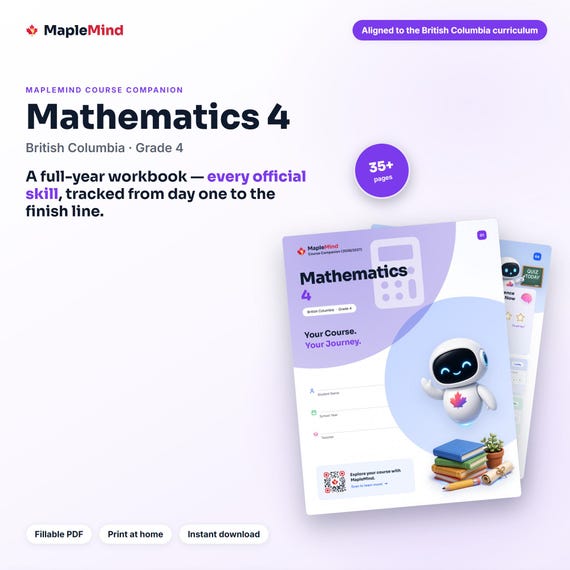
A Mathematics 4 workbook worth keeping
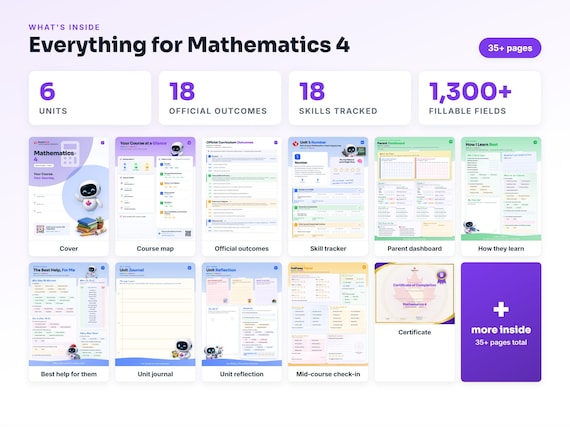
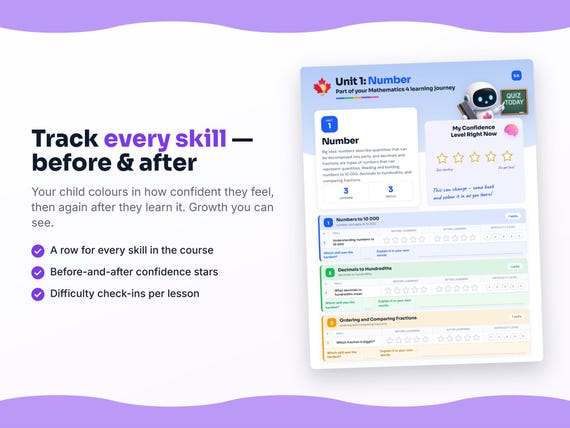
Built from the same official curriculum as this page. Before and after each skill above, your student colours in how sure they feel — so the two of you can see, on one page, what's clicking and what needs another look. It's a quiet way to follow how the year is really going.
By June it's full of their own handwriting: units worked through, confidence grown, a mid-year check-in, notes from parent-teacher night, and a certificate at the end. Less a worksheet, more a record of the year worth keeping on the shelf.
Instant download · see every page, reviews and the full description · five or more workbooks are $2.99 each
What it looks like in the app



Preparing for the Grade 4 Foundation Skills Assessment (FSA)?
BC students write the Foundation Skills Assessment in Grade 4. MapleMind's practice mode builds familiar question formats from this course's skills.
Common questions
Can MapleMind help my child with Mathematics 4?
Yes. MapleMind's AI tutor covers all 18 skills in British Columbia's Mathematics 4 — your child picks the exact skill, and the tutor teaches it step by step: a short lesson, a worked example, solving together, then a skill check to show it stuck.
Is MapleMind aligned to British Columbia's official curriculum?
Yes. Every skill in this course maps to an official outcome code from British Columbia's Grade 4 Mathematics curriculum, and the ministry's own wording is quoted under each unit on this page — with the official government source linked so you can check it yourself.
What does MapleMind cost?
It's free to start — 5 tutoring chats and a practice quiz every day, no credit card. A Pro subscription ($9.99/month or $49.99/year CAD, 7-day free trial) unlocks unlimited tutoring, practice, and exam simulations.
What if my child is stuck on just one topic?
That's the point of skill-level tutoring: open Mathematics 4 in the app, tap the exact skill from the list on this page, and the tutor teaches just that — no wading through lessons your child doesn't need.
Does MapleMind work in French or other languages?
Yes — 14 languages, including French. Both the app and the tutor's explanations switch to the language your child chooses.
Where can I see the official British Columbia curriculum for Mathematics 4?
The official source is linked on this page — BC's official mathematics curriculum. The outline here follows it: every MapleMind skill carries its official outcome code, and the ministry's own wording is quoted under each unit.
Does MapleMind help with the Grade 4 Foundation Skills Assessment (FSA)?
Yes. BC students write the Foundation Skills Assessment in Grade 4. MapleMind's practice mode builds familiar question formats from this course's skills.
Keep exploring
Ready when you are
Pick a skill from this page and see it taught properly — free, in the browser, in under a minute.