Get help with Social Studies 4
Most tutoring makes your child sit through material your child already knows. MapleMind flips that: pick the exact skill that's causing trouble — any of the 10 below — and the tutor teaches just that one, step by step, as many times as it takes. Ask questions in plain words, any time of day, in English, French, or 12 other languages.
The official British Columbia Social Studies 4 curriculum
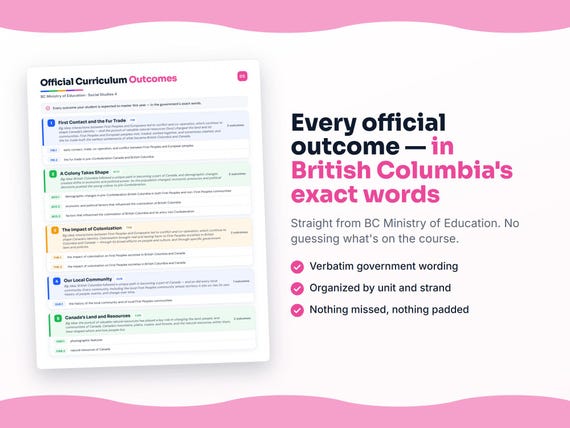
British Columbia defines Social Studies 4 by strands and outcomes. MapleMind teaches the same curriculum reorganized for one-skill-at-a-time tutoring — the table shows exactly where every official strand lands, and the ministry's own wording is quoted under each unit below.
Official source BC's official social studies curriculumRead it on the government site — curriculum.gov.bc.ca ↗| Official strand | Outcomes | Where MapleMind teaches it |
|---|---|---|
| Content | 10 | First Contact and the Fur Trade · A Colony Takes Shape · The Impact of Colonization · Our Local Community · Canada's Land and Resources |
Every skill below, taught one on one.
 Try the first session free
How MapleMind teaches Social Studies 4 — every unit, lesson, and skill
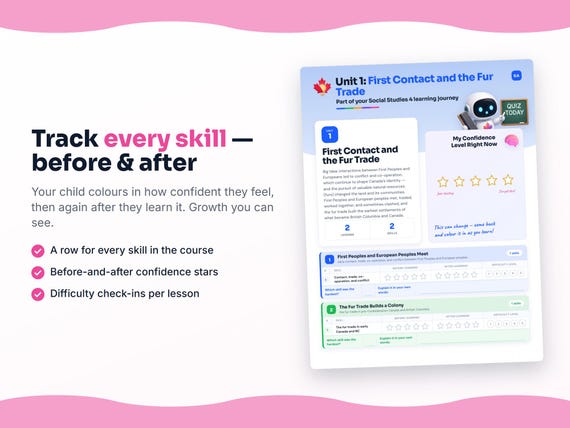
Every skill below runs as a short session: a plain-words lesson, a worked example, solving it together, then a five-question skill check that earns up to three stars. Guided Mode keeps it teaching instead of answer-handing — turning it off needs a parent's password.
Unit 1First Contact and the Fur TradeOfficial strand · Content
Big Idea: interactions between First Peoples and Europeans led to conflict and co-operation, which continue to shape Canada's identity — and the pursuit of valuable natural resources (furs) changed the land and its communities. First Peoples and European peoples met, traded, worked together, and sometimes clashed, and the fur trade built the earliest settlements of what became British Columbia and Canada.
First Peoples and European Peoples Meet
- Contact, trade, co-operation, and conflict4.CONTACT.1 — Explore how First Peoples and European peoples first met, traded useful goods with each other, sometimes worked together, and sometimes disagreed or fought — and why each side needed the other.
The Fur Trade Builds a Colony
- The fur trade in early Canada and BC4.FURTRADE.1 — Learn how the fur trade — especially in beaver pelts — connected First Peoples trappers and traders with European fur companies, and how trading posts and forts grew into the earliest non-Indigenous settlements in pre-Confederation Canada and British Columbia.
The official wording — 2 outcomes in this unit
- 4.CONTACT.1
early contact, trade, co-operation, and conflict between First Peoples and European peoples
- 4.FURTRADE.1
the fur trade in pre-Confederation Canada and British Columbia
Unit 2A Colony Takes ShapeOfficial strand · Content
Big Idea: British Columbia followed a unique path in becoming a part of Canada, and demographic changes created shifts in economic and political power. As the population changed, economic pressures and political decisions pushed the young colony to join Confederation.
A Changing Population
- How BC's population changed4.DEMOG.1 — Find out how disease, settlement, migration, and the relocation of First Peoples changed the number and mix of people living in pre-Confederation British Columbia, in both First Peoples and non-First Peoples communities.
Money, Furs, and Gold: The Economic Story
- Economic factors in BC's colonization4.CONFED.1 — Examine the economic forces that shaped colonial British Columbia — the fur trade, the gold rush population boom and bust, American settlement pressure, and the heavy colonial debt from building roads and forts.
Why BC Joined Confederation
- Political factors and BC's entry into Confederation4.CONFED.2 — Examine the political factors behind BC's decision to join Canada — the Oregon boundary dispute that set the BC-US border, the expansion and purchase of Rupert's Land, and the promise of a Canadian Pacific Railway — and how BC finally entered Confederation.
The official wording — 3 outcomes in this unit
- 4.DEMOG.1
demographic changes in pre-Confederation British Columbia in both First Peoples and non–First Peoples communities
- 4.CONFED.1
economic and political factors that influenced the colonization of British Columbia
- 4.CONFED.2
factors that influenced the colonization of British Columbia and its entry into Confederation
Unit 3The Impact of ColonizationOfficial strand · Content
Big Idea: interactions between First Peoples and Europeans led to conflict and co-operation, which continue to shape Canada's identity. Colonization brought real and lasting harm to First Peoples societies in British Columbia and Canada — through its broad effects on people and culture, and through specific government laws and policies.
How Colonization Changed First Peoples' Lives
- Broad impacts of colonization4.IMPACT.1 — Understand, honestly and age-appropriately, the broad impacts of colonization on First Peoples societies in British Columbia and Canada — disease and population loss, the loss of territory, and the impact on language and culture.
Laws That Harmed First Peoples
- Government laws and policies affecting First Peoples4.IMPACT.2 — Learn about the specific government laws and policies that directly harmed First Peoples — the Indian Act, the ban on the potlatch, the reserve system, residential schools, and treaties — and why these still matter today.
The official wording — 2 outcomes in this unit
- 4.IMPACT.1
the impact of colonization on First Peoples societies in British Columbia and Canada
- 4.IMPACT.2
the impact of colonization on First Peoples societies in British Columbia and Canada
Unit 4Our Local CommunityOfficial strand · Content
Big Idea: British Columbia followed a unique path in becoming a part of Canada — and so did every local community. Every community, including the local First Peoples community whose territory it sits on, has its own history of people, events, and change over time.
The Story of Our Community
- The history of our local community4.LOCAL.1 — Investigate the history of your own local community and of local First Peoples communities — using sources like local archives and museums to find out who lived there first, what changed over time, and what stayed the same.
The official wording — 1 outcome in this unit
- 4.LOCAL.1
the history of the local community and of local First Peoples communities
Unit 5Canada's Land and ResourcesOfficial strand · Content
Big Idea: the pursuit of valuable natural resources has played a key role in changing the land, people, and communities of Canada. Canada's mountains, plains, coasts, and forests, and the natural resources within them, have shaped where and how people live.
Canada's Landforms
- Canada's physiographic features4.LAND.1 — Identify major physiographic features of Canada — mountain ranges, plains, coastlines, and forest regions — and locate them on a map of the country.
Canada's Natural Resources
- Canada's natural resources4.LAND.2 — Identify natural resources found across Canada — such as forests, fish, minerals, and energy sources — and consider how they have shaped where and how people live and work.
The official wording — 2 outcomes in this unit
- 4.LAND.1
physiographic features
- 4.LAND.2
natural resources of Canada
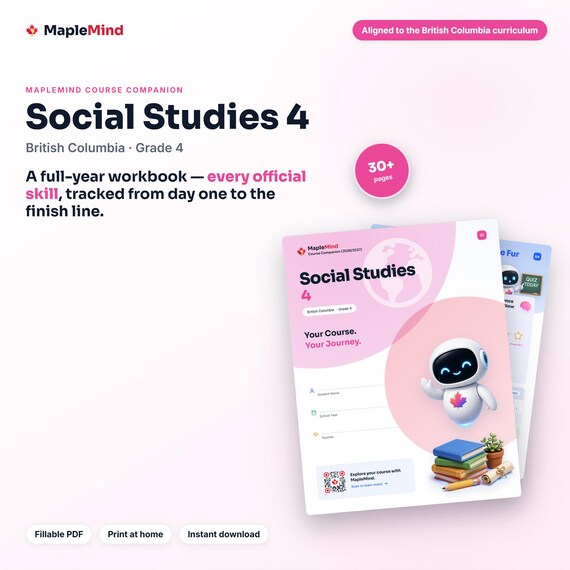
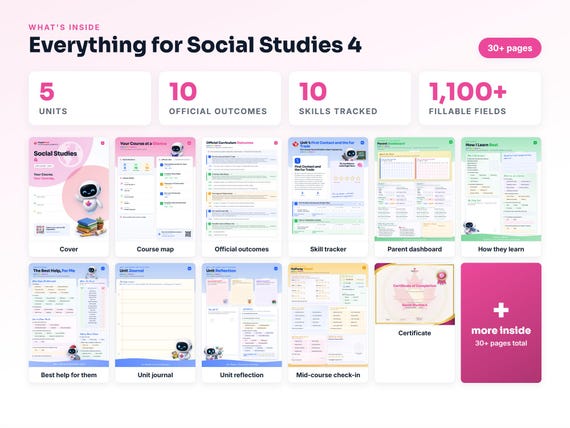
Printable workbook · A keepsake of the year
A Social Studies 4 workbook worth keeping
Built from the same official curriculum as this page. Before and after each skill above, your student colours in how sure they feel — so the two of you can see, on one page, what's clicking and what needs another look. It's a quiet way to follow how the year is really going.
By June it's full of their own handwriting: units worked through, confidence grown, a mid-year check-in, notes from parent-teacher night, and a certificate at the end. Less a worksheet, more a record of the year worth keeping on the shelf.
Instant download · see every page, reviews and the full description · five or more workbooks are $2.99 each
What it looks like in the app



Common questions
Can MapleMind help my child with Social Studies 4?
Yes. MapleMind's AI tutor covers all 10 skills in British Columbia's Social Studies 4 — your child picks the exact skill, and the tutor teaches it step by step: a short lesson, a worked example, solving together, then a skill check to show it stuck.
Is MapleMind aligned to British Columbia's official curriculum?
Yes. Every skill in this course maps to an official outcome code from British Columbia's Grade 4 Social Studies curriculum, and the ministry's own wording is quoted under each unit on this page — with the official government source linked so you can check it yourself.
What does MapleMind cost?
It's free to start — 5 tutoring chats and a practice quiz every day, no credit card. A Pro subscription ($9.99/month or $49.99/year CAD, 7-day free trial) unlocks unlimited tutoring, practice, and exam simulations.
What if my child is stuck on just one topic?
That's the point of skill-level tutoring: open Social Studies 4 in the app, tap the exact skill from the list on this page, and the tutor teaches just that — no wading through lessons your child doesn't need.
Does MapleMind work in French or other languages?
Yes — 14 languages, including French. Both the app and the tutor's explanations switch to the language your child chooses.
Where can I see the official British Columbia curriculum for Social Studies 4?
The official source is linked on this page — BC's official social studies curriculum. The outline here follows it: every MapleMind skill carries its official outcome code, and the ministry's own wording is quoted under each unit.
Keep exploring
Ready when you are
Pick a skill from this page and see it taught properly — free, in the browser, in under a minute.