Get help with Social Studies 5
Most tutoring makes your child sit through material your child already knows. MapleMind flips that: pick the exact skill that's causing trouble — any of the 11 below — and the tutor teaches just that one, step by step, as many times as it takes. Ask questions in plain words, any time of day, in English, French, or 12 other languages.
The official British Columbia Social Studies 5 curriculum
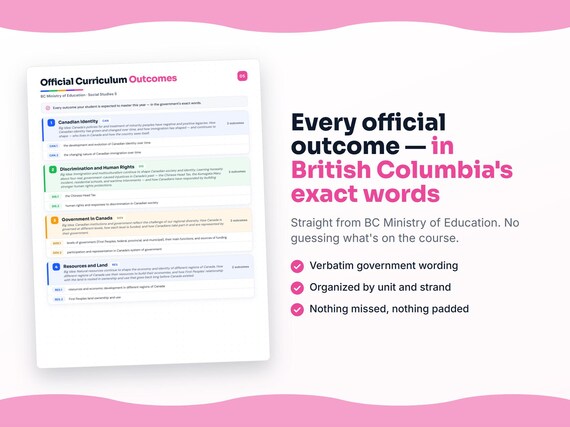
British Columbia defines Social Studies 5 by strands and outcomes. MapleMind teaches the same curriculum reorganized for one-skill-at-a-time tutoring — the table shows exactly where every official strand lands, and the ministry's own wording is quoted under each unit below.
Official source BC's official social studies curriculumRead it on the government site — curriculum.gov.bc.ca ↗| Official strand | Outcomes | Where MapleMind teaches it |
|---|---|---|
| Content | 11 | Canadian Identity · Discrimination and Human Rights · Government in Canada · Resources and Land |
Every skill below, taught one on one.
 Try the first session free
How MapleMind teaches Social Studies 5 — every unit, lesson, and skill
Every skill below runs as a short session: a plain-words lesson, a worked example, solving it together, then a five-question skill check that earns up to three stars. Guided Mode keeps it teaching instead of answer-handing — turning it off needs a parent's password.
Unit 1Canadian IdentityOfficial strand · Content
Big Idea: Canada's policies for and treatment of minority peoples have negative and positive legacies. How Canadian identity has grown and changed over time, and how immigration has shaped — and continues to shape — who lives in Canada and how the country sees itself.
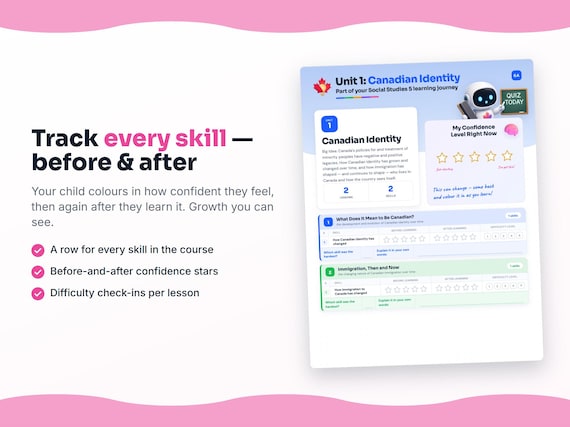
What Does It Mean to Be Canadian?
- How Canadian identity has changed5.IDEN.1 — Explain how the idea of "being Canadian" has developed and changed over time, shaped by First Peoples, settlers, immigrants, symbols, and events.
Immigration, Then and Now
- How immigration to Canada has changed5.IMM.1 — Describe how immigration to Canada has changed over time — who came, why, from where, and how policies about who was welcomed have shifted.
The official wording — 2 outcomes in this unit
- 5.IDEN.1
the development and evolution of Canadian identity over time
- 5.IMM.1
the changing nature of Canadian immigration over time
Unit 2Discrimination and Human RightsOfficial strand · Content
Big Idea: Immigration and multiculturalism continue to shape Canadian society and identity. Learning honestly about four real, government-caused injustices in Canada's past — the Chinese Head Tax, the Komagata Maru incident, residential schools, and wartime internments — and how Canadians have responded by building stronger human rights protections.
Unfair Government Policies in Canada's Past
- The Chinese Head Tax5.INJ.1 — Explain what the Chinese Head Tax was — a fee the government charged only to Chinese immigrants — why it was unfair, and its impact on the families affected.
- The Komagata Maru Incident5.INJ.2 — Describe the Komagata Maru incident — the 1914 ship of South Asian passengers turned away from Canada — and explain what it shows about discriminatory immigration rules of the time.
- Residential Schools5.INJ.3 — Explain what residential schools were — government schools that forcibly removed First Peoples children from their families and communities — and their lasting effects, in honest, age-appropriate terms.
- Wartime Internments5.INJ.4 — Describe how the government interned Japanese Canadians during World War II and German and Ukrainian Canadians during World War I — locking people up because of their background — and why historians now agree it was not justified.
Human Rights and Standing Up to Discrimination
- Human rights and responses to discrimination5.HRR.1 — Explain what human rights are and describe how Canadian society has responded to discrimination — through apologies, laws, and human rights protections.
The official wording — 5 outcomes in this unit
- 5.INJ.1
the Chinese Head Tax
- 5.INJ.2
the Komagata Maru incident
- 5.INJ.3
residential schools
- 5.INJ.4
and internments
- 5.HRR.1
human rights and responses to discrimination in Canadian society
Unit 3Government in CanadaOfficial strand · Content
Big Idea: Canadian institutions and government reflect the challenge of our regional diversity. How Canada is governed at different levels, how each level is funded, and how Canadians take part in and are represented by their government.
Levels of Government
- First Peoples, federal, provincial, and municipal government5.GOV.1 — Identify the levels of government in Canada — First Peoples, federal, provincial, and municipal — and describe their main functions and where their funding comes from.
Taking Part in Government
- How Canadians participate in and are represented by government5.PRC.1 — Describe how Canadians take part in the system of government — such as voting and contacting representatives — and how elected representatives stand for the people in their riding or community.
The official wording — 2 outcomes in this unit
- 5.GOV.1
levels of government (First Peoples, federal, provincial, and municipal), their main functions, and sources of funding
- 5.PRC.1
participation and representation in Canada’s system of government
Unit 4Resources and LandOfficial strand · Content
Big Idea: Natural resources continue to shape the economy and identity of different regions of Canada. How different regions of Canada use their resources to build their economies, and how First Peoples' relationship with the land is rooted in ownership and use that goes back long before Canada existed.
Resources and Economic Development
- Resources and economic development by region5.RED.1 — Describe the natural resources found in different regions of Canada and explain how those resources support economic development in each region.
First Peoples and the Land
- First Peoples land ownership and use5.FPL.1 — Explain First Peoples' ownership of and use of land, including how it differs from other forms of land ownership and why it matters in Canada today.
The official wording — 2 outcomes in this unit
- 5.RED.1
resources and economic development in different regions of Canada
- 5.FPL.1
First Peoples land ownership and use
Printable workbook · A keepsake of the year
A Social Studies 5 workbook worth keeping
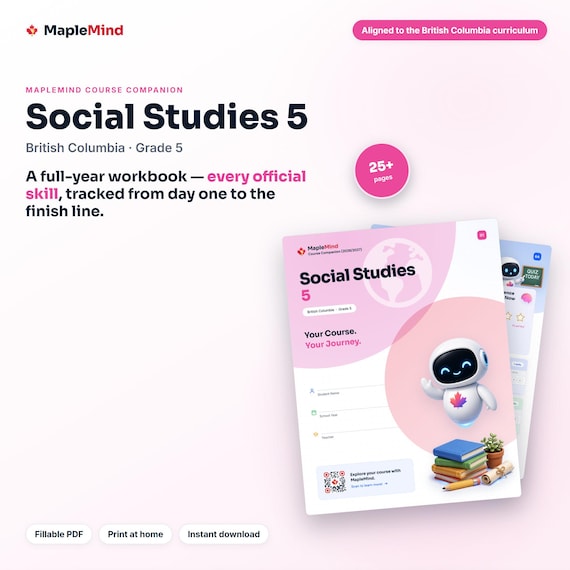
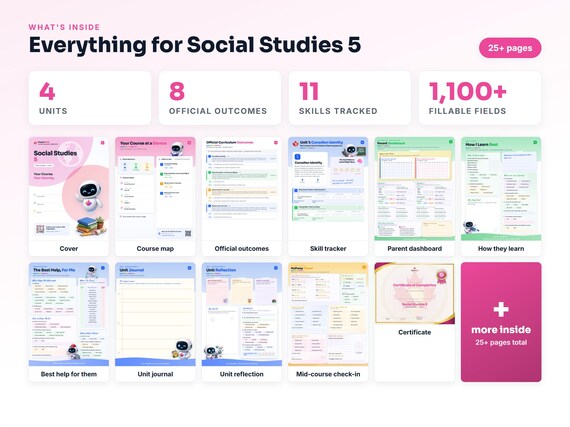
Built from the same official curriculum as this page. Before and after each skill above, your student colours in how sure they feel — so the two of you can see, on one page, what's clicking and what needs another look. It's a quiet way to follow how the year is really going.
By June it's full of their own handwriting: units worked through, confidence grown, a mid-year check-in, notes from parent-teacher night, and a certificate at the end. Less a worksheet, more a record of the year worth keeping on the shelf.
Instant download · see every page, reviews and the full description · five or more workbooks are $2.99 each
What it looks like in the app



Common questions
Can MapleMind help my child with Social Studies 5?
Yes. MapleMind's AI tutor covers all 11 skills in British Columbia's Social Studies 5 — your child picks the exact skill, and the tutor teaches it step by step: a short lesson, a worked example, solving together, then a skill check to show it stuck.
Is MapleMind aligned to British Columbia's official curriculum?
Yes. Every skill in this course maps to an official outcome code from British Columbia's Grade 5 Social Studies curriculum, and the ministry's own wording is quoted under each unit on this page — with the official government source linked so you can check it yourself.
What does MapleMind cost?
It's free to start — 5 tutoring chats and a practice quiz every day, no credit card. A Pro subscription ($9.99/month or $49.99/year CAD, 7-day free trial) unlocks unlimited tutoring, practice, and exam simulations.
What if my child is stuck on just one topic?
That's the point of skill-level tutoring: open Social Studies 5 in the app, tap the exact skill from the list on this page, and the tutor teaches just that — no wading through lessons your child doesn't need.
Does MapleMind work in French or other languages?
Yes — 14 languages, including French. Both the app and the tutor's explanations switch to the language your child chooses.
Where can I see the official British Columbia curriculum for Social Studies 5?
The official source is linked on this page — BC's official social studies curriculum. The outline here follows it: every MapleMind skill carries its official outcome code, and the ministry's own wording is quoted under each unit.
Keep exploring
Ready when you are
Pick a skill from this page and see it taught properly — free, in the browser, in under a minute.