Get help with Social Studies 6
Most tutoring makes your child sit through material your child already knows. MapleMind flips that: pick the exact skill that's causing trouble — any of the 13 below — and the tutor teaches just that one, step by step, as many times as it takes. Ask questions in plain words, any time of day, in English, French, or 12 other languages.
The official British Columbia Social Studies 6 curriculum
British Columbia defines Social Studies 6 by strands and outcomes. MapleMind teaches the same curriculum reorganized for one-skill-at-a-time tutoring — the table shows exactly where every official strand lands, and the ministry's own wording is quoted under each unit below.
Official source BC's official social studies curriculumRead it on the government site — curriculum.gov.bc.ca ↗| Official strand | Outcomes | Where MapleMind teaches it |
|---|---|---|
| Content | 13 | People on the Move · Who Makes the Decisions · A Connected World Economy · Conflict and the Media |
Every skill below, taught one on one.
 Try the first session free
How MapleMind teaches Social Studies 6 — every unit, lesson, and skill
Every skill below runs as a short session: a plain-words lesson, a worked example, solving it together, then a five-question skill check that earns up to three stars. Guided Mode keeps it teaching instead of answer-handing — turning it off needs a parent's password.
Unit 1People on the MoveOfficial strand · Content
Big Idea: complex global problems require international co-operation and difficult choices for the future. Looking at where and how people live — why cities are growing, why people migrate, and how poverty and inequality (through both class and gender) show up differently across the world.
Cities Growing, People Moving
- Why cities grow and people migrate6.UMP.1 — Explore why more and more people around the world are moving into cities (urbanization), and why people migrate from one place to another — for jobs, safety, family, or opportunity.
Poverty and the Gap Between Rich and Poor
- Poverty and class structure6.GPI.1 — Examine global poverty and how class structure — the gap between rich and poor, including caste and class systems and the unequal distribution of wealth — shapes the opportunities people have.
Gender Inequality Around the World
- Gender inequality6.GPI.2 — Examine gender inequality — how people are treated differently, and often unfairly, based on gender — including women’s rights and unequal access to education, work, and opportunity around the world.
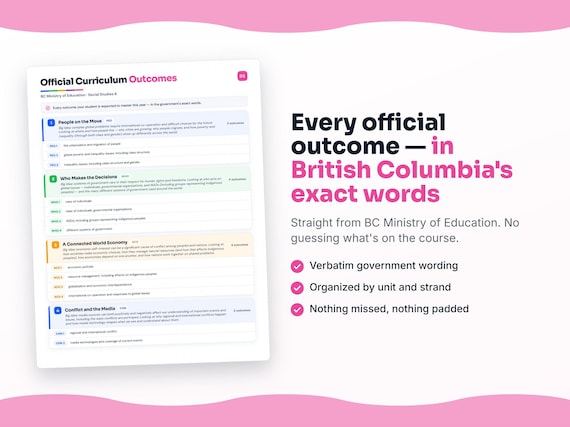
The official wording — 3 outcomes in this unit
- 6.UMP.1
the urbanization and migration of people
- 6.GPI.1
global poverty and inequality issues, including class structure
- 6.GPI.2
inequality issues, including class structure and gender
Unit 2Who Makes the DecisionsOfficial strand · Content
Big Idea: systems of government vary in their respect for human rights and freedoms. Looking at who acts on global issues — individuals, governmental organizations, and NGOs (including groups representing Indigenous peoples) — and the many different systems of government used around the world.
What One Person Can Do
- The role of individuals and activists6.RIG.1 — Find out how individuals — activists and lobby groups — draw attention to global issues and push for change, and why the actions of one determined person can matter.
Organizations Made of Governments
- Governmental organizations6.RIG.2 — Explore governmental organizations made up of countries — the United Nations, the International Criminal Court, and the World Trade Organization — and how they make and enforce rules between nations.
NGOs and Groups Representing Indigenous Peoples
- NGOs and groups representing Indigenous peoples6.RIG.3 — Find out how NGOs (non-governmental organizations) — international aid groups, private foundations, and lobby groups — and groups representing Indigenous peoples take action on global issues without being run by any government.
Different Ways to Run a Country
- Comparing systems of government6.DSG.1 — Compare different systems of government used by countries around the world and how each one makes decisions for its citizens.
The official wording — 4 outcomes in this unit
- 6.RIG.1
roles of individuals
- 6.RIG.2
roles of individuals, governmental organizations
- 6.RIG.3
NGOs, including groups representing indigenous peoples
- 6.DSG.1
different systems of government
Unit 3A Connected World EconomyOfficial strand · Content
Big Idea: economic self-interest can be a significant cause of conflict among peoples and nations. Looking at how societies make economic choices, how they manage natural resources (and how that affects Indigenous peoples), how economies depend on one another, and how nations work together on shared problems.
How Societies Make Economic Choices
- Economic policies6.EPR.1 — Investigate economic policies — the choices societies make about their economy, who those choices benefit or cost, and how such decisions should be made.
Managing Resources — and Who It Affects
- Resource management and effects on Indigenous peoples6.EPR.2 — Investigate how countries manage natural resources — deforestation, mining, oil and gas, fisheries, infrastructure — the balance with protecting the environment, and the serious effects these decisions have on Indigenous peoples.
A World of Connected Economies
- Globalization and economic interdependence6.GEI.1 — Understand globalization — how countries, businesses, and people around the world are connected — and how economies depend on one another (economic interdependence).
Working Together on Global Issues
- International co-operation6.ICO.1 — Explore how countries and organizations co-operate internationally to respond to shared global issues, like disasters, disease, or environmental problems.
The official wording — 4 outcomes in this unit
- 6.EPR.1
economic policies
- 6.EPR.2
resource management, including effects on indigenous peoples
- 6.GEI.1
globalization and economic interdependence
- 6.ICO.1
international co-operation and responses to global issues
Unit 4Conflict and the MediaOfficial strand · Content
Big Idea: media sources can both positively and negatively affect our understanding of important events and issues, including the ways conflicts are portrayed. Looking at why regional and international conflicts happen and how media technology shapes what we see and understand about them.
Why Conflicts Happen
- Regional and international conflict6.RIC.1 — Examine causes of regional and international conflict, such as competition over resources, land, power, or beliefs, and their effects on people.
Media and Current Events
- How media technologies cover current events6.MTC.1 — Explore how media technologies shape the way current events are covered and shared, and how this can affect what people believe about global issues.
The official wording — 2 outcomes in this unit
- 6.RIC.1
regional and international conflict
- 6.MTC.1
media technologies and coverage of current events
Printable workbook · A keepsake of the year
A Social Studies 6 workbook worth keeping
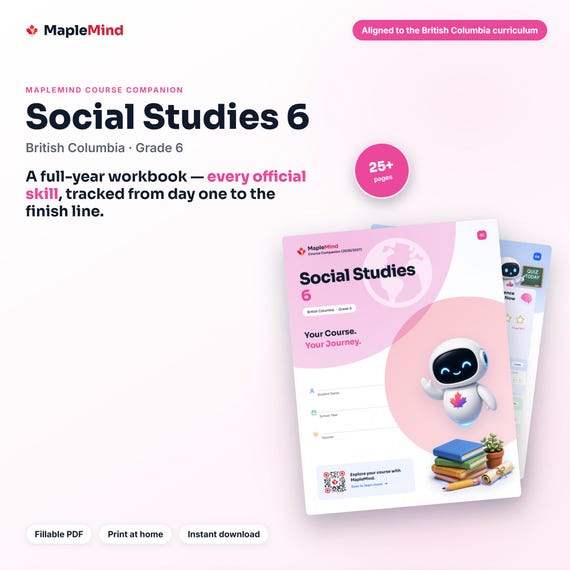
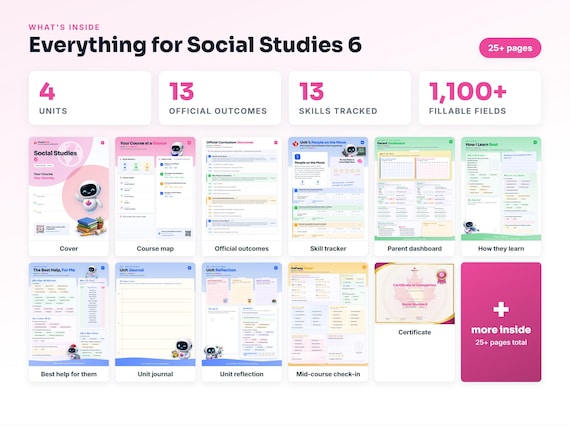
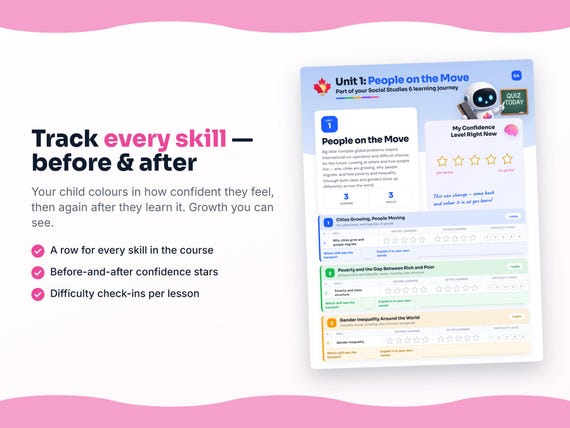
Built from the same official curriculum as this page. Before and after each skill above, your student colours in how sure they feel — so the two of you can see, on one page, what's clicking and what needs another look. It's a quiet way to follow how the year is really going.
By June it's full of their own handwriting: units worked through, confidence grown, a mid-year check-in, notes from parent-teacher night, and a certificate at the end. Less a worksheet, more a record of the year worth keeping on the shelf.
Instant download · see every page, reviews and the full description · five or more workbooks are $2.99 each
What it looks like in the app



Common questions
Can MapleMind help my child with Social Studies 6?
Yes. MapleMind's AI tutor covers all 13 skills in British Columbia's Social Studies 6 — your child picks the exact skill, and the tutor teaches it step by step: a short lesson, a worked example, solving together, then a skill check to show it stuck.
Is MapleMind aligned to British Columbia's official curriculum?
Yes. Every skill in this course maps to an official outcome code from British Columbia's Grade 6 Social Studies curriculum, and the ministry's own wording is quoted under each unit on this page — with the official government source linked so you can check it yourself.
What does MapleMind cost?
It's free to start — 5 tutoring chats and a practice quiz every day, no credit card. A Pro subscription ($9.99/month or $49.99/year CAD, 7-day free trial) unlocks unlimited tutoring, practice, and exam simulations.
What if my child is stuck on just one topic?
That's the point of skill-level tutoring: open Social Studies 6 in the app, tap the exact skill from the list on this page, and the tutor teaches just that — no wading through lessons your child doesn't need.
Does MapleMind work in French or other languages?
Yes — 14 languages, including French. Both the app and the tutor's explanations switch to the language your child chooses.
Where can I see the official British Columbia curriculum for Social Studies 6?
The official source is linked on this page — BC's official social studies curriculum. The outline here follows it: every MapleMind skill carries its official outcome code, and the ministry's own wording is quoted under each unit.
Keep exploring
Ready when you are
Pick a skill from this page and see it taught properly — free, in the browser, in under a minute.