Ministerial exam · Quebec
French as a Second Language, Core Program, Secondary V
Ministerial Examinations — French as a Second Language, Core Program, Secondary V: oral interaction (634‑510), reading comprehension (634‑520) and written production (634‑530)
- Grade 11
- 634-504
- Written in French
Dates and details can change. We do our best to keep this page up to date, but check the official sources before relying on it.
- Total time
- 5 h 15 min
- Marked questions
- 23
- Parts
- 3
- Counts for
- 50% of the final mark
- Calculator
- Not allowed
- Format
- On paper
Secondary 5 French Ministry Exam practice test
The whole exam or the parts you choose, in its own format, on the clock.
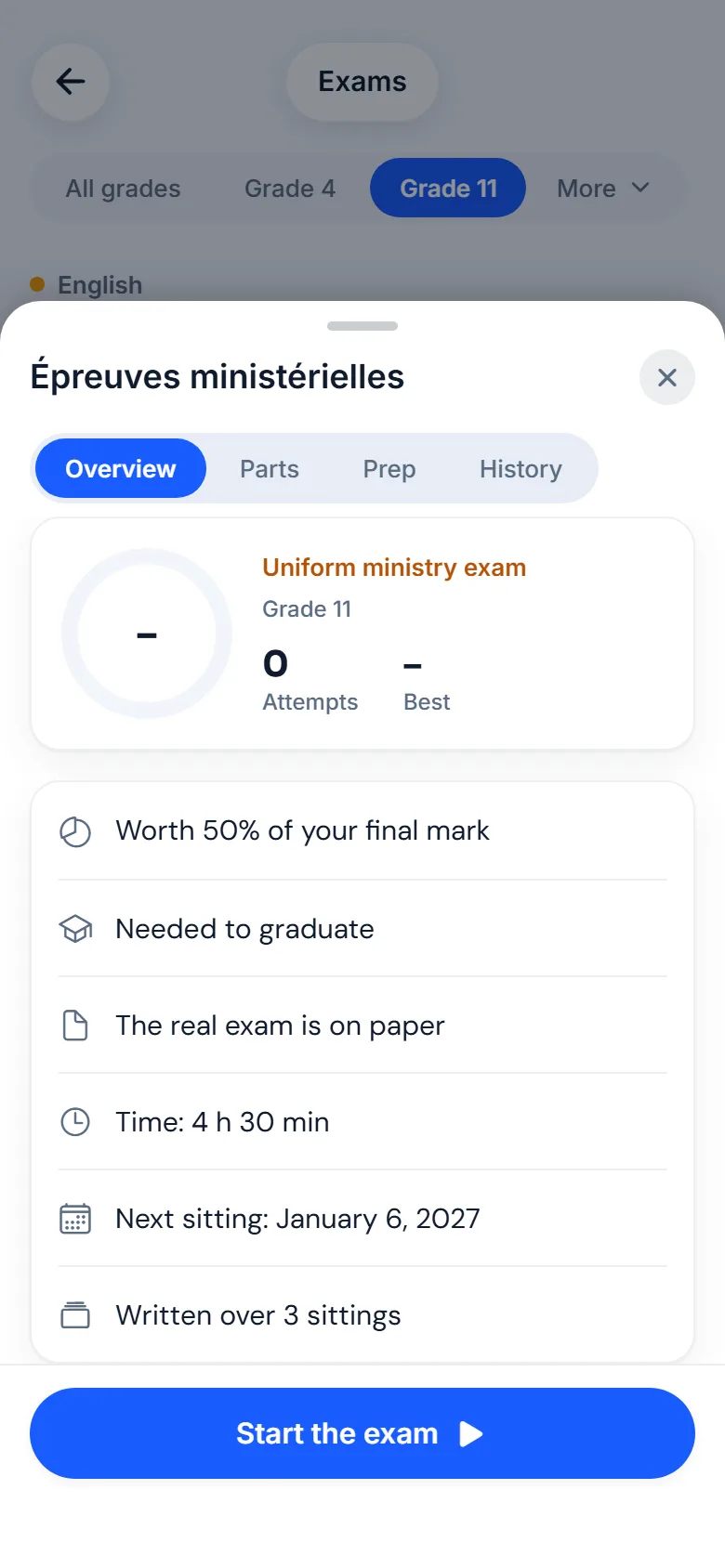 The exam in the app
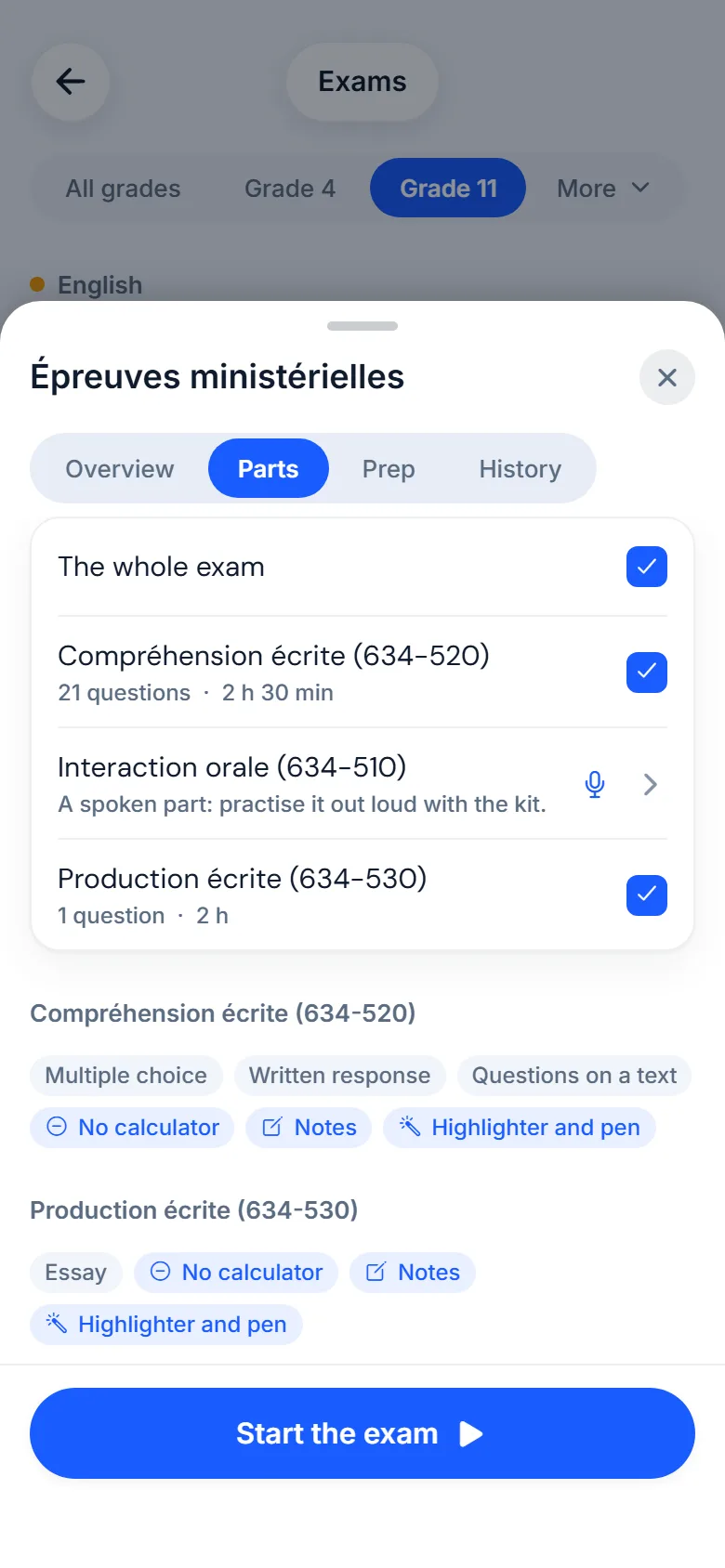 Its parts, and what you can use in each
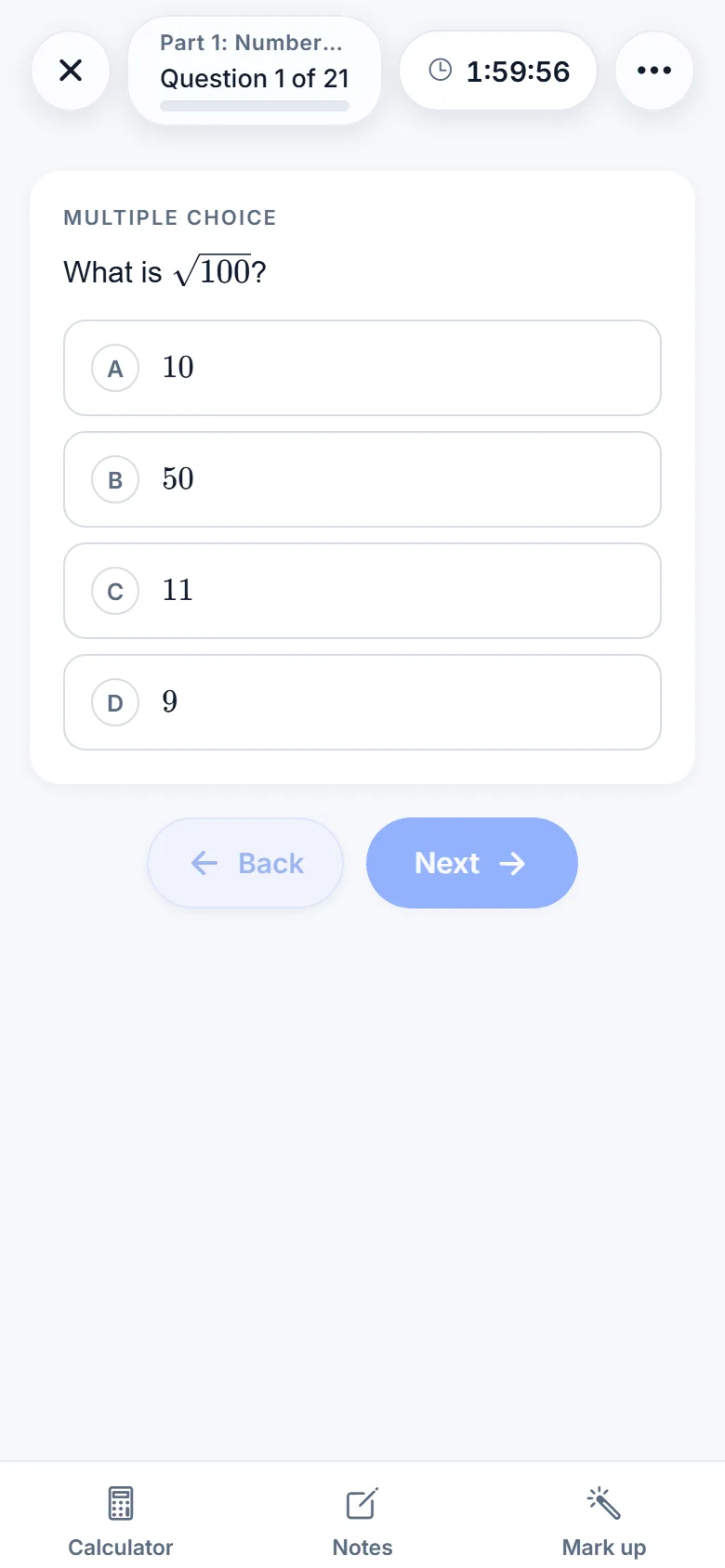 A question, timed, with the exam’s tools
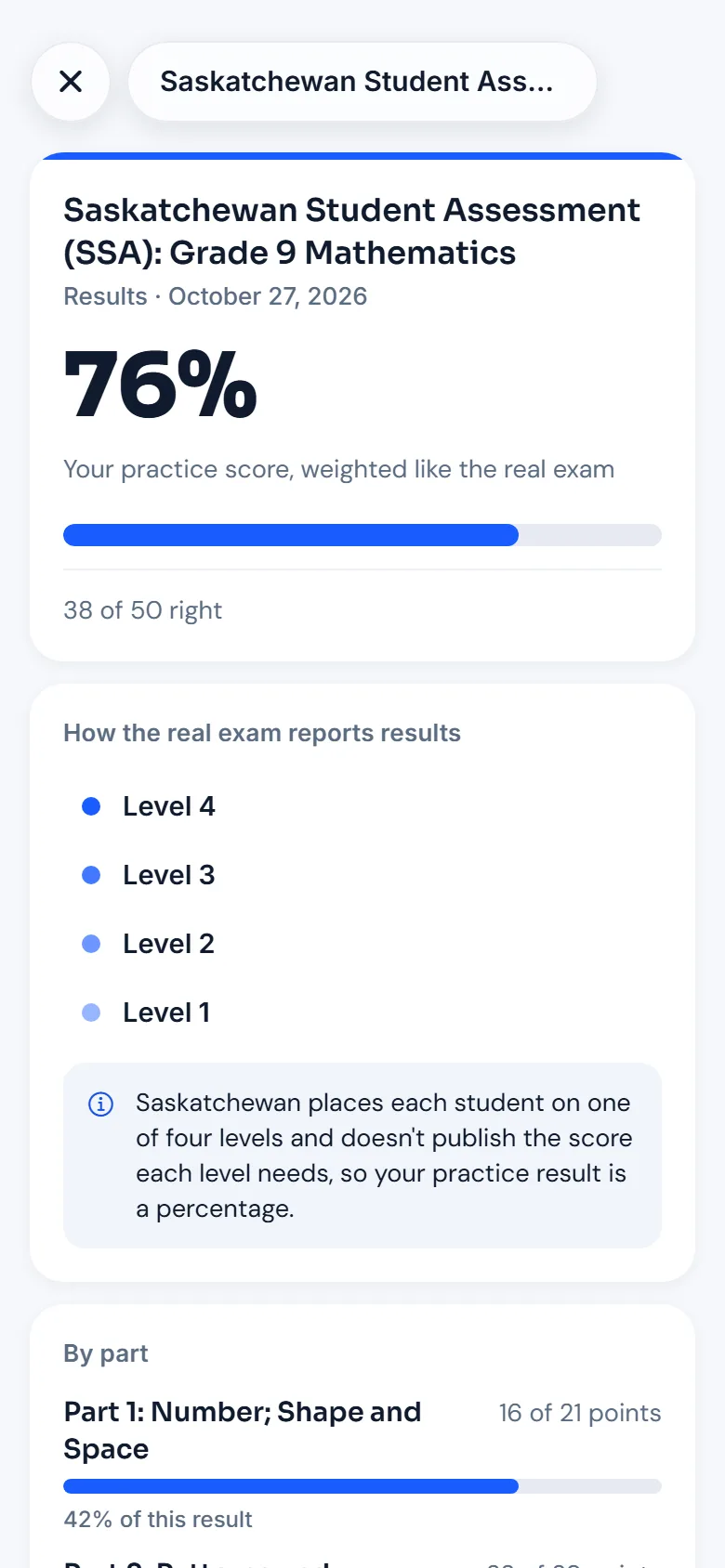 The marked result, part by part
A practice run of Saskatchewan’s Grade 9 math assessment.
Free with a MapleMind account
When
3 sessions this school year: January, June and August.
January 2027 session
- Wednesday, January 6, 2027Set by the school · Remise du document Modalités d'évaluation (634‑510, 634‑520 et 634‑530)
- Monday, January 11, 20279:00 a.m.-12:00 p.m. · Activité préparatoire et compréhension écrite (634‑520)
- January 11 to January 19, 2027From the afternoon of January 11; set by the school · Activité préparatoire et interaction orale (634‑510), before 634‑530
- Tuesday, January 19, 20279:30 a.m.-11:30 a.m. · Production écrite (634‑530)
Later sessions · 2
June 2027 session
- May 10 to May 14, 2027Set by the school · Remise du document Modalités d'évaluation (634‑510, 634‑520 et 634‑530)
- Wednesday, May 19, 20279:00 a.m.-12:00 p.m. · Activité préparatoire et compréhension écrite (634‑520)
- May 20 to June 8, 2027Set by the school · Activité préparatoire et interaction orale (634‑510), before 634‑530
- Tuesday, June 8, 20279:30 a.m.-11:30 a.m. · Production écrite (634‑530)
August 2027 session
- Wednesday, July 21, 2027Set by the school · Remise du document Modalités d'évaluation (634‑510, 634‑520 et 634‑530)
- Monday, July 26, 20279:00 a.m.-12:00 p.m. · Activité préparatoire et compréhension écrite (634‑520)
- July 26 to July 30, 2027From the afternoon of July 26; set by the school · Activité préparatoire et interaction orale (634‑510), before 634‑530
- Friday, July 30, 20279:30 a.m.-11:30 a.m. · Production écrite (634‑530)
The dates are Quebec’s own, read on September 28, 2026. See the official schedule (quebec.ca)
What’s on it
- Interagir en français: the team discussion634‑510
- Lire des textes variés en français: reading comprehension634‑520
- Produire des textes variés en français: a text of about 225 words urging action634‑530
Its own result: 50% of the competency's final mark (2025-26)
The skills it tests · 33 skills
- Use: Adapter ses réalisations langagières à son intention de communication et aux autres éléments de la situation de communication (ex. : à partir de la même intention d’informer, la description d’un phénomène scientifique varie selon que le destinataire est un spécialiste du domaine ou non) (2/2)
- Use: argumenter (ex. : lettre d’opinion, débat)
- Use: Avec de l’aide, établir les critères de réussite associés à la tâche (2/2)
- Use: Choisir l’auxiliaire approprié, être ou avoir, dans les temps composés (ex. : l’auxiliaire être est utilisé avec des verbes dénotant un changement d’état tels naître ou mourir ou de déplacement tels partir, venir) (2/2)
- Use: Comprendre le vocabulaire spécialisé associé au sujet abordé (ex. : un greffier, un juge, une avocate pour parler de métiers et professions dans le domaine juridique) (1/2)
- Use: Comprendre le vocabulaire utilisé dans une variété de textes entendus, lus ou vus (2/2)
- Use: Décrire brièvement la contribution de personnalités publiques marquantes à la culture et à la société québécoises (ex. : la nationalisation de l’électricité par René Lévesque)
- Use: Dégager ou décrire les sentiments, les idées, les valeurs ou les éléments culturels explicitement ou implicitement véhiculés ou à véhiculer (1/2)
- Use: des archaïsmes (ex. : ouïr, peignure)
- Use: des locutions (ex. : de temps en temps, avoir faim, à la différence de)
- Use: Discuter de l’efficacité du message transmis, du support choisi et du registre de langue utilisé (1/2)
- Use: elle est obligatoire devant certains coordonnants (ex. : Il a mangé un fruit, car il fait attention à son alimentation.) (1/2)
- Use: Explorer et apprécier des œuvres théâtrales et cinématographiques d’expression française (ex. : Les voisins de Louis Saïa, Bon cop, bad cop d’Erik Canuel, Le grand bleu de Luc Besson) (2/2)
- Use: Explorer et apprécier la littérature classique ou contemporaine en langue française (ex. : les nouvelles de Guy de Maupassant, les romans de Dominique Demers, les pièces de théâtre de Michel Tremblay) (1/2)
- Use: Faire un résumé pour démontrer sa compréhension des propos entendus et des textes lus
- Use: la métaphore (ex. : l’or noir, être sur la corde raide)
- Use: la polysémie (ex. : donner un coup de pied, recevoir un coup de téléphone, faire un bon coup)
- Use: le participe présent pour désigner l’aspect accompli ou en cours d’accomplissement (2/2)
- Use: les hésitations et l’utilisation de mots de remplissage
- Use: les parties d’une séquence textuelle (ex. : les aspects du sujet dans une séquence descriptive)
- Use: Mener sa tâche à terme en régulant sa démarche (2/2)
- Use: Placer l’accent tonique de façon appropriée ou l’accent d’insistance selon l’intention
- Use: Produire un texte à séquence dominante argumentative
- Use: Produire un texte en s’assurant qu’aucune partie du texte n’en contredit une autre et que les temps verbaux utilisés sont conformes aux indices de temps
- Use: pronom de reprise (ex. : il renvoie à un objet ou à une situation évoquée dans le texte) (1/2)
- Use: Reconnaître les principales intentions de communication : exprimer, informer ou s’informer, inciter à agir ou à réagir, se divertir ou amuser, évaluer (1/2)
- Use: Recourir à des opérations syntaxiques pour clarifier le message, réorganiser les idées, enrichir, préciser ou nuancer sa pensée, ainsi que pour créer ou comprendre des effets de style
- Use: Recourir à des techniques variées pour gérer son stress (ex. : prendre de grandes respirations, écouter une musique relaxante)
- Use: une phrase subordonnée complétive
- Use: utilisation du conditionnel présent pour marquer la postériorité (ex. : Martine a composé une nouvelle chanson. Elle a dit qu’elle la mettrait en ligne bientôt.) (2/2)
- Use: Utiliser le discours indirect pour rapporter des paroles d’autres énonciateurs
- Use: Utiliser le registre de langue approprié à l’intention de communication et à d’autres éléments de la situation de communication
- Use: Utiliser les temps de verbes appropriés dans une séquence descriptive au présent (1/2)
How it’s built
Multiple-choice questions, written answers, questions in sets, a task and an essay.
- Compréhension écrite (634‑520)
- Time
- 150 min
- Questions
- 21
- Marks
- 44
- Of the marks
- 30%
- Multiple choice
- Written answers
- Questions in sets
Read the collection of texts on your own and answer every question: multiple choice with three choices, matching, short answers in French, and one long answer reacting to a text.
- Interaction orale (634‑510)
- Time
- 15 min
- Question
- 1
- Marks
- 100
- Of the marks
- 40%
- A task
In a team of 3 to 5, discuss an aspect of the theme in French for 12 to 15 minutes, with the examiner present.
- Production écrite (634‑530)
- Time
- 120 min
- Question
- 1
- Marks
- 100
- Of the marks
- 30%
- Essay
Write, on your own, a text in French of about 225 words that urges the reader to act, on a topic tied to the theme. Plan it in the organizer, draft, revise and correct, then write the final version.
How it’s marked
The ministry marks the June multiple choice, and your school marks the rest. Each result counts for 50% of your final result in that skill; you need 60% to pass the course.
On the day
- Day 1, morningA 30-minute team discussion in French on the theme, then the reading exam, in two and a half hours.
- Then, a day your school setsA preparation activity in teams, then the oral: 12 to 15 minutes of discussion in French, in a team of 3 to 5.
- Writing dayA text of about 225 words that urges the reader to act, in 2 hours.
Three exams in a set order. A 30-minute team discussion before the reading is required: without it, you can't take the reading exam. No one more than 10 minutes late gets in. A phone or other device gets you 0%.
Getting ready
2 official documents to practise with, and 4 tips.
Official practice
Tips from the people who write it
- Write short answers in French, complete and clear: copying a whole passage scores 0.
- For the long answer, use two pieces of information from the text, each linked to your own interests, skills or personality.
- In the writing, urge the reader to act, in about 225 words.
- For the writing, you may use dictionaries, a grammar and a conjugation book, but no notes of your own.
The mark you need
Your class mark counts for 50% of the final mark, the exam for 50%. Quebec may moderate your class mark before it’s blended.
You need
65% on the exam
With 75% in class, your final mark lands between 37.5% (0 on the exam) and 87.5% (100% on it).
After the exam
- Results
After marking, the Ministry mails you your achievement record, and the results are on your Online Academic Record. Your school mark may be moderated: moved up or down by comparing your group’s school marks with its exam results. If your exam mark is higher than your moderated school mark, only the exam mark counts.
- Re-marking
You can ask for a review within six months of receiving your achievement record, through the person in charge of exams at your school, for a fee. A lower result never replaces your original mark.
- Writing it again
If you fail, or want a better mark, your school may let you retake it at the January, June or August session; you show you’ve worked on it first. Your final mark uses your best result.
- If you miss it
Without a valid reason, ABS goes on your record and you can write at another session. Valid reasons: a serious illness or accident with a medical note, the death of a close relative, a court summons, or an important event approved in advance. Then you write at a later date, or, if that’s impossible, your moderated school mark can stand in (only if it’s a pass and you attended at least 120 class days; never for the August session).
From Final results in Secondary IV and V (Quebec) (quebec.ca) and Administrative Guide for the Certification of Studies and Management of Ministerial Examinations (the edition Quebec links today) (cdn-contenu.quebec.ca), read on October 27, 2026.
More for you
Students
Read what’s on it, then write full practice exams under the real time limit.
Practise itParents
Put the dates on the family calendar. The Parent Dashboard shows each practice exam’s result and the skills that need another look.
See the Parent DashboardEducators
The official practice above makes a review plan. Students can practise each skill on its own in MapleMind, free with daily limits.
For schools
Questions about this exam
When is the French as a Second Language, Core Program, Secondary V in 2026–27?
The next sitting is January 6, 2027, Set by the school. This school year it’s written in January 2027 session, June 2027 session and August 2027 session.
How long is the French as a Second Language, Core Program, Secondary V?
It takes 5 hours 15 minutes in all, over 3 parts.
How many questions are on the French as a Second Language, Core Program, Secondary V?
It has 23 marked questions: 21 in Compréhension écrite (634-520), 1 in Interaction orale (634-510) and 1 in Production écrite (634-530).
Can you use a calculator on the French as a Second Language, Core Program, Secondary V?
No. Calculators aren’t allowed.
How much does the French as a Second Language, Core Program, Secondary V count?
It’s worth 50% of the final mark in Français, langue seconde (Core), Secondary 5.
Where can I find practice tests for the French as a Second Language, Core Program, Secondary V?
Quebec publishes Guide for Parents (December 2025): sample texts and questions. MapleMind also builds a full practice exam in its format, free with an account.

Practise for the French as a Second Language, Core Program, Secondary V
Every skill on the French as a Second Language, Core Program, Secondary V, taught one at a time, then practised on questions written like the real ones.


