Ministerial exam · Quebec
English Language Arts, Secondary V
Ministerial Examination — English Language Arts, Secondary V: Reading (612‑520) and Production (612‑530)
- Grade 11
- 612-536
Dates and details can change. We do our best to keep this page up to date, but check the official sources before relying on it.
- Total time
- 6 h
- Marked questions
- 2
- Marked parts
- 2
- Counts for
- 50% of the final mark
- Calculator
- Not allowed
- Format
- On paper
Secondary 5 English Ministry Exam practice test
The whole exam or the parts you choose, in its own format, on the clock.
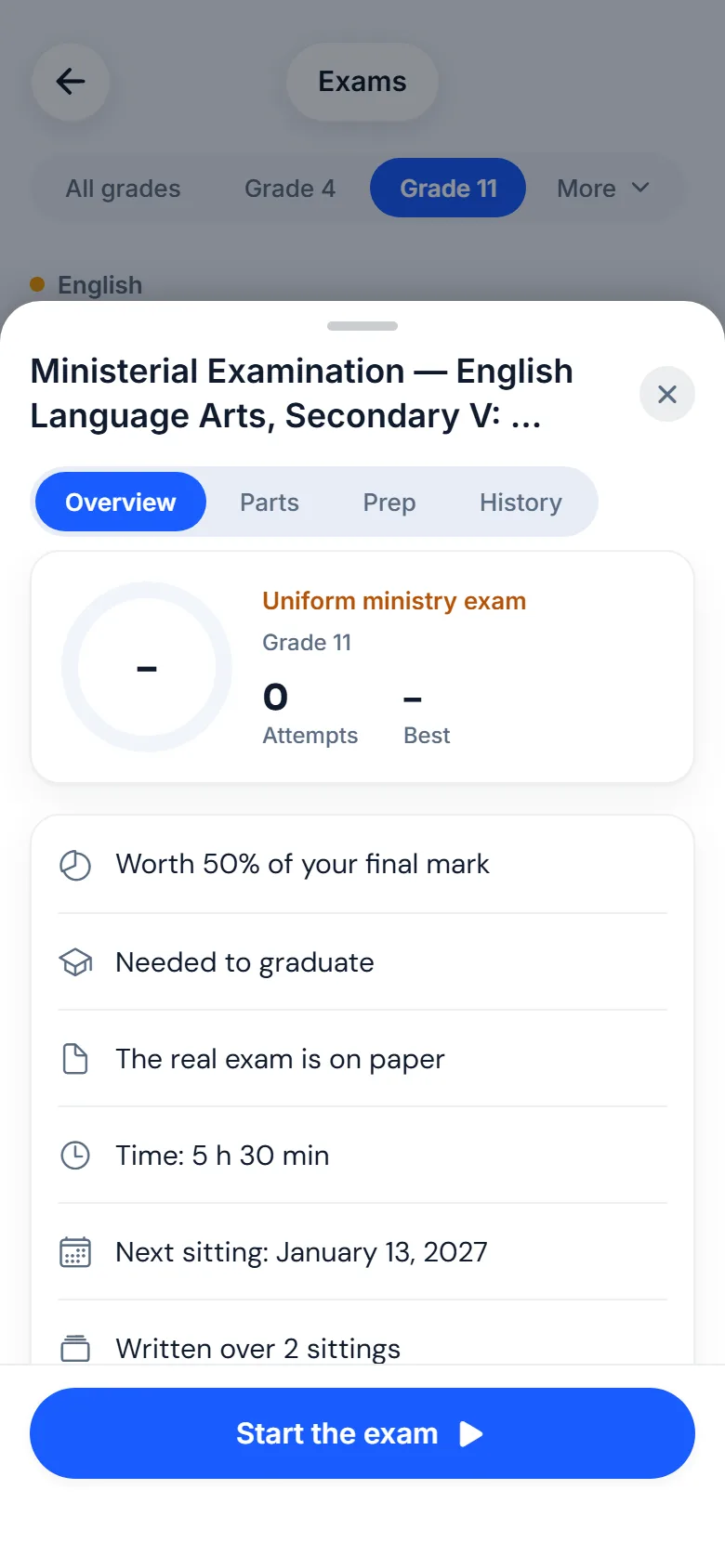 The exam in the app
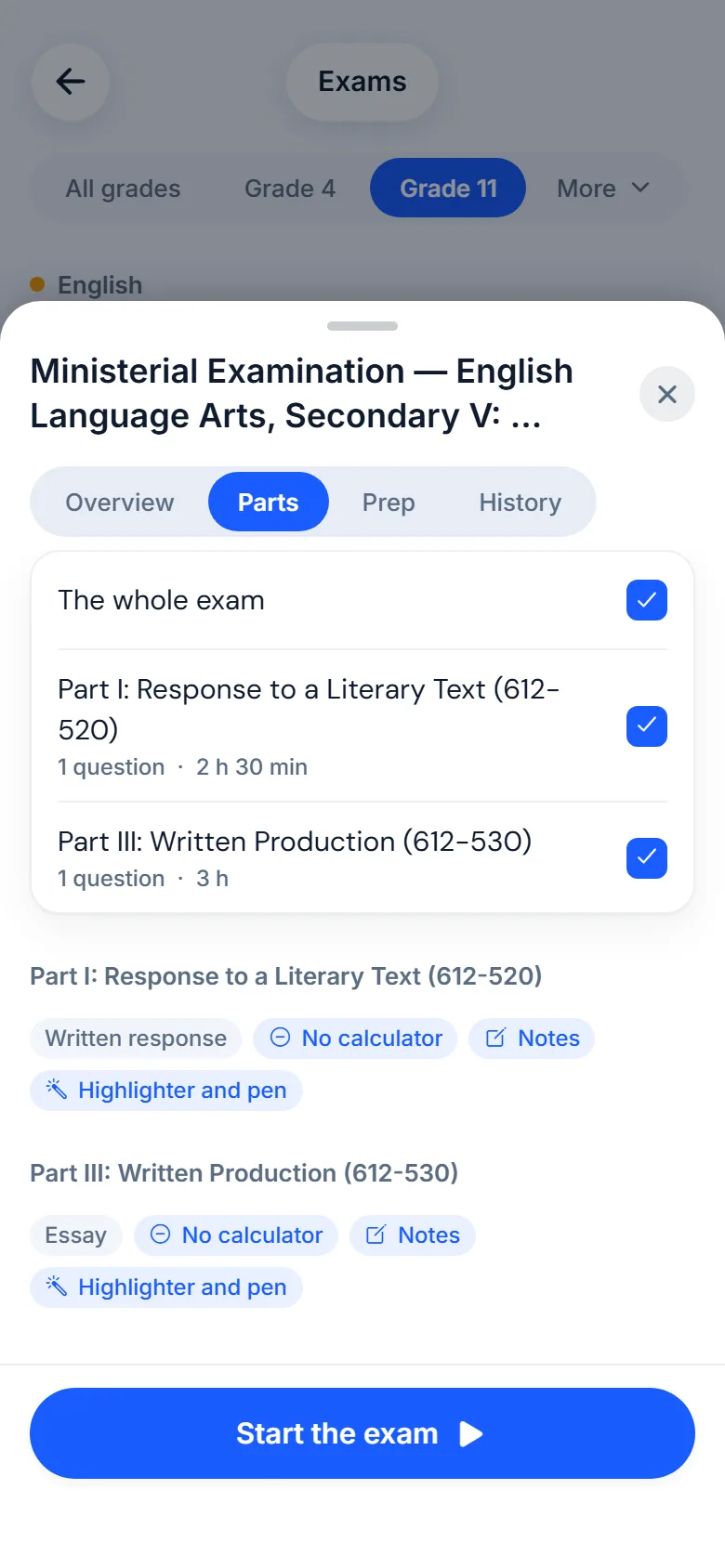 Its parts, and what you can use in each
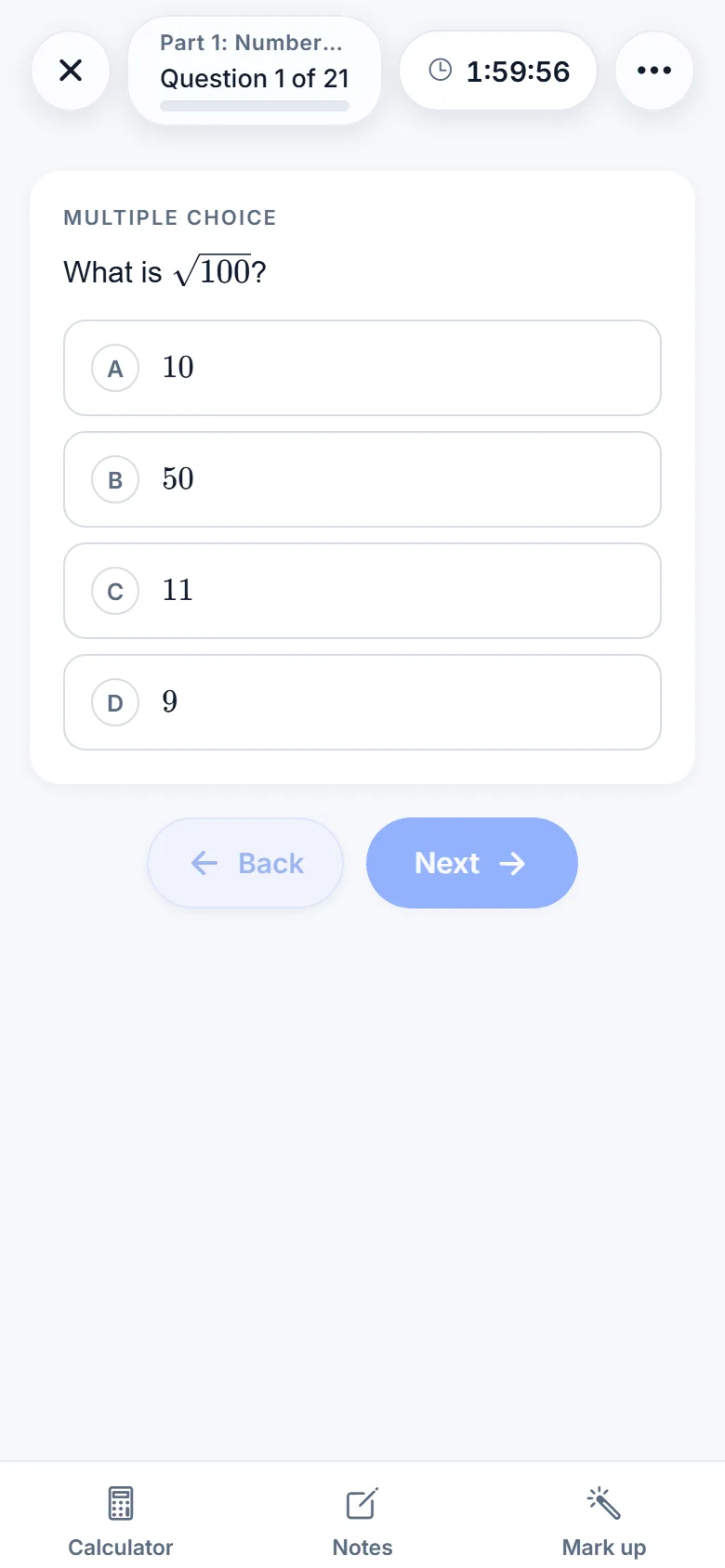 A question, timed, with the exam’s tools
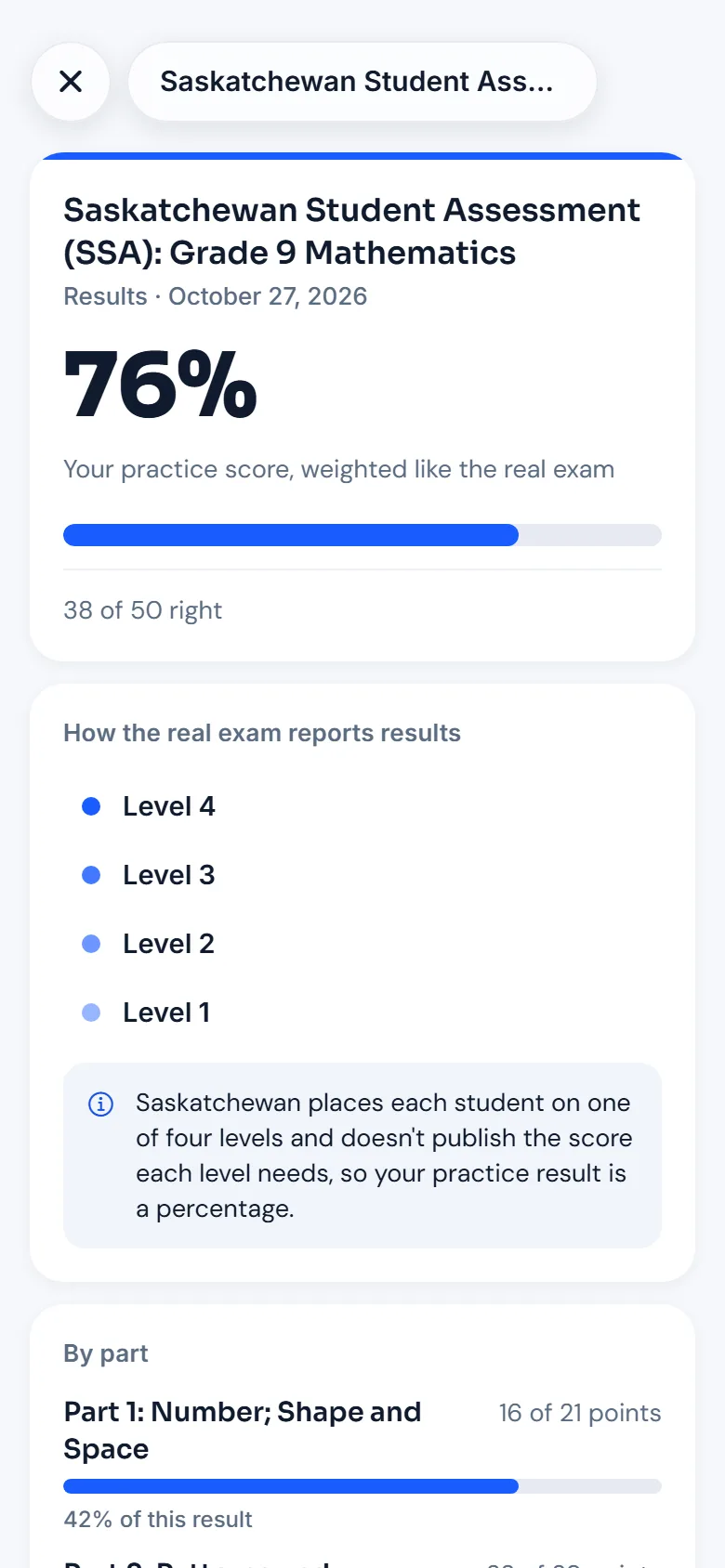 The marked result, part by part
A practice run of Saskatchewan’s Grade 9 math assessment.
Free with a MapleMind account
When
3 sessions this school year: January, June and August.
January 2027 session
- Wednesday, January 13, 20279:00 a.m.-11:30 a.m., then from 11:45 a.m. · English Language Arts, Sec. 5: Reading (612‑520), then Production Preparation (612‑530) from 11:45 a.m.
- Thursday, January 14, 20279:00 a.m.-12:00 p.m. · English Language Arts, Sec. 5: Production Writing (612‑530)
June 2027 session
- Tuesday, May 25, 20279:00 a.m.-11:30 a.m., then from 11:45 a.m. · English Language Arts, Sec. 5: Reading (612‑520), then Production Preparation (612‑530) from 11:45 a.m.
- Wednesday, May 26, 20279:00 a.m.-12:00 p.m. · English Language Arts, Sec. 5: Production Writing (612‑530)
August 2027 session
- Tuesday, July 27, 20279:00 a.m.-11:30 a.m., then from 11:45 a.m. · English Language Arts, Sec. 5: Reading (612‑520), then Production Preparation (612‑530) from 11:45 a.m.
- Wednesday, July 28, 20279:00 a.m.-12:00 p.m. · English Language Arts, Sec. 5: Production Writing (612‑530)
The dates are Quebec’s own, read on September 28, 2026. See the official schedule (quebec.ca)
What’s on it
- Competency 2, Reads and listens to written, spoken and media texts: Part I response to a literary text612‑520Its own result: 50% of competency 2's final mark (2025-26)
- Competency 3, Produces texts for personal and social purposes: Part III expository text that takes a position612‑530Its own result: 50% of competency 3's final mark (2025-26)
The skills it tests · 54 skills
- Use: (Reading only) Multimodal conventions (e.g. use of t
- Use: (Reading only) Structural irony (i.e. a double meani
- Use: Analyzes how readers are positioned or situated by t
- Use: Analyzes implications and/or impact and/or influence
- Use: Basic structure: opening statement of the issue
- Use: Compares/contrasts own ideas, values and beliefs wit
- Use: Conclusion which convinces reader either to behave (buy, donate, act
- Use: Conclusion which wraps up the argument by: generaliz
- Use: Connects significant facts/information in relation t
- Use: Conventions of specific literary genres (e.g. use
- Use: Conventions of specific text types (e.g. use of gutt
- Use: Conventions to establish a sense of unity and cohere
- Use: Conventions to establish credibility and authority s
- Use: Conventions which establish relationships between id…
- Use: Distance between self as writer/producer, topic, purpose and intended/target audience
- Use: Distant but known audience, conceptually appropriate
- Use: Essays dealing with issues arising from literature (i.e. literary essay)
- Use: Essays dealing with issues/topics arising from literature, popular culture and the media
- Use: Essays dealing with personal and social concerns (e.g. opinion column, position paper)
- Use: Establishes interrelationships between the structure
- Use: Evidence organized as points in a logical sequence (
- Use: Evidence organized as points in a logical sequence (
- Use: Focus on current issues and events in the news
- Use: Identifies dominant discourses and how they shape th
- Use: Introduction which includes a lead, an elaboration of the topic, a clear thesis statement and a path statement
- Use: Introduction which situates issue within a local and/or national context
- Use: Introduction with an engaging lead and an elaboration of topic
- Use: Irony (e.g. situational, dramatic)
- Use: Known characteristics of a closed narrative text (e.
- Use: Known characteristics of an open narrative text (e.g. figurative language in a short story or symbolism in a poem)
- Use: Multigenre conventions (e.g. journal entries in a novel; historical footage in a contemporary film)
- Use: Multigenre conventions (e.g. use of melodrama in a s
- Use: Multigenre conventions (e.g. use of personal narrative in an essay; ‘call to action’ conclusion in an editorial)
- Use: Multimodal conventions (e.g. sound of grasshoppers t
- Use: Multimodal conventions (e.g. video clips of recent n
- Use: Persuasive language such as connotation, loaded word
- Use: Proper citation(s) of reference material (e.g. ellipsis points, brackets, formatting, footnotes, bibliography )
- Use: Recurring motifs, concepts, and other patterns
- Use: Respect for production constraints that influence th
- Use: Respect for production constraints that influence th
- Use: Rhetorical strategies such as anticipating and addre
- Use: Rhetorical strategies to address and/or distract opp
- Use: Rhetorical strategies to engage and convince reader
- Use: Satire
- Use: Speeches (e.g. pitch an ad campaign, book talk)
- Use: Spoken conventions such as intonation patterns, paus
- Use: Stance/role of editor is consistent with the ideology of a given news source
- Use: Texts dealing with personal and social concerns (e.g. editorial, blog, research thesis)
- Use: Texts dealing with personal and social concerns, suc
- Use: Thesis/controlling idea (i.e. thesis statement)
- Use: Transformation of ideas/concept from one mode/medium
- Use: Use of a procedure such as Parliamentary procedure
- Use: Use of a variety of strategies to prove/illustrate point (e.g. anecdote, famous quotations, popular media examples)
- Use: Written for adults and reflecting the variety of tex
How it’s built
Written answers and an essay.
- Part I: Response to a Literary Text (612‑520)
- Time
- 150 min
- Question
- 1
- Marks
- 100
- Of the marks
- 49%
- Written answers
Read a literary text silently, more than once, making notes: about an hour. Then write a response of about 500 to 700 words that interprets it critically, in about an hour and a half.
- Part II: Reading for StanceNot marked
- Time
- 30 min
- A task
- Part III: Written Production (612‑530)
- Time
- 180 min
- Question
- 1
- Marks
- 100
- Of the marks
- 51%
- Essay
Write a text of about 600 to 800 words that takes a position on a topic tied to the REACT File. It can be an essay, an open letter or a speech, but not fiction or poetry. Draft it, then revise and write the final version.
How it’s marked
Your school board marks it, comparing your work with sample answers at each level. Each result counts for 50% of your final result in that skill; you need 60% to pass the course. A blank task gets 0.
On the day
- Day 1, morningPart I: read a literary text and write a response to it, in 2.5 hours.
- Day 1, after a short breakPart II: read The REACT File and make notes for Part III, in 30 minutes. It isn't marked.
- Day 2Part III: a text that takes a position, about 600 to 800 words, in 3 hours.
Three parts. All reading is silent and done on your own. Only a dictionary and a thesaurus may be brought in, and a phone or other device gets you 0%. Once you hand in a final version, you can't go back to it. You may get five extra minutes for each hour.
Getting ready
2 official documents to practise with, and 4 tips.
Official practice
Tips from the people who write it
- In Part I, go beyond a first understanding, and back your interpretation with references to the text.
- Use Part II's 30 minutes to plan your position: the REACT File's texts feed Part III.
- In Part III, take a clear position for your audience, and go beyond summarizing or quoting the File.
- Spelling, grammar and punctuation are part of the Part III marks.
The mark you need
Your class mark counts for 50% of the final mark, the exam for 50%. Quebec may moderate your class mark before it’s blended.
You need
65% on the exam
With 75% in class, your final mark lands between 37.5% (0 on the exam) and 87.5% (100% on it).
After the exam
- Results
After marking, the Ministry mails you your achievement record, and the results are on your Online Academic Record. Your school mark may be moderated: moved up or down by comparing your group’s school marks with its exam results. If your exam mark is higher than your moderated school mark, only the exam mark counts.
- Re-marking
You can ask for a review within six months of receiving your achievement record, through the person in charge of exams at your school, for a fee. A lower result never replaces your original mark.
- Writing it again
If you fail, or want a better mark, your school may let you retake it at the January, June or August session; you show you’ve worked on it first. Your final mark uses your best result.
- If you miss it
Without a valid reason, ABS goes on your record and you can write at another session. Valid reasons: a serious illness or accident with a medical note, the death of a close relative, a court summons, or an important event approved in advance. Then you write at a later date, or, if that’s impossible, your moderated school mark can stand in (only if it’s a pass and you attended at least 120 class days; never for the August session).
From Final results in Secondary IV and V (Quebec) (quebec.ca) and Administrative Guide for the Certification of Studies and Management of Ministerial Examinations (the edition Quebec links today) (cdn-contenu.quebec.ca), read on October 27, 2026.
More for you
Students
Read what’s on it, then write full practice exams under the real time limit.
Practise itParents
Put the dates on the family calendar. The Parent Dashboard shows each practice exam’s result and the skills that need another look.
See the Parent DashboardEducators
The official practice above makes a review plan. Students can practise each skill on its own in MapleMind, free with daily limits.
For schools
Questions about this exam
When is the English Language Arts, Secondary V in 2026–27?
The next sitting is January 13, 2027, 9:00 a.m.-11:30 a.m., then from 11:45 a.m.. This school year it’s written in January 2027 session, June 2027 session and August 2027 session.
How long is the English Language Arts, Secondary V?
It takes 6 hours in all, over 2 parts.
How many questions are on the English Language Arts, Secondary V?
It has 2 marked questions: 1 in Part I: Response to a Literary Text (612-520) and 1 in Part III: Written Production (612-530).
Can you use a calculator on the English Language Arts, Secondary V?
No. Calculators aren’t allowed.
How much does the English Language Arts, Secondary V count?
It’s worth 50% of the final mark in English Language Arts, Secondary 5.
Where can I find practice tests for the English Language Arts, Secondary V?
MapleMind builds a full practice exam in its format. Start it from this page, free with an account.

Practise for the English Language Arts, Secondary V
Every skill on the English Language Arts, Secondary V, taught one at a time, then practised on questions written like the real ones.


