Ministerial exam · Quebec
English as a Second Language, Core Program, Secondary V
Ministerial Examinations — English as a Second Language, Core Program, Secondary V: oral interaction (134‑510) and written production (134‑530)
- Grade 11
- 134-504
Dates and details can change. We do our best to keep this page up to date, but check the official sources before relying on it.
- Total time
- 3 h 15 min
- Marked questions
- 2
- Marked parts
- 2
- Counts for
- 50% of the final mark
- Calculator
- Not allowed
- Format
- On paper
Secondary 5 ESL Ministry Exam practice test
The whole exam or the parts you choose, in its own format, on the clock.
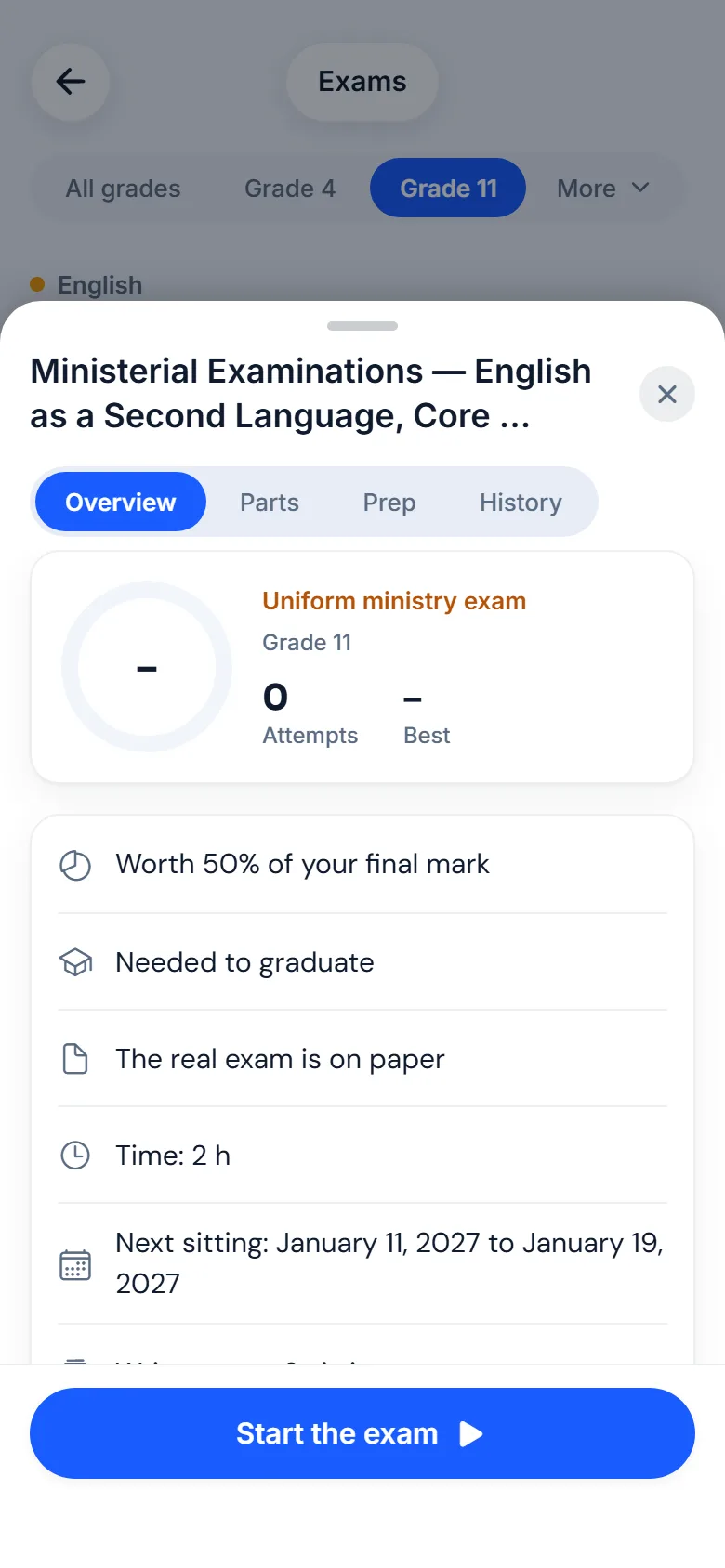 The exam in the app
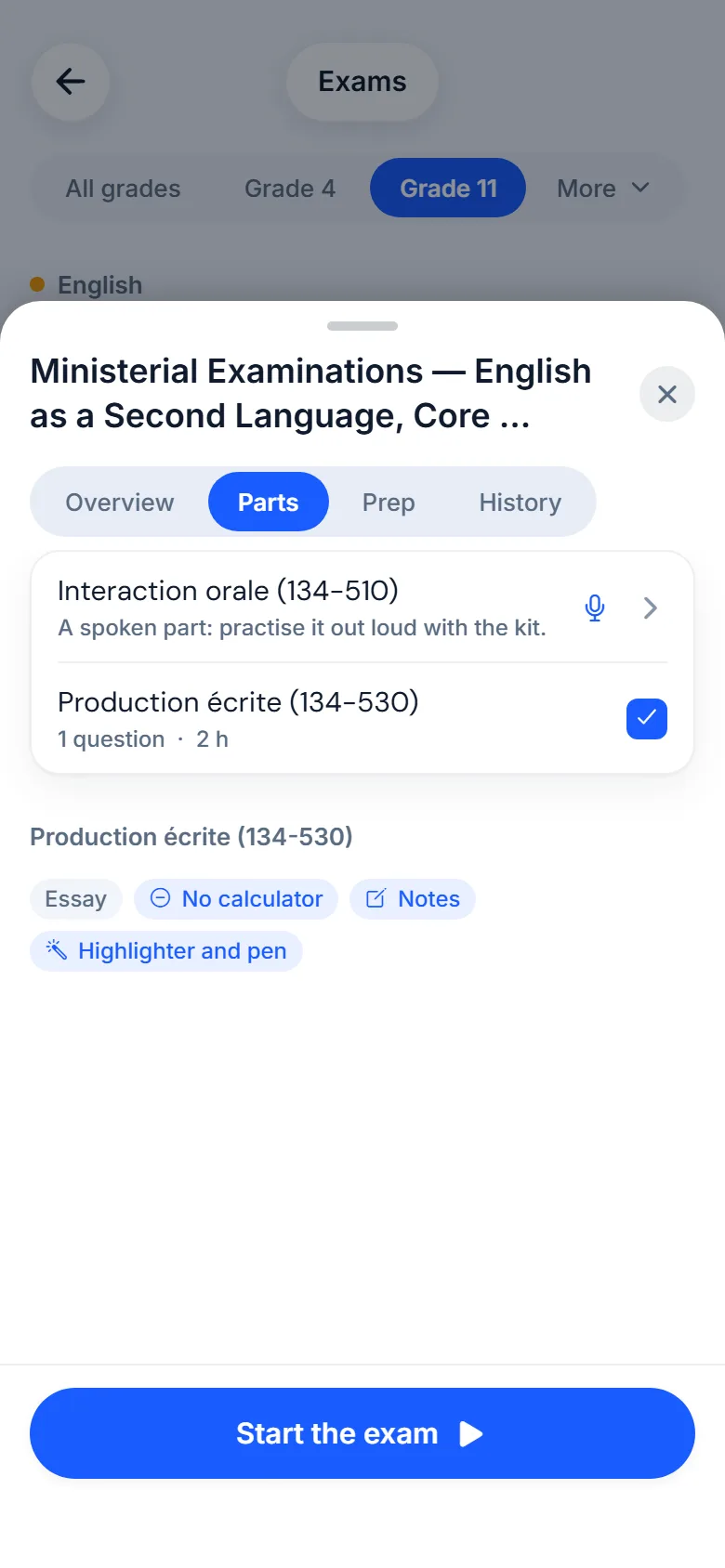 Its parts, and what you can use in each
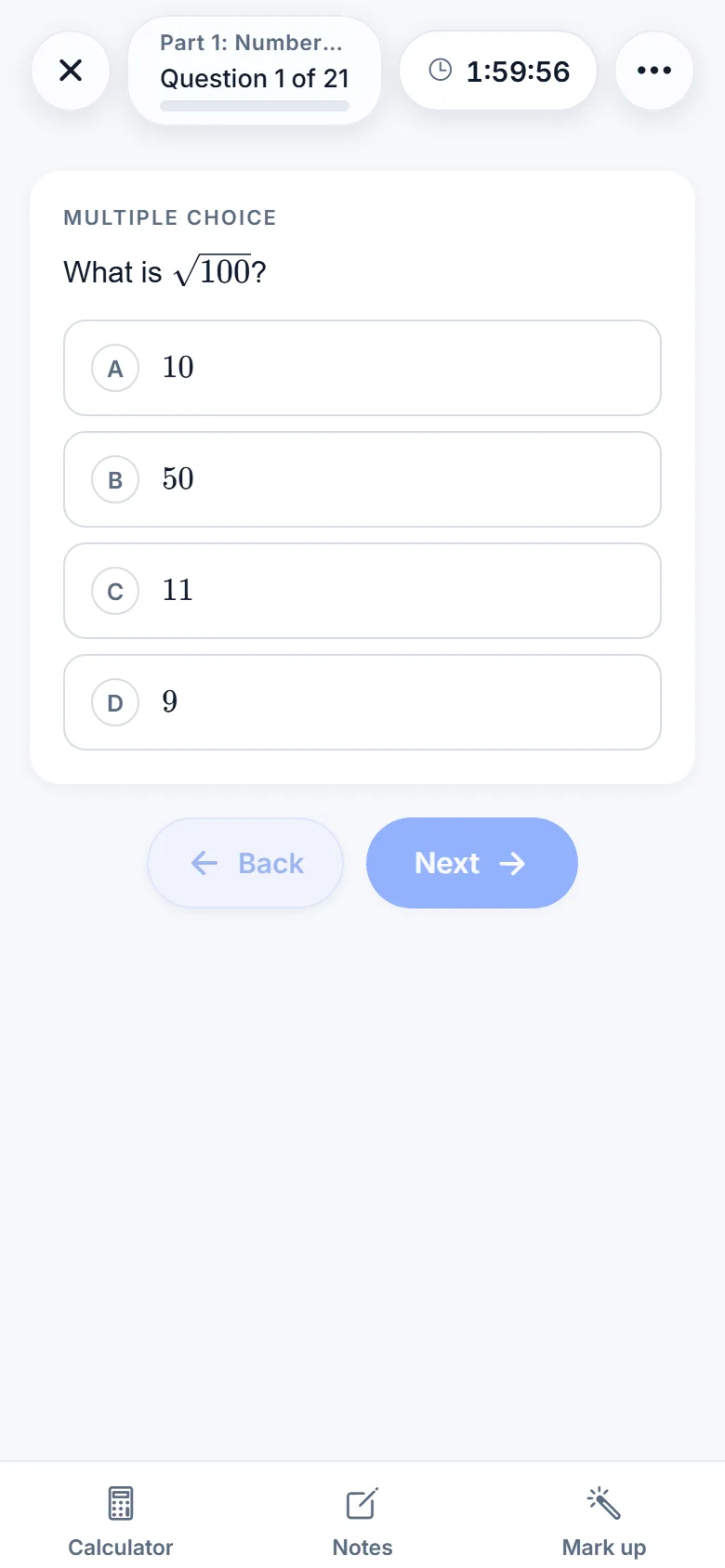 A question, timed, with the exam’s tools
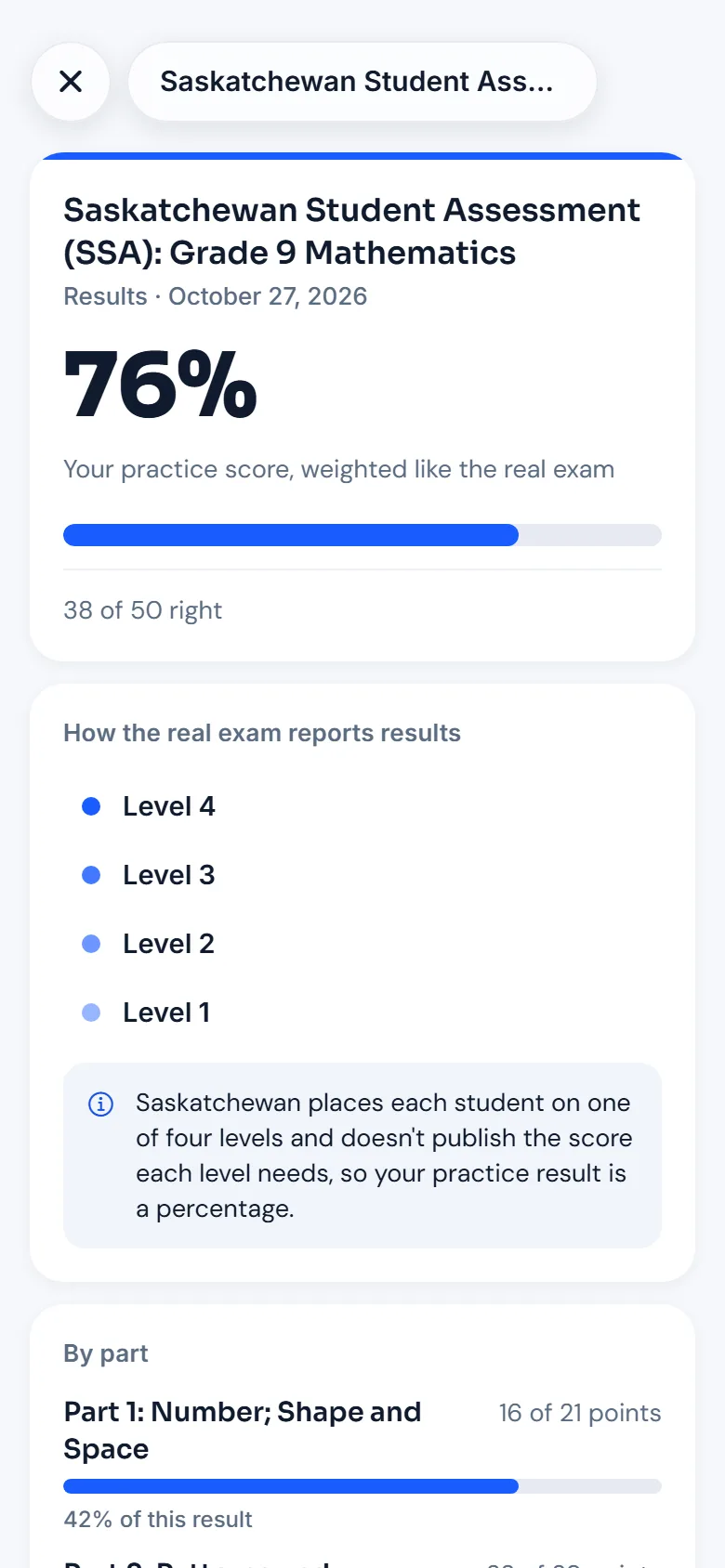 The marked result, part by part
A practice run of Saskatchewan’s Grade 9 math assessment.
Free with a MapleMind account
When
3 sessions this school year: January, June and August.
January 2027 session
- January 11 to January 19, 2027Set by the school · Tâche préparatoire et interaction orale (134‑510), before 134‑530
- Tuesday, January 19, 20279:30 a.m.-11:30 a.m. · Production écrite (134‑530)
June 2027 session
- May 13 to June 10, 2027Set by the school · Tâche préparatoire et interaction orale (134‑510), before 134‑530
- Thursday, June 10, 20279:30 a.m.-11:30 a.m. · Production écrite (134‑530)
August 2027 session
- July 23 to July 30, 2027Set by the school · Tâche préparatoire et interaction orale (134‑510), before 134‑530
- Friday, July 30, 20279:30 a.m.-11:30 a.m. · Production écrite (134‑530)
The dates are Quebec’s own, read on September 28, 2026. See the official schedule (quebec.ca)
What’s on it
- Competency 1, Interagir oralement en anglais: the team discussion134‑510Its own result: 50% of C1's final mark (2025-26)
- Competency 3, Écrire et produire des textes: the opinion piece134‑530Its own result: 50% of C3's final mark (2025-26)
The skills it tests · 16 skills
- Consolidating English: your lifelong strategies and functional language
- Using English: Compares communication conventions from English-language cul
- Using English: Compares cultural products from English-language cultures wi
- Using English: Compares daily life practices from English-language cultures
- Using English: Explores a variety of authentic popular, literary and inform
- Using English: Explores communication conventions from English-language cul
- Using English: Explores cultural products from English-language cultures
- Using English: Explores daily life practices from English-language cultures
- Using English: Health and Well-Being
- Using English: selects which ones to use for a given task
- Using English: Tries to communicate with someone who speaks English; learns
- Using English: Uses creativity
- Using English: Uses information
- Using English: Uses knowledge of targeted grammatical structures to constru
- Using English: Uses targeted grammatical structures to express oral and wri
- Using English: Vocabulary for personal and career planning
How it’s built
A task and an essay.
- Tâche préparatoireNot marked
- Time
- 60 min
- A task
- Interaction orale (134‑510)
- Time
- 15 min
- Question
- 1
- Marks
- 20
- Of the marks
- 57%
- A task
In a team of four, a 15-minute discussion in English from given questions. Your teacher listens and rates each student but never takes part.
- Production écrite (134‑530)
- Time
- 120 min
- Question
- 1
- Marks
- 50
- Of the marks
- 43%
- Essay
Write, on your own, an opinion piece of about 225 words for an online magazine. Open with a firm position, give convincing arguments for a reader who knows little about the topic, and end with a conclusion.
How it’s marked
Your teacher rates the discussion live, and your school marks the writing. Each result counts for 50% of your final result in that skill; you need 60% to pass the course.
On the day
- First, in classThe preparation task, 45 to 60 minutes: read the booklet's texts, react in writing, then discuss them in teams of four. It isn't marked.
- Then, a day your school setsThe oral: a 15-minute discussion in a team of four, from given questions.
- Writing dayAn opinion piece of about 225 words, in 2 hours. Your Preparation Booklet isn't allowed.
Two exams in order: a team discussion after a preparation task, then the writing. Your Preparation Booklet, with your handwritten notes, is allowed for the discussion but not for the writing. A phone or other device gets you 0%.
Getting ready
3 official documents to practise with, and 3 tips.
Official practice
Tips from the people who write it
- In the discussion, react to others and move the conversation forward: don't just answer.
- State a firm position in your introduction: 'it depends' isn't one.
- Your Preparation Booklet helps for the discussion, but you can't use it for the writing.
The mark you need
Your class mark counts for 50% of the final mark, the exam for 50%. Quebec may moderate your class mark before it’s blended.
You need
65% on the exam
With 75% in class, your final mark lands between 37.5% (0 on the exam) and 87.5% (100% on it).
After the exam
- Results
After marking, the Ministry mails you your achievement record, and the results are on your Online Academic Record. Your school mark may be moderated: moved up or down by comparing your group’s school marks with its exam results. If your exam mark is higher than your moderated school mark, only the exam mark counts.
- Re-marking
You can ask for a review within six months of receiving your achievement record, through the person in charge of exams at your school, for a fee. A lower result never replaces your original mark.
- Writing it again
If you fail, or want a better mark, your school may let you retake it at the January, June or August session; you show you’ve worked on it first. Your final mark uses your best result.
- If you miss it
Without a valid reason, ABS goes on your record and you can write at another session. Valid reasons: a serious illness or accident with a medical note, the death of a close relative, a court summons, or an important event approved in advance. Then you write at a later date, or, if that’s impossible, your moderated school mark can stand in (only if it’s a pass and you attended at least 120 class days; never for the August session).
From Final results in Secondary IV and V (Quebec) (quebec.ca) and Administrative Guide for the Certification of Studies and Management of Ministerial Examinations (the edition Quebec links today) (cdn-contenu.quebec.ca), read on October 27, 2026.
More for you
Students
Read what’s on it, then write full practice exams under the real time limit.
Practise itParents
Put the dates on the family calendar. The Parent Dashboard shows each practice exam’s result and the skills that need another look.
See the Parent DashboardEducators
The official practice above makes a review plan. Students can practise each skill on its own in MapleMind, free with daily limits.
For schools
Questions about this exam
When is the English as a Second Language, Core Program, Secondary V in 2026–27?
The next sitting is January 11 to January 19, 2027. This school year it’s written in January 2027 session, June 2027 session and August 2027 session.
How long is the English as a Second Language, Core Program, Secondary V?
It takes 3 hours 15 minutes in all, over 2 parts.
How many questions are on the English as a Second Language, Core Program, Secondary V?
It has 2 marked questions: 1 in Interaction orale (134-510) and 1 in Production écrite (134-530).
Can you use a calculator on the English as a Second Language, Core Program, Secondary V?
No. Calculators aren’t allowed.
How much does the English as a Second Language, Core Program, Secondary V count?
It’s worth 50% of the final mark in English as a Second Language (Core), Secondary Cycle Two — Year 3.
Where can I find practice tests for the English as a Second Language, Core Program, Secondary V?
MapleMind builds a full practice exam in its format. Start it from this page, free with an account.

Practise for the English as a Second Language, Core Program, Secondary V
Every skill on the English as a Second Language, Core Program, Secondary V, taught one at a time, then practised on questions written like the real ones.