Get help with English Language Arts, Secondary 5
Most tutoring makes you sit through material you already know. MapleMind flips that: pick the exact skill that's causing trouble — any of the 64 below — and the tutor teaches just that one, step by step, as many times as it takes. Ask questions in plain words, any time of day, in English, French, or 12 other languages.
The official Quebec English Language Arts, Secondary 5 curriculum
Quebec defines English Language Arts, Secondary 5 by strands and outcomes. MapleMind teaches the same curriculum reorganized for one-skill-at-a-time tutoring — the table shows exactly where every official strand lands, and the ministry's own wording is quoted under each unit below.
Official source Québec's official English language arts programRead it on the government site — quebec.ca ↗| Official strand | Outcomes | Where MapleMind teaches it |
|---|---|---|
| Strand A | 8 | Reading Process: Interpreting Texts |
| Strand B | 4 | Production Process |
| Strand C | 2 | Research Process |
| Strand F | 9 | Required Genres: Narrative Texts |
| Strand H | 4 | Required Genres: Reports |
| Strand I | 13 | Exposition: Persuasive Texts |
| Strand J | 22 | Exposition: Argumentative Texts |
| Strand M | 2 | Conventions: Media Language |
Every skill below, taught one on one.
 Try the first session free
How MapleMind teaches English Language Arts, Secondary 5 — every unit, lesson, and skill
Every skill below runs as a short session: a plain-words lesson, a worked example, solving it together, then a five-question skill check that earns up to three stars. Guided Mode keeps it teaching instead of answer-handing — turning it off needs a parent's password.
Unit 1Reading Process: Interpreting TextsOfficial strand · Strand A
Reading Process: Interpreting Texts — the Québec secondary ELA strand, at Secondary Cycle Two, Year 3 (Sec 5) register.
Recognizing closed narrative patterns
- Use: Known characteristics of a closed narrative text (e.…s009-Read.11 — Mastery of “Known characteristics of a closed narrative text (e.g. t…” (Reading Process: Interpreting Texts) at Secondary Cycle Two, Year 3 (Sec 5) ELA.
- Use: Known characteristics of an open narrative text (e.g…s010-Read.12 — Mastery of “Known characteristics of an open narrative text (e.g. fi…” (Reading Process: Interpreting Texts) at Secondary Cycle Two, Year 3 (Sec 5) ELA.
Connecting facts to a controlling idea
- Use: Connects significant facts/information in relation t…s016-Read.18 — Mastery of “Connects significant facts/information in relation to ma…” (Reading Process: Interpreting Texts) at Secondary Cycle Two, Year 3 (Sec 5) ELA.
- Use: Analyzes implications and/or impact and/or influence…s017-Read.19 — Mastery of “Analyzes implications and/or impact and/or influence of…” (Reading Process: Interpreting Texts) at Secondary Cycle Two, Year 3 (Sec 5) ELA.
- Use: Identifies dominant discourses and how they shape th…s018-Read.20 — Mastery of “Identifies dominant discourses and how they shape the wr…” (Reading Process: Interpreting Texts) at Secondary Cycle Two, Year 3 (Sec 5) ELA.
Interrelating genre, context, and meaning
- Use: Establishes interrelationships between the structure…s031-Read.33 — Mastery of “Establishes interrelationships between the structure and…” (Reading Process: Interpreting Texts) at Secondary Cycle Two, Year 3 (Sec 5) ELA.
Comparing your values with a text's
- Use: Compares/contrasts own ideas, values and beliefs wit…s033-Read.35 — Mastery of “Compares/contrasts own ideas, values and beliefs with th…” (Reading Process: Interpreting Texts) at Secondary Cycle Two, Year 3 (Sec 5) ELA.
- Use: Analyzes how readers are positioned or situated by t…s034-Read.36 — Mastery of “Analyzes how readers are positioned or situated by the t…” (Reading Process: Interpreting Texts) at Secondary Cycle Two, Year 3 (Sec 5) ELA.
The official wording — 8 outcomes in this unit
- s009-Read.11
Known characteristics of a closed narrative text (e.g. the formulaic pattern in a heroic myth or in a
- s010-Read.12
Known characteristics of an open narrative text (e.g. figurative language in a short story or symbolism in a
- s016-Read.18
Connects significant facts/information in relation to main idea(s), hypothesis, thesis statement or stance
- s017-Read.19
Analyzes implications and/or impact and/or influence of stereotyping or cliché, false representation, gender
- s018-Read.20
Identifies dominant discourses and how they shape the writer’s/producer’s intended meanings/messages (i.e.
- s031-Read.33
Establishes interrelationships between the structure and features of the genre, the context in which the text
- s033-Read.35
Compares/contrasts own ideas, values and beliefs with those presented by writer/producer (e.g. notions of
- s034-Read.36
Analyzes how readers are positioned or situated by the text and how this can alter an interpretation (e.g.
Unit 2Production ProcessOfficial strand · Strand B
Production Process — the Québec secondary ELA strand, at Secondary Cycle Two, Year 3 (Sec 5) register.
Writing for a distant but known audience
- Use: Distant but known audience, conceptually appropriate…s050-Prod.16 — Mastery of “Distant but known audience, conceptually appropriate for…” (Production Process) at Secondary Cycle Two, Year 3 (Sec 5) ELA.
Managing distance between writer and audience
- Use: Distance between self as writer/producer, topic, pur…s053-Prod.19 — Mastery of “Distance between self as writer/producer, topic, purpose…” (Production Process) at Secondary Cycle Two, Year 3 (Sec 5) ELA.
Managing resources and rights in media production
- Use: Looks into issues of ownership, property and privacy…s057-Prod.23 — Mastery of “Looks into issues of ownership, property and privacy com…” (Production Process) at Secondary Cycle Two, Year 3 (Sec 5) ELA.
Transforming a text across media
- Use: Transforms the information from one mode or medium t…s079-Prod.47 — Mastery of “Transforms the information from one mode or medium to an…” (Production Process) at Secondary Cycle Two, Year 3 (Sec 5) ELA.
The official wording — 4 outcomes in this unit
- s050-Prod.16
Distant but known audience, conceptually appropriate for an adolescent (e.g. considers audience knowledge
- s053-Prod.19
Distance between self as writer/producer, topic, purpose and intended/target audience
- s057-Prod.23
Looks into issues of ownership, property and privacy common to the media industry (e.g. checks that copyright
- s079-Prod.47
Transforms the information from one mode or medium to another (e.g. prepares a slideshow that synthesizes the
Unit 3Research ProcessOfficial strand · Strand C
Research Process — the Québec secondary ELA strand, at Secondary Cycle Two, Year 3 (Sec 5) register.
Research Process
Adopting a stance from your findings
- Use: Adopts a stance that promotes the smooth development…s098-Rese.17 — Mastery of “Adopts a stance that promotes the smooth development of…” (Research Process) at Secondary Cycle Two, Year 3 (Sec 5) ELA.
The official wording — 2 outcomes in this unit
- s086-Rese.4
Uses ethnography to study a social world relevant to an adolescent
- s098-Rese.17
Adopts a stance that promotes the smooth development of a hypothesis, thesis statement or controlling idea in
Unit 4Required Genres: Narrative TextsOfficial strand · Strand F
Required Genres: Narrative Texts — the Québec secondary ELA strand, at Secondary Cycle Two, Year 3 (Sec 5) register.
Classic, modern, and contemporary literature
- Use: Written for adults and reflecting the variety of tex…s147-Requ.8 — Mastery of “Written for adults and reflecting the variety of texts i…” (Required Genres: Narrative Texts) at Secondary Cycle Two, Year 3 (Sec 5) ELA.
How narrative texts are built: structural irony
- Use: (Reading only) Structural irony (i.e. a double meani…s166-Requ.32 — Mastery of “(Reading only) Structural irony (i.e. a double meaning e…” (Required Genres: Narrative Texts) at Secondary Cycle Two, Year 3 (Sec 5) ELA.
Reading recurring motifs and patterns
- Use: Recurring motifs, concepts, and other patternss171-Requ.38 — Mastery of “Recurring motifs, concepts, and other patterns” (Required Genres: Narrative Texts) at Secondary Cycle Two, Year 3 (Sec 5) ELA.
Situational and dramatic irony
- Use: Irony (e.g. situational, dramatic)s182-Requ.49 — Mastery of “Irony (e.g. situational, dramatic)” (Required Genres: Narrative Texts) at Secondary Cycle Two, Year 3 (Sec 5) ELA.
- Use: Satires183-Requ.50 — Mastery of “Satire” (Required Genres: Narrative Texts) at Secondary Cycle Two, Year 3 (Sec 5) ELA.
- Use: Conventions of specific literary genres (e.g. use of…s184-Requ.51 — Mastery of “Conventions of specific literary genres (e.g. use of myt…” (Required Genres: Narrative Texts) at Secondary Cycle Two, Year 3 (Sec 5) ELA.
- Use: Conventions of specific text types (e.g. use of gutt…s185-Requ.52 — Mastery of “Conventions of specific text types (e.g. use of gutters…” (Required Genres: Narrative Texts) at Secondary Cycle Two, Year 3 (Sec 5) ELA.
- Use: Multigenre conventions (e.g. journal entries in a no…s186-Requ.53 — Mastery of “Multigenre conventions (e.g. journal entries in a novel;…” (Required Genres: Narrative Texts) at Secondary Cycle Two, Year 3 (Sec 5) ELA.
- Use: (Reading only) Multimodal conventions (e.g. use of t…s187-Requ.54 — Mastery of “(Reading only) Multimodal conventions (e.g. use of theat…” (Required Genres: Narrative Texts) at Secondary Cycle Two, Year 3 (Sec 5) ELA.
The official wording — 9 outcomes in this unit
- s147-Requ.8
Written for adults and reflecting the variety of texts in the literary tradition, including novels, short
- s166-Requ.32
(Reading only) Structural irony (i.e. a double meaning established by a naive protagonist that continues
- s171-Requ.38
Recurring motifs, concepts, and other patterns
- s182-Requ.49
Irony (e.g. situational, dramatic)
- s183-Requ.50
Satire
- s184-Requ.51
Conventions of specific literary genres (e.g. use of mythical characters in an allegory; scene gathering all
- s185-Requ.52
Conventions of specific text types (e.g. use of gutters and panel shape/size in a comic; use of asides,
- s186-Requ.53
Multigenre conventions (e.g. journal entries in a novel; historical footage in a contemporary film)
- s187-Requ.54
(Reading only) Multimodal conventions (e.g. use of theatrical elements such as costume, set design, makeup,
Unit 5Required Genres: ReportsOfficial strand · Strand H
Required Genres: Reports — the Québec secondary ELA strand, at Secondary Cycle Two, Year 3 (Sec 5) register.
How multigenre reports work
- Use: Multigenre conventions (e.g. use of case studies in…s221-Requ.24 — Mastery of “Multigenre conventions (e.g. use of case studies in a re…” (Required Genres: Reports) at Secondary Cycle Two, Year 3 (Sec 5) ELA.
- Use: Multimodal conventions (e.g. video clips or still im…s222-Requ.25 — Mastery of “Multimodal conventions (e.g. video clips or still images…” (Required Genres: Reports) at Secondary Cycle Two, Year 3 (Sec 5) ELA.
Conventions that establish authority
- Use: Rhetorical strategies to construct a relationship wi…s238-Requ.44 — Mastery of “Rhetorical strategies to construct a relationship with t…” (Required Genres: Reports) at Secondary Cycle Two, Year 3 (Sec 5) ELA.
The official wording — 4 outcomes in this unit
- s221-Requ.24
Multigenre conventions (e.g. use of case studies in a research report; use of narration and/or description to
- s222-Requ.25
Multimodal conventions (e.g. video clips or still images interspersed throughout a televised interview; sound
- s236-Requ.41
Conventions that establish authority and expertise (e.g. formal register, technical/disciplinary diction/word
- s238-Requ.44
Rhetorical strategies to construct a relationship with the subject such as sharing short anecdotes,
Unit 6Exposition: Persuasive TextsOfficial strand · Strand I
Exposition: Persuasive Texts — the Québec secondary ELA strand, at Secondary Cycle Two, Year 3 (Sec 5) register.
Required Persuasive Texts
- Use: Speeches (e.g. pitch an ad campaign, book talk)s243-Expo.8 — Mastery of “Speeches (e.g. pitch an ad campaign, book talk)” (Exposition: Persuasive Texts) at Secondary Cycle Two, Year 3 (Sec 5) ELA.
How persuasive texts are built
- Use: Persuasive language such as connotation, loaded word…s251-Expo.19 — Mastery of “Persuasive language such as connotation, loaded words, m…” (Exposition: Persuasive Texts) at Secondary Cycle Two, Year 3 (Sec 5) ELA.
- Use: Respect for production constraints that influence th…s252-Expo.20 — Mastery of “Respect for production constraints that influence the co…” (Exposition: Persuasive Texts) at Secondary Cycle Two, Year 3 (Sec 5) ELA.
- Use: Rhetorical strategies such as anticipating and addre…s253-Expo.21 — Mastery of “Rhetorical strategies such as anticipating and addressin…” (Exposition: Persuasive Texts) at Secondary Cycle Two, Year 3 (Sec 5) ELA.
- Use: Multigenre conventions (e.g. use of melodrama in a s…s254-Expo.22 — Mastery of “Multigenre conventions (e.g. use of melodrama in a serie…” (Exposition: Persuasive Texts) at Secondary Cycle Two, Year 3 (Sec 5) ELA.
- Use: Multimodal conventions (e.g. sound of grasshoppers t…s255-Expo.23 — Mastery of “Multimodal conventions (e.g. sound of grasshoppers to in…” (Exposition: Persuasive Texts) at Secondary Cycle Two, Year 3 (Sec 5) ELA.
Transforming persuasion across media
- Use: Transformation of ideas/concept from one mode/medium…s261-Expo.30 — Mastery of “Transformation of ideas/concept from one mode/medium to…” (Exposition: Persuasive Texts) at Secondary Cycle Two, Year 3 (Sec 5) ELA.
- Use: Thesis/controlling idea (i.e. thesis statement)s267-Expo.38 — Mastery of “Thesis/controlling idea (i.e. thesis statement)” (Exposition: Persuasive Texts) at Secondary Cycle Two, Year 3 (Sec 5) ELA.
- Use: Introduction with an engaging lead and an elaboratio…s268-Expo.39 — Mastery of “Introduction with an engaging lead and an elaboration of…” (Exposition: Persuasive Texts) at Secondary Cycle Two, Year 3 (Sec 5) ELA.
- Use: Evidence organized as points in a logical sequence (…s269-Expo.40 — Mastery of “Evidence organized as points in a logical sequence (i.e.…” (Exposition: Persuasive Texts) at Secondary Cycle Two, Year 3 (Sec 5) ELA.
- Use: Use of a variety of strategies to prove/illustrate p…s270-Expo.41 — Mastery of “Use of a variety of strategies to prove/illustrate point…” (Exposition: Persuasive Texts) at Secondary Cycle Two, Year 3 (Sec 5) ELA.
- Use: Conclusion which convinces reader either to behave (…s271-Expo.42 — Mastery of “Conclusion which convinces reader either to behave (buy,…” (Exposition: Persuasive Texts) at Secondary Cycle Two, Year 3 (Sec 5) ELA.
The official wording — 13 outcomes in this unit
- s243-Expo.8
Speeches (e.g. pitch an ad campaign, book talk)
- s246-Expo.12
Essays dealing with personal and social concerns (e.g. opinion column, position paper)
- s251-Expo.19
Persuasive language such as connotation, loaded words, modals (should, would, must), polarizing rhetoric,
- s252-Expo.20
Respect for production constraints that influence the content of a newspaper/magazine/show (e.g. word limit,
- s253-Expo.21
Rhetorical strategies such as anticipating and addressing opposing viewpoints, repetition, questions,
- s254-Expo.22
Multigenre conventions (e.g. use of melodrama in a series of TV ads; use of fairy tale conventions in an
- s255-Expo.23
Multimodal conventions (e.g. sound of grasshoppers to indicate deafening silence in a speech; manipulated
- s261-Expo.30
Transformation of ideas/concept from one mode/medium to another (e.g. creating a spoof PSA based on a current
- s267-Expo.38
Thesis/controlling idea (i.e. thesis statement)
- s268-Expo.39
Introduction with an engaging lead and an elaboration of topic
- s269-Expo.40
Evidence organized as points in a logical sequence (i.e. using a structure such as classification, cause and
- s270-Expo.41
Use of a variety of strategies to prove/illustrate point (e.g. anecdote, famous quotations, popular media
- s271-Expo.42
Conclusion which convinces reader either to behave (buy, donate, act
Unit 7Exposition: Argumentative TextsOfficial strand · Strand J
Exposition: Argumentative Texts — the Québec secondary ELA strand, at Secondary Cycle Two, Year 3 (Sec 5) register.
Required Argumentative Texts
- Use: Essays dealing with issues/topics arising from liter…s275-Expo.5 — Mastery of “Essays dealing with issues/topics arising from literatur…” (Exposition: Argumentative Texts) at Secondary Cycle Two, Year 3 (Sec 5) ELA.
- Use: Essays dealing with issues arising from literature (…s278-Expo.10 — Mastery of “Essays dealing with issues arising from literature (i.e.…” (Exposition: Argumentative Texts) at Secondary Cycle Two, Year 3 (Sec 5) ELA.
How argumentative texts are built
- Use: Rhetorical strategies to engage and convince reader…s280-Expo.13 — Mastery of “Rhetorical strategies to engage and convince reader (e.g…” (Exposition: Argumentative Texts) at Secondary Cycle Two, Year 3 (Sec 5) ELA.
- Use: Conventions which establish relationships between id…s282-Expo.15 — Mastery of “Conventions which establish relationships between ideas…” (Exposition: Argumentative Texts) at Secondary Cycle Two, Year 3 (Sec 5) ELA.
- Use: Multigenre conventions (e.g. use of personal narrati…s283-Expo.16 — Mastery of “Multigenre conventions (e.g. use of personal narrative i…” (Exposition: Argumentative Texts) at Secondary Cycle Two, Year 3 (Sec 5) ELA.
- Use: Multimodal conventions (e.g. video clips of recent n…s284-Expo.17 — Mastery of “Multimodal conventions (e.g. video clips of recent news…” (Exposition: Argumentative Texts) at Secondary Cycle Two, Year 3 (Sec 5) ELA.
- Use: Use of a procedure such as Parliamentary procedures285-Expo.20 — Mastery of “Use of a procedure such as Parliamentary procedure” (Exposition: Argumentative Texts) at Secondary Cycle Two, Year 3 (Sec 5) ELA.
- Use: Basic structure: opening statement of the issue and…s286-Expo.21 — Mastery of “Basic structure: opening statement of the issue and a pr…” (Exposition: Argumentative Texts) at Secondary Cycle Two, Year 3 (Sec 5) ELA.
- Use: Rhetorical strategies to address and/or distract opp…s287-Expo.22 — Mastery of “Rhetorical strategies to address and/or distract opponen…” (Exposition: Argumentative Texts) at Secondary Cycle Two, Year 3 (Sec 5) ELA.
- Use: Spoken conventions such as intonation patterns, paus…s288-Expo.23 — Mastery of “Spoken conventions such as intonation patterns, pauses a…” (Exposition: Argumentative Texts) at Secondary Cycle Two, Year 3 (Sec 5) ELA.
- Use: Introduction which includes a lead, an elaboration o…s289-Expo.25 — Mastery of “Introduction which includes a lead, an elaboration of th…” (Exposition: Argumentative Texts) at Secondary Cycle Two, Year 3 (Sec 5) ELA.
- Use: Evidence organized as points in a logical sequence (…s290-Expo.26 — Mastery of “Evidence organized as points in a logical sequence (e.g.…” (Exposition: Argumentative Texts) at Secondary Cycle Two, Year 3 (Sec 5) ELA.
- Use: Conventions to establish a sense of unity and cohere…s291-Expo.27 — Mastery of “Conventions to establish a sense of unity and coherence…” (Exposition: Argumentative Texts) at Secondary Cycle Two, Year 3 (Sec 5) ELA.
- Use: Conclusion which wraps up the argument by: generaliz…s292-Expo.28 — Mastery of “Conclusion which wraps up the argument by: generalizing…” (Exposition: Argumentative Texts) at Secondary Cycle Two, Year 3 (Sec 5) ELA.
- Use: Proper citation(s) of reference material (e.g. ellip…s293-Expo.29 — Mastery of “Proper citation(s) of reference material (e.g. ellipsis…” (Exposition: Argumentative Texts) at Secondary Cycle Two, Year 3 (Sec 5) ELA.
- Use: Focus on current issues and events in the newss294-Expo.31 — Mastery of “Focus on current issues and events in the news” (Exposition: Argumentative Texts) at Secondary Cycle Two, Year 3 (Sec 5) ELA.
- Use: Introduction which situates issue within a local and…s295-Expo.32 — Mastery of “Introduction which situates issue within a local and/or…” (Exposition: Argumentative Texts) at Secondary Cycle Two, Year 3 (Sec 5) ELA.
- Use: Stance/role of editor is consistent with the ideolog…s296-Expo.33 — Mastery of “Stance/role of editor is consistent with the ideology of…” (Exposition: Argumentative Texts) at Secondary Cycle Two, Year 3 (Sec 5) ELA.
- Use: Respect for production constraints that influence th…s297-Expo.34 — Mastery of “Respect for production constraints that influence the ed…” (Exposition: Argumentative Texts) at Secondary Cycle Two, Year 3 (Sec 5) ELA.
The official wording — 22 outcomes in this unit
- s274-Expo.4
Texts dealing with personal and social concerns, such as political blogs, editorials, televised panel
- s275-Expo.5
Essays dealing with issues/topics arising from literature, popular culture and the media
- s277-Expo.9
Texts dealing with personal and social concerns (e.g. editorial, blog, research thesis)
- s278-Expo.10
Essays dealing with issues arising from literature (i.e. literary essay)
- s280-Expo.13
Rhetorical strategies to engage and convince reader (e.g. stating basis of argument (pros/cons) upfront,
- s281-Expo.14
Conventions to establish credibility and authority such as using a formal, academic register; 1st or 3rd
- s282-Expo.15
Conventions which establish relationships between ideas and serve to extend the argument (e.g. syntactic
- s283-Expo.16
Multigenre conventions (e.g. use of personal narrative in an essay; ‘call to action’ conclusion in an
- s284-Expo.17
Multimodal conventions (e.g. video clips of recent news events in a panel discussion; satirical cartoon with
- s285-Expo.20
Use of a procedure such as Parliamentary procedure
- s286-Expo.21
Basic structure: opening statement of the issue and a preview of main arguments, followed by arguments for a
- s287-Expo.22
Rhetorical strategies to address and/or distract opponent such as rephrasing, paraphrasing, and/or
- s288-Expo.23
Spoken conventions such as intonation patterns, pauses and silences, gestures, turn-taking, use of a
- s289-Expo.25
Introduction which includes a lead, an elaboration of the topic, a clear thesis statement and a path statement
- s290-Expo.26
Evidence organized as points in a logical sequence (e.g. using a structure such as classification, cause and
- s291-Expo.27
Conventions to establish a sense of unity and coherence (i.e. paragraphs structured using a formulaic
- s292-Expo.28
Conclusion which wraps up the argument by: generalizing the thesis/ideas to the human condition, elevating
- s293-Expo.29
Proper citation(s) of reference material (e.g. ellipsis points, brackets, formatting, footnotes, bibliography
- s294-Expo.31
Focus on current issues and events in the news
- s295-Expo.32
Introduction which situates issue within a local and/or national context
- s296-Expo.33
Stance/role of editor is consistent with the ideology of a given news source
- s297-Expo.34
Respect for production constraints that influence the editorial content of a newspaper/magazine/show (e.g.
Unit 8Conventions: Media LanguageOfficial strand · Strand M
Conventions: Media Language — the Québec secondary ELA strand, at Secondary Cycle Two, Year 3 (Sec 5) register.
How a producer communicates a stance
- Use: Establish relevance (i.e. image/word/sound coexist a…s349-Conv.13 — Mastery of “Establish relevance (i.e. image/word/sound coexist and/o…” (Conventions: Media Language) at Secondary Cycle Two, Year 3 (Sec 5) ELA.
Analyzing values and ideology in media
- Use: Values, beliefs, ideologies (e.g. a close-up of a sl…s367-Conv.32 — Mastery of “Values, beliefs, ideologies (e.g. a close-up of a sleepi…” (Conventions: Media Language) at Secondary Cycle Two, Year 3 (Sec 5) ELA.
The official wording — 2 outcomes in this unit
- s349-Conv.13
Establish relevance (i.e. image/word/sound coexist and/or are juxtaposed to create meaning/message such as
- s367-Conv.32
Values, beliefs, ideologies (e.g. a close-up of a sleeping baby is associated with a new beginning; the
Printable workbook · A keepsake of the year
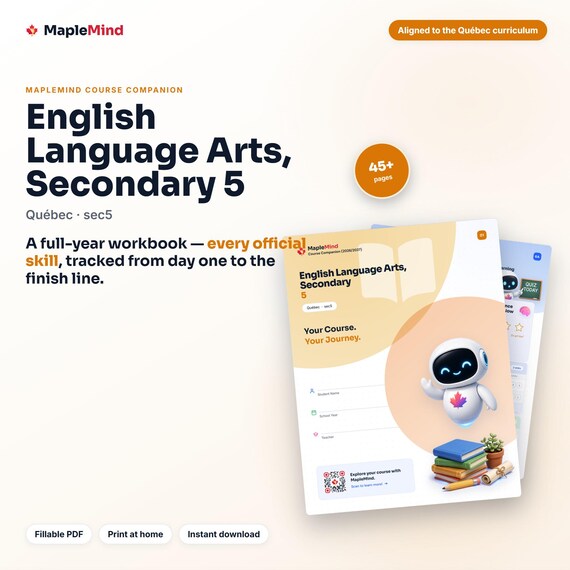
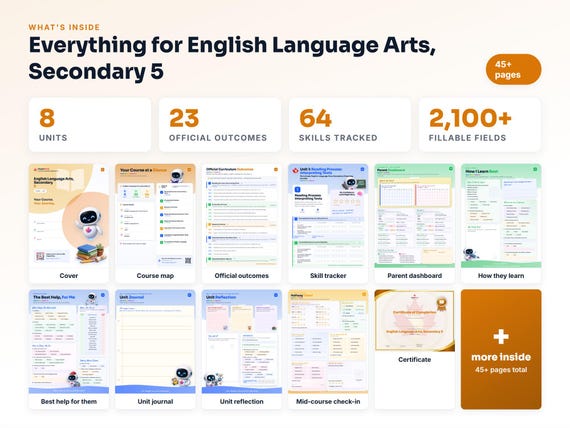
A English Language Arts, Secondary 5 workbook worth keeping
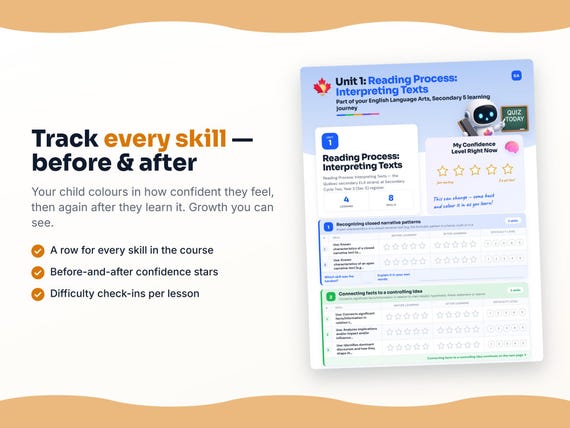
Built from the same official curriculum as this page. Before and after each skill above, your student colours in how sure they feel — so the two of you can see, on one page, what's clicking and what needs another look. It's a quiet way to follow how the year is really going.
By June it's full of their own handwriting: units worked through, confidence grown, a mid-year check-in, notes from parent-teacher night, and a certificate at the end. Less a worksheet, more a record of the year worth keeping on the shelf.
Instant download · see every page, reviews and the full description · five or more workbooks are $2.99 each
What it looks like in the app



Common questions
Can MapleMind help me with English Language Arts, Secondary 5?
Yes. MapleMind's AI tutor covers all 64 skills in Quebec's English Language Arts, Secondary 5 — you pick the exact skill, and the tutor teaches it step by step: a short lesson, a worked example, solving together, then a skill check to show it stuck.
Is MapleMind aligned to Quebec's official curriculum?
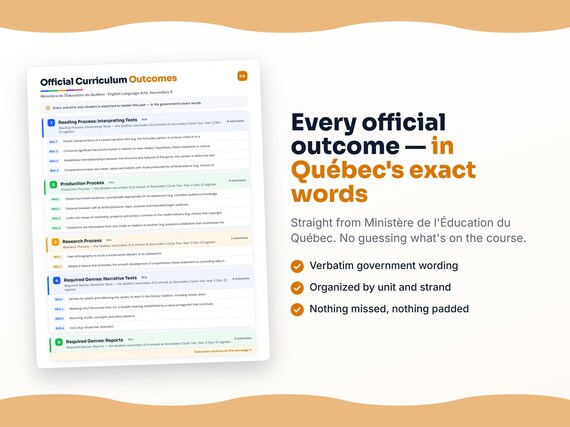
Yes. Every skill in this course maps to an official outcome code from Quebec's Secondary 5 English Language Arts curriculum, and the ministry's own wording is quoted under each unit on this page — with the official government source linked so you can check it yourself.
What does MapleMind cost?
It's free to start — 5 tutoring chats and a practice quiz every day, no credit card. A Pro subscription ($9.99/month or $49.99/year CAD, 7-day free trial) unlocks unlimited tutoring, practice, and exam simulations.
What if I'm stuck on just one topic?
That's the point of skill-level tutoring: open English Language Arts, Secondary 5 in the app, tap the exact skill from the list on this page, and the tutor teaches just that — no wading through lessons you don't need.
Does MapleMind work in French or other languages?
Yes — 14 languages, including French. Both the app and the tutor's explanations switch to the language you choose.
Where can I see the official Quebec curriculum for English Language Arts, Secondary 5?
The official source is linked on this page — Québec's official English language arts program. The outline here follows it: every MapleMind skill carries its official outcome code, and the ministry's own wording is quoted under each unit.
Keep exploring
Ready when you are
Pick a skill from this page and see it taught properly — free, in the browser, in under a minute.