Get help with English Language Arts, Secondary 4
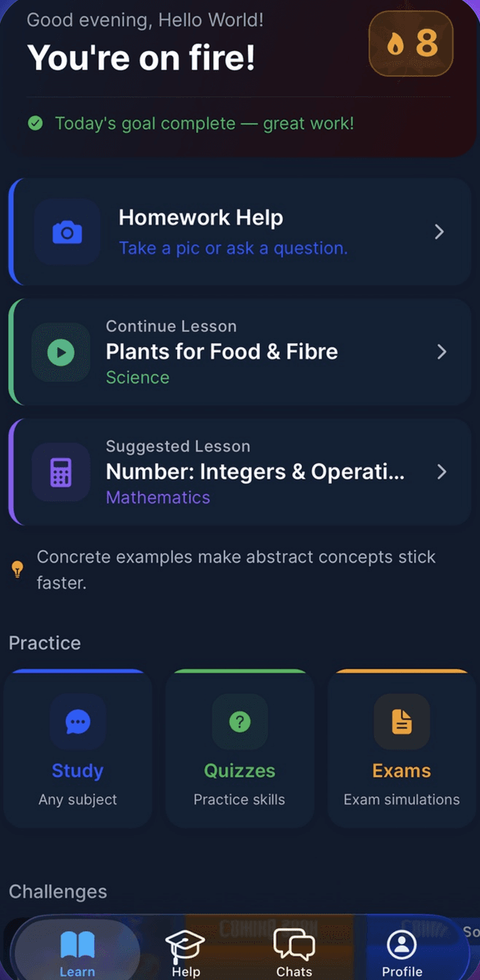
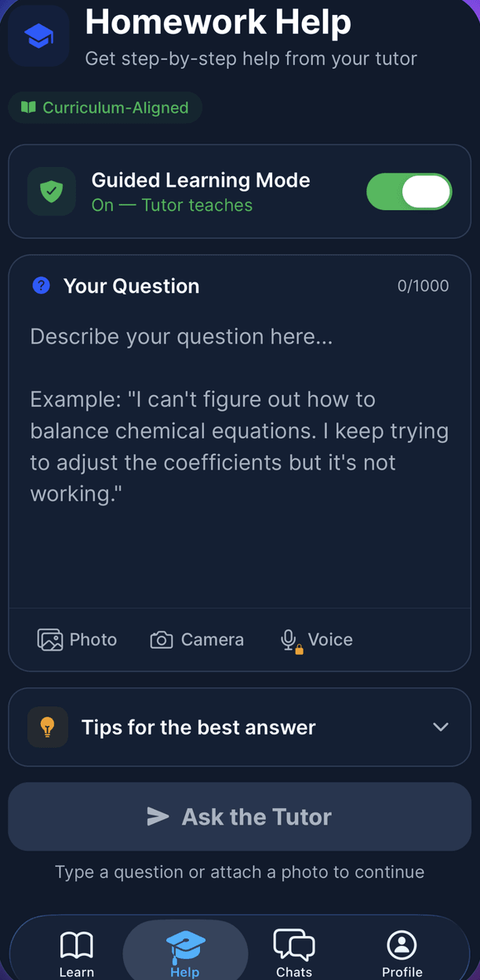
Most tutoring makes you sit through material you already know. MapleMind flips that: pick the exact skill that's causing trouble — any of the 84 below — and the tutor teaches just that one, step by step, as many times as it takes. Ask questions in plain words, any time of day, in English, French, or 12 other languages.
The official Quebec English Language Arts, Secondary 4 curriculum
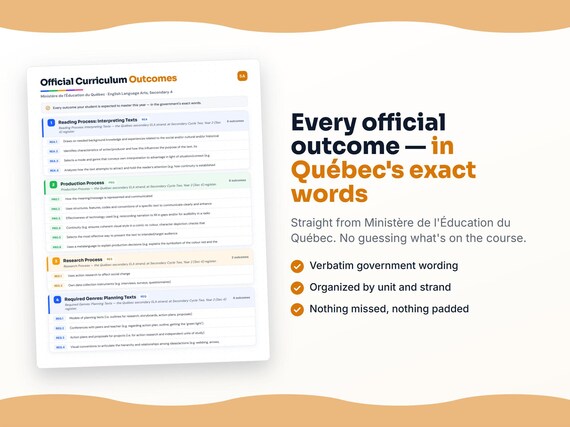
Quebec defines English Language Arts, Secondary 4 by strands and outcomes. MapleMind teaches the same curriculum reorganized for one-skill-at-a-time tutoring — the table shows exactly where every official strand lands, and the ministry's own wording is quoted under each unit below.
Official source Québec's official English language arts programRead it on the government site — quebec.ca ↗| Official strand | Outcomes | Where MapleMind teaches it |
|---|---|---|
| Strand A | 5 | Reading Process: Interpreting Texts |
| Strand B | 14 | Production Process |
| Strand C | 4 | Research Process |
| Strand D | 5 | Required Genres: Planning Texts |
| Strand F | 8 | Required Genres: Narrative Texts |
| Strand G | 2 | Required Genres: Explanatory Texts |
| Strand H | 14 | Required Genres: Reports |
| Strand I | 13 | Exposition: Persuasive Texts |
| Strand J | 1 | Exposition: Argumentative Texts |
| Strand K | 2 | Conventions: Spoken Language |
| Strand L | 7 | Conventions: Written Language |
| Strand M | 9 | Conventions: Media Language |
Every skill below, taught one on one.
 Try the first session free
How MapleMind teaches English Language Arts, Secondary 4 — every unit, lesson, and skill
Every skill below runs as a short session: a plain-words lesson, a worked example, solving it together, then a five-question skill check that earns up to three stars. Guided Mode keeps it teaching instead of answer-handing — turning it off needs a parent's password.
Unit 1Reading Process: Interpreting TextsOfficial strand · Strand A
Reading Process: Interpreting Texts — the Québec secondary ELA strand, at Secondary Cycle Two, Year 2 (Sec 4) register.
Reading Process: Interpreting Texts
- Use: Draws on needed background knowledge and experiences…s003-Read.5 — Mastery of “Draws on needed background knowledge and experiences rel…” (Reading Process: Interpreting Texts) at Secondary Cycle Two, Year 2 (Sec 4) ELA.
- Use: Produces a coherent first reading/initial response t…s004-Read.6 — Mastery of “Produces a coherent first reading/initial response to a…” (Reading Process: Interpreting Texts) at Secondary Cycle Two, Year 2 (Sec 4) ELA.
How a writer or producer shapes a text's purpose
- Use: Identifies characteristics of writer/producer and ho…s015-Read.17 — Mastery of “Identifies characteristics of writer/producer and how th…” (Reading Process: Interpreting Texts) at Secondary Cycle Two, Year 2 (Sec 4) ELA.
Interpretation of the text
- Use: Selects a mode and genre that conveys own interpreta…s023-Read.25 — Mastery of “Selects a mode and genre that conveys own interpretation…” (Reading Process: Interpreting Texts) at Secondary Cycle Two, Year 2 (Sec 4) ELA.
Analyzing how a text holds attention
- Use: Analyzes how the text attempts to attract and hold t…s030-Read.32 — Mastery of “Analyzes how the text attempts to attract and hold the r…” (Reading Process: Interpreting Texts) at Secondary Cycle Two, Year 2 (Sec 4) ELA.
The official wording — 5 outcomes in this unit
- s003-Read.5
Draws on needed background knowledge and experiences related to the social and/or cultural and/or historical
- s004-Read.6
Produces a coherent first reading/initial response to a text. See below for what constitutes a first
- s015-Read.17
Identifies characteristics of writer/producer and how this influences the purpose of the text, its
- s023-Read.25
Selects a mode and genre that conveys own interpretation to advantage in light of situation/context (e.g.
- s030-Read.32
Analyzes how the text attempts to attract and hold the reader’s attention (e.g. how continuity is established
Unit 2Production ProcessOfficial strand · Strand B
Production Process — the Québec secondary ELA strand, at Secondary Cycle Two, Year 2 (Sec 4) register.
How a genre represents its message
- Use: How the meaning/message is represented and communica…s041-Prod.7 — Mastery of “How the meaning/message is represented and communicated” (Production Process) at Secondary Cycle Two, Year 2 (Sec 4) ELA.
- Use: Level of formality of the discourse (i.e. its regist…s042-Prod.8 — Mastery of “Level of formality of the discourse (i.e. its register)” (Production Process) at Secondary Cycle Two, Year 2 (Sec 4) ELA.
- Use: Aspects of the writer’s/producer’s stance and how th…s043-Prod.9 — Mastery of “Aspects of the writer’s/producer’s stance and how these…” (Production Process) at Secondary Cycle Two, Year 2 (Sec 4) ELA.
Using a genre's conventions to communicate
- Use: Uses structures, features, codes and conventions of…s059-Prod.26 — Mastery of “Uses structures, features, codes and conventions of a sp…” (Production Process) at Secondary Cycle Two, Year 2 (Sec 4) ELA.
- Use: Uses knowledge about spoken and/or written and/or me…s060-Prod.27 — Mastery of “Uses knowledge about spoken and/or written and/or media…” (Production Process) at Secondary Cycle Two, Year 2 (Sec 4) ELA.
- Use: Uses rhetorical strategies and different registers i…s061-Prod.28 — Mastery of “Uses rhetorical strategies and different registers in co…” (Production Process) at Secondary Cycle Two, Year 2 (Sec 4) ELA.
- Use: Respects constraints of the media industry (e.g. len…s062-Prod.29 — Mastery of “Respects constraints of the media industry (e.g. length,…” (Production Process) at Secondary Cycle Two, Year 2 (Sec 4) ELA.
Evaluating your use of technology
- Use: Effectiveness of technology used (e.g. rerecording n…s069-Prod.37 — Mastery of “Effectiveness of technology used (e.g. rerecording narra…” (Production Process) at Secondary Cycle Two, Year 2 (Sec 4) ELA.
- Use: Use of stylistic conventions for specific effect (e.…s070-Prod.38 — Mastery of “Use of stylistic conventions for specific effect (e.g. s…” (Production Process) at Secondary Cycle Two, Year 2 (Sec 4) ELA.
Proofreading for continuity
- Use: Continuity (e.g. ensures coherent visual style in a…s074-Prod.42 — Mastery of “Continuity (e.g. ensures coherent visual style in a comi…” (Production Process) at Secondary Cycle Two, Year 2 (Sec 4) ELA.
Preparing to present to an audience
- Use: Selects the most effective way to present the text t…s076-Prod.44 — Mastery of “Selects the most effective way to present the text to in…” (Production Process) at Secondary Cycle Two, Year 2 (Sec 4) ELA.
- Use: Uses the appropriate codes and conventions to presen…s077-Prod.45 — Mastery of “Uses the appropriate codes and conventions to present th…” (Production Process) at Secondary Cycle Two, Year 2 (Sec 4) ELA.
- Use: Manages resources in a presentation (e.g. checks tha…s078-Prod.46 — Mastery of “Manages resources in a presentation (e.g. checks that so…” (Production Process) at Secondary Cycle Two, Year 2 (Sec 4) ELA.
Self-evaluating with a metalanguage
- Use: Uses a metalanguage to explain production decisions…s083-Prod.51 — Mastery of “Uses a metalanguage to explain production decisions (e.g…” (Production Process) at Secondary Cycle Two, Year 2 (Sec 4) ELA.
The official wording — 14 outcomes in this unit
- s041-Prod.7
How the meaning/message is represented and communicated
- s042-Prod.8
Level of formality of the discourse (i.e. its register)
- s043-Prod.9
Aspects of the writer’s/producer’s stance and how these influence readers (e.g. intent, ideology, values,
- s059-Prod.26
Uses structures, features, codes and conventions of a specific text to communicate clearly and enhance
- s060-Prod.27
Uses knowledge about spoken and/or written and/or media modes and genres to make production decisions that
- s061-Prod.28
Uses rhetorical strategies and different registers in context (e.g. uses an active voice to project a sense
- s062-Prod.29
Respects constraints of the media industry (e.g. length, ideology, copyright, layout)
- s069-Prod.37
Effectiveness of technology used (e.g. rerecording narration to fill in gaps and/or for audibility in a radio
- s070-Prod.38
Use of stylistic conventions for specific effect (e.g. sound effects to create mood; use of exaggerated gory
- s074-Prod.42
Continuity (e.g. ensures coherent visual style in a comic re: colour, character depiction; checks that
- s076-Prod.44
Selects the most effective way to present the text to intended/target audience
- s077-Prod.45
Uses the appropriate codes and conventions to present the text (e.g. uses a formal register when presenting a
- s078-Prod.46
Manages resources in a presentation (e.g. checks that software is compatible, CDs are cued up)
- s083-Prod.51
Uses a metalanguage to explain production decisions (e.g. explains the symbolism of the colour red and the
Unit 3Research ProcessOfficial strand · Strand C
Research Process — the Québec secondary ELA strand, at Secondary Cycle Two, Year 2 (Sec 4) register.
Research Process
- Use: Selects a research protocol depending on purpose, co…s089-Rese.8 — Mastery of “Selects a research protocol depending on purpose, contex…” (Research Process) at Secondary Cycle Two, Year 2 (Sec 4) ELA.
- Use: Develops a system to keep track of data/information…s090-Rese.9 — Mastery of “Develops a system to keep track of data/information as s…” (Research Process) at Secondary Cycle Two, Year 2 (Sec 4) ELA.
Building your own research instruments
- Use: Own data collection instruments (e.g. interviews, su…s094-Rese.13 — Mastery of “Own data collection instruments (e.g. interviews, survey…” (Research Process) at Secondary Cycle Two, Year 2 (Sec 4) ELA.
The official wording — 4 outcomes in this unit
- s085-Rese.3
Uses action research to effect social change
- s089-Rese.8
Selects a research protocol depending on purpose, context and inquiry process chosen (i.e. quantitative or
- s090-Rese.9
Develops a system to keep track of data/information as s/he researches (e.g. notebook, bibliographic
- s094-Rese.13
Own data collection instruments (e.g. interviews, surveys, questionnaires)
Unit 4Required Genres: Planning TextsOfficial strand · Strand D
Required Genres: Planning Texts — the Québec secondary ELA strand, at Secondary Cycle Two, Year 2 (Sec 4) register.
Reading models of planning texts
- Use: Models of planning texts (i.e. outlines for research…s104-Requ.6 — Mastery of “Models of planning texts (i.e. outlines for research, st…” (Required Genres: Planning Texts) at Secondary Cycle Two, Year 2 (Sec 4) ELA.
Conferencing to plan a production
- Use: Conferences with peers and teacher (e.g. regarding a…s107-Requ.9 — Mastery of “Conferences with peers and teacher (e.g. regarding actio…” (Required Genres: Planning Texts) at Secondary Cycle Two, Year 2 (Sec 4) ELA.
Writing action plans and proposals
- Use: Action plans and proposals for projects (i.e. for ac…s113-Requ.15 — Mastery of “Action plans and proposals for projects (i.e. for action…” (Required Genres: Planning Texts) at Secondary Cycle Two, Year 2 (Sec 4) ELA.
Showing idea hierarchy with visuals
- Use: Visual conventions to articulate the hierarchy and r…s119-Requ.21 — Mastery of “Visual conventions to articulate the hierarchy and relat…” (Required Genres: Planning Texts) at Secondary Cycle Two, Year 2 (Sec 4) ELA.
- Use: Genre-specific conventions (e.g. quotations from the…s120-Requ.22 — Mastery of “Genre-specific conventions (e.g. quotations from the tex…” (Required Genres: Planning Texts) at Secondary Cycle Two, Year 2 (Sec 4) ELA.
The official wording — 5 outcomes in this unit
- s104-Requ.6
Models of planning texts (i.e. outlines for research, storyboards, action plans, proposals)
- s107-Requ.9
Conferences with peers and teacher (e.g. regarding action plan, outline, getting the ‘green light’)
- s113-Requ.15
Action plans and proposals for projects (i.e. for action research and independent units of study)
- s119-Requ.21
Visual conventions to articulate the hierarchy and relationships among ideas/actions (e.g. webbing, arrows,
- s120-Requ.22
Genre-specific conventions (e.g. quotations from the text in an outline for a literary essay; proposed
Unit 5Required Genres: Narrative TextsOfficial strand · Strand F
Required Genres: Narrative Texts — the Québec secondary ELA strand, at Secondary Cycle Two, Year 2 (Sec 4) register.
Narrative archetypes
- Use: Archetypes (e.g. hero, maiden, arch nemesis)s160-Requ.25 — Mastery of “Archetypes (e.g. hero, maiden, arch nemesis)” (Required Genres: Narrative Texts) at Secondary Cycle Two, Year 2 (Sec 4) ELA.
- Use: Linear and nonlinear plotting (e.g. flashback, multi…s164-Requ.30 — Mastery of “Linear and nonlinear plotting (e.g. flashback, multi-nar…” (Required Genres: Narrative Texts) at Secondary Cycle Two, Year 2 (Sec 4) ELA.
- Use: Features to structure the plot (e.g. series of drama…s165-Requ.31 — Mastery of “Features to structure the plot (e.g. series of dramatic…” (Required Genres: Narrative Texts) at Secondary Cycle Two, Year 2 (Sec 4) ELA.
Archetypal and contemporary themes
- Use: Archetypal and contemporary themes (e.g. Faustian ba…s169-Requ.36 — Mastery of “Archetypal and contemporary themes (e.g. Faustian bargai…” (Required Genres: Narrative Texts) at Secondary Cycle Two, Year 2 (Sec 4) ELA.
Literary techniques: connotation and denotation
- Use: Connotation and denotations177-Requ.44 — Mastery of “Connotation and denotation” (Required Genres: Narrative Texts) at Secondary Cycle Two, Year 2 (Sec 4) ELA.
- Use: Point of view (i.e. first person, second person, thi…s178-Requ.45 — Mastery of “Point of view (i.e. first person, second person, third p…” (Required Genres: Narrative Texts) at Secondary Cycle Two, Year 2 (Sec 4) ELA.
- Use: Tone and moods179-Requ.46 — Mastery of “Tone and mood” (Required Genres: Narrative Texts) at Secondary Cycle Two, Year 2 (Sec 4) ELA.
Symbols, motifs, and allusion
- Use: Repetition and/or juxtaposition of symbols or motifs…s181-Requ.48 — Mastery of “Repetition and/or juxtaposition of symbols or motifs (e.…” (Required Genres: Narrative Texts) at Secondary Cycle Two, Year 2 (Sec 4) ELA.
The official wording — 8 outcomes in this unit
- s160-Requ.25
Archetypes (e.g. hero, maiden, arch nemesis)
- s164-Requ.30
Linear and nonlinear plotting (e.g. flashback, multi-narrative strands, meta-fiction)
- s165-Requ.31
Features to structure the plot (e.g. series of dramatic monologues in a script; flashbacks throughout a
- s169-Requ.36
Archetypal and contemporary themes (e.g. Faustian bargain or deal with the
- s177-Requ.44
Connotation and denotation
- s178-Requ.45
Point of view (i.e. first person, second person, third person limited and/or omniscient narrator)
- s179-Requ.46
Tone and mood
- s181-Requ.48
Repetition and/or juxtaposition of symbols or motifs (e.g. allusion)
Unit 6Required Genres: Explanatory TextsOfficial strand · Strand G
Required Genres: Explanatory Texts — the Québec secondary ELA strand, at Secondary Cycle Two, Year 2 (Sec 4) register.
How multigenre explanatory texts work
- Use: Multigenre conventions (e.g. emotional appeals (pers…s203-Requ.21 — Mastery of “Multigenre conventions (e.g. emotional appeals (persuasi…” (Required Genres: Explanatory Texts) at Secondary Cycle Two, Year 2 (Sec 4) ELA.
- Use: Multimodal conventions (e.g. use of resources such a…s204-Requ.22 — Mastery of “Multimodal conventions (e.g. use of resources such as bl…” (Required Genres: Explanatory Texts) at Secondary Cycle Two, Year 2 (Sec 4) ELA.
The official wording — 2 outcomes in this unit
- s203-Requ.21
Multigenre conventions (e.g. emotional appeals (persuasive) and testimonials (narrative) in a pamphlet
- s204-Requ.22
Multimodal conventions (e.g. use of resources such as blackboard, slideshow, video clips in a spoken
Unit 7Required Genres: ReportsOfficial strand · Strand H
Required Genres: Reports — the Québec secondary ELA strand, at Secondary Cycle Two, Year 2 (Sec 4) register.
Required Reports
- Use: Research reports on areas of student interest and ex…s208-Requ.6 — Mastery of “Research reports on areas of student interest and expert…” (Required Genres: Reports) at Secondary Cycle Two, Year 2 (Sec 4) ELA.
- Use: Interviews (e.g. in print, on radio and/or televisio…s209-Requ.7 — Mastery of “Interviews (e.g. in print, on radio and/or television)” (Required Genres: Reports) at Secondary Cycle Two, Year 2 (Sec 4) ELA.
- Use: Interviews, including written and/or audio and/or vi…s211-Requ.10 — Mastery of “Interviews, including written and/or audio and/or video…” (Required Genres: Reports) at Secondary Cycle Two, Year 2 (Sec 4) ELA.
- Use: Feature news stories on topics of local, national an…s213-Requ.14 — Mastery of “Feature news stories on topics of local, national and/or…” (Required Genres: Reports) at Secondary Cycle Two, Year 2 (Sec 4) ELA.
How bias shapes a report
- Use: Information selected and synthesized to reflect the…s218-Requ.21 — Mastery of “Information selected and synthesized to reflect the bias…” (Required Genres: Reports) at Secondary Cycle Two, Year 2 (Sec 4) ELA.
- Use: Evidence to support details, ideas, concepts (e.g. v…s219-Requ.22 — Mastery of “Evidence to support details, ideas, concepts (e.g. via a…” (Required Genres: Reports) at Secondary Cycle Two, Year 2 (Sec 4) ELA.
- Use: Conclusion(s) which highlight important facts or fin…s220-Requ.23 — Mastery of “Conclusion(s) which highlight important facts or finding…” (Required Genres: Reports) at Secondary Cycle Two, Year 2 (Sec 4) ELA.
Choosing a structure for a feature story
- Use: Structure that suits the subject of a feature story…s227-Requ.31 — Mastery of “Structure that suits the subject of a feature story (e.g…” (Required Genres: Reports) at Secondary Cycle Two, Year 2 (Sec 4) ELA.
- Use: Features that give a sense of depth and context in a…s228-Requ.32 — Mastery of “Features that give a sense of depth and context in a fea…” (Required Genres: Reports) at Secondary Cycle Two, Year 2 (Sec 4) ELA.
- Use: Respect for the production constraints that influenc…s229-Requ.33 — Mastery of “Respect for the production constraints that influence co…” (Required Genres: Reports) at Secondary Cycle Two, Year 2 (Sec 4) ELA.
- Use: Media conventions for specific effect (e.g. using ca…s230-Requ.34 — Mastery of “Media conventions for specific effect (e.g. using camera…” (Required Genres: Reports) at Secondary Cycle Two, Year 2 (Sec 4) ELA.
Matching structure to the information reported
- Use: Classification and compare/contrasts233-Requ.38 — Mastery of “Classification and compare/contrast” (Required Genres: Reports) at Secondary Cycle Two, Year 2 (Sec 4) ELA.
- Use: Features that elucidate/develop the content: paraphr…s235-Requ.40 — Mastery of “Features that elucidate/develop the content: paraphrasin…” (Required Genres: Reports) at Secondary Cycle Two, Year 2 (Sec 4) ELA.
- Use: Question and answer (Q & A) structure, including sho…s237-Requ.43 — Mastery of “Question and answer (Q & A) structure, including short b…” (Required Genres: Reports) at Secondary Cycle Two, Year 2 (Sec 4) ELA.
The official wording — 14 outcomes in this unit
- s208-Requ.6
Research reports on areas of student interest and expertise (e.g. the media, environmental issues, health and
- s209-Requ.7
Interviews (e.g. in print, on radio and/or television)
- s211-Requ.10
Interviews, including written and/or audio and/or video transcriptions
- s213-Requ.14
Feature news stories on topics of local, national and/or international interest
- s218-Requ.21
Information selected and synthesized to reflect the bias/stance of writer/producer
- s219-Requ.22
Evidence to support details, ideas, concepts (e.g. via a variety of primary sources such as field notes,
- s220-Requ.23
Conclusion(s) which highlight important facts or findings (e.g. via synthesis, interpretation of data,
- s227-Requ.31
Structure that suits the subject of a feature story (e.g. chronology in a profile/human interest story;
- s228-Requ.32
Features that give a sense of depth and context in a feature news story: background information, flashback,
- s229-Requ.33
Respect for the production constraints that influence content (e.g. word limit, time restrictions, copyright,
- s230-Requ.34
Media conventions for specific effect (e.g. using camera angle and graphics to convey credibility; using
- s233-Requ.38
Classification and compare/contrast
- s235-Requ.40
Features that elucidate/develop the content: paraphrasing, using examples, description, quotations,
- s237-Requ.43
Question and answer (Q & A) structure, including short biographical introduction, open-ended and relevant
Unit 8Exposition: Persuasive TextsOfficial strand · Strand I
Exposition: Persuasive Texts — the Québec secondary ELA strand, at Secondary Cycle Two, Year 2 (Sec 4) register.
Required Persuasive Texts
- Use: Reviews (i.e. book and film reviews)s245-Expo.11 — Mastery of “Reviews (i.e. book and film reviews)” (Exposition: Persuasive Texts) at Secondary Cycle Two, Year 2 (Sec 4) ELA.
How persuasive texts are built
- Use: Humour (e.g. bathos, double-entendre, pun, parody, s…s248-Expo.16 — Mastery of “Humour (e.g. bathos, double-entendre, pun, parody, sarca…” (Exposition: Persuasive Texts) at Secondary Cycle Two, Year 2 (Sec 4) ELA.
- Use: Figures of speech (e.g. metonymy, euphemism, oxymoro…s249-Expo.17 — Mastery of “Figures of speech (e.g. metonymy, euphemism, oxymoron, h…” (Exposition: Persuasive Texts) at Secondary Cycle Two, Year 2 (Sec 4) ELA.
- Use: Figurative language (e.g. imagery, metaphor, simile,…s250-Expo.18 — Mastery of “Figurative language (e.g. imagery, metaphor, simile, per…” (Exposition: Persuasive Texts) at Secondary Cycle Two, Year 2 (Sec 4) ELA.
Persuasive appeals to needs and emotion
- Use: ‘luxury and style’, ‘doing good’; emotional appeals…s258-Expo.27 — Mastery of “‘luxury and style’, ‘doing good’; emotional appeals such…” (Exposition: Persuasive Texts) at Secondary Cycle Two, Year 2 (Sec 4) ELA.
- Use: Media conventions such as camera language, layout, c…s259-Expo.28 — Mastery of “Media conventions such as camera language, layout, colou…” (Exposition: Persuasive Texts) at Secondary Cycle Two, Year 2 (Sec 4) ELA.
- Use: Manipulation of familiar codes and conventions for s…s260-Expo.29 — Mastery of “Manipulation of familiar codes and conventions for speci…” (Exposition: Persuasive Texts) at Secondary Cycle Two, Year 2 (Sec 4) ELA.
- Use: Introduction that includes: the title and name of pr…s262-Expo.32 — Mastery of “Introduction that includes: the title and name of produc…” (Exposition: Persuasive Texts) at Secondary Cycle Two, Year 2 (Sec 4) ELA.
- Use: Organizational structure that supports the reviewer’…s264-Expo.34 — Mastery of “Organizational structure that supports the reviewer’s op…” (Exposition: Persuasive Texts) at Secondary Cycle Two, Year 2 (Sec 4) ELA.
- Use: Conclusion which contains a positive, negative or am…s265-Expo.35 — Mastery of “Conclusion which contains a positive, negative or ambiva…” (Exposition: Persuasive Texts) at Secondary Cycle Two, Year 2 (Sec 4) ELA.
- Use: Conventions to establish credibility (e.g. informal…s266-Expo.36 — Mastery of “Conventions to establish credibility (e.g. informal but…” (Exposition: Persuasive Texts) at Secondary Cycle Two, Year 2 (Sec 4) ELA.
The official wording — 13 outcomes in this unit
- s242-Expo.6
Texts dealing with personal and social concerns (i.e. Internet sites, documentary films, speeches)
- s245-Expo.11
Reviews (i.e. book and film reviews)
- s248-Expo.16
Humour (e.g. bathos, double-entendre, pun, parody, sarcasm)
- s249-Expo.17
Figures of speech (e.g. metonymy, euphemism, oxymoron, hyperbole and understatement)
- s250-Expo.18
Figurative language (e.g. imagery, metaphor, simile, personification)
- s258-Expo.27
‘luxury and style’, ‘doing good’; emotional appeals such as use of testimonials and sad music)
- s259-Expo.28
Media conventions such as camera language, layout, colour, sound (jingle, repetition, rhyme, voiceover)
- s260-Expo.29
Manipulation of familiar codes and conventions for specific effect
- s262-Expo.32
Introduction that includes: the title and name of producer of the text being reviewed; an overview of the
- s263-Expo.33
Content which includes: background on author and context; comparison with other texts in same genre; critique
- s264-Expo.34
Organizational structure that supports the reviewer’s opinion/critique (e.g. compare/contrast, respecting
- s265-Expo.35
Conclusion which contains a positive, negative or ambivalent recommendation
- s266-Expo.36
Conventions to establish credibility (e.g. informal but expert tone and diction, 1st person point of view)
Unit 9Exposition: Argumentative TextsOfficial strand · Strand J
Exposition: Argumentative Texts — the Québec secondary ELA strand, at Secondary Cycle Two, Year 2 (Sec 4) register.
Required Argumentative Texts
- Use: Debates, formal and informals276-Expo.7 — Mastery of “Debates, formal and informal” (Exposition: Argumentative Texts) at Secondary Cycle Two, Year 2 (Sec 4) ELA.
The official wording — 1 outcome in this unit
- s276-Expo.7
Debates, formal and informal
Unit 10Conventions: Spoken LanguageOfficial strand · Strand K
Conventions: Spoken Language — the Québec secondary ELA strand, at Secondary Cycle Two, Year 2 (Sec 4) register.
Conventions: Spoken Language
- Use: Adapts the rethorical aspects of nonverbal language…s300-Conv.4 — Mastery of “Adapts the rethorical aspects of nonverbal language to a…” (Conventions: Spoken Language) at Secondary Cycle Two, Year 2 (Sec 4) ELA.
- Use: Uses knowledge of affordances of spoken language to…s303-Conv.8 — Mastery of “Uses knowledge of affordances of spoken language to achi…” (Conventions: Spoken Language) at Secondary Cycle Two, Year 2 (Sec 4) ELA.
The official wording — 2 outcomes in this unit
- s300-Conv.4
Adapts the rethorical aspects of nonverbal language to achieve a particular effect, such as maintaining eye
- s303-Conv.8
Uses knowledge of affordances of spoken language to achieve a specific effect in different contexts (e.g.
Unit 11Conventions: Written LanguageOfficial strand · Strand L
Conventions: Written Language — the Québec secondary ELA strand, at Secondary Cycle Two, Year 2 (Sec 4) register.
Syntax and usage
- Use: Uses active and passive voice to good effect (e.g. u…s318-Conv.16 — Mastery of “Uses active and passive voice to good effect (e.g. uses…” (Conventions: Written Language) at Secondary Cycle Two, Year 2 (Sec 4) ELA.
- Use: Uses syntax to suit the genre (e.g. compound-complex…s319-Conv.17 — Mastery of “Uses syntax to suit the genre (e.g. compound-complex in…” (Conventions: Written Language) at Secondary Cycle Two, Year 2 (Sec 4) ELA.
- Use: Uses hyphens, dashes, parentheses, ellipses and brac…s329-Conv.30 — Mastery of “Uses hyphens, dashes, parentheses, ellipses and brackets…” (Conventions: Written Language) at Secondary Cycle Two, Year 2 (Sec 4) ELA.
- Use: Uses punctuation to suit the genre (e.g. parentheses…s330-Conv.31 — Mastery of “Uses punctuation to suit the genre (e.g. parentheses to…” (Conventions: Written Language) at Secondary Cycle Two, Year 2 (Sec 4) ELA.
- Use: Uses appropriate format to cite sources (e.g. Chicag…s332-Conv.33 — Mastery of “Uses appropriate format to cite sources (e.g. Chicago, A…” (Conventions: Written Language) at Secondary Cycle Two, Year 2 (Sec 4) ELA.
Word Choice/Diction
- Use: Demonstrates an extensive, varied vocabulary (i.e. d…s336-Conv.37 — Mastery of “Demonstrates an extensive, varied vocabulary (i.e. deriv…” (Conventions: Written Language) at Secondary Cycle Two, Year 2 (Sec 4) ELA.
- Use: Uses specific vocabulary and/or terminology and/or d…s337-Conv.38 — Mastery of “Uses specific vocabulary and/or terminology and/or disco…” (Conventions: Written Language) at Secondary Cycle Two, Year 2 (Sec 4) ELA.
The official wording — 7 outcomes in this unit
- s318-Conv.16
Uses active and passive voice to good effect (e.g. uses a passive voice in a research report to create a
- s319-Conv.17
Uses syntax to suit the genre (e.g. compound-complex in an argument; compound in a descriptive narrative)
- s329-Conv.30
Uses hyphens, dashes, parentheses, ellipses and brackets correctly
- s330-Conv.31
Uses punctuation to suit the genre (e.g. parentheses to indicate asides in plays; brackets and ellipses
- s332-Conv.33
Uses appropriate format to cite sources (e.g. Chicago, APA, MLA, UPI, any other recognized style manual)
- s336-Conv.37
Demonstrates an extensive, varied vocabulary (i.e. derived from experiences with a range of texts and
- s337-Conv.38
Uses specific vocabulary and/or terminology and/or discourses from other disciplines or fields to convey
Unit 12Conventions: Media LanguageOfficial strand · Strand M
Conventions: Media Language — the Québec secondary ELA strand, at Secondary Cycle Two, Year 2 (Sec 4) register.
Comparing coverage across different media
- Use: Coverage of same action or event by different media…s344-Conv.8 — Mastery of “Coverage of same action or event by different media (e.g…” (Conventions: Media Language) at Secondary Cycle Two, Year 2 (Sec 4) ELA.
How codes position an audience
- Use: Position an intended/target audience (e.g. prime-tim…s346-Conv.10 — Mastery of “Position an intended/target audience (e.g. prime-time pr…” (Conventions: Media Language) at Secondary Cycle Two, Year 2 (Sec 4) ELA.
How a producer communicates a stance
- Use: National Geographic in a documentary on whaling)s348-Conv.12 — Mastery of “National Geographic in a documentary on whaling)” (Conventions: Media Language) at Secondary Cycle Two, Year 2 (Sec 4) ELA.
How sound situates the viewer
- Use: Situate viewer/listener in a context (e.g. canned la…s353-Conv.18 — Mastery of “Situate viewer/listener in a context (e.g. canned laught…” (Conventions: Media Language) at Secondary Cycle Two, Year 2 (Sec 4) ELA.
- Use: Add depth and/or dimension to a text (e.g. voiceover…s354-Conv.19 — Mastery of “Add depth and/or dimension to a text (e.g. voiceover in…” (Conventions: Media Language) at Secondary Cycle Two, Year 2 (Sec 4) ELA.
How image conventions establish continuity
- Use: Establish continuity (e.g. repetitive use of the col…s359-Conv.24 — Mastery of “Establish continuity (e.g. repetitive use of the colour…” (Conventions: Media Language) at Secondary Cycle Two, Year 2 (Sec 4) ELA.
- Use: Add depth and/or dimension to a text (e.g. camera sh…s360-Conv.25 — Mastery of “Add depth and/or dimension to a text (e.g. camera shot a…” (Conventions: Media Language) at Secondary Cycle Two, Year 2 (Sec 4) ELA.
- Use: Explains how symbols and signs connote more or less,…s361-Conv.26 — Mastery of “Explains how symbols and signs connote more or less, res…” (Conventions: Media Language) at Secondary Cycle Two, Year 2 (Sec 4) ELA.
Analyzing how media represents people
- Use: Individuals, groups and cultures (e.g. gendered imag…s366-Conv.31 — Mastery of “Individuals, groups and cultures (e.g. gendered images i…” (Conventions: Media Language) at Secondary Cycle Two, Year 2 (Sec 4) ELA.
The official wording — 9 outcomes in this unit
- s344-Conv.8
Coverage of same action or event by different media (e.g. a baseball game that airs on radio and television)
- s346-Conv.10
Position an intended/target audience (e.g. prime-time programming is aimed at delivering the target audience
- s348-Conv.12
National Geographic in a documentary on whaling)
- s353-Conv.18
Situate viewer/listener in a context (e.g. canned laughter in a comedy, sound effects in a car chase scene)
- s354-Conv.19
Add depth and/or dimension to a text (e.g. voiceover in a narrative sequence depicting a hazardous voyage by
- s359-Conv.24
Establish continuity (e.g. repetitive use of the colour blue in a graphic novel to characterize a protagonist)
- s360-Conv.25
Add depth and/or dimension to a text (e.g. camera shot and/or angle that makes a subject appear powerful or
- s361-Conv.26
Explains how symbols and signs connote more or less, respectively, than what they stand for (e.g. the symbol
- s366-Conv.31
Individuals, groups and cultures (e.g. gendered images in advertising campaigns; the use of camera
Printable workbook · A keepsake of the year
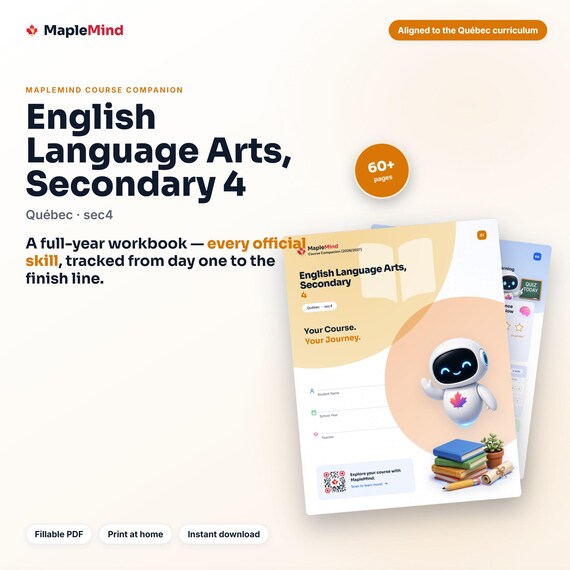
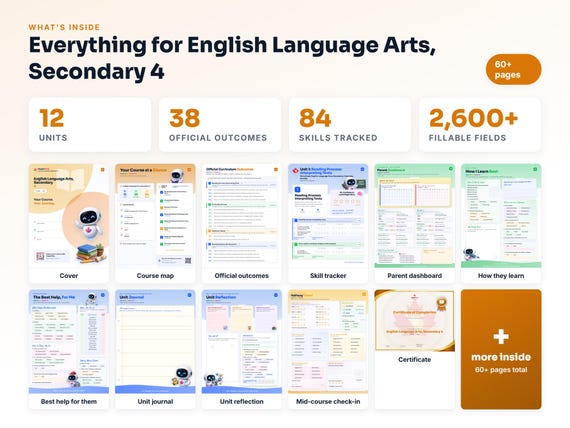
A English Language Arts, Secondary 4 workbook worth keeping
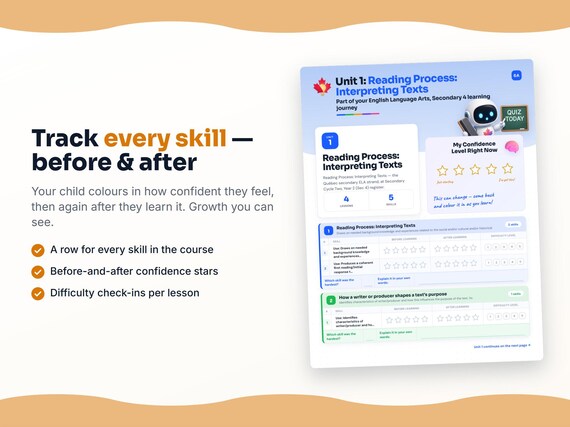
Built from the same official curriculum as this page. Before and after each skill above, your student colours in how sure they feel — so the two of you can see, on one page, what's clicking and what needs another look. It's a quiet way to follow how the year is really going.
By June it's full of their own handwriting: units worked through, confidence grown, a mid-year check-in, notes from parent-teacher night, and a certificate at the end. Less a worksheet, more a record of the year worth keeping on the shelf.
Instant download · see every page, reviews and the full description · five or more workbooks are $2.99 each
What it looks like in the app
Common questions
Can MapleMind help me with English Language Arts, Secondary 4?
Yes. MapleMind's AI tutor covers all 84 skills in Quebec's English Language Arts, Secondary 4 — you pick the exact skill, and the tutor teaches it step by step: a short lesson, a worked example, solving together, then a skill check to show it stuck.
Is MapleMind aligned to Quebec's official curriculum?
Yes. Every skill in this course maps to an official outcome code from Quebec's Secondary 4 English Language Arts curriculum, and the ministry's own wording is quoted under each unit on this page — with the official government source linked so you can check it yourself.
What does MapleMind cost?
It's free to start — 5 tutoring chats and a practice quiz every day, no credit card. A Pro subscription ($9.99/month or $49.99/year CAD, 7-day free trial) unlocks unlimited tutoring, practice, and exam simulations.
What if I'm stuck on just one topic?
That's the point of skill-level tutoring: open English Language Arts, Secondary 4 in the app, tap the exact skill from the list on this page, and the tutor teaches just that — no wading through lessons you don't need.
Does MapleMind work in French or other languages?
Yes — 14 languages, including French. Both the app and the tutor's explanations switch to the language you choose.
Where can I see the official Quebec curriculum for English Language Arts, Secondary 4?
The official source is linked on this page — Québec's official English language arts program. The outline here follows it: every MapleMind skill carries its official outcome code, and the ministry's own wording is quoted under each unit.
Keep exploring
Ready when you are
Pick a skill from this page and see it taught properly — free, in the browser, in under a minute.