Get help with English Language Arts, Secondary 3
Most tutoring makes you sit through material you already know. MapleMind flips that: pick the exact skill that's causing trouble — any of the 97 below — and the tutor teaches just that one, step by step, as many times as it takes. Ask questions in plain words, any time of day, in English, French, or 12 other languages.
The official Quebec English Language Arts, Secondary 3 curriculum
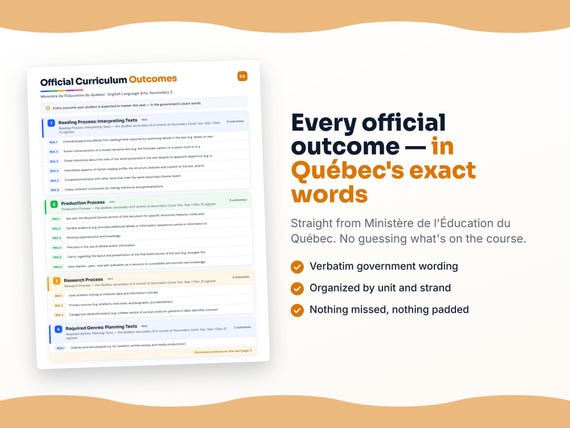
Quebec defines English Language Arts, Secondary 3 by strands and outcomes. MapleMind teaches the same curriculum reorganized for one-skill-at-a-time tutoring — the table shows exactly where every official strand lands, and the ministry's own wording is quoted under each unit below.
Official source Québec's official English language arts programRead it on the government site — quebec.ca ↗| Official strand | Outcomes | Where MapleMind teaches it |
|---|---|---|
| Strand A | 14 | Reading Process: Interpreting Texts |
| Strand B | 13 | Production Process |
| Strand C | 7 | Research Process |
| Strand D | 4 | Required Genres: Planning Texts |
| Strand E | 12 | Required Genres: Reflective Texts |
| Strand F | 12 | Required Genres: Narrative Texts |
| Strand G | 4 | Required Genres: Explanatory Texts |
| Strand H | 5 | Required Genres: Reports |
| Strand I | 4 | Exposition: Persuasive Texts |
| Strand J | 1 | Exposition: Argumentative Texts |
| Strand K | 3 | Conventions: Spoken Language |
| Strand L | 7 | Conventions: Written Language |
| Strand M | 11 | Conventions: Media Language |
Every skill below, taught one on one.
 Try the first session free
How MapleMind teaches English Language Arts, Secondary 3 — every unit, lesson, and skill
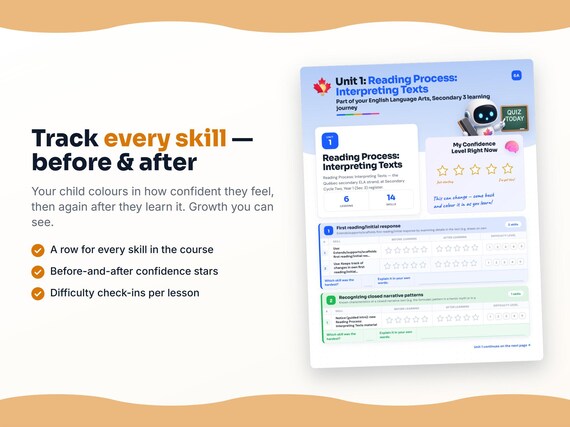
Every skill below runs as a short session: a plain-words lesson, a worked example, solving it together, then a five-question skill check that earns up to three stars. Guided Mode keeps it teaching instead of answer-handing — turning it off needs a parent's password.
Unit 1Reading Process: Interpreting TextsOfficial strand · Strand A
Reading Process: Interpreting Texts — the Québec secondary ELA strand, at Secondary Cycle Two, Year 1 (Sec 3) register.
First reading/initial response
- Use: Extends/supports/scaffolds first reading/initial res…s006-Read.8 — Mastery of “Extends/supports/scaffolds first reading/initial respons…” (Reading Process: Interpreting Texts) at Secondary Cycle Two, Year 1 (Sec 3) ELA.
- Use: Keeps track of changes in own first reading/initial…s007-Read.9 — Mastery of “Keeps track of changes in own first reading/initial resp…” (Reading Process: Interpreting Texts) at Secondary Cycle Two, Year 1 (Sec 3) ELA.
Recognizing closed narrative patterns
- Notice (guided intro): new Reading Process: Interpreting Texts materials009-Read.11 — Guided introduction to the Reading Process: Interpreting Texts strand at Secondary Cycle Two, Year 1 (Sec 3) ELA — a clustered first-develops exposure skill for the strand's newly introduced material (matrix develops-year; representative leaf s009-Read.11).
Inferring a text's view of the world
- Use: Draws inferences about the view of the world present…s012-Read.14 — Mastery of “Draws inferences about the view of the world presented i…” (Reading Process: Interpreting Texts) at Secondary Cycle Two, Year 1 (Sec 3) ELA.
- Use: Draws generalizations and conclusions based on evide…s013-Read.15 — Mastery of “Draws generalizations and conclusions based on evidence…” (Reading Process: Interpreting Texts) at Secondary Cycle Two, Year 1 (Sec 3) ELA.
- Use: Locates evidence in the text of how the writer/produ…s014-Read.16 — Mastery of “Locates evidence in the text of how the writer/producer…” (Reading Process: Interpreting Texts) at Secondary Cycle Two, Year 1 (Sec 3) ELA.
Interpretation of the text
- Use: Interrelates aspects of his/her reading profile, the…s020-Read.22 — Mastery of “Interrelates aspects of his/her reading profile, the str…” (Reading Process: Interpreting Texts) at Secondary Cycle Two, Year 1 (Sec 3) ELA.
- Use: Determines own working hypothesis, theory, controlli…s021-Read.23 — Mastery of “Determines own working hypothesis, theory, controlling i…” (Reading Process: Interpreting Texts) at Secondary Cycle Two, Year 1 (Sec 3) ELA.
- Use: Organizes elements of own interpretation in order to…s022-Read.24 — Mastery of “Organizes elements of own interpretation in order to ach…” (Reading Process: Interpreting Texts) at Secondary Cycle Two, Year 1 (Sec 3) ELA.
Comparing texts on the same theme
- Use: Compares/contrasts with other texts that treat the s…s026-Read.28 — Mastery of “Compares/contrasts with other texts that treat the same…” (Reading Process: Interpreting Texts) at Secondary Cycle Two, Year 1 (Sec 3) ELA.
- Use: Analyzes dominant features of the text, such as its…s027-Read.29 — Mastery of “Analyzes dominant features of the text, such as its poin…” (Reading Process: Interpreting Texts) at Secondary Cycle Two, Year 1 (Sec 3) ELA.
- Use: Explains how real and imaginary are represented by t…s028-Read.30 — Mastery of “Explains how real and imaginary are represented by the w…” (Reading Process: Interpreting Texts) at Secondary Cycle Two, Year 1 (Sec 3) ELA.
- Use: Explains how fact and opinion are represented by the…s029-Read.31 — Mastery of “Explains how fact and opinion are represented by the wri…” (Reading Process: Interpreting Texts) at Secondary Cycle Two, Year 1 (Sec 3) ELA.
Drawing conclusions through inference
- Use: Draws coherent conclusions by making inferences and…s035-Read.37 — Mastery of “Draws coherent conclusions by making inferences and gene…” (Reading Process: Interpreting Texts) at Secondary Cycle Two, Year 1 (Sec 3) ELA.
The official wording — 14 outcomes in this unit
- s006-Read.8
Extends/supports/scaffolds first reading/initial response by examining details in the text (e.g. draws on own
- s007-Read.9
Keeps track of changes in own first reading/initial response as s/he works toward a more considered
- s009-Read.11
Known characteristics of a closed narrative text (e.g. the formulaic pattern in a heroic myth or in a
- s012-Read.14
Draws inferences about the view of the world presented in the text despite its apparent objectivity (e.g. in
- s013-Read.15
Draws generalizations and conclusions based on evidence in the text (e.g. synthesizes key ideas and
- s014-Read.16
Locates evidence in the text of how the writer/producer creates a relationship between the text and its
- s020-Read.22
Interrelates aspects of his/her reading profile, the structure, features and content of the text, and its
- s021-Read.23
Determines own working hypothesis, theory, controlling idea, or thesis statement
- s022-Read.24
Organizes elements of own interpretation in order to achieve coherence and communicate clearly
- s026-Read.28
Compares/contrasts with other texts that treat the same issue/topic/theme /event
- s027-Read.29
Analyzes dominant features of the text, such as its point of view, use of persuasive language, connotation
- s028-Read.30
Explains how real and imaginary are represented by the writer/producer and to what effect
- s029-Read.31
Explains how fact and opinion are represented by the writer/producer and to what effect
- s035-Read.37
Draws coherent conclusions by making inferences and generalizations
Unit 2Production ProcessOfficial strand · Strand B
Production Process — the Québec secondary ELA strand, at Secondary Cycle Two, Year 1 (Sec 3) register.
The unique conventions of a specific genre
- Use: See also the Required Genres section of this documen…s038-Prod.4 — Mastery of “See also the Required Genres section of this document fo…” (Production Process) at Secondary Cycle Two, Year 1 (Sec 3) ELA.
- Use: Purpose and context in which the text was produced t…s039-Prod.5 — Mastery of “Purpose and context in which the text was produced that…” (Production Process) at Secondary Cycle Two, Year 1 (Sec 3) ELA.
- Use: How characteristics of the intended/target audience…s040-Prod.6 — Mastery of “How characteristics of the intended/target audience are…” (Production Process) at Secondary Cycle Two, Year 1 (Sec 3) ELA.
Meeting your audience's needs
- Use: Familiar audience (e.g. provides additional details…s049-Prod.15 — Mastery of “Familiar audience (e.g. provides additional details or i…” (Production Process) at Secondary Cycle Two, Year 1 (Sec 3) ELA.
- Notice (guided intro): new Production Process materials050-Prod.16 — Guided introduction to the Production Process strand at Secondary Cycle Two, Year 1 (Sec 3) ELA — a clustered first-develops exposure skill for the strand's newly introduced material (matrix develops-year; representative leaf s050-Prod.16).
Writing from a range of stances
- Use: Personal experience(s) and knowledges052-Prod.18 — Mastery of “Personal experience(s) and knowledge” (Production Process) at Secondary Cycle Two, Year 1 (Sec 3) ELA.
- Use: Uses appropriate organizational devices in light of…s054-Prod.20 — Mastery of “Uses appropriate organizational devices in light of text…” (Production Process) at Secondary Cycle Two, Year 1 (Sec 3) ELA.
- Use: Researches to locate material, resources and/or expe…s055-Prod.21 — Mastery of “Researches to locate material, resources and/or expertis…” (Production Process) at Secondary Cycle Two, Year 1 (Sec 3) ELA.
Evaluating and revising a draft
- Use: Precision in the use of details and/or informations066-Prod.34 — Mastery of “Precision in the use of details and/or information” (Production Process) at Secondary Cycle Two, Year 1 (Sec 3) ELA.
- Use: Coherence in light of the production context, purpos…s067-Prod.35 — Mastery of “Coherence in light of the production context, purpose, i…” (Production Process) at Secondary Cycle Two, Year 1 (Sec 3) ELA.
- Use: Accuracy in the use of structure, features, codes an…s068-Prod.36 — Mastery of “Accuracy in the use of structure, features, codes and co…” (Production Process) at Secondary Cycle Two, Year 1 (Sec 3) ELA.
Proofreading for layout and presentation
- Use: Clarity regarding the layout and presentation of the…s073-Prod.41 — Mastery of “Clarity regarding the layout and presentation of the fin…” (Production Process) at Secondary Cycle Two, Year 1 (Sec 3) ELA.
Self-evaluating your production process
- Use: Uses teacher- peer- and self-evaluation as a resourc…s082-Prod.50 — Mastery of “Uses teacher- peer- and self-evaluation as a resource to…” (Production Process) at Secondary Cycle Two, Year 1 (Sec 3) ELA.
The official wording — 13 outcomes in this unit
- s038-Prod.4
See also the Required Genres section of this document for specific structures, features, codes and
- s039-Prod.5
Purpose and context in which the text was produced that influence features such as its style, rhetorical
- s040-Prod.6
How characteristics of the intended/target audience are represented such as their needs, expectations, age
- s049-Prod.15
Familiar audience (e.g. provides additional details or information; sequences events or information to
- s050-Prod.16
Distant but known audience, conceptually appropriate for an adolescent (e.g. considers audience knowledge
- s052-Prod.18
Personal experience(s) and knowledge
- s054-Prod.20
Uses appropriate organizational devices in light of text, purpose, intended/target audience,
- s055-Prod.21
Researches to locate material, resources and/or expertise
- s066-Prod.34
Precision in the use of details and/or information
- s067-Prod.35
Coherence in light of the production context, purpose, intended/target audience and production criteria
- s068-Prod.36
Accuracy in the use of structure, features, codes and conventions of the text, including respect for media
- s073-Prod.41
Clarity regarding the layout and presentation of the final draft/version of the text (e.g. arranges the
- s082-Prod.50
Uses teacher- peer- and self-evaluation as a resource to consolidate and reinvest new knowledge,
Unit 3Research ProcessOfficial strand · Strand C
Research Process — the Québec secondary ELA strand, at Secondary Cycle Two, Year 1 (Sec 3) register.
Research Process
- Use: Uses problem solving to interpret data and informati…s084-Rese.2 — Mastery of “Uses problem solving to interpret data and information c…” (Research Process) at Secondary Cycle Two, Year 1 (Sec 3) ELA.
- Use: Narrows topic/subject in order to focus research (e.…s088-Rese.7 — Mastery of “Narrows topic/subject in order to focus research (e.g. l…” (Research Process) at Secondary Cycle Two, Year 1 (Sec 3) ELA.
- Notice (guided intro): new Research Process materials086-Rese.4 — Guided introduction to the Research Process strand at Secondary Cycle Two, Year 1 (Sec 3) ELA — a clustered first-develops exposure skill for the strand's newly introduced material (matrix develops-year; representative leaf s086-Rese.4).
Gathering data from primary sources
- Use: Primary sources (e.g. artefacts, interviews, autobio…s092-Rese.11 — Mastery of “Primary sources (e.g. artefacts, interviews, autobiograp…” (Research Process) at Secondary Cycle Two, Year 1 (Sec 3) ELA.
- Use: Secondary sources (e.g. reference texts, newspaper a…s093-Rese.12 — Mastery of “Secondary sources (e.g. reference texts, newspaper artic…” (Research Process) at Secondary Cycle Two, Year 1 (Sec 3) ELA.
Interpreting data and findings
- Use: Categorizes data/information (e.g. collates results…s096-Rese.15 — Mastery of “Categorizes data/information (e.g. collates results of s…” (Research Process) at Secondary Cycle Two, Year 1 (Sec 3) ELA.
- Use: Makes generalizations (e.g. determines statistical s…s097-Rese.16 — Mastery of “Makes generalizations (e.g. determines statistical signi…” (Research Process) at Secondary Cycle Two, Year 1 (Sec 3) ELA.
The official wording — 7 outcomes in this unit
- s084-Rese.2
Uses problem solving to interpret data and information critically
- s088-Rese.7
Narrows topic/subject in order to focus research (e.g. lists pros/cons, creates sub-questions)
- s086-Rese.4
Uses ethnography to study a social world relevant to an adolescent
- s092-Rese.11
Primary sources (e.g. artefacts, interviews, autobiography, journals/diaries)
- s093-Rese.12
Secondary sources (e.g. reference texts, newspaper articles, books)
- s096-Rese.15
Categorizes data/information (e.g. collates results of surveys; looks for patterns in data; identifies common
- s097-Rese.16
Makes generalizations (e.g. determines statistical significance; chooses relevant evidence to support thesis;
Unit 4Required Genres: Planning TextsOfficial strand · Strand D
Required Genres: Planning Texts — the Québec secondary ELA strand, at Secondary Cycle Two, Year 1 (Sec 3) register.
Planning with outlines and storyboards
- Use: Outlines and storyboards (i.e. for research, written…s112-Requ.14 — Mastery of “Outlines and storyboards (i.e. for research, written ess…” (Required Genres: Planning Texts) at Secondary Cycle Two, Year 1 (Sec 3) ELA.
Planning with action lists
- Use: List of actions to undertake or of ideas to discuss/…s116-Requ.18 — Mastery of “List of actions to undertake or of ideas to discuss/exam…” (Required Genres: Planning Texts) at Secondary Cycle Two, Year 1 (Sec 3) ELA.
- Use: Organization, categorization, collation and sequenci…s117-Requ.19 — Mastery of “Organization, categorization, collation and sequencing o…” (Required Genres: Planning Texts) at Secondary Cycle Two, Year 1 (Sec 3) ELA.
- Use: Conventions associated with thinking something throu…s118-Requ.20 — Mastery of “Conventions associated with thinking something through,…” (Required Genres: Planning Texts) at Secondary Cycle Two, Year 1 (Sec 3) ELA.
The official wording — 4 outcomes in this unit
- s112-Requ.14
Outlines and storyboards (i.e. for research, written essays and media productions)
- s116-Requ.18
List of actions to undertake or of ideas to discuss/examine (e.g. prioritize tasks, decide on a project’s
- s117-Requ.19
Organization, categorization, collation and sequencing of ideas/information
- s118-Requ.20
Conventions associated with thinking something through, such as informal/tentative language, pauses and
Unit 5Required Genres: Reflective TextsOfficial strand · Strand E
Required Genres: Reflective Texts — the Québec secondary ELA strand, at Secondary Cycle Two, Year 1 (Sec 3) register.
Required Reflective Texts
- Use: Texts reflecting on values, experiences, ideas, opin…s124-Requ.6 — Mastery of “Texts reflecting on values, experiences, ideas, opinions…” (Required Genres: Reflective Texts) at Secondary Cycle Two, Year 1 (Sec 3) ELA.
Written self-evaluation and peer feedback
- Use: Written self-evaluations and reflections, including…s130-Requ.14 — Mastery of “Written self-evaluations and reflections, including writ…” (Required Genres: Reflective Texts) at Secondary Cycle Two, Year 1 (Sec 3) ELA.
- Use: Texts reflecting on values, experiences, ideas, opin…s131-Requ.15 — Mastery of “Texts reflecting on values, experiences, ideas, opinions…” (Required Genres: Reflective Texts) at Secondary Cycle Two, Year 1 (Sec 3) ELA.
How reflective texts are built
- Use: Focus on ideas/experiences/qualities that are select…s133-Requ.18 — Mastery of “Focus on ideas/experiences/qualities that are selected a…” (Required Genres: Reflective Texts) at Secondary Cycle Two, Year 1 (Sec 3) ELA.
- Use: Organizational structure to prioritize, sequence and…s134-Requ.19 — Mastery of “Organizational structure to prioritize, sequence and exp…” (Required Genres: Reflective Texts) at Secondary Cycle Two, Year 1 (Sec 3) ELA.
- Use: Evidence from own experience including personal, glo…s135-Requ.20 — Mastery of “Evidence from own experience including personal, global…” (Required Genres: Reflective Texts) at Secondary Cycle Two, Year 1 (Sec 3) ELA.
- Use: Rhetorical strategies to build rapport, create a sen…s137-Requ.22 — Mastery of “Rhetorical strategies to build rapport, create a sense o…” (Required Genres: Reflective Texts) at Secondary Cycle Two, Year 1 (Sec 3) ELA.
- Use: Tone and register to suit the genre and engage the i…s138-Requ.23 — Mastery of “Tone and register to suit the genre and engage the inten…” (Required Genres: Reflective Texts) at Secondary Cycle Two, Year 1 (Sec 3) ELA.
- Use: Genre-specific conventions (e.g. use of anecdotes, f…s139-Requ.24 — Mastery of “Genre-specific conventions (e.g. use of anecdotes, flash…” (Required Genres: Reflective Texts) at Secondary Cycle Two, Year 1 (Sec 3) ELA.
- Use: Multigenre conventions (e.g. poems in a journal; rec…s140-Requ.25 — Mastery of “Multigenre conventions (e.g. poems in a journal; recount…” (Required Genres: Reflective Texts) at Secondary Cycle Two, Year 1 (Sec 3) ELA.
- Use: Multimodal conventions (e.g. tentative language, ges…s141-Requ.26 — Mastery of “Multimodal conventions (e.g. tentative language, gesture…” (Required Genres: Reflective Texts) at Secondary Cycle Two, Year 1 (Sec 3) ELA.
The official wording — 12 outcomes in this unit
- s124-Requ.6
Texts reflecting on values, experiences, ideas, opinions, state of society today (e.g. personal essay,
- s130-Requ.14
Written self-evaluations and reflections, including written feedback to peers
- s131-Requ.15
Texts reflecting on values, experiences, ideas, opinions, state of society today (e.g. responses and
- s133-Requ.18
Focus on ideas/experiences/qualities that are selected and synthesized
- s134-Requ.19
Organizational structure to prioritize, sequence and explore ideas from multiple perspectives (e.g.
- s135-Requ.20
Evidence from own experience including personal, global and/or textual examples
- s136-Requ.21
Conclusion which shares a realization, resolution or judgment
- s137-Requ.22
Rhetorical strategies to build rapport, create a sense of intimacy and closeness, and diminish boundaries
- s138-Requ.23
Tone and register to suit the genre and engage the intended/target audience, including self (e.g. distant and
- s139-Requ.24
Genre-specific conventions (e.g. use of anecdotes, flashback and humour in a personal essay; questions,
- s140-Requ.25
Multigenre conventions (e.g. poems in a journal; recount in a self-evaluation conference)
- s141-Requ.26
Multimodal conventions (e.g. tentative language, gestures in a conference; decoupage/collage and/or personal
Unit 6Required Genres: Narrative TextsOfficial strand · Strand F
Required Genres: Narrative Texts — the Québec secondary ELA strand, at Secondary Cycle Two, Year 1 (Sec 3) register.
Required Narrative Texts
- Use: Popular mass-produced texts such as magazines, graph…s144-Requ.5 — Mastery of “Popular mass-produced texts such as magazines, graphic n…” (Required Genres: Narrative Texts) at Secondary Cycle Two, Year 1 (Sec 3) ELA.
Spoken literary performances
- Use: Spoken performances (e.g. poetry reading, spoken wor…s150-Requ.12 — Mastery of “Spoken performances (e.g. poetry reading, spoken word, s…” (Required Genres: Narrative Texts) at Secondary Cycle Two, Year 1 (Sec 3) ELA.
- Notice (guided intro): new Required Genres: Narrative Texts materials147-Requ.8 — Guided introduction to the Required Genres: Narrative Texts strand at Secondary Cycle Two, Year 1 (Sec 3) ELA — a clustered first-develops exposure skill for the strand's newly introduced material (matrix develops-year; representative leaf s147-Requ.8).
Narratives in poetic form
- Use: Narratives in poetic form (e.g. lyric poetry, free v…s155-Requ.18 — Mastery of “Narratives in poetic form (e.g. lyric poetry, free verse…” (Required Genres: Narrative Texts) at Secondary Cycle Two, Year 1 (Sec 3) ELA.
How narrative texts are built
- Use: Major and minor characters (e.g. protagonist, antago…s158-Requ.23 — Mastery of “Major and minor characters (e.g. protagonist, antagonist…” (Required Genres: Narrative Texts) at Secondary Cycle Two, Year 1 (Sec 3) ELA.
- Use: Stock and/or flat characters (i.e. characters with o…s159-Requ.24 — Mastery of “Stock and/or flat characters (i.e. characters with only…” (Required Genres: Narrative Texts) at Secondary Cycle Two, Year 1 (Sec 3) ELA.
- Use: Conflict and resolution of conflict (i.e. central pr…s161-Requ.26 — Mastery of “Conflict and resolution of conflict (i.e. central proble…” (Required Genres: Narrative Texts) at Secondary Cycle Two, Year 1 (Sec 3) ELA.
- Use: Features that move the story forward (i.e. incidents…s163-Requ.29 — Mastery of “Features that move the story forward (i.e. incidents, sc…” (Required Genres: Narrative Texts) at Secondary Cycle Two, Year 1 (Sec 3) ELA.
Reading overt and implied theme
- Use: Overt or implied theme(s)s168-Requ.35 — Mastery of “Overt or implied theme(s)” (Required Genres: Narrative Texts) at Secondary Cycle Two, Year 1 (Sec 3) ELA.
Literary techniques: character development
- Use: Character development (e.g. dialogue, dialect, patho…s174-Requ.41 — Mastery of “Character development (e.g. dialogue, dialect, pathos)” (Required Genres: Narrative Texts) at Secondary Cycle Two, Year 1 (Sec 3) ELA.
- Use: Figurative language: metaphor, simile, imagery, pers…s175-Requ.42 — Mastery of “Figurative language: metaphor, simile, imagery, personif…” (Required Genres: Narrative Texts) at Secondary Cycle Two, Year 1 (Sec 3) ELA.
- Use: Aesthetic qualities of language (e.g. alliteration,…s176-Requ.43 — Mastery of “Aesthetic qualities of language (e.g. alliteration, rhym…” (Required Genres: Narrative Texts) at Secondary Cycle Two, Year 1 (Sec 3) ELA.
The official wording — 12 outcomes in this unit
- s144-Requ.5
Popular mass-produced texts such as magazines, graphic novels, films and songs
- s150-Requ.12
Spoken performances (e.g. poetry reading, spoken word, storytelling, dialogues)
- s147-Requ.8
Written for adults and reflecting the variety of texts in the literary tradition, including novels, short
- s155-Requ.18
Narratives in poetic form (e.g. lyric poetry, free verse, ballad, poetry of social commentary/conscience)
- s158-Requ.23
Major and minor characters (e.g. protagonist, antagonist, anti-hero, foil)
- s159-Requ.24
Stock and/or flat characters (i.e. characters with only one or two qualities or traits, often stereotypes of
- s161-Requ.26
Conflict and resolution of conflict (i.e. central problem around which a story is typically organized) such
- s163-Requ.29
Features that move the story forward (i.e. incidents, scenes, episodes, and subplots)
- s168-Requ.35
Overt or implied theme(s)
- s174-Requ.41
Character development (e.g. dialogue, dialect, pathos)
- s175-Requ.42
Figurative language: metaphor, simile, imagery, personification
- s176-Requ.43
Aesthetic qualities of language (e.g. alliteration, rhyme, rhythm, onomatopoeia)
Unit 7Required Genres: Explanatory TextsOfficial strand · Strand G
Required Genres: Explanatory Texts — the Québec secondary ELA strand, at Secondary Cycle Two, Year 1 (Sec 3) register.
Required Explanatory Texts
- Use: Explanations of a process (e.g. teaching something t…s193-Requ.9 — Mastery of “Explanations of a process (e.g. teaching something to pe…” (Required Genres: Explanatory Texts) at Secondary Cycle Two, Year 1 (Sec 3) ELA.
How explanatory texts are built
- Use: Visuals to focus reader’s attention on what is most…s201-Requ.19 — Mastery of “Visuals to focus reader’s attention on what is most impo…” (Required Genres: Explanatory Texts) at Secondary Cycle Two, Year 1 (Sec 3) ELA.
- Use: Rhetorical strategies to engage the intended/target…s202-Requ.20 — Mastery of “Rhetorical strategies to engage the intended/target audi…” (Required Genres: Explanatory Texts) at Secondary Cycle Two, Year 1 (Sec 3) ELA.
- Notice (guided intro): new Required Genres: Explanatory Texts materials203-Requ.21 — Guided introduction to the Required Genres: Explanatory Texts strand at Secondary Cycle Two, Year 1 (Sec 3) ELA — a clustered first-develops exposure skill for the strand's newly introduced material (matrix develops-year; representative leaf s203-Requ.21).
The official wording — 4 outcomes in this unit
- s193-Requ.9
Explanations of a process (e.g. teaching something to peers/class, sharing expertise with others)
- s201-Requ.19
Visuals to focus reader’s attention on what is most important (e.g. headings, captions, labels, graphics,
- s202-Requ.20
Rhetorical strategies to engage the intended/target audience and assure their comprehension (e.g. expert to
- s203-Requ.21
Multigenre conventions (e.g. emotional appeals (persuasive) and testimonials (narrative) in a pamphlet
Unit 8Required Genres: ReportsOfficial strand · Strand H
Required Genres: Reports — the Québec secondary ELA strand, at Secondary Cycle Two, Year 1 (Sec 3) register.
Required Reports
- Notice (guided intro): new Required Genres: Reports materials213-Requ.14 — Guided introduction to the Required Genres: Reports strand at Secondary Cycle Two, Year 1 (Sec 3) ELA — a clustered first-develops exposure skill for the strand's newly introduced material (matrix develops-year; representative leaf s213-Requ.14).
- Use: on areas of student interest and/or expertise on top…s214-Requ.16 — Mastery of “on areas of student interest and/or expertise on topics…” (Required Genres: Reports) at Sec 3 ELA. (Unmatched leaf: symbol order-check failed; band fallback anchors mastery here per memo 7.2.)
How reports are built
- Use: Information organized and sequenced using a structur…s216-Requ.19 — Mastery of “Information organized and sequenced using a structure su…” (Required Genres: Reports) at Secondary Cycle Two, Year 1 (Sec 3) ELA.
- Use: Layout which visually cues the reader (e.g. subheadi…s217-Requ.20 — Mastery of “Layout which visually cues the reader (e.g. subheadings,…” (Required Genres: Reports) at Secondary Cycle Two, Year 1 (Sec 3) ELA.
Matching structure to the information reported
- Use: Visual conventions to convey information, meaning(s)…s234-Requ.39 — Mastery of “Visual conventions to convey information, meaning(s) and…” (Required Genres: Reports) at Secondary Cycle Two, Year 1 (Sec 3) ELA.
The official wording — 5 outcomes in this unit
- s213-Requ.14
Feature news stories on topics of local, national and/or international interest
- s214-Requ.16
on areas of student interest and/or expertise on topics of local, national and/or international interest
- s216-Requ.19
Information organized and sequenced using a structure such as chronology, classification, compare/contrast,
- s217-Requ.20
Layout which visually cues the reader (e.g. subheadings, call-outs, paragraphs, arrows, headline, by-line,
- s234-Requ.39
Visual conventions to convey information, meaning(s) and relationships among ideas such as in a timeline or
Unit 9Exposition: Persuasive TextsOfficial strand · Strand I
Exposition: Persuasive Texts — the Québec secondary ELA strand, at Secondary Cycle Two, Year 1 (Sec 3) register.
Required Persuasive Texts
- Use: Advertisements, including public service announcemen…s240-Expo.4 — Mastery of “Advertisements, including public service announcements (…” (Exposition: Persuasive Texts) at Secondary Cycle Two, Year 1 (Sec 3) ELA.
- Use: Reviews (e.g. of books, television programs, films,…s241-Expo.5 — Mastery of “Reviews (e.g. of books, television programs, films, musi…” (Exposition: Persuasive Texts) at Secondary Cycle Two, Year 1 (Sec 3) ELA.
- Use: Advertisements, including public service announcemen…s244-Expo.10 — Mastery of “Advertisements, including public service announcements (…” (Exposition: Persuasive Texts) at Secondary Cycle Two, Year 1 (Sec 3) ELA.
- Notice (guided intro): new Exposition: Persuasive Texts materials246-Expo.12 — Guided introduction to the Exposition: Persuasive Texts strand at Secondary Cycle Two, Year 1 (Sec 3) ELA — a clustered first-develops exposure skill for the strand's newly introduced material (matrix develops-year; representative leaf s246-Expo.12).
The official wording — 4 outcomes in this unit
- s240-Expo.4
Advertisements, including public service announcements (PSAs), publicity campaigns, popular slogans, posters,
- s241-Expo.5
Reviews (e.g. of books, television programs, films, music)
- s244-Expo.10
Advertisements, including public service announcements (PSAs), posters, book trailers
- s246-Expo.12
Essays dealing with personal and social concerns (e.g. opinion column, position paper)
Unit 10Exposition: Argumentative TextsOfficial strand · Strand J
Exposition: Argumentative Texts — the Québec secondary ELA strand, at Secondary Cycle Two, Year 1 (Sec 3) register.
Required Argumentative Texts
- Notice (guided intro): new Exposition: Argumentative Texts materials274-Expo.4 — Guided introduction to the Exposition: Argumentative Texts strand at Secondary Cycle Two, Year 1 (Sec 3) ELA — a clustered first-develops exposure skill for the strand's newly introduced material (matrix develops-year; representative leaf s274-Expo.4).
The official wording — 1 outcome in this unit
- s274-Expo.4
Texts dealing with personal and social concerns, such as political blogs, editorials, televised panel
Unit 11Conventions: Spoken LanguageOfficial strand · Strand K
Conventions: Spoken Language — the Québec secondary ELA strand, at Secondary Cycle Two, Year 1 (Sec 3) register.
Conventions: Spoken Language
- Use: Adapts the rhetorical aspects of spoken language to…s299-Conv.3 — Mastery of “Adapts the rhetorical aspects of spoken language to purp…” (Conventions: Spoken Language) at Secondary Cycle Two, Year 1 (Sec 3) ELA.
- Use: Uses the aesthetic qualities of spoken language to g…s302-Conv.7 — Mastery of “Uses the aesthetic qualities of spoken language to give…” (Conventions: Spoken Language) at Secondary Cycle Two, Year 1 (Sec 3) ELA.
- Notice (guided intro): new Conventions: Spoken Language materials303-Conv.8 — Guided introduction to the Conventions: Spoken Language strand at Secondary Cycle Two, Year 1 (Sec 3) ELA — a clustered first-develops exposure skill for the strand's newly introduced material (matrix develops-year; representative leaf s303-Conv.8).
The official wording — 3 outcomes in this unit
- s299-Conv.3
Adapts the rhetorical aspects of spoken language to purpose, intended/target audience and genre (e.g. uses a
- s302-Conv.7
Uses the aesthetic qualities of spoken language to give added meaning and depth to specific spoken genres
- s303-Conv.8
Uses knowledge of affordances of spoken language to achieve a specific effect in different contexts (e.g.
Unit 12Conventions: Written LanguageOfficial strand · Strand L
Conventions: Written Language — the Québec secondary ELA strand, at Secondary Cycle Two, Year 1 (Sec 3) register.
Syntax and usage
- Use: Uses a variety of sentence structures (simple, compo…s315-Conv.13 — Mastery of “Uses a variety of sentence structures (simple, compound,…” (Conventions: Written Language) at Secondary Cycle Two, Year 1 (Sec 3) ELA.
- Use: Demonstrates consistent variation in sentence beginn…s316-Conv.14 — Mastery of “Demonstrates consistent variation in sentence beginnings…” (Conventions: Written Language) at Secondary Cycle Two, Year 1 (Sec 3) ELA.
- Use: Respects subject/verb agreement, including verb tens…s317-Conv.15 — Mastery of “Respects subject/verb agreement, including verb tense, p…” (Conventions: Written Language) at Secondary Cycle Two, Year 1 (Sec 3) ELA.
- Use: Uses colons and semicolons correctlys328-Conv.29 — Mastery of “Uses colons and semicolons correctly” (Conventions: Written Language) at Secondary Cycle Two, Year 1 (Sec 3) ELA.
- Use: Uses relevant/required print cues (e.g. underlining…s331-Conv.32 — Mastery of “Uses relevant/required print cues (e.g. underlining or i…” (Conventions: Written Language) at Secondary Cycle Two, Year 1 (Sec 3) ELA.
- Notice (guided intro): new Conventions: Written Language materials332-Conv.33 — Guided introduction to the Conventions: Written Language strand at Secondary Cycle Two, Year 1 (Sec 3) ELA — a clustered first-develops exposure skill for the strand's newly introduced material (matrix develops-year; representative leaf s332-Conv.33).
Word Choice/Diction
- Use: Uses a metalanguage to discuss own texts, own progre…s335-Conv.36 — Mastery of “Uses a metalanguage to discuss own texts, own progress a…” (Conventions: Written Language) at Secondary Cycle Two, Year 1 (Sec 3) ELA.
The official wording — 7 outcomes in this unit
- s315-Conv.13
Uses a variety of sentence structures (simple, compound, complex and compound-complex) and transitional words
- s316-Conv.14
Demonstrates consistent variation in sentence beginnings, lengths and patterns (i.e. sentence arrangement)
- s317-Conv.15
Respects subject/verb agreement, including verb tense, point of view, pronouns, etc.
- s328-Conv.29
Uses colons and semicolons correctly
- s331-Conv.32
Uses relevant/required print cues (e.g. underlining or italicizing titles of major works; all caps or bold to
- s332-Conv.33
Uses appropriate format to cite sources (e.g. Chicago, APA, MLA, UPI, any other recognized style manual)
- s335-Conv.36
Uses a metalanguage to discuss own texts, own progress as a learner and/or literary texts
Unit 13Conventions: Media LanguageOfficial strand · Strand M
Conventions: Media Language — the Québec secondary ELA strand, at Secondary Cycle Two, Year 1 (Sec 3) register.
Analyzing the codes of media language
- Use: Depiction of products in advertising (e.g. magazine,…s341-Conv.5 — Mastery of “Depiction of products in advertising (e.g. magazine, tel…” (Conventions: Media Language) at Secondary Cycle Two, Year 1 (Sec 3) ELA.
- Use: Adaptation of a genre in different media (e.g. a nov…s342-Conv.6 — Mastery of “Adaptation of a genre in different media (e.g. a novel a…” (Conventions: Media Language) at Secondary Cycle Two, Year 1 (Sec 3) ELA.
- Use: Coverage of same action or event by a single medium…s343-Conv.7 — Mastery of “Coverage of same action or event by a single medium (e.g…” (Conventions: Media Language) at Secondary Cycle Two, Year 1 (Sec 3) ELA.
How a producer communicates a stance
- Notice (guided intro): new Conventions: Media Language materials349-Conv.13 — Guided introduction to the Conventions: Media Language strand at Secondary Cycle Two, Year 1 (Sec 3) ELA — a clustered first-develops exposure skill for the strand's newly introduced material (matrix develops-year; representative leaf s349-Conv.13).
How sound conventions shape meaning
- Use: Create a sense of tone, mood, emotion, pacing (e.g.…s352-Conv.17 — Mastery of “Create a sense of tone, mood, emotion, pacing (e.g. quic…” (Conventions: Media Language) at Secondary Cycle Two, Year 1 (Sec 3) ELA.
How image conventions shape meaning
- Use: Capture and maintain a viewer’s attention (e.g. came…s356-Conv.21 — Mastery of “Capture and maintain a viewer’s attention (e.g. camera s…” (Conventions: Media Language) at Secondary Cycle Two, Year 1 (Sec 3) ELA.
- Use: Create atmosphere (e.g. dark lighting)s357-Conv.22 — Mastery of “Create atmosphere (e.g. dark lighting)” (Conventions: Media Language) at Secondary Cycle Two, Year 1 (Sec 3) ELA.
- Use: Move action forward (e.g. camera movement and transi…s358-Conv.23 — Mastery of “Move action forward (e.g. camera movement and transition…” (Conventions: Media Language) at Secondary Cycle Two, Year 1 (Sec 3) ELA.
Analyzing bias and stereotyping in media
- Use: Bias or stereotypings363-Conv.28 — Mastery of “Bias or stereotyping” (Conventions: Media Language) at Secondary Cycle Two, Year 1 (Sec 3) ELA.
- Use: Promotion of a product, idea or actions364-Conv.29 — Mastery of “Promotion of a product, idea or action” (Conventions: Media Language) at Secondary Cycle Two, Year 1 (Sec 3) ELA.
- Use: Inferences (e.g. a surge of music to underscore the…s365-Conv.30 — Mastery of “Inferences (e.g. a surge of music to underscore the reun…” (Conventions: Media Language) at Secondary Cycle Two, Year 1 (Sec 3) ELA.
The official wording — 11 outcomes in this unit
- s341-Conv.5
Depiction of products in advertising (e.g. magazine, television, web)
- s342-Conv.6
Adaptation of a genre in different media (e.g. a novel and its adaptation to film)
- s343-Conv.7
Coverage of same action or event by a single medium (e.g. two different radio stations reporting the same
- s349-Conv.13
Establish relevance (i.e. image/word/sound coexist and/or are juxtaposed to create meaning/message such as
- s352-Conv.17
Create a sense of tone, mood, emotion, pacing (e.g. quick tempo to create a sense of urgency in a drama)
- s356-Conv.21
Capture and maintain a viewer’s attention (e.g. camera shots and angles)
- s357-Conv.22
Create atmosphere (e.g. dark lighting)
- s358-Conv.23
Move action forward (e.g. camera movement and transitions, editing)
- s363-Conv.28
Bias or stereotyping
- s364-Conv.29
Promotion of a product, idea or action
- s365-Conv.30
Inferences (e.g. a surge of music to underscore the reunion of lovers in a movie; the downward glance of a
Printable workbook · A keepsake of the year
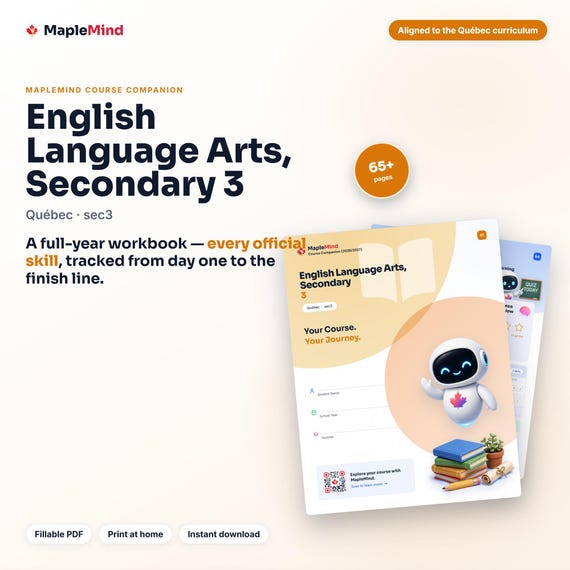
A English Language Arts, Secondary 3 workbook worth keeping
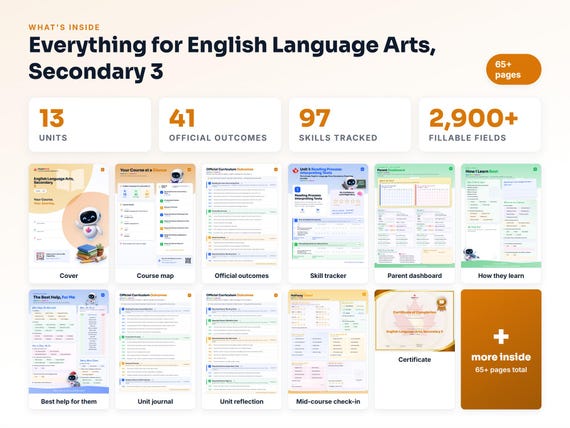
Built from the same official curriculum as this page. Before and after each skill above, your student colours in how sure they feel — so the two of you can see, on one page, what's clicking and what needs another look. It's a quiet way to follow how the year is really going.
By June it's full of their own handwriting: units worked through, confidence grown, a mid-year check-in, notes from parent-teacher night, and a certificate at the end. Less a worksheet, more a record of the year worth keeping on the shelf.
Instant download · see every page, reviews and the full description · five or more workbooks are $2.99 each
What it looks like in the app



Common questions
Can MapleMind help me with English Language Arts, Secondary 3?
Yes. MapleMind's AI tutor covers all 97 skills in Quebec's English Language Arts, Secondary 3 — you pick the exact skill, and the tutor teaches it step by step: a short lesson, a worked example, solving together, then a skill check to show it stuck.
Is MapleMind aligned to Quebec's official curriculum?
Yes. Every skill in this course maps to an official outcome code from Quebec's Secondary 3 English Language Arts curriculum, and the ministry's own wording is quoted under each unit on this page — with the official government source linked so you can check it yourself.
What does MapleMind cost?
It's free to start — 5 tutoring chats and a practice quiz every day, no credit card. A Pro subscription ($9.99/month or $49.99/year CAD, 7-day free trial) unlocks unlimited tutoring, practice, and exam simulations.
What if I'm stuck on just one topic?
That's the point of skill-level tutoring: open English Language Arts, Secondary 3 in the app, tap the exact skill from the list on this page, and the tutor teaches just that — no wading through lessons you don't need.
Does MapleMind work in French or other languages?
Yes — 14 languages, including French. Both the app and the tutor's explanations switch to the language you choose.
Where can I see the official Quebec curriculum for English Language Arts, Secondary 3?
The official source is linked on this page — Québec's official English language arts program. The outline here follows it: every MapleMind skill carries its official outcome code, and the ministry's own wording is quoted under each unit.
Keep exploring
Ready when you are
Pick a skill from this page and see it taught properly — free, in the browser, in under a minute.