Ministerial exam · Quebec
Français, langue d'enseignement, Elementary Grade 6
Ministerial Examinations — Français, langue d'enseignement, Elementary Grade 6: Reading (014‑630) and Writing (014‑620)
- Grade 6
- Written in French
Dates and details can change. We do our best to keep this page up to date, but check the official sources before relying on it.
- Total time
- 9 h
- Marked questions
- 25
- Parts
- 2
- Counts for
- 20% of the final mark
- Calculator
- Not allowed
- Format
- On paper
Épreuve de français, 6e année du primaire practice test
The whole exam or the parts you choose, in its own format, on the clock.
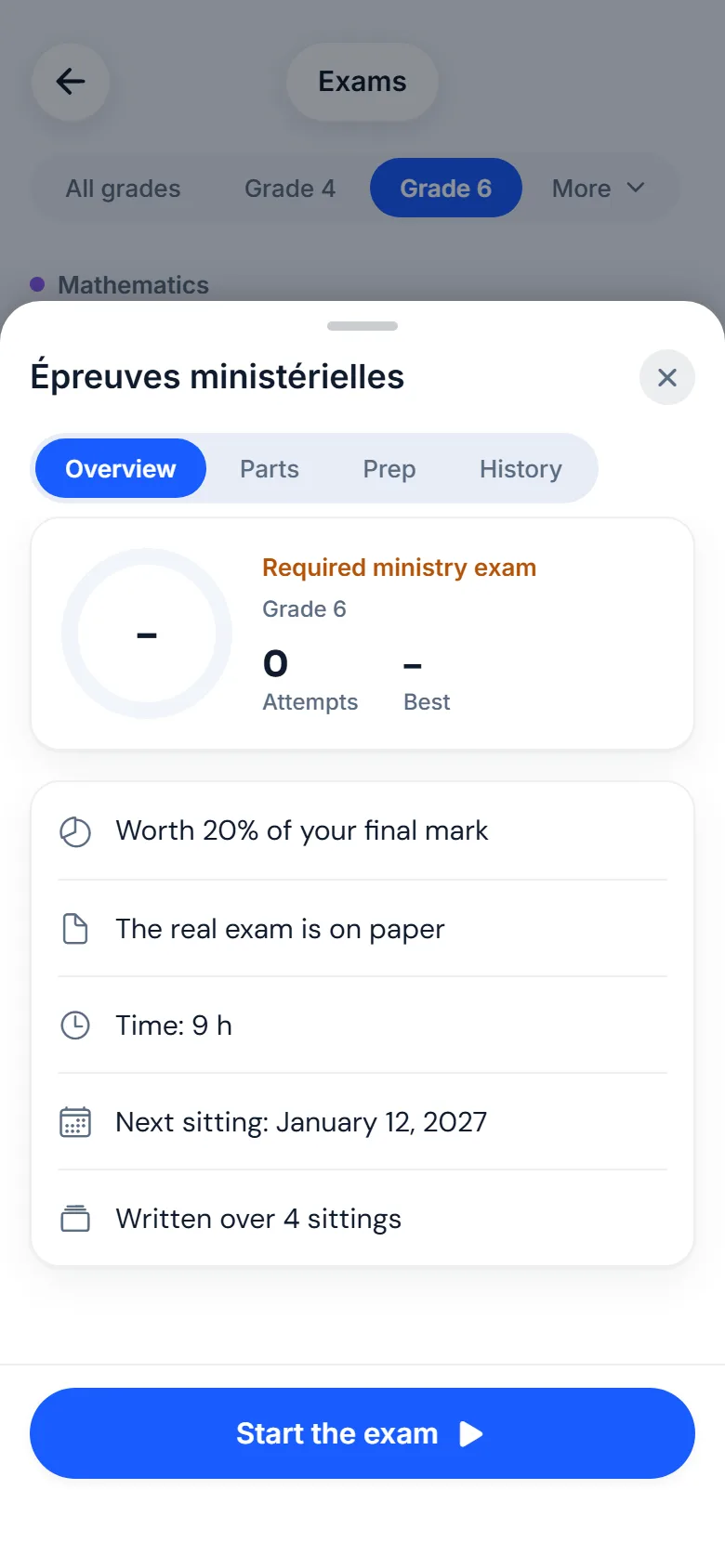 The exam in the app
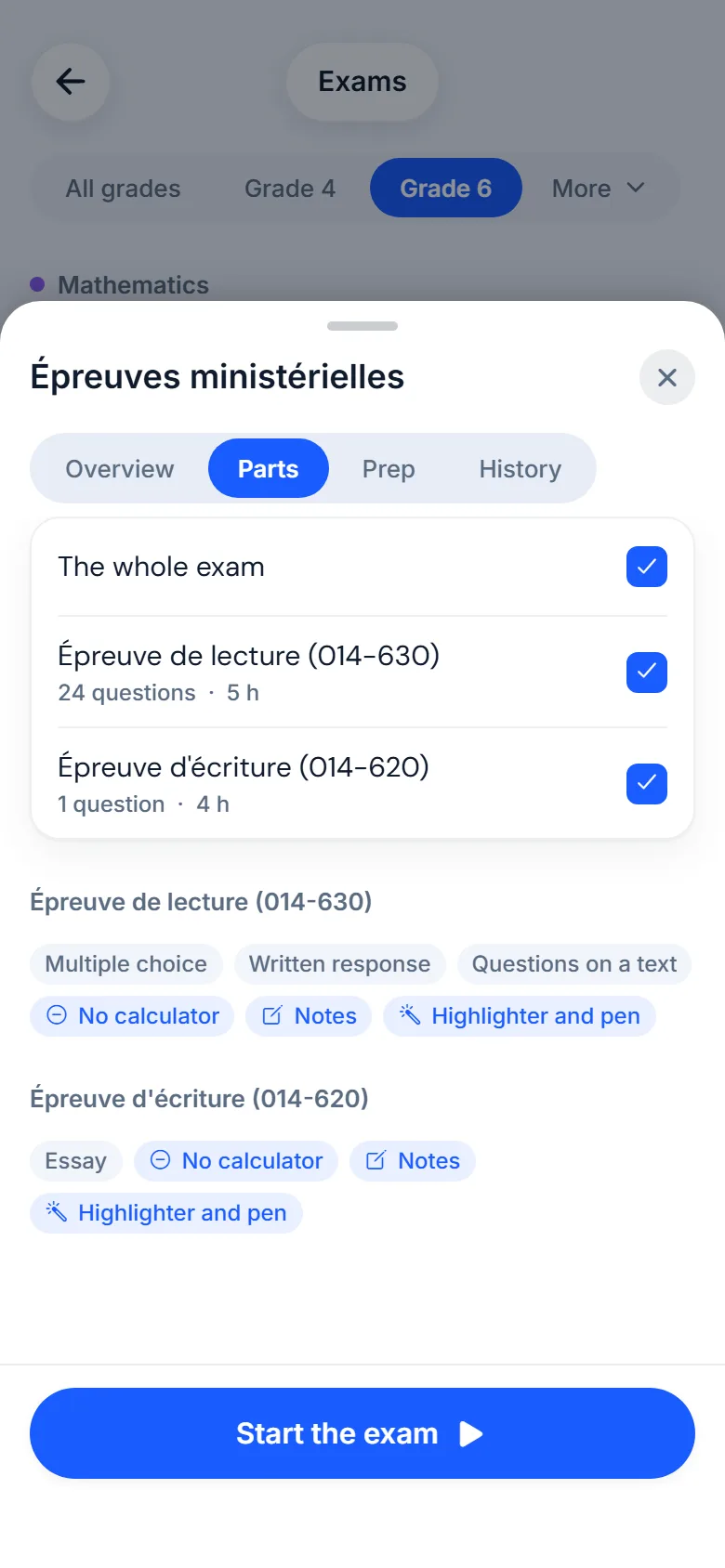 Its parts, and what you can use in each
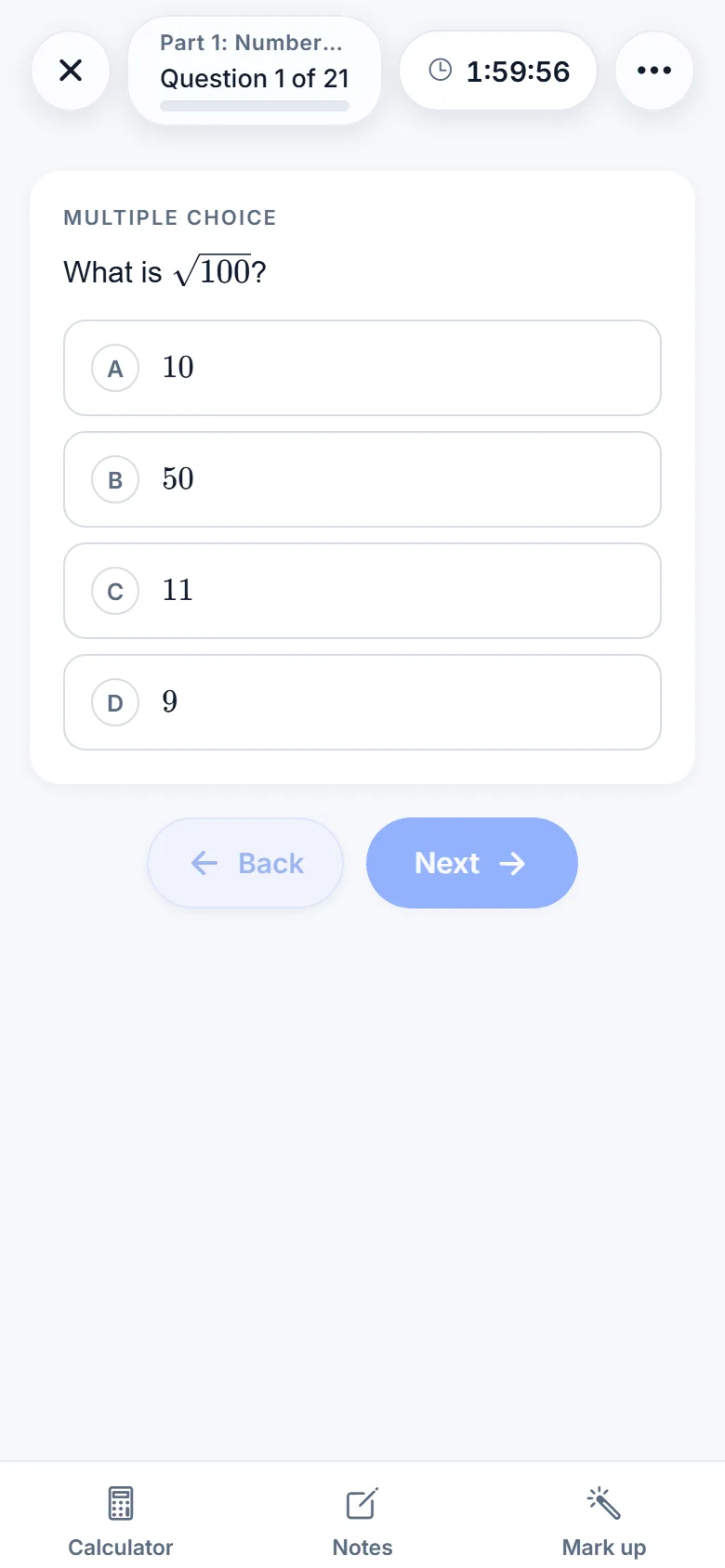 A question, timed, with the exam’s tools
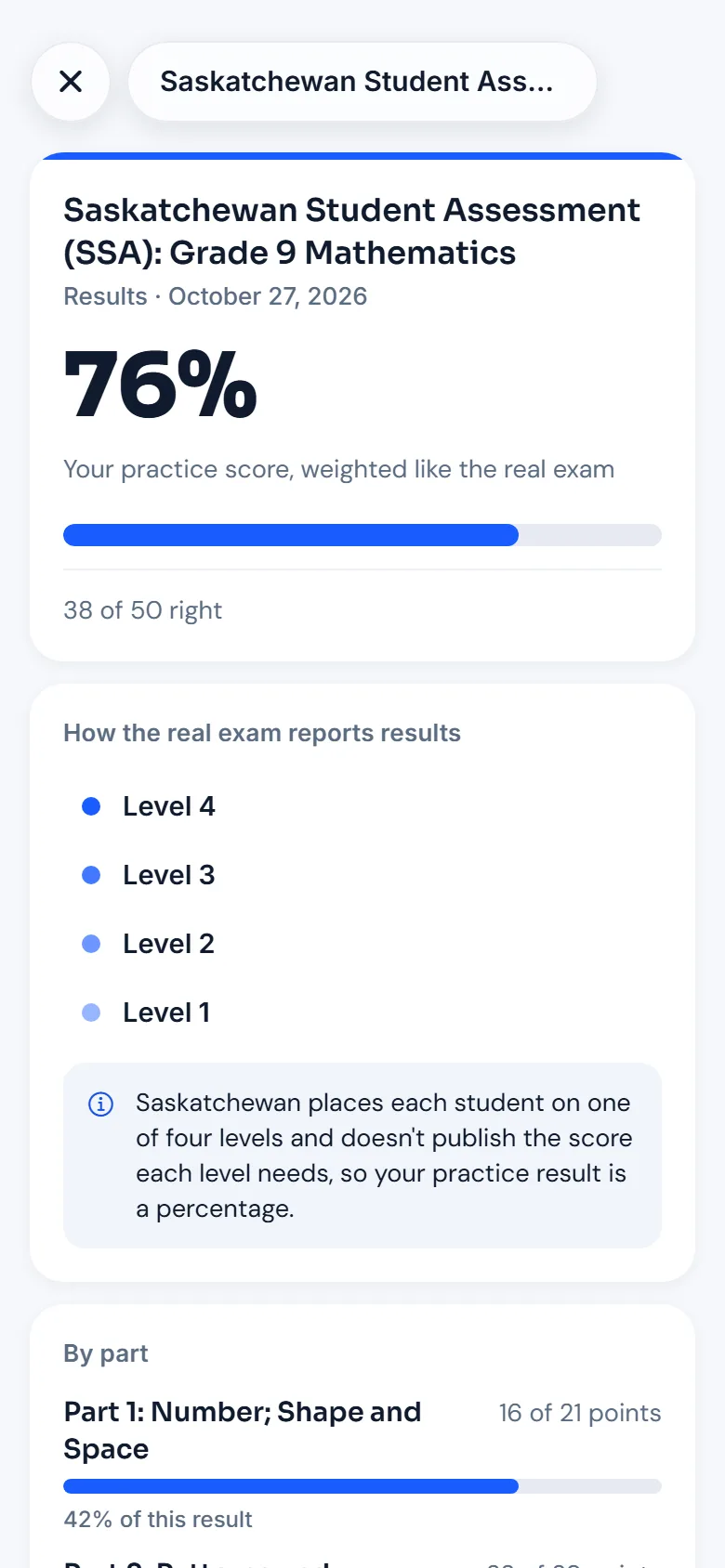 The marked result, part by part
A practice run of Saskatchewan’s Grade 9 math assessment.
Free with a MapleMind account
When
2 sessions this school year: January and June.
January 2027 session
- Tuesday, January 12, 2027Set by the school (about 2 h 30) · Lecture – texte littéraire (014‑630)
- Wednesday, January 13, 2027Set by the school (about 2 h 30) · Lecture – texte courant (014‑630)
- January 14 to January 15, 2027Set by the school (about 2 h each day) · Écriture (014‑620), two half-days
June 2027 session
- Monday, May 31, 2027Set by the school (about 2 h 30) · Lecture – texte littéraire (014‑630)
- Tuesday, June 1, 2027Set by the school (about 2 h 30) · Lecture – texte courant (014‑630)
- June 2 to June 3, 2027Set by the school (about 2 h each day) · Écriture (014‑620), two half-days
The dates are Quebec’s own, read on September 28, 2026. See the official schedule (quebec.ca)
What’s on it
- Lecture, tâche 1: texte littéraireAbout a dozen questionsNot published: the two tasks' points are added
- Lecture, tâche 2: texte courantAbout a dozen questionsNot published: the two tasks' points are added
- Écriture: a letter giving an opinion100%Of the writing result · Five criteria, 20% each
The skills it tests · 145 skills
- Accorder le verbe avec un sujet piège : pronom écran, qui, cela, sujet inversé, sujets coordonnés (verb agreement with tricky subjects)
- Analyser un texte d’opinion et une critique : opinion, arguments, jugement (analysing opinion pieces and reviews)
- Apprécier une œuvre avec des critères propres à son genre (judging a work by the standards of its genre)
- Cerner les constituants d’une phrase déclarative et travailler ses compléments de phrase (analysing statements and their sentence complements)
- Chercher l’information : sources documentaires, mots-clés, moteur de recherche (finding information in sources)
- Choisir la personne des verbes selon le genre de texte (choosing the person of verbs by genre)
- Choisir ses marqueurs de relation dans une banque (choosing linking words from a bank)
- Classer des mots selon leurs préfixes et leurs suffixes pour en trouver le sens (sorting words by prefix and suffix)
- Comparer des introductions et des conclusions d’un même genre (comparing introductions and conclusions)
- Comparer des œuvres : sous-thèmes, personnages, temps et lieux, intrigue (comparing how works are built)
- Compléter, transformer et améliorer un texte ou un paragraphe (completing, transforming and improving a text)
- Comprendre les négations avec aucun, personne et rien en lisant (reading negations with aucun, personne and rien)
- Comprendre une phrase complexe : déplacer, mettre en retrait, relier à l’information principale (making sense of complex sentences)
- Confirmer ou nuancer son appréciation grâce à l’avis des autres (confirming or refining your appreciation)
- Constater la diversité des critères de jugement (noticing that readers judge with different criteria)
- Constater ses apprentissages et sa progression de lecteur (noticing what you learned and how you grew as a reader)
- Construire des questions et les comparer à la phrase de base (building questions and comparing them with the base sentence)
- Corriger les problèmes de cohérence : marqueurs et reprises de l’information (fixing coherence problems)
- Corriger ses accords : outils de référence, procédure et aide d’un pair (correcting agreements with tools and a partner)
- Découverte : Cerner les compléments du verbe et l’attribut par le remplacement par un pronom (pronoun tests for verb complements and attributes)
- Découverte : Classer des adjectifs avec trois critères : position, attribut, très (sorting adjectives with three tests)
- Découverte : Comparer des dictionnaires et des définitions (comparing dictionaries and definitions)
- Découverte : L’accord du verbe avec un sujet comme « Mes amies et moi » (verbs with a subject like “my friends and I”)
- Découverte : L’adjectif qualifiant et l’adjectif classifiant (describing and classifying adjectives)
- Découverte : L’attribut du sujet formé d’un groupe du nom : Mon père est plombier (noun-group subject attributes)
- Découverte : L’ordre des pronoms compléments à l’impératif : prête-le-lui, dis-le-moi (pronoun order in commands)
- Découverte : La négation en début de phrase : personne ne, rien ne, aucun… ne (negation at the start of a sentence)
- Découverte : Le complément de phrase ne se remplace pas par un pronom (sentence complements can’t be replaced by a pronoun)
- Découverte : Le complément direct du verbe (the direct object)
- Découverte : Le complément indirect du verbe (the indirect object)
- Découverte : Le plus-que-parfait, le futur antérieur et le conditionnel passé (more compound tenses)
- Découverte : Les constructions du groupe du verbe (verb-group constructions)
- Découverte : Les mots d’une même situation : voler, le voleur, le butin, la victime (words that go with a verb’s situation)
- Découverte : Les questions qui portent sur un complément : Où ? Que ? À qui ? (questions about a complement)
- Découverte : Les verbes qui demandent une préposition précise : parler à, parler de, se fier à (verbs that take a specific preposition)
- Découverte : Prouver le prédicat en le remplaçant par un verbe seul comme dormir (proving the predicate with a one-word verb)
- Découverte : Vérifier dans ses textes l’accord du verbe avec un sujet comme « Ton frère et toi » (checking coordinated subjects in your writing)
- Découverte : Vérifier en révisant les négations avec personne ne, rien ne, aucun… ne (checking negations that start the sentence)
- Découverte : Vrai ou faux préfixe ? uniforme, mais pas université (real and false prefixes)
- Découvrir des œuvres contemporaines marquantes et les sortes de romans (notable contemporary works and kinds of novels)
- Déduire ce qui est sous-entendu : sentiments, temps, lieux, causes, solutions (inferring unstated information)
- Dégager l’originalité d’une œuvre (identifying what makes a work original)
- Dégager les régularités d’un verbe et le classer selon son modèle (finding a verb’s patterns and model)
- Dégager les sous-thèmes et percevoir les sous-entendus (finding subthemes and hidden meanings)
- Dégager les valeurs, les stéréotypes et les allusions d’un récit (values, stereotypes and allusions in a story)
- Des groupes du nom particuliers : mon amie Axelle, chats à donner, le soir (special noun-group constructions)
- Écrire des phrases à un ou à deux verbes conjugués : quand, parce que, qui (writing sentences with one or two conjugated verbs)
- Effacer les compléments du nom pour trouver le noyau (deleting noun complements to find the head)
- Enrichir les groupes du nom avec des compléments du nom variés (enriching noun groups)
- Faire relire son texte pour améliorer son vocabulaire (getting vocabulary feedback from a classmate)
- Former les temps composés : auxiliaire, participe passé et verbes conjugués avec être (forming compound tenses)
- Garder des traces de ses lectures et consulter le monde du livre (tracking your reading and exploring book publications)
- Identifier le sujet, le prédicat et le complément de phrase (identifying subject, predicate and sentence complement)
- Identifier le temps, la personne et le nombre d’un verbe (identifying a verb’s tense, person and number)
- Infinitif en -er ou participe passé en -é ? (choosing between -er and -é)
- Intégrer des éléments des œuvres dans ses projets, en français et dans les autres matières (using literature in projects)
- Justifier l’accord de l’adjectif attribut, même avec je, tu, on, nous, vous (justifying attribute agreement)
- Justifier l’accord du verbe, de l’auxiliaire et du participe passé avec le sujet (justifying verb agreement step by step)
- Justifier l’auxiliaire et le participe passé d’un verbe à un temps composé (justifying compound-tense spellings)
- Justifier l’orthographe d’un mot : famille, règle, préfixe, homophone (explaining a word’s spelling)
- Justifier le nombre d’un nom selon le sens : beaucoup d’amis, un coffre à crayons (choosing singular or plural by meaning)
- Justifier les accords dans le groupe du nom par un raisonnement complet (justifying noun-group agreement step by step)
- Justifier son analyse de la phrase par plusieurs manipulations (justifying sentence analysis with several tests)
- L’accord de l’adjectif attribut après sembler, devenir, paraître, rester (attribute agreement after any linking verb)
- L’effet du point final : Tu viens. Tu viens ? Viens au parc ! (how the final punctuation changes meaning)
- L’introduction, le développement et la conclusion d’un texte courant (introduction, body and conclusion)
- L’ordre logique des idées et le sens des temps des verbes (logical order and the meaning of verb tenses)
- La disposition, la typographie et le hors-texte (layout, typography and visuals)
- La phrase de base : sujet + prédicat + complément de phrase (the base sentence)
- La phrase impérative : un prédicat sans sujet, un verbe à l’impératif (the imperative sentence)
- La place des mots de négation et le ne oublié (where negation words go, and the missing ne)
- La troncation et les mots-valises : ciné, courriel (clipped words and portmanteaus)
- Laisser des traces de ses doutes sur les verbes en rédigeant (marking doubtful verbs while drafting)
- Le complément de phrase : le prouver par le dédoublement et dire son sens (sentence complements: the doubling test and their meaning)
- Le féminin des déterminants : un/une, tout/toute, cet/cette, quel/quelle (feminine determiners)
- Le groupe du verbe : son noyau conjugué et sa fonction de prédicat (the verb group: its head and its function)
- Le paragraphe, une partie du texte (paragraphs as parts of a text)
- Le participe passé avec être ou sans auxiliaire, un receveur comme l’adjectif (past participles that act like adjectives)
- Le prédicat, toujours un groupe du verbe, sous des formes variées (the predicate is always a verb group)
- Le sens figuré, les locutions et les prépositions courantes (figurative senses, set phrases and common prepositions)
- Le subjonctif présent : il faut que je finisse (the present subjunctive)
- Le sujet formé d’un groupe du nom : le maire de la ville (subjects made of noun groups)
- Le tableau des pronoms : personne, nombre, fonctions et antécédent (building a pronoun table)
- Le trait d’union : va-t-il ?, prends-la, quatre-vingt-dix-sept (hyphens in questions, commands and numbers)
- Les constituants selon le type de phrase : déclarative, interrogative, impérative (sentence parts by sentence type)
- Les indices sémantiques : introduction, répétitions, conclusion (meaning clues to the important information)
- Les liens de sens entre les mots : même thème, antonymes, parties d’un tout (meaning links between words)
- Les marqueurs de conséquence, d’explication et d’opposition : donc, c’est-à-dire, pourtant (linking words for consequence, explanation and contrast)
- Les mots dérivés et composés : préfixes, suffixes, éléments savants (derived and compound words)
- Les négations ne… plus, ne… rien, ne… aucun (negations with plus, rien and aucun)
- Les noms qui changent de sens selon le genre : un manche, une manche (nouns whose meaning changes with gender)
- Les textes courants avec ou sans conclusion (texts with and without a conclusion)
- Les verbes à l’étude : rendre, prendre, mettre, tenir, venir, dire, faire, ouvrir… (conjugating the verbs studied)
- Les virgules à l’étude dans les textes, et corriger un texte mal ponctué (commas in texts and fixing punctuation)
- Lire des textes courants pour faire une recherche et apprendre dans les autres matières (reading to research and to learn in other subjects)
- Lire les textes qui illustrent des idées : tableau, schéma, diagramme, plan, caricature (reading texts that show ideas visually)
- Lire un article de dictionnaire : abréviations, registre, mots apparentés (reading a dictionary entry)
- Lire un compte rendu et un rapport d’observation (reading reports and observation records)
- Lire un tableau de conjugaison : les modes et les temps composés (reading a conjugation table: moods and compound tenses)
- Lire une entrevue, un clavardage, un échange de questions et réponses (reading interviews and chats)
- Lire une nouvelle journalistique et un reportage (reading news stories and reports)
- Mettre en ordre les paragraphes d’un texte et justifier (putting paragraphs in order)
- Négocier une interprétation commune et nuancer la sienne (negotiating and refining interpretations)
- Organiser et intégrer ce qu’on apprend en lisant (organising and integrating what you learn)
- Passer du présent de l’indicatif à l’impératif présent : tu sautes, saute ! (present indicative and imperative)
- Planifier son texte : situation d’écriture, idées à développer, premier regroupement (planning a text)
- Ponctuer les paroles rapportées : deux-points, guillemets et virgules des incises (punctuating reported speech)
- Préciser ses idées : banque de verbes, compléments de phrase et adverbes en -ment (making ideas clearer)
- Prendre conscience des émotions que suscitent les œuvres (noticing the emotions works stir)
- Questions fermées, questions ouvertes et structures de l’écrit (closed and open questions in written form)
- Recommander ou déconseiller une œuvre, et sélectionner des œuvres pour un événement ou un public (recommending and selecting works)
- Reconnaître la structure d’un texte : sujet et aspects, divisions, causes et conséquences, structures particulières (recognising text structures)
- Relever et analyser les phrases impératives d’un texte (finding and analysing commands in texts)
- Relier des informations éloignées dans un texte (connecting distant pieces of information)
- Relire sa version finale et analyser ses erreurs d’orthographe (proofreading and analysing your spelling errors)
- Remplacer faire, avoir, être, dire et les mots vagues (replacing vague words when revising)
- Remplacer les « et » en trop par un point, une virgule ou un marqueur (replacing overused “and”)
- Remplacer les verbes et les adjectifs passe-partout par des mots précis (replacing all-purpose verbs and adjectives)
- Repérer et prouver l’attribut du sujet après un verbe attributif (finding and proving the subject attribute)
- Repérer l’originalité de la présentation d’un livre : illustration, typographie, format (spotting original book design)
- Reprendre une information par un mot générique : des marguerites… ces fleurs (using a general word to refer back)
- Retenir l’orthographe de 1 500 nouveaux mots grâce à des stratégies (learning 1,500 new words)
- Retenir le genre des noms difficiles : un autobus, une erreur (remembering tricky noun genders)
- S’appuyer sur ses repères culturels pour réagir à un texte (drawing on cultural knowledge to react)
- Se bâtir un aide-mémoire de verbes : modèles, terminaisons, familles (building a personal verb memory aid)
- Se servir d’outils de référence variés : glossaire, banque de données, dictionnaires spécialisés (using varied reference texts)
- Se servir d’une liste de verbes attributifs pour repérer et accorder les attributs (using a list of linking verbs)
- Se servir de ses lectures pour écrire et pour développer sa pensée critique et créatrice (using reading to write and to think)
- Suivre seul une notice, un protocole ou un plan technique (following technical instructions independently)
- Survoler un texte : rubriques, légendes et graphiques (previewing with headings, captions and graphs)
- Tenir compte des contraintes et de l’usage prévu des informations en lisant (reading with constraints and purpose in mind)
- Tenir compte des réactions des autres : commentaires et critiques (taking others’ reactions into account)
- Trouver l’infinitif et le modèle d’un verbe pour prédire sa forme (finding a verb’s infinitive and model)
- Trouver le donneur d’accord dans le sujet : le noyau du groupe du nom (finding the agreement source in the subject)
- Trouver le sens d’une expression figée ou d’un proverbe dans un outil de référence (looking up idioms and proverbs)
- Trouver un mot dans le dictionnaire : deviner le début, chercher l’infinitif (finding words in the dictionary)
- Un même mot, plusieurs classes : fort, adjectif ou adverbe (one word, several classes)
- Vérifier dans ses textes l’accord du participe passé des verbes conjugués avec être (checking past participles with être in your writing)
- Vérifier dans ses textes l’accord du verbe avec un pronom écran, qui, cela ou un sujet inversé (checking tricky verb agreements in your writing)
- Vérifier en révisant les négations avec plus, rien et aucun (checking negations when revising)
- Vérifier la ponctuation des dialogues : deux-points, guillemets, virgules des incises (checking dialogue punctuation)
- Vérifier la structure de ses phrases et les faire relire (checking sentence structure and getting a reader’s feedback)
- Vérifier que ses idées conviennent au destinataire (checking that ideas suit the reader)
- Vérifier ses verbes avec ses aide-mémoire et relire sa version finale (checking verbs and proofreading)
- Vérifier son titre et le découpage de ses paragraphes (checking title and paragraph division)
How it’s built
Multiple-choice questions, written answers, questions in sets and an essay.
- Épreuve de lecture (014‑630)
- Time
- 300 min
- Questions
- 24
- Marks
- 100
- Of the marks
- 50%
- Multiple choice
- Written answers
- Questions in sets
Two reading tasks on two half-days, each in one block: a literary text on the first day and an informational text on the second, about 2,000 words each. Then about a dozen written questions on each, answered from the text.
- Épreuve d'écriture (014‑620)
- Time
- 240 min
- Question
- 1
- Marks
- 100
- Of the marks
- 50%
- Essay
Write a letter to a given reader, giving your opinion on a set topic: the informational text's topic. Plan and draft on one day; revise, correct and write the final copy the next. You get a sheet of notes from the text.
How it’s marked
Your school marks each exam out of 100, with the ministry's answer key and grid. There's no pass mark: each result counts for 20% of your final result in reading, and in writing.
On the day
- Day 1Reading: a literary text, about two and a half hours.
- Day 2Reading: an informational text, about two and a half hours.
- Days 3 and 4Writing, over two half-days of about 2 hours each.
Two exams, reading and writing, over four half-days. You may use a French dictionary, grammars, conjugation tables and your class's correction code. Phones and other devices aren't allowed, and no one may help you, even by rephrasing a question.
Getting ready
3 official documents to practise with, and 4 tips.
Official practice
Tips from the people who write it
- Back up every reading answer with the text, and make your explanations full and clear.
- At the end of each reading task, correct your sentences and spelling.
- Your writing is marked on five equal criteria: fitting the task, coherence, vocabulary, sentences and punctuation, and spelling.
- Practise with the tools allowed on the day: a French dictionary, grammars, conjugation tables and your class's correction code.
The mark you need
Your class mark counts for 80% of the final mark, the exam for 20%. Quebec may moderate your class mark before it’s blended.
You need
50% on the exam
With 75% in class, your final mark lands between 60% (0 on the exam) and 80% (100% on it).
After the exam
- Results
Your school marks it, and the result is part of your final mark for the year.
- If you miss it
With a valid reason (a serious illness or accident with a medical note, the death of a close relative, a court summons), your final mark is worked out from your three terms. Without one, your school’s own rules apply.
From About the ministerial examinations (Quebec) (quebec.ca) and Administrative Guide for the Certification of Studies and Management of Ministerial Examinations (the edition Quebec links today) (cdn-contenu.quebec.ca), read on October 27, 2026.
More for you
Students
Start with the topics worth the most marks, then write full practice exams under the real time limit.
Practise itParents
Put the dates on the family calendar. The Parent Dashboard shows each practice exam’s result and the skills that need another look.
See the Parent DashboardEducators
The topic weights and the official practice above make a review plan. Students can practise each skill on its own in MapleMind, free with daily limits.
For schools
Questions about this exam
When is the Français, langue d'enseignement, Elementary Grade 6 in 2026–27?
The next sitting is January 12, 2027, Set by the school (about 2 h 30). This school year it’s written in January 2027 session and June 2027 session.
How long is the Français, langue d'enseignement, Elementary Grade 6?
It takes 9 hours in all, over 2 parts.
How many questions are on the Français, langue d'enseignement, Elementary Grade 6?
It has 25 marked questions: 24 in Épreuve de lecture (014-630) and 1 in Épreuve d'écriture (014-620).
Can you use a calculator on the Français, langue d'enseignement, Elementary Grade 6?
No. Calculators aren’t allowed.
How much does the Français, langue d'enseignement, Elementary Grade 6 count?
It’s worth 20% of the final mark in Français, langue d’enseignement, 6e année.
Where can I find practice tests for the Français, langue d'enseignement, Elementary Grade 6?
Quebec publishes Guide à l'intention des parents (December 2025): sample texts, questions and answers. MapleMind also builds a full practice exam in its format, free with an account.

Practise for the Français, langue d'enseignement, Elementary Grade 6
Every skill on the Français, langue d'enseignement, Elementary Grade 6, taught one at a time, then practised on questions written like the real ones.


