Get help with Français, langue d’enseignement, 6e année
Most tutoring makes your child sit through material your child already knows. MapleMind flips that: pick the exact skill that's causing trouble — any of the 160 below — and the tutor teaches just that one, step by step, as many times as it takes. Ask questions in plain words, any time of day, in English, French, or 12 other languages.
The official Quebec Français, langue d’enseignement, 6e année curriculum
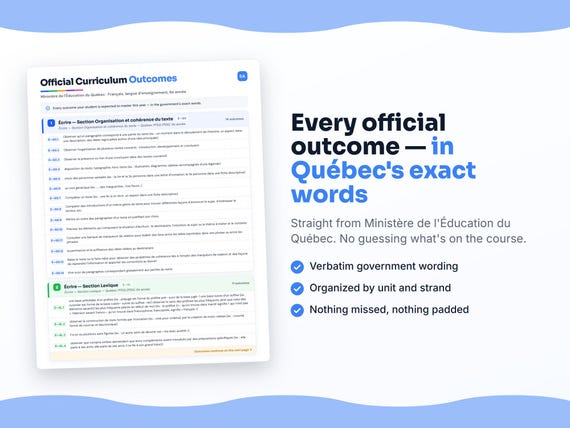
Quebec defines Français, langue d’enseignement, 6e année by strands and outcomes. MapleMind teaches the same curriculum reorganized for one-skill-at-a-time tutoring — the table shows exactly where every official strand lands, and the ministry's own wording is quoted under each unit below.
Official source Québec's official education programRead it on the government site — quebec.ca ↗| Official strand | Outcomes | Where MapleMind teaches it |
|---|---|---|
| Course outcomes | 160 | Écrire — Section Organisation et cohérence du texte · Écrire — Section Lexique · Écrire — Section Orthographe d’usage · Écrire — Section Conjugaison · Écrire — Section Accords · Écrire — Section Syntaxe et ponctuation · Compétence Lire des textes variés · Compétence Apprécier des œuvres littéraires · Compétence Communiquer oralement |
Every skill below, taught one on one.
 Try the first session free
How MapleMind teaches Français, langue d’enseignement, 6e année — every unit, lesson, and skill
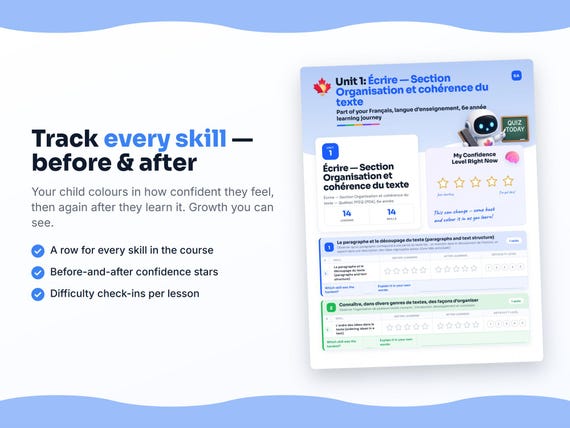
Every skill below runs as a short session: a plain-words lesson, a worked example, solving it together, then a five-question skill check that earns up to three stars. Guided Mode keeps it teaching instead of answer-handing — turning it off needs a parent's password.
Unit 1Écrire — Section Organisation et cohérence du texte
Écrire — Section Organisation et cohérence du texte — Québec PFEQ (PDA), 6e année.
Le paragraphe et le découpage du texte (paragraphs and text structure)
- Le paragraphe et le découpage du texte (paragraphs and text structure)P2.17 — Maîtrise de « Le paragraphe et le découpage du texte » (paragraphs and text structure) en 6e année, Français L1 — l’enfant l’emploie de façon autonome dans ses lectures, ses écrits et à l’oral.
Connaître, dans divers genres de textes, des façons d’organiser
- L’ordre des idées dans le texte (ordering ideas in a text)P2.26 — Maîtrise de « L’ordre des idées dans le texte » (ordering ideas in a text) en 6e année, Français L1 — l’enfant l’emploie de façon autonome dans ses lectures, ses écrits et à l’oral.
Observer le rôle de l’introduction, du développement
- L’ordre des idées dans le texte (ordering ideas in a text)P2.31 — Maîtrise de « L’ordre des idées dans le texte » (ordering ideas in a text) en 6e année, Français L1 — l’enfant l’emploie de façon autonome dans ses lectures, ses écrits et à l’oral.
Observer le découpage d’un texte (observing how a text is divided)
- Le texte et la cohérence (text and coherence)P2.35 — Maîtrise de « Le texte et la cohérence » (text and coherence) en 6e année, Français L1 — l’enfant l’emploie de façon autonome dans ses lectures, ses écrits et à l’oral.
L’emploi des verbes selon le genre de texte (verb use across text genres)
- La situation d’écriture (the writing situation)P2.38 — Maîtrise de « La situation d’écriture » (the writing situation) en 6e année, Français L1 — l’enfant l’emploie de façon autonome dans ses lectures, ses écrits et à l’oral.
Connaître différentes façons de reprendre une même information
- La reprise de l’information (reference chaining)P2.43 — Maîtrise de « La reprise de l’information » (reference chaining) en 6e année, Français L1 — l’enfant l’emploie de façon autonome dans ses lectures, ses écrits et à l’oral.
Relever dans un texte d’élève des passages à améliorer et suggérer
- Le texte et la cohérence (text and coherence)P2.58 — Maîtrise de « Le texte et la cohérence » (text and coherence) en 6e année, Français L1 — l’enfant l’emploie de façon autonome dans ses lectures, ses écrits et à l’oral.
Écrire un court texte en imposant des contraintes d’écriture
- L’ordre des idées dans le texte (ordering ideas in a text)P2.68 — Maîtrise de « L’ordre des idées dans le texte » (ordering ideas in a text) en 6e année, Français L1 — l’enfant l’emploie de façon autonome dans ses lectures, ses écrits et à l’oral.
Découper un texte qui ne l’est pas et justifier le découpage
- Le paragraphe et le découpage du texte (paragraphs and text structure)P2.76 — Maîtrise de « Le paragraphe et le découpage du texte » (paragraphs and text structure) en 6e année, Français L1 — l’enfant l’emploie de façon autonome dans ses lectures, ses écrits et à l’oral.
Planifier son texte selon la situation (planning a text for its situation)
- La situation d’écriture (the writing situation)P2.81 — Maîtrise de « La situation d’écriture » (the writing situation) en 6e année, Français L1 — l’enfant l’emploie de façon autonome dans ses lectures, ses écrits et à l’oral.
Les marqueurs de relation en rédaction et en révision (linking words when drafting and revising)
- Les marqueurs de relation (linking words)P2.87 — Maîtrise de « Les marqueurs de relation » (linking words) en 6e année, Français L1 — l’enfant l’emploie de façon autonome dans ses lectures, ses écrits et à l’oral.
Relire son texte ou le faire relire pour vérifier
- La situation d’écriture (the writing situation)P2.92 — Maîtrise de « La situation d’écriture » (the writing situation) en 6e année, Français L1 — l’enfant l’emploie de façon autonome dans ses lectures, ses écrits et à l’oral.
Les relations entre les idées (relations between ideas)
- Les marqueurs de relation (linking words)P2.96 — Maîtrise de « Les marqueurs de relation » (linking words) en 6e année, Français L1 — l’enfant l’emploie de façon autonome dans ses lectures, ses écrits et à l’oral.
Vérifier le découpage de son texte
- Le paragraphe et le découpage du texte (paragraphs and text structure)P2.100 — Maîtrise de « Le paragraphe et le découpage du texte » (paragraphs and text structure) en 6e année, Français L1 — l’enfant l’emploie de façon autonome dans ses lectures, ses écrits et à l’oral.
The official wording — 14 outcomes in this unit
- P2.17
Observer qu’un paragraphe correspond à une partie du texte (ex. : un moment dans le déroulement de l’histoire; un aspect dans une description; des idées regroupées autour d’une idée principale)
- P2.26
Observer l’organisation de plusieurs textes courants : introduction, développement et conclusion
- P2.31
Observer la présence ou non d’une conclusion dans des textes courants3
- P2.35
disposition du texte, typographie, hors-texte (ex. : illustration, diagramme, tableau accompagnés d’une légende)
- P2.38
choix des personnes verbales (ex. : la 1re et la 2e personne dans une lettre d’invitation; la 3e personne dans une fiche descriptive)
- P2.43
un mot générique (ex. : … des marguerites… Ces fleurs…)
- P2.58
Compléter un texte (ex. : une fin à un récit, un aspect dans une fiche descriptive)
- P2.68
Comparer des introductions d’un même genre de texte pour trouver différentes façons d’annoncer le sujet, d’intéresser le lecteur, etc.
- P2.76
Mettre en ordre des paragraphes d’un texte en justifiant son choix
- P2.81
Préciser les éléments qui composent la situation d’écriture : le destinataire, l’intention, le sujet ou le thème à traiter et le contexte
- P2.87
Consulter une banque de marqueurs de relation pour établir des liens entre les idées exprimées dans une phrase ou entre les phrases
- P2.92
la pertinence et la suffisance des idées reliées au destinataire
- P2.96
Relire le texte ou le faire relire pour détecter des problèmes de cohérence liés à l’emploi des marqueurs de relation et des façons de reprendre l’information et apporter les corrections au besoin
- P2.100
titre suivi de paragraphes correspondant globalement aux parties du texte
Unit 2Écrire — Section Lexique
Écrire — Section Lexique — Québec PFEQ (PDA), 6e année.
La formation des mots par dérivation (word formation through derivation)
- La formation des mots (préfixes, suffixes) (word formation (prefixes, suffixes))P3.4 — Maîtrise de « La formation des mots (préfixes, suffixes) » (word formation (prefixes, suffixes)) en 6e année, Français L1 — l’enfant l’emploie de façon autonome dans ses lectures, ses écrits et à l’oral.
D’autres procédés de formation des mots (other word-formation processes)
- La formation des mots (préfixes, suffixes) (word formation (prefixes, suffixes))P3.10 — Maîtrise de « La formation des mots (préfixes, suffixes) » (word formation (prefixes, suffixes)) en 6e année, Français L1 — l’enfant l’emploie de façon autonome dans ses lectures, ses écrits et à l’oral.
Le sens propre et le sens figuré (literal and figurative meaning)
- Le sens des mots (propre, figuré) (word meanings (literal and figurative))P3.14 — Maîtrise de « Le sens des mots (propre, figuré) » (word meanings (literal and figurative)) en 6e année, Français L1 — l’enfant l’emploie de façon autonome dans ses lectures, ses écrits et à l’oral.
D’autres propriétés des mots
- Découverte : Les relations entre les mots (synonymes, antonymes, génériques) (relations between words)P3.20 — Découverte guidée de « Les relations entre les mots (synonymes, antonymes, génériques) » (relations between words) en 6e année, Français L1 — premier contact accompagné par l’adulte, avant la maîtrise autonome.
- Le sens des mots (propre, figuré) (word meanings (literal and figurative))P3.24 — Maîtrise de « Le sens des mots (propre, figuré) » (word meanings (literal and figurative)) en 6e année, Français L1 — l’enfant l’emploie de façon autonome dans ses lectures, ses écrits et à l’oral.
- Les relations entre les mots (synonymes, antonymes, génériques) (relations between words)P3.71 — Maîtrise de « Les relations entre les mots (synonymes, antonymes, génériques) » (relations between words) en 6e année, Français L1 — l’enfant l’emploie de façon autonome dans ses lectures, ses écrits et à l’oral.
Les relations entre les mots
- Découverte : Les relations entre les mots (synonymes, antonymes, génériques) (relations between words)P3.36 — Découverte guidée de « Les relations entre les mots (synonymes, antonymes, génériques) » (relations between words) en 6e année, Français L1 — premier contact accompagné par l’adulte, avant la maîtrise autonome.
- Les familles de mots (word families)P3.29 — Maîtrise de « Les familles de mots » (word families) en 6e année, Français L1 — l’enfant l’emploie de façon autonome dans ses lectures, ses écrits et à l’oral.
- Découverte : Le dictionnaire (using the dictionary)P3.100 — Découverte guidée de « Le dictionnaire » (using the dictionary) en 6e année, Français L1 — premier contact accompagné par l’adulte, avant la maîtrise autonome.
Le regroupement des mots de la langue dans le dictionnaire
- Le dictionnaire (using the dictionary)P3.43 — Maîtrise de « Le dictionnaire » (using the dictionary) en 6e année, Français L1 — l’enfant l’emploie de façon autonome dans ses lectures, ses écrits et à l’oral.
La formation des mots
- Découverte : La formation des mots (préfixes, suffixes) (word formation (prefixes, suffixes))P3.59 — Découverte guidée de « La formation des mots (préfixes, suffixes) » (word formation (prefixes, suffixes)) en 6e année, Français L1 — premier contact accompagné par l’adulte, avant la maîtrise autonome.
- La formation des mots (préfixes, suffixes) (word formation (prefixes, suffixes))P3.56 — Maîtrise de « La formation des mots (préfixes, suffixes) » (word formation (prefixes, suffixes)) en 6e année, Français L1 — l’enfant l’emploie de façon autonome dans ses lectures, ses écrits et à l’oral.
Exprimer des liens de synonymie et d’antonymie
- Choisir un vocabulaire précis (choosing precise vocabulary)P3.83 — Maîtrise de « Choisir un vocabulaire précis » (choosing precise vocabulary) en 6e année, Français L1 — l’enfant l’emploie de façon autonome dans ses lectures, ses écrits et à l’oral.
Explorer un dictionnaire comme on le fait avec d’autres livres
- Le dictionnaire (using the dictionary)P3.97 — Maîtrise de « Le dictionnaire » (using the dictionary) en 6e année, Français L1 — l’enfant l’emploie de façon autonome dans ses lectures, ses écrits et à l’oral.
Remplacer les répétitions inutiles (replacing needless repetition)
- Les relations entre les mots (synonymes, antonymes, génériques) (relations between words)P3.110 — Maîtrise de « Les relations entre les mots (synonymes, antonymes, génériques) » (relations between words) en 6e année, Français L1 — l’enfant l’emploie de façon autonome dans ses lectures, ses écrits et à l’oral.
Réviser son vocabulaire pour plus de précision (revising vocabulary for precision)
- Choisir un vocabulaire précis (choosing precise vocabulary)P3.113 — Maîtrise de « Choisir un vocabulaire précis » (choosing precise vocabulary) en 6e année, Français L1 — l’enfant l’emploie de façon autonome dans ses lectures, ses écrits et à l’oral.
The official wording — 16 outcomes in this unit
- P3.4
une base précédée d’un préfixe (ex. : préjugé est formé du préfixe pré– suivi de la base jugé–) une base suivie d’un suffixe (ex. : cuisinier est formé de la base cuisin– suivie du suffixe –ier) observer le sens des préfixes les plus fréquents ainsi que celui des éléments savants1 les plus fréquents placés en début de mot (ex. : le préfixe in–, qu’on trouve dans inactif signifie « qui n’est pas »; l’élément savant franco–, qu’on trouve dans francophone, francophile, signifie « français »)
- P3.10
observer la construction de mots formés par troncation (ex. : ciné pour cinéma), par la création de mots-valises (ex. : courriel formé de courrier et électronique)
- P3.14
il a un ou plusieurs sens figurés (ex. : un autre sens de dévorer est « lire avec avidité »)
- P3.20
observer que certains verbes demandent que leurs compléments soient introduits par des prépositions spécifiques (ex. : elle parle à ses amis; elle parle de ses amis; il se fie à son grand frère)2
- P3.24
observer que des paires de noms qui ont la même forme mais un genre différent expriment un sens différent (ex. : un manche et une manche)
- P3.71
se donner des moyens pour se rappeler le genre de noms plus difficile à retenir
- P3.36
les noms des acteurs, des accessoires ou des actions dans une situation exprimée par un verbe, c’est-à-dire le sujet et le ou les compléments de ce verbe, quand ils existent7 (ex. : pour voler, au sens de « dérober » : le sujet est le voleur et les compléments du verbe le butin et la victime)
- P3.29
Observer que les mots qui ont un lien de sens ne sont pas toujours de même famille morphologique (ex. : santé, médecin, infirmier, hôpital, urgence, soins, malade, guéri, opération, médicament)6
- P3.100
Comparer les informations recueillies sur un mot dans deux dictionnaires différents
- P3.43
Connaître les principales abréviations utilisées dans les dictionnaires (ex. : n.m. pour nom masculin, fam. pour familier; inv. pour invariable)
- P3.59
à partir d’une liste de mots qui commencent ou qui finissent par les mêmes lettres, trouver ceux qui contiennent un préfixe ou un suffixe (ex. : les mots uniforme et unisexe contiennent le préfixe uni–, qui veut dire « un » mais non le mot université; les mots fillette et grassouillette contiennent le suffixe diminutif –ette mais non le mot crevette)
- P3.56
des préfixes courants ou des éléments savants placés en début de mot
- P3.83
en remplaçant des verbes au sens général par des verbes plus précis2 (ex. : faire un costume = confectionner un costume; faire un poème = rédiger un poème)
- P3.97
Faire des hypothèses sur le début du mot à l’aide des correspondances phonèmes- graphèmes pour trouver un mot dans le dictionnaire
- P3.110
Rechercher les différents emplois de verbes comme faire, avoir, être, dire quand ils sont suivis d’un groupe du nom et vérifier s’ils peuvent être remplacés par un verbe seul (ex. : faire du magasinage/magasiner; mais non faire l’épicerie/*épicerier) ou par un verbe plus précis
- P3.113
Inviter un ou une autre élève à le lire dans le but d’obtenir des suggestions d’amélioration du vocabulaire
Unit 3Écrire — Section Orthographe d’usage
Écrire — Section Orthographe d’usage — Québec PFEQ (PDA), 6e année.
Les mots à l’étude (the study-word spelling bank)
- Les mots à l’étude (banque orthographique) (the study-word spelling bank)P4.5 — Maîtrise de « Les mots à l’étude (banque orthographique) » (the study-word spelling bank) en 6e année, Français L1 — l’enfant l’emploie de façon autonome dans ses lectures, ses écrits et à l’oral.
Les règles d’emploi du trait d’union
- Les mots à l’étude (banque orthographique) (the study-word spelling bank)P4.37 — Maîtrise de « Les mots à l’étude (banque orthographique) » (the study-word spelling bank) en 6e année, Français L1 — l’enfant l’emploie de façon autonome dans ses lectures, ses écrits et à l’oral.
Associer un graphème à un phonème
- Le rôle des lettres muettes (silent letters)P4.53 — Maîtrise de « Le rôle des lettres muettes » (silent letters) en 6e année, Français L1 — l’enfant l’emploie de façon autonome dans ses lectures, ses écrits et à l’oral.
Consulter des outils de référence (using reference tools for spelling)
- Les stratégies orthographiques (spelling strategies)P4.77 — Maîtrise de « Les stratégies orthographiques » (spelling strategies) en 6e année, Français L1 — l’enfant l’emploie de façon autonome dans ses lectures, ses écrits et à l’oral.
The official wording — 4 outcomes in this unit
- P4.5
Connaître l’orthographe d’environ 1 500 nouveaux mots
- P4.37
dans les cas réguliers (ex. : sont-elles) dans les cas exigeant l’ajout d’un t euphonique (ex. : va-t-il; aime-t-elle) le verbe suivi du pronom ce ou on (ex. : est-ce, veut-on)
- P4.53
Associer un mot à sa famille morphologique1 pour justifier une lettre muette ou un graphème (ex. : le t de enfant n’est pas prononcé, mais il l’est dans enfantin; le o de bœuf se retrouve dans bovin)
- P4.77
Relire attentivement la version finale de ses textes pour repérer et corriger les coquilles ou erreurs qui y restent
Unit 4Écrire — Section Conjugaison
Écrire — Section Conjugaison — Québec PFEQ (PDA), 6e année.
Le radical et la terminaison
- Les temps de conjugaison (verb tenses)P5.21 — Maîtrise de « Les temps de conjugaison » (verb tenses) en 6e année, Français L1 — l’enfant l’emploie de façon autonome dans ses lectures, ses écrits et à l’oral.
Les temps simples avec marques de personne
- Les temps de conjugaison (verb tenses)P5.37 — Maîtrise de « Les temps de conjugaison » (verb tenses) en 6e année, Français L1 — l’enfant l’emploie de façon autonome dans ses lectures, ses écrits et à l’oral.
Les temps simples sans marque de personne
- Découverte : Les temps de conjugaison (verb tenses)P5.46 — Découverte guidée de « Les temps de conjugaison » (verb tenses) en 6e année, Français L1 — premier contact accompagné par l’adulte, avant la maîtrise autonome.
- Les temps de conjugaison (verb tenses)P5.41 — Maîtrise de « Les temps de conjugaison » (verb tenses) en 6e année, Français L1 — l’enfant l’emploie de façon autonome dans ses lectures, ses écrits et à l’oral.
Observer les éléments qui structurent un tableau de conjugaison
- Les temps de conjugaison (verb tenses)P5.59 — Maîtrise de « Les temps de conjugaison » (verb tenses) en 6e année, Français L1 — l’enfant l’emploie de façon autonome dans ses lectures, ses écrits et à l’oral.
Dégager les régularités et les particularités d’un verbe à l’étude
- Vérifier et corriger un verbe (checking and correcting a verb)P5.61 — Maîtrise de « Vérifier et corriger un verbe » (checking and correcting a verb) en 6e année, Français L1 — l’enfant l’emploie de façon autonome dans ses lectures, ses écrits et à l’oral.
Se bâtir un aide-mémoire de verbes (building a personal verb memory aid)
- Les modèles de conjugaison (conjugation models)P5.67 — Maîtrise de « Les modèles de conjugaison » (conjugation models) en 6e année, Français L1 — l’enfant l’emploie de façon autonome dans ses lectures, ses écrits et à l’oral.
Les liens entre les temps et les modes (links between tenses and moods)
- Les temps de conjugaison (verb tenses)P5.80 — Maîtrise de « Les temps de conjugaison » (verb tenses) en 6e année, Français L1 — l’enfant l’emploie de façon autonome dans ses lectures, ses écrits et à l’oral.
En s’appuyant sur le modèle de conjugaison d’un verbe pour justifier
- Les temps de conjugaison (verb tenses)P5.87 — Maîtrise de « Les temps de conjugaison » (verb tenses) en 6e année, Français L1 — l’enfant l’emploie de façon autonome dans ses lectures, ses écrits et à l’oral.
Identifier la personne et le nombre d’un verbe conjugué à un temps
- Les temps de conjugaison (verb tenses)P5.91 — Maîtrise de « Les temps de conjugaison » (verb tenses) en 6e année, Français L1 — l’enfant l’emploie de façon autonome dans ses lectures, ses écrits et à l’oral.
Justifier la graphie du son [e] à la fin d’un verbe en s’appuyant
- L’infinitif du verbe (the infinitive form)P5.93 — Maîtrise de « L’infinitif du verbe » (the infinitive form) en 6e année, Français L1 — l’enfant l’emploie de façon autonome dans ses lectures, ses écrits et à l’oral.
Vérifier ses verbes en rédigeant (checking verbs while drafting)
- Vérifier et corriger un verbe (checking and correcting a verb)P5.98 — Maîtrise de « Vérifier et corriger un verbe » (checking and correcting a verb) en 6e année, Français L1 — l’enfant l’emploie de façon autonome dans ses lectures, ses écrits et à l’oral.
S’appuyer sur les modèles pour corriger ses verbes (using model verbs to correct)
- Les modèles de conjugaison (conjugation models)P5.101 — Maîtrise de « Les modèles de conjugaison » (conjugation models) en 6e année, Français L1 — l’enfant l’emploie de façon autonome dans ses lectures, ses écrits et à l’oral.
Radical et terminaison des verbes à l’étude (stem and ending of study verbs)
- Vérifier et corriger un verbe (checking and correcting a verb)P5.109 — Maîtrise de « Vérifier et corriger un verbe » (checking and correcting a verb) en 6e année, Français L1 — l’enfant l’emploie de façon autonome dans ses lectures, ses écrits et à l’oral.
The official wording — 14 outcomes in this unit
- P5.21
les verbes en –(d)re qui ont un participe présent en –dant (comme rendre)
- P5.37
subjonctif présent
- P5.46
plus-que-parfait, futur antérieur, conditionnel passé
- P5.41
Les temps composés
- P5.59
Les temps composés, les modes
- P5.61
En utilisant un tableau de conjugaison
- P5.67
Des modèles de conjugaison à l’étude (ex. : finir – agir, choisir, maigrir, réunir)
- P5.80
entre l’indicatif présent et l’impératif présent (ex. : tu sautes/saute)
- P5.87
de l’auxiliaire et du participe passé d’un verbe à l’étude conjugué à un temps composé
- P5.91
Reconnaître qu’un verbe à un temps composé est un tout en le transformant à un temps simple
- P5.93
L’emploi de l’infinitif après une préposition ou après un verbe conjugué
- P5.98
Se questionner sur l’orthographe du verbe et laisser des traces de ses doutes
- P5.101
Transformer le verbe conjugué dans sa forme infinitive en vue de trouver son modèle de conjugaison et de prédire la façon de l’écrire
- P5.109
en recourant à ses aide-mémoire personnels ou à des tableaux de conjugaison
Unit 5Écrire — Section Accords
Écrire — Section Accords — Québec PFEQ (PDA), 6e année.
Les classes de mots variables et invariables
- Découverte : L’adjectif et son accord (the adjective and its agreement)P6.29 — Découverte guidée de « L’adjectif et son accord » (the adjective and its agreement) en 6e année, Français L1 — premier contact accompagné par l’adulte, avant la maîtrise autonome.
- L’accord du participe passé (past-participle agreement)P6.38 — Maîtrise de « L’accord du participe passé » (past-participle agreement) en 6e année, Français L1 — l’enfant l’emploie de façon autonome dans ses lectures, ses écrits et à l’oral.
La fonction sujet (the subject function)
- Le nom, donneur d’accord (the noun as the source of agreement)P6.85 — Maîtrise de « Le nom, donneur d’accord » (the noun as the source of agreement) en 6e année, Français L1 — l’enfant l’emploie de façon autonome dans ses lectures, ses écrits et à l’oral.
Les règles de formation du pluriel et du féminin
- La formation du féminin (forming the feminine)P6.103 — Maîtrise de « La formation du féminin » (forming the feminine) en 6e année, Français L1 — l’enfant l’emploie de façon autonome dans ses lectures, ses écrits et à l’oral.
Les accords régis par le sujet (agreements driven by the subject)
- Découverte : Justifier les accords (justifying agreements)P6.116 — Découverte guidée de « Justifier les accords » (justifying agreements) en 6e année, Français L1 — premier contact accompagné par l’adulte, avant la maîtrise autonome.
- Les pronoms de conjugaison (conjugation pronouns)P6.112 — Maîtrise de « Les pronoms de conjugaison » (conjugation pronouns) en 6e année, Français L1 — l’enfant l’emploie de façon autonome dans ses lectures, ses écrits et à l’oral.
- Découverte : Justifier les accords (justifying agreements)P6.197 — Découverte guidée de « Justifier les accords » (justifying agreements) en 6e année, Français L1 — premier contact accompagné par l’adulte, avant la maîtrise autonome.
Les classes de mots variables et invariables (variable and invariable word classes)
- Découverte : L’accord du verbe avec le sujet (subject-verb agreement)P6.139 — Découverte guidée de « L’accord du verbe avec le sujet » (subject-verb agreement) en 6e année, Français L1 — premier contact accompagné par l’adulte, avant la maîtrise autonome.
Justifier l’appartenance d’un mot à différentes classes
- L’adjectif et son accord (the adjective and its agreement)P6.128 — Maîtrise de « L’adjectif et son accord » (the adjective and its agreement) en 6e année, Français L1 — l’enfant l’emploie de façon autonome dans ses lectures, ses écrits et à l’oral.
Se bâtir un tableau de référence des déterminants en les classant
- Justifier les accords (justifying agreements)P6.132 — Maîtrise de « Justifier les accords » (justifying agreements) en 6e année, Français L1 — l’enfant l’emploie de façon autonome dans ses lectures, ses écrits et à l’oral.
Se bâtir un tableau de référence des pronoms à l’étude en les classant
- Justifier les accords (justifying agreements)P6.134 — Maîtrise de « Justifier les accords » (justifying agreements) en 6e année, Français L1 — l’enfant l’emploie de façon autonome dans ses lectures, ses écrits et à l’oral.
Les règles d’accord dans le groupe du nom
- Justifier les accords (justifying agreements)P6.163 — Maîtrise de « Justifier les accords » (justifying agreements) en 6e année, Français L1 — l’enfant l’emploie de façon autonome dans ses lectures, ses écrits et à l’oral.
Justifier l’accord du verbe avec le sujet (justifying subject-verb agreement)
- L’accord du verbe avec le sujet (subject-verb agreement)P6.173 — Maîtrise de « L’accord du verbe avec le sujet » (subject-verb agreement) en 6e année, Français L1 — l’enfant l’emploie de façon autonome dans ses lectures, ses écrits et à l’oral.
- L’accord du verbe avec le sujet (subject-verb agreement)P6.181 — Maîtrise de « L’accord du verbe avec le sujet » (subject-verb agreement) en 6e année, Français L1 — l’enfant l’emploie de façon autonome dans ses lectures, ses écrits et à l’oral.
L’accord du verbe selon les temps à l’étude (verb agreement across tenses)
- Les pronoms de conjugaison (conjugation pronouns)P6.194 — Maîtrise de « Les pronoms de conjugaison » (conjugation pronouns) en 6e année, Français L1 — l’enfant l’emploie de façon autonome dans ses lectures, ses écrits et à l’oral.
L’accord dans les groupes du nom étendus (agreement in expanded noun groups)
- L’accord du participe passé (past-participle agreement)P6.198 — Maîtrise de « L’accord du participe passé » (past-participle agreement) en 6e année, Français L1 — l’enfant l’emploie de façon autonome dans ses lectures, ses écrits et à l’oral.
L’accord de l’adjectif attribut du sujet (agreement of the subject-attribute adjective)
- L’adjectif et son accord (the adjective and its agreement)P6.201 — Maîtrise de « L’adjectif et son accord » (the adjective and its agreement) en 6e année, Français L1 — l’enfant l’emploie de façon autonome dans ses lectures, ses écrits et à l’oral.
Consulter ses outils de référence
- Le déterminant, receveur d’accord (the determiner (receiver of agreement))P6.206 — Maîtrise de « Le déterminant, receveur d’accord » (the determiner (receiver of agreement)) en 6e année, Français L1 — l’enfant l’emploie de façon autonome dans ses lectures, ses écrits et à l’oral.
The official wording — 18 outcomes in this unit
- P6.29
du nom du pronom l’adjectif est qualifiant ou classifiant
- P6.38
le participe passé employé avec l’auxiliaire être ou sans auxiliaire se comporte comme un adjectif
- P6.85
noyau du groupe du nom (ex. : [Le maire] prononce un discours. [Frédéric] s’endort. [Le maire de la ville] prononce un discours.)
- P6.103
Observer que certains déterminants forment leur féminin selon les mêmes règles que celles des noms et des adjectifs (ex. : un/une; tout/toute; aucun/aucune; cet/cette; quel/quelle)
- P6.116
un groupe du nom et un pronom coordonnés (ex. : Mes amies et moi suivons des cours de natation.)
- P6.112
qui précède immédiatement le verbe séparé du verbe par un autre pronom (ex. : Je vous aime.) un autre pronom que le pronom de conjugaison (ex. : qui, cela)
- P6.197
un groupe du nom et un pronom coordonnés
- P6.139
Classer des adjectifs en vue de distinguer les qualifiants des classifiants en fonction de la position qu’ils occupent par rapport au nom, de la possibilité d’occuper la fonction ATTRIBUT DU SUJET ou d’être précédés d’un adverbe
- P6.128
en le plaçant à l’intérieur d’un groupe de mots ou dans une phrase qui démontre les classes possibles, selon les classes à l’étude (ex. : vert est un nom dans j’aime le vert, vert est un adjectif dans le crayon vert [1er cycle]; porte est un nom dans la grande porte est fermée, porte est un verbe dans Je porte une jupe [2e cycle]; fort est un adjectif dans mon père est fort, fort est adverbe dans elle chante fort [3e cycle])
- P6.132
Identifier les noms dans une phrase et justifier le nombre de chacun en fonction du sens à exprimer (ex. : Ma sœur a beaucoup d’amis. Mon coffre à crayons est brisé.)
- P6.134
selon leur personne et leur nombre
- P6.163
Justifier les accords en genre et en nombre dans des phrases correctement orthographiées, selon les cas à l’étude, en exprimant un raisonnement grammatical complet (voir Annexe 2, A et B)
- P6.173
l’accord du verbe à un temps simple
- P6.181
justifier l’accord de l’adjectif ATTRIBUT DU SUJET dans des phrases correctement orthographiées, selon les cas à l’étude, en exprimant un raisonnement grammatical complet (voir Annexe 2, E)
- P6.194
qui précède immédiatement le verbe séparé du verbe par un autre pronom un autre pronom que le pronom de conjugaison (ex. : cela, qui)
- P6.198
accord du participe passé avec le SUJET pour les verbes formant toujours leurs temps composés avec être
- P6.201
lorsque l’adjectif suit tout verbe attributif courant
- P6.206
pour vérifier ou confirmer la classe d’un mot (ex. : tableau de déterminants, grammaire, dictionnaire)
Unit 6Écrire — Section Syntaxe et ponctuation
Écrire — Section Syntaxe et ponctuation — Québec PFEQ (PDA), 6e année.
Structurer et ponctuer ses phrases (structuring and punctuating sentences)
- Le SUJET, le PRÉDICAT et le COMPLÉMENT DE PHRASE (sentence constituents)P7.9 — Maîtrise de « Le SUJET, le PRÉDICAT et le COMPLÉMENT DE PHRASE » (sentence constituents) en 6e année, Français L1 — l’enfant l’emploie de façon autonome dans ses lectures, ses écrits et à l’oral.
La ponctuation pour marquer les paroles rapportées
- La ponctuation du dialogue (dialogue punctuation)P7.38 — Maîtrise de « La ponctuation du dialogue » (dialogue punctuation) en 6e année, Français L1 — l’enfant l’emploie de façon autonome dans ses lectures, ses écrits et à l’oral.
Les formes positive et négative
- Découverte : La forme négative (the negative form)P7.44 — Découverte guidée de « La forme négative » (the negative form) en 6e année, Français L1 — premier contact accompagné par l’adulte, avant la maîtrise autonome.
- La forme négative (the negative form)P7.42 — Maîtrise de « La forme négative » (the negative form) en 6e année, Français L1 — l’enfant l’emploie de façon autonome dans ses lectures, ses écrits et à l’oral.
- La forme négative (the negative form)P7.209 — Maîtrise de « La forme négative » (the negative form) en 6e année, Français L1 — l’enfant l’emploie de façon autonome dans ses lectures, ses écrits et à l’oral.
Les constituants de la phrase (the sentence constituents)
- Le SUJET, le PRÉDICAT et le COMPLÉMENT DE PHRASE (sentence constituents)P7.52 — Maîtrise de « Le SUJET, le PRÉDICAT et le COMPLÉMENT DE PHRASE » (sentence constituents) en 6e année, Français L1 — l’enfant l’emploie de façon autonome dans ses lectures, ses écrits et à l’oral.
Le groupe de mots en fonction sujet (the word group acting as subject)
- Le groupe du nom (GN) (the noun group)P7.61 — Maîtrise de « Le groupe du nom (GN) » (the noun group) en 6e année, Français L1 — l’enfant l’emploie de façon autonome dans ses lectures, ses écrits et à l’oral.
- Découverte : Le SUJET, le PRÉDICAT et le COMPLÉMENT DE PHRASE (sentence constituents)P7.65 — Découverte guidée de « Le SUJET, le PRÉDICAT et le COMPLÉMENT DE PHRASE » (sentence constituents) en 6e année, Français L1 — premier contact accompagné par l’adulte, avant la maîtrise autonome.
- Le groupe du nom (GN) (the noun group)P7.67 — Maîtrise de « Le groupe du nom (GN) » (the noun group) en 6e année, Français L1 — l’enfant l’emploie de façon autonome dans ses lectures, ses écrits et à l’oral.
- Découverte : Les caractéristiques de la phrase (characteristics of the sentence)P7.71 — Découverte guidée de « Les caractéristiques de la phrase » (characteristics of the sentence) en 6e année, Français L1 — premier contact accompagné par l’adulte, avant la maîtrise autonome.
- Les caractéristiques de la phrase (characteristics of the sentence)P7.70 — Maîtrise de « Les caractéristiques de la phrase » (characteristics of the sentence) en 6e année, Français L1 — l’enfant l’emploie de façon autonome dans ses lectures, ses écrits et à l’oral.
La phrase de type interrogatif
- Découverte : La phrase interrogative (the interrogative sentence)P7.96 — Découverte guidée de « La phrase interrogative » (the interrogative sentence) en 6e année, Français L1 — premier contact accompagné par l’adulte, avant la maîtrise autonome.
- Le SUJET, le PRÉDICAT et le COMPLÉMENT DE PHRASE (sentence constituents)P7.87 — Maîtrise de « Le SUJET, le PRÉDICAT et le COMPLÉMENT DE PHRASE » (sentence constituents) en 6e année, Français L1 — l’enfant l’emploie de façon autonome dans ses lectures, ses écrits et à l’oral.
- La phrase interrogative (the interrogative sentence)P7.224 — Maîtrise de « La phrase interrogative » (the interrogative sentence) en 6e année, Français L1 — l’enfant l’emploie de façon autonome dans ses lectures, ses écrits et à l’oral.
La phrase de type impératif
- Découverte : Le SUJET, le PRÉDICAT et le COMPLÉMENT DE PHRASE (sentence constituents)P7.106 — Découverte guidée de « Le SUJET, le PRÉDICAT et le COMPLÉMENT DE PHRASE » (sentence constituents) en 6e année, Français L1 — premier contact accompagné par l’adulte, avant la maîtrise autonome.
- Le SUJET, le PRÉDICAT et le COMPLÉMENT DE PHRASE (sentence constituents)P7.99 — Maîtrise de « Le SUJET, le PRÉDICAT et le COMPLÉMENT DE PHRASE » (sentence constituents) en 6e année, Français L1 — l’enfant l’emploie de façon autonome dans ses lectures, ses écrits et à l’oral.
- Le SUJET, le PRÉDICAT et le COMPLÉMENT DE PHRASE (sentence constituents)P7.233 — Maîtrise de « Le SUJET, le PRÉDICAT et le COMPLÉMENT DE PHRASE » (sentence constituents) en 6e année, Français L1 — l’enfant l’emploie de façon autonome dans ses lectures, ses écrits et à l’oral.
Les fonctions dans une phrase
- Le SUJET, le PRÉDICAT et le COMPLÉMENT DE PHRASE (sentence constituents)P7.109 — Maîtrise de « Le SUJET, le PRÉDICAT et le COMPLÉMENT DE PHRASE » (sentence constituents) en 6e année, Français L1 — l’enfant l’emploie de façon autonome dans ses lectures, ses écrits et à l’oral.
- Le SUJET, le PRÉDICAT et le COMPLÉMENT DE PHRASE (sentence constituents)P7.238 — Maîtrise de « Le SUJET, le PRÉDICAT et le COMPLÉMENT DE PHRASE » (sentence constituents) en 6e année, Français L1 — l’enfant l’emploie de façon autonome dans ses lectures, ses écrits et à l’oral.
L’attribut du sujet dans le groupe du verbe (the subject attribute in the verb group)
- Découverte : Le groupe du nom (GN) (the noun group)P7.127 — Découverte guidée de « Le groupe du nom (GN) » (the noun group) en 6e année, Français L1 — premier contact accompagné par l’adulte, avant la maîtrise autonome.
- Le SUJET, le PRÉDICAT et le COMPLÉMENT DE PHRASE (sentence constituents)P7.119 — Maîtrise de « Le SUJET, le PRÉDICAT et le COMPLÉMENT DE PHRASE » (sentence constituents) en 6e année, Français L1 — l’enfant l’emploie de façon autonome dans ses lectures, ses écrits et à l’oral.
Le complément direct du verbe (the direct object)
- Découverte : Le groupe du nom (GN) (the noun group)P7.130 — Découverte guidée de « Le groupe du nom (GN) » (the noun group) en 6e année, Français L1 — premier contact accompagné par l’adulte, avant la maîtrise autonome.
Le complément indirect du verbe (the indirect object)
- Découverte : Les caractéristiques de la phrase (characteristics of the sentence)P7.140 — Découverte guidée de « Les caractéristiques de la phrase » (characteristics of the sentence) en 6e année, Français L1 — premier contact accompagné par l’adulte, avant la maîtrise autonome.
Le groupe du nom (GN)
- Le groupe du nom (GN) (the noun group)P7.157 — Maîtrise de « Le groupe du nom (GN) » (the noun group) en 6e année, Français L1 — l’enfant l’emploie de façon autonome dans ses lectures, ses écrits et à l’oral.
Le groupe du verbe (GV)
- Découverte : Le groupe du nom (GN) (the noun group)P7.174 — Découverte guidée de « Le groupe du nom (GN) » (the noun group) en 6e année, Français L1 — premier contact accompagné par l’adulte, avant la maîtrise autonome.
- Le groupe du nom (GN) (the noun group)P7.167 — Maîtrise de « Le groupe du nom (GN) » (the noun group) en 6e année, Français L1 — l’enfant l’emploie de façon autonome dans ses lectures, ses écrits et à l’oral.
Apporter des modifications à une phrase formulée correctement
- Les caractéristiques de la phrase (characteristics of the sentence)P7.185 — Maîtrise de « Les caractéristiques de la phrase » (characteristics of the sentence) en 6e année, Français L1 — l’enfant l’emploie de façon autonome dans ses lectures, ses écrits et à l’oral.
Dans un regroupement de phrases non ponctuées, délimiter les phrases
- La virgule (the comma)P7.199 — Maîtrise de « La virgule » (the comma) en 6e année, Français L1 — l’enfant l’emploie de façon autonome dans ses lectures, ses écrits et à l’oral.
Comparer l’effet obtenu sur le sens d’une phrase quand on modifie
- Les caractéristiques de la phrase (characteristics of the sentence)P7.202 — Maîtrise de « Les caractéristiques de la phrase » (characteristics of the sentence) en 6e année, Français L1 — l’enfant l’emploie de façon autonome dans ses lectures, ses écrits et à l’oral.
La phrase de type déclaratif
- Le SUJET, le PRÉDICAT et le COMPLÉMENT DE PHRASE (sentence constituents)P7.215 — Maîtrise de « Le SUJET, le PRÉDICAT et le COMPLÉMENT DE PHRASE » (sentence constituents) en 6e année, Français L1 — l’enfant l’emploie de façon autonome dans ses lectures, ses écrits et à l’oral.
La fonction dans le groupe du nom
- Le groupe du nom (GN) (the noun group)P7.240 — Maîtrise de « Le groupe du nom (GN) » (the noun group) en 6e année, Français L1 — l’enfant l’emploie de façon autonome dans ses lectures, ses écrits et à l’oral.
Les fonctions dans le groupe du verbe
- Découverte : Le SUJET, le PRÉDICAT et le COMPLÉMENT DE PHRASE (sentence constituents)P7.245 — Découverte guidée de « Le SUJET, le PRÉDICAT et le COMPLÉMENT DE PHRASE » (sentence constituents) en 6e année, Français L1 — premier contact accompagné par l’adulte, avant la maîtrise autonome.
- Les caractéristiques de la phrase (characteristics of the sentence)P7.253 — Maîtrise de « Les caractéristiques de la phrase » (characteristics of the sentence) en 6e année, Français L1 — l’enfant l’emploie de façon autonome dans ses lectures, ses écrits et à l’oral.
Le groupe du verbe dans la phrase (the verb group in the sentence)
- Découverte : La forme négative (the negative form)P7.277 — Découverte guidée de « La forme négative » (the negative form) en 6e année, Français L1 — premier contact accompagné par l’adulte, avant la maîtrise autonome.
- Le SUJET, le PRÉDICAT et le COMPLÉMENT DE PHRASE (sentence constituents)P7.261 — Maîtrise de « Le SUJET, le PRÉDICAT et le COMPLÉMENT DE PHRASE » (sentence constituents) en 6e année, Français L1 — l’enfant l’emploie de façon autonome dans ses lectures, ses écrits et à l’oral.
Préciser ses idées pour rendre son texte plus clair
- Les caractéristiques de la phrase (characteristics of the sentence)P7.267 — Maîtrise de « Les caractéristiques de la phrase » (characteristics of the sentence) en 6e année, Français L1 — l’enfant l’emploie de façon autonome dans ses lectures, ses écrits et à l’oral.
Placer les marques de négation au bon endroit (placing negation marks correctly)
- La forme négative (the negative form)P7.275 — Maîtrise de « La forme négative » (the negative form) en 6e année, Français L1 — l’enfant l’emploie de façon autonome dans ses lectures, ses écrits et à l’oral.
Faire relire ses phrases par quelqu’un d’autre (having someone else read your sentences)
- Les manipulations syntaxiques (syntactic manipulations)P7.286 — Maîtrise de « Les manipulations syntaxiques » (syntactic manipulations) en 6e année, Français L1 — l’enfant l’emploie de façon autonome dans ses lectures, ses écrits et à l’oral.
La ponctuation des paroles rapportées (punctuating reported speech)
- La ponctuation du dialogue (dialogue punctuation)P7.290 — Maîtrise de « La ponctuation du dialogue » (dialogue punctuation) en 6e année, Français L1 — l’enfant l’emploie de façon autonome dans ses lectures, ses écrits et à l’oral.
Consulter une grammaire pour vérifier (checking with a grammar reference)
- La virgule (the comma)P7.295 — Maîtrise de « La virgule » (the comma) en 6e année, Français L1 — l’enfant l’emploie de façon autonome dans ses lectures, ses écrits et à l’oral.
The official wording — 40 outcomes in this unit
- P7.9
la présence d’un SUJET, d’un PRÉDICAT et parfois d’un ou de COMPLÉMENTS DE PHRASE dans une phrase déclarative
- P7.38
deux-points et guillemets
- P7.44
personne ne; rien ne; aucun/aucune + nom suivi de ne
- P7.42
ne/n’… plus; ne/n’… rien
- P7.209
Comparer des phrases de forme positive à des phrases de forme négative et dégager les différentes positions des mots de négation par rapport au verbe
- P7.52
la position du SUJET est habituellement avant le PRÉDICAT
- P7.61
groupe du nom (ex. : [Le maire] prononce un discours. [Frédéric] s’endort. [Le maire de la ville] prononce un discours.)
- P7.65
remplacement par un verbe comme dormir, tomber, arriver, apparaître, éternuer qui s’emploie seul sans COMPLÉMENT DIRECT ou INDIRECT et qui n’est pas un verbe attributif
- P7.67
observer la seule construction possible du PRÉDICAT : le groupe du verbe
- P7.71
non-remplacement par un pronom7
- P7.70
dédoublement par « et cela se passe » ou « et il/elle le fait » (ex. : Je fais de la natation tous les mardis soirs. Je fais de la natation, et cela se passe, tous les mardis soirs.)
- P7.96
QUESTION : Où marchions-nous la semaine dernière? PHRASE DE BASE : Nous marchions quelque part la semaine dernière.) l’interrogation porte sur le COMPLÉMENT DIRECT (ex. : QUESTION : Que fabriques-tu? Quel bricolage fabriques-tu? PHRASE DE BASE : Tu fabriques quelque chose.)
- P7.87
la phrase contient obligatoirement un SUJET, un PRÉDICAT et, facultativement, un COMPLÉMENT DE PHRASE, placés dans un ordre souvent différent de celui de la PHRASE DE BASE
- P7.224
la question qui amène une réponse par oui ou non
- P7.106
les pronoms compléments dans le PRÉDICAT se placent habituellement dans l’ordre suivant : le pronom complément direct précède le pronom complément indirect (ex. : Ne le lui donnez pas. Prêtez-le-lui.)
- P7.99
Observer que certaines phrases qui contiennent un verbe conjugué n’ont pas de SUJET
- P7.233
Relever, dans des textes, des phrases impératives et justifier ce classement en s’appuyant sur la présence et l’ordre des constituants
- P7.109
identifier le SUJET, le PRÉDICAT et le COMPLÉMENT DE PHRASE
- P7.238
cerner le SUJET, le PRÉDICAT et le COMPLÉMENT DE PHRASE en recourant à plus d’une manipulation syntaxique et justifier son analyse
- P7.127
le groupe du nom (ex. : Mon père est plombier.)
- P7.119
sa position après un verbe attributif
- P7.130
après le verbe lorsqu’il s’agit d’un groupe du nom avant le verbe lorsqu’il s’agit d’un pronom son caractère généralement obligatoire
- P7.140
après le verbe lorsqu’il s’agit d’une préposition suivie d’un groupe de mots avant le verbe lorsqu’il s’agit d’un pronom son caractère généralement obligatoire
- P7.157
groupe du nom (ex. : mon amie Axelle)
- P7.174
d’un groupe du nom (ex. : Mon ordinateur est un citron.)
- P7.167
Identifier un groupe du verbe et son verbe noyau
- P7.185
Écrire des phrases et vérifier si elles contiennent au moins un verbe conjugué
- P7.199
Trouver dans des textes des exemples d’utilisation de la virgule pour les cas à l’étude
- P7.202
dans une phrase déclarative (ex. : Tu viens. Tu viens? Tu viens!)
- P7.215
Cerner les constituants obligatoires et facultatifs dans des phrases déclaratives en recourant à plus d’une manipulation syntaxique2
- P7.240
effacer les COMPLÉMENTS DU NOM pour trouver le noyau du groupe du nom
- P7.245
cerner les compléments de verbe et l’ATTRIBUT DU SUJET en recourant à plus d’une manipulation syntaxique
- P7.253
en nommant la sorte
- P7.277
personne ne; rien ne; aucun/aucune + nom suivi de ne
- P7.261
Se bâtir une liste de verbes attributifs ou en consulter une dans une grammaire
- P7.267
en consultant une banque de verbes suivis de compléments2 liés au thème, qui a été établie collectivement à l’étape de planification
- P7.275
ne/n’… plus; ne/n’… rien
- P7.286
de détecter des problèmes de sens, de structure ou de ponctuation
- P7.290
deux-points et guillemets
- P7.295
Repérer la présence de plusieurs et dans une longue phrase et vérifier s’ils peuvent être remplacés par un point, par une virgule ou par un marqueur de relation
Unit 7Compétence Lire des textes variés
Compétence Lire des textes variés — Québec PFEQ (PDA), 6e année.
Les textes qui décrivent (texts that describe)
- Reconnaître les genres de textes en lecture (recognising text genres in reading)P8.11 — Maîtrise de « Reconnaître les genres de textes en lecture » (recognising text genres in reading) en 6e année, Français L1 — l’enfant l’emploie de façon autonome dans ses lectures, ses écrits et à l’oral.
Les textes qui expliquent (texts that explain)
- Reconnaître les genres de textes en lecture (recognising text genres in reading)P8.15 — Maîtrise de « Reconnaître les genres de textes en lecture » (recognising text genres in reading) en 6e année, Français L1 — l’enfant l’emploie de façon autonome dans ses lectures, ses écrits et à l’oral.
Les textes qui précisent des consignes (texts that give instructions)
- Reconnaître les genres de textes en lecture (recognising text genres in reading)P8.19 — Maîtrise de « Reconnaître les genres de textes en lecture » (recognising text genres in reading) en 6e année, Français L1 — l’enfant l’emploie de façon autonome dans ses lectures, ses écrits et à l’oral.
Les textes qui visent à convaincre (texts that aim to persuade)
- Comprendre le sens d’un texte (understanding a text)P8.23 — Maîtrise de « Comprendre le sens d’un texte » (understanding a text) en 6e année, Français L1 — l’enfant l’emploie de façon autonome dans ses lectures, ses écrits et à l’oral.
Les textes qui comportent des interactions verbales (texts with dialogue)
- Reconnaître les genres de textes en lecture (recognising text genres in reading)P8.29 — Maîtrise de « Reconnaître les genres de textes en lecture » (recognising text genres in reading) en 6e année, Français L1 — l’enfant l’emploie de façon autonome dans ses lectures, ses écrits et à l’oral.
Les textes qui illustrent des informations (texts that picture information)
- Reconnaître les genres de textes en lecture (recognising text genres in reading)P8.31 — Maîtrise de « Reconnaître les genres de textes en lecture » (recognising text genres in reading) en 6e année, Français L1 — l’enfant l’emploie de façon autonome dans ses lectures, ses écrits et à l’oral.
Les textes qui servent d’outils de référence (reference texts)
- Reconnaître les genres de textes en lecture (recognising text genres in reading)P8.36 — Maîtrise de « Reconnaître les genres de textes en lecture » (recognising text genres in reading) en 6e année, Français L1 — l’enfant l’emploie de façon autonome dans ses lectures, ses écrits et à l’oral.
Les cinq temps du récit (the five stages of a story)
- Les éléments du récit (personnages, temps, lieux) (story elements)P8.43 — Maîtrise de « Les éléments du récit (personnages, temps, lieux) » (story elements) en 6e année, Français L1 — l’enfant l’emploie de façon autonome dans ses lectures, ses écrits et à l’oral.
Principaux éléments littéraires (en lecture)
- Les éléments du récit (personnages, temps, lieux) (story elements)P8.53 — Maîtrise de « Les éléments du récit (personnages, temps, lieux) » (story elements) en 6e année, Français L1 — l’enfant l’emploie de façon autonome dans ses lectures, ses écrits et à l’oral.
Le temps et les lieux d’un récit (time and place in a story)
- Les éléments du récit (personnages, temps, lieux) (story elements)P8.62 — Maîtrise de « Les éléments du récit (personnages, temps, lieux) » (story elements) en 6e année, Français L1 — l’enfant l’emploie de façon autonome dans ses lectures, ses écrits et à l’oral.
Différentes façons d’organiser les idées (ways of organising ideas)
- Comprendre le sens d’un texte (understanding a text)P8.73 — Maîtrise de « Comprendre le sens d’un texte » (understanding a text) en 6e année, Français L1 — l’enfant l’emploie de façon autonome dans ses lectures, ses écrits et à l’oral.
Les mots qui marquent le temps (words that mark time)
- Comprendre le sens d’un texte (understanding a text)P8.79 — Maîtrise de « Comprendre le sens d’un texte » (understanding a text) en 6e année, Français L1 — l’enfant l’emploie de façon autonome dans ses lectures, ses écrits et à l’oral.
Repérer les marqueurs dans le texte (spotting markers in a text)
- Comprendre le sens d’un texte (understanding a text)P8.87 — Maîtrise de « Comprendre le sens d’un texte » (understanding a text) en 6e année, Français L1 — l’enfant l’emploie de façon autonome dans ses lectures, ses écrits et à l’oral.
Survoler le texte pour anticiper (previewing a text to predict)
- Comprendre le sens d’un texte (understanding a text)P8.113 — Maîtrise de « Comprendre le sens d’un texte » (understanding a text) en 6e année, Français L1 — l’enfant l’emploie de façon autonome dans ses lectures, ses écrits et à l’oral.
L’information importante dans les phrases longues (key information in long sentences)
- Comprendre le sens d’un texte (understanding a text)P8.127 — Maîtrise de « Comprendre le sens d’un texte » (understanding a text) en 6e année, Français L1 — l’enfant l’emploie de façon autonome dans ses lectures, ses écrits et à l’oral.
Le sens des expressions figées (the meaning of set expressions)
- Comprendre le sens d’un texte (understanding a text)P8.131 — Maîtrise de « Comprendre le sens d’un texte » (understanding a text) en 6e année, Français L1 — l’enfant l’emploie de façon autonome dans ses lectures, ses écrits et à l’oral.
Des indices pour dégager l’information importante (clues to the important information)
- Comprendre le sens d’un texte (understanding a text)P8.141 — Maîtrise de « Comprendre le sens d’un texte » (understanding a text) en 6e année, Français L1 — l’enfant l’emploie de façon autonome dans ses lectures, ses écrits et à l’oral.
Regrouper l’information dispersée (piecing together scattered information)
- Comprendre le sens d’un texte (understanding a text)P8.145 — Maîtrise de « Comprendre le sens d’un texte » (understanding a text) en 6e année, Français L1 — l’enfant l’emploie de façon autonome dans ses lectures, ses écrits et à l’oral.
Inférer l’information implicite (inferring implicit information)
- Inférer l’implicite (inferring implicit meaning)P8.148 — Maîtrise de « Inférer l’implicite » (inferring implicit meaning) en 6e année, Français L1 — l’enfant l’emploie de façon autonome dans ses lectures, ses écrits et à l’oral.
Construire du sens à l’aide de son bagage de connaissances
- Comprendre le sens d’un texte (understanding a text)P8.165 — Maîtrise de « Comprendre le sens d’un texte » (understanding a text) en 6e année, Français L1 — l’enfant l’emploie de façon autonome dans ses lectures, ses écrits et à l’oral.
Défendre son interprétation personnelle (defending your interpretation)
- Comprendre le sens d’un texte (understanding a text)P8.175 — Maîtrise de « Comprendre le sens d’un texte » (understanding a text) en 6e année, Français L1 — l’enfant l’emploie de façon autonome dans ses lectures, ses écrits et à l’oral.
S’exprimer sur le texte (talking about the text)
- Réagir à un texte (reacting to a text)P8.186 — Maîtrise de « Réagir à un texte » (reacting to a text) en 6e année, Français L1 — l’enfant l’emploie de façon autonome dans ses lectures, ses écrits et à l’oral.
Appuyer ses réactions sur le texte (backing up your reactions with the text)
- Réagir à un texte (reacting to a text)P8.191 — Maîtrise de « Réagir à un texte » (reacting to a text) en 6e année, Français L1 — l’enfant l’emploie de façon autonome dans ses lectures, ses écrits et à l’oral.
Lire des textes courants pour s’informer (reading everyday texts to learn)
- Les éléments du récit (personnages, temps, lieux) (story elements)P8.201 — Maîtrise de « Les éléments du récit (personnages, temps, lieux) » (story elements) en 6e année, Français L1 — l’enfant l’emploie de façon autonome dans ses lectures, ses écrits et à l’oral.
Chercher l’information dans tous les genres de textes (finding information across genres)
- Comprendre le sens d’un texte (understanding a text)P8.207 — Maîtrise de « Comprendre le sens d’un texte » (understanding a text) en 6e année, Français L1 — l’enfant l’emploie de façon autonome dans ses lectures, ses écrits et à l’oral.
Utiliser les stratégies, les connaissances et les techniques requises
- Reconnaître les genres de textes en lecture (recognising text genres in reading)P8.213 — Maîtrise de « Reconnaître les genres de textes en lecture » (recognising text genres in reading) en 6e année, Français L1 — l’enfant l’emploie de façon autonome dans ses lectures, ses écrits et à l’oral.
Sélectionner l’information utile (selecting useful information)
- Reconnaître les genres de textes en lecture (recognising text genres in reading)P8.219 — Maîtrise de « Reconnaître les genres de textes en lecture » (recognising text genres in reading) en 6e année, Français L1 — l’enfant l’emploie de façon autonome dans ses lectures, ses écrits et à l’oral.
Évaluer sa démarche de lecture en vue de l’améliorer
- Rechercher et sélectionner l’information (researching and selecting information)P8.227 — Maîtrise de « Rechercher et sélectionner l’information » (researching and selecting information) en 6e année, Français L1 — l’enfant l’emploie de façon autonome dans ses lectures, ses écrits et à l’oral.
The official wording — 28 outcomes in this unit
- P8.11
compte rendu, rapport d’observation
- P8.15
reportage, nouvelle journalistique
- P8.19
notice de montage ou de fabrication, instructions, protocole expérimental, plan technique
- P8.23
texte d’opinion, critique
- P8.29
clavardage, entretien, échange questions/réponses
- P8.31
tableau, schéma, diagramme, plan, carte sémantique
- P8.36
fiche bibliographique, annuaire, glossaire, banque de données, grammaire adaptée, dictionnaires (analogique, de synonymes, d’antonymes, de rimes, d’expressions figées et de proverbes)
- P8.43
identifier un sujet central et ses différents aspects (ex. : animal : description, habitat, nourriture, comportement)
- P8.53
identifier les sous-thèmes
- P8.62
dégager les valeurs présentées (ex. : entraide, générosité, altruisme)
- P8.73
ordre logique (ex. : regroupement en aspects, hiérarchisation des idées)
- P8.79
ainsi, donc, enfin, pour cette raison
- P8.87
aucun/aucune, personne ne, rien ne
- P8.113
repérer les rubriques, les légendes, les graphiques
- P8.127
au besoin, déplacer ou mettre en retrait un mot ou un groupe de mots
- P8.131
consulter un outil de référence (ex. : dictionnaire, Internet)
- P8.141
indices sémantiques (ex. : introduction, répétitions, conclusion)
- P8.145
établir des liens entre les éléments d’information éloignés
- P8.148
déduire une information sous-entendue (inférence pragmatique) (ex. : sentiment, temps et lieux, cause/effet, problème/solution)
- P8.165
traiter efficacement les éléments d’information recueillis
- P8.175
négocier, au besoin, une interprétation qui fasse l’unanimité
- P8.186
se référer à ses repères culturels (ex. : d’ordre littéraire, artistique, scientifique, géographique, historique)
- P8.191
considérer les réactions d’autres personnes (ex. : commentaire, critique)
- P8.201
effectuer de la recherche sur un sujet (ex. : dinosaures, personnages célèbres)
- P8.207
alimenter ses écrits personnels et scolaires
- P8.213
se rappeler les contraintes du contexte (ex. : temps alloué, lieu, mode réponse)
- P8.219
recourir à des sources documentaires pertinentes (ex. : table des matières, index, fichier, catalogue, répertoires, bibliographie, banque de données)
- P8.227
constater les apprentissages effectués sur la langue et sur sa connaissance du monde
Unit 8Compétence Apprécier des œuvres littéraires
Compétence Apprécier des œuvres littéraires — Québec PFEQ (PDA), 6e année.
Présentation matérielle d’un livre
- Connaître le livre (couverture, format) (the book's features)P9.22 — Maîtrise de « Connaître le livre (couverture, format) » (the book's features) en 6e année, Français L1 — l’enfant l’emploie de façon autonome dans ses lectures, ses écrits et à l’oral.
Les œuvres de littérature pour la jeunesse (works of children’s literature)
- Porter un jugement critique sur une œuvre (forming a critical judgment)P9.26 — Maîtrise de « Porter un jugement critique sur une œuvre » (forming a critical judgment) en 6e année, Français L1 — l’enfant l’emploie de façon autonome dans ses lectures, ses écrits et à l’oral.
Principaux éléments littéraires (en appréciation)
- Comparer des œuvres (comparing works)P9.39 — Maîtrise de « Comparer des œuvres » (comparing works) en 6e année, Français L1 — l’enfant l’emploie de façon autonome dans ses lectures, ses écrits et à l’oral.
Appréciation des œuvres littéraires
- S’inspirer des œuvres et développer sa sensibilité (drawing on literary works)P9.51 — Maîtrise de « S’inspirer des œuvres et développer sa sensibilité » (drawing on literary works) en 6e année, Français L1 — l’enfant l’emploie de façon autonome dans ses lectures, ses écrits et à l’oral.
Relier les œuvres entre elles (connecting works together)
- Comparer des œuvres (comparing works)P9.57 — Maîtrise de « Comparer des œuvres » (comparing works) en 6e année, Français L1 — l’enfant l’emploie de façon autonome dans ses lectures, ses écrits et à l’oral.
Explorer des œuvres variées
- Porter un jugement critique sur une œuvre (forming a critical judgment)P9.63 — Maîtrise de « Porter un jugement critique sur une œuvre » (forming a critical judgment) en 6e année, Français L1 — l’enfant l’emploie de façon autonome dans ses lectures, ses écrits et à l’oral.
Recourir aux œuvres littéraires à diverses fins
- S’inspirer des œuvres et développer sa sensibilité (drawing on literary works)P9.69 — Maîtrise de « S’inspirer des œuvres et développer sa sensibilité » (drawing on literary works) en 6e année, Français L1 — l’enfant l’emploie de façon autonome dans ses lectures, ses écrits et à l’oral.
Appliquer des critères d’appréciation aux genres littéraires (applying criteria across literary genres)
- Les genres littéraires (comptine, poème, BD…) (literary genres)P9.75 — Maîtrise de « Les genres littéraires (comptine, poème, BD…) » (literary genres) en 6e année, Français L1 — l’enfant l’emploie de façon autonome dans ses lectures, ses écrits et à l’oral.
Porter un jugement critique sur les œuvres littéraires
- Porter un jugement critique sur une œuvre (forming a critical judgment)P9.82 — Maîtrise de « Porter un jugement critique sur une œuvre » (forming a critical judgment) en 6e année, Français L1 — l’enfant l’emploie de façon autonome dans ses lectures, ses écrits et à l’oral.
Comparer ses jugements et ses modes d’appréciation avec ceux d’autrui
- Porter un jugement critique sur une œuvre (forming a critical judgment)P9.87 — Maîtrise de « Porter un jugement critique sur une œuvre » (forming a critical judgment) en 6e année, Français L1 — l’enfant l’emploie de façon autonome dans ses lectures, ses écrits et à l’oral.
Comparer son appréciation avec celle des autres (comparing appreciations)
- Porter un jugement critique sur une œuvre (forming a critical judgment)P9.92 — Maîtrise de « Porter un jugement critique sur une œuvre » (forming a critical judgment) en 6e année, Français L1 — l’enfant l’emploie de façon autonome dans ses lectures, ses écrits et à l’oral.
The official wording — 11 outcomes in this unit
- P9.22
relever les éléments de la présentation qui dénotent une forme d’originalité (ex. : illustration, typographie, format)
- P9.26
découvrir des œuvres contemporaines marquantes pour la jeunesse
- P9.39
constater diverses manières de traiter et de lier les sous-thèmes qui sont présentés
- P9.51
prendre conscience des émotions ressenties ou des sentiments éprouvés au contact des œuvres (ex. : plaisir, surprise, peur)
- P9.57
dégager l’originalité d’une œuvre
- P9.63
garder des traces de ses choix pour suivre sa propre évolution
- P9.69
intégrer des éléments issus des œuvres lues, vues ou entendues dans les projets réalisés en français et dans les autres disciplines
- P9.75
à quelques caractéristiques des genres littéraires
- P9.82
recommander ou déconseiller une œuvre pour différentes raisons
- P9.87
constater la diversité des critères utilisés pour porter un jugement
- P9.92
confirmer son appréciation grâce à l’avis d’autres personnes (ex. : critiques dans les magazines ou sur Internet)
Unit 9Compétence Communiquer oralement
Compétence Communiquer oralement — Québec PFEQ (PDA), 6e année.
Mettre en valeur un texte à voix haute (bringing a text to life aloud)
- Prendre la parole (speaking up)P10.11 — Maîtrise de « Prendre la parole » (speaking up) en 6e année, Français L1 — l’enfant l’emploie de façon autonome dans ses lectures, ses écrits et à l’oral.
La diversité des contextes de communication (different communication settings)
- Participer à un échange (taking part in an exchange)P10.19 — Maîtrise de « Participer à un échange » (taking part in an exchange) en 6e année, Français L1 — l’enfant l’emploie de façon autonome dans ses lectures, ses écrits et à l’oral.
L’effet produit par les idées émises (the effect of the ideas you voice)
- Participer à un échange (taking part in an exchange)P10.28 — Maîtrise de « Participer à un échange » (taking part in an exchange) en 6e année, Français L1 — l’enfant l’emploie de façon autonome dans ses lectures, ses écrits et à l’oral.
Observer la façon dont le ou les locuteurs s’adaptent au contexte
- Participer à un échange (taking part in an exchange)P10.32 — Maîtrise de « Participer à un échange » (taking part in an exchange) en 6e année, Français L1 — l’enfant l’emploie de façon autonome dans ses lectures, ses écrits et à l’oral.
Observer diverses manifestations verbales, paraverbales
- Écouter et réagir (listening and responding)P10.49 — Maîtrise de « Écouter et réagir » (listening and responding) en 6e année, Français L1 — l’enfant l’emploie de façon autonome dans ses lectures, ses écrits et à l’oral.
Observer différents types de réactions à l’égard du contenu
- Participer à un échange (taking part in an exchange)P10.58 — Maîtrise de « Participer à un échange » (taking part in an exchange) en 6e année, Français L1 — l’enfant l’emploie de façon autonome dans ses lectures, ses écrits et à l’oral.
Participer à des échanges sur des sujets variés
- Participer à un échange (taking part in an exchange)P10.103 — Maîtrise de « Participer à un échange » (taking part in an exchange) en 6e année, Français L1 — l’enfant l’emploie de façon autonome dans ses lectures, ses écrits et à l’oral.
Organiser progressivement ses propos durant les prises de parole
- Prendre la parole (speaking up)P10.109 — Maîtrise de « Prendre la parole » (speaking up) en 6e année, Français L1 — l’enfant l’emploie de façon autonome dans ses lectures, ses écrits et à l’oral.
Expérimenter différentes intentions de prise de parole et d’écoute
- Participer à un échange (taking part in an exchange)P10.118 — Maîtrise de « Participer à un échange » (taking part in an exchange) en 6e année, Français L1 — l’enfant l’emploie de façon autonome dans ses lectures, ses écrits et à l’oral.
S’impliquer activement comme locuteur et interlocuteur
- Participer à un échange (taking part in an exchange)P10.129 — Maîtrise de « Participer à un échange » (taking part in an exchange) en 6e année, Français L1 — l’enfant l’emploie de façon autonome dans ses lectures, ses écrits et à l’oral.
Ajuster ses propos au fur et à mesure
- Participer à un échange (taking part in an exchange)P10.134 — Maîtrise de « Participer à un échange » (taking part in an exchange) en 6e année, Français L1 — l’enfant l’emploie de façon autonome dans ses lectures, ses écrits et à l’oral.
Varier sa manière de dire quelque chose selon l’interlocuteur
- Adapter sa façon de dire (registre, voix) (adapting register and delivery)P10.140 — Maîtrise de « Adapter sa façon de dire (registre, voix) » (adapting register and delivery) en 6e année, Français L1 — l’enfant l’emploie de façon autonome dans ses lectures, ses écrits et à l’oral.
Manifester son écoute de diverses manières
- Participer à un échange (taking part in an exchange)P10.152 — Maîtrise de « Participer à un échange » (taking part in an exchange) en 6e année, Français L1 — l’enfant l’emploie de façon autonome dans ses lectures, ses écrits et à l’oral.
Utiliser les stratégies et les connaissances requises
- Participer à un échange (taking part in an exchange)P10.157 — Maîtrise de « Participer à un échange » (taking part in an exchange) en 6e année, Français L1 — l’enfant l’emploie de façon autonome dans ses lectures, ses écrits et à l’oral.
Évaluer sa façon de s’exprimer et d’interagir en vue de les améliorer
- Évaluer sa prise de parole et son écoute (evaluating one's speaking and listening)P10.162 — Maîtrise de « Évaluer sa prise de parole et son écoute » (evaluating one's speaking and listening) en 6e année, Français L1 — l’enfant l’emploie de façon autonome dans ses lectures, ses écrits et à l’oral.
The official wording — 15 outcomes in this unit
- P10.11
proposition ou prise en compte d’arguments (ex. : arguments gradués, exemples, exagérations, mise en images)
- P10.19
entrevue, mini-débat, etc.
- P10.28
reformulation4 en fonction des réactions obtenues
- P10.32
engagement dans l’échange selon le contexte privilégié (ex. : causerie, conversation, discussion, table ronde, jeu de rôle)
- P10.49
réception active (ex. : répétition, reformulation, reflet)
- P10.58
intégration des idées (ex. : rappel, reformulation, commentaire)
- P10.103
s’adresser à différents interlocuteurs (ex. : connus/inconnus, familiers/non familiers, du même âge/plus jeunes/plus vieux)
- P10.109
enchaîner les idées (ex. : fil conducteur, déroulement)
- P10.118
convaincre à l’aide d’arguments (ex. : mini-débat, promotion de livres)
- P10.129
rétablir la communication à la suite d’un bris
- P10.134
se recentrer sur le sujet, s’il y a lieu
- P10.140
recourir à un registre de langue approprié (familier, standard ou soutenu)
- P10.152
verbaliser sa compréhension des propos entendus
- P10.157
Expérimenter de nouvelles stratégies en s’inspirant de celles utilisées par ses pairs
- P10.162
Discuter de la pertinence de ses interventions

Printable workbook · A keepsake of the year
A Français, langue d’enseignement, 6e année workbook worth keeping
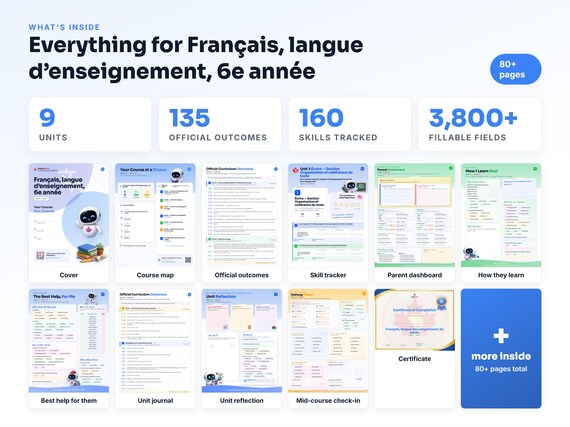
Built from the same official curriculum as this page. Before and after each skill above, your student colours in how sure they feel — so the two of you can see, on one page, what's clicking and what needs another look. It's a quiet way to follow how the year is really going.
By June it's full of their own handwriting: units worked through, confidence grown, a mid-year check-in, notes from parent-teacher night, and a certificate at the end. Less a worksheet, more a record of the year worth keeping on the shelf.
Instant download · see every page, reviews and the full description · five or more workbooks are $2.99 each
What it looks like in the app



Common questions
Can MapleMind help my child with Français, langue d’enseignement, 6e année?
Yes. MapleMind's AI tutor covers all 160 skills in Quebec's Français, langue d’enseignement, 6e année — your child picks the exact skill, and the tutor teaches it step by step: a short lesson, a worked example, solving together, then a skill check to show it stuck.
Is MapleMind aligned to Quebec's official curriculum?
Yes. Every skill in this course maps to an official outcome code from Quebec's Grade 6 French curriculum, and the ministry's own wording is quoted under each unit on this page — with the official government source linked so you can check it yourself.
What does MapleMind cost?
It's free to start — 5 tutoring chats and a practice quiz every day, no credit card. A Pro subscription ($9.99/month or $49.99/year CAD, 7-day free trial) unlocks unlimited tutoring, practice, and exam simulations.
What if my child is stuck on just one topic?
That's the point of skill-level tutoring: open Français, langue d’enseignement, 6e année in the app, tap the exact skill from the list on this page, and the tutor teaches just that — no wading through lessons your child doesn't need.
Does MapleMind work in French or other languages?
Yes — 14 languages, including French. Both the app and the tutor's explanations switch to the language your child chooses.
Where can I see the official Quebec curriculum for Français, langue d’enseignement, 6e année?
The official source is linked on this page — Québec's official education program. The outline here follows it: every MapleMind skill carries its official outcome code, and the ministry's own wording is quoted under each unit.
Keep exploring
Ready when you are
Pick a skill from this page and see it taught properly — free, in the browser, in under a minute.