Get help with Français, langue d’enseignement, 5e année
Most tutoring makes your child sit through material your child already knows. MapleMind flips that: pick the exact skill that's causing trouble — any of the 131 below — and the tutor teaches just that one, step by step, as many times as it takes. Ask questions in plain words, any time of day, in English, French, or 12 other languages.
The official Quebec Français, langue d’enseignement, 5e année curriculum
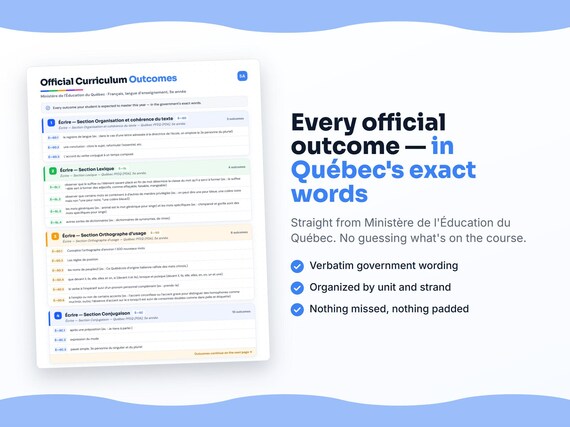
Quebec defines Français, langue d’enseignement, 5e année by strands and outcomes. MapleMind teaches the same curriculum reorganized for one-skill-at-a-time tutoring — the table shows exactly where every official strand lands, and the ministry's own wording is quoted under each unit below.
Official source Québec's official education programRead it on the government site — quebec.ca ↗| Official strand | Outcomes | Where MapleMind teaches it |
|---|---|---|
| Course outcomes | 131 | Écrire — Section Organisation et cohérence du texte · Écrire — Section Lexique · Écrire — Section Orthographe d’usage · Écrire — Section Conjugaison · Écrire — Section Accords · Écrire — Section Syntaxe et ponctuation · Compétence Lire des textes variés · Compétence Apprécier des œuvres littéraires · Compétence Communiquer oralement |
Every skill below, taught one on one.
 Try the first session free
How MapleMind teaches Français, langue d’enseignement, 5e année — every unit, lesson, and skill
Every skill below runs as a short session: a plain-words lesson, a worked example, solving it together, then a five-question skill check that earns up to three stars. Guided Mode keeps it teaching instead of answer-handing — turning it off needs a parent's password.
Unit 1Écrire — Section Organisation et cohérence du texte
Écrire — Section Organisation et cohérence du texte — Québec PFEQ (PDA), 5e année.
La situation d’écriture (the writing situation)
- Découverte : La situation d’écriture (the writing situation)P2.13 — Découverte guidée de « La situation d’écriture » (the writing situation) en 5e année, Français L1 — premier contact accompagné par l’adulte, avant la maîtrise autonome.
- La situation d’écriture (the writing situation)P2.12 — Maîtrise de « La situation d’écriture » (the writing situation) en 5e année, Français L1 — l’enfant l’emploie de façon autonome dans ses lectures, ses écrits et à l’oral.
L’organisation et la cohérence d’un texte
- Découverte : L’ordre des idées dans le texte (ordering ideas in a text)P2.30 — Découverte guidée de « L’ordre des idées dans le texte » (ordering ideas in a text) en 5e année, Français L1 — premier contact accompagné par l’adulte, avant la maîtrise autonome.
- L’ordre des idées dans le texte (ordering ideas in a text)P2.28 — Maîtrise de « L’ordre des idées dans le texte » (ordering ideas in a text) en 5e année, Français L1 — l’enfant l’emploie de façon autonome dans ses lectures, ses écrits et à l’oral.
- Découverte : Les marqueurs de relation (linking words)P2.67 — Découverte guidée de « Les marqueurs de relation » (linking words) en 5e année, Français L1 — premier contact accompagné par l’adulte, avant la maîtrise autonome.
Les accords dans le groupe du nom
- Découverte : Le texte et la cohérence (text and coherence)P2.117 — Découverte guidée de « Le texte et la cohérence » (text and coherence) en 5e année, Français L1 — premier contact accompagné par l’adulte, avant la maîtrise autonome.
The official wording — 6 outcomes in this unit
- P2.13
le registre de langue (ex. : dans le cas d’une lettre adressée à la directrice de l’école, on emploie la 2e personne du pluriel)
- P2.12
le choix du vocabulaire (ex. : dans un texte destiné à des plus jeunes, il faut choisir un vocabulaire plus simple ou expliquer un vocabulaire plus spécialisé dans le texte)
- P2.30
une conclusion : clore le sujet, reformuler l’essentiel, etc.
- P2.28
une introduction : annoncer le sujet, donner un aperçu du contenu, établir un contact avec le destinataire, susciter l’intérêt, etc.
- P2.67
marquer un type de relation (ex. : utiliser deux marqueurs de comparaison)
- P2.117
L’accord du verbe conjugué à un temps composé
Unit 2Écrire — Section Lexique
Écrire — Section Lexique — Québec PFEQ (PDA), 5e année.
La formation des mots
- Découverte : La formation des mots (préfixes, suffixes) (word formation (prefixes, suffixes))P3.6 — Découverte guidée de « La formation des mots (préfixes, suffixes) » (word formation (prefixes, suffixes)) en 5e année, Français L1 — premier contact accompagné par l’adulte, avant la maîtrise autonome.
- Le sens des mots (propre, figuré) (word meanings (literal and figurative))P3.13 — Maîtrise de « Le sens des mots (propre, figuré) » (word meanings (literal and figurative)) en 5e année, Français L1 — l’enfant l’emploie de façon autonome dans ses lectures, ses écrits et à l’oral.
- Découverte : La formation des mots (préfixes, suffixes) (word formation (prefixes, suffixes))P3.58 — Découverte guidée de « La formation des mots (préfixes, suffixes) » (word formation (prefixes, suffixes)) en 5e année, Français L1 — premier contact accompagné par l’adulte, avant la maîtrise autonome.
- Les relations entre les mots (synonymes, antonymes, génériques) (relations between words)P3.62 — Maîtrise de « Les relations entre les mots (synonymes, antonymes, génériques) » (relations between words) en 5e année, Français L1 — l’enfant l’emploie de façon autonome dans ses lectures, ses écrits et à l’oral.
D’autres propriétés des mots
- Découverte : Choisir un vocabulaire précis (choosing precise vocabulary)P3.21 — Découverte guidée de « Choisir un vocabulaire précis » (choosing precise vocabulary) en 5e année, Français L1 — premier contact accompagné par l’adulte, avant la maîtrise autonome.
- Découverte : Les relations entre les mots (synonymes, antonymes, génériques) (relations between words)P3.74 — Découverte guidée de « Les relations entre les mots (synonymes, antonymes, génériques) » (relations between words) en 5e année, Français L1 — premier contact accompagné par l’adulte, avant la maîtrise autonome.
Les relations entre les mots
- Découverte : Les relations entre les mots (synonymes, antonymes, génériques) (relations between words)P3.35 — Découverte guidée de « Les relations entre les mots (synonymes, antonymes, génériques) » (relations between words) en 5e année, Français L1 — premier contact accompagné par l’adulte, avant la maîtrise autonome.
- Découverte : Choisir un vocabulaire précis (choosing precise vocabulary)P3.87 — Découverte guidée de « Choisir un vocabulaire précis » (choosing precise vocabulary) en 5e année, Français L1 — premier contact accompagné par l’adulte, avant la maîtrise autonome.
- Le dictionnaire (using the dictionary)P3.115 — Maîtrise de « Le dictionnaire » (using the dictionary) en 5e année, Français L1 — l’enfant l’emploie de façon autonome dans ses lectures, ses écrits et à l’oral.
Le regroupement des mots de la langue dans le dictionnaire
- Découverte : Les relations entre les mots (synonymes, antonymes, génériques) (relations between words)P3.41 — Découverte guidée de « Les relations entre les mots (synonymes, antonymes, génériques) » (relations between words) en 5e année, Français L1 — premier contact accompagné par l’adulte, avant la maîtrise autonome.
- Le dictionnaire (using the dictionary)P3.48 — Maîtrise de « Le dictionnaire » (using the dictionary) en 5e année, Français L1 — l’enfant l’emploie de façon autonome dans ses lectures, ses écrits et à l’oral.
The official wording — 11 outcomes in this unit
- P3.6
observer que le suffixe ou l’élément savant placé en fin de mot détermine la classe du mot qu’il a servi à former (ex. : le suffixe –able sert à former des adjectifs, comme effaçable, faisable, mangeable)
- P3.13
ses différents sens sont proches les uns des autres (ex. : carte peut être un « petit carton servant dans différents jeux » ou un « carton illustré sur une face et utilisé pour exprimer des souhaits »)
- P3.58
classer des mots qui contiennent un même préfixe ou un même suffixe pour en dégager les différents sens (ex. : para– signifie « à côté de » dans parascolaire, mais « protection contre » dans paravent, parapluie, parachute)
- P3.62
par une explication
- P3.21
observer que certains mots se combinent à d’autres de manière privilégiée (ex. : on peut dire une peur bleue, une colère noire mais non *une peur noire, *une colère bleue3)
- P3.74
bâtir, en préparation d’une situation d’écriture, une banque de verbes liés au thème en faisant ressortir la construction de leurs compléments (ex. : sur le thème de la musique, jouer d’un instrument, lire une partition)
- P3.35
les mots génériques (ex. : animal est le mot générique pour singe) et les mots spécifiques (ex. : chimpanzé et gorille sont des mots spécifiques pour singe)
- P3.87
en remplaçant une phrase de forme négative par une phrase de forme positive en conservant le même sens (ex. : je ne veux pas perdre ce match = je veux gagner ce match; ce garçon n’est pas prudent = ce garçon est imprudent)
- P3.115
en vérifiant son sens dans un dictionnaire
- P3.41
autres sortes de dictionnaires (ex. : dictionnaires de synonymes, de rimes)
- P3.48
la présence d’autant de définitions que le mot a de sens10
Unit 3Écrire — Section Orthographe d’usage
Écrire — Section Orthographe d’usage — Québec PFEQ (PDA), 5e année.
Les mots à l’étude (the study-word spelling bank)
- Découverte : Les mots à l’étude (banque orthographique) (the study-word spelling bank)P4.5 — Découverte guidée de « Les mots à l’étude (banque orthographique) » (the study-word spelling bank) en 5e année, Français L1 — premier contact accompagné par l’adulte, avant la maîtrise autonome.
Le rôle des lettres muettes
- Les règles de position (c/ç, g/gu/ge, m devant b, m, p) (position-based spelling rules)P4.21 — Maîtrise de « Les règles de position (c/ç, g/gu/ge, m devant b, m, p) » (position-based spelling rules) en 5e année, Français L1 — l’enfant l’emploie de façon autonome dans ses lectures, ses écrits et à l’oral.
Les règles d’emploi de la majuscule
- Découverte : La majuscule (capital-letter rules)P4.28 — Découverte guidée de « La majuscule » (capital-letter rules) en 5e année, Français L1 — premier contact accompagné par l’adulte, avant la maîtrise autonome.
Les règles de l’élision
- Découverte : L’apostrophe (l’élision) (the apostrophe (elision))P4.33 — Découverte guidée de « L’apostrophe (l’élision) » (the apostrophe (elision)) en 5e année, Français L1 — premier contact accompagné par l’adulte, avant la maîtrise autonome.
Les règles d’emploi du trait d’union
- Découverte : Les mots à l’étude (banque orthographique) (the study-word spelling bank)P4.38 — Découverte guidée de « Les mots à l’étude (banque orthographique) » (the study-word spelling bank) en 5e année, Français L1 — premier contact accompagné par l’adulte, avant la maîtrise autonome.
Les constantes orthographiques
- Découverte : Les lettres et les signes (letters and diacritical signs)P4.45 — Découverte guidée de « Les lettres et les signes » (letters and diacritical signs) en 5e année, Français L1 — premier contact accompagné par l’adulte, avant la maîtrise autonome.
- Les lettres et les signes (letters and diacritical signs)P4.49 — Maîtrise de « Les lettres et les signes » (letters and diacritical signs) en 5e année, Français L1 — l’enfant l’emploie de façon autonome dans ses lectures, ses écrits et à l’oral.
The official wording — 7 outcomes in this unit
- P4.5
Connaître l’orthographe d’environ 1 500 nouveaux mots
- P4.21
Les règles de position
- P4.28
les noms de peuples3 (ex. : Ce Québécois d’origine italienne raffole des mets chinois.)
- P4.33
que devant il, ils, elle, elles et on, si (devant il et ils), lorsque et puisque (devant il, ils, elle, elles, en, on, un et une)
- P4.38
le verbe à l’impératif suivi d’un pronom personnel complément (ex. : prends-la)
- P4.45
à l’emploi ou non de certains accents (ex. : l’accent circonflexe ou l’accent grave pour distinguer des homophones comme mur/mûr, ou/où, l’absence d’accent sur le e lorsqu’il est suivi de consonnes doubles comme dans pelle et étiquette)
- P4.49
Repérer les détails orthographiques d’un mot (ex. : tête s’écrit avec un accent circonflexe)
Unit 4Écrire — Section Conjugaison
Écrire — Section Conjugaison — Québec PFEQ (PDA), 5e année.
Les temps de conjugaison et l’infinitif (verb tenses and the infinitive)
- Découverte : Les temps de conjugaison (verb tenses)P5.6 — Découverte guidée de « Les temps de conjugaison » (verb tenses) en 5e année, Français L1 — premier contact accompagné par l’adulte, avant la maîtrise autonome.
- L’infinitif du verbe (the infinitive form)P5.2 — Maîtrise de « L’infinitif du verbe » (the infinitive form) en 5e année, Français L1 — l’enfant l’emploie de façon autonome dans ses lectures, ses écrits et à l’oral.
Le radical et la terminaison
- Découverte : Les temps de conjugaison (verb tenses)P5.13 — Découverte guidée de « Les temps de conjugaison » (verb tenses) en 5e année, Français L1 — premier contact accompagné par l’adulte, avant la maîtrise autonome.
Les temps simples avec marques de personne
- Découverte : Les temps de conjugaison (verb tenses)P5.35 — Découverte guidée de « Les temps de conjugaison » (verb tenses) en 5e année, Français L1 — premier contact accompagné par l’adulte, avant la maîtrise autonome.
Les temps simples sans marque de personne
- Découverte : Les temps de conjugaison (verb tenses)P5.41 — Découverte guidée de « Les temps de conjugaison » (verb tenses) en 5e année, Français L1 — premier contact accompagné par l’adulte, avant la maîtrise autonome.
Les valeurs des temps de conjugaison
- Découverte : Les temps de conjugaison (verb tenses)P5.55 — Découverte guidée de « Les temps de conjugaison » (verb tenses) en 5e année, Français L1 — premier contact accompagné par l’adulte, avant la maîtrise autonome.
Observer les éléments qui structurent un tableau de conjugaison
- Le radical et la terminaison du verbe (verb stem and ending)P5.58 — Maîtrise de « Le radical et la terminaison du verbe » (verb stem and ending) en 5e année, Français L1 — l’enfant l’emploie de façon autonome dans ses lectures, ses écrits et à l’oral.
Explorer un temps à l’étude (exploring a tense under study)
- Les temps de conjugaison (verb tenses)P5.73 — Maîtrise de « Les temps de conjugaison » (verb tenses) en 5e année, Français L1 — l’enfant l’emploie de façon autonome dans ses lectures, ses écrits et à l’oral.
Se donner une procédure pour trouver l’orthographe d’un verbe
- Les modèles de conjugaison (conjugation models)P5.83 — Maîtrise de « Les modèles de conjugaison » (conjugation models) en 5e année, Français L1 — l’enfant l’emploie de façon autonome dans ses lectures, ses écrits et à l’oral.
En s’appuyant sur le modèle de conjugaison d’un verbe pour justifier
- Les temps de conjugaison (verb tenses)P5.85 — Maîtrise de « Les temps de conjugaison » (verb tenses) en 5e année, Français L1 — l’enfant l’emploie de façon autonome dans ses lectures, ses écrits et à l’oral.
Recourir à ses connaissances du système de la conjugaison
- Les temps de conjugaison (verb tenses)P5.104 — Maîtrise de « Les temps de conjugaison » (verb tenses) en 5e année, Français L1 — l’enfant l’emploie de façon autonome dans ses lectures, ses écrits et à l’oral.
The official wording — 11 outcomes in this unit
- P5.6
après une préposition (ex. : Je tiens à parler.)
- P5.2
Le verbe à l’infinitif
- P5.13
expression du mode
- P5.35
passé simple, 3e personne du singulier et du pluriel
- P5.41
Les temps composés
- P5.55
des valeurs particulières temporelles ou non (ex : Le présent de l’indicatif peut désigner une situation du passé, une activité qui se fait régulièrement ou un fait considéré comme vrai en tout temps. Émile Nelligan meurt en 1941. Je me brosse les dents tous les matins. La Terre tourne autour du Soleil. L’imparfait peut marquer un souhait. Ah! si j’étais riche!)
- P5.58
Les temps simples, la présence ou l’absence des pronoms de conjugaison, les pronoms de conjugaison marquant les personnes, le radical et la terminaison
- P5.73
à l’indicatif présent (ex. : j’aime, tu aimes, il aime, ils aiment)
- P5.83
En transformant le verbe conjugué dans sa forme infinitive en vue d’identifier son modèle de conjugaison
- P5.85
d’un verbe à l’étude conjugué à un temps simple
- P5.104
selon les cas d’accord sujet-verbe à l’étude1
Unit 5Écrire — Section Accords
Écrire — Section Accords — Québec PFEQ (PDA), 5e année.
Les classes de mots variables et invariables
- Découverte : Le déterminant, receveur d’accord (the determiner (receiver of agreement))P6.21 — Découverte guidée de « Le déterminant, receveur d’accord » (the determiner (receiver of agreement)) en 5e année, Français L1 — premier contact accompagné par l’adulte, avant la maîtrise autonome.
- La formation du féminin (forming the feminine)P6.20 — Maîtrise de « La formation du féminin » (forming the feminine) en 5e année, Français L1 — l’enfant l’emploie de façon autonome dans ses lectures, ses écrits et à l’oral.
La fonction sujet (the subject function)
- Découverte : Justifier les accords (justifying agreements)P6.86 — Découverte guidée de « Justifier les accords » (justifying agreements) en 5e année, Français L1 — premier contact accompagné par l’adulte, avant la maîtrise autonome.
Les règles de formation du pluriel et du féminin
- Découverte : La formation du féminin (forming the feminine)P6.103 — Découverte guidée de « La formation du féminin » (forming the feminine) en 5e année, Français L1 — premier contact accompagné par l’adulte, avant la maîtrise autonome.
Les règles d’accord dans le groupe du nom
- Découverte : L’adjectif et son accord (the adjective and its agreement)P6.108 — Découverte guidée de « L’adjectif et son accord » (the adjective and its agreement) en 5e année, Français L1 — premier contact accompagné par l’adulte, avant la maîtrise autonome.
- Découverte : Justifier les accords (justifying agreements)P6.163 — Découverte guidée de « Justifier les accords » (justifying agreements) en 5e année, Français L1 — premier contact accompagné par l’adulte, avant la maîtrise autonome.
Les accords régis par le sujet (agreements driven by the subject)
- Découverte : Les pronoms de conjugaison (conjugation pronouns)P6.112 — Découverte guidée de « Les pronoms de conjugaison » (conjugation pronouns) en 5e année, Français L1 — premier contact accompagné par l’adulte, avant la maîtrise autonome.
- Les pronoms de conjugaison (conjugation pronouns)P6.111 — Maîtrise de « Les pronoms de conjugaison » (conjugation pronouns) en 5e année, Français L1 — l’enfant l’emploie de façon autonome dans ses lectures, ses écrits et à l’oral.
- Découverte : L’accord du verbe avec le sujet (subject-verb agreement)P6.174 — Découverte guidée de « L’accord du verbe avec le sujet » (subject-verb agreement) en 5e année, Français L1 — premier contact accompagné par l’adulte, avant la maîtrise autonome.
Les classes de mots variables et invariables (variable and invariable word classes)
- Découverte : Justifier les accords (justifying agreements)P6.124 — Découverte guidée de « Justifier les accords » (justifying agreements) en 5e année, Français L1 — premier contact accompagné par l’adulte, avant la maîtrise autonome.
- Le déterminant, receveur d’accord (the determiner (receiver of agreement))P6.140 — Maîtrise de « Le déterminant, receveur d’accord » (the determiner (receiver of agreement)) en 5e année, Français L1 — l’enfant l’emploie de façon autonome dans ses lectures, ses écrits et à l’oral.
Les règles de formation du féminin et du pluriel
- Découverte : Le déterminant, receveur d’accord (the determiner (receiver of agreement))P6.161 — Découverte guidée de « Le déterminant, receveur d’accord » (the determiner (receiver of agreement)) en 5e année, Français L1 — premier contact accompagné par l’adulte, avant la maîtrise autonome.
- L’adjectif et son accord (the adjective and its agreement)P6.160 — Maîtrise de « L’adjectif et son accord » (the adjective and its agreement) en 5e année, Français L1 — l’enfant l’emploie de façon autonome dans ses lectures, ses écrits et à l’oral.
The official wording — 13 outcomes in this unit
- P6.21
identifier des sortes de déterminants (ex. : possessifs, démonstratifs, numéraux)
- P6.20
observer les règles d’utilisation des déterminants mon, ton, son devant des mots féminins et cet devant des mots masculins commençant par une voyelle ou un h muet (ex. : mon auteure préférée, cet adorable personnage)
- P6.86
autres pronoms (ex. : [Cela] fait mon affaire.)
- P6.103
Observer que certains déterminants forment leur féminin selon les mêmes règles que celles des noms et des adjectifs (ex. : un/une; tout/toute; aucun/aucune; cet/cette; quel/quelle)
- P6.108
Connaître la règle d’accord de l'adjectif avec plusieurs noms de même genre coordonnés13 (ex. : les pommes et les poires mûres, les navets et les piments crus, un foulard et un manteau rouges)
- P6.163
Justifier les accords en genre et en nombre dans des phrases correctement orthographiées, selon les cas à l’étude, en exprimant un raisonnement grammatical complet (voir Annexe 2, A et B)
- P6.112
qui précède immédiatement le verbe séparé du verbe par un autre pronom (ex. : Je vous aime.) un autre pronom que le pronom de conjugaison (ex. : qui, cela)
- P6.111
un pronom de conjugaison
- P6.174
l’accord de l’auxiliaire avoir ou être du verbe à un temps composé
- P6.124
conjugué à un temps composé
- P6.140
Repérer les adjectifs et les déterminants et les relier au nom noyau donneur
- P6.161
Remplacer un déterminant dont la variation en genre ou en nombre n’est pas marquée oralement mais dont la forme change à l’écrit par un déterminant dont la forme change tant à l’oral qu’à l’écrit (ex : des canes et leurs canetons/une cane et ses canetons)
- P6.160
Remplacer un adjectif dont la variation en genre ou en nombre n’est pas marquée oralement mais dont la forme change à l’écrit par un adjectif dont la forme change tant à l’oral qu’à l’écrit (ex. : les éternelles discussions/les longues discussions)
Unit 6Écrire — Section Syntaxe et ponctuation
Écrire — Section Syntaxe et ponctuation — Québec PFEQ (PDA), 5e année.
Structurer et ponctuer ses phrases (structuring and punctuating sentences)
- Découverte : Les caractéristiques de la phrase (characteristics of the sentence)P7.2 — Découverte guidée de « Les caractéristiques de la phrase » (characteristics of the sentence) en 5e année, Français L1 — premier contact accompagné par l’adulte, avant la maîtrise autonome.
La virgule à l’intérieur d’une phrase
- Découverte : Le SUJET, le PRÉDICAT et le COMPLÉMENT DE PHRASE (sentence constituents)P7.33 — Découverte guidée de « Le SUJET, le PRÉDICAT et le COMPLÉMENT DE PHRASE » (sentence constituents) en 5e année, Français L1 — premier contact accompagné par l’adulte, avant la maîtrise autonome.
La ponctuation pour marquer les paroles rapportées
- Découverte : La ponctuation du dialogue (dialogue punctuation)P7.38 — Découverte guidée de « La ponctuation du dialogue » (dialogue punctuation) en 5e année, Français L1 — premier contact accompagné par l’adulte, avant la maîtrise autonome.
Les formes positive et négative
- Découverte : La forme négative (the negative form)P7.43 — Découverte guidée de « La forme négative » (the negative form) en 5e année, Français L1 — premier contact accompagné par l’adulte, avant la maîtrise autonome.
- Découverte : La forme négative (the negative form)P7.213 — Découverte guidée de « La forme négative » (the negative form) en 5e année, Français L1 — premier contact accompagné par l’adulte, avant la maîtrise autonome.
Les constituants et les types de phrases (sentence constituents and types)
- Découverte : La phrase interrogative (the interrogative sentence)P7.54 — Découverte guidée de « La phrase interrogative » (the interrogative sentence) en 5e année, Français L1 — premier contact accompagné par l’adulte, avant la maîtrise autonome.
- Le SUJET, le PRÉDICAT et le COMPLÉMENT DE PHRASE (sentence constituents)P7.50 — Maîtrise de « Le SUJET, le PRÉDICAT et le COMPLÉMENT DE PHRASE » (sentence constituents) en 5e année, Français L1 — l’enfant l’emploie de façon autonome dans ses lectures, ses écrits et à l’oral.
Le groupe de mots en fonction sujet (the word group acting as subject)
- Découverte : Les caractéristiques de la phrase (characteristics of the sentence)P7.62 — Découverte guidée de « Les caractéristiques de la phrase » (characteristics of the sentence) en 5e année, Français L1 — premier contact accompagné par l’adulte, avant la maîtrise autonome.
- Le SUJET, le PRÉDICAT et le COMPLÉMENT DE PHRASE (sentence constituents)P7.57 — Maîtrise de « Le SUJET, le PRÉDICAT et le COMPLÉMENT DE PHRASE » (sentence constituents) en 5e année, Français L1 — l’enfant l’emploie de façon autonome dans ses lectures, ses écrits et à l’oral.
- Découverte : Le groupe du nom (GN) (the noun group)P7.67 — Découverte guidée de « Le groupe du nom (GN) » (the noun group) en 5e année, Français L1 — premier contact accompagné par l’adulte, avant la maîtrise autonome.
- Le SUJET, le PRÉDICAT et le COMPLÉMENT DE PHRASE (sentence constituents)P7.66 — Maîtrise de « Le SUJET, le PRÉDICAT et le COMPLÉMENT DE PHRASE » (sentence constituents) en 5e année, Français L1 — l’enfant l’emploie de façon autonome dans ses lectures, ses écrits et à l’oral.
- Découverte : Les caractéristiques de la phrase (characteristics of the sentence)P7.70 — Découverte guidée de « Les caractéristiques de la phrase » (characteristics of the sentence) en 5e année, Français L1 — premier contact accompagné par l’adulte, avant la maîtrise autonome.
La phrase de type interrogatif
- Découverte : Le SUJET, le PRÉDICAT et le COMPLÉMENT DE PHRASE (sentence constituents)P7.87 — Découverte guidée de « Le SUJET, le PRÉDICAT et le COMPLÉMENT DE PHRASE » (sentence constituents) en 5e année, Français L1 — premier contact accompagné par l’adulte, avant la maîtrise autonome.
- La phrase interrogative (the interrogative sentence)P7.85 — Maîtrise de « La phrase interrogative » (the interrogative sentence) en 5e année, Français L1 — l’enfant l’emploie de façon autonome dans ses lectures, ses écrits et à l’oral.
- Découverte : La phrase interrogative (the interrogative sentence)P7.224 — Découverte guidée de « La phrase interrogative » (the interrogative sentence) en 5e année, Français L1 — premier contact accompagné par l’adulte, avant la maîtrise autonome.
- La phrase interrogative (the interrogative sentence)P7.221 — Maîtrise de « La phrase interrogative » (the interrogative sentence) en 5e année, Français L1 — l’enfant l’emploie de façon autonome dans ses lectures, ses écrits et à l’oral.
La phrase de type impératif
- Découverte : Le SUJET, le PRÉDICAT et le COMPLÉMENT DE PHRASE (sentence constituents)P7.103 — Découverte guidée de « Le SUJET, le PRÉDICAT et le COMPLÉMENT DE PHRASE » (sentence constituents) en 5e année, Français L1 — premier contact accompagné par l’adulte, avant la maîtrise autonome.
- Découverte : Le SUJET, le PRÉDICAT et le COMPLÉMENT DE PHRASE (sentence constituents)P7.233 — Découverte guidée de « Le SUJET, le PRÉDICAT et le COMPLÉMENT DE PHRASE » (sentence constituents) en 5e année, Français L1 — premier contact accompagné par l’adulte, avant la maîtrise autonome.
L’attribut du sujet dans le groupe du verbe (the subject attribute in the verb group)
- Découverte : Le SUJET, le PRÉDICAT et le COMPLÉMENT DE PHRASE (sentence constituents)P7.119 — Découverte guidée de « Le SUJET, le PRÉDICAT et le COMPLÉMENT DE PHRASE » (sentence constituents) en 5e année, Français L1 — premier contact accompagné par l’adulte, avant la maîtrise autonome.
- Le SUJET, le PRÉDICAT et le COMPLÉMENT DE PHRASE (sentence constituents)P7.118 — Maîtrise de « Le SUJET, le PRÉDICAT et le COMPLÉMENT DE PHRASE » (sentence constituents) en 5e année, Français L1 — l’enfant l’emploie de façon autonome dans ses lectures, ses écrits et à l’oral.
Le groupe du nom (GN)
- Découverte : Le groupe du nom (GN) (the noun group)P7.157 — Découverte guidée de « Le groupe du nom (GN) » (the noun group) en 5e année, Français L1 — premier contact accompagné par l’adulte, avant la maîtrise autonome.
- Le groupe du nom (GN) (the noun group)P7.154 — Maîtrise de « Le groupe du nom (GN) » (the noun group) en 5e année, Français L1 — l’enfant l’emploie de façon autonome dans ses lectures, ses écrits et à l’oral.
Le groupe du verbe (GV)
- Découverte : Le groupe du nom (GN) (the noun group)P7.167 — Découverte guidée de « Le groupe du nom (GN) » (the noun group) en 5e année, Français L1 — premier contact accompagné par l’adulte, avant la maîtrise autonome.
- Les manipulations syntaxiques (syntactic manipulations)P7.184 — Maîtrise de « Les manipulations syntaxiques » (syntactic manipulations) en 5e année, Français L1 — l’enfant l’emploie de façon autonome dans ses lectures, ses écrits et à l’oral.
La phrase de type déclaratif
- Découverte : Les caractéristiques de la phrase (characteristics of the sentence)P7.216 — Découverte guidée de « Les caractéristiques de la phrase » (characteristics of the sentence) en 5e année, Français L1 — premier contact accompagné par l’adulte, avant la maîtrise autonome.
- Le SUJET, le PRÉDICAT et le COMPLÉMENT DE PHRASE (sentence constituents)P7.218 — Maîtrise de « Le SUJET, le PRÉDICAT et le COMPLÉMENT DE PHRASE » (sentence constituents) en 5e année, Français L1 — l’enfant l’emploie de façon autonome dans ses lectures, ses écrits et à l’oral.
Le groupe du verbe dans la phrase (the verb group in the sentence)
- Découverte : Le SUJET, le PRÉDICAT et le COMPLÉMENT DE PHRASE (sentence constituents)P7.261 — Découverte guidée de « Le SUJET, le PRÉDICAT et le COMPLÉMENT DE PHRASE » (sentence constituents) en 5e année, Français L1 — premier contact accompagné par l’adulte, avant la maîtrise autonome.
The official wording — 27 outcomes in this unit
- P7.2
La structure d’une phrase
- P7.33
pour isoler ou encadrer le COMPLÉMENT DE PHRASE qui n’est pas placé en fin de phrase
- P7.38
deux-points et guillemets
- P7.43
ne/n’… aucun/aucune
- P7.213
redondance d’un mot de négation(ex. : à l’oral, on entend parfois : Y’a pas personne qui vient. On écrit : Il n’y a personne qui vient.)
- P7.54
la présence, à l’occasion, des points d’interrogation ou d’exclamation (ex. : Tu n’aimes pas le chocolat? Tu n’aimes pas le chocolat!)
- P7.50
la présence des constituants obligatoires : SUJET et PRÉDICAT
- P7.62
autres pronoms (ex. : [Cela] fait mon affaire.)
- P7.57
encadrement du SUJET par C’est… qui
- P7.67
observer la seule construction possible du PRÉDICAT : le groupe du verbe
- P7.66
observer la présence d’un verbe conjugué dans le PRÉDICAT
- P7.70
dédoublement par « et cela se passe » ou « et il/elle le fait » (ex. : Je fais de la natation tous les mardis soirs. Je fais de la natation, et cela se passe, tous les mardis soirs.)
- P7.87
la phrase contient obligatoirement un SUJET, un PRÉDICAT et, facultativement, un COMPLÉMENT DE PHRASE, placés dans un ordre souvent différent de celui de la PHRASE DE BASE
- P7.85
la phrase se termine par un point d’interrogation
- P7.224
la question qui amène une réponse par oui ou non
- P7.221
Se bâtir une liste de mots interrogatifs, indiquer le sens qu’ils expriment et rédiger des exemples de questions et de réponses
- P7.103
le SUJET n’est pas présent, mais il peut être identifié en reformant la PHRASE DE BASE
- P7.233
Relever, dans des textes, des phrases impératives et justifier ce classement en s’appuyant sur la présence et l’ordre des constituants
- P7.119
sa position après un verbe attributif
- P7.118
son accord avec le SUJET quand il est un adjectif14
- P7.157
groupe du nom (ex. : mon amie Axelle)
- P7.154
dét. + nom avec expansion17
- P7.167
Identifier un groupe du verbe et son verbe noyau
- P7.184
ajouter des groupes de mots, en déplacer, en remplacer, en effacer et vérifier si la phrase reste bien construite
- P7.216
Modifier une phrase en y ajoutant, déplaçant ou effaçant des COMPLÉMENTS DE PHRASE et modifier la ponctuation en conséquence
- P7.218
Rédiger des phrases déclaratives sur un thème donné et cerner le SUJET, le PRÉDICAT et, s’il y a lieu, le ou les COMPLÉMENTS DE PHRASE
- P7.261
Se bâtir une liste de verbes attributifs ou en consulter une dans une grammaire
Unit 7Compétence Lire des textes variés
Compétence Lire des textes variés — Québec PFEQ (PDA), 5e année.
Les textes qui décrivent (texts that describe)
- Reconnaître les genres de textes en lecture (recognising text genres in reading)P8.10 — Maîtrise de « Reconnaître les genres de textes en lecture » (recognising text genres in reading) en 5e année, Français L1 — l’enfant l’emploie de façon autonome dans ses lectures, ses écrits et à l’oral.
Les textes qui expliquent (texts that explain)
- Reconnaître les genres de textes en lecture (recognising text genres in reading)P8.14 — Maîtrise de « Reconnaître les genres de textes en lecture » (recognising text genres in reading) en 5e année, Français L1 — l’enfant l’emploie de façon autonome dans ses lectures, ses écrits et à l’oral.
Les textes qui précisent des consignes (texts that give instructions)
- Découverte : Reconnaître les genres de textes en lecture (recognising text genres in reading)P8.19 — Découverte guidée de « Reconnaître les genres de textes en lecture » (recognising text genres in reading) en 5e année, Français L1 — premier contact accompagné par l’adulte, avant la maîtrise autonome.
Les textes qui visent à convaincre (texts that aim to persuade)
- Découverte : Comprendre le sens d’un texte (understanding a text)P8.23 — Découverte guidée de « Comprendre le sens d’un texte » (understanding a text) en 5e année, Français L1 — premier contact accompagné par l’adulte, avant la maîtrise autonome.
Les textes qui comportent des interactions verbales (texts with dialogue)
- Reconnaître les genres de textes en lecture (recognising text genres in reading)P8.28 — Maîtrise de « Reconnaître les genres de textes en lecture » (recognising text genres in reading) en 5e année, Français L1 — l’enfant l’emploie de façon autonome dans ses lectures, ses écrits et à l’oral.
Structure des textes
- Comprendre le sens d’un texte (understanding a text)P8.41 — Maîtrise de « Comprendre le sens d’un texte » (understanding a text) en 5e année, Français L1 — l’enfant l’emploie de façon autonome dans ses lectures, ses écrits et à l’oral.
Les cinq temps du récit (the five stages of a story)
- Découverte : Les éléments du récit (personnages, temps, lieux) (story elements)P8.47 — Découverte guidée de « Les éléments du récit (personnages, temps, lieux) » (story elements) en 5e année, Français L1 — premier contact accompagné par l’adulte, avant la maîtrise autonome.
Principaux éléments littéraires (en lecture)
- Découverte : Les éléments du récit (personnages, temps, lieux) (story elements)P8.53 — Découverte guidée de « Les éléments du récit (personnages, temps, lieux) » (story elements) en 5e année, Français L1 — premier contact accompagné par l’adulte, avant la maîtrise autonome.
Les caractéristiques des personnages (character traits)
- Les éléments du récit (personnages, temps, lieux) (story elements)P8.56 — Maîtrise de « Les éléments du récit (personnages, temps, lieux) » (story elements) en 5e année, Français L1 — l’enfant l’emploie de façon autonome dans ses lectures, ses écrits et à l’oral.
Le temps et les lieux d’un récit (time and place in a story)
- Inférer l’implicite (inferring implicit meaning)P8.60 — Maîtrise de « Inférer l’implicite » (inferring implicit meaning) en 5e année, Français L1 — l’enfant l’emploie de façon autonome dans ses lectures, ses écrits et à l’oral.
Les expressions imagées et les figures de style (imagery and figures of speech)
- Comprendre le sens d’un texte (understanding a text)P8.68 — Maîtrise de « Comprendre le sens d’un texte » (understanding a text) en 5e année, Français L1 — l’enfant l’emploie de façon autonome dans ses lectures, ses écrits et à l’oral.
Différentes façons d’organiser les idées (ways of organising ideas)
- Les éléments du récit (personnages, temps, lieux) (story elements)P8.72 — Maîtrise de « Les éléments du récit (personnages, temps, lieux) » (story elements) en 5e année, Français L1 — l’enfant l’emploie de façon autonome dans ses lectures, ses écrits et à l’oral.
Les mots qui marquent le temps (words that mark time)
- Comprendre le sens d’un texte (understanding a text)P8.78 — Maîtrise de « Comprendre le sens d’un texte » (understanding a text) en 5e année, Français L1 — l’enfant l’emploie de façon autonome dans ses lectures, ses écrits et à l’oral.
Repérer les marqueurs dans le texte (spotting markers in a text)
- Découverte : Comprendre le sens d’un texte (understanding a text)P8.87 — Découverte guidée de « Comprendre le sens d’un texte » (understanding a text) en 5e année, Français L1 — premier contact accompagné par l’adulte, avant la maîtrise autonome.
Découvrir les mots nouveaux grâce au contexte (new words from context)
- Comprendre le sens d’un texte (understanding a text)P8.108 — Maîtrise de « Comprendre le sens d’un texte » (understanding a text) en 5e année, Français L1 — l’enfant l’emploie de façon autonome dans ses lectures, ses écrits et à l’oral.
Survoler le texte pour anticiper (previewing a text to predict)
- Les stratégies de lecture (reading strategies)P8.116 — Maîtrise de « Les stratégies de lecture » (reading strategies) en 5e année, Français L1 — l’enfant l’emploie de façon autonome dans ses lectures, ses écrits et à l’oral.
L’information importante dans les phrases longues (key information in long sentences)
- Comprendre le sens d’un texte (understanding a text)P8.126 — Maîtrise de « Comprendre le sens d’un texte » (understanding a text) en 5e année, Français L1 — l’enfant l’emploie de façon autonome dans ses lectures, ses écrits et à l’oral.
Le sens des expressions figées (the meaning of set expressions)
- Reconnaître les genres de textes en lecture (recognising text genres in reading)P8.130 — Maîtrise de « Reconnaître les genres de textes en lecture » (recognising text genres in reading) en 5e année, Français L1 — l’enfant l’emploie de façon autonome dans ses lectures, ses écrits et à l’oral.
Des indices pour dégager l’information importante (clues to the important information)
- Comprendre le sens d’un texte (understanding a text)P8.140 — Maîtrise de « Comprendre le sens d’un texte » (understanding a text) en 5e année, Français L1 — l’enfant l’emploie de façon autonome dans ses lectures, ses écrits et à l’oral.
Regrouper l’information dispersée (piecing together scattered information)
- Comprendre le sens d’un texte (understanding a text)P8.144 — Maîtrise de « Comprendre le sens d’un texte » (understanding a text) en 5e année, Français L1 — l’enfant l’emploie de façon autonome dans ses lectures, ses écrits et à l’oral.
Inférer l’information implicite (inferring implicit information)
- Reconnaître les genres de textes en lecture (recognising text genres in reading)P8.147 — Maîtrise de « Reconnaître les genres de textes en lecture » (recognising text genres in reading) en 5e année, Français L1 — l’enfant l’emploie de façon autonome dans ses lectures, ses écrits et à l’oral.
Recourir à divers outils de référence (using reference tools)
- Comprendre le sens d’un texte (understanding a text)P8.158 — Maîtrise de « Comprendre le sens d’un texte » (understanding a text) en 5e année, Français L1 — l’enfant l’emploie de façon autonome dans ses lectures, ses écrits et à l’oral.
Construire du sens à l’aide de son bagage de connaissances
- Inférer l’implicite (inferring implicit meaning)P8.164 — Maîtrise de « Inférer l’implicite » (inferring implicit meaning) en 5e année, Français L1 — l’enfant l’emploie de façon autonome dans ses lectures, ses écrits et à l’oral.
Défendre son interprétation personnelle (defending your interpretation)
- Réagir à un texte (reacting to a text)P8.174 — Maîtrise de « Réagir à un texte » (reacting to a text) en 5e année, Français L1 — l’enfant l’emploie de façon autonome dans ses lectures, ses écrits et à l’oral.
S’exprimer sur le texte (talking about the text)
- Découverte : Réagir à un texte (reacting to a text)P8.186 — Découverte guidée de « Réagir à un texte » (reacting to a text) en 5e année, Français L1 — premier contact accompagné par l’adulte, avant la maîtrise autonome.
Appuyer ses réactions sur le texte (backing up your reactions with the text)
- Comprendre le sens d’un texte (understanding a text)P8.189 — Maîtrise de « Comprendre le sens d’un texte » (understanding a text) en 5e année, Français L1 — l’enfant l’emploie de façon autonome dans ses lectures, ses écrits et à l’oral.
Pourquoi lire des textes littéraires (why we read literary texts)
- Les éléments du récit (personnages, temps, lieux) (story elements)P8.196 — Maîtrise de « Les éléments du récit (personnages, temps, lieux) » (story elements) en 5e année, Français L1 — l’enfant l’emploie de façon autonome dans ses lectures, ses écrits et à l’oral.
Chercher l’information dans tous les genres de textes (finding information across genres)
- Comprendre le sens d’un texte (understanding a text)P8.206 — Maîtrise de « Comprendre le sens d’un texte » (understanding a text) en 5e année, Français L1 — l’enfant l’emploie de façon autonome dans ses lectures, ses écrits et à l’oral.
Utiliser les stratégies, les connaissances et les techniques requises
- Comprendre le sens d’un texte (understanding a text)P8.212 — Maîtrise de « Comprendre le sens d’un texte » (understanding a text) en 5e année, Français L1 — l’enfant l’emploie de façon autonome dans ses lectures, ses écrits et à l’oral.
Sélectionner l’information utile (selecting useful information)
- Comprendre le sens d’un texte (understanding a text)P8.217 — Maîtrise de « Comprendre le sens d’un texte » (understanding a text) en 5e année, Français L1 — l’enfant l’emploie de façon autonome dans ses lectures, ses écrits et à l’oral.
Évaluer sa démarche de lecture en vue de l’améliorer
- Rechercher et sélectionner l’information (researching and selecting information)P8.225 — Maîtrise de « Rechercher et sélectionner l’information » (researching and selecting information) en 5e année, Français L1 — l’enfant l’emploie de façon autonome dans ses lectures, ses écrits et à l’oral.
The official wording — 31 outcomes in this unit
- P8.10
description (ex. : personnage, objet, lieu)
- P8.14
article d’encyclopédie, de magazine et de revue
- P8.19
notice de montage ou de fabrication, instructions, protocole expérimental, plan technique
- P8.23
texte d’opinion, critique
- P8.28
bande dessinée, saynète, pièce de théâtre
- P8.41
détecter les marques de paroles ou de dialogue : deux-points, guillemets, tirets
- P8.47
repérer le double renversement dans une fable où ce qui se produit est le contraire de ce qui est attendu (ex. : Le lièvre et la tortue)
- P8.53
identifier les sous-thèmes
- P8.56
rôle et importance dans l’histoire
- P8.60
mentionnés de façon implicite
- P8.68
mot-valise (ex. : animots, coucouturière)
- P8.72
ordre non chronologique (ex. : retour en arrière, saut dans le futur, bris dans le temps)
- P8.78
parce que, puisque, car, à cause de
- P8.87
aucun/aucune, personne ne, rien ne
- P8.108
sources externes (ex. : dictionnaire, lexique, glossaire)
- P8.116
planifier sa manière d’aborder le texte en fonction de son intention (ex. : dessin, schéma, surlignement, annotation)
- P8.126
dégager l’information principale
- P8.130
s’appuyer sur le contexte (ex. : illustrations, sens du paragraphe)
- P8.140
indices lexicaux (ex. : mots ou expressions qui attirent l’attention, mots génériques)
- P8.144
saisir les indices annonçant des liens (ex. : intertitres, marqueurs de relation, référents des pronoms)
- P8.147
faire des liens entre des informations contenues dans le texte pour créer une information nouvelle (inférence logique)
- P8.158
schémas, graphiques, diagrammes
- P8.164
extraire de plusieurs textes des informations explicites et implicites
- P8.174
en s’appuyant sur des extraits du texte (preuves)
- P8.186
se référer à ses repères culturels (ex. : d’ordre littéraire, artistique, scientifique, géographique, historique)
- P8.189
sur d’autres textes lus ou connus
- P8.196
vivre diverses expériences par procuration (ex. : identification à un personnage)
- P8.206
nourrir ses prises de parole
- P8.212
décider de sa façon de lire (ex. : survol, lecture intégrale ou sélective)
- P8.217
autres informations utiles
- P8.225
se donner des défis (ex. : variété de textes, longueur des textes, stratégies à expérimenter)
Unit 8Compétence Apprécier des œuvres littéraires
Compétence Apprécier des œuvres littéraires — Québec PFEQ (PDA), 5e année.
Explorer les œuvres et leurs auteurs (exploring works and their authors)
- Connaître le livre (couverture, format) (the book's features)P9.7 — Maîtrise de « Connaître le livre (couverture, format) » (the book's features) en 5e année, Français L1 — l’enfant l’emploie de façon autonome dans ses lectures, ses écrits et à l’oral.
Parties d’un livre
- Connaître le livre (couverture, format) (the book's features)P9.14 — Maîtrise de « Connaître le livre (couverture, format) » (the book's features) en 5e année, Français L1 — l’enfant l’emploie de façon autonome dans ses lectures, ses écrits et à l’oral.
Présentation matérielle d’un livre
- Connaître le livre (couverture, format) (the book's features)P9.21 — Maîtrise de « Connaître le livre (couverture, format) » (the book's features) en 5e année, Français L1 — l’enfant l’emploie de façon autonome dans ses lectures, ses écrits et à l’oral.
Les œuvres de littérature pour la jeunesse (works of children’s literature)
- Porter un jugement critique sur une œuvre (forming a critical judgment)P9.25 — Maîtrise de « Porter un jugement critique sur une œuvre » (forming a critical judgment) en 5e année, Français L1 — l’enfant l’emploie de façon autonome dans ses lectures, ses écrits et à l’oral.
Principaux éléments littéraires (en appréciation)
- Comparer des œuvres (comparing works)P9.38 — Maîtrise de « Comparer des œuvres » (comparing works) en 5e année, Français L1 — l’enfant l’emploie de façon autonome dans ses lectures, ses écrits et à l’oral.
Relier les œuvres entre elles (connecting works together)
- Connaître le livre (couverture, format) (the book's features)P9.56 — Maîtrise de « Connaître le livre (couverture, format) » (the book's features) en 5e année, Français L1 — l’enfant l’emploie de façon autonome dans ses lectures, ses écrits et à l’oral.
Explorer des œuvres variées
- S’inspirer des œuvres et développer sa sensibilité (drawing on literary works)P9.62 — Maîtrise de « S’inspirer des œuvres et développer sa sensibilité » (drawing on literary works) en 5e année, Français L1 — l’enfant l’emploie de façon autonome dans ses lectures, ses écrits et à l’oral.
Recourir aux œuvres littéraires à diverses fins
- S’inspirer des œuvres et développer sa sensibilité (drawing on literary works)P9.68 — Maîtrise de « S’inspirer des œuvres et développer sa sensibilité » (drawing on literary works) en 5e année, Français L1 — l’enfant l’emploie de façon autonome dans ses lectures, ses écrits et à l’oral.
Porter un jugement critique sur les œuvres littéraires
- Comparer des œuvres (comparing works)P9.80 — Maîtrise de « Comparer des œuvres » (comparing works) en 5e année, Français L1 — l’enfant l’emploie de façon autonome dans ses lectures, ses écrits et à l’oral.
Comparer son appréciation avec celle des autres (comparing appreciations)
- Porter un jugement critique sur une œuvre (forming a critical judgment)P9.90 — Maîtrise de « Porter un jugement critique sur une œuvre » (forming a critical judgment) en 5e année, Français L1 — l’enfant l’emploie de façon autonome dans ses lectures, ses écrits et à l’oral.
The official wording — 10 outcomes in this unit
- P9.7
identifier quelques séries (mêmes personnages, intrigues semblables)
- P9.14
repérer dans les pages de garde la dédicace (à qui le livre rend hommage)
- P9.21
constater l’emploi de différents procédés artistiques (ex. : dessin, peinture, collage, gravure, photo)
- P9.25
découvrir des œuvres du patrimoine littéraire d’ici et d’ailleurs (ex. : contes, légendes, fables)
- P9.38
constater diverses manières de traiter un même thème (ex. : pour l’amitié : aventures, échange de lettres, témoignage, journal intime, dialogues)
- P9.56
constater les variantes d’une œuvre (ex. : transformation des personnages, des lieux, de l’histoire; transposition d’un conte en bande dessinée ou d’un roman en film)
- P9.62
participer à l’élaboration d’un répertoire collectif
- P9.68
s’inspirer, à l’oral et à l’écrit, des œuvres lues, vues ou entendues (ex. : idées, organisation du texte, structure de phrase, vocabulaire)
- P9.80
évaluer une œuvre en la comparant à d’autres œuvres semblables
- P9.90
à l’écrit (ex. : fiches d’appréciation, journal dialogué, blogues)
Unit 9Compétence Communiquer oralement
Compétence Communiquer oralement — Québec PFEQ (PDA), 5e année.
Mettre en valeur un texte à voix haute (bringing a text to life aloud)
- Participer à un échange (taking part in an exchange)P10.10 — Maîtrise de « Participer à un échange » (taking part in an exchange) en 5e année, Français L1 — l’enfant l’emploie de façon autonome dans ses lectures, ses écrits et à l’oral.
Observer la diversité des interlocuteurs
- Prendre la parole (speaking up)P10.15 — Maîtrise de « Prendre la parole » (speaking up) en 5e année, Français L1 — l’enfant l’emploie de façon autonome dans ses lectures, ses écrits et à l’oral.
L’effet produit par les idées émises (the effect of the ideas you voice)
- Participer à un échange (taking part in an exchange)P10.27 — Maîtrise de « Participer à un échange » (taking part in an exchange) en 5e année, Français L1 — l’enfant l’emploie de façon autonome dans ses lectures, ses écrits et à l’oral.
Observer la façon de s’adapter au contexte d’écoute
- Participer à un échange (taking part in an exchange)P10.53 — Maîtrise de « Participer à un échange » (taking part in an exchange) en 5e année, Français L1 — l’enfant l’emploie de façon autonome dans ses lectures, ses écrits et à l’oral.
Observer différents types de réactions à l’égard du contenu
- Participer à un échange (taking part in an exchange)P10.56 — Maîtrise de « Participer à un échange » (taking part in an exchange) en 5e année, Français L1 — l’enfant l’emploie de façon autonome dans ses lectures, ses écrits et à l’oral.
Participer à des échanges sur des sujets variés
- Participer à un échange (taking part in an exchange)P10.102 — Maîtrise de « Participer à un échange » (taking part in an exchange) en 5e année, Français L1 — l’enfant l’emploie de façon autonome dans ses lectures, ses écrits et à l’oral.
Organiser progressivement ses propos durant les prises de parole
- Participer à un échange (taking part in an exchange)P10.107 — Maîtrise de « Participer à un échange » (taking part in an exchange) en 5e année, Français L1 — l’enfant l’emploie de façon autonome dans ses lectures, ses écrits et à l’oral.
Expérimenter différentes intentions de prise de parole et d’écoute
- Prendre la parole (speaking up)P10.117 — Maîtrise de « Prendre la parole » (speaking up) en 5e année, Français L1 — l’enfant l’emploie de façon autonome dans ses lectures, ses écrits et à l’oral.
Tenir compte des règles établies
- Participer à un échange (taking part in an exchange)P10.121 — Maîtrise de « Participer à un échange » (taking part in an exchange) en 5e année, Français L1 — l’enfant l’emploie de façon autonome dans ses lectures, ses écrits et à l’oral.
S’impliquer activement comme locuteur et interlocuteur
- Participer à un échange (taking part in an exchange)P10.127 — Maîtrise de « Participer à un échange » (taking part in an exchange) en 5e année, Français L1 — l’enfant l’emploie de façon autonome dans ses lectures, ses écrits et à l’oral.
Ajuster ses propos au fur et à mesure
- Participer à un échange (taking part in an exchange)P10.133 — Maîtrise de « Participer à un échange » (taking part in an exchange) en 5e année, Français L1 — l’enfant l’emploie de façon autonome dans ses lectures, ses écrits et à l’oral.
Varier sa manière de dire quelque chose selon l’interlocuteur
- Adapter sa façon de dire (registre, voix) (adapting register and delivery)P10.139 — Maîtrise de « Adapter sa façon de dire (registre, voix) » (adapting register and delivery) en 5e année, Français L1 — l’enfant l’emploie de façon autonome dans ses lectures, ses écrits et à l’oral.
Adapter son écoute
- Écouter et réagir (listening and responding)P10.147 — Maîtrise de « Écouter et réagir » (listening and responding) en 5e année, Français L1 — l’enfant l’emploie de façon autonome dans ses lectures, ses écrits et à l’oral.
Manifester son écoute de diverses manières
- Participer à un échange (taking part in an exchange)P10.151 — Maîtrise de « Participer à un échange » (taking part in an exchange) en 5e année, Français L1 — l’enfant l’emploie de façon autonome dans ses lectures, ses écrits et à l’oral.
Évaluer sa façon de s’exprimer et d’interagir en vue de les améliorer
- Écouter et réagir (listening and responding)P10.161 — Maîtrise de « Écouter et réagir » (listening and responding) en 5e année, Français L1 — l’enfant l’emploie de façon autonome dans ses lectures, ses écrits et à l’oral.
The official wording — 15 outcomes in this unit
- P10.10
justification des propos ou acceptation des justifications des autres (ex. : explications, clarifications, preuves, conclusion avec donc)
- P10.15
statut social différent
- P10.27
ajustement des propos selon le destinataire
- P10.53
comportements appropriés selon la modalité retenue (ex. : audio/vidéo/visio, public/privé, direct/différé, formel/informel)
- P10.56
interventions à la suite de bris de compréhension (ex. : questions ou demandes de clarification)
- P10.102
intervenir dans différents contextes (ex. : causerie, cercle de lecture, mini-débat)
- P10.107
porter attention à la pertinence et à la suffisance des informations à partager
- P10.117
informer (ex. : présentation d’un visiteur, expérience culturelle, compte rendu d’expérience scientifique ou de sortie éducative, entrevue avec un auteur pour le journal ou le blogue de l’école)
- P10.121
intervenir à bon escient (ex. : à tour de rôle, en alternance, en réponse aux demandes)
- P10.127
questionner ses interlocuteurs1
- P10.133
tenir compte de ce qui vient d’être dit (ex. : idée nouvelle, précision)
- P10.139
ajuster sa prononciation, son intonation, son volume et son débit
- P10.147
ajuster son écoute selon le contenu
- P10.151
répéter, reformuler ou vérifier ce qui a été exprimé
- P10.161
Se prononcer sur l’efficacité de sa prise de parole et de son écoute

Printable workbook · A keepsake of the year
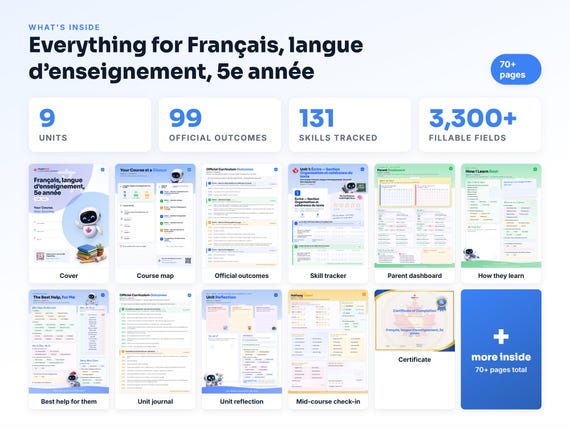
A Français, langue d’enseignement, 5e année workbook worth keeping
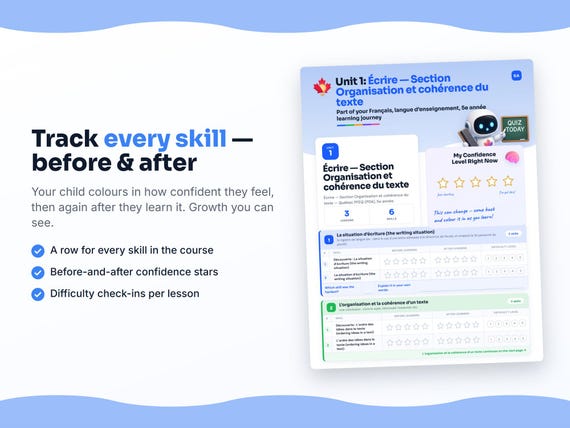
Built from the same official curriculum as this page. Before and after each skill above, your student colours in how sure they feel — so the two of you can see, on one page, what's clicking and what needs another look. It's a quiet way to follow how the year is really going.
By June it's full of their own handwriting: units worked through, confidence grown, a mid-year check-in, notes from parent-teacher night, and a certificate at the end. Less a worksheet, more a record of the year worth keeping on the shelf.
Instant download · see every page, reviews and the full description · five or more workbooks are $2.99 each
What it looks like in the app



Common questions
Can MapleMind help my child with Français, langue d’enseignement, 5e année?
Yes. MapleMind's AI tutor covers all 131 skills in Quebec's Français, langue d’enseignement, 5e année — your child picks the exact skill, and the tutor teaches it step by step: a short lesson, a worked example, solving together, then a skill check to show it stuck.
Is MapleMind aligned to Quebec's official curriculum?
Yes. Every skill in this course maps to an official outcome code from Quebec's Grade 5 French curriculum, and the ministry's own wording is quoted under each unit on this page — with the official government source linked so you can check it yourself.
What does MapleMind cost?
It's free to start — 5 tutoring chats and a practice quiz every day, no credit card. A Pro subscription ($9.99/month or $49.99/year CAD, 7-day free trial) unlocks unlimited tutoring, practice, and exam simulations.
What if my child is stuck on just one topic?
That's the point of skill-level tutoring: open Français, langue d’enseignement, 5e année in the app, tap the exact skill from the list on this page, and the tutor teaches just that — no wading through lessons your child doesn't need.
Does MapleMind work in French or other languages?
Yes — 14 languages, including French. Both the app and the tutor's explanations switch to the language your child chooses.
Where can I see the official Quebec curriculum for Français, langue d’enseignement, 5e année?
The official source is linked on this page — Québec's official education program. The outline here follows it: every MapleMind skill carries its official outcome code, and the ministry's own wording is quoted under each unit.
Keep exploring
Ready when you are
Pick a skill from this page and see it taught properly — free, in the browser, in under a minute.