Get help with Français, langue d’enseignement, 1re secondaire
Most tutoring makes you sit through material you already know. MapleMind flips that: pick the exact skill that's causing trouble — any of the 101 below — and the tutor teaches just that one, step by step, as many times as it takes. Ask questions in plain words, any time of day, in English, French, or 12 other languages.
The official Quebec Français, langue d’enseignement, 1re secondaire curriculum
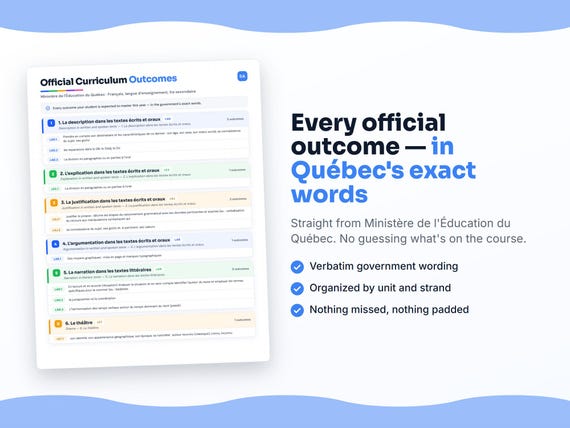
Quebec defines Français, langue d’enseignement, 1re secondaire by strands and outcomes. MapleMind teaches the same curriculum reorganized for one-skill-at-a-time tutoring — the table shows exactly where every official strand lands, and the ministry's own wording is quoted under each unit below.
Official source Québec's official education programRead it on the government site — quebec.ca ↗| Official strand | Outcomes | Where MapleMind teaches it |
|---|---|---|
| Strand S1 | 11 | 1. La description dans les textes écrits et oraux |
| Strand S2 | 2 | 2. L’explication dans les textes écrits et oraux |
| Strand S3 | 8 | 3. La justification dans les textes écrits et oraux |
| Strand S4 | 1 | 4. L’argumentation dans les textes écrits et oraux |
| Strand S5 | 12 | 5. La narration dans les textes littéraires |
| Strand S6 | 1 | 6. Le théâtre |
| Strand S7 | 12 | 7. La poésie |
| Strand S8 | 26 | 1. Les ressources de la langue pour nommer et caractériser |
| Strand S9 | 20 | 2. Les ressources de la langue pour situer dans le temps |
| S10 | 6 | 3. Les ressources de la langue pour introduire des discours rapportés (DR) |
| S11 | 2 | 4. Les ressources de la langue pour modaliser |
Every skill below, taught one on one.
 Try the first session free
How MapleMind teaches Français, langue d’enseignement, 1re secondaire — every unit, lesson, and skill
Every skill below runs as a short session: a plain-words lesson, a worked example, solving it together, then a five-question skill check that earns up to three stars. Guided Mode keeps it teaching instead of answer-handing — turning it off needs a parent's password.
Unit 11. La description dans les textes écrits et orauxOfficial strand · Strand S1
Description in written and spoken texts — 1. La description dans les textes écrits et oraux.
Décrire pour inciter à agir (describing to prompt action)
- Prendre en compte son destinataire — Prendre en compte son destinataire et les… (taking the addressee into account)S1.16 — Maîtrise autonome de « Prendre en compte son destinataire » (taking the addressee into account) au Secondaire 1 en Français L1 — registre secondaire francophone natif.
- Le titre neutre ou évocateur — un titre neutre ou évocateur indiquant le sujet (neutral or evocative title)S1.22 — Maîtrise autonome de « Le titre neutre ou évocateur » (neutral or evocative title) au Secondaire 1 en Français L1 — registre secondaire francophone natif.
- Le plan du texte — un plan thématique : agencement ordonné d’aspects… (text plan (thematic / cause-effect / etc.))S1.27 — Maîtrise autonome de « Le plan du texte » (text plan (thematic / cause-effect / etc.)) au Secondaire 1 en Français L1 — registre secondaire francophone natif.
- Le nom et son sens — le lexique pour situer dans l’espace le nom propre… (the noun (common / proper) and its sense)S1.39 — Maîtrise autonome de « Le nom et son sens » (the noun (common / proper) and its sense) au Secondaire 1 en Français L1 — registre secondaire francophone natif.
Enrichir la description : expansions du GN et figures (expanding noun groups and figures of speech)
- Le groupe nominal et ses expansions — les expansions dans le GN, le GAdj, le GV (the noun group and its expansions)S1.45 — Maîtrise autonome de « Le groupe nominal et ses expansions » (the noun group and its expansions) au Secondaire 1 en Français L1 — registre secondaire francophone natif.
- Les figures de style — des figures: la comparaison, l’énumération (figures of speech (comparison, metaphor, etc.))S1.50 — Maîtrise autonome de « Les figures de style » (figures of speech (comparison, metaphor, etc.)) au Secondaire 1 en Français L1 — registre secondaire francophone natif.
- L’analyse et la production du genre — Interpréter ou ajouter des éléments complémentaires (analysing and producing a text genre)S1.55 — Maîtrise autonome de « L’analyse et la production du genre » (analysing and producing a text genre) au Secondaire 1 en Français L1 — registre secondaire francophone natif.
- La cohérence et la reprise de l’information — La non-contradiction entre les éléments de la… (textual coherence and cohesion devices)S1.69 — Maîtrise autonome de « La cohérence et la reprise de l’information » (textual coherence and cohesion devices) au Secondaire 1 en Français L1 — registre secondaire francophone natif.
L’organisation visible du texte descriptif (organising and laying out a descriptive text)
- L’analyse et la production du genre — La division en paragraphes ou en parties à l’oral (analysing and producing a text genre)S1.71 — Maîtrise autonome de « L’analyse et la production du genre » (analysing and producing a text genre) au Secondaire 1 en Français L1 — registre secondaire francophone natif.
- Les moyens graphiques et typographiques — la mise en page (alinéas, disposition, espaces,… (graphic and typographic devices)S1.78 — Maîtrise autonome de « Les moyens graphiques et typographiques » (graphic and typographic devices) au Secondaire 1 en Français L1 — registre secondaire francophone natif.
- Découverte guidée : Prendre en compte son destinataire — ses caractéristiques : sa renommée, sa connaissance… (taking the addressee into account)S1.3 — Découverte guidée de « Prendre en compte son destinataire » (taking the addressee into account) au Secondaire 1 en Français L1 — registre secondaire francophone natif.
The official wording — 11 outcomes in this unit
- S1.16
Prendre en compte son destinataire et les caractéristiques de ce dernier : son âge, son sexe, son statut social, sa connaissance du sujet, ses goûts
- S1.22
Comprendre ou donner un titre neutre ou évocateur indiquant le sujet
- S1.27
un plan thématique : agencement ordonné d’aspects et de sous-aspects du sujet (parties ou composantes, propriétés, qualités)
- S1.39
le lexique pour situer dans l’espace le nom propre ou commun de lieu pour localiser (ex. : il est parti pour New York; l’édifice Marie-Guyart)
- S1.45
les expansions dans le GN, le GAdj, le GV
- S1.50
des figures: la comparaison, l’énumération
- S1.55
Interpréter ou ajouter des éléments complémentaires (ex. : graphique, illustration, schéma, support sonore ou visuel, tableau)
- S1.69
La non-contradiction entre les éléments de la description
- S1.71
La division en paragraphes ou en parties à l’oral
- S1.78
la mise en page (alinéas, disposition, espaces, numérotation)
- S1.3
ses caractéristiques : sa renommée, sa connaissance du sujet
Unit 22. L’explication dans les textes écrits et orauxOfficial strand · Strand S2
Explanation in written and spoken texts — 2. L’explication dans les textes écrits et oraux.
La continuité et la progression de l’explication (cohesion and progression in an explanation)
- L’analyse et la production du genre — La division en paragraphes ou en parties à l’oral (analysing and producing a text genre)S2.60 — Maîtrise autonome de « L’analyse et la production du genre » (analysing and producing a text genre) au Secondaire 1 en Français L1 — registre secondaire francophone natif.
- Découverte guidée : Prendre en compte son destinataire — sa connaissance du sujet (taking the addressee into account)S2.12 — Découverte guidée de « Prendre en compte son destinataire » (taking the addressee into account) au Secondaire 1 en Français L1 — registre secondaire francophone natif.
The official wording — 2 outcomes in this unit
- S2.60
La division en paragraphes ou en parties à l’oral
- S2.12
sa connaissance du sujet
Unit 33. La justification dans les textes écrits et orauxOfficial strand · Strand S3
Justification in written and spoken texts — 3. La justification dans les textes écrits et oraux.
Énoncer le propos
- La phrase syntaxique et ses constituants — Justifier le propos : décrire les étapes du… (the syntactic sentence and its constituents)S3.26 — Maîtrise autonome de « La phrase syntaxique et ses constituants » (the syntactic sentence and its constituents) au Secondaire 1 en Français L1 — registre secondaire francophone natif.
- L’appréciation d’une œuvre littéraire — par l’établissement de liens entre une… (appreciating a literary work)S3.30 — Maîtrise autonome de « L’appréciation d’une œuvre littéraire » (appreciating a literary work) au Secondaire 1 en Français L1 — registre secondaire francophone natif.
- La précision du vocabulaire — termes précis et spécifiques au domaine du savoir (precise and appropriate vocabulary)S3.33 — Maîtrise autonome de « La précision du vocabulaire » (precise and appropriate vocabulary) au Secondaire 1 en Français L1 — registre secondaire francophone natif.
- Les temps verbaux et leurs valeurs — L’harmonisation des temps verbaux autour du temps… (tenses and their values)S3.50 — Maîtrise autonome de « Les temps verbaux et leurs valeurs » (tenses and their values) au Secondaire 1 en Français L1 — registre secondaire francophone natif.
Analyser la situation d’une justification en réception (analysing the communication situation of a justification)
- Découverte guidée : Prendre en compte son destinataire — sa connaissance du sujet, ses goûts et, si… (taking the addressee into account)S3.3 — Découverte guidée de « Prendre en compte son destinataire » (taking the addressee into account) au Secondaire 1 en Français L1 — registre secondaire francophone natif.
- Découverte guidée : L’analyse et la production du genre — utilisation de moyens pour manifester son intérêt… (analysing and producing a text genre)S3.9 — Découverte guidée de « L’analyse et la production du genre » (analysing and producing a text genre) au Secondaire 1 en Français L1 — registre secondaire francophone natif.
- Découverte guidée : L’appréciation d’une œuvre littéraire — subjectif (appreciating a literary work)S3.14 — Découverte guidée de « L’appréciation d’une œuvre littéraire » (appreciating a literary work) au Secondaire 1 en Français L1 — registre secondaire francophone natif.
- Découverte guidée : La justification : propos et raisons — Prendre en considération le contexte de réception… (justifying a stance (propos + reasons))S3.19 — Découverte guidée de « La justification : propos et raisons » (justifying a stance (propos + reasons)) au Secondaire 1 en Français L1 — registre secondaire francophone natif.
The official wording — 8 outcomes in this unit
- S3.26
Justifier le propos : décrire les étapes du raisonnement grammatical avec les données pertinentes et exactes (ex. : verbalisation du recours aux manipulations syntaxiques qui
- S3.30
par l’établissement de liens entre une interprétation et un texte ou entre un commentaire et l’effet de l’œuvre sur le lecteur (ex. : le sentiment provoqué par la lecture, le lien
- S3.33
termes précis et spécifiques au domaine du savoir
- S3.50
L’harmonisation des temps verbaux autour du temps dominant (présent ou passé composé)
- S3.3
sa connaissance du sujet, ses goûts et, si pertinent, ses valeurs
- S3.9
utilisation de moyens pour manifester son intérêt et sa compréhension ou son incompréhension : des phrases interrogatives et exclamatives, des reformulations et des gestes, etc.
- S3.14
subjectif (ex. : appréciation critique d’une œuvre)
- S3.19
Prendre en considération le contexte de réception et de production Tenir compte du contexte de production de la justification : date, lieu, support (journal, revue, Internet);
Unit 44. L’argumentation dans les textes écrits et orauxOfficial strand · Strand S4
Argumentation in written and spoken texts — 4. L’argumentation dans les textes écrits et oraux.
Les moyens graphiques qui organisent le texte argumentatif (graphic devices that organise an argumentative text)
- Découverte guidée : Les moyens graphiques et typographiques — Des moyens graphiques : mise en page et marques… (graphic and typographic devices)S4.63 — Découverte guidée de « Les moyens graphiques et typographiques » (graphic and typographic devices) au Secondaire 1 en Français L1 — registre secondaire francophone natif.
The official wording — 1 outcome in this unit
- S4.63
Des moyens graphiques : mise en page et marques typographiques
Unit 55. La narration dans les textes littérairesOfficial strand · Strand S5
Narration in literary texts — 5. La narration dans les textes littéraires.
Situation de communication
- La construction de l’univers narratif — En lecture et en écoute (réception) Analyser la… (building the narrative world (setting, characters, time))S5.2 — Maîtrise autonome de « La construction de l’univers narratif » (building the narrative world (setting, characters, time)) au Secondaire 1 en Français L1 — registre secondaire francophone natif.
- La construction de l’univers narratif — donner libre cours à son imagination, à ses… (building the narrative world (setting, characters, time))S5.7 — Maîtrise autonome de « La construction de l’univers narratif » (building the narrative world (setting, characters, time)) au Secondaire 1 en Français L1 — registre secondaire francophone natif.
- Les marques énonciatives — Reconnaître, lorsque c’est le cas, que celui qui… (enunciative marks (speaker/addressee presence))S5.22 — Maîtrise autonome de « Les marques énonciatives » (enunciative marks (speaker/addressee presence)) au Secondaire 1 en Français L1 — registre secondaire francophone natif.
- La précision du vocabulaire — vocabulaire neutre ou expressif pour désigner ou… (precise and appropriate vocabulary)S5.37 — Maîtrise autonome de « La précision du vocabulaire » (precise and appropriate vocabulary) au Secondaire 1 en Français L1 — registre secondaire francophone natif.
Décrire l’univers narratif : lieux et séquences descriptives (describing the narrative world)
- La construction de l’univers narratif — la juxtaposition et la coordination (building the narrative world (setting, characters, time))S5.41 — Maîtrise autonome de « La construction de l’univers narratif » (building the narrative world (setting, characters, time)) au Secondaire 1 en Français L1 — registre secondaire francophone natif.
- La construction de l’univers narratif — la description du lieu, ses caractéristiques (building the narrative world (setting, characters, time))S5.49 — Maîtrise autonome de « La construction de l’univers narratif » (building the narrative world (setting, characters, time)) au Secondaire 1 en Français L1 — registre secondaire francophone natif.
- L’insertion de séquences — l’insertion de séquences descriptives : lieu,… (inserting secondary sequences into a text)S5.71 — Maîtrise autonome de « L’insertion de séquences » (inserting secondary sequences into a text) au Secondaire 1 en Français L1 — registre secondaire francophone natif.
- La construction de l’univers narratif — des caractéristiques de genres (ou des écarts par… (building the narrative world (setting, characters, time))S5.79 — Maîtrise autonome de « La construction de l’univers narratif » (building the narrative world (setting, characters, time)) au Secondaire 1 en Français L1 — registre secondaire francophone natif.
La cohérence du récit : temps verbaux et organisation (narrative cohesion: tenses and organisation)
- Les temps verbaux et leurs valeurs — L’harmonisation des temps verbaux autour du temps… (tenses and their values)S5.87 — Maîtrise autonome de « Les temps verbaux et leurs valeurs » (tenses and their values) au Secondaire 1 en Français L1 — registre secondaire francophone natif.
- La construction de l’univers narratif — les moyens qui marquent l’organisation du texte La… (building the narrative world (setting, characters, time))S5.92 — Maîtrise autonome de « La construction de l’univers narratif » (building the narrative world (setting, characters, time)) au Secondaire 1 en Français L1 — registre secondaire francophone natif.
- Découverte guidée : L’appréciation d’une œuvre littéraire — ses caractéristiques : ses champs d’intérêt, ses… (appreciating a literary work)S5.5 — Découverte guidée de « L’appréciation d’une œuvre littéraire » (appreciating a literary work) au Secondaire 1 en Français L1 — registre secondaire francophone natif.
- Découverte guidée : Le contexte de production et de réception — la date de production ou de publication, l’édition,… (context of production and reception)S5.14 — Découverte guidée de « Le contexte de production et de réception » (context of production and reception) au Secondaire 1 en Français L1 — registre secondaire francophone natif.
The official wording — 12 outcomes in this unit
- S5.2
En lecture et en écoute (réception) Analyser la situation et en tenir compte Identifier l’auteur du texte et employer les termes spécifiques pour le nommer (ex. : bédéiste,
- S5.7
donner libre cours à son imagination, à ses sentiments et à ses émotions, se représenter le monde, répondre à une quête identitaire, développer sa sensibilité esthétique, etc.
- S5.22
Reconnaître, lorsque c’est le cas, que celui qui raconte n’est pas un personnage de l’histoire ou identifier celui qui raconte par les marques énonciatives explicites qui le
- S5.37
vocabulaire neutre ou expressif pour désigner ou caractériser la taille, le visage, l’allure; les qualités, les goûts; les liens de parenté
- S5.41
la juxtaposition et la coordination
- S5.49
la description du lieu, ses caractéristiques (ex. : repères géographiques, traits particuliers : ce qu’on y voit, entend, sent, fait, etc.)
- S5.71
l’insertion de séquences descriptives : lieu, personnage
- S5.79
des caractéristiques de genres (ou des écarts par rapport à un genre)
- S5.87
L’harmonisation des temps verbaux autour du temps dominant du récit (passé)
- S5.92
Reconnaître ou utiliser les moyens qui marquent l’organisation du texte La page de couverture, le titre ou les intitulés de chapitre
- S5.5
ses caractéristiques : ses champs d’intérêt, ses genres préférés, ses connaissances littéraires (lien avec son répertoire personnalisé), l’efficacité de ses stratégies de lecture
- S5.14
la date de production ou de publication, l’édition, la collection, le lieu
Unit 66. Le théâtreOfficial strand · Strand S6
Drama — 6. Le théâtre.
Analyser la situation de communication au théâtre (analysing the communication situation of a play)
- Découverte guidée : La lecture du texte de théâtre — son identité, son appartenance géographique, son… (reading and analysing drama)S6.3 — Découverte guidée de « La lecture du texte de théâtre » (reading and analysing drama) au Secondaire 1 en Français L1 — registre secondaire francophone natif.
The official wording — 1 outcome in this unit
- S6.3
son identité, son appartenance géographique, son époque, sa notoriété : auteur reconnu (classique), connu, inconnu
Unit 77. La poésieOfficial strand · Strand S7
Poetry — 7. La poésie.
Créer un poème : situation et jeux poétiques (creating a poem: situation and word play)
- Les figures de style — expérimenter des jeux poétiques (figures of speech (comparison, metaphor, etc.))S7.9 — Maîtrise autonome de « Les figures de style » (figures of speech (comparison, metaphor, etc.)) au Secondaire 1 en Français L1 — registre secondaire francophone natif.
- Le contexte de production et de réception — la date de production ou de publication, l’édition,… (context of production and reception)S7.14 — Maîtrise autonome de « Le contexte de production et de réception » (context of production and reception) au Secondaire 1 en Français L1 — registre secondaire francophone natif.
- La formation des mots — l’invention de mots (word formation (derivation, composition))S7.20 — Maîtrise autonome de « La formation des mots » (word formation (derivation, composition)) au Secondaire 1 en Français L1 — registre secondaire francophone natif.
- Les figures de style — des jeux de sonorité (figures of speech (comparison, metaphor, etc.))S7.24 — Maîtrise autonome de « Les figures de style » (figures of speech (comparison, metaphor, etc.)) au Secondaire 1 en Français L1 — registre secondaire francophone natif.
L’agencement de mots
- La structure du poème — la répétition de mots, de groupes de mots, de… (the structure of a poem)S7.29 — Maîtrise autonome de « La structure du poème » (the structure of a poem) au Secondaire 1 en Français L1 — registre secondaire francophone natif.
- La structure du poème — les répétitions de sons, de mots, de structures (the structure of a poem)S7.33 — Maîtrise autonome de « La structure du poème » (the structure of a poem) au Secondaire 1 en Français L1 — registre secondaire francophone natif.
- Les figures de style — le vers et la strophe en comparaison avec la phrase… (figures of speech (comparison, metaphor, etc.))S7.37 — Maîtrise autonome de « Les figures de style » (figures of speech (comparison, metaphor, etc.)) au Secondaire 1 en Français L1 — registre secondaire francophone natif.
- L’insertion de séquences — l’insertion d’une séquence descriptive ou narrative (inserting secondary sequences into a text)S7.45 — Maîtrise autonome de « L’insertion de séquences » (inserting secondary sequences into a text) au Secondaire 1 en Français L1 — registre secondaire francophone natif.
La voix du poète : engagement et réseaux de sens (the poet’s voice: engagement and networks of meaning)
- Les thèmes et les réseaux de sens — Comparer les réseaux de sens établis avec ceux des… (themes and networks of meaning in a work)S7.54 — Maîtrise autonome de « Les thèmes et les réseaux de sens » (themes and networks of meaning in a work) au Secondaire 1 en Français L1 — registre secondaire francophone natif.
- Les figures de style — élaboration d’un champ lexical (figures of speech (comparison, metaphor, etc.))S7.58 — Maîtrise autonome de « Les figures de style » (figures of speech (comparison, metaphor, etc.)) au Secondaire 1 en Français L1 — registre secondaire francophone natif.
- Découverte guidée : La structure du poème — son identité, son appartenance géographique, son… (the structure of a poem)S7.3 — Découverte guidée de « La structure du poème » (the structure of a poem) au Secondaire 1 en Français L1 — registre secondaire francophone natif.
- Découverte guidée : Les procédés de reprise — la cohérence du texte poétique par les moyens… (reprise (reference-chaining) devices)S7.64 — Découverte guidée de « Les procédés de reprise » (reprise (reference-chaining) devices) au Secondaire 1 en Français L1 — registre secondaire francophone natif.
The official wording — 12 outcomes in this unit
- S7.9
expérimenter des jeux poétiques
- S7.14
la date de production ou de publication, l’édition, le lieu
- S7.20
l’invention de mots (ex. : mots valises)
- S7.24
des jeux de sonorité (ex. : rime, allitération)
- S7.29
la répétition de mots, de groupes de mots, de structures
- S7.33
les répétitions de sons, de mots, de structures
- S7.37
le vers et la strophe en comparaison avec la phrase et le paragraphe
- S7.45
l’insertion d’une séquence descriptive ou narrative
- S7.54
Comparer les réseaux de sens établis avec ceux des autres lecteurs pour interpréter le poème (ex. : découverte d’éléments symboliques), découvrir la pluralité de sens et d’effets
- S7.58
élaboration d’un champ lexical
- S7.3
son identité, son appartenance géographique, son époque, sa notoriété : auteur reconnu (classique), connu ou inconnu
- S7.64
Reconnaître ou assurer la cohérence du texte poétique par les moyens suivants Les procédés de reprise (ex. répétition de mots ou de structures)
Unit 81. Les ressources de la langue pour nommer et caractériserOfficial strand · Strand S8
Language resources for naming and describing — 1. Les ressources de la langue pour nommer et caractériser.
Le nom propre et sa majuscule (proper nouns and their capital letter)
- Le nom et son sens — dans les noms de personnes, de lieux (pays, ville,… (the noun (common / proper) and its sense)S8.5 — Maîtrise autonome de « Le nom et son sens » (the noun (common / proper) and its sense) au Secondaire 1 en Français L1 — registre secondaire francophone natif.
- Le nom et son sens — le sens propre (neutre ou expressif) (the noun (common / proper) and its sense)S8.11 — Maîtrise autonome de « Le nom et son sens » (the noun (common / proper) and its sense) au Secondaire 1 en Français L1 — registre secondaire francophone natif.
- Les relations de sens entre les mots — la famille de mots (sense relations (synonym, antonym, families of words))S8.17 — Maîtrise autonome de « Les relations de sens entre les mots » (sense relations (synonym, antonym, families of words)) au Secondaire 1 en Français L1 — registre secondaire francophone natif.
- Le nom et son sens — mots séparés par un blanc (the noun (common / proper) and its sense)S8.24 — Maîtrise autonome de « Le nom et son sens » (the noun (common / proper) and its sense) au Secondaire 1 en Français L1 — registre secondaire francophone natif.
Former et introduire des mots : abrègement, télescopage, présentatifs (word formation and presentatives)
- La formation des mots — télescopage, abrègement (word formation (derivation, composition))S8.29 — Maîtrise autonome de « La formation des mots » (word formation (derivation, composition)) au Secondaire 1 en Français L1 — registre secondaire francophone natif.
- Le pronom — le pronom pour nommer Les pronoms de communication… (the pronoun as a naming/reprise device)S8.35 — Maîtrise autonome de « Le pronom » (the pronoun as a naming/reprise device) au Secondaire 1 en Français L1 — registre secondaire francophone natif.
- Le groupe nominal et ses expansions — Les présentatifs pour introduire un groupe nominal… (the noun group and its expansions)S8.60 — Maîtrise autonome de « Le groupe nominal et ses expansions » (the noun group and its expansions) au Secondaire 1 en Français L1 — registre secondaire francophone natif.
- Le nom et son sens — des adjectifs (the noun (common / proper) and its sense)S8.67 — Maîtrise autonome de « Le nom et son sens » (the noun (common / proper) and its sense) au Secondaire 1 en Français L1 — registre secondaire francophone natif.
Les relations de sens entre les mots (sense relations between words)
- Les relations de sens entre les mots — sens contextuel (sense relations (synonym, antonym, families of words))S8.69 — Maîtrise autonome de « Les relations de sens entre les mots » (sense relations (synonym, antonym, families of words)) au Secondaire 1 en Français L1 — registre secondaire francophone natif.
- Les relations de sens entre les mots — les mots exprimant la comparaison (sense relations (synonym, antonym, families of words))S8.73 — Maîtrise autonome de « Les relations de sens entre les mots » (sense relations (synonym, antonym, families of words)) au Secondaire 1 en Français L1 — registre secondaire francophone natif.
- La formation des mots — préfixes, suffixes qui servent à former des mots… (word formation (derivation, composition))S8.76 — Maîtrise autonome de « La formation des mots » (word formation (derivation, composition)) au Secondaire 1 en Français L1 — registre secondaire francophone natif.
- Les figures de style — Comprendre le sens et l’intérêt des figures… (figures of speech (comparison, metaphor, etc.))S8.79 — Maîtrise autonome de « Les figures de style » (figures of speech (comparison, metaphor, etc.)) au Secondaire 1 en Français L1 — registre secondaire francophone natif.
L’adjectif noyau et le groupe adjectival (the adjective as head of the adjective group)
- L’adjectif et son accord — syntaxiques : se place généralement après le nom,… (the adjective and adjective agreement)S8.90 — Maîtrise autonome de « L’adjectif et son accord » (the adjective and adjective agreement) au Secondaire 1 en Français L1 — registre secondaire francophone natif.
- Le groupe nominal et ses expansions — Le GN, détaché ou non, complément du nom, avec la… (the noun group and its expansions)S8.105 — Maîtrise autonome de « Le groupe nominal et ses expansions » (the noun group and its expansions) au Secondaire 1 en Français L1 — registre secondaire francophone natif.
- Le nom et son sens — avec et, ou (the noun (common / proper) and its sense)S8.124 — Maîtrise autonome de « Le nom et son sens » (the noun (common / proper) and its sense) au Secondaire 1 en Français L1 — registre secondaire francophone natif.
- Les procédés de reprise — des procédés de reprise pour nommer La répétition… (reprise (reference-chaining) devices)S8.136 — Maîtrise autonome de « Les procédés de reprise » (reprise (reference-chaining) devices) au Secondaire 1 en Français L1 — registre secondaire francophone natif.
La reprise par le pronom (pronoun reprise)
- Le pronom — les pronoms démonstratif et possessif ayant la… (the pronoun as a naming/reprise device)S8.141 — Maîtrise autonome de « Le pronom » (the pronoun as a naming/reprise device) au Secondaire 1 en Français L1 — registre secondaire francophone natif.
- Le nom et son sens — avec déterminant défini ou possessif (the noun (common / proper) and its sense)S8.149 — Maîtrise autonome de « Le nom et son sens » (the noun (common / proper) and its sense) au Secondaire 1 en Français L1 — registre secondaire francophone natif.
- Le nom et son sens — par un GN (the noun (common / proper) and its sense)S8.153 — Maîtrise autonome de « Le nom et son sens » (the noun (common / proper) and its sense) au Secondaire 1 en Français L1 — registre secondaire francophone natif.
- La phrase syntaxique et ses constituants — la phrase syntaxique de la phrase graphique (the syntactic sentence and its constituents)S8.163 — Maîtrise autonome de « La phrase syntaxique et ses constituants » (the syntactic sentence and its constituents) au Secondaire 1 en Français L1 — registre secondaire francophone natif.
La phrase syntaxique et ses constituants (the syntactic sentence and its constituents)
- Les types et les formes de phrases — phrases de type déclaratif, interrogatif,… (sentence types and forms)S8.165 — Maîtrise autonome de « Les types et les formes de phrases » (sentence types and forms) au Secondaire 1 en Français L1 — registre secondaire francophone natif.
- Le nom et son sens — phrases de tous les types (the noun (common / proper) and its sense)S8.168 — Maîtrise autonome de « Le nom et son sens » (the noun (common / proper) and its sense) au Secondaire 1 en Français L1 — registre secondaire francophone natif.
- La phrase syntaxique et ses constituants — le groupe nominal (GN) et ses fonctions Le GN dans… (the syntactic sentence and its constituents)S8.180 — Maîtrise autonome de « La phrase syntaxique et ses constituants » (the syntactic sentence and its constituents) au Secondaire 1 en Français L1 — registre secondaire francophone natif.
- L’adjectif et son accord — le groupe adjectival (GAdj) et ses fonctions Le… (the adjective and adjective agreement)S8.183 — Maîtrise autonome de « L’adjectif et son accord » (the adjective and adjective agreement) au Secondaire 1 en Français L1 — registre secondaire francophone natif.
Le groupe prépositionnel et ses fonctions (the prepositional group and its functions)
- Le nom et son sens — La fonction de complément (the noun (common / proper) and its sense)S8.187 — Maîtrise autonome de « Le nom et son sens » (the noun (common / proper) and its sense) au Secondaire 1 en Français L1 — registre secondaire francophone natif.
- L’usage du dictionnaire — un dictionnaire encyclopédique illustré (mots de la… (using dictionaries (print and electronic))S8.191 — Maîtrise autonome de « L’usage du dictionnaire » (using dictionaries (print and electronic)) au Secondaire 1 en Français L1 — registre secondaire francophone natif.
The official wording — 26 outcomes in this unit
- S8.5
dans les noms de personnes, de lieux (pays, ville, rue) i.
- S8.11
le sens propre (neutre ou expressif) i.
- S8.17
la famille de mots (ex. : meuble, ameublement; coffre, coffre-fort) ii.
- S8.24
mots séparés par un blanc (ex. : blé d’Inde, bord de mer)
- S8.29
télescopage, abrègement (ex. : bibliobus, courriel, prof, télé)
- S8.35
Reconnaître ou utiliser le pronom pour nommer Les pronoms de communication (je, me, moi, nous, tu, te, toi, vous) a.
- S8.60
Les présentatifs pour introduire un groupe nominal : c’est, voici, voilà, il y a, il y avait (ex. : c’est mon mentor; voici la salle de spectacle; il y a de la brume sur le fleuve)
- S8.67
Reconnaître ou utiliser des adjectifs (ex. : geste généreux, ingrédient actif), des noms (ex. : du bois de cèdre; l’effet papillon), qui indiquent des qualités, des propriétés,
- S8.69
sens contextuel (ex. : gai, joyeux)
- S8.73
les mots exprimant la comparaison (ex. : plus que, différemment, pareil à) iii.
- S8.76
préfixes, suffixes qui servent à former des mots exprimant une caractéristique (ex. : disjoint, flatteur, imperceptible, punissable, punitif, rareté, savamment, surgelé)
- S8.79
Comprendre le sens et l’intérêt des figures suivantes ou employer certaines de ces figures La comparaison (ex. : gros comme un bœuf) a.
- S8.90
syntaxiques : se place généralement après le nom, receveur de genre et de nombre du nom ou du pronom donneur morphologiques : variation en genre et en nombre sémantiques :
- S8.105
Le GN, détaché ou non, complément du nom, avec la ponctuation adéquate (ex. : Le Nil, le fleuve égyptien, est long de 6500 km; mon amie Maya)
- S8.124
avec et, ou (ex. : Ce mobilier comprend un lit, une armoire, deux tables de nuit ou un fauteuil; des femmes pleines d’énergie et de courage)
- S8.136
Reconnaître ou utiliser des procédés de reprise pour nommer La répétition d’un GN souvent abrégé (ex. : Le grand sage de la montagne → le sage) ou d’un nom avec un déterminant
- S8.141
les pronoms démonstratif et possessif ayant la fonction de sujet (ex. : Cela me convient.; J’aime le jazz, c’est vivant.; Luc a reçu un magnifique vélo de course; le mien est
- S8.149
avec déterminant défini ou possessif (ex. : les pièces → la cuisine, le salon; Liza → sa collègue)
- S8.153
par un GN (ex. : L’homme oublie son document. L’étourdi se dirige vers la sortie sans se retourner.)
- S8.163
Distinguer la phrase syntaxique de la phrase graphique
- S8.165
phrases de type déclaratif, interrogatif, impératif; ajout de l’exclamatif au secondaire
- S8.168
phrases de tous les types
- S8.180
Identifier le groupe nominal (GN) et ses fonctions Le GN dans chacun des constituants de la phrase par une procédure stable et opératoire de reconnaissance du déterminant et du
- S8.183
Identifier le groupe adjectival (GAdj) et ses fonctions Le GAdj par une procédure stable et opératoire de reconnaissance de l’adjectif, noyau du GAdj
- S8.187
La fonction de complément
- S8.191
Utiliser un dictionnaire encyclopédique illustré (mots de la langue, noms propres et images) pour donner l’information suivante : renseignements encyclopédiques, distinctions de
Unit 92. Les ressources de la langue pour situer dans le tempsOfficial strand · Strand S9
Language resources for situating in time — 2. Les ressources de la langue pour situer dans le temps.
Le lexique du temps (the vocabulary of time)
- Les temps verbaux et leurs valeurs — les mots et les groupes de mots qui donnent des… (tenses and their values)S9.3 — Maîtrise autonome de « Les temps verbaux et leurs valeurs » (tenses and their values) au Secondaire 1 en Français L1 — registre secondaire francophone natif.
- Les temps verbaux et leurs valeurs — La fréquence (tenses and their values)S9.5 — Maîtrise autonome de « Les temps verbaux et leurs valeurs » (tenses and their values) au Secondaire 1 en Français L1 — registre secondaire francophone natif.
- Le groupe verbal, prédicat — le groupe verbal (GV) Le groupe verbal, prédicat,… (the verb group (predicate))S9.10 — Maîtrise autonome de « Le groupe verbal, prédicat » (the verb group (predicate)) au Secondaire 1 en Français L1 — registre secondaire francophone natif.
- Les temps verbaux et leurs valeurs — morphologiques : variation du radical, de la… (tenses and their values)S9.13 — Maîtrise autonome de « Les temps verbaux et leurs valeurs » (tenses and their values) au Secondaire 1 en Français L1 — registre secondaire francophone natif.
L’accord du verbe avec son sujet (subject–verb agreement)
- L’accord du verbe avec son sujet — règle générale : receveur de la personne et du… (agreement of the verb with its subject)S9.18 — Maîtrise autonome de « L’accord du verbe avec son sujet » (agreement of the verb with its subject) au Secondaire 1 en Français L1 — registre secondaire francophone natif.
- Les temps verbaux et leurs valeurs — plusieurs sujets de 3 personne, coordonnés par des… (tenses and their values)S9.20 — Maîtrise autonome de « Les temps verbaux et leurs valeurs » (tenses and their values) au Secondaire 1 en Français L1 — registre secondaire francophone natif.
- Les temps verbaux et leurs valeurs — la phrase subordonnée à valeur temporelle dans la… (tenses and their values)S9.32 — Maîtrise autonome de « Les temps verbaux et leurs valeurs » (tenses and their values) au Secondaire 1 en Français L1 — registre secondaire francophone natif.
- La phrase subordonnée — Utilisation de la variété de langue standard à… (subordinate clauses)S9.36 — Maîtrise autonome de « La phrase subordonnée » (subordinate clauses) au Secondaire 1 en Français L1 — registre secondaire francophone natif.
Le verbe et son complément direct; les temps dominants (the verb’s direct object and dominant tenses)
- Le groupe nominal et ses expansions — le GN (recours à la manipulation de… (the noun group and its expansions)S9.52 — Maîtrise autonome de « Le groupe nominal et ses expansions » (the noun group and its expansions) au Secondaire 1 en Français L1 — registre secondaire francophone natif.
- Les temps verbaux et leurs valeurs — le présent comme temps dominant pour informer,… (tenses and their values)S9.76 — Maîtrise autonome de « Les temps verbaux et leurs valeurs » (tenses and their values) au Secondaire 1 en Français L1 — registre secondaire francophone natif.
- Les temps verbaux et leurs valeurs — le passé simple comme temps dominant, surtout dans… (tenses and their values)S9.79 — Maîtrise autonome de « Les temps verbaux et leurs valeurs » (tenses and their values) au Secondaire 1 en Français L1 — registre secondaire francophone natif.
- Les temps verbaux et leurs valeurs — le présent d’énonciation : évènement qui se déroule… (tenses and their values)S9.85 — Maîtrise autonome de « Les temps verbaux et leurs valeurs » (tenses and their values) au Secondaire 1 en Français L1 — registre secondaire francophone natif.
Les valeurs des temps verbaux (the values of verb tenses)
- L’usage du dictionnaire — le présent de l’indicatif (using dictionaries (print and electronic))S9.88 — Maîtrise autonome de « L’usage du dictionnaire » (using dictionaries (print and electronic)) au Secondaire 1 en Français L1 — registre secondaire francophone natif.
- Les temps verbaux et leurs valeurs — le futur situe un évènement dans l’avenir (tenses and their values)S9.94 — Maîtrise autonome de « Les temps verbaux et leurs valeurs » (tenses and their values) au Secondaire 1 en Français L1 — registre secondaire francophone natif.
- La conjugaison, un système organisé — Connaître et utiliser les formes du verbe… (verb conjugation as an organised system)S9.101 — Maîtrise autonome de « La conjugaison, un système organisé » (verb conjugation as an organised system) au Secondaire 1 en Français L1 — registre secondaire francophone natif.
- Les temps verbaux et leurs valeurs — les verbes suivants aux temps à l’étude verbes… (tenses and their values)S9.105 — Maîtrise autonome de « Les temps verbaux et leurs valeurs » (tenses and their values) au Secondaire 1 en Français L1 — registre secondaire francophone natif.
Les finales verbales en [i] et les temps composés (verb endings in [i] and compound tenses)
- La conjugaison, un système organisé — l’auxiliaire approprié Dans les temps composés des… (verb conjugation as an organised system)S9.120 — Maîtrise autonome de « La conjugaison, un système organisé » (verb conjugation as an organised system) au Secondaire 1 en Français L1 — registre secondaire francophone natif.
- La phrase syntaxique et ses constituants — la phrase syntaxique et ses constituants… (the syntactic sentence and its constituents)S9.125 — Maîtrise autonome de « La phrase syntaxique et ses constituants » (the syntactic sentence and its constituents) au Secondaire 1 en Français L1 — registre secondaire francophone natif.
- Le groupe verbal, prédicat — Le GV prédicat dans des phrases qui contiennent… (the verb group (predicate))S9.128 — Maîtrise autonome de « Le groupe verbal, prédicat » (the verb group (predicate)) au Secondaire 1 en Français L1 — registre secondaire francophone natif.
- Découverte guidée : L’adjectif et son accord — un GAdj ou un GN (the adjective and adjective agreement)S9.42 — Découverte guidée de « L’adjectif et son accord » (the adjective and adjective agreement) au Secondaire 1 en Français L1 — registre secondaire francophone natif.
The official wording — 20 outcomes in this unit
- S9.3
Reconnaître ou utiliser les mots et les groupes de mots qui donnent des précisions sur le temps Le moment, l’époque (ex. : le 2 mai, à l’adolescence, après, aux environs de quatre
- S9.5
La fréquence (ex. : avoir l’habitude, parfois, répéter, trois fois par jour) c.
- S9.10
Reconnaître ou utiliser le groupe verbal (GV) Le groupe verbal, prédicat, dont le verbe noyau est au mode indicatif a.
- S9.13
morphologiques : variation du radical, de la terminaison; correspondance des temps simples et des temps composés
- S9.18
règle générale : receveur de la personne et du nombre du nom ou du pronom donneur, dans la fonction de sujet (utiliser les manipulations syntaxiques : pronominalisation (Il) et
- S9.20
plusieurs sujets de 3 personne, coordonnés par des coordonnants exprimant le choix
- S9.32
Reconnaître ou utiliser la phrase subordonnée à valeur temporelle dans la fonction de complément de phrase La phrase dans sa forme complète (ex. : Ma mère trouvera la maison bien
- S9.36
Utilisation de la variété de langue standard à l’oral (ex. : éviter le double subordonnant quand que)
- S9.52
le GN (recours à la manipulation de pronominalisation) (ex. : Les jeunes ont perçu les nuances. → Les jeunes les ont perçues.) ou le pronom (ex. : Attends-moi.)
- S9.76
le présent comme temps dominant pour informer, commenter, soutenir une position
- S9.79
le passé simple comme temps dominant, surtout dans les textes littéraires, pour raconter au passé (4.2)
- S9.85
le présent d’énonciation : évènement qui se déroule dans le temps même de l’énonciation (ex. : conversation, journal personnel, aparté au théâtre)
- S9.88
le présent de l’indicatif (ex. : article encyclopédique, article de dictionnaire)
- S9.94
le futur situe un évènement dans l’avenir i.
- S9.101
Connaître et utiliser les formes du verbe organisées en système Les formes (radical et terminaison) de tous les temps simples de l’indicatif et le passé composé de l’indicatif des
- S9.105
Utiliser les verbes suivants aux temps à l’étude verbes fréquents : aller, avoir, dire, devoir, être, faire, partir, pouvoir, prendre, savoir, vouloir, voir
- S9.120
Employer l’auxiliaire approprié Dans les temps composés des verbes usuels (ex. : *Un homme avait rentré dans sa maison pour était rentré)
- S9.125
Identifier la phrase syntaxique et ses constituants obligatoires et facultatifs à partir du modèle de la phrase de base ou phrase P et des manipulations syntaxiques
- S9.128
Le GV prédicat dans des phrases qui contiennent plus d'un verbe conjugé à un mode personnel
- S9.42
un GAdj ou un GN (ex. : Léa est fière d’elle . Ma mère est une musicienne.)
Unit 103. Les ressources de la langue pour introduire des discours rapportés (DR)Official strand · S10
Language resources for reported speech — 3. Les ressources de la langue pour introduire des discours rapportés (DR).
La situation de communication du discours rapporté (the communication situation of reported speech)
- L’identification des énonciateurs — les différents énonciateurs des propos rapportés… (identifying the speakers in reported speech)S10.3 — Maîtrise autonome de « L’identification des énonciateurs » (identifying the speakers in reported speech) au Secondaire 1 en Français L1 — registre secondaire francophone natif.
- L’identification des énonciateurs — Plusieurs énonciateurs sont désignés par des… (identifying the speakers in reported speech)S10.7 — Maîtrise autonome de « L’identification des énonciateurs » (identifying the speakers in reported speech) au Secondaire 1 en Français L1 — registre secondaire francophone natif.
- Le discours direct — Reconnaître les caractéristiques du discours direct… (direct reported speech)S10.19 — Maîtrise autonome de « Le discours direct » (direct reported speech) au Secondaire 1 en Français L1 — registre secondaire francophone natif.
- Le discours direct — la citation, le dialogue, le monologue intérieur,… (direct reported speech)S10.21 — Maîtrise autonome de « Le discours direct » (direct reported speech) au Secondaire 1 en Français L1 — registre secondaire francophone natif.
Insérer et encadrer les paroles rapportées (inserting and framing quoted words)
- Le discours direct — Un mot entre guillemets (direct reported speech)S10.28 — Maîtrise autonome de « Le discours direct » (direct reported speech) au Secondaire 1 en Français L1 — registre secondaire francophone natif.
- Découverte guidée : La justification : propos et raisons — par les modalités d’enchaînement des propos : les… (justifying a stance (propos + reasons))S10.12 — Découverte guidée de « La justification : propos et raisons » (justifying a stance (propos + reasons)) au Secondaire 1 en Français L1 — registre secondaire francophone natif.
The official wording — 6 outcomes in this unit
- S10.3
Distinguer les différents énonciateurs des propos rapportés Les énonciateurs (singulier ou collectif) sont désignés par leur nom, leur titre ou encore leur fonction
- S10.7
Plusieurs énonciateurs sont désignés par des pronoms personnels de 1 personne (ex. : Je vous répète que le présumé coupable a déclaré : « Je suis innocent. »)
- S10.19
Reconnaître les caractéristiques du discours direct Les propos sont rapportés sans modification; le temps du verbe est indépendant de celui du verbe introducteur
- S10.21
la citation, le dialogue, le monologue intérieur, le mot entre guillemets
- S10.28
Un mot entre guillemets (ex. : On vit arriver la « comète blonde », pour parler de Guy Lafleur)
- S10.12
par les modalités d’enchaînement des propos : les mots employés, les interruptions (ex. : l’arrivée d’un personnage), etc.
Unit 114. Les ressources de la langue pour modaliserOfficial strand · S11
Language resources for modalisation — 4. Les ressources de la langue pour modaliser.
Des figures pour modaliser : comparaison et métaphore (figures that modalise: comparison and metaphor)
- Les figures de style — la comparaison et la métaphore courante ou… (figures of speech (comparison, metaphor, etc.))S11.32 — Maîtrise autonome de « Les figures de style » (figures of speech (comparison, metaphor, etc.)) au Secondaire 1 en Français L1 — registre secondaire francophone natif.
- Découverte guidée : L’identification des énonciateurs — les marques énonciatives qui renvoient à… (identifying the speakers in reported speech)S11.2 — Découverte guidée de « L’identification des énonciateurs » (identifying the speakers in reported speech) au Secondaire 1 en Français L1 — registre secondaire francophone natif.
The official wording — 2 outcomes in this unit
- S11.32
la comparaison et la métaphore courante ou littéraire (ex. : il se sent comme un poisson dans l’eau; ce politicien est un vrai renard)
- S11.2
Reconnaître ou choisir les marques énonciatives qui renvoient à l’énonciateur Des pronoms personnels et des déterminants possessifs de la 1 personne (ex. : si je peux dire; de

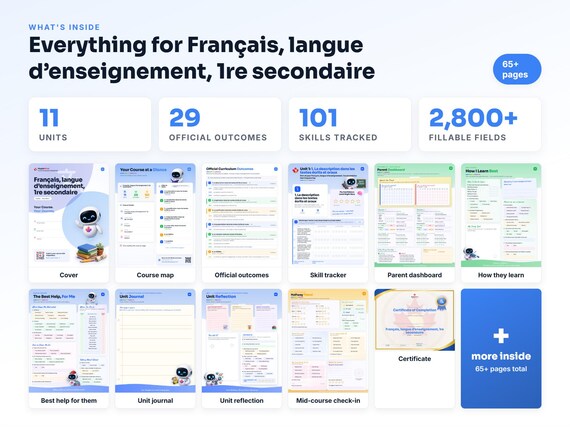

Printable workbook · A keepsake of the year
A Français, langue d’enseignement, 1re secondaire workbook worth keeping
Built from the same official curriculum as this page. Before and after each skill above, your student colours in how sure they feel — so the two of you can see, on one page, what's clicking and what needs another look. It's a quiet way to follow how the year is really going.
By June it's full of their own handwriting: units worked through, confidence grown, a mid-year check-in, notes from parent-teacher night, and a certificate at the end. Less a worksheet, more a record of the year worth keeping on the shelf.
Instant download · see every page, reviews and the full description · five or more workbooks are $2.99 each
What it looks like in the app



Common questions
Can MapleMind help me with Français, langue d’enseignement, 1re secondaire?
Yes. MapleMind's AI tutor covers all 101 skills in Quebec's Français, langue d’enseignement, 1re secondaire — you pick the exact skill, and the tutor teaches it step by step: a short lesson, a worked example, solving together, then a skill check to show it stuck.
Is MapleMind aligned to Quebec's official curriculum?
Yes. Every skill in this course maps to an official outcome code from Quebec's Secondaire 1 French curriculum, and the ministry's own wording is quoted under each unit on this page — with the official government source linked so you can check it yourself.
What does MapleMind cost?
It's free to start — 5 tutoring chats and a practice quiz every day, no credit card. A Pro subscription ($9.99/month or $49.99/year CAD, 7-day free trial) unlocks unlimited tutoring, practice, and exam simulations.
What if I'm stuck on just one topic?
That's the point of skill-level tutoring: open Français, langue d’enseignement, 1re secondaire in the app, tap the exact skill from the list on this page, and the tutor teaches just that — no wading through lessons you don't need.
Does MapleMind work in French or other languages?
Yes — 14 languages, including French. Both the app and the tutor's explanations switch to the language you choose.
Where can I see the official Quebec curriculum for Français, langue d’enseignement, 1re secondaire?
The official source is linked on this page — Québec's official education program. The outline here follows it: every MapleMind skill carries its official outcome code, and the ministry's own wording is quoted under each unit.
Keep exploring
Ready when you are
Pick a skill from this page and see it taught properly — free, in the browser, in under a minute.