Ministerial exam · Quebec
Mathematics, Elementary 6
Ministerial Examination — Mathematics, Elementary 6 (022‑610; 522‑610 in English)
- Grade 6
Dates and details can change. We do our best to keep this page up to date, but check the official sources before relying on it.
- Total time
- 4 h 30 min
- Marked questions
- 26
- Parts
- 4
- Counts for
- 20% of the final mark
- Calculator
- In some parts
- Format
- On paper
Elementary 6 Math Ministry Exam practice test
The whole exam or the parts you choose, in its own format, on the clock.
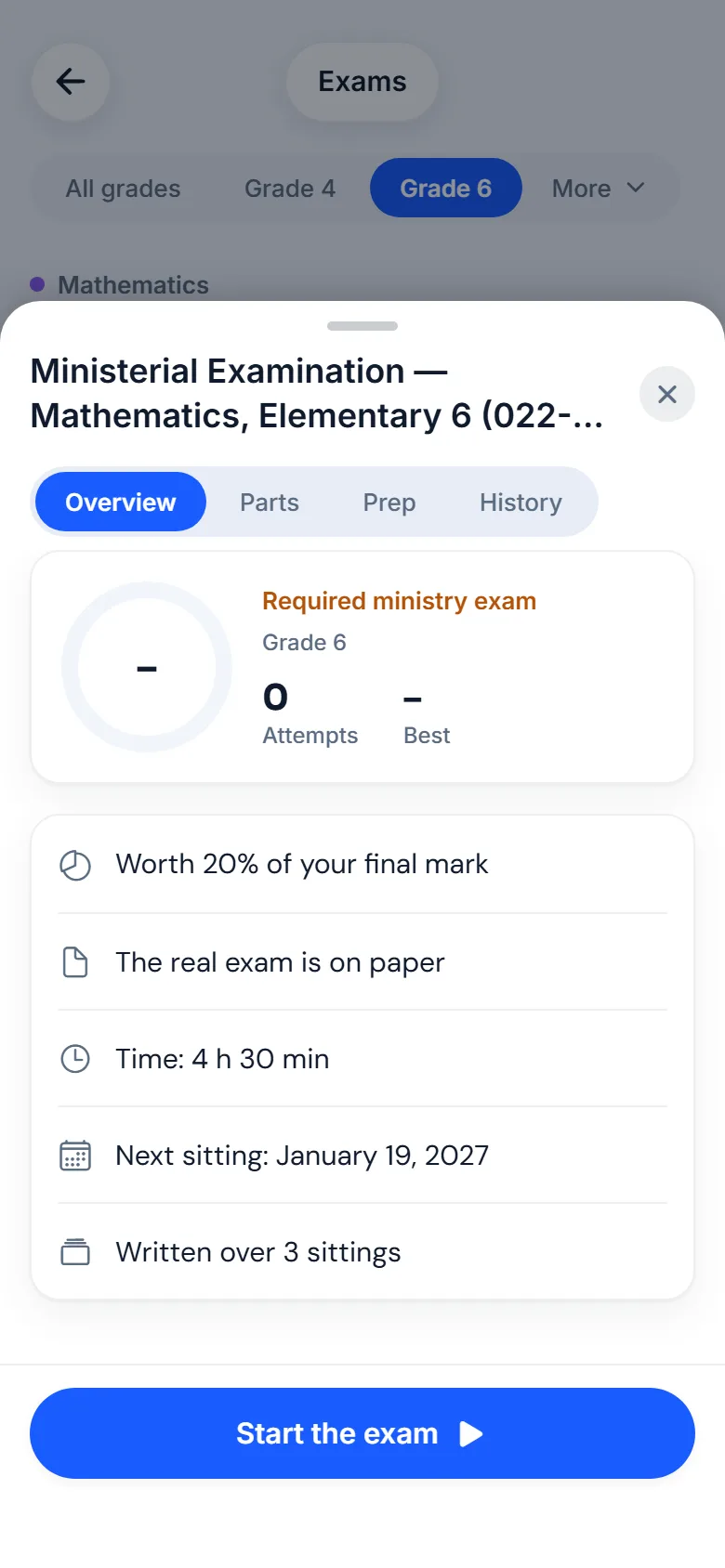 The exam in the app
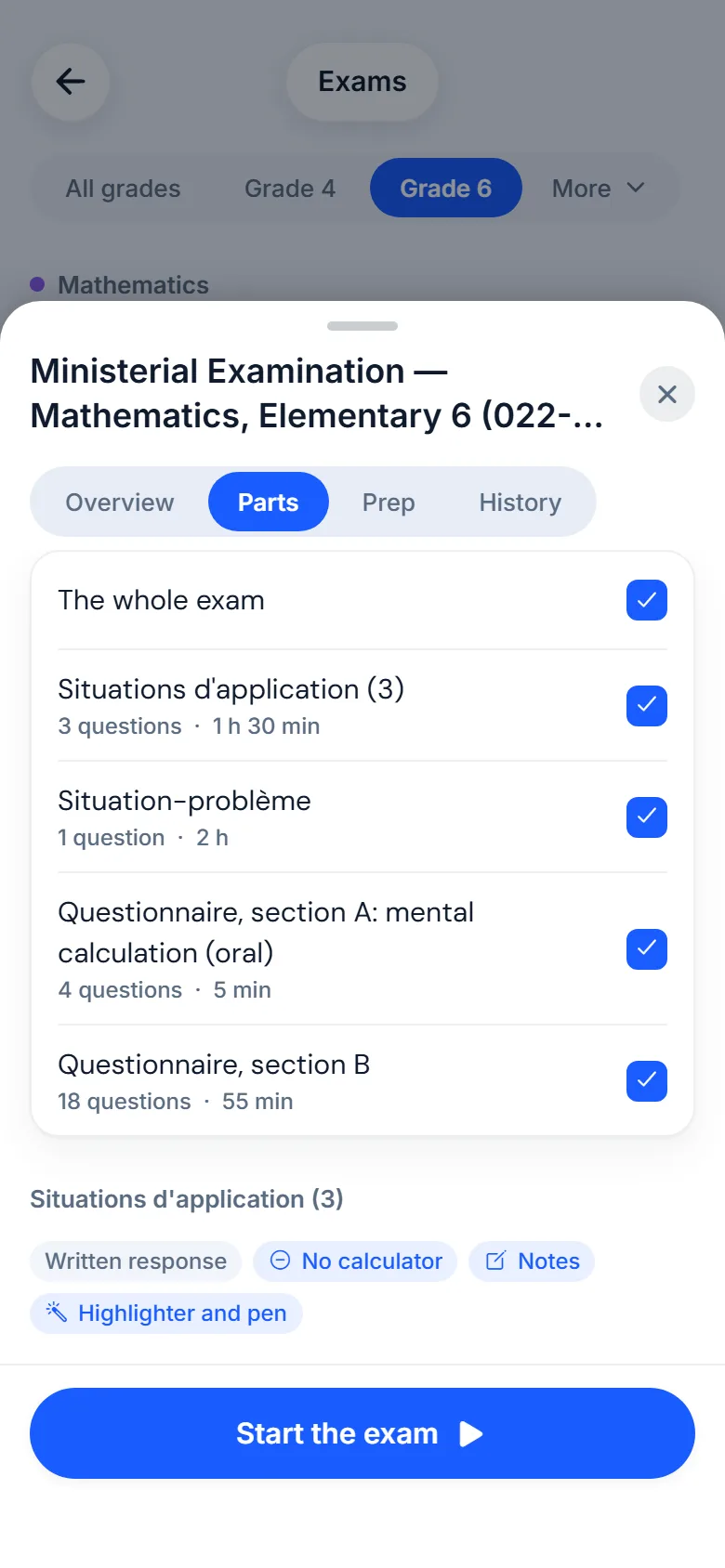 Its parts, and what you can use in each
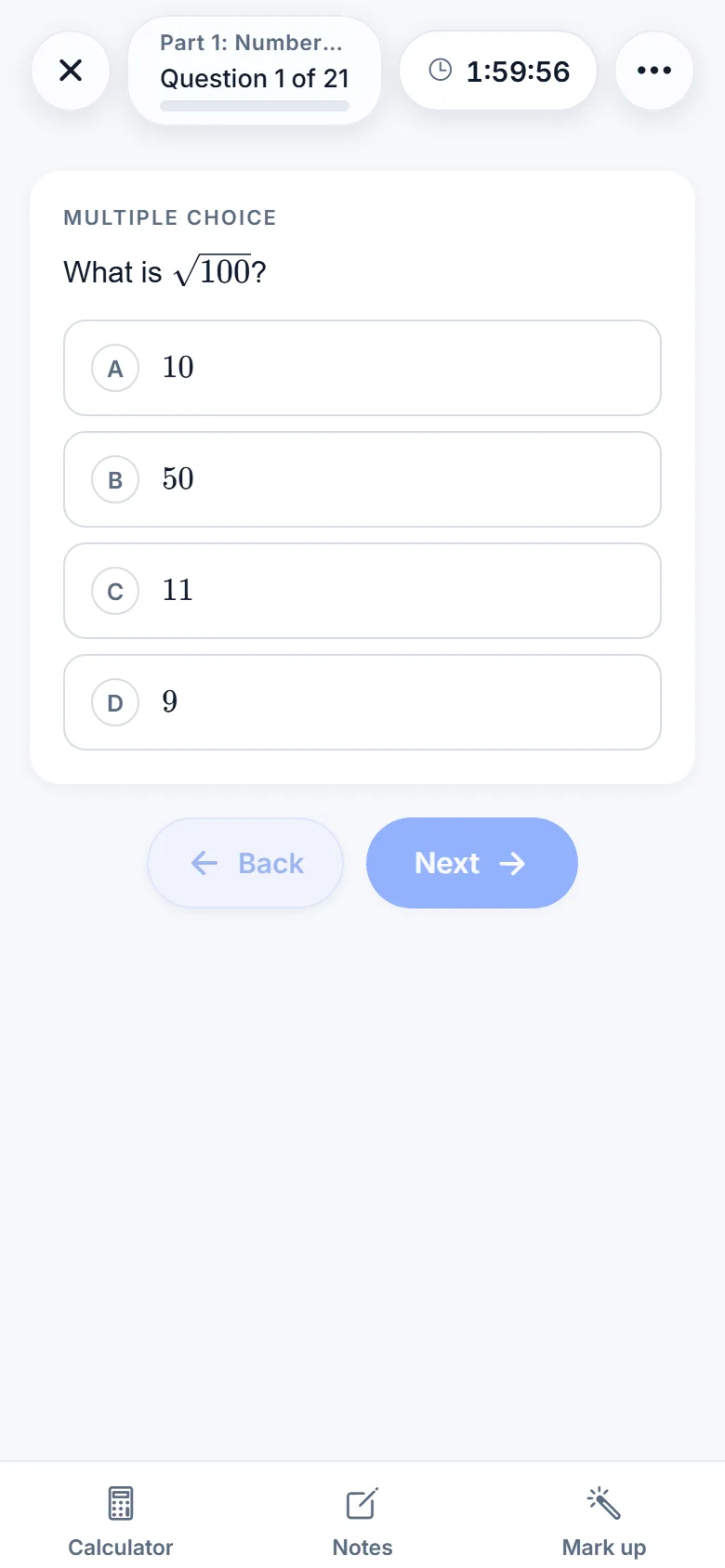 A question, timed, with the exam’s tools
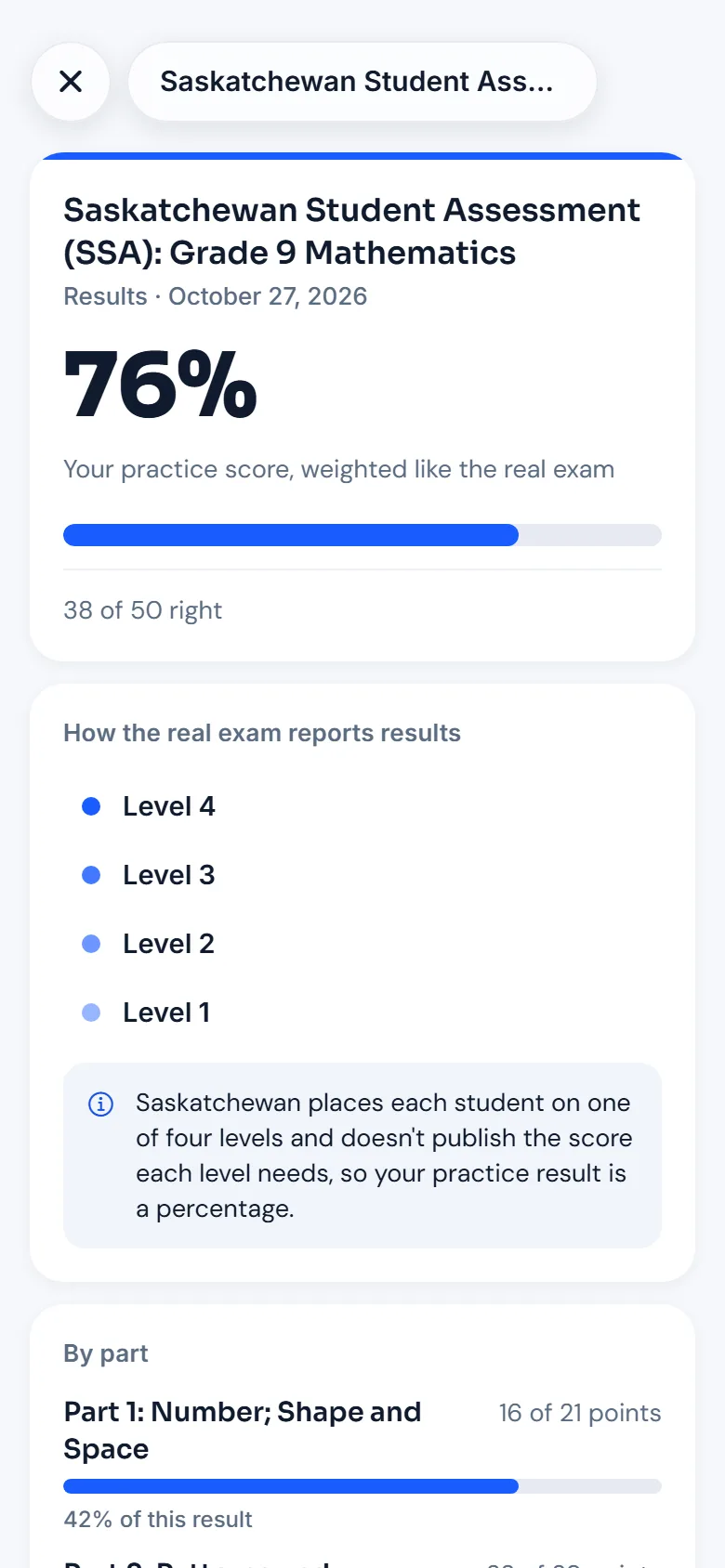 The marked result, part by part
A practice run of Saskatchewan’s Grade 9 math assessment.
Free with a MapleMind account
When
2 sessions this school year: January and June.
January 2027 session
- Tuesday, January 19, 2027Set by the school (30 minutes each) · Situations d'application 1 et 2 (022‑610)
- Wednesday, January 20, 2027Set by the school (2 hours) · Situation-problème (022‑610)
- Thursday, January 21, 2027Set by the school (30 + 60 minutes) · Situation d'application 3 et Questionnaire (022‑610)
June 2027 session
- Tuesday, June 8, 2027Set by the school (30 minutes each) · Situations d'application 1 et 2 (022‑610 and 522‑610)
- Wednesday, June 9, 2027Set by the school (2 hours) · Situation-problème (022‑610 and 522‑610)
- Thursday, June 10, 2027Set by the school (30 + 60 minutes) · Situation d'application 3 et Questionnaire (022‑610 and 522‑610)
The dates are Quebec’s own, read on September 28, 2026. See the official schedule (quebec.ca)
What’s on it
- ArithmétiqueNombres naturels, nombres décimaux, fractions, utilisation des nombres
- Géométrie
- Mesure
- Statistique
- Probabilité
Each topic’s share of the marks isn’t published.
The skills it tests · 111 skills
- Adds and subtracts fractions when the denominator of one fraction is a multiple of the other fraction(s)
- Adds new terms to a series when the first three terms or more are given
- Approximates a collection, using objects or drawings
- Approximates a decimal (estimates, rounds or truncates)
- Approximates the result of an operation on decimals
- Approximates the result of any of the four operations on natural numbers
- Arranges decimals in increasing or decreasing order
- Arranges integers in increasing or decreasing order
- Arranges natural numbers in increasing or decreasing order
- Builds a repertoire of memorized multiplication and division facts — develops various strategies that promote mastery of number facts and relate them to the properties of multiplication
- Calculates the power of a number
- Chooses an appropriate number form for a given context
- Classifies natural numbers in various ways, based on their properties
- Classifies triangles
- Collects, describes and organizes data (classifies or categorizes) using tables
- Compares integers
- Compares natural numbers
- Compares qualitatively the theoretical or experimental probability of events
- Compares the outcomes of a random experiment with known theoretical probabilities
- Compares two decimals
- Composes and decomposes a decimal written in decimal notation
- Composes and decomposes a natural number in a variety of ways
- Counts collections (using objects or drawings)
- Counts collections (using objects or drawings) — counts a collection by grouping or regrouping
- Counts or recites counting rhymes involving natural numbers — counts forward or backward
- Decomposes a number into prime factors
- Describes circles
- Describes number patterns, using his/her own words and appropriate mathematical vocabulary
- Describes patterns in a series of numbers and a family of operations
- Describes triangles — scalene, right, isosceles and equilateral triangles
- Determines numerical equivalencies using operations and the commutative property
- Determines numerical equivalencies using relationships between operations
- Determines the divisibility of a number by 2, 3, 4, 5, 6, 8, 9, 10
- Determines the missing term in an equation (relationships between operations) — a × b = □, a × □ = c, □ × b = c, a ÷ b = □, a ÷ □ = c, □ ÷ b = c
- Determines the operation(s) to perform in a given situation
- Develops processes for mental computation
- Develops processes for mental computation — uses his/her own processes to determine the product or quotient of two natural numbers
- Develops processes for written computation (multiplication and division) — uses conventional processes to determine the product of a three-digit natural number and a two-digit natural number
- Develops processes for written computation (multiplication and division) — uses conventional processes to determine the quotient of a four-digit natural number and a two-digit natural number, expresses the remainder of a division as a decimal that does not go beyond the second decimal place
- Distinguishes between prediction and outcome
- Divides a decimal by a natural number less than 11
- Enumerates the possible outcomes of a random experiment using a table or tree diagram
- Establishes equality relations between numerical expressions
- Establishes relationships between units of measure for capacity
- Establishes relationships between units of measure for length
- Establishes relationships between units of measure for mass
- Establishes relationships between units of measure for time
- Estimates and determines the degree measurement of angles (right, acute, obtuse)
- Estimates and measures capacity using conventional units
- Estimates and measures capacity using unconventional units
- Estimates and measures mass using conventional units
- Estimates and measures mass using unconventional units
- Estimates and measures surface area — using conventional units
- Estimates and measures temperature using conventional units
- Estimates and measures the dimensions of an object using conventional units — metre, decimetre, centimetre, millimetre and kilometre
- Estimates and measures volume — using conventional units
- Experiments with activities involving chance, using various objects
- Expresses a decimal as a fraction, and vice versa
- Expresses a decimal as a percentage, and vice versa
- Expresses a fraction as a percentage, and vice versa
- Formulates questions for a survey (based on age-appropriate topics, students’ language level, etc.)
- Generates a set of equivalent fractions
- Identifies equivalent expressions
- Identifies equivalent representations (using objects or drawings)
- Identifies the different meanings of fractions (sharing, division, ratio)
- Interprets data using a table, a bar graph, a pictograph, a broken-line graph and a circle graph
- Locates decimals on a number line
- Locates fractions on a number line
- Locates integers on a number line or Cartesian plane
- Locates natural numbers using different visual aids
- Locates objects on an axis (based on the types of numbers studied)
- Locates points in a Cartesian plane — in all four quadrants
- Matches a decimal or percentage to a fraction
- Matches a fraction or percentage to its decimal
- Matches the net of a convex polyhedron to the corresponding solid
- Multiplies a natural number by a fraction
- Multiplies decimals whose product stays within two decimal places
- Observes and produces frieze patterns and tessellations — using translations
- Orders fractions where one denominator is a multiple of the other(s)
- Orders fractions with the same denominator
- Orders fractions with the same numerator
- Performs a series of operations in accordance with the order of operations
- Predicts qualitatively an outcome or several events using a probability line, among other things
- Reads and writes any natural number
- Reads and writes integers
- Reads and writes numbers written in decimal notation
- Recognizes equivalent expressions
- Recognizes that a probability is always between 0 and 1
- Reduces a fraction to its simplest form (lowest terms)
- Represents a fraction in a variety of ways, based on a whole or a collection of objects
- Represents a situation with objects, diagrams or equations (addition and subtraction of decimals)
- Represents decimals in a variety of ways (using objects or drawings)
- Represents integers in a variety of ways (using objects or drawings)
- Represents natural numbers in different ways or associates a number with a set of objects or drawings
- Represents the power of a natural number
- Simulates random experiments with or without the use of technology
- Tests Euler's theorem on convex polyhedrons (vertex, edge, net of a solid)
- Translates a situation into a series of operations in accordance with the order of operations
- Translates a situation using a series of operations in accordance with the order of operations
- Understands and calculates the arithmetic mean
- Uses a calculator: becomes familiar with memory keys and change-of-sign keys
- Uses fractions, decimals or percentages to quantify a probability
- Uses objects, diagrams or equations to represent a situation and conversely, describes a situation represented by objects, diagrams or equations (use of different meanings of addition and subtraction)
- Uses objects, diagrams or equations to represent a situation and conversely, describes a situation represented by objects, diagrams or equations (use of different meanings of addition, subtraction and multiplication by a natural number)
- Uses objects, diagrams or equations to represent a situation and conversely, describes a situation represented by objects, diagrams or equations (use of different meanings of multiplication and division: rectangular arrays, Cartesian product, area, volume, sharing, number of times x goes into y, and comparisons)
- Uses objects, diagrams or equations to represent a situation and conversely, describes a situation represented by objects, diagrams or equations (use of different meanings of multiplication and division) — rectangular arrays, repeated addition, Cartesian product, area, volume, repeated subtraction, sharing, number of times x goes into y, and comparisons (using objects, diagrams or equations)
- Uses tables or diagrams to collect and display the outcomes of an experiment
- Verifies whether two fractions are equivalent
- When applicable, becomes aware of the independence of events in an experiment
- When applicable, recognizes equiprobability
- When applicable, recognizes variability in possible outcomes (uncertainty)
How it’s built
Written answers, numerical-response questions and multiple-choice questions.
- Situations d'application (3)
- Time
- 90 min
- Questions
- 3
- Marks
- 60
- Of the marks
- 42%
- Written answers
Three tasks in different settings, each done without a break. Apply the right math and show your reasoning, or justify, check or critique a claim with math arguments. Your teacher reads each task with you first.
- Situation-problème
- Time
- 120 min
- Question
- 1
- Marks
- 100
- Of the marks
- 30%
- Written answers
One rich problem where you choose the math to use, and the path isn't obvious. The instructions give no hints about how to solve it.
- Questionnaire, section A: mental calculation (oral)
- Time
- 5 min
- Questions
- 4
- Marks
- 4
- Of the marks
- 2.8%
- Numerical response
Four mental math operations, each shown and read aloud. You get 10 seconds to work each one out, then you write the result.
- Questionnaire, section B
- Time
- 55 min
- Questions
- 18
- Marks
- 36
- Of the marks
- 25.2%
- Multiple choice
- Numerical response
Written multiple-choice and short-answer questions, where the answer is a number, letter, word or expression. No calculator.
How it’s marked
Your school marks it out of 100 for each competency, with the ministry's guide. There's no pass mark: each result counts for 20% of your final result in that competency.
On the day
- Calculator
- Bring a calculator for the situational problem: one is recommended there. The other parts have no calculator.
- Day 1Two Situations d'application, 30 minutes each.
- Day 2The Situation-problème: 2 hours, first preparing, then solving. It may be split by recess or lunch.
- Day 3The third Situation d'application (30 minutes), then the Questionnaire (60 minutes): mental math read aloud, then section B.
Several parts on different days. Your teacher can explain everyday words but not math words, and can't hint at how to solve a problem. Math posters come down, and phones and other devices aren't allowed.
Getting ready
3 official documents to practise with, and 4 tips.
Official practice
Tips from the people who write it
- Mental math is oral: you get 10 seconds per operation and nothing but a pencil.
- No calculator except for the situational problem, where one is recommended.
- Make your reasoning clear: justifying is marked on its own in the application situations.
- Prepare the one-page memory aid you're allowed for the situational problem.
The mark you need
Your class mark counts for 80% of the final mark, the exam for 20%. Quebec may moderate your class mark before it’s blended.
You need
50% on the exam
With 75% in class, your final mark lands between 60% (0 on the exam) and 80% (100% on it).
After the exam
- Results
Your school marks it, and the result is part of your final mark for the year.
- If you miss it
With a valid reason (a serious illness or accident with a medical note, the death of a close relative, a court summons), your final mark is worked out from your three terms. Without one, your school’s own rules apply.
From About the ministerial examinations (Quebec) (quebec.ca) and Administrative Guide for the Certification of Studies and Management of Ministerial Examinations (the edition Quebec links today) (cdn-contenu.quebec.ca), read on October 27, 2026.
More for you
Students
Read what’s on it, then write full practice exams under the real time limit.
Practise itParents
Put the dates on the family calendar. The Parent Dashboard shows each practice exam’s result and the skills that need another look.
See the Parent DashboardEducators
The official practice above makes a review plan. Students can practise each skill on its own in MapleMind, free with daily limits.
For schools
Questions about this exam
When is the Mathematics, Elementary 6 in 2026–27?
The next sitting is January 19, 2027, Set by the school (30 minutes each). This school year it’s written in January 2027 session and June 2027 session.
How long is the Mathematics, Elementary 6?
It takes 4 hours 30 minutes in all, over 4 parts.
How many questions are on the Mathematics, Elementary 6?
It has 26 marked questions: 3 in Situations d'application (3), 1 in Situation-problème, 4 in Questionnaire, section A: mental calculation (oral) and 18 in Questionnaire, section B.
Can you use a calculator on the Mathematics, Elementary 6?
In some parts only: Situation-problème.
How much does the Mathematics, Elementary 6 count?
It’s worth 20% of the final mark in Mathematics, Grade 6.
Where can I find practice tests for the Mathematics, Elementary 6?
MapleMind builds a full practice exam in its format. Start it from this page, free with an account.

Practise for the Mathematics, Elementary 6
Every skill on the Mathematics, Elementary 6, taught one at a time, then practised on questions written like the real ones.


