Ministerial exam · Quebec
English Language Arts, Elementary 6
Ministerial Examination — English Language Arts, Elementary 6 (514‑600)
- Grade 6
Dates and details can change. We do our best to keep this page up to date, but check the official sources before relying on it.
- Total time
- 7 h
- Marked questions
- 2
- Marked parts
- 2
- Counts for
- 20% of the final mark
- Calculator
- Not allowed
- Format
- On paper
Elementary 6 English Ministry Exam practice test
The whole exam or the parts you choose, in its own format, on the clock.
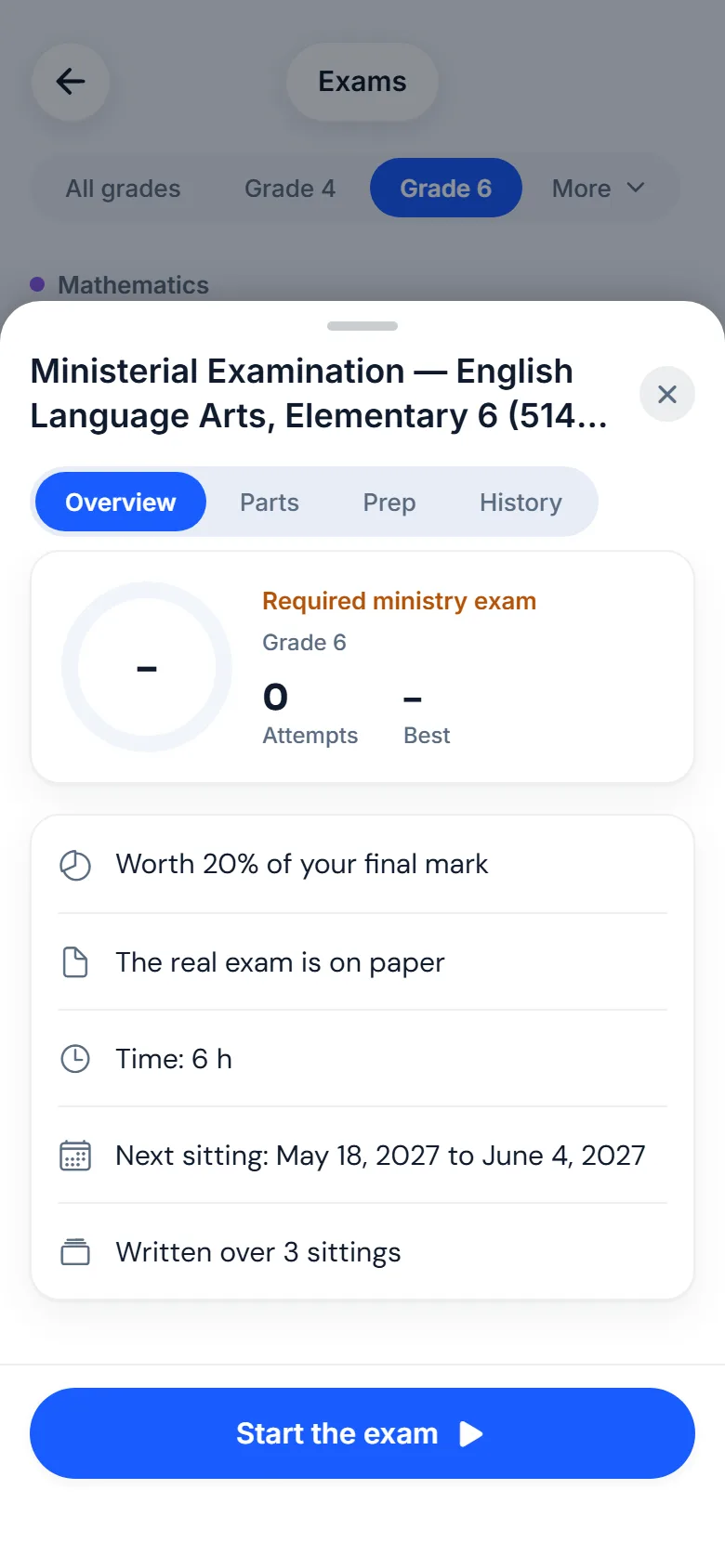 The exam in the app
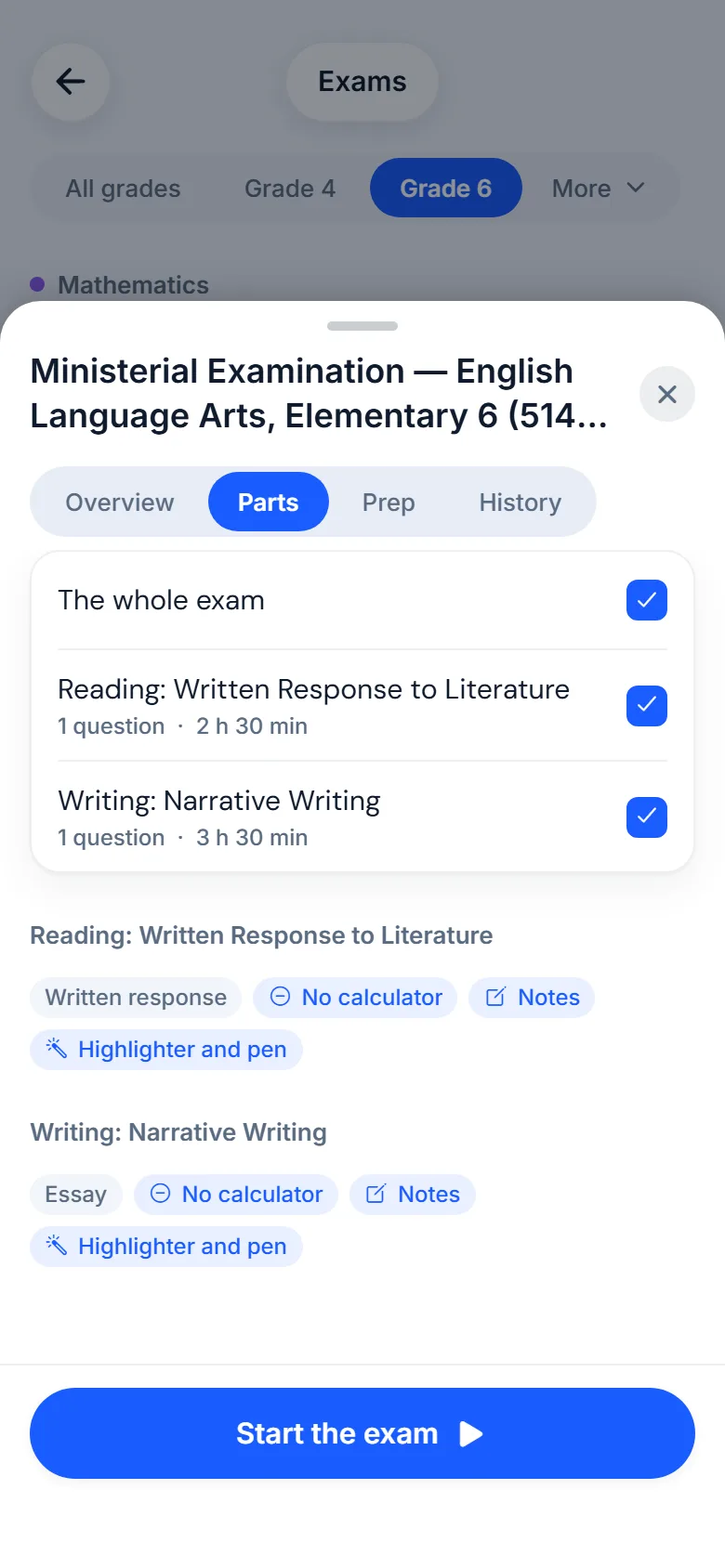 Its parts, and what you can use in each
 A question, timed, with the exam’s tools
 The marked result, part by part
A practice run of Saskatchewan’s Grade 9 math assessment.
Free with a MapleMind account
When
June 2027 session
- May 18 to June 4, 2027Set by the school · English Language Arts, Elementary 6 (514‑600): all parts, on dates chosen by the school
The dates are Quebec’s own, read on September 28, 2026. See the official schedule (quebec.ca)
What’s on it
- Competency 1, To read and listen to literary, popular and information-based texts: written response to an illustrated literary textIts own result: 20% of the reading competency's final mark (2025-26)
- Competency 2, To write self-expressive, narrative and information-based texts: a narrative for peersIts own result: 20% of the writing competency's final mark (2025-26)
The skills it tests · 35 skills
- Notice: Theme
- Use: Adjusts writing decisions to purpose and audience
- Use: Builds needed background knowledge and experiences
- Use: Connects needs and expectations of a specific audience
- Use: Deletes unnecessary details and/or information
- Use: Determines the specific or target audience by selecting
- Use: Dialogue
- Use: Distinguishes fact from opinion, and real from imaginary
- Use: Examines how the message attracts and holds the reader’s/viewer’s attention
- Use: Examines models of text type through immersion into the text
- Use: Examples would include man against man, man against nature, issues involving what is right or wrong, etc.
- Use: Foreshadowing
- Use: Graphic organizers, outlines, timelines, graphs and diagrams to organize ideas and information coherently
- Use: Identifies and locates information about who wrote the text
- Use: Identifies some of the ways that the author/producer has tried to influence the reader/audience
- Use: Illustrated wordless and picture books written for older
- Use: In simple and compound sentences
- Use: Noticing what a text leaves out, and asking why
- Use: Point of view
- Use: Rearranges sentences and paragraphs for clarity and effect
- Use: Relies on common structures and features of media texts to construct meaning
- Use: Repetition of symbols, or motifs, to create mood, suspense
- Use: Resolution of conflict
- Use: Selects words that convey the intended meaning and create a picture in the reader’s mind
- Use: Stock and/or flat characters
- Use: Understands that all spoken, written and media texts
- Use: Use of colour to suggest emotion, to create mood, etc.
- Use: Uses and interprets the visual element of color
- Use: Uses and interprets the visual element of perspective
- Use: Uses evidence to distinguish between own thinking, values
- Use: Uses knowledge of the genre/text type to be viewed/read
- Use: Uses literal and figurative language in a variety of ways
- Use: Uses other readers’ interpretations to clarify and extend
- Use: Uses quotation marks to punctuate dialogue
- Use: Webbing and mapping texts, such as story mapping
How it’s built
Written answers and an essay.
- Reading: initiation taskNot marked
- Time
- 60 min
- A task
- Reading: Written Response to Literature
- Time
- 150 min
- Question
- 1
- Marks
- 100
- Of the marks
- 49%
- Written answers
Look at the book cover, read an illustrated text, read it again taking notes, and discuss it in teams. Then write a response on your own: interpret the text and comment on how the author and illustrator made it.
- Writing: Narrative Writing
- Time
- 210 min
- Question
- 1
- Marks
- 100
- Of the marks
- 51%
- Essay
After some warm-up activities, plan, draft, talk your draft over with a partner, revise, and write the final version of a story to entertain readers your age.
How it’s marked
Your school marks it, comparing your work with the ministry's examples at each level. There's no pass mark: each part's result counts for 20% of your final mark in that skill, reading or writing.
On the day
- FirstAn initiation task, about 1 hour: activities and discussion that set up the topic. It isn't marked.
- NextReading: a written response to the text you read, about 2.5 hours.
- LastWriting: a narrative, about 3.5 hours, including the activities that prepare it.
Several parts, all built around one topic and taken in a set order. Talking with classmates runs through it, but isn't marked on its own. Dictionaries and a thesaurus are allowed; phones and other devices aren't. No one may help you, for example by clarifying a question.
Getting ready
2 official documents to practise with, and 4 tips.
Official practice
Tips from the people who write it
- In the response to literature, interpret the text and its pictures: don't just retell the story.
- Plan your story for readers your age, and revise it with a partner before the final copy.
- Spelling, grammar and punctuation matter: weak control caps your writing mark at 60%.
- Practise with a dictionary and thesaurus: you may use them.
The mark you need
Your class mark counts for 80% of the final mark, the exam for 20%. Quebec may moderate your class mark before it’s blended.
You need
50% on the exam
With 75% in class, your final mark lands between 60% (0 on the exam) and 80% (100% on it).
After the exam
- Results
Your school marks it, and the result is part of your final mark for the year.
- If you miss it
With a valid reason (a serious illness or accident with a medical note, the death of a close relative, a court summons), your final mark is worked out from your three terms. Without one, your school’s own rules apply.
From About the ministerial examinations (Quebec) (quebec.ca) and Administrative Guide for the Certification of Studies and Management of Ministerial Examinations (the edition Quebec links today) (cdn-contenu.quebec.ca), read on October 27, 2026.
More for you
Students
Read what’s on it, then write full practice exams under the real time limit.
Practise itParents
Put the dates on the family calendar. The Parent Dashboard shows each practice exam’s result and the skills that need another look.
See the Parent DashboardEducators
The official practice above makes a review plan. Students can practise each skill on its own in MapleMind, free with daily limits.
For schools
Questions about this exam
When is the English Language Arts, Elementary 6 in 2026–27?
The next sitting is May 18 to June 4, 2027.
How long is the English Language Arts, Elementary 6?
It takes 7 hours in all, over 2 parts.
How many questions are on the English Language Arts, Elementary 6?
It has 2 marked questions: 1 in Reading: Written Response to Literature and 1 in Writing: Narrative Writing.
Can you use a calculator on the English Language Arts, Elementary 6?
No. Calculators aren’t allowed.
How much does the English Language Arts, Elementary 6 count?
It’s worth 20% of the final mark in English Language Arts, Grade 6.
Where can I find practice tests for the English Language Arts, Elementary 6?
Quebec publishes Guide for Parents (December 2025): excerpts of a past exam and the rubrics. MapleMind also builds a full practice exam in its format, free with an account.

Practise for the English Language Arts, Elementary 6
Every skill on the English Language Arts, Elementary 6, taught one at a time, then practised on questions written like the real ones.


