Get help with English Language Arts, Grade 6
Most tutoring makes your child sit through material your child already knows. MapleMind flips that: pick the exact skill that's causing trouble — any of the 70 below — and the tutor teaches just that one, step by step, as many times as it takes. Ask questions in plain words, any time of day, in English, French, or 12 other languages.
The official Quebec English Language Arts, Grade 6 curriculum
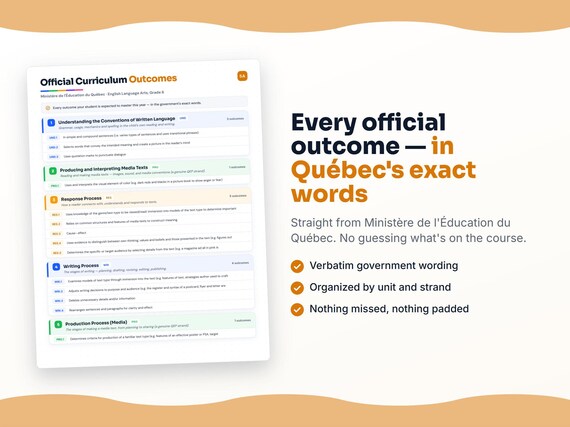
Quebec defines English Language Arts, Grade 6 by strands and outcomes. MapleMind teaches the same curriculum reorganized for one-skill-at-a-time tutoring — the table shows exactly where every official strand lands, and the ministry's own wording is quoted under each unit below.
Official source Québec's official English language arts programRead it on the government site — quebec.ca ↗| Official strand | Outcomes | Where MapleMind teaches it |
|---|---|---|
| Strand A | 39 | Understanding the Conventions of Written Language · Response Process · Narrative and Literary Texts · Information-Based: Planning Texts |
| Strand B | 14 | Producing and Interpreting Media Texts · Writing Process · Self-Expressive: Reflective Texts · Information-Based: Explanatory Texts |
| Strand C | 12 | Production Process (Media) · Information-Based: Descriptive Reports |
| Strand D | 5 | Information-Based: Persuasive Texts |
Every skill below, taught one on one.
 Try the first session free
How MapleMind teaches English Language Arts, Grade 6 — every unit, lesson, and skill
Every skill below runs as a short session: a plain-words lesson, a worked example, solving it together, then a five-question skill check that earns up to three stars. Guided Mode keeps it teaching instead of answer-handing — turning it off needs a parent's password.
Unit 1Understanding the Conventions of Written LanguageOfficial strand · Strand A
Grammar, usage, mechanics and spelling in the child's own reading and writing.
How a sentence's shape shows its job
- Use: In simple and compound sentencesc007-A.8 — Mastery of “In simple and compound sentences (i.e. varies types of sentences and uses…” (Understanding the Conventions of Written Language) at Grade 6 ELA.
Usage Conventions (agreement and word choice)
- Use: Selects words that convey the intended meaning and create a…c011-A.12 — Mastery of “Selects words that convey the intended meaning and create a picture in the…” (Understanding the Conventions of Written Language) at Grade 6 ELA.
- Use: Uses literal and figurative language in a variety of waysc012-A.13 — Mastery of “Uses literal and figurative language in a variety of ways (e.g. imitating,…” (Understanding the Conventions of Written Language) at Grade 6 ELA.
Mechanics (spelling, capitalization and punctuation)
- Use: Uses quotation marks to punctuate dialoguec018-A.21 — Mastery of “Uses quotation marks to punctuate dialogue” (Understanding the Conventions of Written Language) at Grade 6 ELA.
The official wording — 4 outcomes in this unit
- c007-A.8
In simple and compound sentences (i.e. varies types of sentences and uses transitional phrases)
- c011-A.12
Selects words that convey the intended meaning and create a picture in the reader’s mind
- c012-A.13
Uses literal and figurative language in a variety of ways (e.g. imitating, creating new words, rhyming)
- c018-A.21
Uses quotation marks to punctuate dialogue
Unit 2Producing and Interpreting Media TextsOfficial strand · Strand B
Reading and making media texts — images, sound, and media conventions (a genuine QEP strand).
Images (in photographs, drawings and illustrations)
- Use: Uses and interprets the visual element of colorc026-B.3 — Mastery of “Uses and interprets the visual element of color (e.g. dark reds and blacks in a…” (Producing and Interpreting Media Texts) at Grade 6 ELA.
- Use: Uses and interprets the visual element of perspective in…c027-B.4 — Mastery of “Uses and interprets the visual element of perspective in illustrations or…” (Producing and Interpreting Media Texts) at Grade 6 ELA.
- Use: Uses and interprets camera techniques, such as camera…c028-B.5 — Mastery of “Uses and interprets camera techniques, such as camera distance (e.g. long and…” (Producing and Interpreting Media Texts) at Grade 6 ELA.
- Use: Sound—in television, movies, some commercialsc029-B.6 — Mastery of “Sound—in television, movies, some commercials (e.g. scary music indicates…” (Producing and Interpreting Media Texts) at Grade 6 ELA.
- Use: Visuals that convey information and/or ideas, such as…c030-B.7 — Mastery of “Visuals that convey information and/or ideas, such as timelines, graphs,…” (Producing and Interpreting Media Texts) at Grade 6 ELA.
The official wording — 5 outcomes in this unit
- c026-B.3
Uses and interprets the visual element of color (e.g. dark reds and blacks in a picture book to show anger or fear)
- c027-B.4
Uses and interprets the visual element of perspective in illustrations or drawings (e.g. to connote a viewpoint, as in
- c028-B.5
Uses and interprets camera techniques, such as camera distance (e.g. long and medium shots, close-ups)
- c029-B.6
Sound—in television, movies, some commercials (e.g. scary music indicates suspense)
- c030-B.7
Visuals that convey information and/or ideas, such as timelines, graphs, graphics in comic books
Unit 3Response ProcessOfficial strand · Strand A
How a reader connects with, understands and responds to texts.
Prereading/Viewing
- Use: Uses knowledge of the genre/text type to be viewed/read:…c036-A.6 — Mastery of “Uses knowledge of the genre/text type to be viewed/read: immersion into models…” (Response Process) at Grade 6 ELA.
- Use: Builds needed background knowledge and experiencesc037-A.7 — Mastery of “Builds needed background knowledge and experiences (e.g. of content, setting…” (Response Process) at Grade 6 ELA.
During Reading/ Viewing
- Use: Relies on common structures and features of media texts to…c043-A.13 — Mastery of “Relies on common structures and features of media texts to construct meaning” (Response Process) at Grade 6 ELA.
How cause-and-effect texts work
- Use: Cause- effectc049-A.19 — Mastery of “Cause- effect” (Response Process) at Grade 6 ELA.
After Reading/Viewing: Interpreting the Text
- Use: Uses evidence to distinguish between own thinking, values…c055-A.25 — Mastery of “Uses evidence to distinguish between own thinking, values and beliefs and those…” (Response Process) at Grade 6 ELA.
- Use: Uses other readers’ interpretations to clarify and extend…c056-A.26 — Mastery of “Uses other readers’ interpretations to clarify and extend own ideas (e.g.…” (Response Process) at Grade 6 ELA.
- Use: Understands that all spoken, written and media texts are…c057-A.27 — Mastery of “Understands that all spoken, written and media texts are constructed by people…” (Response Process) at Grade 6 ELA.
Spotting a text's intended audience
- Use: Determines the specific or target audience by selecting…c059-A.29 — Mastery of “Determines the specific or target audience by selecting details from the text…” (Response Process) at Grade 6 ELA.
- Use: Identifies and locates information about who wrote the textc060-A.30 — Mastery of “Identifies and locates information about who wrote the text (i.e. its…” (Response Process) at Grade 6 ELA.
- Use: Examines how the message attracts and holds the…c061-A.31 — Mastery of “Examines how the message attracts and holds the reader’s/viewer’s attention” (Response Process) at Grade 6 ELA.
- Use: Distinguishes fact from opinion, and real from imaginaryc062-A.32 — Mastery of “Distinguishes fact from opinion, and real from imaginary” (Response Process) at Grade 6 ELA.
- Use: Considers who/what has been left out of the text and why…c063-A.33 — Mastery of “Considers who/what has been left out of the text and why this might be” (Response Process) at Grade 6 ELA.
The official wording — 13 outcomes in this unit
- c036-A.6
Uses knowledge of the genre/text type to be viewed/read: immersion into models of the text type to determine important
- c037-A.7
Builds needed background knowledge and experiences (e.g. of content, setting and/or author, in a variety of ways such
- c043-A.13
Relies on common structures and features of media texts to construct meaning
- c049-A.19
Cause- effect
- c055-A.25
Uses evidence to distinguish between own thinking, values and beliefs and those presented in the text (e.g. figures out
- c056-A.26
Uses other readers’ interpretations to clarify and extend own ideas (e.g. discusses information, ideas and new insights
- c057-A.27
Understands that all spoken, written and media texts are constructed by people to appeal to a specific or target
- c059-A.29
Determines the specific or target audience by selecting details from the text (e.g. a magazine ad all in pink is
- c060-A.30
Identifies and locates information about who wrote the text (i.e. its writer/producer) and why (i.e. the purpose)
- c061-A.31
Examines how the message attracts and holds the reader’s/viewer’s attention
- c062-A.32
Distinguishes fact from opinion, and real from imaginary
- c063-A.33
Considers who/what has been left out of the text and why this might be
- c064-A.34
Identifies some of the ways that the author/producer has tried to influence the reader/audience
Unit 4Writing ProcessOfficial strand · Strand B
The stages of writing — planning, drafting, revising, editing, publishing.
Studying examples before you write
- Use: Examines models of text type through immersion into the textc068-B.5 — Mastery of “Examines models of text type through immersion into the text (e.g. features of…” (Writing Process) at Grade 6 ELA.
Drafting
- Use: Adjusts writing decisions to purpose and audiencec073-B.10 — Mastery of “Adjusts writing decisions to purpose and audience (e.g. the register and syntax…” (Writing Process) at Grade 6 ELA.
- Use: Connects needs and expectations of a specific audience to…c074-B.11 — Mastery of “Connects needs and expectations of a specific audience to writing decisions…” (Writing Process) at Grade 6 ELA.
Revision
- Use: Deletes unnecessary details and/or informationc079-B.16 — Mastery of “Deletes unnecessary details and/or information” (Writing Process) at Grade 6 ELA.
Editing
- Use: Rearranges sentences and paragraphs for clarity and effectc083-B.20 — Mastery of “Rearranges sentences and paragraphs for clarity and effect” (Writing Process) at Grade 6 ELA.
The official wording — 5 outcomes in this unit
- c068-B.5
Examines models of text type through immersion into the text (e.g. features of text, strategies author used to craft
- c073-B.10
Adjusts writing decisions to purpose and audience (e.g. the register and syntax of a postcard, flyer and letter are
- c074-B.11
Connects needs and expectations of a specific audience to writing decisions (e.g. provides additional details or
- c079-B.16
Deletes unnecessary details and/or information
- c083-B.20
Rearranges sentences and paragraphs for clarity and effect
Unit 5Production Process (Media)Official strand · Strand C
The stages of making a media text, from planning to sharing (a genuine QEP strand).
Setting criteria for a text type
- Use: Determines criteria for production of a familiar text typec093-C.8 — Mastery of “Determines criteria for production of a familiar text type (e.g. features of an…” (Production Process (Media)) at Grade 6 ELA.
- Use: Uses appropriate technology resources for the specific…c097-C.13 — Mastery of “Uses appropriate technology resources for the specific production as needed…” (Production Process (Media)) at Grade 6 ELA.
- Use: Reviews images, records narration, adds titles or text,…c098-C.15 — Mastery of “Reviews images, records narration, adds titles or text, adds transitions,…” (Production Process (Media)) at Grade 6 ELA.
- Use: Edits, depending on technology resourcesc099-C.16 — Mastery of “Edits, depending on technology resources” (Production Process (Media)) at Grade 6 ELA.
- Use: Considers feedback from peers and othersc100-C.17 — Mastery of “Considers feedback from peers and others” (Production Process (Media)) at Grade 6 ELA.
The official wording — 5 outcomes in this unit
- c093-C.8
Determines criteria for production of a familiar text type (e.g. features of an effective poster or PSA, target
- c097-C.13
Uses appropriate technology resources for the specific production as needed (e.g. downloading digital images for a
- c098-C.15
Reviews images, records narration, adds titles or text, adds transitions, depending on the production and its
- c099-C.16
Edits, depending on technology resources
- c100-C.17
Considers feedback from peers and others
Unit 6Self-Expressive: Reflective TextsOfficial strand · Strand B
Texts that reflect on the child's own thoughts, feelings and experiences.
Synthesizing many ideas into one focus
- Use: Synthesis of ideas and feelings to focus on what is most…c128-B.12 — Mastery of “Synthesis of ideas and feelings to focus on what is most important” (Self-Expressive: Reflective Texts) at Grade 6 ELA.
The official wording — 1 outcome in this unit
- c128-B.12
Synthesis of ideas and feelings to focus on what is most important
Unit 7Narrative and Literary TextsOfficial strand · Strand A
Stories and literary texts — their features, genres and required reading.
Reading words and pictures together
- Use: Illustrated wordless and picture books written for older…c136-A.10 — Mastery of “Illustrated wordless and picture books written for older children with more…” (Narrative and Literary Texts) at Grade 6 ELA.
Reading and writing memoir
- Use: Memoir in a variety of text typesc148-A.23 — Mastery of “Memoir in a variety of text types” (Narrative and Literary Texts) at Grade 6 ELA.
Plot structures and features
- Use: Foreshadowingc159-A.36 — Mastery of “Foreshadowing, i.e. the use of hints or clues to suggest what will happen later…” (Narrative and Literary Texts) at Grade 6 ELA.
Conflict
- Use: Examples would include man against man, man against nature,…c163-A.40 — Mastery of “Examples would include man against man, man against nature, issues involving…” (Narrative and Literary Texts) at Grade 6 ELA.
- Use: Resolution of conflictc164-A.41 — Mastery of “Resolution of conflict” (Narrative and Literary Texts) at Grade 6 ELA.
- Notice: Themec165-A.42 — Guided introduction of “Theme, i.e. the central or underlying meaning or dominant idea(s) that…” (Narrative and Literary Texts) at Grade 6 ELA.
Characterization
- Use: Stock and/or flat charactersc168-A.45 — Mastery of “Stock and/or flat characters, i.e. characters with only one or two qualities or…” (Narrative and Literary Texts) at Grade 6 ELA.
Other features of narrative
- Use: Dialoguec176-A.54 — Mastery of “Dialogue, e.g. to reveal character” (Narrative and Literary Texts) at Grade 6 ELA.
- Use: Point of viewc177-A.55 — Mastery of “Point of view, i.e. narrative voice in first or third person” (Narrative and Literary Texts) at Grade 6 ELA.
Plot structure and features
- Use: Use of music and/or sound to create suspense, mood, humor,…c182-A.61 — Mastery of “Use of music and/or sound to create suspense, mood, humor, conflict, etc.…” (Narrative and Literary Texts) at Grade 6 ELA.
- Use: Use of colour to suggest emotion, to create mood, etc.c183-A.62 — Mastery of “Use of colour to suggest emotion, to create mood, etc.” (Narrative and Literary Texts) at Grade 6 ELA.
- Use: Use of different scenes or episodes to move the story…c184-A.63 — Mastery of “Use of different scenes or episodes to move the story forward (Viewing only)” (Narrative and Literary Texts) at Grade 6 ELA.
- Use: Use of body language and gesture to convey character…c188-A.68 — Mastery of “Use of body language and gesture to convey character traits, including emotions…” (Narrative and Literary Texts) at Grade 6 ELA.
- Use: Use of music and/or sound to signal or stress some aspect…c189-A.69 — Mastery of “Use of music and/or sound to signal or stress some aspect of character, e.g.…” (Narrative and Literary Texts) at Grade 6 ELA.
- Use: Repetition of symbols, or motifs, to create mood, suspense,…c192-A.73 — Mastery of “Repetition of symbols, or motifs, to create mood, suspense, sense of continuity…” (Narrative and Literary Texts) at Grade 6 ELA.
How light and dark set mood (viewing only)
- Use: Use of light and darkc194-A.75 — Mastery of “Use of light and dark (e.g. to create a sense of foreboding, to change time…” (Narrative and Literary Texts) at Grade 6 ELA.
- Use: Clothing and other details that create a sense of time and…c195-A.76 — Mastery of “Clothing and other details that create a sense of time and location” (Narrative and Literary Texts) at Grade 6 ELA.
The official wording — 17 outcomes in this unit
- c136-A.10
Illustrated wordless and picture books written for older children with more sophisticated concepts, language, issues,
- c148-A.23
Memoir in a variety of text types
- c159-A.36
Foreshadowing, i.e. the use of hints or clues to suggest what will happen later in the story (Reading only)
- c163-A.40
Examples would include man against man, man against nature, issues involving what is right or wrong, etc.
- c164-A.41
Resolution of conflict
- c165-A.42
Theme, i.e. the central or underlying meaning or dominant idea(s) that structures a narrative. It should be noted,
- c168-A.45
Stock and/or flat characters, i.e. characters with only one or two qualities or traits. Stereotypes, such as the mean
- c176-A.54
Dialogue, e.g. to reveal character
- c177-A.55
Point of view, i.e. narrative voice in first or third person
- c182-A.61
Use of music and/or sound to create suspense, mood, humor, conflict, etc. (Viewing only)
- c183-A.62
Use of colour to suggest emotion, to create mood, etc.
- c184-A.63
Use of different scenes or episodes to move the story forward (Viewing only)
- c188-A.68
Use of body language and gesture to convey character traits, including emotions (Viewing only)
- c189-A.69
Use of music and/or sound to signal or stress some aspect of character, e.g. music to signal the reappearance of a
- c192-A.73
Repetition of symbols, or motifs, to create mood, suspense, sense of continuity (e.g. scenes of the ocean in a story
- c194-A.75
Use of light and dark (e.g. to create a sense of foreboding, to change time frame) (Viewing only)
- c195-A.76
Clothing and other details that create a sense of time and location
Unit 8Information-Based: Planning TextsOfficial strand · Strand A
Texts that organise and plan information.
Webbing and mapping ideas
- Use: Webbing and mapping texts, such as story mapping, to…c201-A.8 — Mastery of “Webbing and mapping texts, such as story mapping, to represent the…” (Information-Based: Planning Texts) at Grade 6 ELA.
- Use: Graphic organizers, outlines, timelines, graphs and…c202-A.9 — Mastery of “Graphic organizers, outlines, timelines, graphs and diagrams to organize ideas…” (Information-Based: Planning Texts) at Grade 6 ELA.
Written and Media Texts
- Use: Visuals such as graphic organizers used to articulate…c207-A.15 — Mastery of “Visuals such as graphic organizers used to articulate relationship among…” (Information-Based: Planning Texts) at Grade 6 ELA.
- Use: Hierarchy of ideas/ informationc208-A.16 — Mastery of “Hierarchy of ideas/ information, (e.g. in an rough outline, diagram)” (Information-Based: Planning Texts) at Grade 6 ELA.
- Use: Visuals/images for organizing or planning a textc209-A.17 — Mastery of “Visuals/images for organizing or planning a text (e.g. arrows in a concept map…” (Information-Based: Planning Texts) at Grade 6 ELA.
The official wording — 5 outcomes in this unit
- c201-A.8
Webbing and mapping texts, such as story mapping, to represent the relationship(s) between ideas or separate pieces of
- c202-A.9
Graphic organizers, outlines, timelines, graphs and diagrams to organize ideas and information coherently
- c207-A.15
Visuals such as graphic organizers used to articulate relationship among actions or ideas, (e.g. webbing)
- c208-A.16
Hierarchy of ideas/ information, (e.g. in an rough outline, diagram)
- c209-A.17
Visuals/images for organizing or planning a text (e.g. arrows in a concept map to indicate linked ideas)
Unit 9Information-Based: Explanatory TextsOfficial strand · Strand B
Texts that explain how or why.
How web sites organize information
- Use: Web sites (Reading and Viewing only)c218-B.11 — Mastery of “Web sites (Reading and Viewing only)” (Information-Based: Explanatory Texts) at Grade 6 ELA.
Spoken, Written and Media texts
- Use: Bibliography (if needed)c226-B.20 — Mastery of “Bibliography (if needed)” (Information-Based: Explanatory Texts) at Grade 6 ELA.
The official wording — 3 outcomes in this unit
- c218-B.11
Web sites (Reading and Viewing only)
- c225-B.19
Navigational aids such as table of contents or alphabetical listing in longer texts, index, headings and page numbers
- c226-B.20
Bibliography (if needed)
Unit 10Information-Based: Descriptive ReportsOfficial strand · Strand C
Texts that describe and report on a topic.
Following news reports
- Use: Local and national radio and television news reports that…c235-C.11 — Mastery of “Local and national radio and television news reports that are appropriate and…” (Information-Based: Descriptive Reports) at Grade 6 ELA.
- Use: Web pages, blogs and Internet sites appropriate and…c236-C.12 — Mastery of “Web pages, blogs and Internet sites appropriate and accessible to children…” (Information-Based: Descriptive Reports) at Grade 6 ELA.
How subheadings organize a long text
- Use: Subheadings and paragraphs to group and/or categorize…c244-C.23 — Mastery of “Subheadings and paragraphs to group and/or categorize information” (Information-Based: Descriptive Reports) at Grade 6 ELA.
- Use: Use of comparison and contrastc245-C.24 — Mastery of “Use of comparison and contrast” (Information-Based: Descriptive Reports) at Grade 6 ELA.
- Use: Visuals and/or graphic organizers to extend content of…c246-C.25 — Mastery of “Visuals and/or graphic organizers to extend content of written text (e.g.…” (Information-Based: Descriptive Reports) at Grade 6 ELA.
- Use: Summary of events, observations, impressions to highlight…c247-C.26 — Mastery of “Summary of events, observations, impressions to highlight what is most important” (Information-Based: Descriptive Reports) at Grade 6 ELA.
- Use: Specific features of different formats depending on topics…c248-C.27 — Mastery of “Specific features of different formats depending on topics and purposes (i.e. a…” (Information-Based: Descriptive Reports) at Grade 6 ELA.
The official wording — 7 outcomes in this unit
- c235-C.11
Local and national radio and television news reports that are appropriate and accessible to children
- c236-C.12
Web pages, blogs and Internet sites appropriate and accessible to children (e.g., short video clips)
- c244-C.23
Subheadings and paragraphs to group and/or categorize information
- c245-C.24
Use of comparison and contrast
- c246-C.25
Visuals and/or graphic organizers to extend content of written text (e.g. pictures, labels, diagrams)
- c247-C.26
Summary of events, observations, impressions to highlight what is most important
- c248-C.27
Specific features of different formats depending on topics and purposes (i.e. a science report has different features
Unit 11Information-Based: Persuasive TextsOfficial strand · Strand D
Texts that try to persuade a reader.
Reading public service ads
- Use: Public Service Ads and posters created for childrenc258-D.13 — Mastery of “Public Service Ads and posters created for children” (Information-Based: Persuasive Texts) at Grade 6 ELA.
Writing a review
- Use: TV and/or movie reviews for peers or younger childrenc264-D.20 — Mastery of “TV and/or movie reviews for peers or younger children” (Information-Based: Persuasive Texts) at Grade 6 ELA.
How persuasive language sells
- Use: Use of persuasive images, words or phrases to promote a…c266-D.24 — Mastery of “Use of persuasive images, words or phrases to promote a product and/or some…” (Information-Based: Persuasive Texts) at Grade 6 ELA.
- Use: Strategic placement of images (photo or drawing) to attract…c267-D.25 — Mastery of “Strategic placement of images (photo or drawing) to attract the attention of…” (Information-Based: Persuasive Texts) at Grade 6 ELA.
- Use: Music/sound to promote a product and/or appeal to the…c268-D.26 — Mastery of “Music/sound to promote a product and/or appeal to the viewer to take action…” (Information-Based: Persuasive Texts) at Grade 6 ELA.
The official wording — 5 outcomes in this unit
- c258-D.13
Public Service Ads and posters created for children
- c264-D.20
TV and/or movie reviews for peers or younger children
- c266-D.24
Use of persuasive images, words or phrases to promote a product and/or some aspect of consumerism (e.g. on product
- c267-D.25
Strategic placement of images (photo or drawing) to attract the attention of reader/viewer (e.g. as in a poster, in a
- c268-D.26
Music/sound to promote a product and/or appeal to the viewer to take action (e.g. in a TV commercial) (Viewing only)
Printable workbook · A keepsake of the year
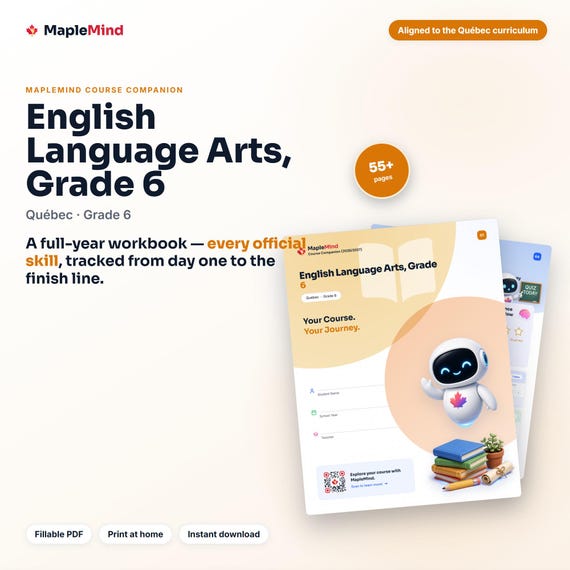
A English Language Arts, Grade 6 workbook worth keeping
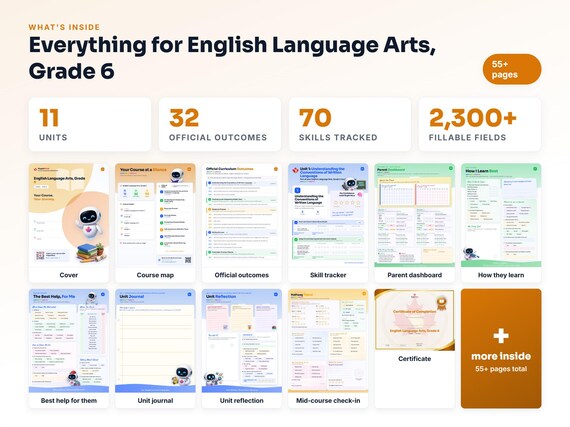
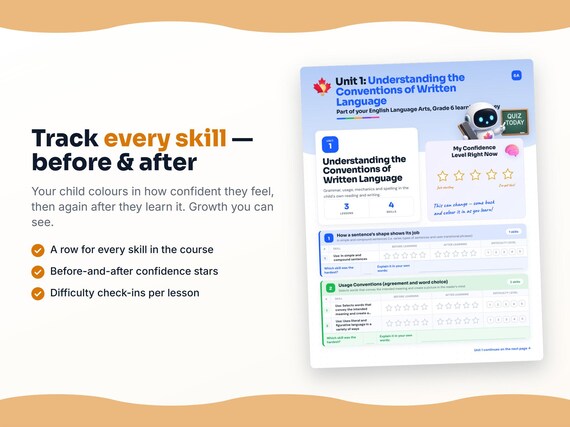
Built from the same official curriculum as this page. Before and after each skill above, your student colours in how sure they feel — so the two of you can see, on one page, what's clicking and what needs another look. It's a quiet way to follow how the year is really going.
By June it's full of their own handwriting: units worked through, confidence grown, a mid-year check-in, notes from parent-teacher night, and a certificate at the end. Less a worksheet, more a record of the year worth keeping on the shelf.
Instant download · see every page, reviews and the full description · five or more workbooks are $2.99 each
What it looks like in the app



Common questions
Can MapleMind help my child with English Language Arts, Grade 6?
Yes. MapleMind's AI tutor covers all 70 skills in Quebec's English Language Arts, Grade 6 — your child picks the exact skill, and the tutor teaches it step by step: a short lesson, a worked example, solving together, then a skill check to show it stuck.
Is MapleMind aligned to Quebec's official curriculum?
Yes. Every skill in this course maps to an official outcome code from Quebec's Grade 6 English Language Arts curriculum, and the ministry's own wording is quoted under each unit on this page — with the official government source linked so you can check it yourself.
What does MapleMind cost?
It's free to start — 5 tutoring chats and a practice quiz every day, no credit card. A Pro subscription ($9.99/month or $49.99/year CAD, 7-day free trial) unlocks unlimited tutoring, practice, and exam simulations.
What if my child is stuck on just one topic?
That's the point of skill-level tutoring: open English Language Arts, Grade 6 in the app, tap the exact skill from the list on this page, and the tutor teaches just that — no wading through lessons your child doesn't need.
Does MapleMind work in French or other languages?
Yes — 14 languages, including French. Both the app and the tutor's explanations switch to the language your child chooses.
Where can I see the official Quebec curriculum for English Language Arts, Grade 6?
The official source is linked on this page — Québec's official English language arts program. The outline here follows it: every MapleMind skill carries its official outcome code, and the ministry's own wording is quoted under each unit.
Keep exploring
Ready when you are
Pick a skill from this page and see it taught properly — free, in the browser, in under a minute.