Get help with English Language Arts, Grade 5
Most tutoring makes your child sit through material your child already knows. MapleMind flips that: pick the exact skill that's causing trouble — any of the 28 below — and the tutor teaches just that one, step by step, as many times as it takes. Ask questions in plain words, any time of day, in English, French, or 12 other languages.
The official Quebec English Language Arts, Grade 5 curriculum
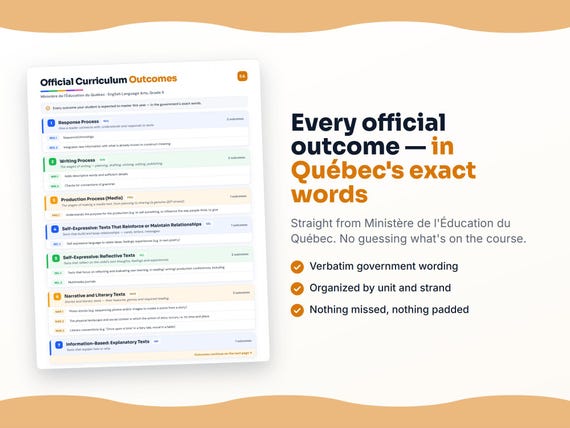
Quebec defines English Language Arts, Grade 5 by strands and outcomes. MapleMind teaches the same curriculum reorganized for one-skill-at-a-time tutoring — the table shows exactly where every official strand lands, and the ministry's own wording is quoted under each unit below.
Official source Québec's official English language arts programRead it on the government site — quebec.ca ↗| Official strand | Outcomes | Where MapleMind teaches it |
|---|---|---|
| Strand A | 12 | Response Process · Self-Expressive: Texts That Reinforce or Maintain Relationships · Narrative and Literary Texts |
| Strand B | 6 | Writing Process · Self-Expressive: Reflective Texts · Information-Based: Explanatory Texts |
| Strand C | 8 | Production Process (Media) |
| Strand D | 2 | Information-Based: Persuasive Texts |
Every skill below, taught one on one.
 Try the first session free
How MapleMind teaches English Language Arts, Grade 5 — every unit, lesson, and skill
Every skill below runs as a short session: a plain-words lesson, a worked example, solving it together, then a five-question skill check that earns up to three stars. Guided Mode keeps it teaching instead of answer-handing — turning it off needs a parent's password.
Unit 1Response ProcessOfficial strand · Strand A
How a reader connects with, understands and responds to texts.
How sequence texts order events
- Use: Sequence/chronologyc046-A.16 — Mastery of “Sequence/chronology” (Response Process) at Grade 5 ELA.
- Use: Compare/contrastc047-A.17 — Mastery of “Compare/contrast” (Response Process) at Grade 5 ELA.
- Use: Problem-solutionc048-A.18 — Mastery of “Problem-solution” (Response Process) at Grade 5 ELA.
- Use: Uses the purpose for reading and clues in the text to…c050-A.20 — Mastery of “Uses the purpose for reading and clues in the text to determine important…” (Response Process) at Grade 5 ELA.
After Reading/Viewing: Interpreting the Text
- Use: Integrates new information with what is already known to…c054-A.24 — Mastery of “Integrates new information with what is already known to construct meaning” (Response Process) at Grade 5 ELA.
The official wording — 5 outcomes in this unit
- c046-A.16
Sequence/chronology
- c047-A.17
Compare/contrast
- c048-A.18
Problem-solution
- c050-A.20
Uses the purpose for reading and clues in the text to determine important aspects of a text (e.g. nonfiction features
- c054-A.24
Integrates new information with what is already known to construct meaning
Unit 2Writing ProcessOfficial strand · Strand B
The stages of writing — planning, drafting, revising, editing, publishing.
Revision
- Use: Adds descriptive words and sufficient detailsc077-B.14 — Mastery of “Adds descriptive words and sufficient details” (Writing Process) at Grade 5 ELA.
- Use: Sequences information, eventsc078-B.15 — Mastery of “Sequences information, events” (Writing Process) at Grade 5 ELA.
Editing
- Use: Checks for conventions of grammarc082-B.19 — Mastery of “Checks for conventions of grammar” (Writing Process) at Grade 5 ELA.
The official wording — 3 outcomes in this unit
- c077-B.14
Adds descriptive words and sufficient details
- c078-B.15
Sequences information, events
- c082-B.19
Checks for conventions of grammar
Unit 3Production Process (Media)Official strand · Strand C
The stages of making a media text, from planning to sharing (a genuine QEP strand).
Why media texts are made
- Use: Understands the purpose for the productionc088-C.3 — Mastery of “Understands the purpose for the production (e.g. to sell something, to…” (Production Process (Media)) at Grade 5 ELA.
- Use: Selects text type depending on purpose, audience and contextc089-C.4 — Mastery of “Selects text type depending on purpose, audience and context” (Production Process (Media)) at Grade 5 ELA.
- Use: Examines models of text type to be produced through…c090-C.5 — Mastery of “Examines models of text type to be produced through immersion into the type…” (Production Process (Media)) at Grade 5 ELA.
- Use: Drafts storyboardc091-C.6 — Mastery of “Drafts storyboard (i.e. a plan or representation of the project)” (Production Process (Media)) at Grade 5 ELA.
- Use: Identifies and gathers material, resources, expertise for…c092-C.7 — Mastery of “Identifies and gathers material, resources, expertise for the production” (Production Process (Media)) at Grade 5 ELA.
- Use: Uses prior knowledge of media text type from experiences…c094-C.10 — Mastery of “Uses prior knowledge of media text type from experiences with similar texts,…” (Production Process (Media)) at Grade 5 ELA.
- Use: Uses images and/or print and/or sound to produce a familiar…c095-C.11 — Mastery of “Uses images and/or print and/or sound to produce a familiar media text” (Production Process (Media)) at Grade 5 ELA.
- Use: Uses storyboard and/or other planning resources to guide…c096-C.12 — Mastery of “Uses storyboard and/or other planning resources to guide production of the text” (Production Process (Media)) at Grade 5 ELA.
The official wording — 8 outcomes in this unit
- c088-C.3
Understands the purpose for the production (e.g. to sell something, to influence the way people think, to give
- c089-C.4
Selects text type depending on purpose, audience and context
- c090-C.5
Examines models of text type to be produced through immersion into the type (e.g. unique features of a text, target
- c091-C.6
Drafts storyboard (i.e. a plan or representation of the project)
- c092-C.7
Identifies and gathers material, resources, expertise for the production
- c094-C.10
Uses prior knowledge of media text type from experiences with similar texts, immersion into text
- c095-C.11
Uses images and/or print and/or sound to produce a familiar media text
- c096-C.12
Uses storyboard and/or other planning resources to guide production of the text
Unit 4Self-Expressive: Texts That Reinforce or Maintain RelationshipsOfficial strand · Strand A
Texts that build and keep relationships — cards, letters, messages.
Reading, Writing and Media Production
- Use: Self expressive language to relate ideas, feelings,…c119-A.18 — Mastery of “Self expressive language to relate ideas, feelings, experiences (e.g. in own…” (Self-Expressive: Texts That Reinforce or Maintain Relationships) at Grade 5 ELA.
- Use: Self-expressive language in poetry: line breaks or stanzas,…c120-A.19 — Mastery of “Self-expressive language in poetry: line breaks or stanzas, images, figurative…” (Self-Expressive: Texts That Reinforce or Maintain Relationships) at Grade 5 ELA.
The official wording — 2 outcomes in this unit
- c119-A.18
Self expressive language to relate ideas, feelings, experiences (e.g. in own poetry)
- c120-A.19
Self-expressive language in poetry: line breaks or stanzas, images, figurative language to create vivid pictures
Unit 5Self-Expressive: Reflective TextsOfficial strand · Strand B
Texts that reflect on the child's own thoughts, feelings and experiences.
Self-Expressive: Reflective Texts
- Use: Texts that focus on reflecting and evaluating own learning,…c121-B.3 — Mastery of “Texts that focus on reflecting and evaluating own learning, in reading/…” (Self-Expressive: Reflective Texts) at Grade 5 ELA.
Writing and Media Production
- Use: Multimedia journalsc124-B.6 — Mastery of “Multimedia journals” (Self-Expressive: Reflective Texts) at Grade 5 ELA.
The official wording — 2 outcomes in this unit
- c121-B.3
Texts that focus on reflecting and evaluating own learning, in reading/ writing/ production conferences, including
- c124-B.6
Multimedia journals
Unit 6Narrative and Literary TextsOfficial strand · Strand A
Stories and literary texts — their features, genres and required reading.
Telling a story with a photo sequence
- Use: Photo storiesc152-A.28 — Mastery of “Photo stories (e.g. sequencing photos and/or images to create a scene from a…” (Narrative and Literary Texts) at Grade 5 ELA.
Characterization
- Use: Descriptive details that construct the world of the storyc171-A.49 — Mastery of “Descriptive details that construct the world of the story (e.g. the forest in” (Narrative and Literary Texts) at Grade 5 ELA.
Other features of narrative
- Use: Literary conventionsc174-A.52 — Mastery of “Literary conventions (e.g. "Once upon a time" in a fairy tale, moral in a fable)” (Narrative and Literary Texts) at Grade 5 ELA.
- Use: Humor, suspense, repetitionc175-A.53 — Mastery of “Humor, suspense, repetition” (Narrative and Literary Texts) at Grade 5 ELA.
The official wording — 5 outcomes in this unit
- c152-A.28
Photo stories (e.g. sequencing photos and/or images to create a scene from a story)
- c170-A.48
The physical landscape and social context in which the action of story occurs, i.e. its time and place
- c171-A.49
Descriptive details that construct the world of the story (e.g. the forest in
- c174-A.52
Literary conventions (e.g. "Once upon a time" in a fairy tale, moral in a fable)
- c175-A.53
Humor, suspense, repetition
Unit 7Information-Based: Explanatory TextsOfficial strand · Strand B
Texts that explain how or why.
Information-Based: Explanatory Texts
- Use: Explanation of reasons for a decisionc212-B.5 — Mastery of “Explanation of reasons for a decision” (Information-Based: Explanatory Texts) at Grade 5 ELA.
The official wording — 1 outcome in this unit
- c212-B.5
Explanation of reasons for a decision
Unit 8Information-Based: Persuasive TextsOfficial strand · Strand D
Texts that try to persuade a reader.
Speaking to persuade
- Use: Texts that seek to persuade peers to change their habits…c250-D.4 — Mastery of “Texts that seek to persuade peers to change their habits and/or actions and/or…” (Information-Based: Persuasive Texts) at Grade 5 ELA.
How music and sound persuade
- Notice: Music/sound to promote a product and/or appeal to the…c268-D.26 — Guided introduction of “Music/sound to promote a product and/or appeal to the viewer to take action…” (Information-Based: Persuasive Texts) at Grade 5 ELA.
The official wording — 2 outcomes in this unit
- c250-D.4
Texts that seek to persuade peers to change their habits and/or actions and/or behaviours (e.g. appeals concerning the
- c268-D.26
Music/sound to promote a product and/or appeal to the viewer to take action (e.g. in a TV commercial) (Viewing only)
Printable workbook · A keepsake of the year
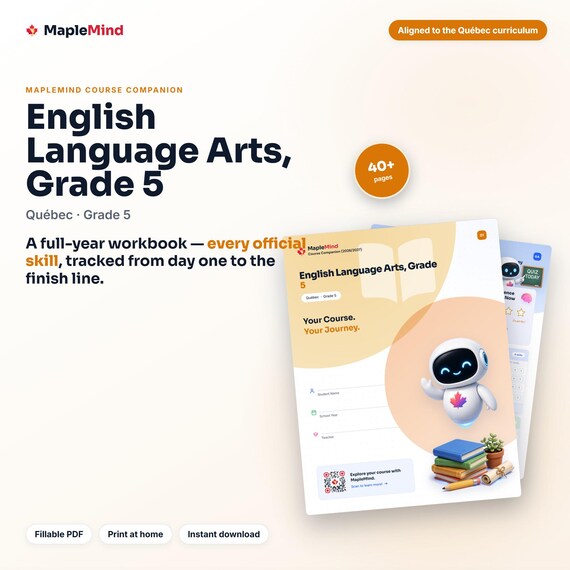
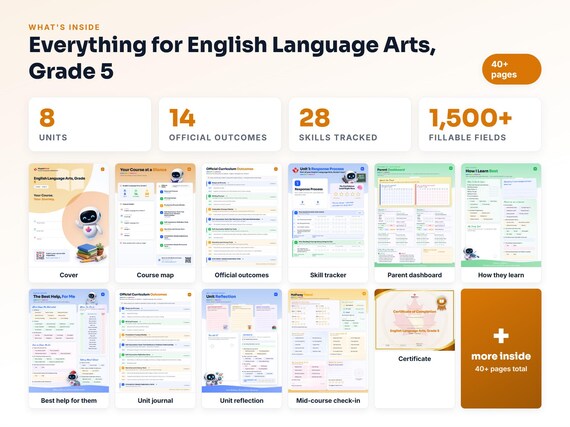
A English Language Arts, Grade 5 workbook worth keeping
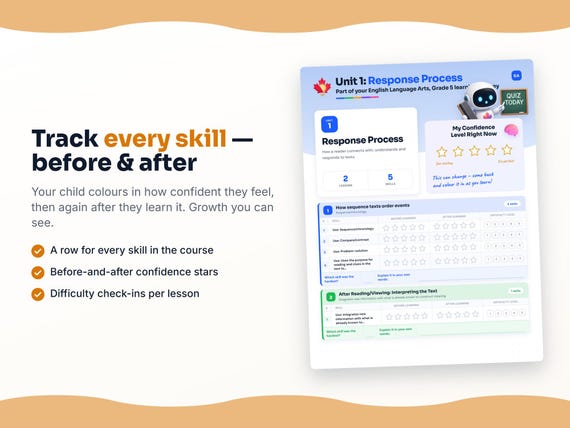
Built from the same official curriculum as this page. Before and after each skill above, your student colours in how sure they feel — so the two of you can see, on one page, what's clicking and what needs another look. It's a quiet way to follow how the year is really going.
By June it's full of their own handwriting: units worked through, confidence grown, a mid-year check-in, notes from parent-teacher night, and a certificate at the end. Less a worksheet, more a record of the year worth keeping on the shelf.
Instant download · see every page, reviews and the full description · five or more workbooks are $2.99 each
What it looks like in the app



Common questions
Can MapleMind help my child with English Language Arts, Grade 5?
Yes. MapleMind's AI tutor covers all 28 skills in Quebec's English Language Arts, Grade 5 — your child picks the exact skill, and the tutor teaches it step by step: a short lesson, a worked example, solving together, then a skill check to show it stuck.
Is MapleMind aligned to Quebec's official curriculum?
Yes. Every skill in this course maps to an official outcome code from Quebec's Grade 5 English Language Arts curriculum, and the ministry's own wording is quoted under each unit on this page — with the official government source linked so you can check it yourself.
What does MapleMind cost?
It's free to start — 5 tutoring chats and a practice quiz every day, no credit card. A Pro subscription ($9.99/month or $49.99/year CAD, 7-day free trial) unlocks unlimited tutoring, practice, and exam simulations.
What if my child is stuck on just one topic?
That's the point of skill-level tutoring: open English Language Arts, Grade 5 in the app, tap the exact skill from the list on this page, and the tutor teaches just that — no wading through lessons your child doesn't need.
Does MapleMind work in French or other languages?
Yes — 14 languages, including French. Both the app and the tutor's explanations switch to the language your child chooses.
Where can I see the official Quebec curriculum for English Language Arts, Grade 5?
The official source is linked on this page — Québec's official English language arts program. The outline here follows it: every MapleMind skill carries its official outcome code, and the ministry's own wording is quoted under each unit.
Keep exploring
Ready when you are
Pick a skill from this page and see it taught properly — free, in the browser, in under a minute.