Get help with English Language Arts, Grade 4
Most tutoring makes your child sit through material your child already knows. MapleMind flips that: pick the exact skill that's causing trouble — any of the 62 below — and the tutor teaches just that one, step by step, as many times as it takes. Ask questions in plain words, any time of day, in English, French, or 12 other languages.
The official Quebec English Language Arts, Grade 4 curriculum
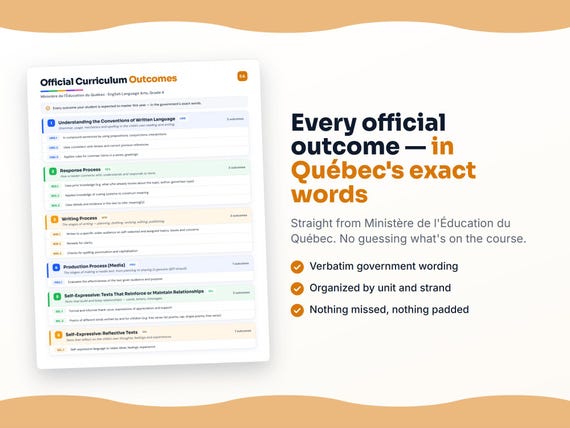
Quebec defines English Language Arts, Grade 4 by strands and outcomes. MapleMind teaches the same curriculum reorganized for one-skill-at-a-time tutoring — the table shows exactly where every official strand lands, and the ministry's own wording is quoted under each unit below.
Official source Québec's official English language arts programRead it on the government site — quebec.ca ↗| Official strand | Outcomes | Where MapleMind teaches it |
|---|---|---|
| Strand A | 31 | Understanding the Conventions of Written Language · Response Process · Self-Expressive: Texts That Reinforce or Maintain Relationships · Narrative and Literary Texts · Information-Based: Planning Texts |
| Strand B | 15 | Writing Process · Self-Expressive: Reflective Texts · Information-Based: Explanatory Texts |
| Strand C | 8 | Production Process (Media) · Information-Based: Descriptive Reports |
| Strand D | 8 | Information-Based: Persuasive Texts |
Every skill below, taught one on one.
 Try the first session free
How MapleMind teaches English Language Arts, Grade 4 — every unit, lesson, and skill
Every skill below runs as a short session: a plain-words lesson, a worked example, solving it together, then a five-question skill check that earns up to three stars. Guided Mode keeps it teaching instead of answer-handing — turning it off needs a parent's password.
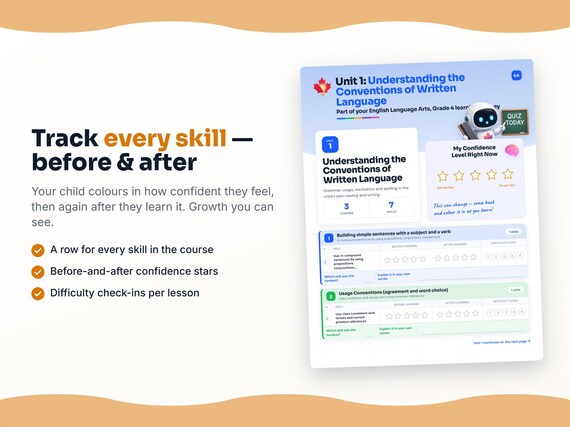
Unit 1Understanding the Conventions of Written LanguageOfficial strand · Strand A
Grammar, usage, mechanics and spelling in the child's own reading and writing.
Building simple sentences with a subject and a verb
- Use: In compound sentences by using prepositions, conjunctions,…c006-A.7 — Mastery of “In compound sentences by using prepositions, conjunctions, interjections” (Understanding the Conventions of Written Language) at Grade 4 ELA.
Usage Conventions (agreement and word choice)
- Use: Uses consistent verb tenses and correct pronoun referencesc010-A.11 — Mastery of “Uses consistent verb tenses and correct pronoun references” (Understanding the Conventions of Written Language) at Grade 4 ELA.
Mechanics (spelling, capitalization and punctuation)
- Use: Applies rules for commas: items in a series, greetingsc016-A.19 — Mastery of “Applies rules for commas: items in a series, greetings” (Understanding the Conventions of Written Language) at Grade 4 ELA.
- Use: Uses apostrophes to punctuate contractions and singular…c017-A.20 — Mastery of “Uses apostrophes to punctuate contractions and singular possessive” (Understanding the Conventions of Written Language) at Grade 4 ELA.
- Use: Indicates words that are misspelledc021-A.25 — Mastery of “Indicates words that are misspelled” (Understanding the Conventions of Written Language) at Grade 4 ELA.
- Use: Applies common spelling patterns/generalizations including:…c022-A.26 — Mastery of “Applies common spelling patterns/generalizations including: word families,…” (Understanding the Conventions of Written Language) at Grade 4 ELA.
- Use: Uses resources to correct own spellingc023-A.27 — Mastery of “Uses resources to correct own spelling (e.g. environmental print, word lists,…” (Understanding the Conventions of Written Language) at Grade 4 ELA.
The official wording — 7 outcomes in this unit
- c006-A.7
In compound sentences by using prepositions, conjunctions, interjections
- c010-A.11
Uses consistent verb tenses and correct pronoun references
- c016-A.19
Applies rules for commas: items in a series, greetings
- c017-A.20
Uses apostrophes to punctuate contractions and singular possessive
- c021-A.25
Indicates words that are misspelled
- c022-A.26
Applies common spelling patterns/generalizations including: word families, regular plurals, prefixes, suffixes,
- c023-A.27
Uses resources to correct own spelling (e.g. environmental print, word lists, dictionaries, peers, spell check)
Unit 2Response ProcessOfficial strand · Strand A
How a reader connects with, understands and responds to texts.
Prereading/Viewing
- Use: Uses prior knowledgec034-A.4 — Mastery of “Uses prior knowledge (e.g. what s/he already knows about the topic, author,…” (Response Process) at Grade 4 ELA.
- Use: Previews the textc035-A.5 — Mastery of “Previews the text (e.g. attends to the cover, dedication, title page and…” (Response Process) at Grade 4 ELA.
During Reading/ Viewing
- Use: Applies knowledge of cueing systems to construct meaningc040-A.10 — Mastery of “Applies knowledge of cueing systems to construct meaning” (Response Process) at Grade 4 ELA.
- Use: Uses a variety of reading strategies to make meaning of…c041-A.11 — Mastery of “Uses a variety of reading strategies to make meaning of different text types” (Response Process) at Grade 4 ELA.
- Use: Relies on common structures and features of literary,…c042-A.12 — Mastery of “Relies on common structures and features of literary, popular and…” (Response Process) at Grade 4 ELA.
After Reading/Viewing: Interpreting the Text
- Use: Uses details and evidence in the text to infer meaning(s)c053-A.23 — Mastery of “Uses details and evidence in the text to infer meaning(s)” (Response Process) at Grade 4 ELA.
The official wording — 6 outcomes in this unit
- c034-A.4
Uses prior knowledge (e.g. what s/he already knows about the topic, author, genre/text type)
- c035-A.5
Previews the text (e.g. attends to the cover, dedication, title page and author’s notes for clues that will add to
- c040-A.10
Applies knowledge of cueing systems to construct meaning
- c041-A.11
Uses a variety of reading strategies to make meaning of different text types
- c042-A.12
Relies on common structures and features of literary, popular and information-based texts to construct meaning (e.g.
- c053-A.23
Uses details and evidence in the text to infer meaning(s)
Unit 3Writing ProcessOfficial strand · Strand B
The stages of writing — planning, drafting, revising, editing, publishing.
Drafting
- Use: Writes to a specific wider audience on self-selected and…c071-B.8 — Mastery of “Writes to a specific wider audience on self-selected and assigned topics,…” (Writing Process) at Grade 4 ELA.
- Use: Uses a structure that fits the type of writingc072-B.9 — Mastery of “Uses a structure that fits the type of writing (e.g. letter format, narrative)” (Writing Process) at Grade 4 ELA.
Revision
- Use: Rereads for clarityc076-B.13 — Mastery of “Rereads for clarity” (Writing Process) at Grade 4 ELA.
Editing
- Use: Checks for spelling, punctuation and capitalizationc081-B.18 — Mastery of “Checks for spelling, punctuation and capitalization” (Writing Process) at Grade 4 ELA.
- Use: Selects layout and highlights relevant structures and…c085-B.23 — Mastery of “Selects layout and highlights relevant structures and features to enhance the…” (Writing Process) at Grade 4 ELA.
- Use: Feedback: seeks and provides throughout all stages of the…c086-B.24 — Mastery of “Feedback: seeks and provides throughout all stages of the writing process” (Writing Process) at Grade 4 ELA.
The official wording — 6 outcomes in this unit
- c071-B.8
Writes to a specific wider audience on self-selected and assigned topics, issues and concerns
- c072-B.9
Uses a structure that fits the type of writing (e.g. letter format, narrative)
- c076-B.13
Rereads for clarity
- c081-B.18
Checks for spelling, punctuation and capitalization
- c085-B.23
Selects layout and highlights relevant structures and features to enhance the presentation
- c086-B.24
Feedback: seeks and provides throughout all stages of the writing process
Unit 4Production Process (Media)Official strand · Strand C
The stages of making a media text, from planning to sharing (a genuine QEP strand).
Judging whether a media text works
- Use: Evaluates the effectiveness of the text given audience and…c102-C.19 — Mastery of “Evaluates the effectiveness of the text given audience and purpose” (Production Process (Media)) at Grade 4 ELA.
The official wording — 1 outcome in this unit
- c102-C.19
Evaluates the effectiveness of the text given audience and purpose
Unit 5Self-Expressive: Texts That Reinforce or Maintain RelationshipsOfficial strand · Strand A
Texts that build and keep relationships — cards, letters, messages.
Required Text Types
- Use: Formal and informal thank-yous, expressions of appreciation…c104-A.3 — Mastery of “Formal and informal thank-yous, expressions of appreciation and support” (Self-Expressive: Texts That Reinforce or Maintain Relationships) at Grade 4 ELA.
- Use: Formal and informal introductionc105-A.4 — Mastery of “Formal and informal introduction (e.g. of a guest speaker)” (Self-Expressive: Texts That Reinforce or Maintain Relationships) at Grade 4 ELA.
Exploring kinds of poems
- Use: Poetry of different kinds written by and for childrenc111-A.10 — Mastery of “Poetry of different kinds written by and for children (e.g. free verse, list…” (Self-Expressive: Texts That Reinforce or Maintain Relationships) at Grade 4 ELA.
The official wording — 3 outcomes in this unit
- c104-A.3
Formal and informal thank-yous, expressions of appreciation and support
- c105-A.4
Formal and informal introduction (e.g. of a guest speaker)
- c111-A.10
Poetry of different kinds written by and for children (e.g. free verse, list poems, rap, shape poems, free verse)
Unit 6Self-Expressive: Reflective TextsOfficial strand · Strand B
Texts that reflect on the child's own thoughts, feelings and experiences.
Writing in your own voice
- Use: Self-expressive language to relate ideas, feelings,…c126-B.10 — Mastery of “Self-expressive language to relate ideas, feelings, experience” (Self-Expressive: Reflective Texts) at Grade 4 ELA.
- Use: Word choice to indicate a specific time framec127-B.11 — Mastery of “Word choice to indicate a specific time frame (e.g. past tense to indicate a…” (Self-Expressive: Reflective Texts) at Grade 4 ELA.
The official wording — 2 outcomes in this unit
- c126-B.10
Self-expressive language to relate ideas, feelings, experience
- c127-B.11
Word choice to indicate a specific time frame (e.g. past tense to indicate a memory)
Unit 7Narrative and Literary TextsOfficial strand · Strand A
Stories and literary texts — their features, genres and required reading.
Telling a story out loud
- Use: Storytellingc131-A.5 — Mastery of “Storytelling” (Narrative and Literary Texts) at Grade 4 ELA.
Reading comic strips
- Use: Comic stripsc142-A.17 — Mastery of “Comic strips” (Narrative and Literary Texts) at Grade 4 ELA.
- Use: Stories in children’s magazines, illustrated picture books,…c143-A.18 — Mastery of “Stories in children’s magazines, illustrated picture books, online talking…” (Narrative and Literary Texts) at Grade 4 ELA.
Telling stories in comic-strip panels
- Use: Illustrated narrative in comic strip using own drawings,…c150-A.26 — Mastery of “Illustrated narrative in comic strip using own drawings, images or photos” (Narrative and Literary Texts) at Grade 4 ELA.
- Use: Illustrated picture books using drawings and/or images…c151-A.27 — Mastery of “Illustrated picture books using drawings and/or images and/or photos” (Narrative and Literary Texts) at Grade 4 ELA.
Plot structures and features
- Use: Incidentsc158-A.35 — Mastery of “Incidents (e.g. actions that take place in the story usually related to the…” (Narrative and Literary Texts) at Grade 4 ELA.
Characterization
- Use: Main character in a storyc167-A.44 — Mastery of “Main character in a story” (Narrative and Literary Texts) at Grade 4 ELA.
Plot structure and features
- Use: Use of images (photos or drawings) to extend the story and…c181-A.60 — Mastery of “Use of images (photos or drawings) to extend the story and to provide story…” (Narrative and Literary Texts) at Grade 4 ELA.
- Use: Surface appearance of a characterc185-A.65 — Mastery of “Surface appearance of a character (e.g. clothing, physical attributes)” (Narrative and Literary Texts) at Grade 4 ELA.
- Use: Use of details to convey an imaginary characterc186-A.66 — Mastery of “Use of details to convey an imaginary character (e.g. wings, exaggerated or…” (Narrative and Literary Texts) at Grade 4 ELA.
- Use: Use of explanation marks and speech bubbles to show thought…c187-A.67 — Mastery of “Use of explanation marks and speech bubbles to show thought and dialogue, e.g.…” (Narrative and Literary Texts) at Grade 4 ELA.
The official wording — 11 outcomes in this unit
- c131-A.5
Storytelling
- c142-A.17
Comic strips
- c143-A.18
Stories in children’s magazines, illustrated picture books, online talking books (i.e. that combine spoken word and
- c150-A.26
Illustrated narrative in comic strip using own drawings, images or photos
- c151-A.27
Illustrated picture books using drawings and/or images and/or photos
- c158-A.35
Incidents (e.g. actions that take place in the story usually related to the main conflict)
- c167-A.44
Main character in a story
- c181-A.60
Use of images (photos or drawings) to extend the story and to provide story details
- c185-A.65
Surface appearance of a character (e.g. clothing, physical attributes)
- c186-A.66
Use of details to convey an imaginary character (e.g. wings, exaggerated or invented facial features)
- c187-A.67
Use of explanation marks and speech bubbles to show thought and dialogue, e.g. in comic books or some animation films
Unit 8Information-Based: Planning TextsOfficial strand · Strand A
Texts that organise and plan information.
Speaking and Listening
- Use: Understands the use of talk to clarify the steps in a…c198-A.4 — Mastery of “Understands the use of talk to clarify the steps in a procedure or an…” (Information-Based: Planning Texts) at Grade 4 ELA.
Capturing ideas in logs and lists
- Use: Learning/thinking logs and lists that record thoughts,…c200-A.7 — Mastery of “Learning/thinking logs and lists that record thoughts, ideas and information” (Information-Based: Planning Texts) at Grade 4 ELA.
Written and Media Texts
- Use: Events/information in sequencec205-A.13 — Mastery of “Events/information in sequence (e.g. timelines, graphs)” (Information-Based: Planning Texts) at Grade 4 ELA.
- Use: Chronology or ordering of actions to undertakec206-A.14 — Mastery of “Chronology or ordering of actions to undertake, (e.g. in notes or lists)” (Information-Based: Planning Texts) at Grade 4 ELA.
The official wording — 4 outcomes in this unit
- c198-A.4
Understands the use of talk to clarify the steps in a procedure or an organizational plan (e.g. brainstorming, pulling
- c200-A.7
Learning/thinking logs and lists that record thoughts, ideas and information
- c205-A.13
Events/information in sequence (e.g. timelines, graphs)
- c206-A.14
Chronology or ordering of actions to undertake, (e.g. in notes or lists)
Unit 9Information-Based: Explanatory TextsOfficial strand · Strand B
Texts that explain how or why.
Information-Based: Explanatory Texts
- Use: Explanation of a procedure or how something worksc211-B.4 — Mastery of “Explanation of a procedure or how something works” (Information-Based: Explanatory Texts) at Grade 4 ELA.
Writing a how-to text
- Use: Illustrated and multimedia how-to booksc215-B.8 — Mastery of “Illustrated and multimedia how-to books” (Information-Based: Explanatory Texts) at Grade 4 ELA.
- Use: Texts that explain how or why something happens using a…c216-B.9 — Mastery of “Texts that explain how or why something happens using a narrative structure…” (Information-Based: Explanatory Texts) at Grade 4 ELA.
- Use: Posters that explainc217-B.10 — Mastery of “Posters that explain” (Information-Based: Explanatory Texts) at Grade 4 ELA.
Spoken, Written and Media texts
- Use: Headings, captions or labels to focus readers’ attention on…c222-B.16 — Mastery of “Headings, captions or labels to focus readers’ attention on what is most…” (Information-Based: Explanatory Texts) at Grade 4 ELA.
- Use: Sequential/chronological organization of information to…c223-B.17 — Mastery of “Sequential/chronological organization of information to explain how and/or why…” (Information-Based: Explanatory Texts) at Grade 4 ELA.
- Use: Images (photo or drawing) and text features that provide…c224-B.18 — Mastery of “Images (photo or drawing) and text features that provide additional information…” (Information-Based: Explanatory Texts) at Grade 4 ELA.
The official wording — 7 outcomes in this unit
- c211-B.4
Explanation of a procedure or how something works
- c215-B.8
Illustrated and multimedia how-to books
- c216-B.9
Texts that explain how or why something happens using a narrative structure (e.g. picture books such as The Magic
- c217-B.10
Posters that explain
- c222-B.16
Headings, captions or labels to focus readers’ attention on what is most important
- c223-B.17
Sequential/chronological organization of information to explain how and/or why something is done in the way it is
- c224-B.18
Images (photo or drawing) and text features that provide additional information or contribute to the organization of
Unit 10Information-Based: Descriptive ReportsOfficial strand · Strand C
Texts that describe and report on a topic.
Sharing a spoken report
- Use: spoken reports that describe the way things are or werec229-C.5 — Mastery of “spoken reports that describe the way things are or were (e.g. an observed event…” (Information-Based: Descriptive Reports) at Grade 4 ELA.
Reading articles that report
- Use: Articles in children’s magazines that reportc232-C.8 — Mastery of “Articles in children’s magazines that report (e.g. on a topic, event)” (Information-Based: Descriptive Reports) at Grade 4 ELA.
- Use: Letters that describe or reportc233-C.9 — Mastery of “Letters that describe or report (e.g. a character’s letter that describes an…” (Information-Based: Descriptive Reports) at Grade 4 ELA.
- Use: Local and national newspaper articles that are appropriate…c234-C.10 — Mastery of “Local and national newspaper articles that are appropriate and accessible to…” (Information-Based: Descriptive Reports) at Grade 4 ELA.
- Use: Reports about their classroom or local communityc239-C.16 — Mastery of “Reports about their classroom or local community (e.g. in a class or school…” (Information-Based: Descriptive Reports) at Grade 4 ELA.
Opening a report with a topic statement
- Use: General statement about the topic in opening paragraphc242-C.21 — Mastery of “General statement about the topic in opening paragraph (e.g. Dogs are mammals)” (Information-Based: Descriptive Reports) at Grade 4 ELA.
- Use: Logical sequencing of details, facts, opinions based on…c243-C.22 — Mastery of “Logical sequencing of details, facts, opinions based on events and/or…” (Information-Based: Descriptive Reports) at Grade 4 ELA.
The official wording — 7 outcomes in this unit
- c229-C.5
spoken reports that describe the way things are or were (e.g. an observed event such as a solar eclipse, the stages of
- c232-C.8
Articles in children’s magazines that report (e.g. on a topic, event)
- c233-C.9
Letters that describe or report (e.g. a character’s letter that describes an experience or event)
- c234-C.10
Local and national newspaper articles that are appropriate and accessible to children
- c239-C.16
Reports about their classroom or local community (e.g. in a class or school newspaper, on a class Web site or in a
- c242-C.21
General statement about the topic in opening paragraph (e.g. Dogs are mammals)
- c243-C.22
Logical sequencing of details, facts, opinions based on events and/or information
Unit 11Information-Based: Persuasive TextsOfficial strand · Strand D
Texts that try to persuade a reader.
Reading posters and flyers
- Use: Promotional posters or flyersc254-D.9 — Mastery of “Promotional posters or flyers” (Information-Based: Persuasive Texts) at Grade 4 ELA.
- Use: TV commercials aimed at childrenc255-D.10 — Mastery of “TV commercials aimed at children” (Information-Based: Persuasive Texts) at Grade 4 ELA.
- Use: Magazine and newspaper advertisementsc256-D.11 — Mastery of “Magazine and newspaper advertisements (i.e. in children’s magazines)” (Information-Based: Persuasive Texts) at Grade 4 ELA.
- Use: TV and/or movie reviews aimed at childrenc257-D.12 — Mastery of “TV and/or movie reviews aimed at children (e.g. a movie trailer for a popular…” (Information-Based: Persuasive Texts) at Grade 4 ELA.
- Notice: Public Service Ads and posters created for childrenc258-D.13 — Guided introduction of “Public Service Ads and posters created for children” (Information-Based: Persuasive Texts) at Grade 4 ELA.
Making posters and flyers
- Use: Promotional posters or flyersc261-D.17 — Mastery of “Promotional posters or flyers (e.g. for a special event at school or to…” (Information-Based: Persuasive Texts) at Grade 4 ELA.
- Use: Packagingc262-D.18 — Mastery of “Packaging (e.g. for a new toy, cereal box, video game)” (Information-Based: Persuasive Texts) at Grade 4 ELA.
- Use: Adsc263-D.19 — Mastery of “Ads (e.g. for a children’s magazine, for a commercial)” (Information-Based: Persuasive Texts) at Grade 4 ELA.
The official wording — 8 outcomes in this unit
- c254-D.9
Promotional posters or flyers
- c255-D.10
TV commercials aimed at children
- c256-D.11
Magazine and newspaper advertisements (i.e. in children’s magazines)
- c257-D.12
TV and/or movie reviews aimed at children (e.g. a movie trailer for a popular film or a TV show)
- c258-D.13
Public Service Ads and posters created for children
- c261-D.17
Promotional posters or flyers (e.g. for a special event at school or to advertise a favorite game)
- c262-D.18
Packaging (e.g. for a new toy, cereal box, video game)
- c263-D.19
Ads (e.g. for a children’s magazine, for a commercial)
Printable workbook · A keepsake of the year
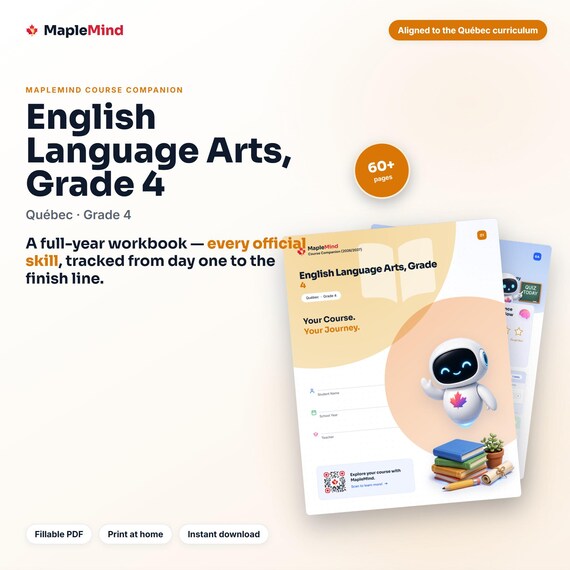
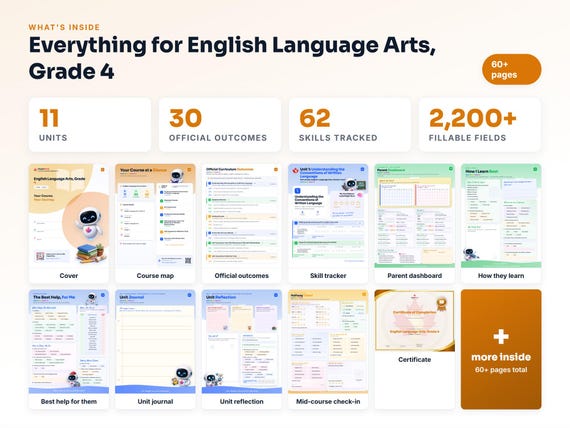
A English Language Arts, Grade 4 workbook worth keeping
Built from the same official curriculum as this page. Before and after each skill above, your student colours in how sure they feel — so the two of you can see, on one page, what's clicking and what needs another look. It's a quiet way to follow how the year is really going.
By June it's full of their own handwriting: units worked through, confidence grown, a mid-year check-in, notes from parent-teacher night, and a certificate at the end. Less a worksheet, more a record of the year worth keeping on the shelf.
Instant download · see every page, reviews and the full description · five or more workbooks are $2.99 each
What it looks like in the app



Common questions
Can MapleMind help my child with English Language Arts, Grade 4?
Yes. MapleMind's AI tutor covers all 62 skills in Quebec's English Language Arts, Grade 4 — your child picks the exact skill, and the tutor teaches it step by step: a short lesson, a worked example, solving together, then a skill check to show it stuck.
Is MapleMind aligned to Quebec's official curriculum?
Yes. Every skill in this course maps to an official outcome code from Quebec's Grade 4 English Language Arts curriculum, and the ministry's own wording is quoted under each unit on this page — with the official government source linked so you can check it yourself.
What does MapleMind cost?
It's free to start — 5 tutoring chats and a practice quiz every day, no credit card. A Pro subscription ($9.99/month or $49.99/year CAD, 7-day free trial) unlocks unlimited tutoring, practice, and exam simulations.
What if my child is stuck on just one topic?
That's the point of skill-level tutoring: open English Language Arts, Grade 4 in the app, tap the exact skill from the list on this page, and the tutor teaches just that — no wading through lessons your child doesn't need.
Does MapleMind work in French or other languages?
Yes — 14 languages, including French. Both the app and the tutor's explanations switch to the language your child chooses.
Where can I see the official Quebec curriculum for English Language Arts, Grade 4?
The official source is linked on this page — Québec's official English language arts program. The outline here follows it: every MapleMind skill carries its official outcome code, and the ministry's own wording is quoted under each unit.
Keep exploring
Ready when you are
Pick a skill from this page and see it taught properly — free, in the browser, in under a minute.