Get help with English Language Arts, Grade 3
Most tutoring makes your child sit through material your child already knows. MapleMind flips that: pick the exact skill that's causing trouble — any of the 21 below — and the tutor teaches just that one, step by step, as many times as it takes. Ask questions in plain words, any time of day, in English, French, or 12 other languages.
The official Quebec English Language Arts, Grade 3 curriculum
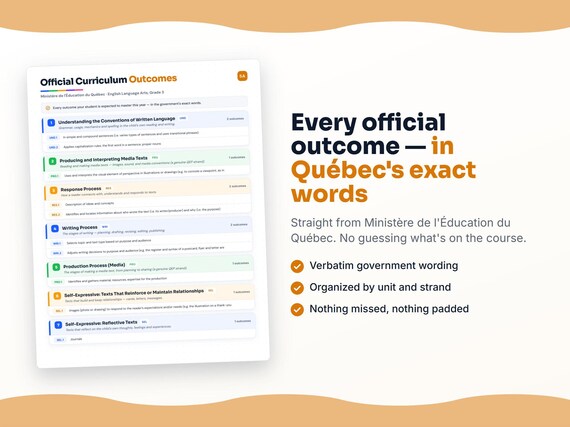
Quebec defines English Language Arts, Grade 3 by strands and outcomes. MapleMind teaches the same curriculum reorganized for one-skill-at-a-time tutoring — the table shows exactly where every official strand lands, and the ministry's own wording is quoted under each unit below.
Official source Québec's official English language arts programRead it on the government site — quebec.ca ↗| Official strand | Outcomes | Where MapleMind teaches it |
|---|---|---|
| Strand A | 9 | Understanding the Conventions of Written Language · Response Process · Self-Expressive: Texts That Reinforce or Maintain Relationships · Narrative and Literary Texts · Information-Based: Planning Texts |
| Strand B | 8 | Producing and Interpreting Media Texts · Writing Process · Self-Expressive: Reflective Texts · Information-Based: Explanatory Texts |
| Strand C | 3 | Production Process (Media) · Information-Based: Descriptive Reports |
| Strand D | 1 | Information-Based: Persuasive Texts |
Every skill below, taught one on one.
 Try the first session free
How MapleMind teaches English Language Arts, Grade 3 — every unit, lesson, and skill
Every skill below runs as a short session: a plain-words lesson, a worked example, solving it together, then a five-question skill check that earns up to three stars. Guided Mode keeps it teaching instead of answer-handing — turning it off needs a parent's password.
Unit 1Understanding the Conventions of Written LanguageOfficial strand · Strand A
Grammar, usage, mechanics and spelling in the child's own reading and writing.
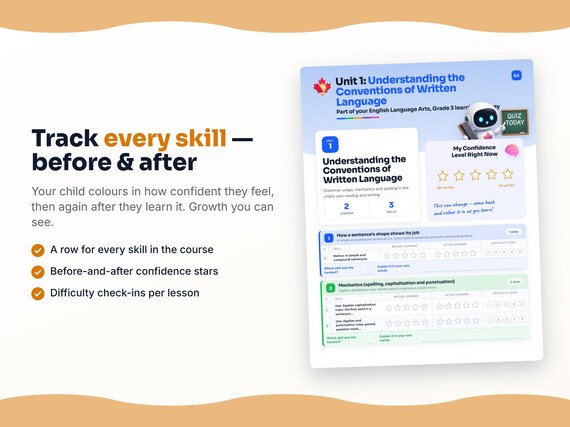
How a sentence's shape shows its job
- Notice: In simple and compound sentencesc007-A.8 — Guided introduction of “In simple and compound sentences (i.e. varies types of sentences and uses…” (Understanding the Conventions of Written Language) at Grade 3 ELA.
Mechanics (spelling, capitalization and punctuation)
- Use: Applies capitalization rules: the first word in a sentence,…c014-A.16 — Mastery of “Applies capitalization rules: the first word in a sentence, proper nouns” (Understanding the Conventions of Written Language) at Grade 3 ELA.
- Use: Applies end punctuation rules: period, question mark,…c015-A.18 — Mastery of “Applies end punctuation rules: period, question mark, exclamation point” (Understanding the Conventions of Written Language) at Grade 3 ELA.
The official wording — 3 outcomes in this unit
- c007-A.8
In simple and compound sentences (i.e. varies types of sentences and uses transitional phrases)
- c014-A.16
Applies capitalization rules: the first word in a sentence, proper nouns
- c015-A.18
Applies end punctuation rules: period, question mark, exclamation point
Unit 2Producing and Interpreting Media TextsOfficial strand · Strand B
Reading and making media texts — images, sound, and media conventions (a genuine QEP strand).
Images (in photographs, drawings and illustrations)
- Notice: Uses and interprets the visual element of perspective in…c027-B.4 — Guided introduction of “Uses and interprets the visual element of perspective in illustrations or…” (Producing and Interpreting Media Texts) at Grade 3 ELA.
The official wording — 1 outcome in this unit
- c027-B.4
Uses and interprets the visual element of perspective in illustrations or drawings (e.g. to connote a viewpoint, as in
Unit 3Response ProcessOfficial strand · Strand A
How a reader connects with, understands and responds to texts.
How texts are built to describe and explain
- Use: Description of ideas and conceptsc045-A.15 — Mastery of “Description of ideas and concepts” (Response Process) at Grade 3 ELA.
Finding the author behind a text
- Notice: Identifies and locates information about who wrote the textc060-A.30 — Guided introduction of “Identifies and locates information about who wrote the text (i.e. its…” (Response Process) at Grade 3 ELA.
The official wording — 2 outcomes in this unit
- c045-A.15
Description of ideas and concepts
- c060-A.30
Identifies and locates information about who wrote the text (i.e. its writer/producer) and why (i.e. the purpose)
Unit 4Writing ProcessOfficial strand · Strand B
The stages of writing — planning, drafting, revising, editing, publishing.
Choosing your topic and text type
- Use: Selects topic and text type based on purpose and audiencec067-B.4 — Mastery of “Selects topic and text type based on purpose and audience” (Writing Process) at Grade 3 ELA.
Drafting
- Notice: Adjusts writing decisions to purpose and audiencec073-B.10 — Guided introduction of “Adjusts writing decisions to purpose and audience (e.g. the register and syntax…” (Writing Process) at Grade 3 ELA.
The official wording — 2 outcomes in this unit
- c067-B.4
Selects topic and text type based on purpose and audience
- c073-B.10
Adjusts writing decisions to purpose and audience (e.g. the register and syntax of a postcard, flyer and letter are
Unit 5Production Process (Media)Official strand · Strand C
The stages of making a media text, from planning to sharing (a genuine QEP strand).
Gathering what a media production needs
- Notice: Identifies and gathers material, resources, expertise for…c092-C.7 — Guided introduction of “Identifies and gathers material, resources, expertise for the production” (Production Process (Media)) at Grade 3 ELA.
- Use: Presents text to intended audiencec101-C.18 — Mastery of “Presents text to intended audience” (Production Process (Media)) at Grade 3 ELA.
The official wording — 2 outcomes in this unit
- c092-C.7
Identifies and gathers material, resources, expertise for the production
- c101-C.18
Presents text to intended audience
Unit 6Self-Expressive: Texts That Reinforce or Maintain RelationshipsOfficial strand · Strand A
Texts that build and keep relationships — cards, letters, messages.
Reading, Writing and Media Production
- Use: Images (photo or drawing) to respond to the reader’s…c118-A.17 — Mastery of “Images (photo or drawing) to respond to the reader’s expectations and/or needs…” (Self-Expressive: Texts That Reinforce or Maintain Relationships) at Grade 3 ELA.
The official wording — 1 outcome in this unit
- c118-A.17
Images (photo or drawing) to respond to the reader’s expectations and/or needs (e.g. the illustration on a thank-you
Unit 7Self-Expressive: Reflective TextsOfficial strand · Strand B
Texts that reflect on the child's own thoughts, feelings and experiences.
Writing and Media Production
- Use: Journalsc123-B.5 — Mastery of “Journals” (Self-Expressive: Reflective Texts) at Grade 3 ELA.
- Notice: Multimedia journalsc124-B.6 — Guided introduction of “Multimedia journals” (Self-Expressive: Reflective Texts) at Grade 3 ELA.
The official wording — 2 outcomes in this unit
- c123-B.5
Journals
- c124-B.6
Multimedia journals
Unit 8Narrative and Literary TextsOfficial strand · Strand A
Stories and literary texts — their features, genres and required reading.
Stepping into a character through role-play
- Use: Role-play involving character from own stories, from…c130-A.4 — Mastery of “Role-play involving character from own stories, from literature and from…” (Narrative and Literary Texts) at Grade 3 ELA.
Reading words and pictures together
- Notice: Illustrated wordless and picture books written for older…c136-A.10 — Guided introduction of “Illustrated wordless and picture books written for older children with more…” (Narrative and Literary Texts) at Grade 3 ELA.
The official wording — 2 outcomes in this unit
- c130-A.4
Role-play involving character from own stories, from literature and from nonfiction
- c136-A.10
Illustrated wordless and picture books written for older children with more sophisticated concepts, language, issues,
Unit 9Information-Based: Planning TextsOfficial strand · Strand A
Texts that organise and plan information.
Organizing ideas with graphic organizers
- Notice: Graphic organizers, outlines, timelines, graphs and…c202-A.9 — Guided introduction of “Graphic organizers, outlines, timelines, graphs and diagrams to organize ideas…” (Information-Based: Planning Texts) at Grade 3 ELA.
The official wording — 1 outcome in this unit
- c202-A.9
Graphic organizers, outlines, timelines, graphs and diagrams to organize ideas and information coherently
Unit 10Information-Based: Explanatory TextsOfficial strand · Strand B
Texts that explain how or why.
Explaining how or why something happens
- Use: Texts that explain a process/procedurec214-B.7 — Mastery of “Texts that explain a process/procedure (e.g. rules, recipes, directions)” (Information-Based: Explanatory Texts) at Grade 3 ELA.
- Notice: Web sites (Reading and Viewing only)c218-B.11 — Guided introduction of “Web sites (Reading and Viewing only)” (Information-Based: Explanatory Texts) at Grade 3 ELA.
Writing a how-to text
- Use: A title and a series of logical steps, in images and/or…c221-B.15 — Mastery of “A title and a series of logical steps, in images and/or print, explaining how…” (Information-Based: Explanatory Texts) at Grade 3 ELA.
The official wording — 3 outcomes in this unit
- c214-B.7
Texts that explain a process/procedure (e.g. rules, recipes, directions)
- c218-B.11
Web sites (Reading and Viewing only)
- c221-B.15
A title and a series of logical steps, in images and/or print, explaining how or why something occurs
Unit 11Information-Based: Descriptive ReportsOfficial strand · Strand C
Texts that describe and report on a topic.
Following news reports
- Notice: Local and national radio and television news reports that…c235-C.11 — Guided introduction of “Local and national radio and television news reports that are appropriate and…” (Information-Based: Descriptive Reports) at Grade 3 ELA.
The official wording — 1 outcome in this unit
- c235-C.11
Local and national radio and television news reports that are appropriate and accessible to children
Unit 12Information-Based: Persuasive TextsOfficial strand · Strand D
Texts that try to persuade a reader.
Speaking to persuade
- Notice: Texts that seek to persuade peers to change their habits…c250-D.4 — Guided introduction of “Texts that seek to persuade peers to change their habits and/or actions and/or…” (Information-Based: Persuasive Texts) at Grade 3 ELA.
The official wording — 1 outcome in this unit
- c250-D.4
Texts that seek to persuade peers to change their habits and/or actions and/or behaviours (e.g. appeals concerning the
Printable workbook · A keepsake of the year
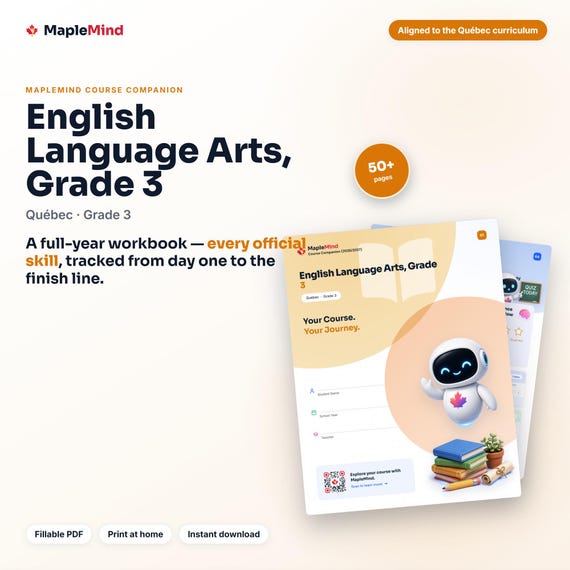
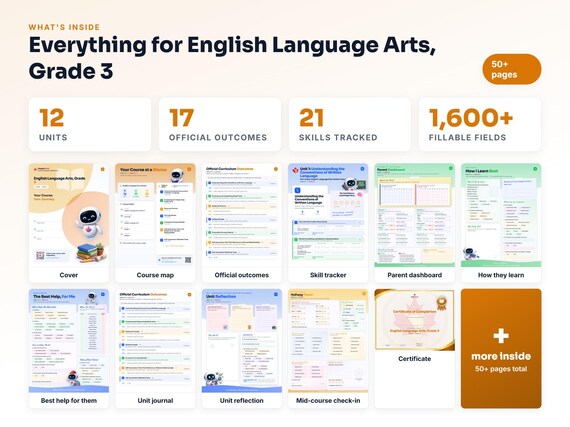
A English Language Arts, Grade 3 workbook worth keeping
Built from the same official curriculum as this page. Before and after each skill above, your student colours in how sure they feel — so the two of you can see, on one page, what's clicking and what needs another look. It's a quiet way to follow how the year is really going.
By June it's full of their own handwriting: units worked through, confidence grown, a mid-year check-in, notes from parent-teacher night, and a certificate at the end. Less a worksheet, more a record of the year worth keeping on the shelf.
Instant download · see every page, reviews and the full description · five or more workbooks are $2.99 each
What it looks like in the app



Common questions
Can MapleMind help my child with English Language Arts, Grade 3?
Yes. MapleMind's AI tutor covers all 21 skills in Quebec's English Language Arts, Grade 3 — your child picks the exact skill, and the tutor teaches it step by step: a short lesson, a worked example, solving together, then a skill check to show it stuck.
Is MapleMind aligned to Quebec's official curriculum?
Yes. Every skill in this course maps to an official outcome code from Quebec's Grade 3 English Language Arts curriculum, and the ministry's own wording is quoted under each unit on this page — with the official government source linked so you can check it yourself.
What does MapleMind cost?
It's free to start — 5 tutoring chats and a practice quiz every day, no credit card. A Pro subscription ($9.99/month or $49.99/year CAD, 7-day free trial) unlocks unlimited tutoring, practice, and exam simulations.
What if my child is stuck on just one topic?
That's the point of skill-level tutoring: open English Language Arts, Grade 3 in the app, tap the exact skill from the list on this page, and the tutor teaches just that — no wading through lessons your child doesn't need.
Does MapleMind work in French or other languages?
Yes — 14 languages, including French. Both the app and the tutor's explanations switch to the language your child chooses.
Where can I see the official Quebec curriculum for English Language Arts, Grade 3?
The official source is linked on this page — Québec's official English language arts program. The outline here follows it: every MapleMind skill carries its official outcome code, and the ministry's own wording is quoted under each unit.
Keep exploring
Ready when you are
Pick a skill from this page and see it taught properly — free, in the browser, in under a minute.