Diploma exam · Alberta
Physics 30 Diploma Exam
Physics 30 Diploma Examination
- Grade 12
- SCN3797
Dates and details can change. We do our best to keep this page up to date, but check the official sources before relying on it.
- Total time
- 3 h
- Marked questions
- 50
- Counts for
- 30% of the final mark
- Calculator
- Approved models
- Format
- Paper and computer
Physics 30 Diploma practice test
The whole exam or the parts you choose, in its own format, on the clock.
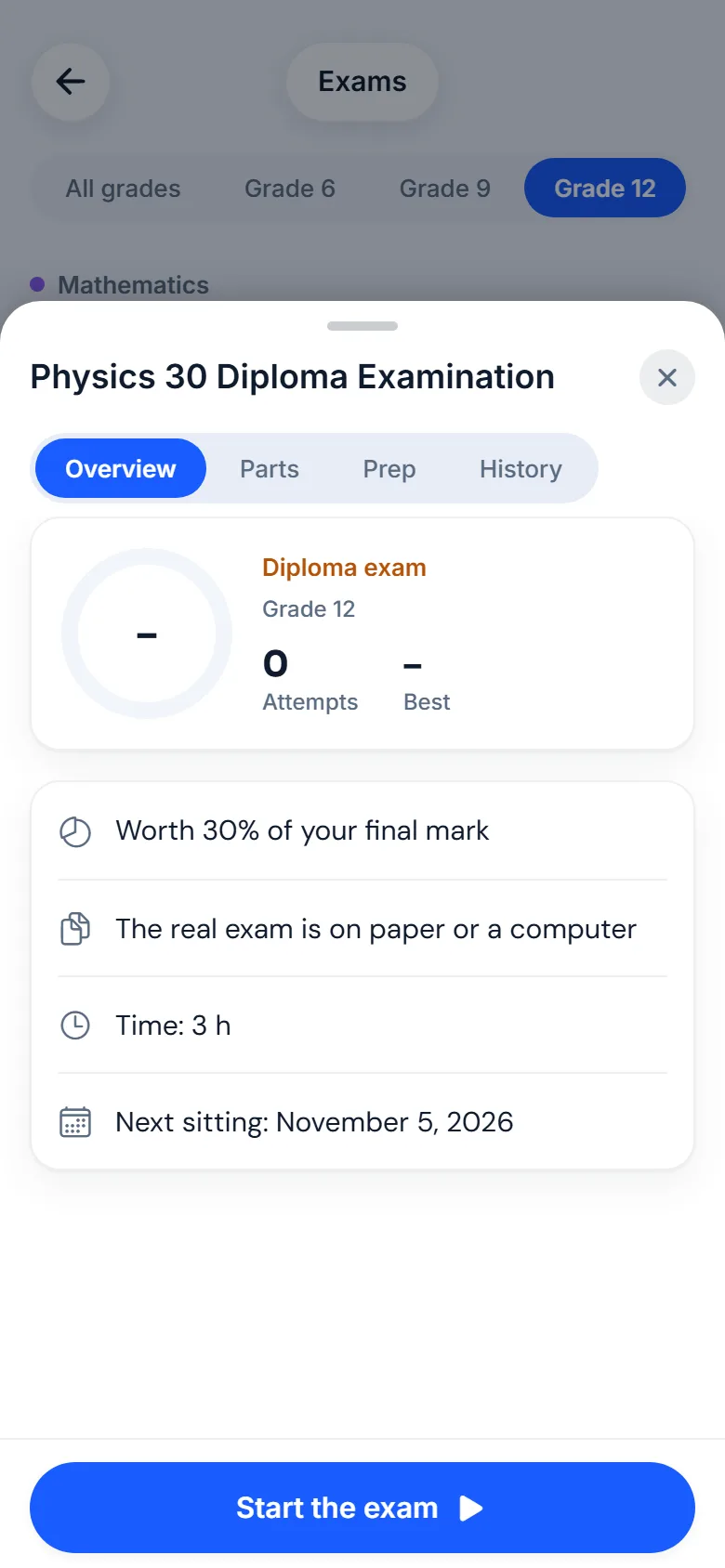 The exam in the app
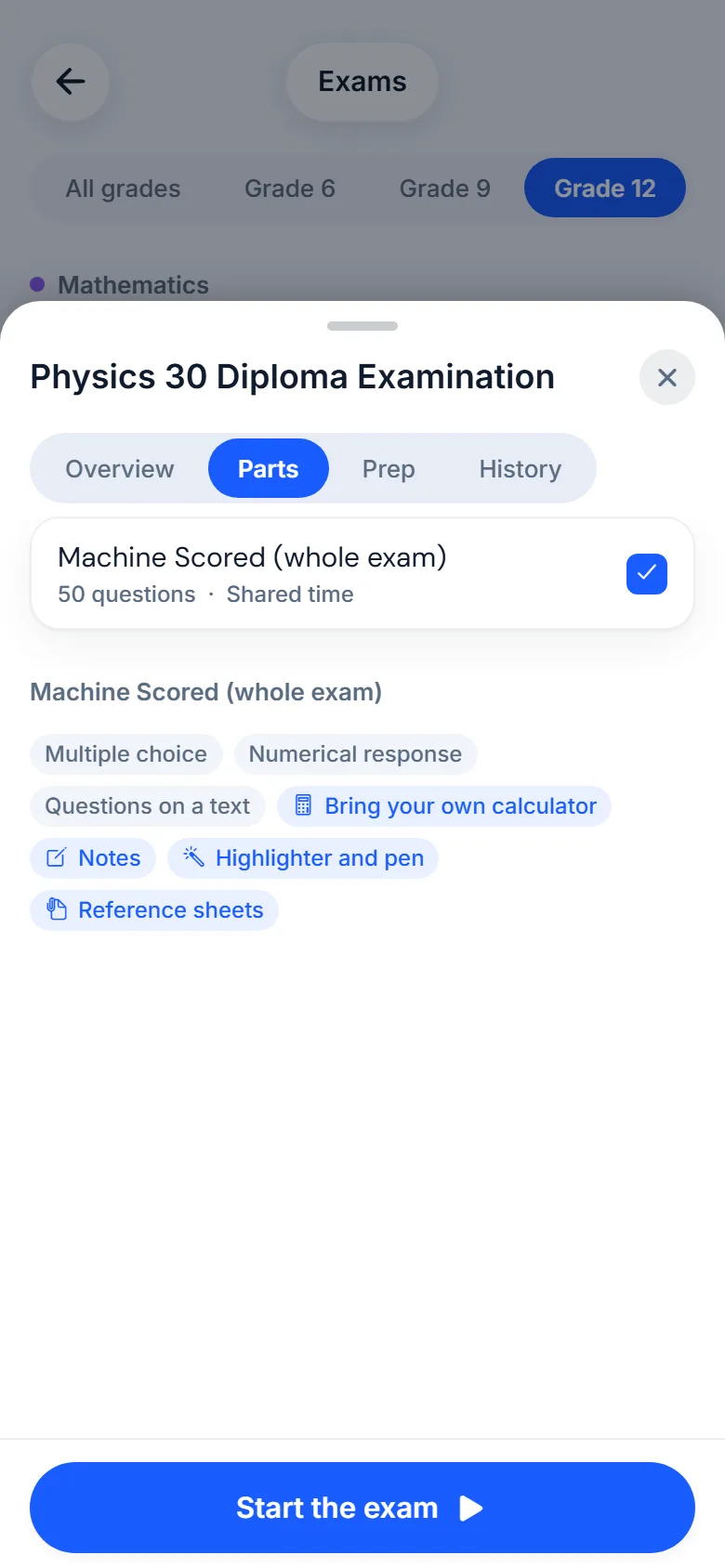 Its parts, and what you can use in each
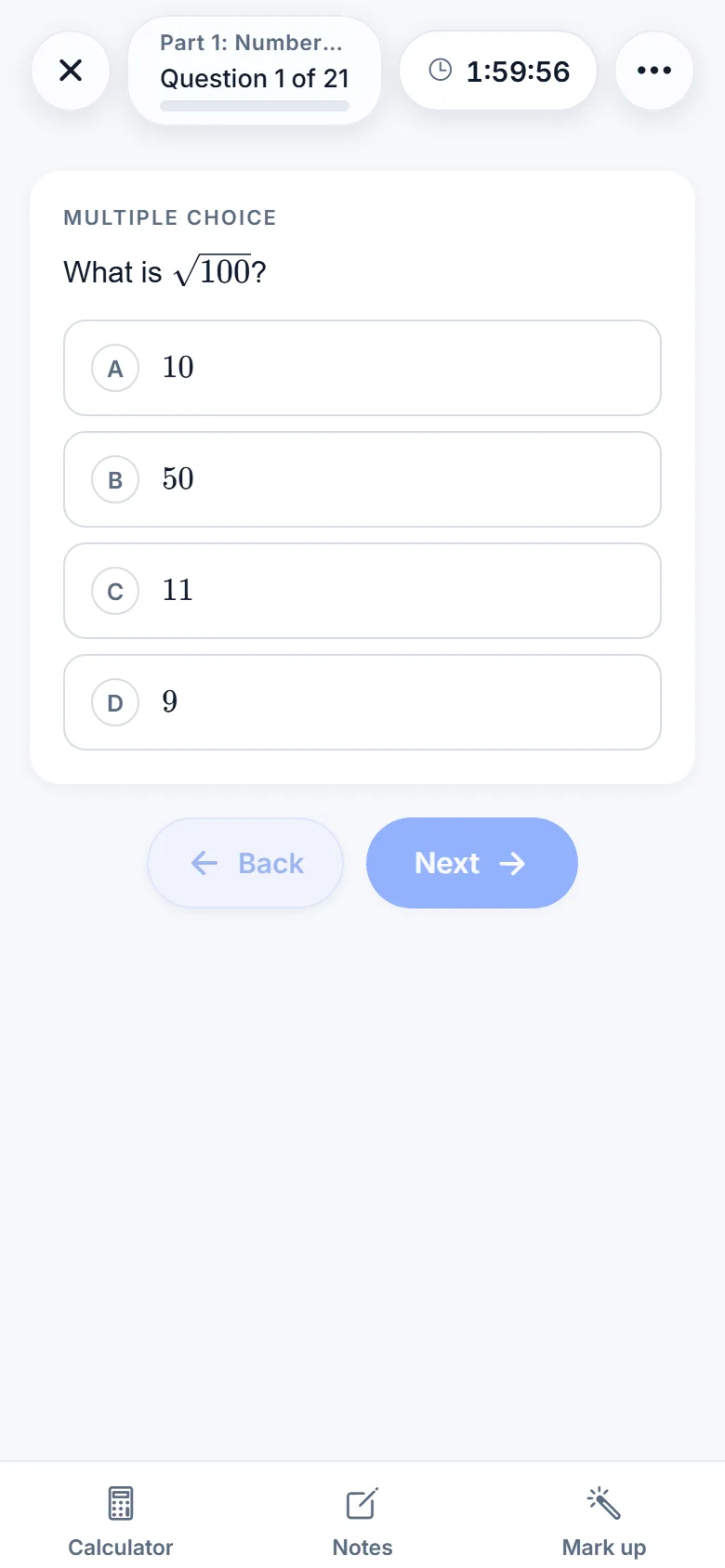 A question, timed, with the exam’s tools
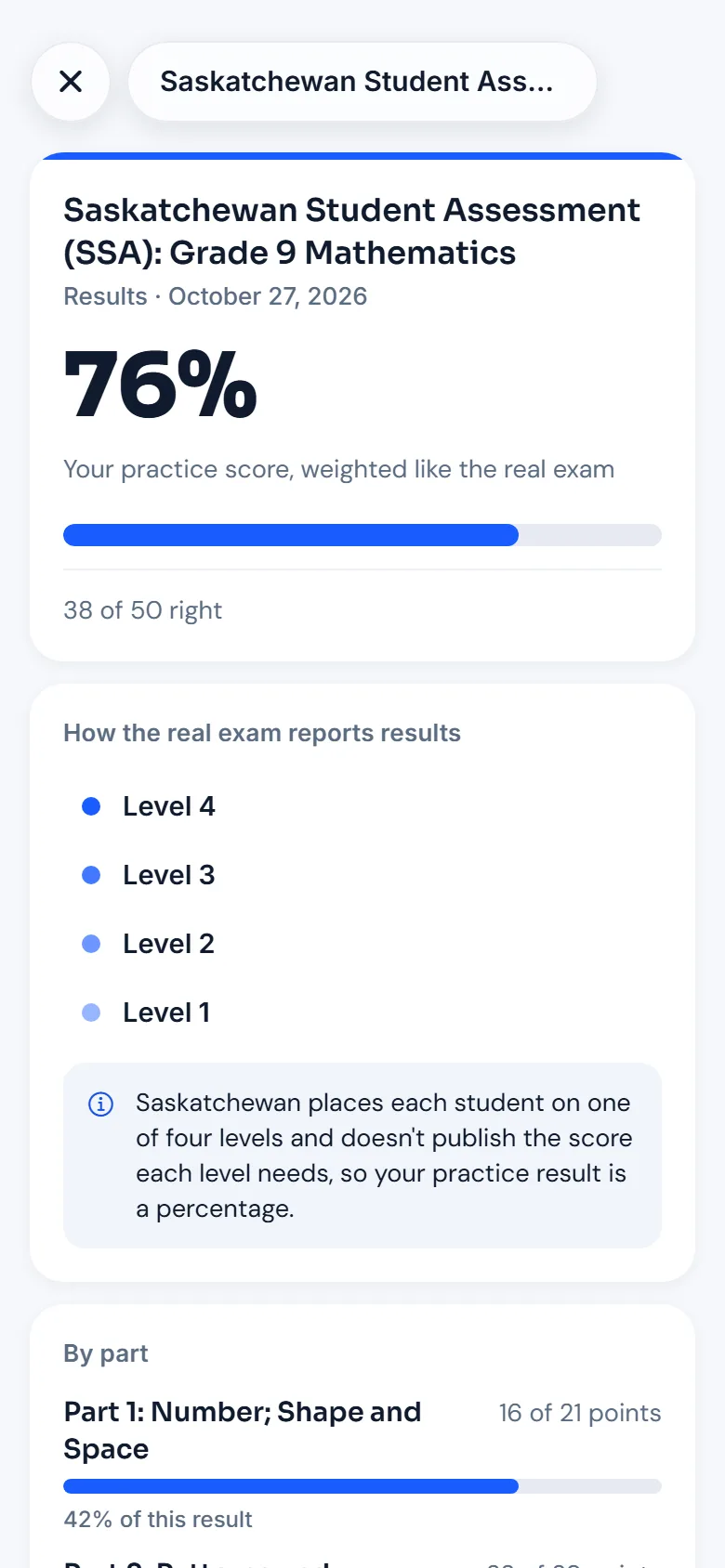 The marked result, part by part
A practice run of Saskatchewan’s Grade 9 math assessment.
Free with a MapleMind account
When
5 sessions this school year: November, January, April, June and August.
November 2026
- Thursday, November 5, 20269:00 AM–12:00 PM
January 2027
- Wednesday, January 27, 20279:00 AM–12:00 PM
April 2027
- Tuesday, April 13, 20271:00–4:00 PM
June 2027
- Friday, June 25, 20279:00 AM–12:00 PM
August 2027
- Wednesday, August 11, 20279:00 AM–12:00 PM
The dates are Alberta’s own, read on September 28, 2026. See the official schedule (alberta.ca)
What’s on it
4 topics. Forces and Fields and Electromagnetic Radiation count most, at 25–35% each.
- Momentum and Impulse10–20%GO A
- Forces and Fields25–35%GO B
- Electromagnetic Radiation25–35%GO C
- Atomic Physics20–30%GO D
The skills it tests · 72 skills
- A moving charge as a field source
- Accelerating charges produce EMR
- Alpha, beta and gamma radiation
- Applying Coulomb's law to two charges
- Attraction and repulsion of charges
- Beta decay with elementary fermions
- Cathode rays and atomic models
- Charge distribution on conductors and insulators
- Charge in combined magnetic and electric fields
- Charge motion in a uniform field
- Charging by conduction and induction
- Classifying the spectrum by photon energy
- Comparing forces and fields
- Comparing fundamental particles
- Comparing gravitational, electric and magnetic fields
- Conservation of charge
- Conservation of charge and mass number
- Continuous, emission and absorption spectra
- Coulomb's torsion balance experiment
- Defining electric current
- Defining vector fields
- Diffraction, interference and polarization
- Double-slit and diffraction-grating problems
- Each element has a unique line spectrum
- Elastic vs inelastic collisions
- Electric field intensity and direction
- Electric potential difference
- Electrical interactions and energy conservation
- Electron diffraction and de Broglie
- Energy difference between states
- Fields on charges and current-carrying wires
- Fission versus fusion
- Force on a current-carrying conductor
- Grating vs prism spectra
- Gravitational vs electric potential energy
- Half-life calculations
- Impulse and change in momentum
- Inverse-square: Coulomb vs gravitation
- Lenses and curved mirrors
- Magnetic force on a moving charge
- Magnetic interactions as forces and fields
- Mass defect and released energy
- Matter contains discrete charges
- Measuring the speed of EMR
- Michelson-type speed calculation
- Millikan's oil-drop experiment
- Momentum as a vector
- Momentum conservation (qualitative)
- Momentum conservation in 1-D and 2-D
- Moving a conductor in a magnetic field
- Net electric force from multiple charges
- Oersted, Faraday and electromagnetism
- Particle tracks and discovery
- Photoelectric effect and duality
- Photoelectric emission and energy conservation
- Potential difference in a uniform field
- Propagation of EMR
- Reflection, refraction and total internal reflection
- Refraction supports the wave model
- Rutherford's scattering experiment
- Stationary states explain spectra
- The Compton effect
- The electromagnetic spectrum
- The photoelectric effect
- The photon and its energy
- The quark model of nucleons
- The strong force and accelerators
- Thomson's experiment
- Two-slit electron interference
- Why the classical atom fails
- Writing nuclear decay equations
- Young's double-slit and the wave model
How it’s built
- Machine Scored (whole exam)
- Questions
- 50
- Marks
- 50
- Of the marks
- 100%
- Multiple choice
- Numerical response
- Questions in sets
Multiple-choice and numerical-response questions built around situations. For a numerical response you calculate a value, choose or match items, or put events in order, and enter it as digits.
How it’s marked
- Below the acceptable standardUnder 50%
- Acceptable standard50% to 79%
- Standard of excellence80% and up
A computer marks every question. Your exam mark is 30% of your final Physics 30 mark, and your school mark is the other 70%. You need a final mark of at least 50% for the credit; 80% meets the standard of excellence.
On the day
- Calculator
- Bring your own calculator from Alberta Education's approved list.
- Provided
- Physics 30 Data Pages (constants, equations, periodic table)
One sitting of 3 hours, and everyone may take up to double the time, 6 hours. The booklet has tear-out data pages with constants, equations and a periodic table.
Getting ready
1 official document to practise with, and 4 tips.
Official practice
Tips from the people who write it
- Use the constants on the data pages, given to three significant digits. Constants stored in a calculator can give a wrong numerical answer.
- Fewer than half the questions need a calculation: understanding the situations matters most.
- Some questions have more than one valid answer and need cause-and-effect reasoning.
- Forces and fields, and electromagnetic radiation, together make up 50 to 70% of the exam.
The mark you need
Your class mark counts for 70% of the final mark, the exam for 30%.
You need
59% on the exam
With 75% in class, your final mark lands between 52.5% (0 on the exam) and 82.5% (100% on it).
After the exam
- Results
Your marks are posted on myPass: your school mark, your exam mark and your blended final mark. A final mark of 48% or 49% is raised to 50%.
- November 2026November 19, 2026
- January 2027February 12, 2027
- April 2027April 30, 2027
- June 2027July 16, 2027
- August 2027August 20, 2027
- Re-marking
Ask for a rescore on myPass by the deadline: November 26, February 25, May 6, August 3 or August 27, by sitting. It costs $35, refunded if your mark rises 5% or more. Teachers re-mark the written part without seeing the first marks; the machine-scored part isn’t rescored. The new mark stands, even if it’s lower.
- Writing it again
You can rewrite at any later sitting: register on myPass and pay $35 (Alberta students). An exam with two parts is rewritten whole. Every mark stays on your record, but only your highest exam mark goes on your transcript. Retaking the course for a new school mark doesn’t mean rewriting the exam.
- If you miss it
If illness, a death in the family or another emergency keeps you from writing, your school applies to Alberta Education: either an exemption, where your school mark stands in for the exam, or a later sitting. A planned trip or work isn’t a reason; you write at a later sitting. Without a passing school mark, an exemption doesn’t help you.
From General Information Bulletin 2026–2027, Diploma Examinations Program (alberta.ca), read on October 27, 2026.
More for you
Students
Start with the topics worth the most marks, then write full practice exams under the real time limit.
Practise itParents
Put the dates on the family calendar. The Parent Dashboard shows each practice exam’s result and the skills that need another look.
See the Parent DashboardEducators
The topic weights and the official practice above make a review plan. Students can practise each skill on its own in MapleMind, free with daily limits.
For schools
Questions about this exam
When is the Physics 30 Diploma Exam in 2026–27?
The next sitting is January 27, 2027, 9:00 AM–12:00 PM. This school year it’s written in November 2026, January 2027, April 2027, June 2027 and August 2027.
How long is the Physics 30 Diploma Exam?
It takes 3 hours in all, over 1 part.
How many questions are on the Physics 30 Diploma Exam?
It has 50 marked questions.
Can you use a calculator on the Physics 30 Diploma Exam?
Yes, a calculator from the approved list.
How much does the Physics 30 Diploma Exam count?
It’s worth 30% of the final mark in Physics 30.
How are Physics 30 Diploma Exam results reported?
At 3 levels: Below the acceptable standard (under 50%), Acceptable standard (50% and up) and Standard of excellence (80% and up).
When do Physics 30 Diploma Exam results come out?
For 2026–27: the November 2026 sitting on November 19, 2026, the January 2027 sitting on February 12, 2027, the April 2027 sitting on April 30, 2027, the June 2027 sitting on July 16, 2027 and the August 2027 sitting on August 20, 2027.
Where can I find practice tests for the Physics 30 Diploma Exam?
Alberta publishes Physics 30 released items + digital Practice Test. MapleMind also builds a full practice exam in its format, free with an account.

Practise for the Physics 30 Diploma Exam
Every skill on the Physics 30 Diploma Exam, taught one at a time, then practised on questions written like the real ones.