Diploma exam · Alberta
Chemistry 30 Diploma Exam
Chemistry 30 Diploma Examination
- Grade 12
- SCN3796
Dates and details can change. We do our best to keep this page up to date, but check the official sources before relying on it.
- Total time
- 3 h
- Marked questions
- 60
- Counts for
- 30% of the final mark
- Calculator
- Approved models
- Format
- Paper and computer
Chemistry 30 Diploma practice test
The whole exam or the parts you choose, in its own format, on the clock.
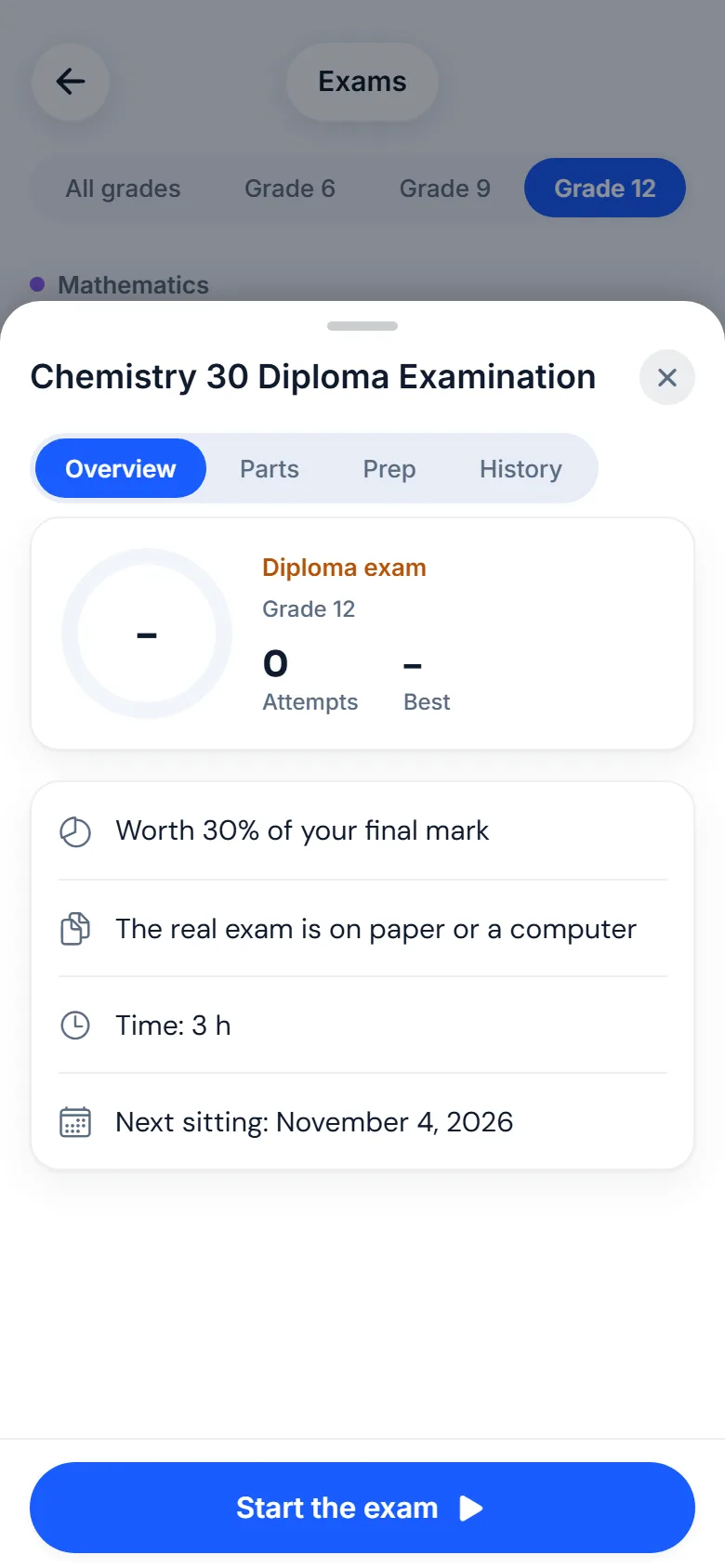 The exam in the app
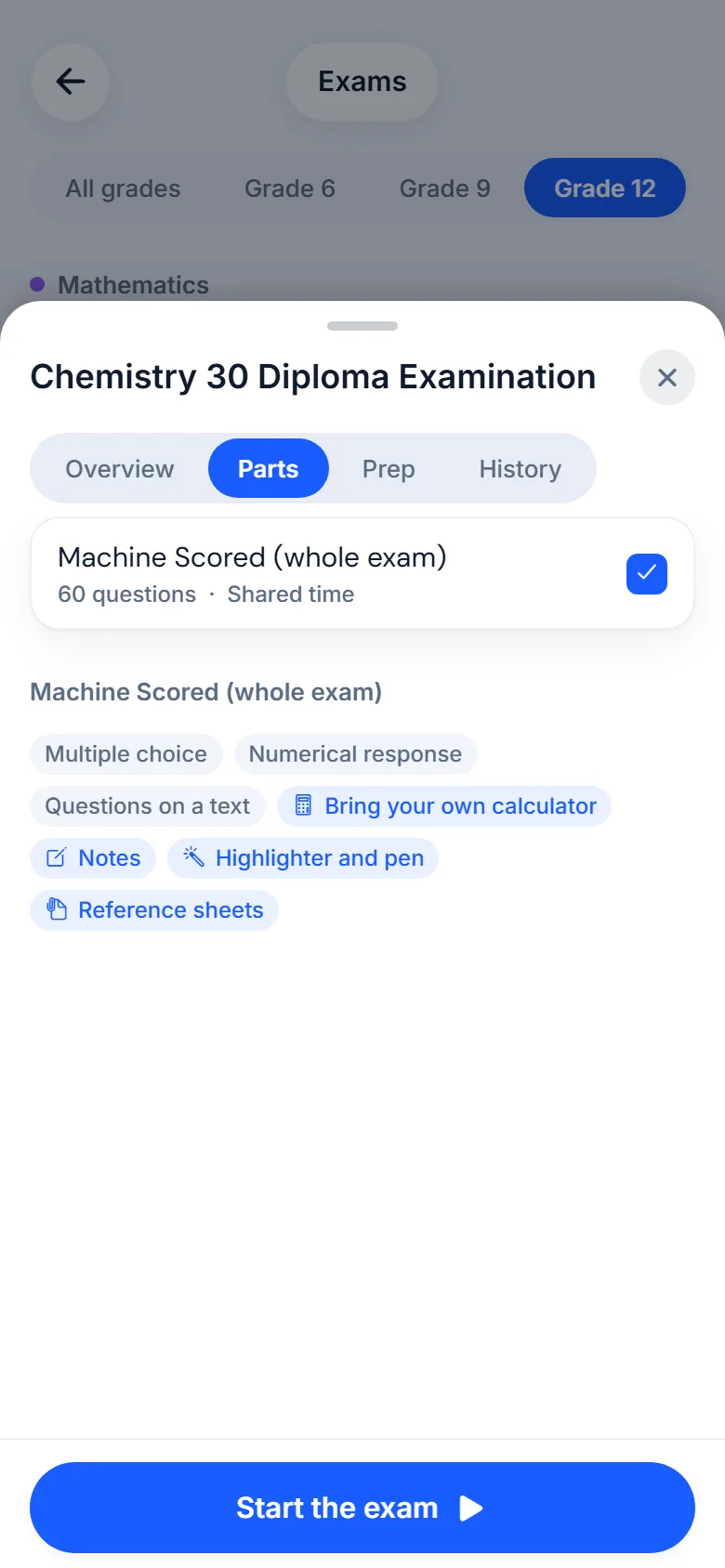 Its parts, and what you can use in each
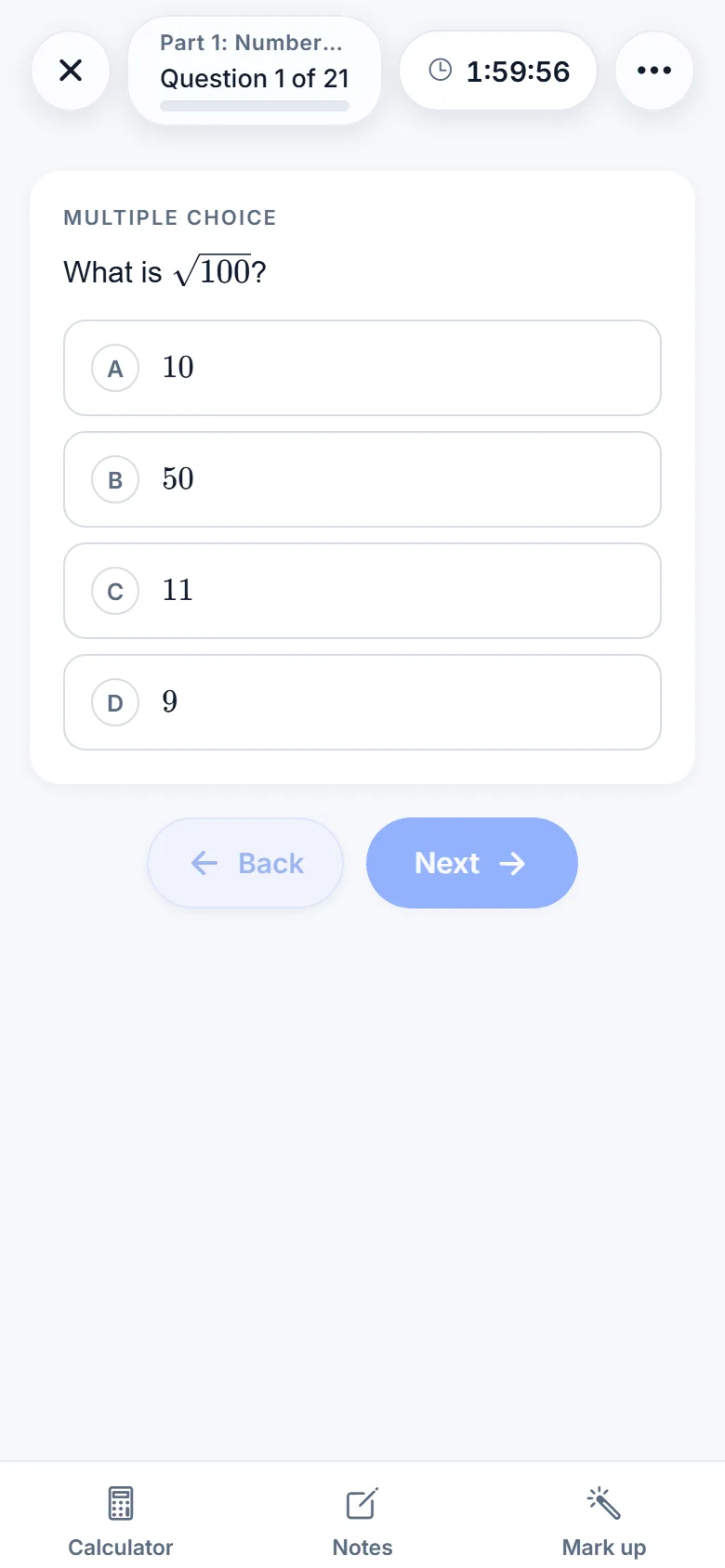 A question, timed, with the exam’s tools
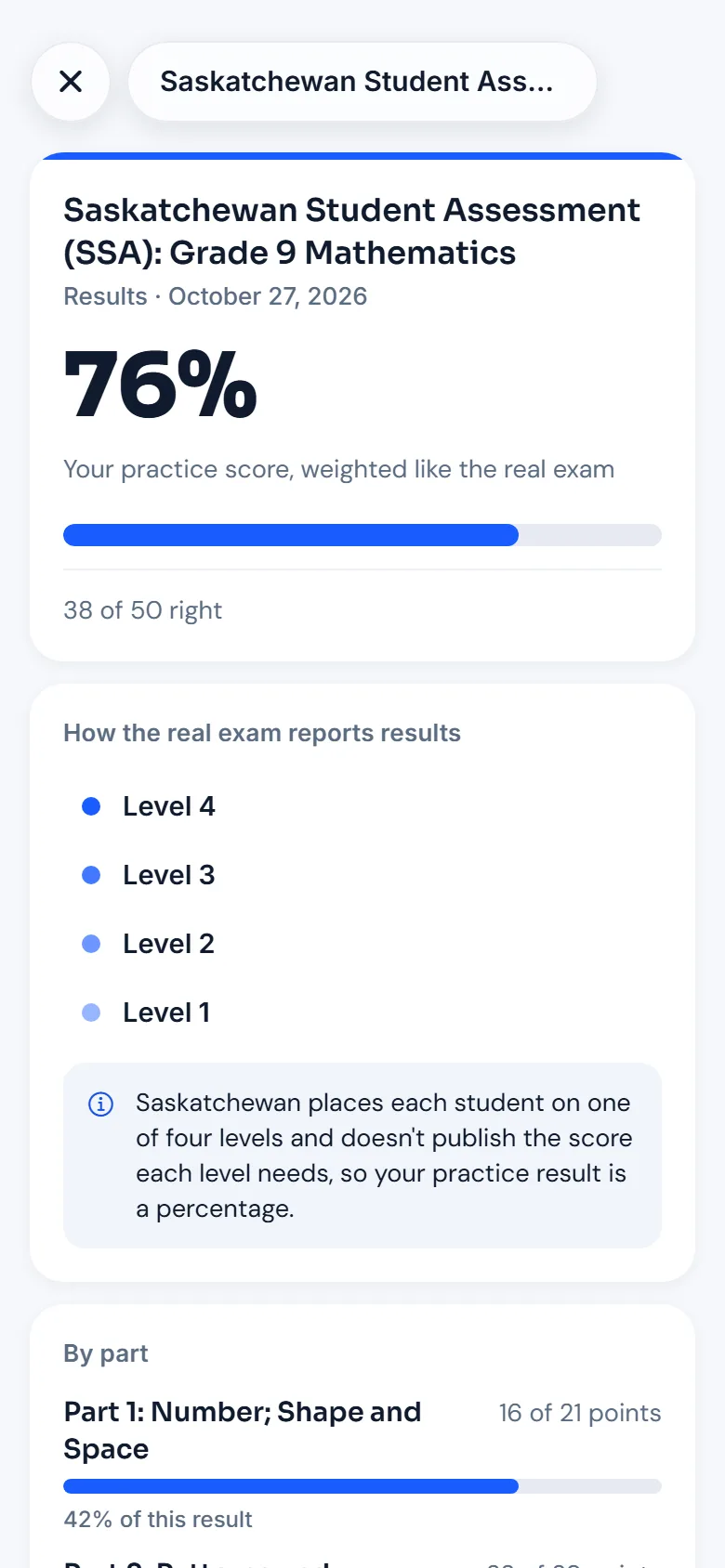 The marked result, part by part
A practice run of Saskatchewan’s Grade 9 math assessment.
Free with a MapleMind account
When
5 sessions this school year: November, January, April, June and August.
November 2026
- Wednesday, November 4, 20269:00 AM–12:00 PM
January 2027
- Tuesday, January 26, 20279:00 AM–12:00 PM
April 2027
- Wednesday, April 14, 20279:00 AM–12:00 PM
June 2027
- Thursday, June 24, 20279:00 AM–12:00 PM
August 2027
- Tuesday, August 10, 20271:00–4:00 PM
The dates are Alberta’s own, read on September 28, 2026. See the official schedule (alberta.ca)
What’s on it
4 topics. Electrochemical Changes and Chemical Equations Focusing on Acid–Base Systems count most, at 29–32% each.
- Thermochemical Changes20–22%GO A1, A2
- Electrochemical Changes29–32%GO B1, B2
- Chemical Changes of Organic Compounds20–22%GO C1, C2
- Chemical Equations Focusing on Acid–Base Systems29–32%GO D1, D2
The skills it tests · 52 skills
- Activation energy as the energy barrier
- Analyzing and labelling energy diagrams
- Analyzing heat transfer with Q = mcΔt
- Balanced equations that include energy changes
- Brønsted–Lowry acids and bases
- Buffers
- Calculating standard cell potential
- Calculations for redox titrations
- Classifying reactions as endothermic or exothermic
- Comparing boiling points and solubility
- Comparing strengths of oxidizing and reducing agents
- Conjugate pairs and amphiprotic substances
- Defining equilibrium and its criteria
- Defining organic compounds
- Defining oxidation and reduction
- Energy changes from bonds breaking and forming
- Enthalpy and molar enthalpy
- Enthalpy changes from calorimetry data
- Equilibrium constant and concentration calculations
- Faraday's law and cell stoichiometry
- Hess's law for net reactions
- How catalysts speed reactions
- Identifying compound types from functional groups
- IUPAC naming and drawing organic structures
- Le Chatelier's principle
- Monomers, polymers and polymerization
- Organic reactions and the fossil-fuel economy
- Predicting products and balancing organic equations
- Predicting spontaneity from reduction potentials
- Predicting the half-reaction at each electrode
- Predicting ΔH from standard enthalpies of formation
- Reactants and products of key energy reactions
- Recalling pH, pOH and ion concentration
- Redox in living and nonliving systems
- Redox terms: agents, oxidation number, half-reactions
- Reduction potentials relative to the hydrogen electrode
- Separating organic compounds from mixtures
- Significant organic compounds in daily life
- Spontaneity from cell potential
- Stored chemical energy came from the sun
- Structural isomerism
- Telling redox reactions apart from other reactions
- The equilibrium constant Kc and equilibrium-law expressions
- The five organic reaction types
- The parts of an electrochemical cell
- Using and interpreting ΔH notation
- Using Kw, Ka and Kb
- Voltaic vs electrolytic cells
- When predicted reactions do not occur
- Writing and balancing redox equations
- Writing Brønsted–Lowry equations and predicting the favoured side
- Writing equations for systems at equilibrium
How it’s built
- Machine Scored (whole exam)
- Questions
- 60
- Marks
- 60
- Of the marks
- 100%
- Multiple choice
- Numerical response
- Questions in sets
Sets of multiple-choice and numerical-response questions around shared information. For a numerical response you work out the answer and enter it as digits.
How it’s marked
- Below the acceptable standardUnder 50%
- Acceptable standard50% to 79%
- Standard of excellence80% and up
A computer marks every question. Your exam mark is 30% of your final Chemistry 30 mark, and your school mark is the other 70%. You need a final mark of at least 50% for the credit; 80% meets the standard of excellence.
On the day
- Calculator
- Bring your own calculator from Alberta Education's approved list.
- Provided
- Chemistry Data Booklet
One sitting of 3 hours, and everyone may take up to double the time, 6 hours. You get the Chemistry Data Booklet with the exam.
Getting ready
1 official document to practise with, and 4 tips.
Official practice
Tips from the people who write it
- Learn how to record each kind of numerical-response answer: calculations, putting things in order, choosing, scientific notation and matching.
- Practise with the Chemistry Data Booklet, so looking things up is quick.
- Electrochemistry and acids and bases together make up about 60% of the exam.
- Questions come in sets around shared information, and a set may mix multiple-choice and numerical-response questions.
The mark you need
Your class mark counts for 70% of the final mark, the exam for 30%.
You need
59% on the exam
With 75% in class, your final mark lands between 52.5% (0 on the exam) and 82.5% (100% on it).
After the exam
- Results
Your marks are posted on myPass: your school mark, your exam mark and your blended final mark. A final mark of 48% or 49% is raised to 50%.
- November 2026November 19, 2026
- January 2027February 12, 2027
- April 2027April 30, 2027
- June 2027July 16, 2027
- August 2027August 20, 2027
- Re-marking
Ask for a rescore on myPass by the deadline: November 26, February 25, May 6, August 3 or August 27, by sitting. It costs $35, refunded if your mark rises 5% or more. Teachers re-mark the written part without seeing the first marks; the machine-scored part isn’t rescored. The new mark stands, even if it’s lower.
- Writing it again
You can rewrite at any later sitting: register on myPass and pay $35 (Alberta students). An exam with two parts is rewritten whole. Every mark stays on your record, but only your highest exam mark goes on your transcript. Retaking the course for a new school mark doesn’t mean rewriting the exam.
- If you miss it
If illness, a death in the family or another emergency keeps you from writing, your school applies to Alberta Education: either an exemption, where your school mark stands in for the exam, or a later sitting. A planned trip or work isn’t a reason; you write at a later sitting. Without a passing school mark, an exemption doesn’t help you.
From General Information Bulletin 2026–2027, Diploma Examinations Program (alberta.ca), read on October 27, 2026.
More for you
Students
Start with the topics worth the most marks, then write full practice exams under the real time limit.
Practise itParents
Put the dates on the family calendar. The Parent Dashboard shows each practice exam’s result and the skills that need another look.
See the Parent DashboardEducators
The topic weights and the official practice above make a review plan. Students can practise each skill on its own in MapleMind, free with daily limits.
For schools
Questions about this exam
When is the Chemistry 30 Diploma Exam in 2026–27?
The next sitting is January 26, 2027, 9:00 AM–12:00 PM. This school year it’s written in November 2026, January 2027, April 2027, June 2027 and August 2027.
How long is the Chemistry 30 Diploma Exam?
It takes 3 hours in all, over 1 part.
How many questions are on the Chemistry 30 Diploma Exam?
It has 60 marked questions.
Can you use a calculator on the Chemistry 30 Diploma Exam?
Yes, a calculator from the approved list.
How much does the Chemistry 30 Diploma Exam count?
It’s worth 30% of the final mark in Chemistry 30.
How are Chemistry 30 Diploma Exam results reported?
At 3 levels: Below the acceptable standard (under 50%), Acceptable standard (50% and up) and Standard of excellence (80% and up).
When do Chemistry 30 Diploma Exam results come out?
For 2026–27: the November 2026 sitting on November 19, 2026, the January 2027 sitting on February 12, 2027, the April 2027 sitting on April 30, 2027, the June 2027 sitting on July 16, 2027 and the August 2027 sitting on August 20, 2027.
Where can I find practice tests for the Chemistry 30 Diploma Exam?
Alberta publishes Chemistry 30 released items + digital Practice Test. MapleMind also builds a full practice exam in its format, free with an account.

Practise for the Chemistry 30 Diploma Exam
Every skill on the Chemistry 30 Diploma Exam, taught one at a time, then practised on questions written like the real ones.