Get help with Workplace and Apprenticeship Mathematics 30
Most tutoring makes you sit through material you already know. MapleMind flips that: pick the exact skill that's causing trouble — any of the 23 below — and the tutor teaches just that one, step by step, as many times as it takes. Ask questions in plain words, any time of day, in English, French, or 12 other languages.
The official Saskatchewan Workplace and Apprenticeship Mathematics 30 curriculum
Saskatchewan defines Workplace and Apprenticeship Mathematics 30 by strands and outcomes. MapleMind teaches the same curriculum reorganized for one-skill-at-a-time tutoring — the table shows exactly where every official strand lands, and the ministry's own wording is quoted under each unit below.
Official source Saskatchewan's official curriculumRead it on the government site — curriculum.gov.sk.ca ↗| Official strand | Outcomes | Where MapleMind teaches it |
|---|---|---|
| Strand WA | 11 | Reasoning and Measurement · Financial and Business Mathematics · Linear Relations and Statistics |
Every skill below, taught one on one.
 Try the first session free
How MapleMind teaches Workplace and Apprenticeship Mathematics 30 — every unit, lesson, and skill
Every skill below runs as a short session: a plain-words lesson, a worked example, solving it together, then a five-question skill check that earns up to three stars. Guided Mode keeps it teaching instead of answer-handing — turning it off needs a parent's password.
Unit 1Reasoning and MeasurementOfficial strand · Strand WA
Logical reasoning in puzzles and games, the limitations of measuring instruments, the sine and cosine laws, properties of polygons, and transformations on 2-D shapes and 3-D objects.
Reasoning in Puzzles and Games
- Strategies to solve puzzles and win gamesWA30.1 — Determine, verify, and create problem-solving strategies to solve puzzles and win games, and identify errors in solutions.
Limitations of Measuring Instruments
- Precision and accuracyWA30.2 — Explain the difference between precision and accuracy and justify the degree of each required in a context.
- Uncertainty and toleranceWA30.2 — Relate the margin of accuracy to uncertainty and calculate maximum and minimum values using a degree of tolerance.
- Choosing and using trade instrumentsWA30.2 — Compare the limitations of trade measuring instruments and solve situational problems involving precision, accuracy, or tolerance.
Sine and Cosine Laws
- Solving triangles with the sine and cosine lawsWA30.3 — Solve situational problems in construction and trade contexts using the sine law and cosine law (excluding the ambiguous case).
Properties of Polygons
- Properties of triangles, quadrilaterals, and polygonsWA30.4 — Analyze and generalize the properties of triangles, quadrilaterals, and regular polygons and explain why a property does or does not apply.
- Applying polygon propertiesWA30.4 — Identify applications of polygon properties in construction, industry, and design and solve situational questions using them.
Transformations of Shapes and Objects
- Translations, rotations, and reflectionsWA30.5 — Identify and apply translations, rotations, and reflections on 2-D shapes and create and analyze designs using them.
- Dilations and similarityWA30.5 — Use similarity to identify and draw dilations of 2-D shapes and 3-D objects and explain their proportionality.
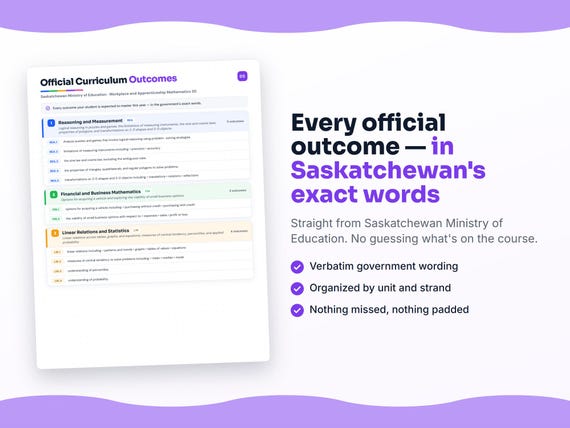
The official wording — 5 outcomes in this unit
- WA30.1
Analyze puzzles and games that involve logical reasoning using problem- solving strategies.
- WA30.2
limitations of measuring instruments including: • precision • accuracy
- WA30.3
the sine law and cosine law, excluding the ambiguous case.
- WA30.4
the properties of triangles, quadrilaterals, and regular polygons to solve problems.
- WA30.5
transformations on 2-D shapes and 3-D objects including: • translations • rotations • reflections
Unit 2Financial and Business MathematicsOfficial strand · Strand WA
Options for acquiring a vehicle and exploring the viability of small business options.
Acquiring a Vehicle
- Buying a vehicle, with and without creditWA30.6 — Solve situational questions about purchasing a vehicle with and without credit, including the cost of financing.
- Leasing and leasing to purchaseWA30.6 — Solve situational questions about leasing and leasing to purchase a vehicle and justify an acquisition decision.
Small Business Viability
- Expenses, sales, and profit or lossWA30.7 — Identify a small business's expenses, sales, and profit or loss and explain factors that affect profitability.
- Break-even and improving viabilityWA30.7 — Determine the break-even point for a small business and generate and report options to improve its profitability.
The official wording — 2 outcomes in this unit
- WA30.6
options for acquiring a vehicle including: • purchasing without credit • purchasing with credit
- WA30.7
the viability of small business options with respect to: • expenses • sales • profit or loss.
Unit 3Linear Relations and StatisticsOfficial strand · Strand WA
Linear relations across tables, graphs, and equations; measures of central tendency; percentiles; and applied probability.
Linear Relations
- Representing linear relationsWA30.8 — Represent and explain a linear relation across tables of values, graphs, and equations, including direct and partial variation.
- Patterns, trends, and scatterplotsWA30.8 — Create scatterplots, describe their trends, and relate slope and rate of change to linear relations.
- Interpolation and extrapolationWA30.8 — Solve situational questions that require interpolation or extrapolation and critique the reliability of predictions.
- Solving linear-relation problemsWA30.8 — Match contexts to their graphs and create and solve applied problems using a formula for a linear relation.
Measures of Central Tendency
- Mean, median, and modeWA30.9 — Determine the mean, median, and mode of data sets and explain the advantages and disadvantages of each.
- Outliers and the trimmed meanWA30.9 — Identify outliers, explain their effect on the measures, and calculate a trimmed mean.
- The weighted meanWA30.9 — Explain why some data is weighted more heavily and calculate a weighted mean.
Percentiles
- Percentiles and percentile rankWA30.10 — Explain and interpret percentile rank in context, compare it with percent, and solve percentile problems from charts.
Applied Probability
- Calculating and expressing probabilityWA30.11 — Calculate the probability of an event from a data set and express it as a fraction, decimal, percentage, and in words.
- Odds and applications of probabilityWA30.11 — Compare odds and probability, find probability given odds, and apply probability to real contexts and decisions.
The official wording — 4 outcomes in this unit
- WA30.8
linear relations including: • patterns and trends • graphs • tables of values • equations
- WA30.9
measures of central tendency to solve problems including: • mean • median • mode
- WA30.10
understanding of percentiles.
- WA30.11
understanding of probability.
Printable workbook · A keepsake of the year
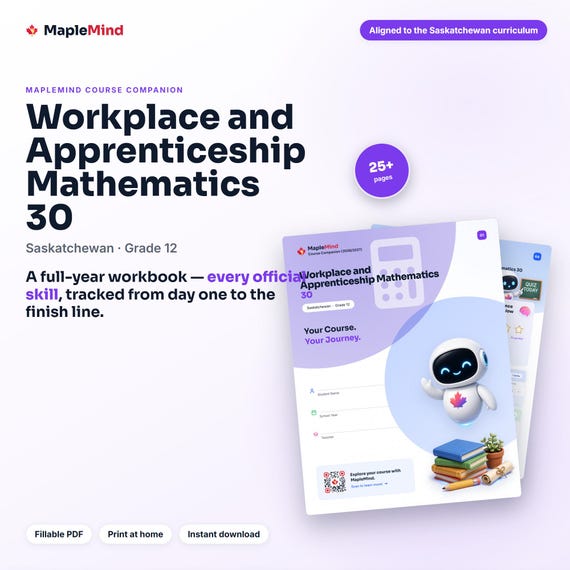
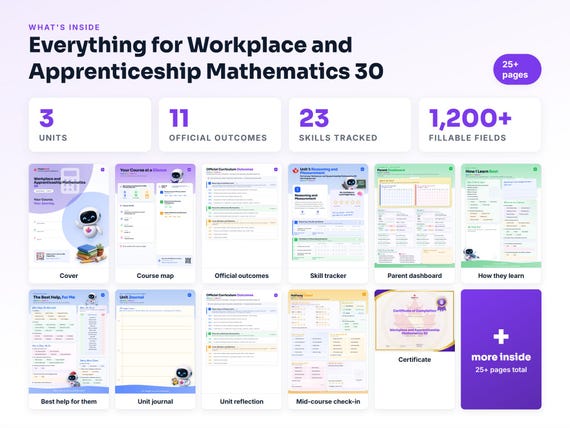
A Workplace and Apprenticeship Mathematics 30 workbook worth keeping
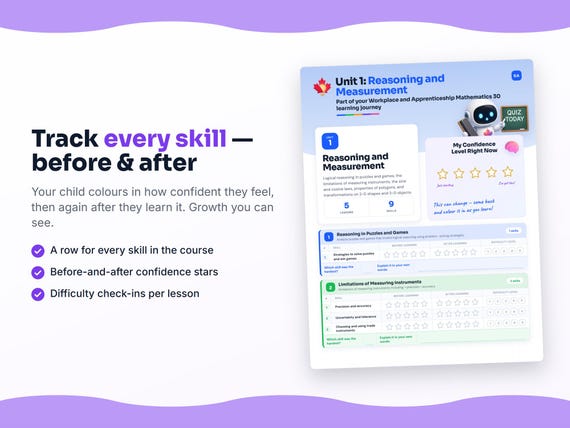
Built from the same official curriculum as this page. Before and after each skill above, your student colours in how sure they feel — so the two of you can see, on one page, what's clicking and what needs another look. It's a quiet way to follow how the year is really going.
By June it's full of their own handwriting: units worked through, confidence grown, a mid-year check-in, notes from parent-teacher night, and a certificate at the end. Less a worksheet, more a record of the year worth keeping on the shelf.
Instant download · see every page, reviews and the full description · five or more workbooks are $2.99 each
What it looks like in the app



Common questions
Can MapleMind help me with Workplace and Apprenticeship Mathematics 30?
Yes. MapleMind's AI tutor covers all 23 skills in Saskatchewan's Workplace and Apprenticeship Mathematics 30 — you pick the exact skill, and the tutor teaches it step by step: a short lesson, a worked example, solving together, then a skill check to show it stuck.
Is MapleMind aligned to Saskatchewan's official curriculum?
Yes. Every skill in this course maps to an official outcome code from Saskatchewan's Grade 12 Mathematics curriculum, and the ministry's own wording is quoted under each unit on this page — with the official government source linked so you can check it yourself.
What does MapleMind cost?
It's free to start — 5 tutoring chats and a practice quiz every day, no credit card. A Pro subscription ($9.99/month or $49.99/year CAD, 7-day free trial) unlocks unlimited tutoring, practice, and exam simulations.
What if I'm stuck on just one topic?
That's the point of skill-level tutoring: open Workplace and Apprenticeship Mathematics 30 in the app, tap the exact skill from the list on this page, and the tutor teaches just that — no wading through lessons you don't need.
Does MapleMind work in French or other languages?
Yes — 14 languages, including French. Both the app and the tutor's explanations switch to the language you choose.
Where can I see the official Saskatchewan curriculum for Workplace and Apprenticeship Mathematics 30?
The official source is linked on this page — Saskatchewan's official curriculum. The outline here follows it: every MapleMind skill carries its official outcome code, and the ministry's own wording is quoted under each unit.
Keep exploring
Ready when you are
Pick a skill from this page and see it taught properly — free, in the browser, in under a minute.