Get help with Calculus 30
Most tutoring makes you sit through material you already know. MapleMind flips that: pick the exact skill that's causing trouble — any of the 19 below — and the tutor teaches just that one, step by step, as many times as it takes. Ask questions in plain words, any time of day, in English, French, or 12 other languages.
The official Saskatchewan Calculus 30 curriculum
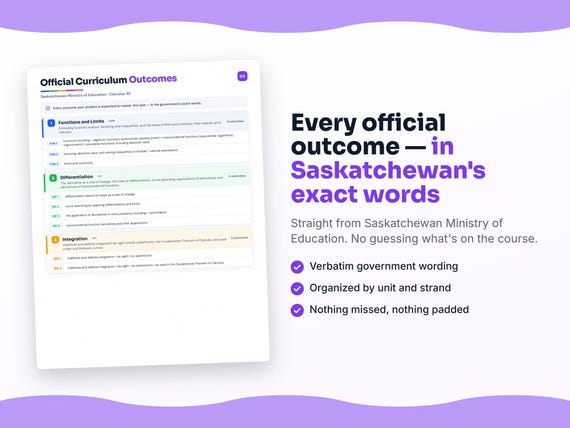
Saskatchewan defines Calculus 30 by strands and outcomes. MapleMind teaches the same curriculum reorganized for one-skill-at-a-time tutoring — the table shows exactly where every official strand lands, and the ministry's own wording is quoted under each unit below.
Official source Saskatchewan's official curriculumRead it on the government site — curriculum.gov.sk.ca ↗| Official strand | Outcomes | Where MapleMind teaches it |
|---|---|---|
| Strand C | 8 | Functions and Limits · Differentiation · Integration |
Every skill below, taught one on one.
 Try the first session free
How MapleMind teaches Calculus 30 — every unit, lesson, and skill
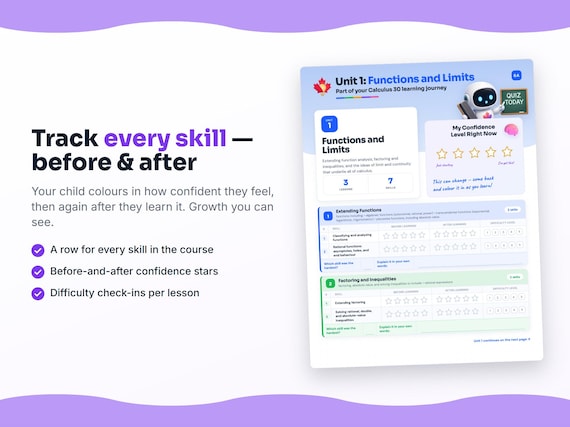
Every skill below runs as a short session: a plain-words lesson, a worked example, solving it together, then a five-question skill check that earns up to three stars. Guided Mode keeps it teaching instead of answer-handing — turning it off needs a parent's password.
Unit 1Functions and LimitsOfficial strand · Strand C
Extending function analysis, factoring and inequalities, and the ideas of limit and continuity that underlie all of calculus.
Extending Functions
- Classifying and analyzing functionsC30.1 — Classify functions as algebraic, transcendental, or piecewise and determine even/odd, one-to-one, domain, and range using set and interval notation.
- Rational functions: asymptotes, holes, and end behaviourC30.1 — Analyze rational functions to determine x-intercepts, vertical asymptotes, holes, and end behaviour.
Factoring and Inequalities
- Extending factoringC30.2 — Extend factoring to negative and rational exponents, the real numbers, and the sum and difference of cubes and xⁿ − yⁿ.
- Solving rational, double, and absolute-value inequalitiesC30.2 — Solve inequalities containing rational expressions, double inequalities, and absolute-value inequalities.
Limits and Continuity
- The meaning of a limitC30.3 — Explain the meaning of a limit, express limits using limit notation from graphs and expressions, and identify when a limit does not exist.
- Evaluating limitsC30.3 — Evaluate limits at real numbers and at infinity using direct substitution, factoring, simplifying, and rationalizing.
- Continuity and discontinuityC30.3 — Determine whether a function is continuous at a point and classify discontinuities as removable, jump, or infinite.
The official wording — 3 outcomes in this unit
- C30.1
functions including: • algebraic functions (polynomial, rational, power) • transcendental functions (exponential, logarithmic, trigonometric) • piecewise functions, including absolute value.
- C30.2
factoring, absolute value, and solving inequalities to include: • rational expressions
- C30.3
limits and continuity.
Unit 2DifferentiationOfficial strand · Strand C
The derivative as a rate of change, the rules of differentiation, curve sketching, applications of derivatives, and derivatives of transcendental functions.
The Derivative
- The derivative from first principlesC30.4 — Explain average versus instantaneous rate of change and develop the derivative as the limit of secant slopes.
- Rules of differentiationC30.4 — Apply the power, product, quotient, and chain rules, including combining two or more rules on one function.
- Implicit differentiation, tangents, and notationC30.4 — Apply implicit differentiation, find tangent and normal line equations, identify non-differentiable points, and use derivative notations.
Curve Sketching
- First-derivative analysisC30.5 — Use the first derivative to find critical points, increasing and decreasing intervals, and relative extrema.
- Second-derivative analysis and sketchingC30.5 — Use the second derivative for concavity and inflection points, apply limits for asymptotes, and sketch the full curve.
Applications of Derivatives
- OptimizationC30.6 — Solve optimization problems using derivatives to find maximum or minimum values in area, volume, and cost contexts.
Derivatives of Transcendental Functions
- Defining e and differentiating transcendental functionsC30.7 — Develop e using limits and determine derivatives of exponential, logarithmic, sine, and cosine functions.
- Sketching and applying transcendental derivativesC30.7 — Apply first and second derivatives to sketch transcendental and composite functions and solve situational problems.
The official wording — 4 outcomes in this unit
- C30.4
differentiation based on slope as a rate of change.
- C30.5
curve sketching by applying differentiation and limits.
- C30.6
the application of derivatives to solve problems including: • optimization
- C30.7
transcendental function derivatives and their applications.
Unit 3IntegrationOfficial strand · Strand C
Indefinite and definite integration by sight and by substitution, the Fundamental Theorem of Calculus, and area under and between curves.
Indefinite Integration
- Indefinite integrals by sight and substitutionC30.8 — Distinguish indefinite from definite integration and determine indefinite integrals by sight and by substitution.
The Fundamental Theorem of Calculus
- The FTC and definite integralsC30.8 — Apply the Fundamental Theorem of Calculus to evaluate definite integrals by sight and by substitution.
- Area under and between curvesC30.8 — Use definite integration to find the area bounded by a curve and the x-axis and the area between two curves.
The official wording — 1 outcome in this unit
- C30.8
indefinite and definite integration: • by sight • by substitution
Printable workbook · A keepsake of the year
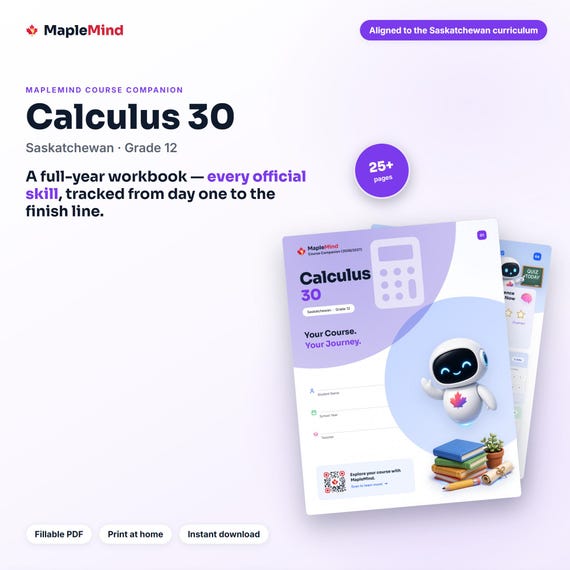
A Calculus 30 workbook worth keeping
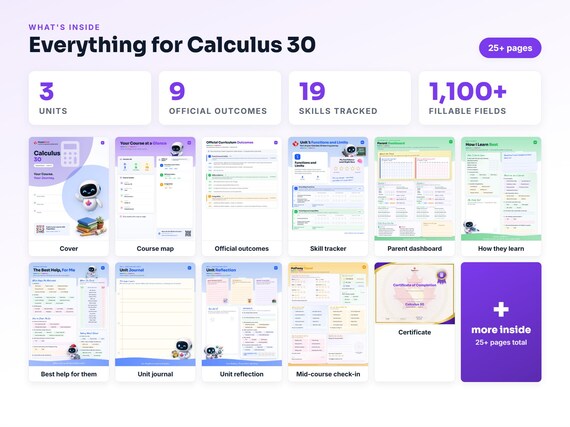
Built from the same official curriculum as this page. Before and after each skill above, your student colours in how sure they feel — so the two of you can see, on one page, what's clicking and what needs another look. It's a quiet way to follow how the year is really going.
By June it's full of their own handwriting: units worked through, confidence grown, a mid-year check-in, notes from parent-teacher night, and a certificate at the end. Less a worksheet, more a record of the year worth keeping on the shelf.
Instant download · see every page, reviews and the full description · five or more workbooks are $2.99 each
What it looks like in the app
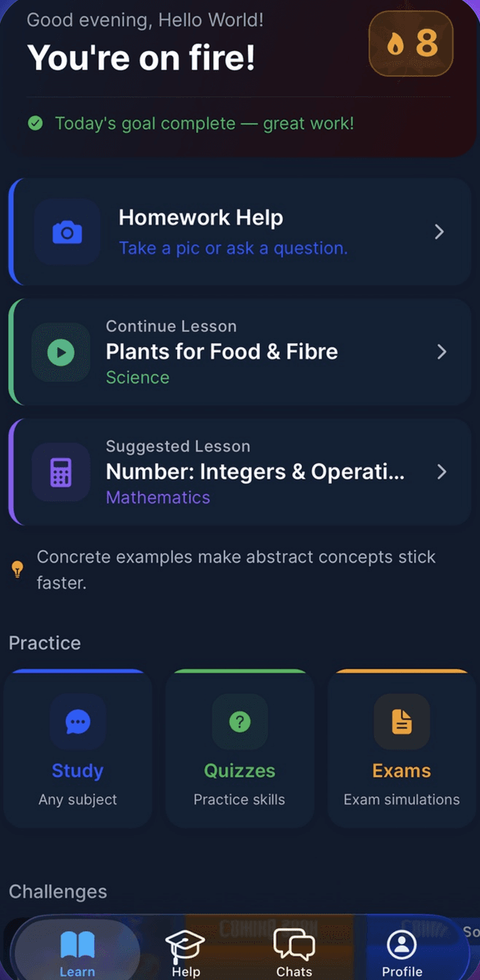
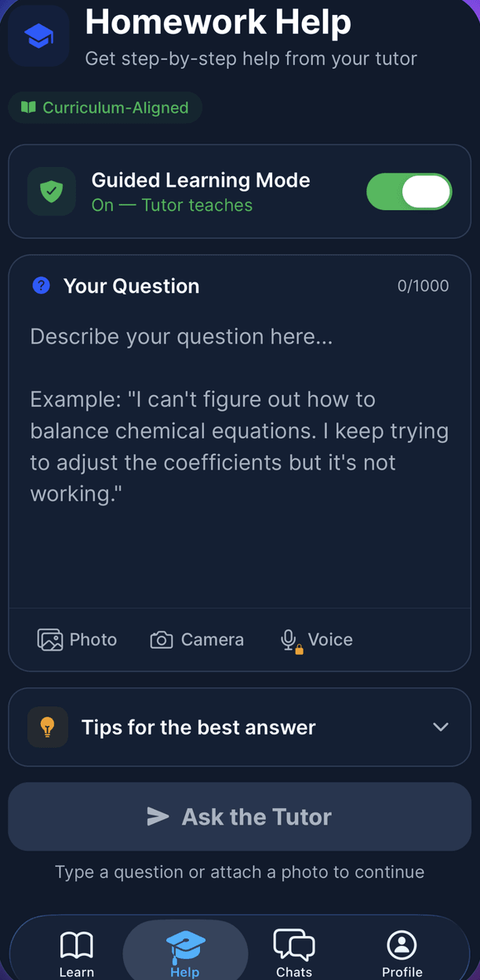
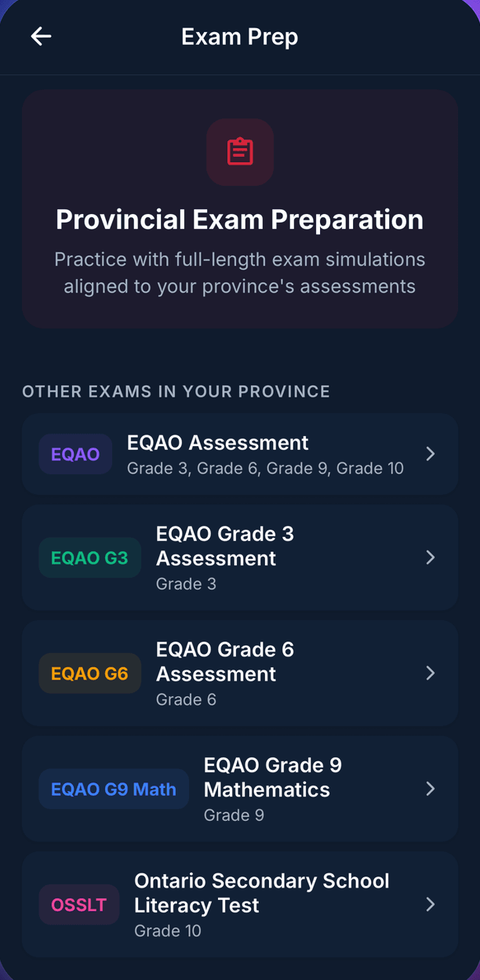
Common questions
Can MapleMind help me with Calculus 30?
Yes. MapleMind's AI tutor covers all 19 skills in Saskatchewan's Calculus 30 — you pick the exact skill, and the tutor teaches it step by step: a short lesson, a worked example, solving together, then a skill check to show it stuck.
Is MapleMind aligned to Saskatchewan's official curriculum?
Yes. Every skill in this course maps to an official outcome code from Saskatchewan's Grade 12 Mathematics curriculum, and the ministry's own wording is quoted under each unit on this page — with the official government source linked so you can check it yourself.
What does MapleMind cost?
It's free to start — 5 tutoring chats and a practice quiz every day, no credit card. A Pro subscription ($9.99/month or $49.99/year CAD, 7-day free trial) unlocks unlimited tutoring, practice, and exam simulations.
What if I'm stuck on just one topic?
That's the point of skill-level tutoring: open Calculus 30 in the app, tap the exact skill from the list on this page, and the tutor teaches just that — no wading through lessons you don't need.
Does MapleMind work in French or other languages?
Yes — 14 languages, including French. Both the app and the tutor's explanations switch to the language you choose.
Where can I see the official Saskatchewan curriculum for Calculus 30?
The official source is linked on this page — Saskatchewan's official curriculum. The outline here follows it: every MapleMind skill carries its official outcome code, and the ministry's own wording is quoted under each unit.
Keep exploring
Ready when you are
Pick a skill from this page and see it taught properly — free, in the browser, in under a minute.