Get help with Foundations of Mathematics 30
Most tutoring makes you sit through material you already know. MapleMind flips that: pick the exact skill that's causing trouble — any of the 23 below — and the tutor teaches just that one, step by step, as many times as it takes. Ask questions in plain words, any time of day, in English, French, or 12 other languages.
The official Saskatchewan Foundations of Mathematics 30 curriculum
Saskatchewan defines Foundations of Mathematics 30 by strands and outcomes. MapleMind teaches the same curriculum reorganized for one-skill-at-a-time tutoring — the table shows exactly where every official strand lands, and the ministry's own wording is quoted under each unit below.
Official source Saskatchewan's official curriculumRead it on the government site — curriculum.gov.sk.ca ↗| Official strand | Outcomes | Where MapleMind teaches it |
|---|---|---|
| Strand FM | 8 | Financial Mathematics · Logical Reasoning · Set Theory · Probability · Modelling Data with Functions · Research and Presentation Project |
Every skill below, taught one on one.
 Try the first session free
How MapleMind teaches Foundations of Mathematics 30 — every unit, lesson, and skill
Every skill below runs as a short session: a plain-words lesson, a worked example, solving it together, then a five-question skill check that earns up to three stars. Guided Mode keeps it teaching instead of answer-handing — turning it off needs a parent's password.
Unit 1Financial MathematicsOfficial strand · Strand FM
Making real financial decisions with math: renting, leasing, and buying; credit; compound interest; and building and comparing investment portfolios.
Rent, Lease, or Buy
- Renting, leasing, and buying large itemsFM30.1 — Compare renting, leasing, and buying large-cost items and solve situational cost-and-benefit questions about each choice.
Credit and Compound Interest
- Comparing credit optionsFM30.1 — Analyze different credit options that involve compound interest (bank cards, store cards, promotions) and justify a credit choice.
- Compound interest and the Rule of 72FM30.1 — Apply compound interest across different compounding periods, contrast it with simple interest, and use the Rule of 72.
Investment Portfolios
- Analyzing investment portfoliosFM30.1 — Analyze and compare investment portfolios, including the effect of regular contributions and long- versus short-term options, and make recommendations.
The official wording — 1 outcome in this unit
- FM30.1
financial decision making including analysis of: • renting, leasing, and buying
Unit 2Logical ReasoningOfficial strand · Strand FM
Inductive and deductive reasoning: conditional statements, biconditionals, truth tables and Venn diagrams, and strategy in puzzles and games.
Conditional Statements
- If-then statements and their variationsFM30.2 — Analyze if-then statements and write and evaluate their converse, inverse, and contrapositive, using counterexamples where false.
Biconditionals and Logical Arguments
- Biconditionals, truth tables, and Venn logicFM30.2 — Identify and use biconditional statements and solve logical-argument problems using truth tables or Venn diagrams.
Reasoning in Puzzles and Games
- Strategies for puzzles and gamesFM30.2 — Develop, verify, and critique problem-solving strategies for puzzles and games, and identify errors in solutions.
The official wording — 1 outcome in this unit
- FM30.2
inductive and deductive reasoning including: • analysis of conditional statements
Unit 3Set TheoryOfficial strand · Strand FM
Sets, Venn diagrams, and set notation, and using set operations to solve situational problems.
Sets and Venn Diagrams
- Sets, Venn diagrams, and set notationFM30.3 — Describe types of sets and represent relationships with Venn diagrams, naming regions with Boolean operators and set notation.
Set Operations and Problem Solving
- Solving problems with set operationsFM30.3 — Determine the complement, intersection, and union of sets and solve situational questions that involve sets.
The official wording — 1 outcome in this unit
- FM30.3
set theory and its applications.
Unit 4ProbabilityOfficial strand · Strand FM
Odds and probability, and the probability of two events that are mutually exclusive, non-mutually exclusive, dependent, or independent.
Odds and Probability
- Relating odds and probabilityFM30.4 — Explain the relationship between odds (part-part) and probability (part-whole) and convert between them.
- Solving and critiquing odds and probabilityFM30.4 — Solve contextual problems involving odds and probability and critique correct and incorrect uses of the terms.
Probability of Two Events
- Mutually exclusive and non-mutually exclusive eventsFM30.5 — Determine the probability of mutually exclusive and non-mutually exclusive events using the addition rule.
- Dependent and independent eventsFM30.5 — Determine the probability of dependent and independent events, including conditional probability given a previous event.
- Solving two-event probability problemsFM30.5 — Create and solve situational questions that combine mutually exclusive, non-mutually exclusive, dependent, and independent events.
Combinatorics
- The fundamental counting principle and factorialsFM30.6 — Develop and apply the fundamental counting principle and use factorial notation.
- PermutationsFM30.6 — Determine the number of permutations of n elements taken r at a time, including cases with non-distinguishable elements.
- CombinationsFM30.6 — Determine the number of combinations of n elements taken r at a time and distinguish combinations from permutations.
The official wording — 3 outcomes in this unit
- FM30.4
understanding of odds and probability.
- FM30.5
the probability of two events, including events that are: • mutually exclusive • non-mutually exclusive
- FM30.6
combinatorics including: • the fundamental counting principle
Unit 5Modelling Data with FunctionsOfficial strand · Strand FM
Representing and analyzing data using polynomial, exponential, logarithmic, and sinusoidal functions as modelling tools.
Modelling Data with Polynomial Functions
- Polynomial models of dataFM30.7 — Analyze graphs of polynomial functions and use technology to fit a polynomial model to data and interpret it.
Modelling Data with Exponential and Logarithmic Functions
- Exponential and logarithmic models of dataFM30.7 — Analyze graphs of exponential and logarithmic functions and use technology to fit them to data and interpret the models.
Modelling Data with Sinusoidal Functions
- Sinusoidal models of dataFM30.7 — Analyze graphs of sinusoidal functions and use technology to fit a sinusoidal model to cyclic data and interpret it.
The official wording — 1 outcome in this unit
- FM30.7
representation and analysis of data using: • polynomial functions of degree ≤ 3
Unit 6Research and Presentation ProjectOfficial strand · Strand FM
A staged research project: designing an inquiry, collecting and analyzing data, and presenting findings on a current event or area of interest.
Designing the Inquiry
- Planning a data-based inquiryFM30.8 — Frame a research question on a current event or area of interest and develop a rubric to assess the project.
Collecting and Analyzing Data
- Collecting and assessing dataFM30.8 — Collect primary or secondary data, assess its accuracy, reliability, and bias, and interpret it using statistical methods.
Presenting the Findings
- Presenting research findingsFM30.8 — Organize and deliver a presentation of research findings and conclusions, presenting multiple sides of any controversial issue.
The official wording — 1 outcome in this unit
- FM30.8
Research and give a presentation of a current event or an area of interest that requires data collection and analysis.
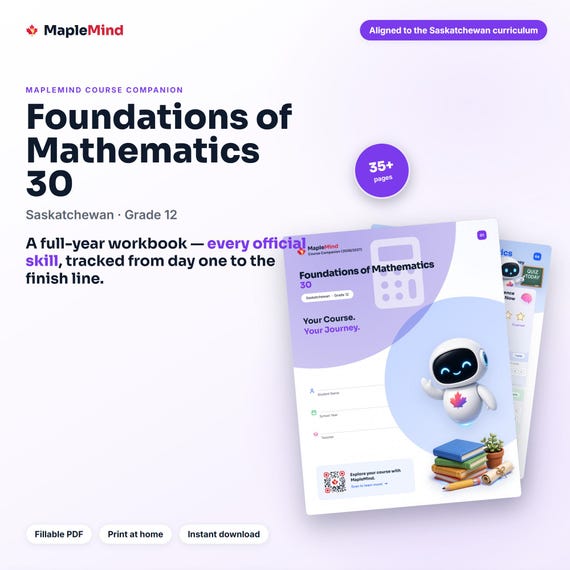
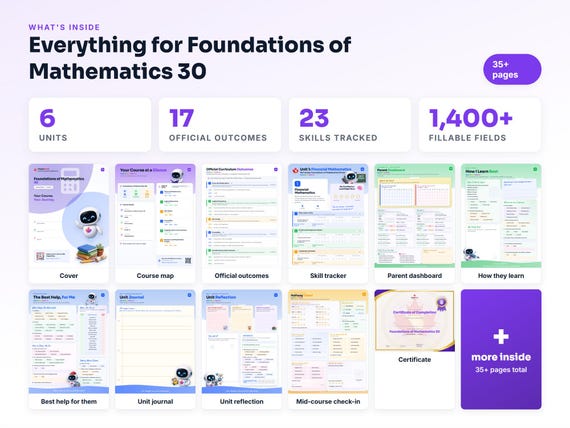
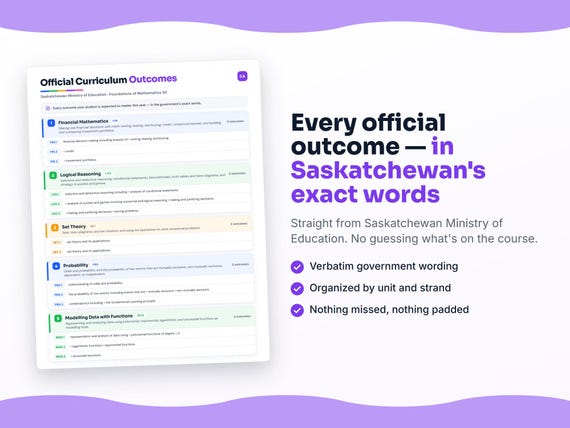

Printable workbook · A keepsake of the year
A Foundations of Mathematics 30 workbook worth keeping
Built from the same official curriculum as this page. Before and after each skill above, your student colours in how sure they feel — so the two of you can see, on one page, what's clicking and what needs another look. It's a quiet way to follow how the year is really going.
By June it's full of their own handwriting: units worked through, confidence grown, a mid-year check-in, notes from parent-teacher night, and a certificate at the end. Less a worksheet, more a record of the year worth keeping on the shelf.
Instant download · see every page, reviews and the full description · five or more workbooks are $2.99 each
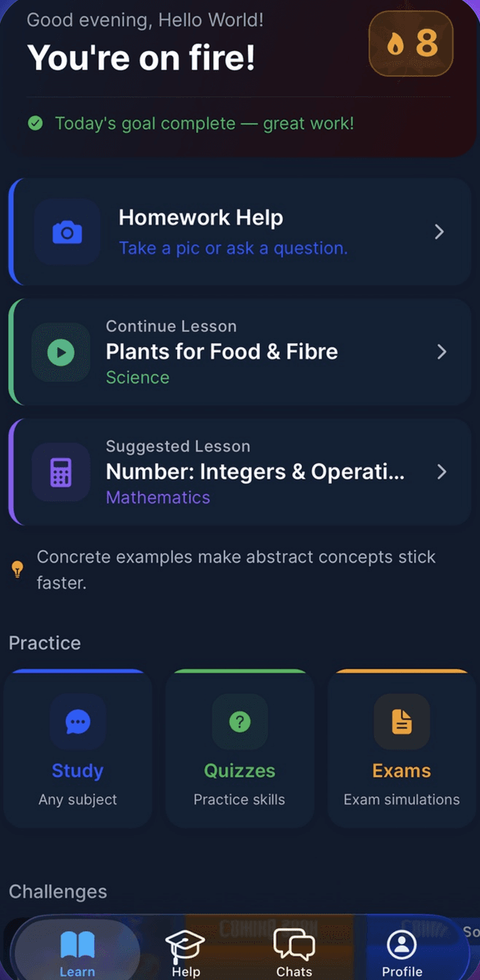
What it looks like in the app
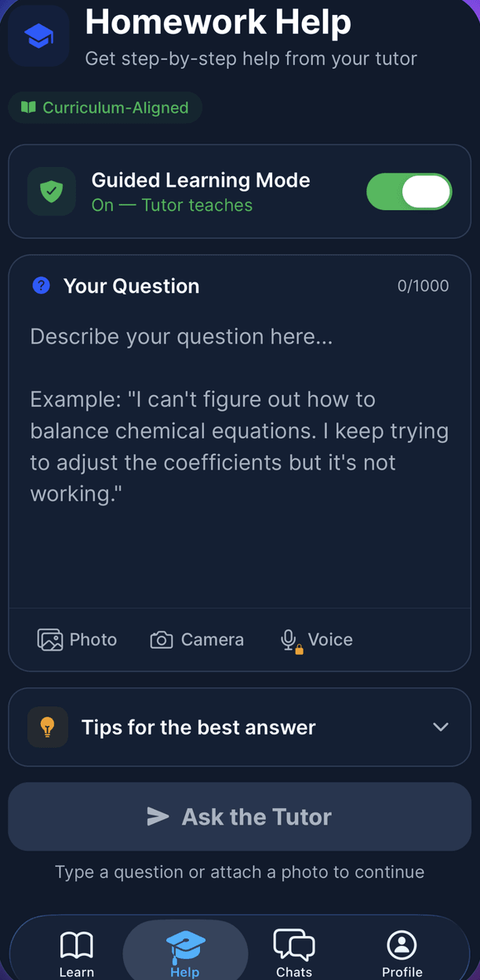
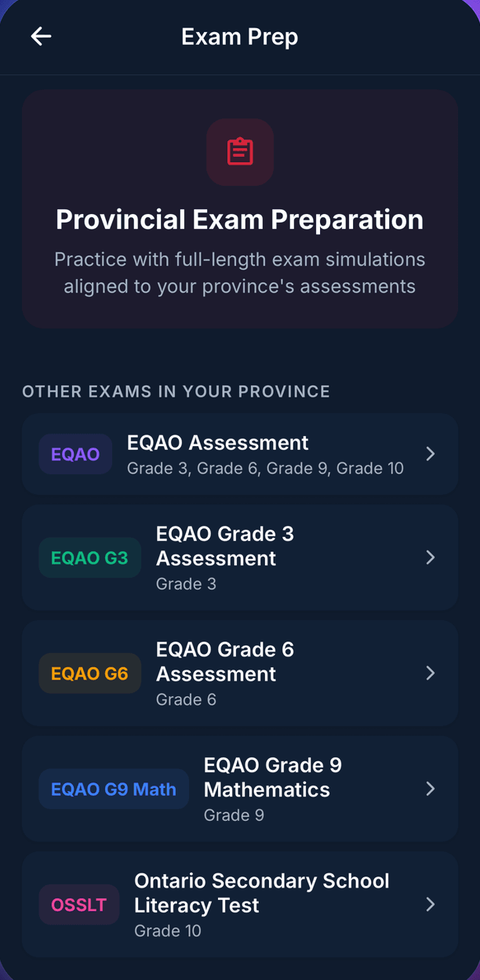
Common questions
Can MapleMind help me with Foundations of Mathematics 30?
Yes. MapleMind's AI tutor covers all 23 skills in Saskatchewan's Foundations of Mathematics 30 — you pick the exact skill, and the tutor teaches it step by step: a short lesson, a worked example, solving together, then a skill check to show it stuck.
Is MapleMind aligned to Saskatchewan's official curriculum?
Yes. Every skill in this course maps to an official outcome code from Saskatchewan's Grade 12 Mathematics curriculum, and the ministry's own wording is quoted under each unit on this page — with the official government source linked so you can check it yourself.
What does MapleMind cost?
It's free to start — 5 tutoring chats and a practice quiz every day, no credit card. A Pro subscription ($9.99/month or $49.99/year CAD, 7-day free trial) unlocks unlimited tutoring, practice, and exam simulations.
What if I'm stuck on just one topic?
That's the point of skill-level tutoring: open Foundations of Mathematics 30 in the app, tap the exact skill from the list on this page, and the tutor teaches just that — no wading through lessons you don't need.
Does MapleMind work in French or other languages?
Yes — 14 languages, including French. Both the app and the tutor's explanations switch to the language you choose.
Where can I see the official Saskatchewan curriculum for Foundations of Mathematics 30?
The official source is linked on this page — Saskatchewan's official curriculum. The outline here follows it: every MapleMind skill carries its official outcome code, and the ministry's own wording is quoted under each unit.
Keep exploring
Ready when you are
Pick a skill from this page and see it taught properly — free, in the browser, in under a minute.