

Get help with Law 30
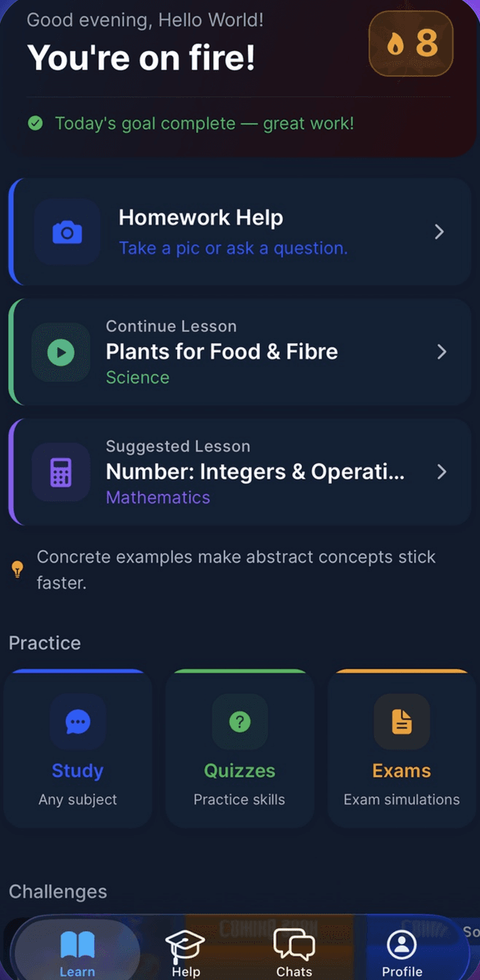
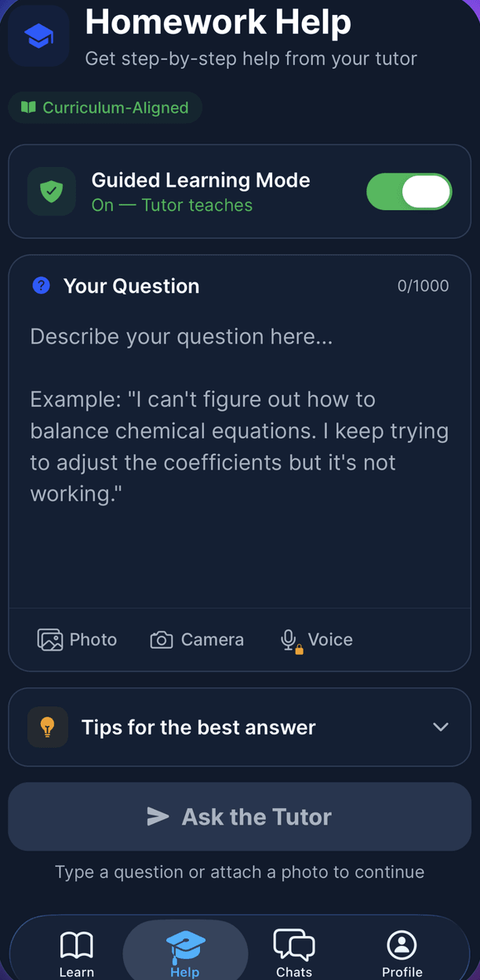
Most tutoring makes you sit through material you already know. MapleMind flips that: pick the exact skill that's causing trouble — any of the 18 below — and the tutor teaches just that one, step by step, as many times as it takes. Ask questions in plain words, any time of day, in English, French, or 12 other languages.
The official Saskatchewan Law 30 curriculum
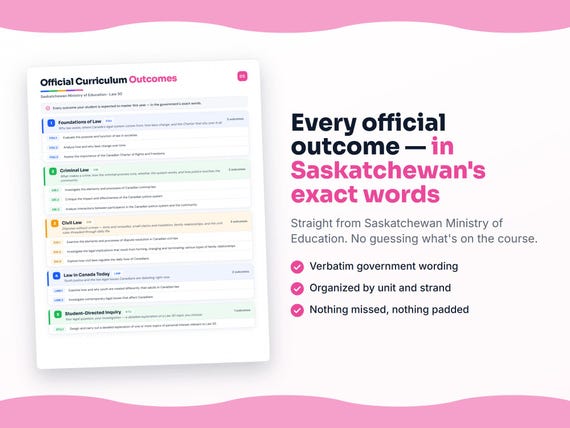
Saskatchewan defines Law 30 by strands and outcomes. MapleMind teaches the same curriculum reorganized for one-skill-at-a-time tutoring — the table shows exactly where every official strand lands, and the ministry's own wording is quoted under each unit below.
Official source Saskatchewan's official curriculumRead it on the government site — curriculum.gov.sk.ca ↗| Official strand | Outcomes | Where MapleMind teaches it |
|---|---|---|
| Strand FL | 3 | Foundations of Law |
| Strand CR | 3 | Criminal Law |
| Strand CV | 3 | Civil Law |
| Strand LT | 2 | Law in Canada Today |
| Strand SI | 1 | Student-Directed Inquiry |
Every skill below, taught one on one.
 Try the first session free
How MapleMind teaches Law 30 — every unit, lesson, and skill
Every skill below runs as a short session: a plain-words lesson, a worked example, solving it together, then a five-question skill check that earns up to three stars. Guided Mode keeps it teaching instead of answer-handing — turning it off needs a parent's password.
Unit 1Foundations of LawOfficial strand · Strand FL
Why law exists, where Canada's legal system comes from, how laws change, and the Charter that sits over it all.
Why Law Exists and Where Ours Comes From
- The purpose and function of lawLAW30-FL1 — Evaluate why societies build law — the worldviews behind legal systems, the order-versus-freedom debate, the rule of law in democracies, and the difference between equality and equity in justice.
- Canada's legal foundations and safeguardsLAW30-FL1 — Trace Canada's legal system to its sources — the Constitution and Charter, treaties, the Indian Act, and case law — its roots in Indigenous legal systems, British common law, and Québec's Civil Code, and the safeguards that protect Canadians from abuse of power.
How Laws Change
- The machinery of legal changeLAW30-FL2 — Analyze how and why Canadian laws change — the social forces behind landmark changes like the abolition of the death penalty, the law-making process at local, provincial, and federal levels, the three branches of government, and how to plan for change yourself.
- Treaties, reconciliation, and the lawLAW30-FL2 — Investigate the evolving legal relationship between First Nations, Métis, and Inuit peoples and non-Indigenous Canadians — treaty promises and land entitlement, differing understandings of the treaties, truth and reconciliation, and traditional restorative practices.
The Charter of Rights and Freedoms
- The Charter's structure and famous clausesLAW30-FL3 — Assess the Charter as a legal instrument — why it entered the Constitution in 1982, how it balances individual and societal rights, its structure and jurisdiction, and the reasonable-limits and notwithstanding clauses.
- Rights protection in practiceLAW30-FL3 — Assess how rights get protected in practice — the bodies that guard them in Saskatchewan, how courts reshape laws in the Charter's light, the struggles of groups seeking recognition, and what you can do if your own rights are violated.
The official wording — 3 outcomes in this unit
- LAW30-FL1
Evaluate the purpose and function of law in societies
- LAW30-FL2
Analyze how and why laws change over time
- LAW30-FL3
Assess the importance of the Canadian Charter of Rights and Freedoms
Unit 2Criminal LawOfficial strand · Strand CR
What makes a crime, how the criminal process runs, whether the system works, and how justice touches the community.
What Makes a Crime
- Elements of a crime, offence types, and defencesLAW30-CR1 — Investigate what makes a crime — the Criminal Code's definition, indictable versus summary versus hybrid offences, mens rea and actus reus in real cases, and the defences available to the accused.
- The criminal process and its institutionsLAW30-CR1 — Follow a criminal case through the system — court jurisdictions, the institutions from police to corrections, Saskatchewan's levels of policing, and the full process from investigation and arrest through trial, sentencing, and appeal.
Does the System Work?
- Sentencing goals, options, and alternativesLAW30-CR2 — Weigh the goals of sentencing — rehabilitation, deterrence, reparation — against the options: discharges, conditional sentences, incarceration, parole, probation, and the plea bargains that resolve most cases.
- Critiquing the system — causes, Gladue, and outcomesLAW30-CR2 — Critique the system's effectiveness — the root causes of crime, whether imprisonment changes behaviour, the over-representation of Indigenous people and the Gladue factors courts must weigh, correctional programs, and the Jordan decision's trial-delay limits.
Justice and the Community
- The justice system in the communityLAW30-CR3 — Analyze how the justice system and community interact — crime's impact on victims and families, systemic barriers like racial profiling and court delays, reintegration supports for offenders, and responses to wrongful imprisonment.
The official wording — 3 outcomes in this unit
- LAW30-CR1
Investigate the elements and processes of Canadian criminal law
- LAW30-CR2
Critique the impact and effectiveness of the Canadian justice system
- LAW30-CR3
Analyze interactions between participants in the Canadian justice system and the community
Unit 3Civil LawOfficial strand · Strand CV
Disputes without crimes — torts and remedies, small claims and mediation, family relationships, and the civil rules threaded through daily life.
Civil Disputes and Torts
- Civil law basics, torts, and remediesLAW30-CV1 — Examine civil law's foundations — how it differs from criminal law, the case types from torts to wills, when a civil action makes sense, intentional and unintentional torts with their defences, and the remedies courts can order.
- Small claims, ADR, class actions, and inquiriesLAW30-CV1 — Assess the pathways for resolving civil disputes — small claims court with Saskatchewan's own templates, negotiation, mediation, arbitration, and tribunals, class actions, and public inquiries like the National Inquiry into MMIWG.
Family Law
- The legal life of family relationshipsLAW30-CV2 — Investigate the legal implications of forming, changing, and ending family relationships — marriage and common-law status, custody and support obligations, and how the law follows the family through change.
Civil Law in Daily Life
- The civil rules of ordinary lifeLAW30-CV3 — Explore how civil laws regulate the daily lives of Canadians — contracts you already sign, employment standards at your first job, consumer protection, and property rules.
The official wording — 3 outcomes in this unit
- LAW30-CV1
Examine the elements and processes of dispute resolution in Canadian civil law
- LAW30-CV2
Investigate the legal implications that result from forming, changing and terminating various types of family relationships
- LAW30-CV3
Explore how civil laws regulate the daily lives of Canadians
Unit 4Law in Canada TodayOfficial strand · Strand LT
Youth justice and the live legal issues Canadians are debating right now.
Youth and the Law
- Why youth are treated differentlyLAW30-LT1 — Examine how and why young people are treated differently than adults in Canadian law — the Youth Criminal Justice Act's principles, protections, and consequences.
Contemporary Legal Issues
- Investigating live legal issuesLAW30-LT2 — Investigate contemporary legal issues affecting Canadians — from digital privacy and online harm to climate litigation — mapping the positions, the stakes, and the law's current answer.
The official wording — 2 outcomes in this unit
- LAW30-LT1
Examine how and why youth are treated differently than adults in Canadian law
- LAW30-LT2
Investigate contemporary legal issues that affect Canadians
Unit 5Student-Directed InquiryOfficial strand · Strand SI
Your legal question, your investigation — a detailed exploration of a Law 30 topic you choose.
Your Legal Inquiry
- Designing and carrying out a legal inquiryLAW30-SI1 — Design and carry out a detailed exploration of one or more Law 30 topics of personal interest — a focused question, a research plan, credible legal sources, and presented findings.
The official wording — 1 outcome in this unit
- LAW30-SI1
Design and carry out a detailed exploration of one or more topics of personal interest relevant to Law 30
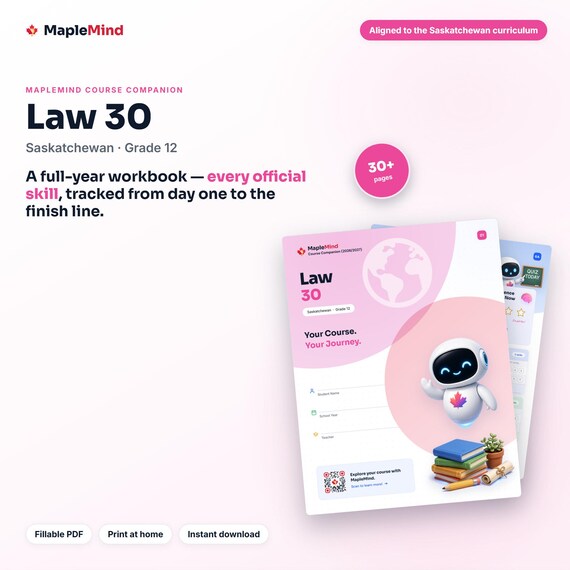
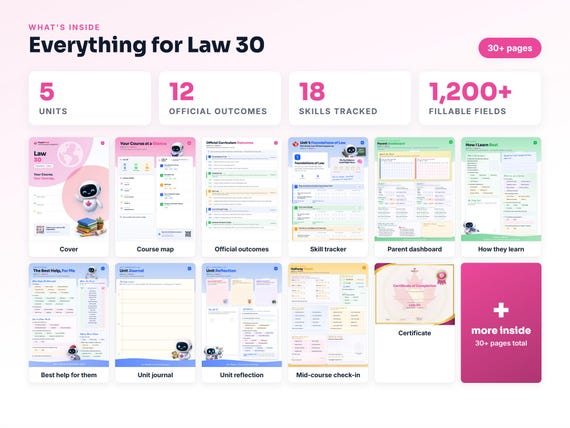
Printable workbook · A keepsake of the year
A Law 30 workbook worth keeping
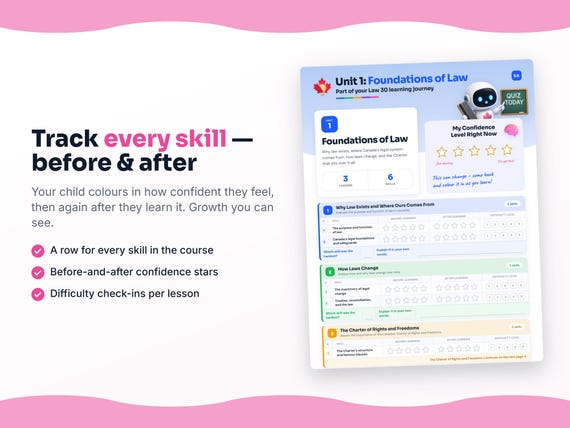
Built from the same official curriculum as this page. Before and after each skill above, your student colours in how sure they feel — so the two of you can see, on one page, what's clicking and what needs another look. It's a quiet way to follow how the year is really going.
By June it's full of their own handwriting: units worked through, confidence grown, a mid-year check-in, notes from parent-teacher night, and a certificate at the end. Less a worksheet, more a record of the year worth keeping on the shelf.
Instant download · see every page, reviews and the full description · five or more workbooks are $2.99 each
What it looks like in the app
Common questions
Can MapleMind help me with Law 30?
Yes. MapleMind's AI tutor covers all 18 skills in Saskatchewan's Law 30 — you pick the exact skill, and the tutor teaches it step by step: a short lesson, a worked example, solving together, then a skill check to show it stuck.
Is MapleMind aligned to Saskatchewan's official curriculum?
Yes. Every skill in this course maps to an official outcome code from Saskatchewan's Grade 12 Social Studies curriculum, and the ministry's own wording is quoted under each unit on this page — with the official government source linked so you can check it yourself.
What does MapleMind cost?
It's free to start — 5 tutoring chats and a practice quiz every day, no credit card. A Pro subscription ($9.99/month or $49.99/year CAD, 7-day free trial) unlocks unlimited tutoring, practice, and exam simulations.
What if I'm stuck on just one topic?
That's the point of skill-level tutoring: open Law 30 in the app, tap the exact skill from the list on this page, and the tutor teaches just that — no wading through lessons you don't need.
Does MapleMind work in French or other languages?
Yes — 14 languages, including French. Both the app and the tutor's explanations switch to the language you choose.
Where can I see the official Saskatchewan curriculum for Law 30?
The official source is linked on this page — Saskatchewan's official curriculum. The outline here follows it: every MapleMind skill carries its official outcome code, and the ministry's own wording is quoted under each unit.
Keep exploring
Ready when you are
Pick a skill from this page and see it taught properly — free, in the browser, in under a minute.