Get help with Mathematics, Secondary 5 (Technical and Scientific)
Most tutoring makes you sit through material you already know. MapleMind flips that: pick the exact skill that's causing trouble — any of the 70 below — and the tutor teaches just that one, step by step, as many times as it takes. Ask questions in plain words, any time of day, in English, French, or 12 other languages.
The official Quebec Mathematics, Secondary 5 (Technical and Scientific) curriculum
Quebec defines Mathematics, Secondary 5 (Technical and Scientific) by strands and outcomes. MapleMind teaches the same curriculum reorganized for one-skill-at-a-time tutoring — the table shows exactly where every official strand lands, and the ministry's own wording is quoted under each unit below.
Official source Québec's official education programRead it on the government site — quebec.ca ↗| Official strand | Outcomes | Where MapleMind teaches it |
|---|---|---|
| Strand A | 3 | Arithmetic |
| Strand B | 31 | Algebra |
| Strand E | 18 | Geometry |
| Strand F | 14 | Analytic Geometry |
| Strand G | 4 | Discrete Mathematics |
Every skill below, taught one on one.
 Try the first session free
How MapleMind teaches Mathematics, Secondary 5 (Technical and Scientific) — every unit, lesson, and skill
Every skill below runs as a short session: a plain-words lesson, a worked example, solving it together, then a five-question skill check that earns up to three stars. Guided Mode keeps it teaching instead of answer-handing — turning it off needs a parent's password.
Unit 1ArithmeticOfficial strand · Strand A
The PDA Arithmetic branch, taught in the Technical and Scientific sequence register (mathematics tied to technical instruments, measurement and case studies (Quebec TS program: "design, operation or use of certain technical instruments", identifying errors and anomalies)).
Writes numbers in logarithmic notation
- Writes numbers in logarithmic notation using the equivalence log_a x = n ⇔ a^n = xARITH.N11.h — The student carries out: numbers in logarithmic notation using the equivalence loga x = n an = x, if necessary — in Technical and Scientific contexts (run the technical procedure precisely, checking the measurement and catching anomalies).
Manipulates numerical expressions involving powers, radicals and logarithms
- Manipulates numerical expressions involving powers (change of base), exponents and radicals (nth root), using their propertiesARITH.N14.b — The student carries out: powers of bases (change of base), exponents, radicals (nth root), using their properties — in Technical and Scientific contexts (run the technical procedure precisely, checking the measurement and catching anomalies).
- Manipulates numerical expressions involving logarithmsARITH.N14.c.ii — The student carries out: logarithms — in Technical and Scientific contexts (run the technical procedure precisely, checking the measurement and catching anomalies).
The official wording — 3 outcomes in this unit
- ARITH.N11.h
numbers in logarithmic notation using the equivalence loga x = n an = x, if necessary
- ARITH.N14.b
powers of bases (change of base), exponents, radicals (nth root), using their properties
- ARITH.N14.c.ii
logarithms
Unit 2AlgebraOfficial strand · Strand B
The PDA Algebra branch, taught in the Technical and Scientific sequence register (mathematics tied to technical instruments, measurement and case studies (Quebec TS program: "design, operation or use of certain technical instruments", identifying errors and anomalies)).
Interprets parameters and solves systems of inequalities
- Interprets the role of a parameter in an algebraic expressionALG.N4.c — The student carries out: parameter — in Technical and Scientific contexts (run the technical procedure precisely, checking the measurement and catching anomalies).
- Solves systems of first-degree inequalities in two variablesALG.N4.a.4 — The student carries out: of first-degree inequalities in two variables — in Technical and Scientific contexts (run the technical procedure precisely, checking the measurement and catching anomalies).
- Solves inequalities involving various functional models (mostly graphical solutions)ALG.N4.b.2 — The student carries out: involving various functional models (mostly graphical solutions) — in Technical and Scientific contexts (run the technical procedure precisely, checking the measurement and catching anomalies).
- Interprets parameters (multiplicative or additive) and describes the effect of changing their valuesALG.N4.2 — The student carries out: Interprets parameters (multiplicative or additive) and describes the effect of changing — in Technical and Scientific contexts (run the technical procedure precisely, checking the measurement and catching anomalies).
Factors by completing the square and manipulates expressions
- Factors by completing the square (switching from one type of notation to another)ALG.N6.c — The student carries out: completing the square (factoring and switching from one type of notation to another) — in Technical and Scientific contexts (run the technical procedure precisely, checking the measurement and catching anomalies).
- Manipulates expressions involving additive parametersALG.N6.b.2 — The student carries out: additive parameters — in Technical and Scientific contexts (run the technical procedure precisely, checking the measurement and catching anomalies).
- Determines values or data by solving equations and inequalitiesALG.N6.4 — The student carries out: Determines values or data by solving equations and inequalities — in Technical and Scientific contexts (run the technical procedure precisely, checking the measurement and catching anomalies).
Solves equations and inequalities in one variable
- Solves second-degree equations and inequalities in one variableALG.N11.a — The student carries out: second-degree — in Technical and Scientific contexts (run the technical procedure precisely, checking the measurement and catching anomalies).
- Solves exponential, logarithmic and square root equations and inequalities using the properties of exponents, logarithms and radicalsALG.N11.b — The student carries out: exponential, logarithmic or square root, using the properties of exponents, logarithms and radicals — in Technical and Scientific contexts (run the technical procedure precisely, checking the measurement and catching anomalies).
- Solves rational equations and inequalities in one variableALG.N11.c — The student carries out: rational — in Technical and Scientific contexts (run the technical procedure precisely, checking the measurement and catching anomalies).
- Solves first-degree trigonometric equations involving a sine, cosine or tangent expressionALG.N11.e — The student carries out: first-degree trigonometric involving a sine, cosine or tangent expression — in Technical and Scientific contexts (run the technical procedure precisely, checking the measurement and catching anomalies).
Solves a second-degree equation in two variables
- Solves a second-degree equation in two variablesALG.N12 — The student carries out: Solves a second-degree equation in two variables — in Technical and Scientific contexts (run the technical procedure precisely, checking the measurement and catching anomalies).
Analyzes a second-degree inequality in two variables
- Analyzes a second-degree inequality in two variablesALG.N14.b — The student carries out: second-degree inequality in two variables — in Technical and Scientific contexts (run the technical procedure precisely, checking the measurement and catching anomalies).
Analyzes and models situations to be optimized
- Solves inequalities when analyzing a situation to be optimizedALG.N1.b.2 — The student carries out: inequalities — in Technical and Scientific contexts (run the technical procedure precisely, checking the measurement and catching anomalies).
- Models a situation verbally, algebraically, graphically, using a table of values or a scatter plotALG.N1.5 — The student carries out: Models a situation verbally, algebraically, graphically, using a table of values or a scatter — in Technical and Scientific contexts (run the technical procedure precisely, checking the measurement and catching anomalies).
Optimizes a situation under constraints
- Uses inequalities when optimizing a situationALG.N2.b — The student carries out: inequalities — in Technical and Scientific contexts (run the technical procedure precisely, checking the measurement and catching anomalies).
- Optimizes a situation by taking into account different constraints and makes decisions with respect to this situation determining the best solution(s) for a particular situation, given a set of possibilities validating and interpreting the optimal solution, depending on the context justifying the solution(s) chosen changing certain conditions associated with the situation to provide a more optimal solution, if necessaryALG.N2.3 — The student carries out: Optimizes a situation by taking into account different constraints and makes decisions with respect to this situation determining the best solution(s) for a particular situation, given a set of possibilities validating and interpreting the optimal solution, depending on the context justifying the solution(s) chosen changing certain conditions associated with the situation to provide a more optimal solution, if necessary — in Technical and Scientific contexts (run the technical procedure precisely, checking the measurement and catching anomalies).
- Finds the rule of a function or its inverse, depending on the contextALG.N2.5 — The student carries out: Finds the rule of a function or its inverse, depending on the context — in Technical and Scientific contexts (run the technical procedure precisely, checking the measurement and catching anomalies).
Solves systems combining first- and second-degree equations
- Solves systems composed of a first-degree equation and a second-degree equation in two variablesALG.N3.c — The student carries out: composed of a first-degree equation in two variables and a second-degree equation in two variables — in Technical and Scientific contexts (run the technical procedure precisely, checking the measurement and catching anomalies).
- Solves systems involving various functional models (mostly graphical solutions)ALG.N3.e — The student carries out: involving various functional models (mostly graphical solutions) — in Technical and Scientific contexts (run the technical procedure precisely, checking the measurement and catching anomalies).
- Represents and interprets the inverse of a functionALG.N3.5 — The student carries out: Represents and interprets the inverse — in Technical and Scientific contexts (run the technical procedure precisely, checking the measurement and catching anomalies).
Performs operations on functions (including composition)
- Performs operations on functions (including composition)ALG.N7.4 — The student carries out: Performs operations on functions (including composition) — in Technical and Scientific contexts (run the technical procedure precisely, checking the measurement and catching anomalies).
- Interpolates and extrapolates data, if applicableALG.N7.5 — The student carries out: Interpolates and extrapolates data, if applicable — in Technical and Scientific contexts (run the technical procedure precisely, checking the measurement and catching anomalies).
Analyzes second-degree polynomial functions
- Analyzes second-degree polynomial functions of the form f(x) = ax² + bx + c, f(x) = a(b(x – h))² + k or f(x) = a(x – x₁)(x – x₂)ALG.b.iii — The student carries out: f(x) = ax2+ bx + c, f(x) = a(b(x – h))2 + k, f(x) = a(x – x1)(x – x2) — in Technical and Scientific contexts (run the technical procedure precisely, checking the measurement and catching anomalies).
Analyzes square root functions of the form f(x) = a√b(x – h) + k
- Analyzes square root functions of the form f(x) = a√b(x – h) + kALG.c.ii — The student carries out: f(x) = a b(x – h)+ k — in Technical and Scientific contexts (run the technical procedure precisely, checking the measurement and catching anomalies).
Analyzes rational functions of the form f(x) = (ax + b)/(cx + d)
- Analyzes rational functions of the form f(x) = (ax + b)/(cx + d)ALG.d.ii — The student carries out: ax + b — in Technical and Scientific contexts (run the technical procedure precisely, checking the measurement and catching anomalies).
Analyzes exponential functions of the form f(x) = a·c^(b(x – h)) + k
- Analyzes exponential functions of the form f(x) = a·c^(b(x – h)) + kALG.e.iii — The student carries out: f(x) = acb(x – h) + k — in Technical and Scientific contexts (run the technical procedure precisely, checking the measurement and catching anomalies).
Analyzes logarithmic functions of the form f(x) = a log_c b(x – h) + k
- Analyzes logarithmic functions of the form f(x) = a log_c b(x – h) + kALG.f.iii — The student carries out: f(x) = a logc b(x – h) + k — in Technical and Scientific contexts (run the technical procedure precisely, checking the measurement and catching anomalies).
Analyzes greatest-integer functions of the form f(x) = a[b(x – h)] + k
- Analyzes greatest-integer functions of the form f(x) = a[b(x – h)] + kALG.j.ii — The student carries out: f(x) = a[b(x – h)] + k — in Technical and Scientific contexts (run the technical procedure precisely, checking the measurement and catching anomalies).
Analyzes sinusoidal and tangent functions
- Analyzes sinusoidal functions of the form f(x) = a sin b(x – h) + k or f(x) = a cos b(x – h) + kALG.k.ii — The student carries out: sinusoidal : f(x) = a sin b(x – h) + k, f(x) = a cos b(x – h) + k — in Technical and Scientific contexts (run the technical procedure precisely, checking the measurement and catching anomalies).
- Analyzes tangent functions of the form f(x) = a tan b(x – h) + kALG.k.iii — The student carries out: tangent : f(x) = a tan b(x – h) + k — in Technical and Scientific contexts (run the technical procedure precisely, checking the measurement and catching anomalies).
The official wording — 31 outcomes in this unit
- ALG.N4.c
parameter
- ALG.N4.a.4
of first-degree inequalities in two variables
- ALG.N4.b.2
involving various functional models (mostly graphical solutions)
- ALG.N4.2
Interprets parameters (multiplicative or additive) and describes the effect of changing
- ALG.N6.c
completing the square (factoring and switching from one type of notation to another)
- ALG.N6.b.2
additive parameters
- ALG.N6.4
Determines values or data by solving equations and inequalities
- ALG.N11.a
second-degree
- ALG.N11.b
exponential, logarithmic or square root, using the properties of exponents, logarithms and radicals
- ALG.N11.c
rational
- ALG.N11.e
first-degree trigonometric involving a sine, cosine or tangent expression
- ALG.N12
Solves a second-degree equation in two variables
- ALG.N14.b
second-degree inequality in two variables
- ALG.N1.b.2
inequalities
- ALG.N1.5
Models a situation verbally, algebraically, graphically, using a table of values or a scatter
- ALG.N2.b
inequalities
- ALG.N2.3
Optimizes a situation by taking into account different constraints and makes decisions with respect to this situation determining the best solution(s) for a particular situation, given a set of possibilities validating and interpreting the optimal solution, depending on the context justifying the solution(s) chosen changing certain conditions associated with the situation to provide a more optimal solution, if necessary
- ALG.N2.5
Finds the rule of a function or its inverse, depending on the context
- ALG.N3.c
composed of a first-degree equation in two variables and a second-degree equation in two variables
- ALG.N3.e
involving various functional models (mostly graphical solutions)
- ALG.N3.5
Represents and interprets the inverse
- ALG.N7.4
Performs operations on functions (including composition)
- ALG.N7.5
Interpolates and extrapolates data, if applicable
- ALG.b.iii
f(x) = ax2+ bx + c, f(x) = a(b(x – h))2 + k, f(x) = a(x – x1)(x – x2)
- ALG.c.ii
f(x) = a b(x – h)+ k
- ALG.d.ii
ax + b
- ALG.e.iii
f(x) = acb(x – h) + k
- ALG.f.iii
f(x) = a logc b(x – h) + k
- ALG.j.ii
f(x) = a[b(x – h)] + k
- ALG.k.ii
sinusoidal : f(x) = a sin b(x – h) + k, f(x) = a cos b(x – h) + k
- ALG.k.iii
tangent : f(x) = a tan b(x – h) + k
Unit 3GeometryOfficial strand · Strand E
The PDA Geometry branch, taught in the Technical and Scientific sequence register (mathematics tied to technical instruments, measurement and case studies (Quebec TS program: "design, operation or use of certain technical instruments", identifying errors and anomalies)).
Recognizes equivalent figures (plane figures or solids)
- Recognizes equivalent figures (plane figures or solids)GEOM.N7.3 — The student carries out: Recognizes equivalent figures (plane figures or solids) — in Technical and Scientific contexts (run the technical procedure precisely, checking the measurement and catching anomalies).
- Determines the correspondence between degrees and radiansGEOM.N7.4 — The student carries out: Determines the correspondence between degrees and radians — in Technical and Scientific contexts (run the technical procedure precisely, checking the measurement and catching anomalies).
Defines the concept of radian
- Defines the concept of radianGEOM.N6.4 — The student carries out: Defines the concept of radian — in Technical and Scientific contexts (run the technical procedure precisely, checking the measurement and catching anomalies).
- Determines the area of equivalent figuresGEOM.N6.h — The student carries out: area of equivalent figures — in Technical and Scientific contexts (run the technical procedure precisely, checking the measurement and catching anomalies).
- Determines the volume of equivalent solidsGEOM.N6.d.2 — The student carries out: volume of equivalent solids — in Technical and Scientific contexts (run the technical procedure precisely, checking the measurement and catching anomalies).
- Analyzes and models situations using vectors (e.g. displacements, forces, speeds or velocities)GEOM.N6.6 — The student carries out: Analyzes and models situations using vectors (e.g. displacements, forces, speeds or velocities) — in Technical and Scientific contexts (run the technical procedure precisely, checking the measurement and catching anomalies).
Determines measures of segments or perimeters in equivalent figures
- Determines measures of segments or perimeters in equivalent figuresGEOM.N5.d — The student carries out: segments or perimeters resulting from equivalent figures — in Technical and Scientific contexts (run the technical procedure precisely, checking the measurement and catching anomalies).
Determines metric relations and defines vectors
- Determines, through exploration or deduction, different metric relations associated with plane figuresGEOM.N1.11 — The student carries out: Determines, through exploration or deduction, different metric relations associated with plane figures — in Technical and Scientific contexts (run the technical procedure precisely, checking the measurement and catching anomalies).
- Defines a vector: magnitude (length or norm), direction, senseGEOM.N1.12 — The student carries out: Defines a vector: magnitude (length or norm), direction, sense — in Technical and Scientific contexts (run the technical procedure precisely, checking the measurement and catching anomalies).
Uses the cosine law and represents vectors graphically
- Finds unknown measurements using the cosine lawGEOM.N2.b.ii — The student carries out: cosine law — in Technical and Scientific contexts (run the technical procedure precisely, checking the measurement and catching anomalies).
- Represents a vector graphically (arrow in a plane or pair in a Cartesian plane)GEOM.N2.11 — The student carries out: Represents a vector graphically (arrow in a plane or pair in a Cartesian plane) — in Technical and Scientific contexts (run the technical procedure precisely, checking the measurement and catching anomalies).
Determines measures in a circle: arcs, chords and angles
- Determines measures in a circle: arcs, chords, inscribed angles, interior angles and exterior anglesGEOM.c — The student carries out: in a circle: measure of arcs, chords, inscribed angles, interior angles and exterior angles — in Technical and Scientific contexts (run the technical procedure precisely, checking the measurement and catching anomalies).
Proves trigonometric identities and performs vector operations
- Proves trigonometric identities by using algebraic properties, definitions (sine, cosine, tangent, cosecant, secant, cotangent), Pythagorean identities, and the properties of periodicity and symmetryGEOM.N4.8 — The student carries out: Proves trigonometric identities by using algebraic properties, definitions (sine, cosine, tangent, cosecant, secant, cotangent), Pythagorean identities, and the properties of periodicity and symmetry — in Technical and Scientific contexts (run the technical procedure precisely, checking the measurement and catching anomalies).
- Determines the resultant or projection of a vectorGEOM.N4.a.3 — The student carries out: determination of the resultant or projection of a vector — in Technical and Scientific contexts (run the technical procedure precisely, checking the measurement and catching anomalies).
- Adds and subtracts vectorsGEOM.N4.b.3 — The student carries out: addition and subtraction of vectors — in Technical and Scientific contexts (run the technical procedure precisely, checking the measurement and catching anomalies).
- Multiplies a vector by a scalarGEOM.N4.c.2 — The student carries out: multiplication of a vector by a scalar — in Technical and Scientific contexts (run the technical procedure precisely, checking the measurement and catching anomalies).
- Calculates the scalar product of two vectorsGEOM.N4.d — The student carries out: scalar product of two vectors — in Technical and Scientific contexts (run the technical procedure precisely, checking the measurement and catching anomalies).
Identifies properties of vectors
- Identifies properties of vectorsGEOM.N3.11 — The student carries out: Identifies properties of vectors — in Technical and Scientific contexts (run the technical procedure precisely, checking the measurement and catching anomalies).
The official wording — 18 outcomes in this unit
- GEOM.N7.3
Recognizes equivalent figures (plane figures or solids)
- GEOM.N7.4
Determines the correspondence between degrees and radians
- GEOM.N6.4
Defines the concept of radian
- GEOM.N6.h
area of equivalent figures
- GEOM.N6.d.2
volume of equivalent solids
- GEOM.N6.6
Analyzes and models situations using vectors (e.g. displacements, forces, speeds or velocities)
- GEOM.N5.d
segments or perimeters resulting from equivalent figures
- GEOM.N1.11
Determines, through exploration or deduction, different metric relations associated with plane figures
- GEOM.N1.12
Defines a vector: magnitude (length or norm), direction, sense
- GEOM.N2.b.ii
cosine law
- GEOM.N2.11
Represents a vector graphically (arrow in a plane or pair in a Cartesian plane)
- GEOM.c
in a circle: measure of arcs, chords, inscribed angles, interior angles and exterior angles
- GEOM.N4.8
Proves trigonometric identities by using algebraic properties, definitions (sine, cosine, tangent, cosecant, secant, cotangent), Pythagorean identities, and the properties of periodicity and symmetry
- GEOM.N4.a.3
determination of the resultant or projection of a vector
- GEOM.N4.b.3
addition and subtraction of vectors
- GEOM.N4.c.2
multiplication of a vector by a scalar
- GEOM.N4.d
scalar product of two vectors
- GEOM.N3.11
Identifies properties of vectors
Unit 4Analytic GeometryOfficial strand · Strand F
The PDA Analytic Geometry branch, taught in the Technical and Scientific sequence register (mathematics tied to technical instruments, measurement and case studies (Quebec TS program: "design, operation or use of certain technical instruments", identifying errors and anomalies)).
Identifies the characteristics of geometric transformations
- Identifies, through observation, the characteristics of geometric transformations in the Cartesian plane: translations, rotations centred at the origin, reflections with respect to the x-axis and y-axis, dilatations centred at the origin, scaling (expansions and contractions)ANGEO.N1.2 — The student carries out: Identifies, through observation, the characteristics of geometric transformations in the Cartesian plane: translations, rotations centred at the origin, reflections with respect to the x-axis and y-axis, dilatations centred at the origin, scaling (expansions and contractions) — in Technical and Scientific contexts (run the technical procedure precisely, checking the measurement and catching anomalies).
- Describes, represents and constructs geometric loci in the Euclidian and Cartesian planes, with or without technological toolsANGEO.N1.3 — The student carries out: Describes, represents and constructs geometric loci in the Euclidian and Cartesian planes, with or without technological tools — in Technical and Scientific contexts (run the technical procedure precisely, checking the measurement and catching anomalies).
- Establishes the relationship between trigonometric ratios and the standard unit circle (trigonometric ratios and lines)ANGEO.N1.4 — The student carries out: Establishes the relationship between trigonometric ratios and the standard unit circle (trigonometric ratios and lines) — in Technical and Scientific contexts (run the technical procedure precisely, checking the measurement and catching anomalies).
Defines algebraically the rule for a geometric transformation
- Defines algebraically the rule for a geometric transformationANGEO.N2.3 — The student carries out: Defines algebraically the rule for a geometric transformation — in Technical and Scientific contexts (run the technical procedure precisely, checking the measurement and catching anomalies).
- Analyzes and models situations involving geometric loci in the Euclidian and Cartesian planesANGEO.N2.4 — The student carries out: Analyzes and models situations involving geometric loci in the in the Euclidian and Cartesian planes — in Technical and Scientific contexts (run the technical procedure precisely, checking the measurement and catching anomalies).
- Determines the coordinates of points associated with significant angles using metric relations in right triangles (Pythagorean relation, properties of angles: 30°, 45°, 60°)ANGEO.N2.5 — The student carries out: Determines the coordinates of points associated with significant angles using metric relations in right triangles (Pythagorean relation, properties of angles: 30°, 45°, 60°) — in Technical and Scientific contexts (run the technical procedure precisely, checking the measurement and catching anomalies).
Constructs the image of a figure using a transformation rule
- Constructs, in the Cartesian plane, the image of a figure using a transformation ruleANGEO.N3 — The student carries out: Constructs, in the Cartesian plane, the image of a figure using a transformation rule — in Technical and Scientific contexts (run the technical procedure precisely, checking the measurement and catching anomalies).
- Describes and represents a parabola centred at the origin or resulting from a translationANGEO.N3.a.2 — The student carries out: parabola centred at the origin and resulting from a translation — in Technical and Scientific contexts (run the technical procedure precisely, checking the measurement and catching anomalies).
- Describes and represents the circle, ellipse and hyperbola centred at the originANGEO.N3.b.2 — The student carries out: circle, ellipse and hyperbola centred at the origin — in Technical and Scientific contexts (run the technical procedure precisely, checking the measurement and catching anomalies).
- Describes and represents the circle, ellipse and hyperbola resulting from a translationANGEO.N3.c.2 — The student carries out: circle, ellipse and hyperbola resulting from a translation — in Technical and Scientific contexts (run the technical procedure precisely, checking the measurement and catching anomalies).
- Analyzes and uses periodicity and symmetry to determine coordinates of points associated with significant angles in the standard unit circleANGEO.N3.2 — The student carries out: Analyzes and uses periodicity and symmetry to determine coordinates of points associated with significant angles in the standard unit circle — in Technical and Scientific contexts (run the technical procedure precisely, checking the measurement and catching anomalies).
Anticipates the effect of a geometric transformation on a figure
- Anticipates the effect of a geometric transformation on a figureANGEO.N4.2 — The student carries out: Anticipates the effect of a geometric transformation on a figure — in Technical and Scientific contexts (run the technical procedure precisely, checking the measurement and catching anomalies).
- Finds the points of intersection between a line and a conicANGEO.N4.a — The student carries out: a line and a conic — in Technical and Scientific contexts (run the technical procedure precisely, checking the measurement and catching anomalies).
- Proves Pythagorean identitiesANGEO.N4.3 — The student carries out: Proves Pythagorean identities — in Technical and Scientific contexts (run the technical procedure precisely, checking the measurement and catching anomalies).
The official wording — 14 outcomes in this unit
- ANGEO.N1.2
Identifies, through observation, the characteristics of geometric transformations in the Cartesian plane: translations, rotations centred at the origin, reflections with respect to the x-axis and y-axis, dilatations centred at the origin, scaling (expansions and contractions)
- ANGEO.N1.3
Describes, represents and constructs geometric loci in the Euclidian and Cartesian planes, with or without technological tools
- ANGEO.N1.4
Establishes the relationship between trigonometric ratios and the standard unit circle (trigonometric ratios and lines)
- ANGEO.N2.3
Defines algebraically the rule for a geometric transformation
- ANGEO.N2.4
Analyzes and models situations involving geometric loci in the in the Euclidian and Cartesian planes
- ANGEO.N2.5
Determines the coordinates of points associated with significant angles using metric relations in right triangles (Pythagorean relation, properties of angles: 30°, 45°, 60°)
- ANGEO.N3
Constructs, in the Cartesian plane, the image of a figure using a transformation rule
- ANGEO.N3.a.2
parabola centred at the origin and resulting from a translation
- ANGEO.N3.b.2
circle, ellipse and hyperbola centred at the origin
- ANGEO.N3.c.2
circle, ellipse and hyperbola resulting from a translation
- ANGEO.N3.2
Analyzes and uses periodicity and symmetry to determine coordinates of points associated with significant angles in the standard unit circle
- ANGEO.N4.2
Anticipates the effect of a geometric transformation on a figure
- ANGEO.N4.a
a line and a conic
- ANGEO.N4.3
Proves Pythagorean identities
Unit 5Discrete MathematicsOfficial strand · Strand G
The PDA Discrete Mathematics branch, taught in the Technical and Scientific sequence register (mathematics tied to technical instruments, measurement and case studies (Quebec TS program: "design, operation or use of certain technical instruments", identifying errors and anomalies)).
Represents, interprets data using matrices
- Represents, interprets data using matricesDISCR.N2.3 — The student carries out: Represents, interprets data using matrices — in Technical and Scientific contexts (run the technical procedure precisely, checking the measurement and catching anomalies).
Performs operations on matrices
- Performs operations on matrices: addition and subtraction, multiplication with a scalar and with another matrixDISCR.N3.3 — The student carries out: Performs operations on matrices: addition and subtraction, multiplication with a scalar and with another matrix — in Technical and Scientific contexts (run the technical procedure precisely, checking the measurement and catching anomalies).
Performs geometric transformations (transformation matrices)
- Performs geometric transformations (transformation matrices)DISCR.N4.3 — The student carries out: Performs geometric transformations (transformation matrices) — in Technical and Scientific contexts (run the technical procedure precisely, checking the measurement and catching anomalies).
Solves systems of equations (augmented matrix)
- Solves systems of equations (augmented matrix)DISCR.N5 — The student carries out: Solves systems of equations (augmented matrix) — in Technical and Scientific contexts (run the technical procedure precisely, checking the measurement and catching anomalies).
The official wording — 4 outcomes in this unit
- DISCR.N2.3
Represents, interprets data using matrices
- DISCR.N3.3
Performs operations on matrices: addition and subtraction, multiplication with a scalar and with another matrix
- DISCR.N4.3
Performs geometric transformations (transformation matrices)
- DISCR.N5
Solves systems of equations (augmented matrix)

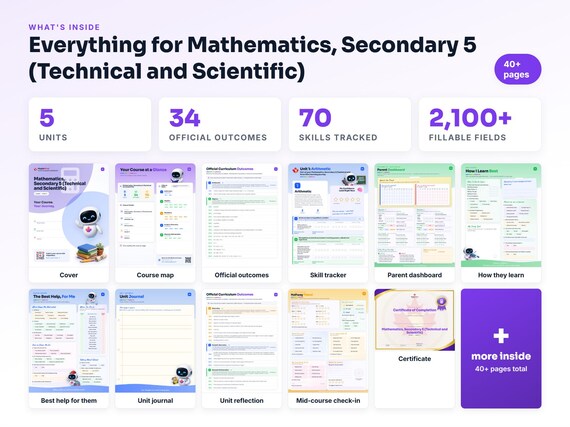


Printable workbook · A keepsake of the year
A Mathematics, Secondary 5 (Technical and Scientific) workbook worth keeping
Built from the same official curriculum as this page. Before and after each skill above, your student colours in how sure they feel — so the two of you can see, on one page, what's clicking and what needs another look. It's a quiet way to follow how the year is really going.
By June it's full of their own handwriting: units worked through, confidence grown, a mid-year check-in, notes from parent-teacher night, and a certificate at the end. Less a worksheet, more a record of the year worth keeping on the shelf.
Instant download · see every page, reviews and the full description · five or more workbooks are $2.99 each
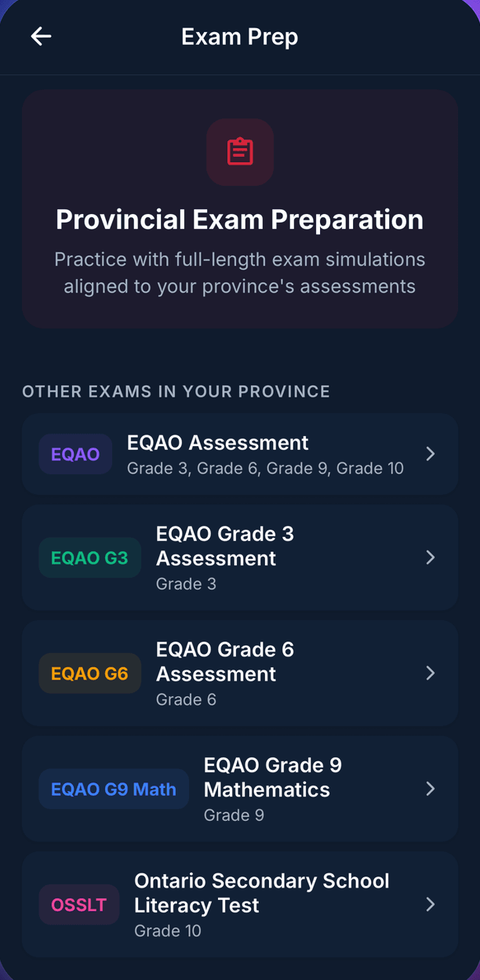
What it looks like in the app


Common questions
Can MapleMind help me with Mathematics, Secondary 5 (Technical and Scientific)?
Yes. MapleMind's AI tutor covers all 70 skills in Quebec's Mathematics, Secondary 5 (Technical and Scientific) — you pick the exact skill, and the tutor teaches it step by step: a short lesson, a worked example, solving together, then a skill check to show it stuck.
Is MapleMind aligned to Quebec's official curriculum?
Yes. Every skill in this course maps to an official outcome code from Quebec's Grade 11 Mathematics curriculum, and the ministry's own wording is quoted under each unit on this page — with the official government source linked so you can check it yourself.
What does MapleMind cost?
It's free to start — 5 tutoring chats and a practice quiz every day, no credit card. A Pro subscription ($9.99/month or $49.99/year CAD, 7-day free trial) unlocks unlimited tutoring, practice, and exam simulations.
What if I'm stuck on just one topic?
That's the point of skill-level tutoring: open Mathematics, Secondary 5 (Technical and Scientific) in the app, tap the exact skill from the list on this page, and the tutor teaches just that — no wading through lessons you don't need.
Does MapleMind work in French or other languages?
Yes — 14 languages, including French. Both the app and the tutor's explanations switch to the language you choose.
Where can I see the official Quebec curriculum for Mathematics, Secondary 5 (Technical and Scientific)?
The official source is linked on this page — Québec's official education program. The outline here follows it: every MapleMind skill carries its official outcome code, and the ministry's own wording is quoted under each unit.
Keep exploring
Ready when you are
Pick a skill from this page and see it taught properly — free, in the browser, in under a minute.