Get help with Mathematics for Work and Everyday Life, Grade 12 (Workplace)
Most tutoring makes you sit through material you already know. MapleMind flips that: pick the exact skill that's causing trouble — any of the 52 below — and the tutor teaches just that one, step by step, as many times as it takes. Ask questions in plain words, any time of day, in English, French, or 12 other languages.
The official Ontario Mathematics for Work and Everyday Life, Grade 12 (Workplace) curriculum
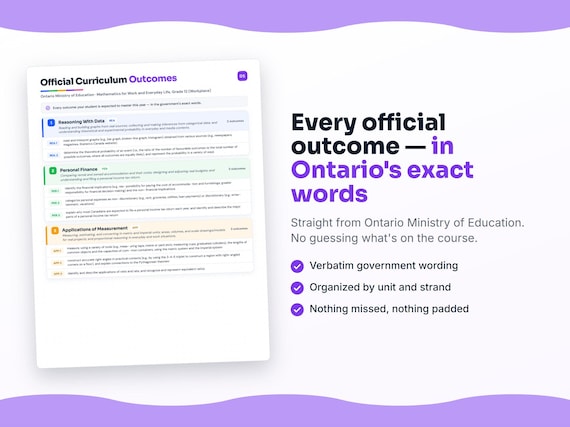
Ontario defines Mathematics for Work and Everyday Life, Grade 12 (Workplace) by strands and outcomes. MapleMind teaches the same curriculum reorganized for one-skill-at-a-time tutoring — the table shows exactly where every official strand lands, and the ministry's own wording is quoted under each unit below.
Official source Ontario's official mathematics curriculumRead it on the government site — dcp.edu.gov.on.ca ↗| Official strand | Outcomes | Where MapleMind teaches it |
|---|---|---|
| Strand A | 14 | Reasoning With Data |
| Strand B | 19 | Personal Finance |
| Strand C | 19 | Applications of Measurement |
Every skill below, taught one on one.
 Try the first session free
How MapleMind teaches Mathematics for Work and Everyday Life, Grade 12 (Workplace) — every unit, lesson, and skill
Every skill below runs as a short session: a plain-words lesson, a worked example, solving it together, then a five-question skill check that earns up to three stars. Guided Mode keeps it teaching instead of answer-handing — turning it off needs a parent's password.
Unit 1Reasoning With DataOfficial strand · Strand A
Reading and building graphs from real sources; collecting and making inferences from categorical data; and understanding theoretical and experimental probability in everyday and media contexts.
Interpreting and Displaying Data
- Reading and interpreting graphs from real sourcesmel4e.1.1 — Read and interpret graphs like bar graphs, broken-line graphs, and histograms obtained from sources like newspapers, magazines, and Statistics Canada.
- Population versus sample and why sampling is necessarymel4e.1.2 — Explain the distinction between population and sample, describe a good sample's characteristics, and explain why sampling is necessary.
- Collecting categorical data from primary and secondary sourcesmel4e.1.3 — Collect categorical data from primary sources through observation or measurement, or from secondary sources, and organize and store it using tools like spreadsheets.
- Representing categorical data by constructing graphsmel4e.1.4 — Represent categorical data by constructing graphs like bar graphs, broken-line graphs, and circle graphs using tools like dynamic statistical software.
- Making and justifying inferences from graphed datamel4e.1.5 — Make inferences based on the graphical representation of data, and justify conclusions orally or in writing using convincing arguments.
- Investigating a topic of personal interest using collected datamel4e.1.6 — Make and justify conclusions about a topic of personal interest by collecting, organizing, representing, and making inferences from categorical data.
- How the media and advertisers use and misuse statisticsmel4e.1.7 — Explain how the media, advertising industry, and others use and misuse statistics to promote a certain point of view.
- Gathering information about data management in the workplace and daily lifemel4e.1.8 — Gather, interpret, and describe information about applications of data management in the workplace and in everyday life.
Investigating Probability
- Determining and representing theoretical probabilitymel4e.1.9 — Determine the theoretical probability of an event, and represent the probability as a fraction, percent, or decimal.
- Identifying probability in the media and its representationsmel4e.1.10 — Identify examples of probability used in the media, like the probability of rain or of winning a lottery, and the ways probability is represented.
- Performing probability experiments and finding experimental probabilitymel4e.1.11 — Perform simple probability experiments like rolling number cubes or flipping coins, record the results, and determine the experimental probability of an event.
- Comparing theoretical and experimental probabilitymel4e.1.12 — Compare, through investigation, the theoretical probability of an event with the experimental probability, and describe how uncertainty explains why they might differ.
- How experimental probability approaches theoretical probability with more trialsmel4e.1.13 — Investigate, using class-generated data and technology-based simulations, how experimental probability tends to approach theoretical probability as the number of trials increases.
- Using probability and statistics in the media to make informed decisionsmel4e.1.14 — Interpret information involving probability and statistics in the media, and describe how they help make informed decisions in situations like planning outdoor activities or choosing occupations.
The official wording — 14 outcomes in this unit
- mel4e.1.1
read and interpret graphs (e.g., bar graph, broken-line graph, histogram) obtained from various sources (e.g., newspapers, magazines, Statistics Canada website)
- mel4e.1.2
explain the distinction between the terms population and sample, describe the character- istics of a good sample, and explain why sampling is necessary
- mel4e.1.3
collect categorical data from primary sources, through experimentation involving observation (e.g., by tracking food orders in restaurants offering healthy food options) or measurement, or from secondary sources
- mel4e.1.4
represent categorical data by constructing graphs (e.g., bar graph, broken-line graph, circle graph) using a variety of tools
- mel4e.1.5
make inferences based on the graphical repre- sentation of data (e.g., an inference about a sample from the graphical representation of a population), and justify conclusions orally or in writing using convincing arguments
- mel4e.1.6
make and justify conclusions about a topic of personal interest by collecting, organizing (e.g., using spreadsheets), representing (e.g., using graphs), and making inferences from categorical data
- mel4e.1.7
explain how the media, the advertising indus- try, and others (e.g., marketers, pollsters) use and misuse statistics
- mel4e.1.8
gather, interpret, and describe information about applications of data management in the workplace and in everyday life
- mel4e.1.9
determine the theoretical probability of an event (i.e., the ratio of the number of favourable outcomes to the total number of possible outcomes, where all outcomes are equally likely), and represent the probability in a variety of ways
- mel4e.1.10
identify examples of the use of probability in the media (e.g., the probability of rain, of winning a lottery, of wait times for a service exceeding specified amounts) and various ways in which probability is represented
- mel4e.1.11
perform simple probability experiments (e.g., rolling number cubes, spinning spinners, flip- ping coins, playing Aboriginal stick-and-stone games), record the results, and determine the experimental probability of an event
- mel4e.1.12
compare, through investigation, the theoretical probability of an event with the experimental probability, and describe how uncertainty explains why they might differ
- mel4e.1.13
determine, through investigation using class- generated data and technology-based simula- tion models (e.g., using a random-number generator on a spreadsheet or on a graphing calculator), the tendency of experimental probability to approach theoretical probability as the number of trials in an experiment increases
- mel4e.1.14
interpret information involving the use of probability and statistics in the media, and describe how probability and statistics can help in making informed decisions in a variety of situations
Unit 2Personal FinanceOfficial strand · Strand B
Comparing rental and owned accommodation and their costs; designing and adjusting real budgets; and understanding and filing a personal income tax return.
Renting or Owning Accommodation
- Financial and non-financial implications of living independentlymel4e.2.1 — Identify the financial implications, like paying for accommodation, and non-financial implications, like greater freedom or the need to share responsibilities, of living independently.
- Comparing the costs and advantages of different rental accommodation typesmel4e.2.2 — Gather and compare information about the costs and the advantages and disadvantages of different types of rental accommodation in the local community.
- Comparing purchase prices of different owned accommodation typesmel4e.2.3 — Gather and compare information about purchase prices of different types of owned accommodation in the local community, like a condominium, townhouse, or detached home.
- Comparing ongoing living expenses of renting and owningmel4e.2.4 — Gather, interpret, and compare information about ongoing living expenses associated with renting and owning accommodation, like hydro, heating, and groceries.
- Rights and responsibilities of tenants and landlordsmel4e.2.5 — Gather, interpret, and describe information about the rights and responsibilities of tenants and landlords.
- Generating a moving checklist and estimating moving costsmel4e.2.6 — Generate a checklist of necessary tasks associated with moving, and estimate the total cost involved under various conditions.
Designing Budgets
- Categorizing expenses as discretionary or non-discretionarymel4e.2.7 — Categorize personal expenses as non-discretionary, like rent and groceries, or discretionary, like entertainment and vacations.
- Categorizing non-discretionary expenses as fixed or variablemel4e.2.8 — Categorize personal non-discretionary expenses as fixed, like rent or car insurance, or variable, like groceries or vehicle maintenance.
- Reading and interpreting prepared budgets and how they reflect valuesmel4e.2.9 — Read and interpret prepared individual or family budgets, identify their key components, and describe how budgets can reflect personal values.
- Designing, explaining, and justifying a monthly budget from a case studymel4e.2.10 — Design, with and without technology, explain, and justify a monthly budget suitable for an individual or family described in a case study.
- Identifying factors in the affordability of accommodationmel4e.2.11 — Identify and describe factors to be considered in determining the affordability of accommodation in the local community.
- Adjusting a budget for changed circumstancesmel4e.2.12 — Make adjustments to a budget to accommodate changes in circumstances, with technology like a spreadsheet template.
Filing Income Tax
- Why Canadians file a tax return and its major partsmel4e.2.13 — Explain why most Canadians are expected to file a personal income tax return each year, and identify and describe its major parts.
- Gathering the documents required to file a tax returnmel4e.2.14 — Gather, interpret, and describe the information and documents required for filing a personal income tax return, like T4 slips and receipts, and explain why they are required.
- Comparing common tax credits and tax deductionsmel4e.2.15 — Gather, interpret, and compare information about common tax credits, like tuition fees, and tax deductions, like moving expenses.
- Completing a simple personal income tax returnmel4e.2.16 — Complete a simple personal income tax return, with or without tax preparation software.
- Additional tax-filing information for a self-employed individualmel4e.2.17 — Gather, interpret, and describe additional information a self-employed individual should provide when filing a personal income tax return.
- Comparing tax-filing services and resourcesmel4e.2.18 — Gather, interpret, and describe information about services and resources that help complete a personal income tax return, and compare them by assistance and cost.
- Gathering information about personal finance applications in the workplacemel4e.2.19 — Gather, interpret, and describe information about applications of the mathematics of personal finance in the workplace.
The official wording — 19 outcomes in this unit
- mel4e.2.1
identify the financial implications (e.g., res- ponsibility for paying the cost of accommoda- tion and furnishings; greater responsibility for financial decision making) and the non- financial implications
- mel4e.2.2
gather and compare, through investigation, information about the costs and the advan- tages and disadvantages of different types of rental accommodation in the local community
- mel4e.2.3
gather and compare, through investigation, information about purchase prices of different types of owned accommodation in the local community
- mel4e.2.4
gather, interpret, and compare information about the different types of ongoing living expenses associated with renting and owning accommodation
- mel4e.2.5
gather, interpret, and describe information about the rights and responsibilities of tenants and landlords
- mel4e.2.6
generate a checklist of necessary tasks asso- ciated with moving (e.g., change of address, set-up of utilities and services, truck rental), and estimate the total cost involved under various conditions
- mel4e.2.7
categorize personal expenses as non- discretionary (e.g., rent, groceries, utilities, loan payments) or discretionary (e.g., enter- tainment, vacations)
- mel4e.2.8
categorize personal non-discretionary ex- penses as fixed (e.g., rent, cable, car insur- ance) or variable (e.g., groceries, clothing, vehicle maintenance)
- mel4e.2.9
read and interpret prepared individual or family budgets, identify and describe the key components of a budget, and describe how budgets can reflect personal values
- mel4e.2.10
design, with technology (e.g., using spread- sheet templates, budgeting software, online tools) and without technology (e.g., using budget templates), explain, and justify a monthly budget suitable for an individual or family described in a given case study
- mel4e.2.11
identify and describe factors to be considered in determining the affordability of accommo- dation in the local community
- mel4e.2.12
make adjustments to a budget to accommo- date changes in circumstances (e.g., loss of hours at work, change of job, change in per- sonal responsibilities, move to new accommo- dation, achievement of a long-term goal, major purchase), with technology
- mel4e.2.13
explain why most Canadians are expected to file a personal income tax return each year, and identify and describe the major parts of a personal income tax return
- mel4e.2.14
gather, interpret, and describe the information and documents required for filing a personal income tax return (e.g., CRA guides, forms, and schedules; T4 slips; receipts for charitable donations), and explain why they are required
- mel4e.2.15
gather, interpret, and compare information about common tax credits (e.g., tuition fees, medical expenses, charitable donations) and tax deductions (e.g., moving expenses, child care expenses, union dues)
- mel4e.2.16
complete a simple personal income tax return (i.e., forms and schedules), with or without tax preparation software
- mel4e.2.17
gather, interpret, and describe some addition- al information that a self-employed individual should provide when filing a personal income tax return
- mel4e.2.18
gather, interpret, and describe information about services that will complete a personal income tax return (e.g., tax preparation serv- ice, chartered accountant, voluntary service in the community) and resources that will help with completing a personal income tax return
- mel4e.2.19
gather, interpret, and describe information about applications of the mathematics of personal finance in the workplace
Unit 3Applications of MeasurementOfficial strand · Strand C
Measuring, estimating, and converting in metric and imperial units; areas, volumes, and scale drawings/models for real projects; and proportional reasoning in everyday and work situations.
Measuring and Estimating
- Measuring lengths and capacities with metric and imperial toolsmel4e.3.1 — Measure, using tools like a measuring tape or graduated cylinder, the lengths of common objects and the capacities of common containers, in metric and imperial units.
- Estimating lengths and capacities using personal referentsmel4e.3.2 — Estimate lengths, distances, and capacities in metric and imperial units by applying personal referents, like a finger's width being about 1 cm.
- Estimating quantities and describing the strategies usedmel4e.3.3 — Estimate quantities, like bricks in a pile or people in a crowd, and describe the strategies used.
- Converting measures within the same systemmel4e.3.4 — Convert measures within the same system, like centimetres and metres or feet and inches, as required within familiar applications.
- Converting measures between the metric and imperial systemsmel4e.3.5 — Convert measures between systems, like centimetres and inches or degrees Celsius and Fahrenheit, as required within familiar applications.
Applying Measurement and Design
- Constructing accurate right angles and connecting to the Pythagorean theoremmel4e.3.6 — Construct accurate right angles in practical contexts, like using the 3-4-5 triplet, and explain connections to the Pythagorean theorem.
- Applying perimeter in familiar contextsmel4e.3.7 — Apply the concept of perimeter in familiar contexts, like baseboard, fencing, or door and window trim.
- Estimating the areas and volumes of irregular shapesmel4e.3.8 — Estimate the areas and volumes of irregular shapes and figures using strategies like counting grid squares or displacing water.
- Solving real-world problems with areas of rectangles, triangles, circles, and composite shapesmel4e.3.9 — Solve problems involving the areas of rectangles, triangles, and circles, and related composite shapes, in real-world applications.
- Solving real-world problems with volumes and surface areas of prisms and cylindersmel4e.3.10 — Solve problems involving the volumes and surface areas of rectangular prisms, triangular prisms, and cylinders, and related composite figures, in real-world applications.
- Constructing a 2D scale drawing of a familiar settingmel4e.3.11 — Construct a two-dimensional scale drawing of a familiar setting, like a classroom or flower bed, on grid paper or with design software.
- Constructing a 3D scale model of a personal-interest object or environmentmel4e.3.12 — Construct, with reasonable accuracy, a three-dimensional scale model of an object or environment of personal interest, like a room or a bridge.
- Planning, designing, and budgeting for a household improvementmel4e.3.13 — Investigate, plan, design, and prepare a budget for a household improvement, like landscaping or renovating a room, using appropriate technologies.
Solving Measurement Problems Using Proportional Reasoning
- Identifying applications of ratio and rate, and equivalent ratios and ratesmel4e.3.14 — Identify and describe applications of ratio and rate, and recognize and represent equivalent ratios and equivalent rates using tools like concrete materials and diagrams.
- Using unit rates to make comparisonsmel4e.3.15 — Identify situations where it is useful to compare using unit rates, and solve problems that involve comparisons of unit rates.
- Distinguishing proportional from non-proportional real-world situationsmel4e.3.16 — Identify and describe real-world applications of proportional reasoning, and distinguish between proportional and non-proportional relationships in personal and workplace contexts.
- Identifying consequences of errors in proportional reasoningmel4e.3.17 — Identify and describe possible consequences, like medication overdoses or ruined clothing, of errors in proportional reasoning.
- Solving everyday-life problems using proportional reasoningmel4e.3.18 — Solve problems involving proportional reasoning in everyday life, like mixing gasoline and oil, doubling recipes, or determining fibre content of food servings.
The official wording — 19 outcomes in this unit
- mel4e.3.1
measure, using a variety of tools (e.g., meas- uring tape, metre or yard stick, measuring cups, graduated cylinders), the lengths of common objects and the capacities of com- mon containers, using the metric system and the imperial system
- mel4e.3.2
estimate lengths, distances, and capacities in metric units and in imperial units by applying personal referents
- mel4e.3.3
estimate quantities (e.g., bricks in a pile, time to complete a job, people in a crowd), and describe the strategies used
- mel4e.3.4
convert measures within systems (e.g., cen- timetres and metres, kilograms and grams, litres and millilitres, feet and inches, ounces and pounds), as required within applications that arise from familiar contexts
- mel4e.3.5
convert measures between systems (e.g., cen- timetres and inches, pounds and kilograms, square feet and square metres, litres and U.S. gallons, kilometres and miles, cups and milli- litres, millilitres and teaspoons, degrees Celsius and degrees Fahrenheit), as required within applications that arise from familiar contexts
- mel4e.3.6
construct accurate right angles in practical contexts (e.g., by using the 3-4-5 triplet to construct a region with right-angled corners on a floor), and explain connections to the Pythagorean theorem
- mel4e.3.7
apply the concept of perimeter in familiar contexts (e.g., baseboard, fencing, door and window trim)
- mel4e.3.8
estimate the areas and volumes of irregular shapes and figures, using a variety of strat- egies (e.g., counting grid squares; displacing water)
- mel4e.3.9
solve problems involving the areas of rectan- gles, triangles, and circles, and of related composite shapes, in situations arising from real-world applications
- mel4e.3.10
solve problems involving the volumes and surface areas of rectangular prisms, triangular prisms, and cylinders, and of related compo- site figures, in situations arising from real- world applications
- mel4e.3.11
construct a two-dimensional scale drawing of a familiar setting (e.g., classroom, flower bed, playground) on grid paper or using design or drawing software
- mel4e.3.12
construct, with reasonable accuracy, a three- dimensional scale model of an object or envi- ronment of personal interest (e.g., appliance, room, building, garden, bridge)
- mel4e.3.13
investigate, plan, design, and prepare a budg- et for a household improvement (e.g., land- scaping a property; renovating a room), using appropriate technologies
- mel4e.3.14
identify and describe applications of ratio and rate, and recognize and represent equivalent ratios
- mel4e.3.15
identify situations in which it is useful to make comparisons using unit rates, and solve problems that involve comparisons of unit rates
- mel4e.3.16
identify and describe real-world applications of proportional reasoning (e.g., mixing con- crete; calculating dosages; converting units; painting walls; calculating fuel consumption; calculating pay; enlarging patterns), distinguish between a situation involving a proportional relationship
- mel4e.3.17
identify and describe the possible consequences (e.g., overdoses of medication; seized engines; ruined clothing; cracked or crumbling concrete) of errors in proportional reasoning
- mel4e.3.18
solve problems involving proportional reason- ing in everyday life (e.g., applying fertilizers; mixing gasoline and oil for use in small engines; mixing cement; buying plants for flower beds; using pool or laundry chemicals; doubling recipes; estimating cooking time from the time needed per pound; determining the fibre content of different sizes of food servings)
- mel4e.3.19
solve problems involving proportional reason- ing in work-related situations (e.g., calculating overtime pay; calculating pay for piecework; mixing concrete for small or large jobs)
Printable workbook · A keepsake of the year
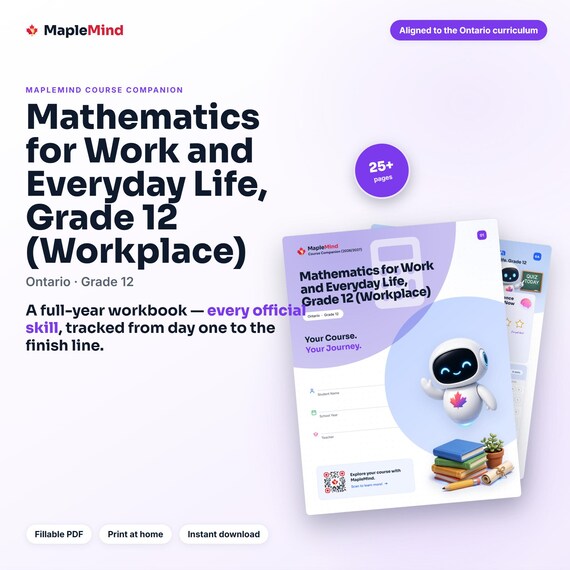
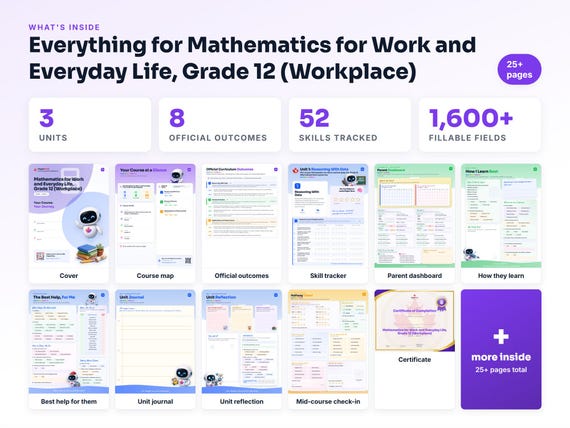
A Mathematics for Work and Everyday Life, Grade 12 (Workplace) workbook worth keeping
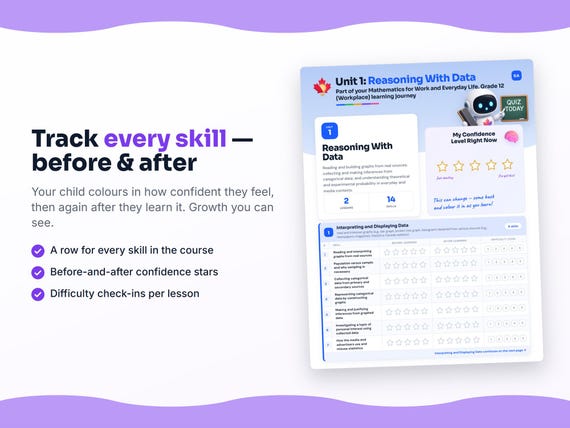
Built from the same official curriculum as this page. Before and after each skill above, your student colours in how sure they feel — so the two of you can see, on one page, what's clicking and what needs another look. It's a quiet way to follow how the year is really going.
By June it's full of their own handwriting: units worked through, confidence grown, a mid-year check-in, notes from parent-teacher night, and a certificate at the end. Less a worksheet, more a record of the year worth keeping on the shelf.
Instant download · see every page, reviews and the full description · five or more workbooks are $2.99 each
What it looks like in the app



Common questions
Can MapleMind help me with Mathematics for Work and Everyday Life, Grade 12 (Workplace)?
Yes. MapleMind's AI tutor covers all 52 skills in Ontario's Mathematics for Work and Everyday Life, Grade 12 (Workplace) — you pick the exact skill, and the tutor teaches it step by step: a short lesson, a worked example, solving together, then a skill check to show it stuck.
Is MapleMind aligned to Ontario's official curriculum?
Yes. Every skill in this course maps to an official outcome code from Ontario's Grade 12 Mathematics curriculum, and the ministry's own wording is quoted under each unit on this page — with the official government source linked so you can check it yourself.
What does MapleMind cost?
It's free to start — 5 tutoring chats and a practice quiz every day, no credit card. A Pro subscription ($9.99/month or $49.99/year CAD, 7-day free trial) unlocks unlimited tutoring, practice, and exam simulations.
What if I'm stuck on just one topic?
That's the point of skill-level tutoring: open Mathematics for Work and Everyday Life, Grade 12 (Workplace) in the app, tap the exact skill from the list on this page, and the tutor teaches just that — no wading through lessons you don't need.
Does MapleMind work in French or other languages?
Yes — 14 languages, including French. Both the app and the tutor's explanations switch to the language you choose.
Where can I see the official Ontario curriculum for Mathematics for Work and Everyday Life, Grade 12 (Workplace)?
The official source is linked on this page — Ontario's official mathematics curriculum. The outline here follows it: every MapleMind skill carries its official outcome code, and the ministry's own wording is quoted under each unit.
Keep exploring
Ready when you are
Pick a skill from this page and see it taught properly — free, in the browser, in under a minute.