Get help with Mathematics for College Technology, Grade 12 (College)
Most tutoring makes you sit through material you already know. MapleMind flips that: pick the exact skill that's causing trouble — any of the 57 below — and the tutor teaches just that one, step by step, as many times as it takes. Ask questions in plain words, any time of day, in English, French, or 12 other languages.
The official Ontario Mathematics for College Technology, Grade 12 (College) curriculum
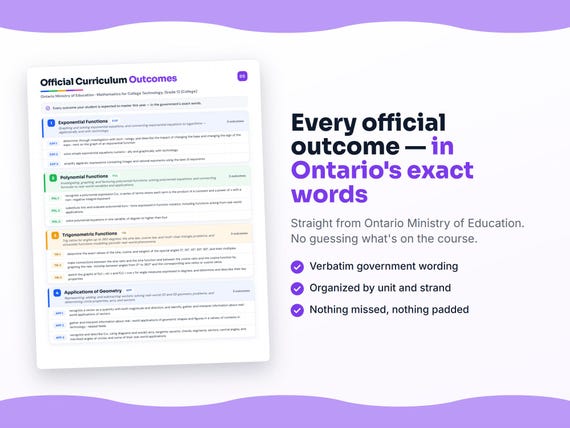
Ontario defines Mathematics for College Technology, Grade 12 (College) by strands and outcomes. MapleMind teaches the same curriculum reorganized for one-skill-at-a-time tutoring — the table shows exactly where every official strand lands, and the ministry's own wording is quoted under each unit below.
Official source Ontario's official mathematics curriculumRead it on the government site — dcp.edu.gov.on.ca ↗| Official strand | Outcomes | Where MapleMind teaches it |
|---|---|---|
| Strand A | 10 | Exponential Functions |
| Strand B | 19 | Polynomial Functions |
| Strand C | 14 | Trigonometric Functions |
| Strand D | 14 | Applications of Geometry |
Every skill below, taught one on one.
 Try the first session free
How MapleMind teaches Mathematics for College Technology, Grade 12 (College) — every unit, lesson, and skill
Every skill below runs as a short session: a plain-words lesson, a worked example, solving it together, then a five-question skill check that earns up to three stars. Guided Mode keeps it teaching instead of answer-handing — turning it off needs a parent's password.
Unit 1Exponential FunctionsOfficial strand · Strand A
Graphing and solving exponential equations, and connecting exponential equations to logarithms — algebraically and with technology.
Graphing and Comparing Exponential Functions
- How changing the base or the sign of the exponent affects an exponential graphmct4c.1.1 — Investigate, with technology, and describe the impact of changing the base and changing the sign of the exponent on the graph of an exponential function.
Solving Exponential Equations Graphically
- Solving simple exponential equations numerically and graphicallymct4c.1.2 — Solve simple exponential equations numerically and graphically with technology, recognizing that solutions may not be exact.
- Solving exponential equations by the intersection of two exponential graphsmct4c.1.3 — Investigate, with graphing technology, the point of intersection of two exponential functions' graphs, recognize its x-coordinate as the equation's solution, and solve exponential equations graphically.
- Posing and solving real-world exponential problems with a graphmct4c.1.4 — Pose problems based on real-world applications like compound interest or population growth that can be modelled with exponential equations, and solve them using a given or generated graph.
Solving Exponential Equations Algebraically
- Simplifying expressions with integer and rational exponentsmct4c.1.5 — Simplify algebraic expressions containing integer and rational exponents using the laws of exponents.
- Solving exponential equations using a common basemct4c.1.6 — Solve exponential equations in one variable by determining a common base, and verify by substitution.
- The logarithm as the inverse of exponentiationmct4c.1.7 — Recognize the logarithm of a number to a given base as the exponent needed to get that number, recognize logarithm as the inverse of exponentiation, and evaluate simple logarithmic expressions.
- Approximating the logarithm of a number to any base with technologymct4c.1.8 — Determine, with technology, the approximate logarithm of a number to any base, including base 10.
- Connecting logarithmic and exponential equationsmct4c.1.9 — Make connections between related logarithmic and exponential equations, and solve simple exponential equations by rewriting them in logarithmic form.
- Posing and solving real-world exponential problems by rewriting in logarithmic formmct4c.1.10 — Pose problems based on real-world applications that can be modelled with given exponential equations, and solve them algebraically by rewriting in logarithmic form.
The official wording — 10 outcomes in this unit
- mct4c.1.1
determine, through investigation with tech- nology, and describe the impact of changing the base and changing the sign of the expo- nent on the graph of an exponential function
- mct4c.1.2
solve simple exponential equations numeric- ally and graphically, with technology
- mct4c.1.3
determine, through investigation using graph- ing technology, the point of intersection of the graphs of two exponential functions
- mct4c.1.4
pose problems based on real-world applica- tions (e.g., compound interest, population growth) that can be modelled with exponen- tial equations, and solve these and other such problems by using a given graph or a graph generated with technology from a table of values or from its equation
- mct4c.1.5
simplify algebraic expressions containing integer and rational exponents using the laws of exponents
- mct4c.1.6
solve exponential equations in one variable by determining a common base
- mct4c.1.7
recognize the logarithm of a number to a given base as the exponent to which the base must be raised to get the number, recognize the operation of finding the logarithm to be the inverse operation (i.e., the undoing or reversing) of exponentiation, and evaluate simple logarithmic expressions
- mct4c.1.8
determine, with technology, the approximate logarithm of a number to any base, including base 10
- mct4c.1.9
make connections between related logarithmic and exponential equations
- mct4c.1.10
pose problems based on real-world applica- tions that can be modelled with given expo- nential equations, and solve these and other such problems algebraically by rewriting them in logarithmic form
Unit 2Polynomial FunctionsOfficial strand · Strand B
Investigating, graphing, and factoring polynomial functions; solving polynomial equations; and connecting formulas to real-world variables and applications.
Investigating Graphs of Polynomial Functions
- Recognizing polynomial expressions and functionsmct4c.2.1 — Recognize a polynomial expression, recognize the equation of a polynomial function and give reasons why it is a function, and identify linear and quadratic functions as examples of polynomial functions.
- Comparing graphical and algebraic representations of polynomial functionsmct4c.2.2 — Compare, with graphing technology, the graphical and algebraic representations of linear, quadratic, cubic, and quartic functions, investigating the effect of degree and leading coefficient sign on the graph.
- Describing key features of polynomial function graphsmct4c.2.3 — Describe key features of the graphs of polynomial functions, like domain, range, shape, and end behaviour.
- Distinguishing polynomial functions from sinusoidal and exponential functionsmct4c.2.4 — Distinguish polynomial functions from sinusoidal and exponential functions, and compare and contrast their graphs with other function types.
Connecting Graphs and Equations of Polynomial Functions
- Evaluating polynomial functions in function notationmct4c.2.5 — Substitute into and evaluate polynomial functions expressed in function notation, including functions arising from real-world applications.
- Posing and solving real-world problems using polynomial function graphsmct4c.2.6 — Pose problems based on real-world applications that can be modelled with polynomial functions, and solve them using a given or generated graph.
- Recognizing the limitations and domain/range restrictions of polynomial modelsmct4c.2.7 — Recognize, using graphs, the limitations of modelling a real-world relationship with a polynomial function, and identify and explain any restrictions on the domain and range.
- Factoring polynomial expressions up to degree fourmct4c.2.8 — Factor polynomial expressions in one variable, of degree no higher than four, by selecting and applying strategies like common factoring, difference of squares, and trinomial factoring.
- Connecting a polynomial function's factored form to its x-intercepts and sketching its graphmct4c.2.9 — Investigate, with graphing technology, the connection between a polynomial function in factored form and the x-intercepts of its graph, and sketch the graph using its key features.
- Connecting the real roots of a polynomial equation to its graph's x-interceptsmct4c.2.10 — Investigate, with technology, and describe the connection between the real roots of a polynomial equation and the x-intercepts of its corresponding function's graph.
Solving Problems Involving Polynomial Equations
- Solving polynomial equations up to degree fourmct4c.2.11 — Solve polynomial equations in one variable, of degree no higher than four, by selecting and applying factoring strategies, and verify solutions using technology.
- Solving real-world problems involving polynomial functions and equationsmct4c.2.12 — Solve problems algebraically that involve polynomial functions and equations of degree no higher than four, including those from real-world applications.
- Identifying and explaining the roles of constants and variables in a formulamct4c.2.13 — Identify and explain the roles of constants and variables in a given formula, like a known initial value versus a quantity that changes with conditions.
- Expanding and simplifying polynomial expressions with more than one variablemct4c.2.14 — Expand and simplify polynomial expressions involving more than one variable, including expressions arising from real-world applications.
- Solving equations of the form xⁿ = a using rational exponentsmct4c.2.15 — Solve equations of the form xⁿ = a using rational exponents, by raising both sides to an exponent.
- Determining a variable's value from a real-world formulamct4c.2.16 — Determine the value of a variable of degree no higher than three, using a formula from an application, by substituting known values then solving, and by isolating the variable then substituting.
- Connecting formulas to linear, quadratic, and exponential functionsmct4c.2.17 — Make connections between formulas and linear, quadratic, and exponential functions, using tools and strategies like comparing graphs when different variables in a formula are set as constants.
- Solving multi-step real-world problems using formulasmct4c.2.18 — Solve multi-step problems requiring formulas arising from real-world applications.
- Gathering information about mathematical modelling in occupations and college programsmct4c.2.19 — Gather, interpret, and describe information about applications of mathematical modelling in occupations, and about college programs that explore these applications.
The official wording — 19 outcomes in this unit
- mct4c.2.1
recognize a polynomial expression (i.e., a series of terms where each term is the product of a constant and a power of x with a non- negative integral exponent
- mct4c.2.2
compare, through investigation using graph- ing technology, the graphical and algebraic representations of polynomial (i.e., linear, quadratic, cubic, quartic) functions
- mct4c.2.3
describe key features of the graphs of poly- nomial functions (e.g., the domain and range, the shape of the graphs, the end behaviour of the functions for very large positive or negative x-values)
- mct4c.2.4
distinguish polynomial functions from sinusoidal and exponential functions
- mct4c.2.5
substitute into and evaluate polynomial func- tions expressed in function notation, including functions arising from real-world applications
- mct4c.2.6
pose problems based on real-world applica- tions that can be modelled with polynomial functions, and solve these and other such problems by using a given graph or a graph generated with technology from a table of values or from its equation
- mct4c.2.7
recognize, using graphs, the limitations of modelling a real-world relationship using a polynomial function, and identify and explain any restrictions on the domain and range
- mct4c.2.8
factor polynomial expressions in one variable, of degree no higher than four, by selecting and applying strategies (i.e., common factor- ing, difference of squares, trinomial factoring)
- mct4c.2.9
make connections, through investigation using graphing technology (e.g., dynamic geometry software), between a polynomial function given in factored form
- mct4c.2.10
determine, through investigation using tech- nology (e.g., graphing calculator, computer algebra systems), and describe the connection between the real roots of a polynomial equa- tion and the x-intercepts of the graph
- mct4c.2.11
solve polynomial equations in one variable, of degree no higher than four
- mct4c.2.12
solve problems algebraically that involve polynomial functions and equations of degree no higher than four, including those arising from real-world applications
- mct4c.2.13
identify and explain the roles of constants and variables in a given formula
- mct4c.2.14
expand and simplify polynomial expressions involving more than one variable
- mct4c.2.15
solve equations of the form x = a using rational exponents
- mct4c.2.16
determine the value of a variable of degree no higher than three, using a formula drawn from an application
- mct4c.2.17
make connections between formulas and lin- ear, quadratic, and exponential functions
- mct4c.2.18
solve multi-step problems requiring formulas arising from real-world applications
- mct4c.2.19
gather, interpret, and describe information about applications of mathematical modelling in occupations, and about college programs that explore these applications
Unit 3Trigonometric FunctionsOfficial strand · Strand C
Trig ratios for angles up to 360 degrees; the sine law, cosine law, and multi-step triangle problems; and sinusoidal functions modelling periodic real-world phenomena.
Applying Trigonometric Ratios
- Exact sine, cosine, and tangent values of special anglesmct4c.3.1 — Determine the exact values of the sine, cosine, and tangent of the special angles 0°, 30°, 45°, 60°, 90°, and their multiples.
- Determining sine, cosine, and tangent for angles from 0° to 360°mct4c.3.2 — Determine the values of the sine, cosine, and tangent of angles from 0° to 360°, through investigation with tools like dynamic geometry software and the unit circle.
- Finding two angles from 0° to 360° with the same trig ratio valuemct4c.3.3 — Determine the measures of two angles from 0° to 360° for which the value of a given trigonometric ratio is the same.
- Solving multi-step 2D and 3D right-triangle problemsmct4c.3.4 — Solve multi-step problems in two and three dimensions, including real-world applications like surveying and navigation, by determining sides and angles of right triangles using primary trig ratios.
- Solving oblique triangle problems including the ambiguous casemct4c.3.5 — Solve problems involving oblique triangles, including real-world applications, using the sine law (including the ambiguous case) and the cosine law.
Connecting Graphs and Equations of Sinusoidal Functions
- Connecting the sine and cosine ratios to the sine and cosine functionsmct4c.3.6 — Make connections between the sine ratio and sine function, and cosine ratio and cosine function, by graphing angles 0° to 360° against their ratios, defining this as a function, and explaining why it is one.
- Representing a sinusoidal function with an equation given its graph or propertiesmct4c.3.7 — Represent a sinusoidal function with an equation, given its graph or its properties.
- Collecting and graphing data that fits a sinusoidal modelmct4c.3.8 — Collect data that can be modelled as a sinusoidal function, through investigation with and without technology from primary or secondary sources, and graph the data.
- Identifying periodic and sinusoidal functions and their domain/range restrictionsmct4c.3.9 — Identify periodic and sinusoidal functions, including from real-world applications, given tables, graphs, or equations, and explain any context restrictions on the domain and range.
- Posing and solving real-world sinusoidal function problemsmct4c.3.10 — Pose problems based on applications involving a sinusoidal function, and solve them using a given or generated graph, in degree mode.
Solving Problems Involving Sinusoidal Functions
- Sketching sine and cosine graphs and describing their key propertiesmct4c.3.11 — Sketch the graphs of f(x) = sin x and f(x) = cos x for degree-measured angles, and determine and describe their key properties like cycle, domain, range, amplitude, and period.
- Investigating the roles of d and c in vertical and horizontal sinusoidal translationsmct4c.3.12 — Investigate, with technology, the roles of the parameters d and c in y = sin(x-d)+c and y = cos(x-d)+c, and describe them as vertical and horizontal translations.
- Investigating the roles of a and k in reflections and stretches of sinusoidal graphsmct4c.3.13 — Investigate, with technology, the roles of the parameters a and k in y = a sin kx and y = a cos kx, and describe them as reflections, stretches, and compressions.
- Determining amplitude, period, and phase shift, and sketching transformed sinusoidal graphsmct4c.3.14 — Determine the amplitude, period, and phase shift of sinusoidal functions in the form f(x) = a sin(k(x-d))+c or a cos(k(x-d))+c, and sketch their graphs by applying transformations.
The official wording — 14 outcomes in this unit
- mct4c.3.1
determine the exact values of the sine, cosine, and tangent of the special angles 0°, 30°, 45°, 60°, 90°, and their multiples
- mct4c.3.2
determine the values of the sine, cosine, and tangent of angles from 0º to 360º, through investigation using a variety of tools
- mct4c.3.3
determine the measures of two angles from 0º to 360º for which the value of a given trigono- metric ratio is the same
- mct4c.3.4
solve multi-step problems in two and three dimensions, including those that arise from real-world applications (e.g., surveying, navi- gation), by determining the measures of the sides and angles of right triangles using the primary trigonometric ratios
- mct4c.3.5
solve problems involving oblique triangles, including those that arise from real-world applications, using the sine law (including the ambiguous case) and the cosine law
- mct4c.3.6
make connections between the sine ratio and the sine function and between the cosine ratio and the cosine function by graphing the rela- tionship between angles from 0º to 360º and the corresponding sine ratios or cosine ratios
- mct4c.3.7
represent a sinusoidal function with an equation, given its graph or its properties
- mct4c.3.8
collect data that can be modelled as a sinu- soidal function (e.g., voltage in an AC circuit, pressure in sound waves, the height of a tack on a bicycle wheel that is rotating at a fixed speed), through investigation with and with- out technology
- mct4c.3.9
identify periodic and sinusoidal functions, including those that arise from real-world applications involving periodic phenomena, given various representations
- mct4c.3.10
pose problems based on applications involv- ing a sinusoidal function, and solve these and other such problems by using a given graph or a graph generated with technology, in degree mode
- mct4c.3.11
sketch the graphs of f(x) = sin x and f(x) = cos x for angle measures expressed in degrees, and determine and describe their key properties
- mct4c.3.12
determine, through investigation using technology, the roles of the parameters d and c in functions of the form y = sin (x – d) + c and y = cos (x – d) + c
- mct4c.3.13
determine, through investigation using technol- ogy, the roles of the parameters a and k in functions of the form y = a sin kx and y = a cos kx
- mct4c.3.14
determine the amplitude, period, and phase shift of sinusoidal functions whose equations are given in the form f(x) = a sin (k(x – d)) + c or f(x) = a cos (k(x – d)) + c, and sketch graphs
Unit 4Applications of GeometryOfficial strand · Strand D
Representing, adding, and subtracting vectors; solving real-world 2D and 3D geometry problems; and determining circle properties, arcs, and sectors.
Modelling With Vectors
- Recognizing vectors and their real-world applicationsmct4c.4.1 — Recognize a vector as a quantity with magnitude and direction, and identify, gather, and interpret information about real-world vector applications like displacement, structural design, and GPS.
- Representing a vector as a directed line segmentmct4c.4.2 — Represent a vector as a directed line segment with directions expressed in different ways, and recognize equal vectors as having the same magnitude and direction.
- Resolving a vector into vertical and horizontal componentsmct4c.4.3 — Resolve a vector represented as a directed line segment into its vertical and horizontal components.
- Representing a vector as a directed line segment given its componentsmct4c.4.4 — Represent a vector as a directed line segment, given its vertical and horizontal components.
- Determining the sum or difference of two vectorsmct4c.4.5 — Determine, with tools like graph paper and technology and strategies like the head-to-tail and parallelogram methods, the sum or difference of two vectors.
- Solving real-world problems with vector addition and subtractionmct4c.4.6 — Solve problems involving the addition and subtraction of vectors, including real-world applications like surveying, statics, and orienteering.
Solving Problems Involving Geometry
- Gathering information about real-world geometric shapes in technology-related fieldsmct4c.4.7 — Gather and interpret information about real-world applications of geometric shapes and figures in technology-related fields like product design and architecture, and explain the applications.
- Converting between the imperial and metric systemsmct4c.4.8 — Perform required conversions between the imperial system and the metric system using tools like tables, calculators, and online conversion tools, as needed within applications.
- Solving real-world problems with areas of rectangles, parallelograms, trapezoids, triangles, circles, and composite shapesmct4c.4.9 — Solve problems involving the areas of rectangles, parallelograms, trapezoids, triangles, and circles, and related composite shapes, in real-world applications.
- Solving real-world problems with volumes and surface areas of spheres, prisms, and cylindersmct4c.4.10 — Solve problems involving the volumes and surface areas of spheres, right prisms, and cylinders, and related composite figures, in real-world applications.
Solving Problems Involving Circle Properties
- Recognizing and describing arcs, tangents, secants, chords, and angles of circlesmct4c.4.11 — Recognize and describe, using diagrams and words, arcs, tangents, secants, chords, segments, sectors, central angles, and inscribed angles of circles, and some real-world applications.
- Determining arc length and the area of a sector or segmentmct4c.4.12 — Determine the length of an arc and the area of a sector or segment of a circle, and solve related problems.
- Investigating circle properties involving chords, central and inscribed angles, and tangentsmct4c.4.13 — Investigate, with tools like dynamic geometry software, properties of the circle associated with chords, central angles, inscribed angles, and tangents.
- Solving real-world problems involving circle propertiesmct4c.4.14 — Solve problems involving properties of circles, including problems arising from real-world applications.
The official wording — 14 outcomes in this unit
- mct4c.4.1
recognize a vector as a quantity with both magnitude and direction, and identify, gather, and interpret information about real-world applications of vectors
- mct4c.4.2
represent a vector as a directed line segment, with directions expressed in different ways
- mct4c.4.3
resolve a vector represented as a directed line segment into its vertical and horizontal components
- mct4c.4.4
represent a vector as a directed line segment, given its vertical and horizontal components
- mct4c.4.5
determine, through investigation using a va- riety of tools (e.g., graph paper, technology) and strategies (i.e., head-to-tail method; paral- lelogram method; resolving vectors into their vertical and horizontal components), the sum (i.e., resultant) or difference of two vectors
- mct4c.4.6
solve problems involving the addition and subtraction of vectors, including problems arising from real-world applications
- mct4c.4.7
gather and interpret information about real- world applications of geometric shapes and figures in a variety of contexts in technology- related fields
- mct4c.4.8
perform required conversions between the imperial system and the metric system using a variety of tools
- mct4c.4.9
solve problems involving the areas of rect- angles, parallelograms, trapezoids, triangles, and circles, and of related composite shapes, in situations arising from real-world applications
- mct4c.4.10
solve problems involving the volumes and surface areas of spheres, right prisms, and cylinders, and of related composite figures, in situations arising from real-world applications
- mct4c.4.11
recognize and describe (i.e., using diagrams and words) arcs, tangents, secants, chords, segments, sectors, central angles, and inscribed angles of circles, and some of their real-world applications
- mct4c.4.12
determine the length of an arc and the area of a sector or segment of a circle, and solve relat- ed problems
- mct4c.4.13
determine, through investigation using a vari- ety of tools (e.g., dynamic geometry software), properties of the circle associated with chords, central angles, inscribed angles, and tangents
- mct4c.4.14
solve problems involving properties of circles, including problems arising from real-world applications
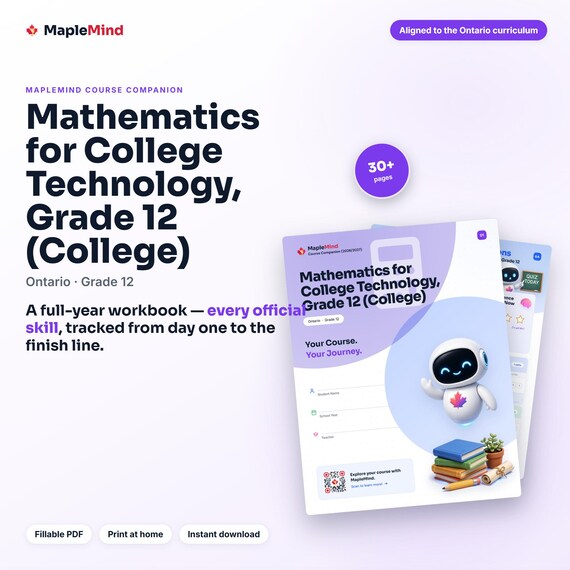
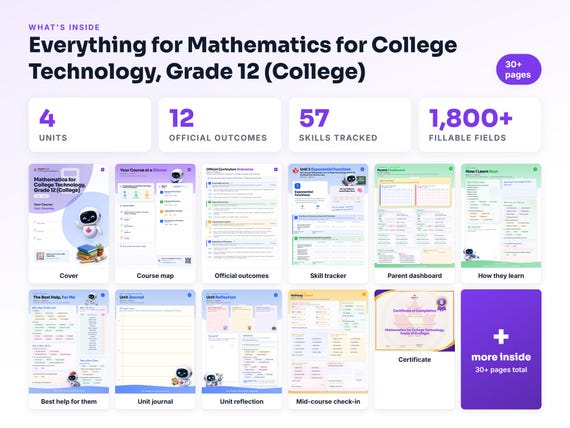

Printable workbook · A keepsake of the year
A Mathematics for College Technology, Grade 12 (College) workbook worth keeping
Built from the same official curriculum as this page. Before and after each skill above, your student colours in how sure they feel — so the two of you can see, on one page, what's clicking and what needs another look. It's a quiet way to follow how the year is really going.
By June it's full of their own handwriting: units worked through, confidence grown, a mid-year check-in, notes from parent-teacher night, and a certificate at the end. Less a worksheet, more a record of the year worth keeping on the shelf.
Instant download · see every page, reviews and the full description · five or more workbooks are $2.99 each
What it looks like in the app



Common questions
Can MapleMind help me with Mathematics for College Technology, Grade 12 (College)?
Yes. MapleMind's AI tutor covers all 57 skills in Ontario's Mathematics for College Technology, Grade 12 (College) — you pick the exact skill, and the tutor teaches it step by step: a short lesson, a worked example, solving together, then a skill check to show it stuck.
Is MapleMind aligned to Ontario's official curriculum?
Yes. Every skill in this course maps to an official outcome code from Ontario's Grade 12 Mathematics curriculum, and the ministry's own wording is quoted under each unit on this page — with the official government source linked so you can check it yourself.
What does MapleMind cost?
It's free to start — 5 tutoring chats and a practice quiz every day, no credit card. A Pro subscription ($9.99/month or $49.99/year CAD, 7-day free trial) unlocks unlimited tutoring, practice, and exam simulations.
What if I'm stuck on just one topic?
That's the point of skill-level tutoring: open Mathematics for College Technology, Grade 12 (College) in the app, tap the exact skill from the list on this page, and the tutor teaches just that — no wading through lessons you don't need.
Does MapleMind work in French or other languages?
Yes — 14 languages, including French. Both the app and the tutor's explanations switch to the language you choose.
Where can I see the official Ontario curriculum for Mathematics for College Technology, Grade 12 (College)?
The official source is linked on this page — Ontario's official mathematics curriculum. The outline here follows it: every MapleMind skill carries its official outcome code, and the ministry's own wording is quoted under each unit.
Keep exploring
Ready when you are
Pick a skill from this page and see it taught properly — free, in the browser, in under a minute.