Provincial assessment · Newfoundland & Labrador
Provincial Literacy and Numeracy Assessment
Provincial Literacy and Numeracy Assessment (Grade 9)
- Grade 9
Dates and details can change. We do our best to keep this page up to date, but check the official sources before relying on it.
- Total time
- 1 h 30 min
- Marked questions
- 30
- Parts
- 2
- Calculator
- Not allowed
- Format
- On a computer
Provincial Literacy and Numeracy Assessment practice test
The whole exam or the parts you choose, in its own format, on the clock.
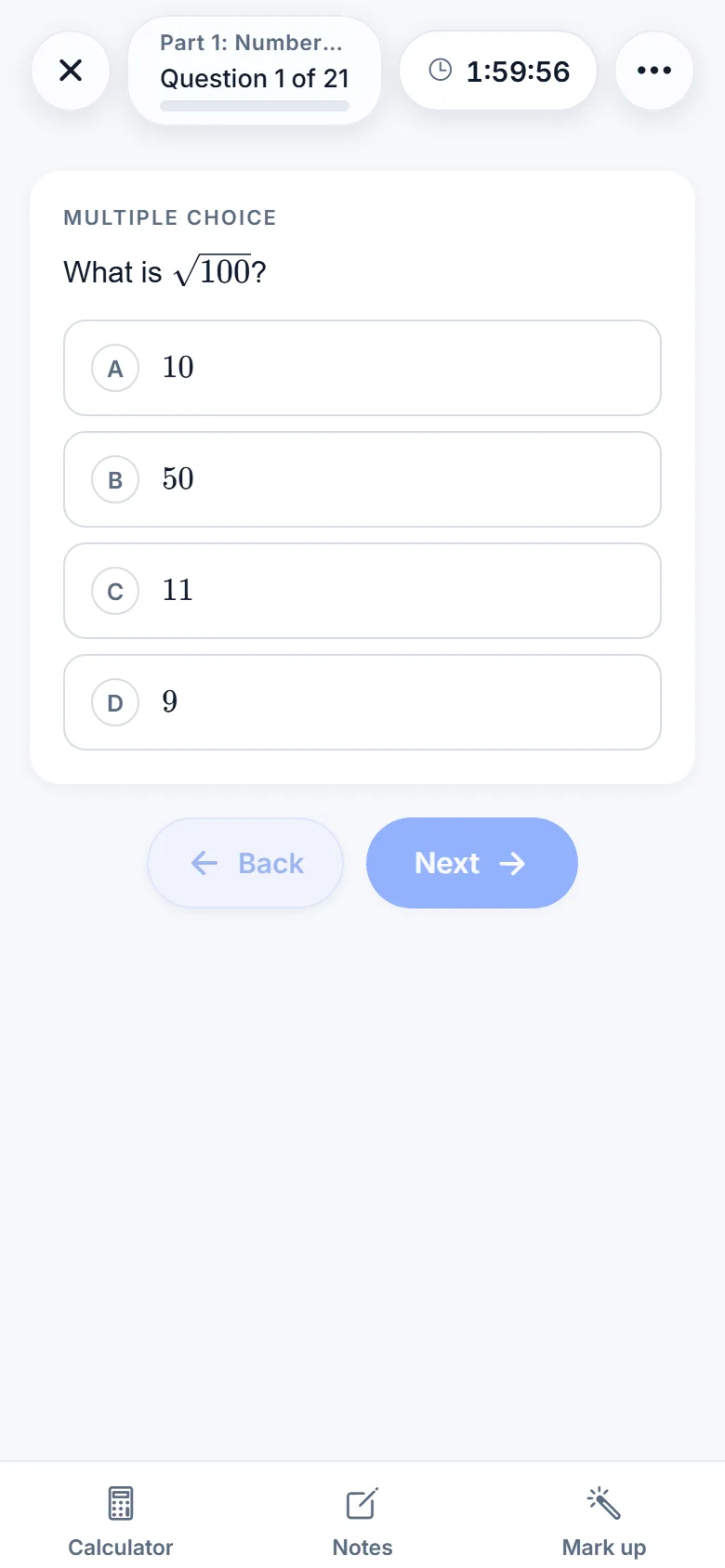 A question, timed, with the exam’s tools
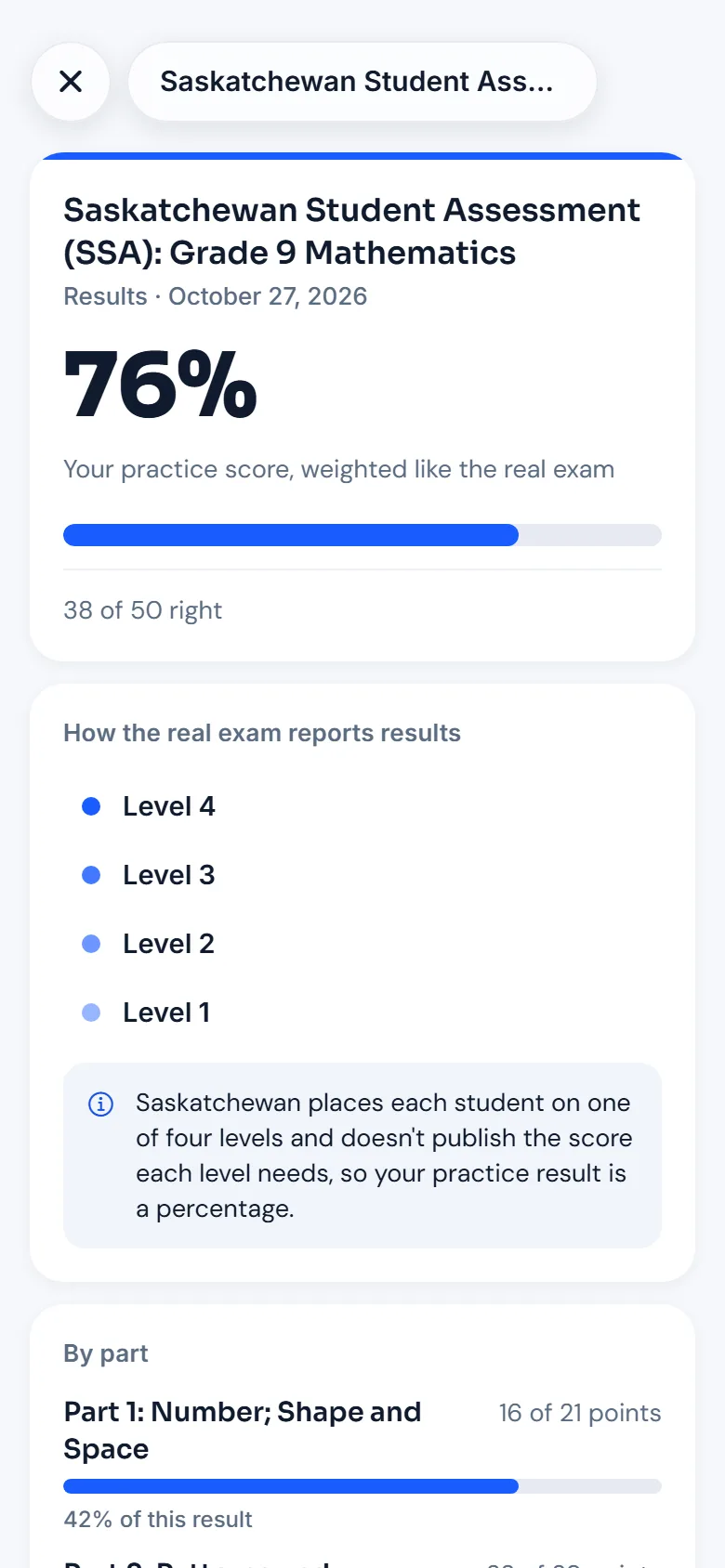 The marked result, part by part
A practice run of Saskatchewan’s Grade 9 math assessment.
Free with a MapleMind account
When
Spring 2027 (the date isn't published; inferred from the June 2026 field test)
- May 17 to June 18, 2027School day · Provincial Literacy and Numeracy Assessment, Grade 9
The dates are Newfoundland & Labrador’s own, read on November 9, 2026. See the official schedule (evalnl.vretta.com)
What’s on it
Literacy
- Reading a textNot published
- Writing an emailNot published
Numeracy
- A real-life scenarioNot published
The skills it tests · 60 skills
- Adding and subtracting polynomials
- Analyzing the tools authors use
- Assessing feedback to inform future work
- Assessing personal reading strategies
- Assessing strategies and describing growth
- Awareness that values influence critical response
- Bias in data collection
- Central and inscribed angles
- Committing to the process of creating texts
- Comparing equations and inequalities
- Comparing information from sources
- Creating a range of texts
- Creating and completing symmetric designs
- Equivalent polynomial expressions
- Estimating square roots of rationals
- Evaluating a text's language, form, and genre
- Evaluating forms and styles for purpose and audience
- Evaluating strategies for creating texts
- Evaluating the portrayal of culture and reality
- Examining points of view with cited evidence
- Experimenting with strategies as a language learner
- Explaining how authors use text features
- Exponent laws
- Graphing linear relations
- Identifying the parts of a polynomial
- Identifying topics and questions for study
- Integrating stylistic effects for a specific purpose
- Interpolating and extrapolating from a graph
- Interpreting probability in society
- Line symmetry
- Modelling linear equations
- Multiplying and dividing polynomials by a monomial
- Order of operations with rational numbers
- Ordering rational numbers
- Planning and completing a data project
- Recognizing that texts can be biased
- Reflecting on personal responses with support
- Rotation symmetry
- Samples and populations
- Scale diagrams and scale factor
- Scale problems with similar triangles
- Selecting texts for needs and interests
- Similar polygons
- Solving and graphing inequalities
- Solving linear equations symbolically
- Solving problems with linear equations
- Square roots of perfect-square rationals
- Sums and differences of powers
- Surface area of composite objects
- Symmetry on the coordinate plane
- Tangents and chords
- The meaning of a power
- Using effective inquiry strategies
- Using reading and viewing strategies
- Using reliable information from various sources
- Using technologies for varied purposes and audiences
- Using the conventions of written language
- Writing and testing inequalities
- Writing linear equations from patterns and contexts
- Writing to reflect on ideas, values, and attitudes
How it’s built
Multiple-choice questions, questions in sets, written answers and numerical-response questions.
- Literacy
- Time
- 30 min
- Questions
- 10
- Marks
- 21
- Of the marks
- 41.18%
- Multiple choice
- Questions in sets
- Written answers
One text to read with multiple-choice questions and two written answers, then an email to write on a proposed policy.
- Numeracy
- Time
- 60 min
- Questions
- 20
- Marks
- 30
- Of the marks
- 58.82%
- Multiple choice
- Numerical response
- Questions in sets
- Written answers
One real-life scenario: 15 questions answered on screen and 5 where you show your work.
How it’s marked
The province hasn't published how it is marked. Here, each multiple-choice or typed answer is one mark and written work earns marks for what you show.
On the day
- Provided
- Formula and Data Sheet
- LiteracyOne text with questions, then an email to write: 30 minutes on the sample.
- NumeracyOne scenario with 20 questions: 45 to 60 minutes on the sample. When the two parts are written isn't published.
You write on a school Chromebook. For numeracy, a calculator and a formula sheet are on screen; no other calculator is permitted. The province hasn't published the real assessment's length. This practice uses the samples' times: 30 minutes for literacy and 60 for numeracy.
Getting ready
1 official document to practise with, and 5 tips.
Official practice
Tips from the people who write it
- Read each question carefully and answer every one.
- Write your literacy answers in full, complete sentences.
- In the email, pick one side and give two supporting details.
- Show all your workings on the numeracy questions done on paper.
- Open the formula sheet when you need it.
More for you
Students
Read what’s on it, then write full practice exams under the real time limit.
Practise itParents
Put the dates on the family calendar. The Parent Dashboard shows each practice exam’s result and the skills that need another look.
See the Parent DashboardEducators
The official practice above makes a review plan. Students can practise each skill on its own in MapleMind, free with daily limits.
For schools
Questions about this exam
When is the Provincial Literacy and Numeracy Assessment in 2026–27?
The next sitting is May 17 to June 18, 2027.
How long is the Provincial Literacy and Numeracy Assessment?
It takes 1 hour 30 minutes in all, over 2 parts.
How many questions are on the Provincial Literacy and Numeracy Assessment?
It has 30 marked questions: 10 in Literacy and 20 in Numeracy.
Can you use a calculator on the Provincial Literacy and Numeracy Assessment?
No. Calculators aren’t allowed.
Where can I find practice tests for the Provincial Literacy and Numeracy Assessment?
Newfoundland & Labrador publishes Sample Items: Literacy and Numeracy, on the department's computer-based testing platform. MapleMind also builds a full practice exam in its format, free with an account.

Practise for the Provincial Literacy and Numeracy Assessment
Every skill on the Provincial Literacy and Numeracy Assessment, taught one at a time, then practised on questions written like the real ones.


