Provincial assessment · New Brunswick
Grade 7 Mathematics Assessment
- Grade 7
Dates and details can change. We do our best to keep this page up to date, but check the official sources before relying on it.
- Total time
- 1 h
- Marked questions
- 30
- Calculator
- Not allowed
- Format
- On a computer
NB Grade 7 Math Assessment practice test
The whole exam or the parts you choose, in its own format, on the clock.
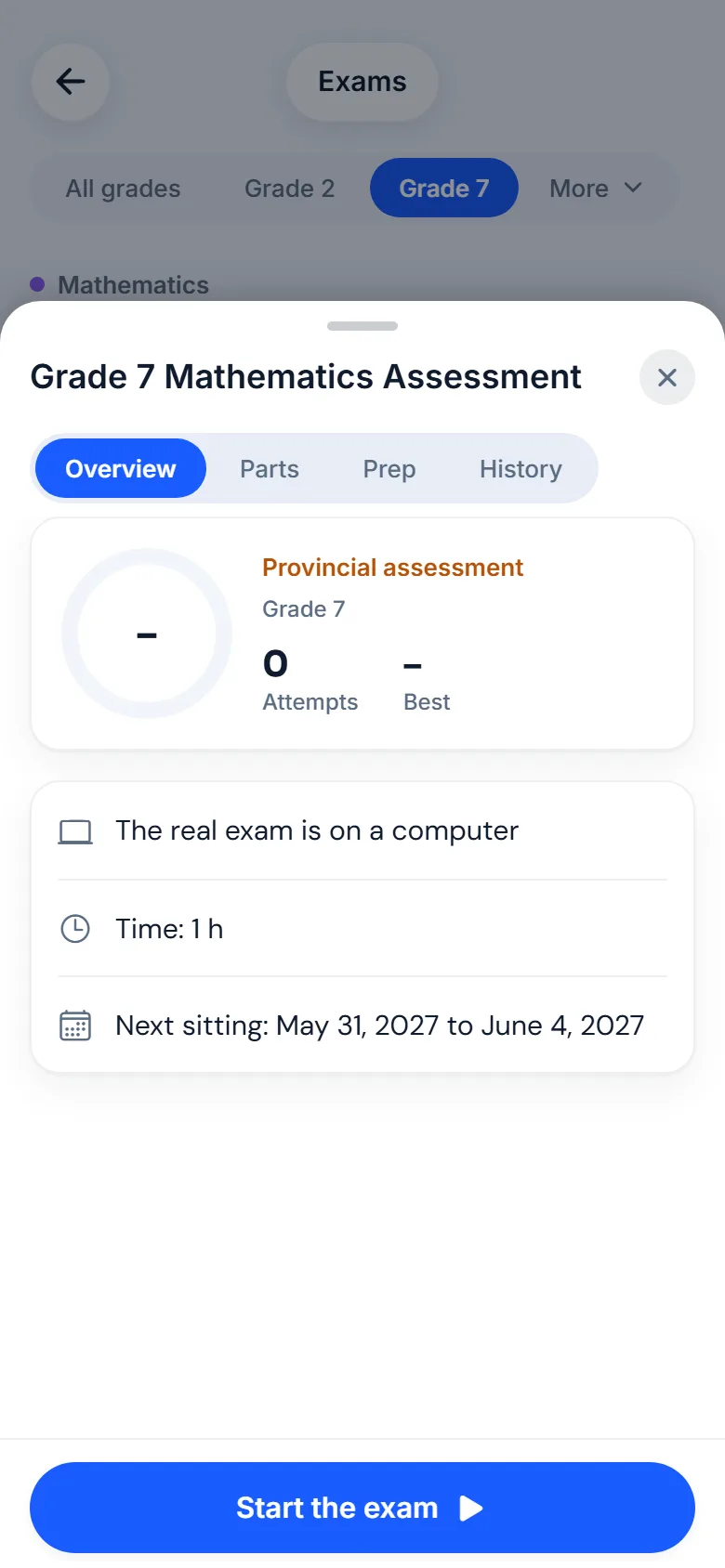 The exam in the app
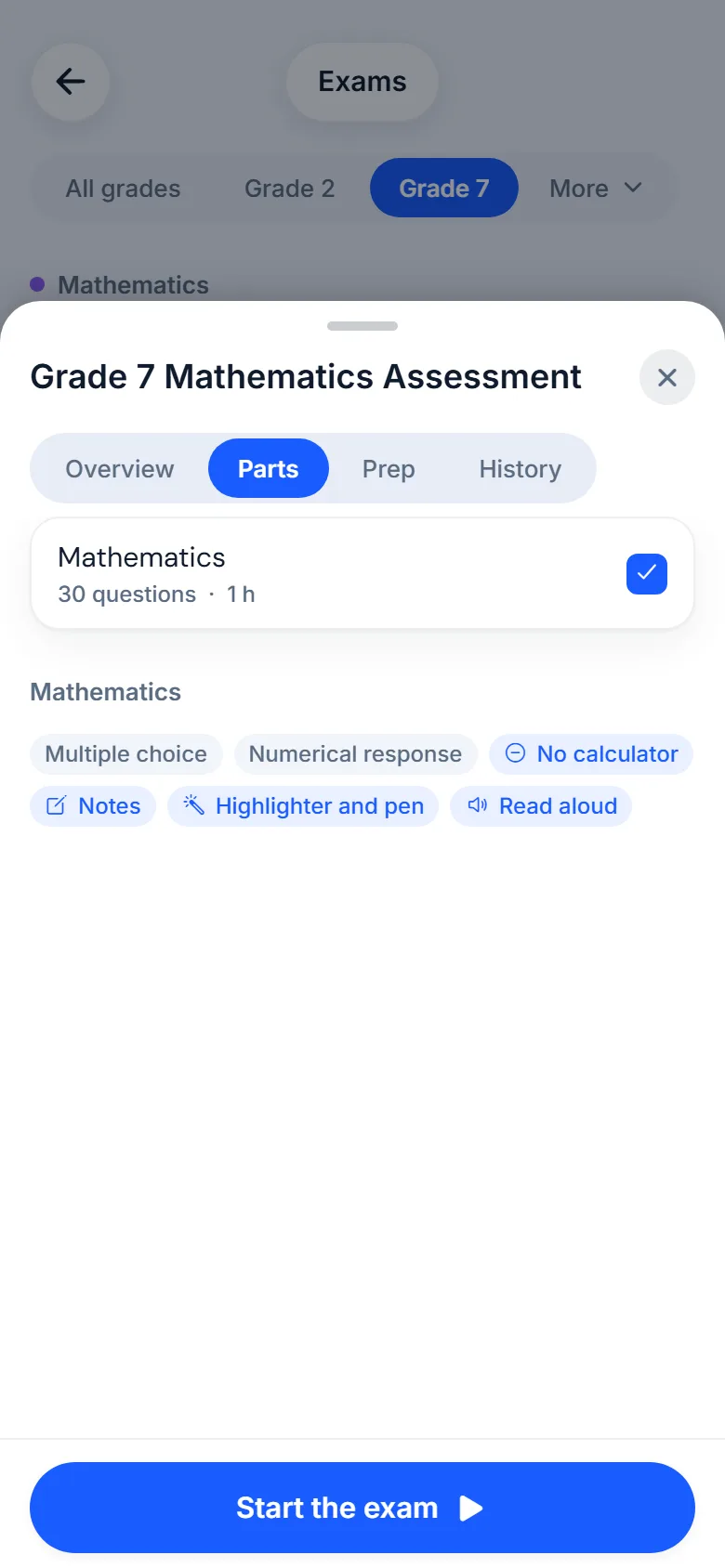 Its parts, and what you can use in each
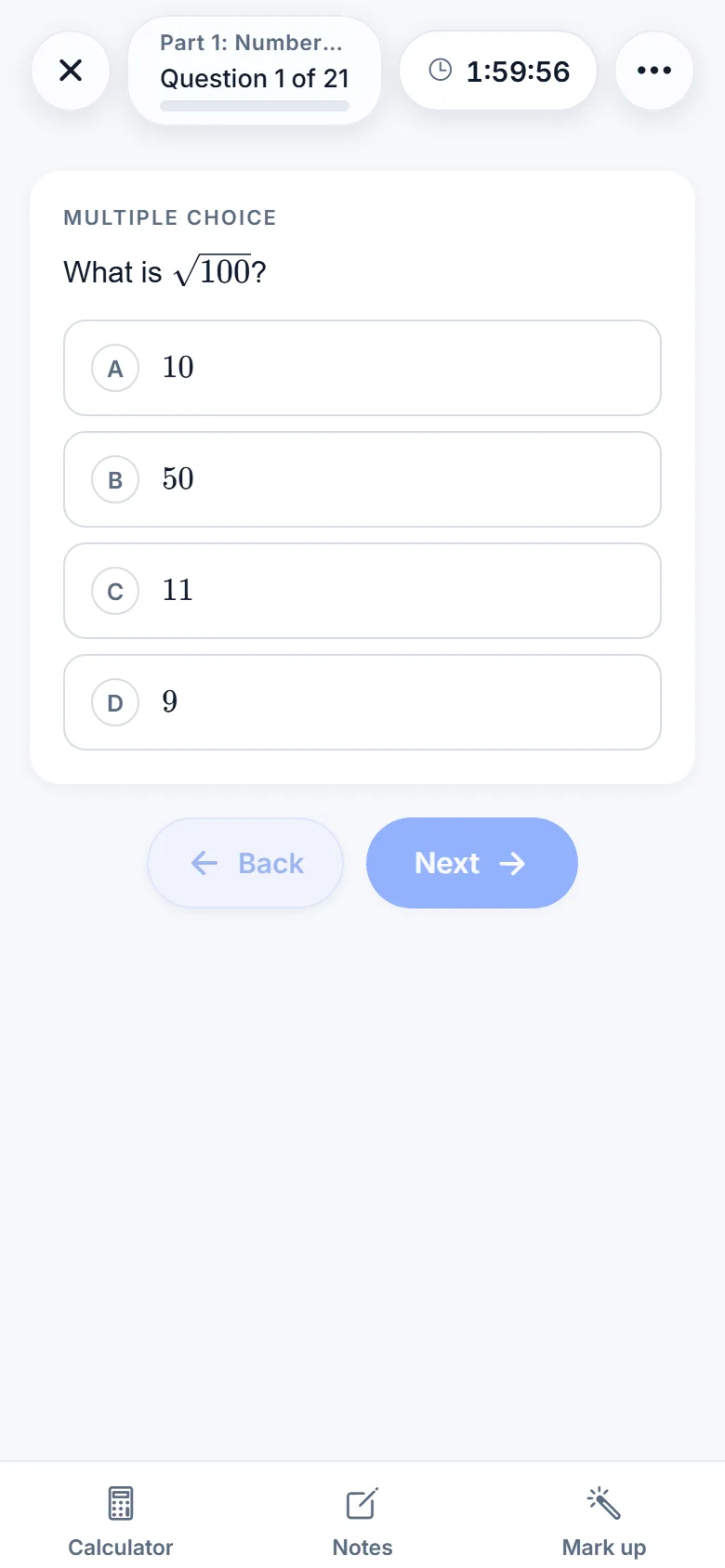 A question, timed, with the exam’s tools
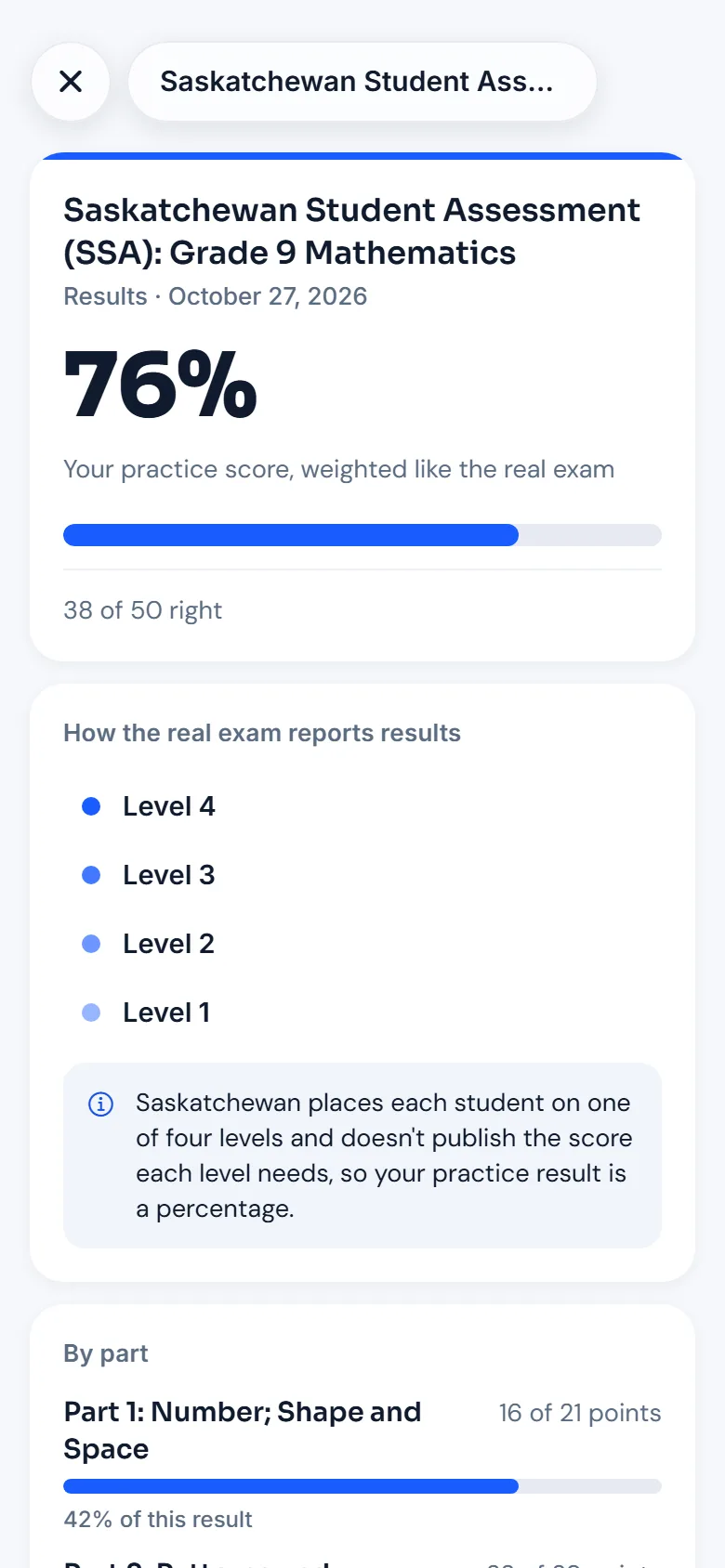 The marked result, part by part
A practice run of Saskatchewan’s Grade 9 math assessment.
Free with a MapleMind account
When
Spring assessment window
- May 31 to June 4, 2027School day · Grade 7 Mathematics Assessment (the school sets the day)
The dates are New Brunswick’s own, read on September 29, 2026. See the official schedule (gnb.ca)
What’s on it
4 topics. Number and Statistics & Probability count most, at 35% each.
- Number35%Number Sense; Operations
- Statistics & Probability35%Data Analysis; Chance and Uncertainty
- Patterns & Relations17%Algebra
- Shape & Space13%Measurement; 2-D Shapes & 3-D Objects
The skills it tests · 34 skills
- Adding and subtracting decimals
- Adding and subtracting fractions with like denominators
- Adding and subtracting fractions with unlike denominators
- Adding integers
- Area of parallelograms
- Area of rectangles
- Area of triangles
- Choosing the best measure of central tendency
- Comparing theoretical and experimental probability of two events
- Determining central tendency and range
- Dividing fractions and mixed numbers
- Effect of an outlier
- Evaluating an expression
- Expression versus equation
- Modelling preservation of equality
- Multiplying and dividing decimals
- Multiplying fractions and mixed numbers
- Nets for 3-D objects
- One-step equations x + a = b
- Patterns and equivalent linear relations
- Perimeter of polygons
- Perpendicular and parallel line segments
- Perpendicular bisectors and angle bisectors
- Plotting points in four quadrants
- Probabilities as ratios, fractions, and percents
- Sample space for two independent events
- Solving linear equations
- Subtracting integers
- Tables, graphs, and analysis of linear relations
- Transformations in four quadrants
- Understanding integers
- Using preservation of equality to solve equations
- Volume of right prisms
- Volume of right rectangular prisms
How it’s built
- Mathematics
- Time
- 60 min
- Questions
- 30
- Marks
- 30
- Of the marks
- 100%
- Multiple choice
- Numerical response
Questions on number, statistics and probability, algebra, and shape and space: multiple choice, fill in a number, drag-and-drop and plotting points on a grid. No calculator.
How it’s marked
- Below Appropriate Achievement
- Appropriate Achievement
- Strong Achievement
A computer marks your answers. There's no pass mark: you get an achievement level, and Appropriate Achievement or above counts as successful.
On the day
One online sitting, followed by a short survey, with no calculator. You may use text-to-speech and switch between English and French. Everyone may take up to double the time: 60 minutes plus another 60.
Getting ready
5 official documents to practise with, and 3 tips.
Official practice
- Grade 7 Mathematics Assessment Blueprintgnb.ca
- Information for Parents and Guardians: Grade 7 Provincial Assessmentsgnb.ca
- G7 Mathematics Assessment Practice (online)nbed.vretta.com
- Provincial Assessment Results 2025‑26: Grades 5 and 7 Mathematicsgnb.ca
- Mathematics: NB Curriculum Framework, middle block (Grade 7 skill descriptors)curriculum.nbed.ca
Tips from the people who write it
- Try the online practice first: it walks through every question format, including plotting points on a grid.
- For fill-in-the-blank questions, enter a number only.
- Practise without a calculator.
After the exam
- Results
Results are published by school, district and province, with summary results in the fall of 2027.
- If you miss it
Barring exceptional circumstances, every student takes part. A student can be exempted when their Personalized Learning Plan says so, in the first stages of learning English, or after a serious illness, a bereavement or another event no one could plan for. Parents are always part of the decision.
From Assessments and evaluations (Anglophone sector), with the information for parents for each grade (gnb.ca) and Provincial Assessment Program: Protocols for Accommodations and Exemptions (gnb.ca), read on October 27, 2026.
More for you
Students
Start with the topics worth the most marks, then write full practice exams under the real time limit.
Practise itParents
Put the dates on the family calendar. The Parent Dashboard shows each practice exam’s result and the skills that need another look.
See the Parent DashboardEducators
The topic weights and the official practice above make a review plan. Students can practise each skill on its own in MapleMind, free with daily limits.
For schools
Questions about this exam
When is the Grade 7 Mathematics Assessment in 2026–27?
The next sitting is May 31 to June 4, 2027.
How long is the Grade 7 Mathematics Assessment?
It takes 1 hour in all, over 1 part.
How many questions are on the Grade 7 Mathematics Assessment?
It has 30 marked questions.
Can you use a calculator on the Grade 7 Mathematics Assessment?
No. Calculators aren’t allowed.
How are Grade 7 Mathematics Assessment results reported?
At 3 levels: Below Appropriate Achievement, Appropriate Achievement and Strong Achievement.
Where can I find practice tests for the Grade 7 Mathematics Assessment?
New Brunswick publishes G7 Mathematics Assessment Practice (online). MapleMind also builds a full practice exam in its format, free with an account.

Practise for the Grade 7 Mathematics Assessment
Every skill on the Grade 7 Mathematics Assessment, taught one at a time, then practised on questions written like the real ones.


