Get help with Social Sciences (Geography, History and Citizenship Education), Grade 5
Most tutoring makes your child sit through material your child already knows. MapleMind flips that: pick the exact skill that's causing trouble — any of the 16 below — and the tutor teaches just that one, step by step, as many times as it takes. Ask questions in plain words, any time of day, in English, French, or 12 other languages.
The official Quebec Social Sciences (Geography, History and Citizenship Education), Grade 5 curriculum
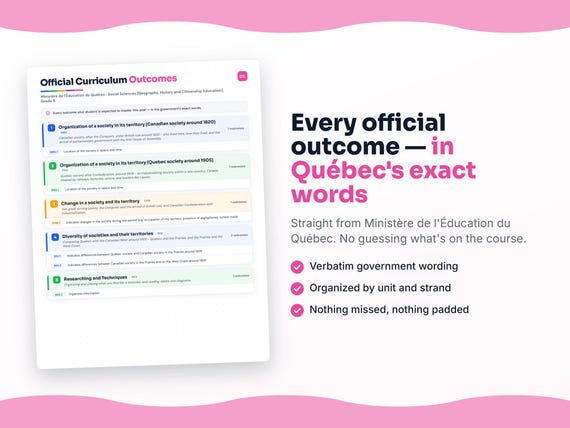
Quebec defines Social Sciences (Geography, History and Citizenship Education), Grade 5 by strands and outcomes. MapleMind teaches the same curriculum reorganized for one-skill-at-a-time tutoring — the table shows exactly where every official strand lands, and the ministry's own wording is quoted under each unit below.
Official source Québec's official education programRead it on the government site — quebec.ca ↗| Official strand | Outcomes | Where MapleMind teaches it |
|---|---|---|
| ORG | 10 | Organization of a society in its territory (Canadian society around 1820) · Organization of a society in its territory (Quebec society around 1905) |
| CHG | 2 | Change in a society and its territory |
| DIV | 2 | Diversity of societies and their territories |
| RES | 2 | Researching and Techniques |
Every skill below, taught one on one.
 Try the first session free
How MapleMind teaches Social Sciences (Geography, History and Citizenship Education), Grade 5 — every unit, lesson, and skill
Every skill below runs as a short session: a plain-words lesson, a worked example, solving it together, then a five-question skill check that earns up to three stars. Guided Mode keeps it teaching instead of answer-handing — turning it off needs a parent's password.
Unit 1Organization of a society in its territory (Canadian society around 1820)Official strand · ORG
Canadian society after the Conquest, under British rule around 1820 - who lived here, how they lived, and the arrival of parliamentary government with the first House of Assembly.
Canada Under British Rule Around 1820
- Where and who: Canada around 1820ORG.E.1 — Locate Canadian society around 1820 and describe its people - First Nations, Canadians, and the English - and where they lived.
- Language, faith, and daily lifeORG.E.2.2.a — Describe the culture of Canadian society around 1820 - its two main languages, its faiths, art, and everyday life.
- Making a living around 1820ORG.E.2.3.a — Describe how Canadian society around 1820 made a living, and how people and goods moved by land, water, and the new canals.
- The first House of AssemblyORG.E.2.4.c — Explain the new government of Canadian society around 1820 - an appointed governor, but now with elected representatives in a House of Assembly.
- The land, key people, and lasting tracesORG.E.3 — Explain how the land shaped Canadian society around 1820, name key people and events (including the Conquest), and find lasting traces like parliamentary government.
The official wording — 5 outcomes in this unit
- ORG.E.1
Location of the society in space and time
- ORG.E.2.2.a
Names the main languages spoken: French, English
- ORG.E.2.3.a
Names economic activities (e.g. agriculture, animal husbandry, trade and in particular the lumber trade)
- ORG.E.2.4.c
Names an institution: the House of Assembly
- ORG.E.3
Assets and limitations of the territory
Unit 2Organization of a society in its territory (Quebec society around 1905)Official strand · ORG
Quebec society after Confederation, around 1905 - an industrializing society within a new country, Canada, shaped by railways, factories, unions, and leaders like Laurier.
Industrial Quebec Around 1905
- Where and who: Quebec around 1905ORG.F.1 — Locate Quebec society around 1905 within the new country of Canada, and describe its people.
- Language, faith, and daily lifeORG.F.2.2.a — Describe the culture of Quebec society around 1905 - its languages, faiths, art, and everyday life.
- The industrial economyORG.F.2.3.a — Describe the industrial economy of Quebec around 1905 - factories, trade, and the railways that tied it together.
- Government within ConfederationORG.F.2.4.c — Explain how Quebec was governed around 1905 - an elected Legislative Assembly within the country of Canada.
- The land, key people, and lasting tracesORG.F.3 — Explain how the land powered industry around 1905, name key people and events (Confederation, industrialization), and find lasting traces like unions and electrification.
The official wording — 5 outcomes in this unit
- ORG.F.1
Location of the society in space and time
- ORG.F.2.2.a
Names the main languages spoken: French, English
- ORG.F.2.3.a
Names economic activities: agriculture, animal husbandry, industry, trade
- ORG.F.2.4.c
Names an institution: the Legislative Assembly
- ORG.F.3
Assets and limitations of the territory
Unit 3Change in a society and its territoryOfficial strand · CHG
Two great turning points: the Conquest and the arrival of British rule, and Canadian Confederation with industrialization.
The Conquest and a New Order
- Changes after the ConquestCHG.D.0.a — Describe the changes that came after the Conquest, and name the people and events that reshaped the society.
- Confederation and industrializationCHG.E.0.a — Describe the changes of the Confederation era - industrialization, urbanization, and settlement - and name the people and events behind them.
The official wording — 2 outcomes in this unit
- CHG.D.0.a
Indicates changes in the society during this period (e.g. occupation of the territory, presence of anglophones, lumber trade
- CHG.E.0.a
Indicates changes in the society during this period: occupation of the territory
Unit 4Diversity of societies and their territoriesOfficial strand · DIV
Comparing Quebec with the Canadian West around 1905 - Quebec and the Prairies, and the Prairies and the West Coast.
Quebec and the Prairies Around 1905
- Comparing Quebec and the PrairiesDIV.E.1 — Compare Quebec society and Canadian society in the Prairies around 1905 across population, economy, language, religion, and territory.
The Prairies and the West Coast
- Comparing the Prairies and the West CoastDIV.F.1 — Compare Canadian society in the Prairies and on the West Coast around 1905 across population, economy, religion, and territory.
The official wording — 2 outcomes in this unit
- DIV.E.1
Indicates differences between Québec society and Canadian society in the Prairies around 1905
- DIV.F.1
Indicates differences between Canadian society in the Prairies and on the West Coast around 1905
Unit 5Researching and TechniquesOfficial strand · RES
Organizing and sharing what you find like a historian, and reading tables and diagrams.
Organizing Information and Reading Tables
- Organizing and sharing informationRES.-.5 — Organize the information you gather into a clear form - a table, list, diagram, or text - and always indicate your sources.
- Reading tables and diagramsTEC.-.5 — Read a table or diagram: use its title, legend, and scale to find the data you need.
The official wording — 2 outcomes in this unit
- RES.-.5
Organizes information
- TEC.-.5
Interprets tables and diagrams
Printable workbook · A keepsake of the year
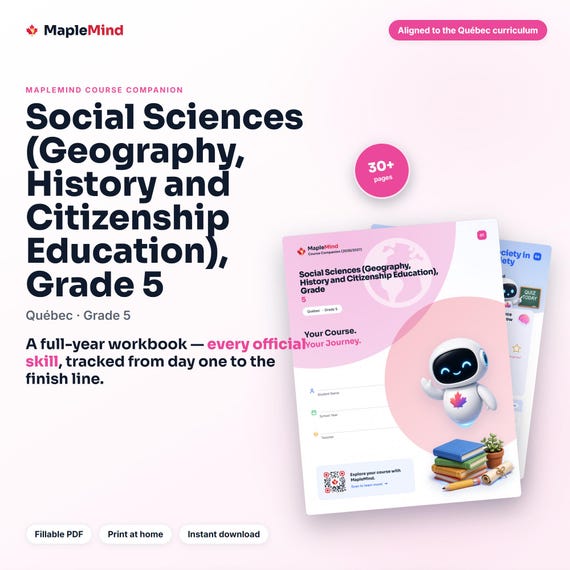
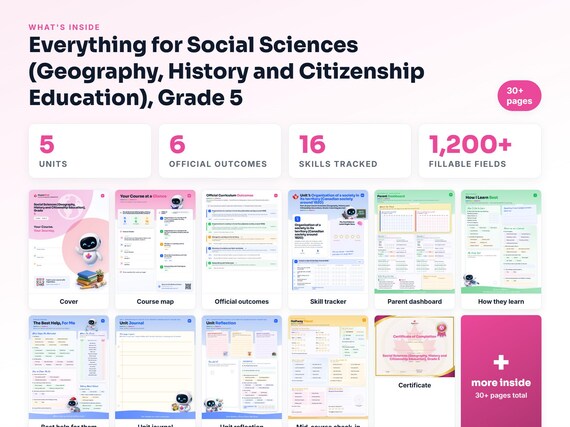
A Social Sciences (Geography, History and Citizenship Education), Grade 5 workbook worth keeping
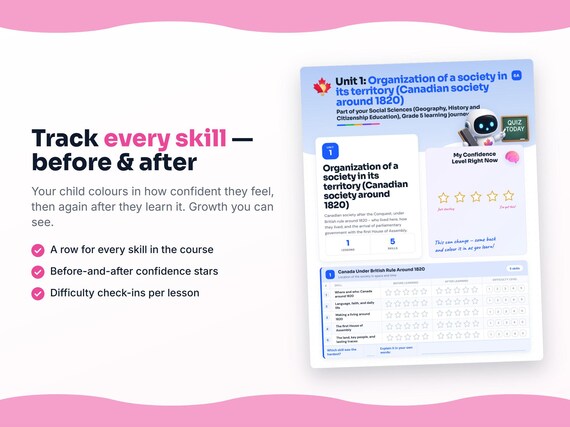
Built from the same official curriculum as this page. Before and after each skill above, your student colours in how sure they feel — so the two of you can see, on one page, what's clicking and what needs another look. It's a quiet way to follow how the year is really going.
By June it's full of their own handwriting: units worked through, confidence grown, a mid-year check-in, notes from parent-teacher night, and a certificate at the end. Less a worksheet, more a record of the year worth keeping on the shelf.
Instant download · see every page, reviews and the full description · five or more workbooks are $2.99 each
What it looks like in the app



Common questions
Can MapleMind help my child with Social Sciences (Geography, History and Citizenship Education), Grade 5?
Yes. MapleMind's AI tutor covers all 16 skills in Quebec's Social Sciences (Geography, History and Citizenship Education), Grade 5 — your child picks the exact skill, and the tutor teaches it step by step: a short lesson, a worked example, solving together, then a skill check to show it stuck.
Is MapleMind aligned to Quebec's official curriculum?
Yes. Every skill in this course maps to an official outcome code from Quebec's Grade 5 Social Studies curriculum, and the ministry's own wording is quoted under each unit on this page — with the official government source linked so you can check it yourself.
What does MapleMind cost?
It's free to start — 5 tutoring chats and a practice quiz every day, no credit card. A Pro subscription ($9.99/month or $49.99/year CAD, 7-day free trial) unlocks unlimited tutoring, practice, and exam simulations.
What if my child is stuck on just one topic?
That's the point of skill-level tutoring: open Social Sciences (Geography, History and Citizenship Education), Grade 5 in the app, tap the exact skill from the list on this page, and the tutor teaches just that — no wading through lessons your child doesn't need.
Does MapleMind work in French or other languages?
Yes — 14 languages, including French. Both the app and the tutor's explanations switch to the language your child chooses.
Where can I see the official Quebec curriculum for Social Sciences (Geography, History and Citizenship Education), Grade 5?
The official source is linked on this page — Québec's official education program. The outline here follows it: every MapleMind skill carries its official outcome code, and the ministry's own wording is quoted under each unit.
Keep exploring
Ready when you are
Pick a skill from this page and see it taught properly — free, in the browser, in under a minute.