Get help with Social Sciences (Geography, History and Citizenship Education), Grade 4
Most tutoring makes your child sit through material your child already knows. MapleMind flips that: pick the exact skill that's causing trouble — any of the 18 below — and the tutor teaches just that one, step by step, as many times as it takes. Ask questions in plain words, any time of day, in English, French, or 12 other languages.
The official Quebec Social Sciences (Geography, History and Citizenship Education), Grade 4 curriculum
Quebec defines Social Sciences (Geography, History and Citizenship Education), Grade 4 by strands and outcomes. MapleMind teaches the same curriculum reorganized for one-skill-at-a-time tutoring — the table shows exactly where every official strand lands, and the ministry's own wording is quoted under each unit below.
Official source Québec's official education programRead it on the government site — quebec.ca ↗| Official strand | Outcomes | Where MapleMind teaches it |
|---|---|---|
| ORG | 13 | Organization of a society in its territory (French society in New France, around 1645) · Organization of a society in its territory (Canadian society in New France, around 1745) |
| CHG | 1 | Change in a society and its territory |
| DIV | 2 | Diversity of societies and their territories |
| RES | 2 | Researching and Techniques |
Every skill below, taught one on one.
 Try the first session free
How MapleMind teaches Social Sciences (Geography, History and Citizenship Education), Grade 4 — every unit, lesson, and skill
Every skill below runs as a short session: a plain-words lesson, a worked example, solving it together, then a five-question skill check that earns up to three stars. Guided Mode keeps it teaching instead of answer-handing — turning it off needs a parent's password.
Unit 1Organization of a society in its territory (French society in New France, around 1645)Official strand · ORG
Getting to know French society in New France in its founding era - where it took root, who lived there (French and First Nations), how people lived, and how the colony was governed from France.
Founding New France
- Where and when French New France beganORG.C.1 — Locate the territory of French society in New France around its founding, and place the society in time.
- Who lived in New FranceORG.C.2.1.b — Describe who lived in New France - First Nations peoples and the French - where they were concentrated, and roughly how many.
- Languages, faith, and daily lifeORG.C.2.2.a — Describe the languages, faiths, art, and daily life of New France - both First Nations and French.
- The fur trade and making a livingORG.C.2.3.a — Describe how New France made a living - above all the fur trade - and how people and goods moved.
- Ruled from FranceORG.C.2.4.a — Explain how founding-era New France was governed - decisions made by the king of France, with a governor and the Company of One Hundred Associates.
- How the land shaped the founding colonyORG.C.3 — Explain how the land helped and limited founding-era New France - its soil, rivers, and the beaver that drove the fur trade.
- Key people, events, and what remainsORG.C.4 — Name the key people, groups, and events of founding-era New France - including First Nations and the Iroquois wars - and find traces that remain today.
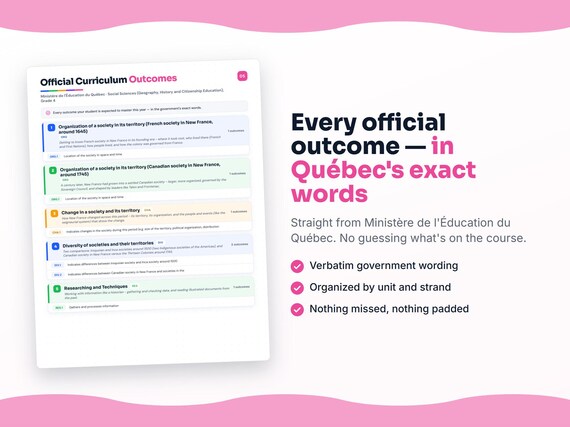
The official wording — 7 outcomes in this unit
- ORG.C.1
Location of the society in space and time
- ORG.C.2.1.b
Describes the composition of the population: Native peoples, French
- ORG.C.2.2.a
Names languages spoken: Native languages, French
- ORG.C.2.3.a
Names economic activities: fur trade, agriculture, hunting and fishing
- ORG.C.2.4.a
Indicates the means of decision making: made unilaterally by the king of France
- ORG.C.3
Assets and limitations of the territory
- ORG.C.4
Influence of people and events on social and territorial organization
Unit 2Organization of a society in its territory (Canadian society in New France, around 1745)Official strand · ORG
A century later, New France had grown into a settled Canadian society - larger, more organized, governed by the Sovereign Council, and shaped by leaders like Talon and Frontenac.
A Grown-Up Colony Around 1745
- Where and who: Canadian society around 1745ORG.D.1 — Locate Canadian society in New France around 1745 and describe its people - First Nations, French, and now Canadians born in the colony.
- Culture of the grown colonyORG.D.2.2.a — Describe the culture of Canadian society around 1745 - its languages, faiths, art, and everyday life.
- A more developed economyORG.D.2.3.a — Describe the more developed economy of Canadian society around 1745 - agriculture, animal husbandry, early industries - and new routes like the Chemin du Roy.
- The Sovereign CouncilORG.D.2.4.a — Explain how Canadian society in New France was governed around 1745 - by the king of France, with a governor and the Sovereign Council.
- How the land shaped the grown colonyORG.D.3 — Explain how the land helped and limited Canadian society around 1745 - its natural defences, waters, and forests for shipbuilding.
- Key people, events, and lasting tracesORG.D.4 — Name the key people, groups, and events of Canadian society around 1745, and find lasting traces like the strip-farm land pattern.
The official wording — 6 outcomes in this unit
- ORG.D.1
Location of the society in space and time
- ORG.D.2.2.a
Names languages spoken: Native languages, French
- ORG.D.2.3.a
Names economic activities (e.g. agriculture, animal husbandry, early industries, t
- ORG.D.2.4.a
Indicates the means of decision making: made unilaterally by the king of France
- ORG.D.3
Assets and limitations of the territory
- ORG.D.4
Influence of people and events on social and territorial organization
Unit 3Change in a society and its territoryOfficial strand · CHG
How New France changed across this period - its territory, its organization, and the people and events (like the seigneurial system) that drove the change.
How New France Changed
- Changes across the periodCHG.C.0.a — Describe how New France changed across this period, and name the people and events that drove the change.
The official wording — 1 outcome in this unit
- CHG.C.0.a
Indicates changes in the society during this period (e.g. size of the territory, political organization, distribution
Unit 4Diversity of societies and their territoriesOfficial strand · DIV
Two comparisons: Iroquoian and Inca societies around 1500 (two Indigenous societies of the Americas), and Canadian society in New France versus the Thirteen Colonies around 1745.
Two Indigenous Societies: Iroquoian and Inca
- Comparing Iroquoian and Inca societiesDIV.C.1 — Compare Iroquoian and Inca societies around 1500 - how leaders were chosen, their social structure, dwellings, and territory - fairly and respectfully.
New France and the Thirteen Colonies
- Comparing New France and the Thirteen ColoniesDIV.D.1 — Compare Canadian society in New France with the Thirteen Colonies around 1745 across population, government, language, religion, economy, and military.
The official wording — 2 outcomes in this unit
- DIV.C.1
Indicates differences between Iroquoian society and Inca society around 1500
- DIV.D.1
Indicates differences between Canadian society in New France and societies in the
Unit 5Researching and TechniquesOfficial strand · RES
Working with information like a historian - gathering and checking data, and reading illustrated documents from the past.
Gathering Information and Reading Pictures from the Past
- Gathering and checking informationRES.-.4 — Gather information, sort it, tell facts from opinions, and judge whether a source is trustworthy and relevant.
- Reading a picture from the pastTEC.-.4 — Read an illustrated document from the past - a painting, poster, or mural - by finding its source, subject, and what it shows.
The official wording — 2 outcomes in this unit
- RES.-.4
Gathers and processes information
- TEC.-.4
Interprets illustrated documents (e.g. illustrations, posters, murals, paintings)
Printable workbook · A keepsake of the year
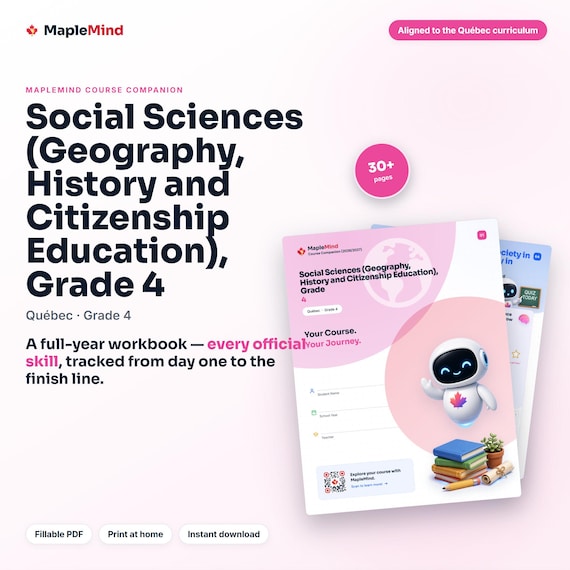
A Social Sciences (Geography, History and Citizenship Education), Grade 4 workbook worth keeping
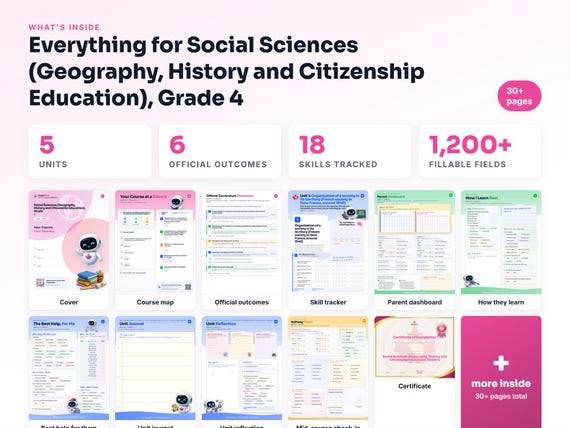
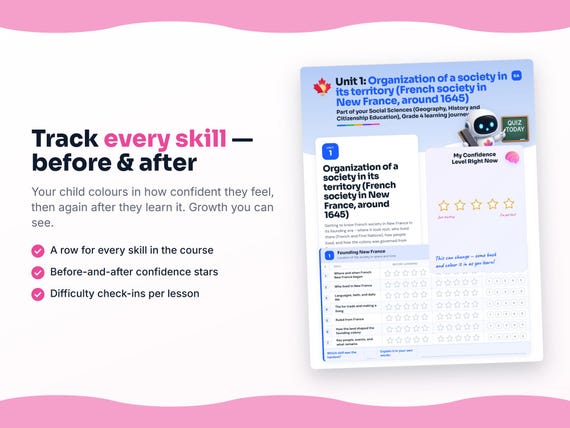
Built from the same official curriculum as this page. Before and after each skill above, your student colours in how sure they feel — so the two of you can see, on one page, what's clicking and what needs another look. It's a quiet way to follow how the year is really going.
By June it's full of their own handwriting: units worked through, confidence grown, a mid-year check-in, notes from parent-teacher night, and a certificate at the end. Less a worksheet, more a record of the year worth keeping on the shelf.
Instant download · see every page, reviews and the full description · five or more workbooks are $2.99 each
What it looks like in the app



Common questions
Can MapleMind help my child with Social Sciences (Geography, History and Citizenship Education), Grade 4?
Yes. MapleMind's AI tutor covers all 18 skills in Quebec's Social Sciences (Geography, History and Citizenship Education), Grade 4 — your child picks the exact skill, and the tutor teaches it step by step: a short lesson, a worked example, solving together, then a skill check to show it stuck.
Is MapleMind aligned to Quebec's official curriculum?
Yes. Every skill in this course maps to an official outcome code from Quebec's Grade 4 Social Studies curriculum, and the ministry's own wording is quoted under each unit on this page — with the official government source linked so you can check it yourself.
What does MapleMind cost?
It's free to start — 5 tutoring chats and a practice quiz every day, no credit card. A Pro subscription ($9.99/month or $49.99/year CAD, 7-day free trial) unlocks unlimited tutoring, practice, and exam simulations.
What if my child is stuck on just one topic?
That's the point of skill-level tutoring: open Social Sciences (Geography, History and Citizenship Education), Grade 4 in the app, tap the exact skill from the list on this page, and the tutor teaches just that — no wading through lessons your child doesn't need.
Does MapleMind work in French or other languages?
Yes — 14 languages, including French. Both the app and the tutor's explanations switch to the language your child chooses.
Where can I see the official Quebec curriculum for Social Sciences (Geography, History and Citizenship Education), Grade 4?
The official source is linked on this page — Québec's official education program. The outline here follows it: every MapleMind skill carries its official outcome code, and the ministry's own wording is quoted under each unit.
Keep exploring
Ready when you are
Pick a skill from this page and see it taught properly — free, in the browser, in under a minute.