Get help with Français, langue d’enseignement, 3e année
Most tutoring makes your child sit through material your child already knows. MapleMind flips that: pick the exact skill that's causing trouble — any of the 86 below — and the tutor teaches just that one, step by step, as many times as it takes. Ask questions in plain words, any time of day, in English, French, or 12 other languages.
The official Quebec Français, langue d’enseignement, 3e année curriculum
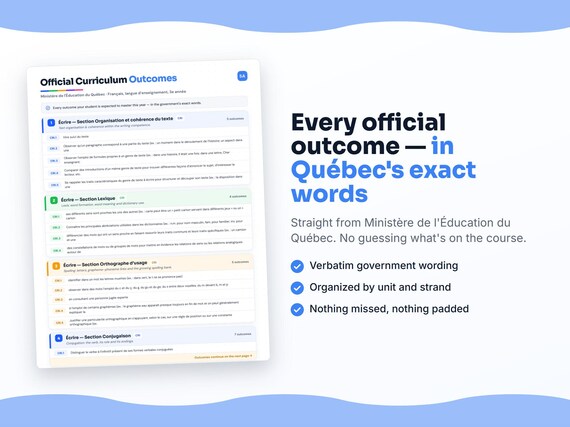
Quebec defines Français, langue d’enseignement, 3e année by strands and outcomes. MapleMind teaches the same curriculum reorganized for one-skill-at-a-time tutoring — the table shows exactly where every official strand lands, and the ministry's own wording is quoted under each unit below.
Official source Québec's official education programRead it on the government site — quebec.ca ↗| Official strand | Outcomes | Where MapleMind teaches it |
|---|---|---|
| Strand B | 45 | Écrire — Section Organisation et cohérence du texte · Écrire — Section Lexique · Écrire — Section Orthographe d’usage · Écrire — Section Conjugaison · Écrire — Section Accords · Écrire — Section Syntaxe et ponctuation |
| Strand C | 19 | Compétence Lire des textes variés |
| Strand D | 9 | Compétence Apprécier des œuvres littéraires |
| Strand E | 13 | Compétence Communiquer oralement |
Every skill below, taught one on one.
 Try the first session free
How MapleMind teaches Français, langue d’enseignement, 3e année — every unit, lesson, and skill
Every skill below runs as a short session: a plain-words lesson, a worked example, solving it together, then a five-question skill check that earns up to three stars. Guided Mode keeps it teaching instead of answer-handing — turning it off needs a parent's password.
Unit 1Écrire — Section Organisation et cohérence du texteOfficial strand · Strand B
Text organisation & coherence within the writing competence.
Vérifier le découpage de son texte
- Le paragraphe et le découpage du texte (paragraphs and text structure)P2.98 — Maîtrise de « Le paragraphe et le découpage du texte » (paragraphs and text structure) en 3e année, Français L1 — l’enfant l’emploie de façon autonome dans ses lectures, ses écrits et à l’oral.
Écrire pour une vraie situation (writing for a real situation)
- Découverte : Le paragraphe et le découpage du texte (paragraphs and text structure)P2.17 — Découverte guidée de « Le paragraphe et le découpage du texte » (paragraphs and text structure) en 3e année, Français L1 — premier contact accompagné par l’adulte, avant la maîtrise autonome.
Comment chaque genre organise ses idées (how each genre organises ideas)
- Découverte : Les genres de textes (text genres)P2.36 — Découverte guidée de « Les genres de textes » (text genres) en 3e année, Français L1 — premier contact accompagné par l’adulte, avant la maîtrise autonome.
Reprendre l’information sans se répéter (repeating information without repeating words)
- Découverte : L’ordre des idées dans le texte (ordering ideas in a text)P2.68 — Découverte guidée de « L’ordre des idées dans le texte » (ordering ideas in a text) en 3e année, Français L1 — premier contact accompagné par l’adulte, avant la maîtrise autonome.
Planifier le découpage de son texte (planning how to divide a text)
- Découverte : Le paragraphe et le découpage du texte (paragraphs and text structure)P2.84 — Découverte guidée de « Le paragraphe et le découpage du texte » (paragraphs and text structure) en 3e année, Français L1 — premier contact accompagné par l’adulte, avant la maîtrise autonome.
The official wording — 5 outcomes in this unit
- P2.98
titre suivi du texte
- P2.17
Observer qu’un paragraphe correspond à une partie du texte (ex. : un moment dans le déroulement de l’histoire; un aspect dans une
- P2.36
Observer l’emploi de formules propres à un genre de texte (ex. : dans une histoire, Il était une fois; dans une lettre, Cher enseignant;
- P2.68
Comparer des introductions d’un même genre de texte pour trouver différentes façons d’annoncer le sujet, d’intéresser le lecteur, etc.
- P2.84
Se rappeler les traits caractéristiques du genre de texte à écrire pour structurer et découper son texte (ex. : la disposition dans une
Unit 2Écrire — Section LexiqueOfficial strand · Strand B
Lexis: word formation, word meaning and dictionary use.
Un mot, un ou plusieurs sens (words with one meaning or many)
- Découverte : Le sens des mots (propre, figuré) (word meanings (literal and figurative))P3.13 — Découverte guidée de « Le sens des mots (propre, figuré) » (word meanings (literal and figurative)) en 3e année, Français L1 — premier contact accompagné par l’adulte, avant la maîtrise autonome.
Les différentes sortes de dictionnaires (different kinds of dictionaries)
- Découverte : Le dictionnaire (using the dictionary)P3.43 — Découverte guidée de « Le dictionnaire » (using the dictionary) en 3e année, Français L1 — premier contact accompagné par l’adulte, avant la maîtrise autonome.
Décrire le sens d’un mot dans ses mots (explaining a word in your own words)
- Découverte : Les relations entre les mots (synonymes, antonymes, génériques) (relations between words)P3.66 — Découverte guidée de « Les relations entre les mots (synonymes, antonymes, génériques) » (relations between words) en 3e année, Français L1 — premier contact accompagné par l’adulte, avant la maîtrise autonome.
Bâtir sa banque de mots (building your own word bank)
- Découverte : Les relations entre les mots (synonymes, antonymes, génériques) (relations between words)P3.81 — Découverte guidée de « Les relations entre les mots (synonymes, antonymes, génériques) » (relations between words) en 3e année, Français L1 — premier contact accompagné par l’adulte, avant la maîtrise autonome.
The official wording — 4 outcomes in this unit
- P3.13
ses différents sens sont proches les uns des autres (ex. : carte peut être un « petit carton servant dans différents jeux » ou un « carton
- P3.43
Connaître les principales abréviations utilisées dans les dictionnaires (ex. : n.m. pour nom masculin, fam. pour familier; inv. pour
- P3.66
différencier des mots qui ont un sens proche en faisant ressortir leurs traits communs et leurs traits spécifiques (ex. : un camion et une
- P3.81
des constellations de mots ou de groupes de mots pour mettre en évidence les relations de sens ou les relations analogiques autour de
Unit 3Écrire — Section Orthographe d’usageOfficial strand · Strand B
Spelling: letters, grapheme–phoneme links and the growing spelling bank.
Le rôle des lettres muettes
- Le rôle des lettres muettes (silent letters)P4.16 — Maîtrise de « Le rôle des lettres muettes » (silent letters) en 3e année, Français L1 — l’enfant l’emploie de façon autonome dans ses lectures, ses écrits et à l’oral.
Les familles de mots pour mieux orthographier (word families that help spelling)
- Les règles de position (c/ç, g/gu/ge, m devant b, m, p) (position-based spelling rules)P4.22 — Maîtrise de « Les règles de position (c/ç, g/gu/ge, m devant b, m, p) » (position-based spelling rules) en 3e année, Français L1 — l’enfant l’emploie de façon autonome dans ses lectures, ses écrits et à l’oral.
Consulter un outil de référence (checking a reference tool)
- Les stratégies orthographiques (spelling strategies)P4.76 — Maîtrise de « Les stratégies orthographiques » (spelling strategies) en 3e année, Français L1 — l’enfant l’emploie de façon autonome dans ses lectures, ses écrits et à l’oral.
Les mots à l’étude
- Découverte : Les correspondances graphème-phonème (letter-sound correspondences)P4.43 — Découverte guidée de « Les correspondances graphème-phonème » (letter-sound correspondences) en 3e année, Français L1 — premier contact accompagné par l’adulte, avant la maîtrise autonome.
Associer graphèmes et phonèmes (matching letters and sounds)
- Découverte : Les correspondances graphème-phonème (letter-sound correspondences)P4.54 — Découverte guidée de « Les correspondances graphème-phonème » (letter-sound correspondences) en 3e année, Français L1 — premier contact accompagné par l’adulte, avant la maîtrise autonome.
The official wording — 5 outcomes in this unit
- P4.16
identifier dans un mot les lettres muettes (ex. : dans vert, le t ne se prononce pas)
- P4.22
observer dans des mots l’emploi du c et du ç; du g, du gu et du ge; du s entre deux voyelles; du m devant b, m et p
- P4.76
en consultant une personne jugée experte
- P4.43
à l’emploi de certains graphèmes (ex. : le graphème eau apparaît presque toujours en fin de mot et on peut généralement expliquer la
- P4.54
Justifier une particularité orthographique en s’appuyant, selon le cas, sur une règle de position ou sur une constante orthographique (ex.
Unit 4Écrire — Section ConjugaisonOfficial strand · Strand B
Conjugation: the verb, its role and its endings.
Reconnaître l’infinitif du verbe (recognising the infinitive)
- Découverte : L’infinitif du verbe (the infinitive form)P5.4 — Découverte guidée de « L’infinitif du verbe » (the infinitive form) en 3e année, Français L1 — premier contact accompagné par l’adulte, avant la maîtrise autonome.
Les verbes en -er (verbs ending in -er)
- Découverte : Les modèles de conjugaison (conjugation models)P5.20 — Découverte guidée de « Les modèles de conjugaison » (conjugation models) en 3e année, Français L1 — premier contact accompagné par l’adulte, avant la maîtrise autonome.
Découvrir les temps composés (discovering compound tenses)
- Découverte : Les temps de conjugaison (verb tenses)P5.51 — Découverte guidée de « Les temps de conjugaison » (verb tenses) en 3e année, Français L1 — premier contact accompagné par l’adulte, avant la maîtrise autonome.
Régularités et particularités d’un verbe (a verb’s patterns and quirks)
- Découverte : Les modèles de conjugaison (conjugation models)P5.69 — Découverte guidée de « Les modèles de conjugaison » (conjugation models) en 3e année, Français L1 — premier contact accompagné par l’adulte, avant la maîtrise autonome.
Se bâtir un aide-mémoire de verbes (building a personal verb memory aid)
- Découverte : Les modèles de conjugaison (conjugation models)P5.70 — Découverte guidée de « Les modèles de conjugaison » (conjugation models) en 3e année, Français L1 — premier contact accompagné par l’adulte, avant la maîtrise autonome.
S’appuyer sur un verbe modèle (using a model verb)
- Découverte : Les modèles de conjugaison (conjugation models)P5.88 — Découverte guidée de « Les modèles de conjugaison » (conjugation models) en 3e année, Français L1 — premier contact accompagné par l’adulte, avant la maîtrise autonome.
Vérifier ses verbes avec ses connaissances (checking verbs with what you know)
- Découverte : Vérifier et corriger un verbe (checking and correcting a verb)P5.109 — Découverte guidée de « Vérifier et corriger un verbe » (checking and correcting a verb) en 3e année, Français L1 — premier contact accompagné par l’adulte, avant la maîtrise autonome.
The official wording — 7 outcomes in this unit
- P5.4
Distinguer le verbe à l’infinitif présent de ses formes verbales conjuguées
- P5.20
les verbes en é + consonne(s) + er (comme céder) les verbes en –ir qui ont un participe présent en –issant (comme finir)
- P5.51
utiliser le futur proche comme transformation pour trouver la forme infinitive d’un verbe conjugué (ex. : je rends – verbe rendre – parce
- P5.69
Identifier les verbes parmi les mots en orthographe d’usage à apprendre et les associer à leur modèle de conjugaison, s’il y lieu (ex. :
- P5.70
Observer les liens de sens et de forme entre le ou les radicaux d’un verbe à l’étude et les mots de la même famille morphologique (ex. :
- P5.88
En prédisant la forme d’un verbe et en s’appuyant sur les modèles de conjugaison à l’étude (ex. : Il faut écrire elles bougeaient et non
- P5.109
en recourant à ses aide-mémoire personnels ou à des tableaux de conjugaison
Unit 5Écrire — Section AccordsOfficial strand · Strand B
Agreement: the système d’accords across the groupe du nom and with the verb.
Identifier un nom par des manipulations (spotting a noun with syntax tests)
- L’adjectif et son accord (the adjective and its agreement)P6.14 — Maîtrise de « L’adjectif et son accord » (the adjective and its agreement) en 3e année, Français L1 — l’enfant l’emploie de façon autonome dans ses lectures, ses écrits et à l’oral.
Identifier un verbe par des manipulations (spotting a verb with syntax tests)
- Les pronoms de conjugaison (conjugation pronouns)P6.44 — Maîtrise de « Les pronoms de conjugaison » (conjugation pronouns) en 3e année, Français L1 — l’enfant l’emploie de façon autonome dans ses lectures, ses écrits et à l’oral.
La formation du pluriel des noms et des adjectifs (forming plurals)
- La formation du pluriel (forming the plural)P6.90 — Maîtrise de « La formation du pluriel » (forming the plural) en 3e année, Français L1 — l’enfant l’emploie de façon autonome dans ses lectures, ses écrits et à l’oral.
La formation du féminin des noms et des adjectifs (forming the feminine)
- La formation du féminin (forming the feminine)P6.96 — Maîtrise de « La formation du féminin » (forming the feminine) en 3e année, Français L1 — l’enfant l’emploie de façon autonome dans ses lectures, ses écrits et à l’oral.
Les règles d’accord dans le groupe du nom
- L’adjectif et son accord (the adjective and its agreement)P6.106 — Maîtrise de « L’adjectif et son accord » (the adjective and its agreement) en 3e année, Français L1 — l’enfant l’emploie de façon autonome dans ses lectures, ses écrits et à l’oral.
La classe d’un mot selon la phrase (a word’s class in its sentence)
- Le déterminant, receveur d’accord (the determiner (receiver of agreement))P6.126 — Maîtrise de « Le déterminant, receveur d’accord » (the determiner (receiver of agreement)) en 3e année, Français L1 — l’enfant l’emploie de façon autonome dans ses lectures, ses écrits et à l’oral.
Du nom au verbe : qui commande l’accord ? (from noun to verb: who drives agreement?)
- Découverte : L’accord du verbe avec le sujet (subject-verb agreement)P6.37 — Découverte guidée de « L’accord du verbe avec le sujet » (subject-verb agreement) en 3e année, Français L1 — premier contact accompagné par l’adulte, avant la maîtrise autonome.
Repérer le verbe pour accorder le participe (finding the verb to agree the participle)
- Découverte : L’accord du participe passé (past-participle agreement)P6.50 — Découverte guidée de « L’accord du participe passé » (past-participle agreement) en 3e année, Français L1 — premier contact accompagné par l’adulte, avant la maîtrise autonome.
Les donneurs d’accord au féminin (agreement givers in the feminine)
- Découverte : La formation du féminin (forming the feminine)P6.102 — Découverte guidée de « La formation du féminin » (forming the feminine) en 3e année, Français L1 — premier contact accompagné par l’adulte, avant la maîtrise autonome.
Justifier la classe d’un mot (explaining a word’s class)
- Découverte : Justifier les accords (justifying agreements)P6.130 — Découverte guidée de « Justifier les accords » (justifying agreements) en 3e année, Français L1 — premier contact accompagné par l’adulte, avant la maîtrise autonome.
Les mots qui ne changent pas au masculin singulier (words that keep their base form)
- Découverte : Justifier les accords (justifying agreements)P6.167 — Découverte guidée de « Justifier les accords » (justifying agreements) en 3e année, Français L1 — premier contact accompagné par l’adulte, avant la maîtrise autonome.
Justifier les accords d’une phrase (explaining the agreements in a sentence)
- Découverte : Justifier les accords (justifying agreements)P6.178 — Découverte guidée de « Justifier les accords » (justifying agreements) en 3e année, Français L1 — premier contact accompagné par l’adulte, avant la maîtrise autonome.
Consulter ses outils de référence
- Découverte : Justifier les accords (justifying agreements)P6.208 — Découverte guidée de « Justifier les accords » (justifying agreements) en 3e année, Français L1 — premier contact accompagné par l’adulte, avant la maîtrise autonome.
The official wording — 13 outcomes in this unit
- P6.14
ajout d’un adjectif avant ou après le nom
- P6.44
nommer les pronoms de conjugaison : je, tu, il, elle, on, nous, vous, ils, elles9
- P6.90
ajout d’un s à la forme de l’adjectif au singulier
- P6.96
règle générale : ajout d’un e à la forme du mot au masculin
- P6.106
Connaître la règle d’accord de l’adjectif avec le nom (en identifiant ou non le groupe du nom)
- P6.126
Répertorier un ensemble de mots appartenant à la classe des déterminants, des noms ou des adjectifs en recourant à la manipulation de
- P6.37
le verbe conjugué est receveur d’accord : il reçoit sa personne et son nombre du SUJET
- P6.50
il donne sa personne et son nombre au verbe conjugué à un temps simple ou à l’auxiliaire d’un verbe conjugué à un temps composé il donne
- P6.102
Observer que certains noms propres forment leur féminin selon les mêmes règles que celles des noms communs (ex. : un Espagnol, une
- P6.130
Annoter la liste de mots à apprendre en orthographe d’usage en identifiant les classes de mots à l’étude et justifier leur classement en
- P6.167
Justifier les accords du déterminant et de l’adjectif avec le nom dans différentes tâches comme le remplacement du nom noyau ou d’un groupe
- P6.178
se trouver des moyens de rendre compte de ses progrès dans le développement d’automatismes dans les accords en cours d’écriture et dans la
- P6.208
Vérifier à l’intérieur de chaque phrase tous les types d’accord connus et apporter les corrections nécessaires en faisant appel à
Unit 6Écrire — Section Syntaxe et ponctuationOfficial strand · Strand B
Syntax & punctuation: the sentence, its structure and its signs.
Les sortes de point (kinds of end punctuation)
- Les sortes de point et la ponctuation finale (end-of-sentence punctuation)P7.26 — Maîtrise de « Les sortes de point et la ponctuation finale » (end-of-sentence punctuation) en 3e année, Français L1 — l’enfant l’emploie de façon autonome dans ses lectures, ses écrits et à l’oral.
Le groupe du nom (GN) (the noun group)
- Le groupe du nom (GN) (the noun group)P7.153 — Maîtrise de « Le groupe du nom (GN) » (the noun group) en 3e année, Français L1 — l’enfant l’emploie de façon autonome dans ses lectures, ses écrits et à l’oral.
Modifier une phrase sans la casser (changing a sentence without breaking it)
- Les manipulations syntaxiques (syntactic manipulations)P7.183 — Maîtrise de « Les manipulations syntaxiques » (syntactic manipulations) en 3e année, Français L1 — l’enfant l’emploie de façon autonome dans ses lectures, ses écrits et à l’oral.
Le groupe du nom minimal dans la phrase (the smallest noun group)
- Les caractéristiques de la phrase (characteristics of the sentence)P7.252 — Maîtrise de « Les caractéristiques de la phrase » (characteristics of the sentence) en 3e année, Français L1 — l’enfant l’emploie de façon autonome dans ses lectures, ses écrits et à l’oral.
La phrase à un seul verbe conjugué (the single-verb sentence)
- Découverte : Les caractéristiques de la phrase (characteristics of the sentence)P7.28 — Découverte guidée de « Les caractéristiques de la phrase » (characteristics of the sentence) en 3e année, Français L1 — premier contact accompagné par l’adulte, avant la maîtrise autonome.
Les façons de marquer la négation (ways of expressing negation)
- Découverte : La phrase interrogative (the interrogative sentence)P7.83 — Découverte guidée de « La phrase interrogative » (the interrogative sentence) en 3e année, Français L1 — premier contact accompagné par l’adulte, avant la maîtrise autonome.
Manipuler le groupe du nom (manipulating the noun group)
- Découverte : Les manipulations syntaxiques (syntactic manipulations)P7.184 — Découverte guidée de « Les manipulations syntaxiques » (syntactic manipulations) en 3e année, Français L1 — premier contact accompagné par l’adulte, avant la maîtrise autonome.
Transformer des phrases par manipulations (transforming sentences with manipulations)
- Découverte : Les manipulations syntaxiques (syntactic manipulations)P7.197 — Découverte guidée de « Les manipulations syntaxiques » (syntactic manipulations) en 3e année, Français L1 — premier contact accompagné par l’adulte, avant la maîtrise autonome.
Les formes positive et négative
- Découverte : La forme négative (the negative form)P7.207 — Découverte guidée de « La forme négative » (the negative form) en 3e année, Français L1 — premier contact accompagné par l’adulte, avant la maîtrise autonome.
La phrase de type interrogatif
- Découverte : La phrase interrogative (the interrogative sentence)P7.222 — Découverte guidée de « La phrase interrogative » (the interrogative sentence) en 3e année, Français L1 — premier contact accompagné par l’adulte, avant la maîtrise autonome.
La ponctuation des paroles rapportées (punctuating reported speech)
- Découverte : La ponctuation du dialogue (dialogue punctuation)P7.289 — Découverte guidée de « La ponctuation du dialogue » (dialogue punctuation) en 3e année, Français L1 — premier contact accompagné par l’adulte, avant la maîtrise autonome.
The official wording — 11 outcomes in this unit
- P7.26
point d’exclamation pour exprimer une émotion ou s’exclamer
- P7.153
dét. + nom sans expansion16 (ex. : la pomme; les deux Sara)
- P7.183
ajouter des mots, en déplacer, en remplacer, en effacer et vérifier si la phrase reste bien construite
- P7.252
sans nommer la sorte4 (ex. : Les chats traversent la rue. Les chats noirs de mon voisin traversent la rue Bleury. J’aime les pommes. J’aime
- P7.28
observer qu’une phrase qui contient plus d’un verbe conjugué et un mot comme quand, lorsque, que, parce que, si, qui suit la règle générale
- P7.83
Connaître les mots10 interrogatifs les plus courants : est-ce que, qui est-ce qui, qu’est-ce que, qu’est-ce qui, combien, combien de,
- P7.184
ajouter des groupes de mots, en déplacer, en remplacer, en effacer et vérifier si la phrase reste bien construite
- P7.197
Délimiter les phrases d’un paragraphe sans ponctuation par une marque graphique (ex. : une barre oblique) en s’appuyant sur sa connaissance
- P7.207
Comparer des phrases négatives à l’oral à des phrases négatives à l’écrit pour prendre conscience que le n’/ne est habituellement omis à
- P7.222
Analyser des phrases interrogatives dans les consignes en dégageant le sens exprimé par les mots interrogatifs et en le mettant en relation
- P7.289
tiret pour indiquer le changement d’interlocuteur
Unit 7Compétence Lire des textes variésOfficial strand · Strand C
Read varied texts.
Les textes qui racontent (texts that tell stories)
- Reconnaître les genres de textes en lecture (recognising text genres in reading)P8.6 — Maîtrise de « Reconnaître les genres de textes en lecture » (recognising text genres in reading) en 3e année, Français L1 — l’enfant l’emploie de façon autonome dans ses lectures, ses écrits et à l’oral.
Le temps et les lieux d’un récit (time and place in a story)
- Comprendre le sens d’un texte (understanding a text)P8.76 — Maîtrise de « Comprendre le sens d’un texte » (understanding a text) en 3e année, Français L1 — l’enfant l’emploie de façon autonome dans ses lectures, ses écrits et à l’oral.
Découvrir les mots nouveaux grâce au contexte (new words from context)
- Comprendre les mots nouveaux en contexte (understanding new words in context)P8.106 — Maîtrise de « Comprendre les mots nouveaux en contexte » (understanding new words in context) en 3e année, Français L1 — l’enfant l’emploie de façon autonome dans ses lectures, ses écrits et à l’oral.
Survoler le texte avant de lire (previewing a text)
- Les stratégies de lecture (reading strategies)P8.118 — Maîtrise de « Les stratégies de lecture » (reading strategies) en 3e année, Français L1 — l’enfant l’emploie de façon autonome dans ses lectures, ses écrits et à l’oral.
Formuler des hypothèses en lisant (making predictions while reading)
- Les stratégies de lecture (reading strategies)P8.153 — Maîtrise de « Les stratégies de lecture » (reading strategies) en 3e année, Français L1 — l’enfant l’emploie de façon autonome dans ses lectures, ses écrits et à l’oral.
Construire du sens avec ce qu’on sait déjà (building meaning from what you know)
- Les stratégies de lecture (reading strategies)P8.161 — Maîtrise de « Les stratégies de lecture » (reading strategies) en 3e année, Français L1 — l’enfant l’emploie de façon autonome dans ses lectures, ses écrits et à l’oral.
Retrouver les éléments du récit dans ses lectures (story elements across your reading)
- Les éléments du récit (personnages, temps, lieux) (story elements)P8.179 — Maîtrise de « Les éléments du récit (personnages, temps, lieux) » (story elements) en 3e année, Français L1 — l’enfant l’emploie de façon autonome dans ses lectures, ses écrits et à l’oral.
S’exprimer sur le texte (talking about the text)
- Réagir à un texte (reacting to a text)P8.194 — Maîtrise de « Réagir à un texte » (reacting to a text) en 3e année, Français L1 — l’enfant l’emploie de façon autonome dans ses lectures, ses écrits et à l’oral.
Lire des textes courants pour s’informer (reading everyday texts to learn)
- Rechercher et sélectionner l’information (researching and selecting information)P8.204 — Maîtrise de « Rechercher et sélectionner l’information » (researching and selecting information) en 3e année, Français L1 — l’enfant l’emploie de façon autonome dans ses lectures, ses écrits et à l’oral.
Sélectionner l’information utile (selecting useful information)
- Rechercher et sélectionner l’information (researching and selecting information)P8.223 — Maîtrise de « Rechercher et sélectionner l’information » (researching and selecting information) en 3e année, Français L1 — l’enfant l’emploie de façon autonome dans ses lectures, ses écrits et à l’oral.
Les textes qui expliquent (texts that explain)
- Découverte : Reconnaître les genres de textes en lecture (recognising text genres in reading)P8.35 — Découverte guidée de « Reconnaître les genres de textes en lecture » (recognising text genres in reading) en 3e année, Français L1 — premier contact accompagné par l’adulte, avant la maîtrise autonome.
Explorer le décor du récit (exploring a story’s setting)
- Découverte : Les éléments du récit (personnages, temps, lieux) (story elements)P8.72 — Découverte guidée de « Les éléments du récit (personnages, temps, lieux) » (story elements) en 3e année, Français L1 — premier contact accompagné par l’adulte, avant la maîtrise autonome.
Des stratégies pour les mots difficiles (strategies for tricky words)
- Découverte : Les stratégies de lecture (reading strategies)P8.116 — Découverte guidée de « Les stratégies de lecture » (reading strategies) en 3e année, Français L1 — premier contact accompagné par l’adulte, avant la maîtrise autonome.
Le sens des expressions figées (the meaning of set expressions)
- Découverte : Comprendre le sens d’un texte (understanding a text)P8.144 — Découverte guidée de « Comprendre le sens d’un texte » (understanding a text) en 3e année, Français L1 — premier contact accompagné par l’adulte, avant la maîtrise autonome.
Inférer l’information implicite (inferring implicit information)
- Découverte : Inférer l’implicite (inferring implicit meaning)P8.148 — Découverte guidée de « Inférer l’implicite » (inferring implicit meaning) en 3e année, Français L1 — premier contact accompagné par l’adulte, avant la maîtrise autonome.
Réagir au texte avec son bagage (reacting to a text with what you know)
- Découverte : Réagir à un texte (reacting to a text)P8.171 — Découverte guidée de « Réagir à un texte » (reacting to a text) en 3e année, Français L1 — premier contact accompagné par l’adulte, avant la maîtrise autonome.
Appuyer ses réactions sur le texte (backing up your reactions with the text)
- Découverte : Les éléments du récit (personnages, temps, lieux) (story elements)P8.196 — Découverte guidée de « Les éléments du récit (personnages, temps, lieux) » (story elements) en 3e année, Français L1 — premier contact accompagné par l’adulte, avant la maîtrise autonome.
Reconnaître les genres, littéraires ou courants (recognising literary and everyday genres)
- Découverte : Reconnaître les genres de textes en lecture (recognising text genres in reading)P8.213 — Découverte guidée de « Reconnaître les genres de textes en lecture » (recognising text genres in reading) en 3e année, Français L1 — premier contact accompagné par l’adulte, avant la maîtrise autonome.
Trouver l’information selon le genre du texte (finding information by text genre)
- Découverte : Reconnaître les genres de textes en lecture (recognising text genres in reading)P8.219 — Découverte guidée de « Reconnaître les genres de textes en lecture » (recognising text genres in reading) en 3e année, Français L1 — premier contact accompagné par l’adulte, avant la maîtrise autonome.
The official wording — 19 outcomes in this unit
- P8.6
mini-roman, bande dessinée, légende, fable, témoignage, anecdote, faits divers
- P8.76
d’abord, ensuite, enfin, après, premièrement, finalement
- P8.106
sens global de la phrase ou du texte pour anticiper le mot à vérifier par la suite
- P8.118
tenir compte des signes de ponctuation
- P8.153
reformuler intérieurement ce qui a été lu (faire un rappel pour soi-même)
- P8.161
se remémorer l’ensemble du texte et les éléments les plus importants
- P8.179
s’identifier aux personnages (ex. : traits de caractère, valeurs, comportements)
- P8.194
le plaisir de lire et répondre à ses besoins d’évasion ou d’imaginaire
- P8.204
acquérir des connaissances sur le monde
- P8.223
constater ses difficultés de lecture
- P8.35
dictionnaire usuel, lexique, code grammatical, tableau de conjugaison, outil de consultation élaboré collectivement, catalogue
- P8.72
ordre non chronologique (ex. : retour en arrière, saut dans le futur, bris dans le temps)
- P8.116
planifier sa manière d’aborder le texte en fonction de son intention (ex. : dessin, schéma, surlignement, annotation)
- P8.144
saisir les indices annonçant des liens (ex. : intertitres, marqueurs de relation, référents des pronoms)
- P8.148
déduire une information sous-entendue (inférence pragmatique) (ex. : sentiment, temps et lieux, cause/effet, problème/solution)
- P8.171
explorer différentes interprétations d’un même texte en s’ouvrant aux interprétations d’autres personnes
- P8.196
vivre diverses expériences par procuration (ex. : identification à un personnage)
- P8.213
se rappeler les contraintes du contexte (ex. : temps alloué, lieu, mode réponse)
- P8.219
recourir à des sources documentaires pertinentes (ex. : table des matières, index, fichier, catalogue, répertoires, bibliographie, banque
Unit 8Compétence Apprécier des œuvres littérairesOfficial strand · Strand D
Appreciate literary works.
Explorer les livres de littérature jeunesse (exploring children’s books)
- Connaître le livre (couverture, format) (the book's features)P9.11 — Maîtrise de « Connaître le livre (couverture, format) » (the book's features) en 3e année, Français L1 — l’enfant l’emploie de façon autonome dans ses lectures, ses écrits et à l’oral.
Œuvres de littérature pour la jeunesse
- Les genres littéraires (comptine, poème, BD…) (literary genres)P9.30 — Maîtrise de « Les genres littéraires (comptine, poème, BD…) » (literary genres) en 3e année, Français L1 — l’enfant l’emploie de façon autonome dans ses lectures, ses écrits et à l’oral.
Appréciation des œuvres littéraires
- Connaître le livre (couverture, format) (the book's features)P9.53 — Maîtrise de « Connaître le livre (couverture, format) » (the book's features) en 3e année, Français L1 — l’enfant l’emploie de façon autonome dans ses lectures, ses écrits et à l’oral.
Observer des œuvres variées (looking closely at varied works)
- Connaître le livre (couverture, format) (the book's features)P9.59 — Maîtrise de « Connaître le livre (couverture, format) » (the book's features) en 3e année, Français L1 — l’enfant l’emploie de façon autonome dans ses lectures, ses écrits et à l’oral.
Découvrir l’objet-livre (discovering the book as an object)
- Découverte : Connaître le livre (couverture, format) (the book's features)P9.20 — Découverte guidée de « Connaître le livre (couverture, format) » (the book's features) en 3e année, Français L1 — premier contact accompagné par l’adulte, avant la maîtrise autonome.
Présentation matérielle d’un livre
- Découverte : Les genres littéraires (comptine, poème, BD…) (literary genres)P9.31 — Découverte guidée de « Les genres littéraires (comptine, poème, BD…) » (literary genres) en 3e année, Français L1 — premier contact accompagné par l’adulte, avant la maîtrise autonome.
Principaux éléments littéraires
- Découverte : Comparer des œuvres (comparing works)P9.41 — Découverte guidée de « Comparer des œuvres » (comparing works) en 3e année, Français L1 — premier contact accompagné par l’adulte, avant la maîtrise autonome.
Recourir aux œuvres littéraires à diverses fins
- Découverte : S’inspirer des œuvres et développer sa sensibilité (drawing on literary works)P9.68 — Découverte guidée de « S’inspirer des œuvres et développer sa sensibilité » (drawing on literary works) en 3e année, Français L1 — premier contact accompagné par l’adulte, avant la maîtrise autonome.
Porter un jugement critique sur une œuvre (forming a critical judgment)
- Découverte : Porter un jugement critique sur une œuvre (forming a critical judgment)P9.81 — Découverte guidée de « Porter un jugement critique sur une œuvre » (forming a critical judgment) en 3e année, Français L1 — premier contact accompagné par l’adulte, avant la maîtrise autonome.
The official wording — 9 outcomes in this unit
- P9.11
relever les éléments de la quatrième de couverture (ex. : résumé, photo, courte biographie de l’auteur, extrait)
- P9.30
dégager quelques caractéristiques du poème (ex. : rime, mots imagés, rythme, sonorités, répétition)
- P9.53
regrouper les œuvres semblables (ex. : thème, auteur, illustrateur, collection, genre)
- P9.59
ses goûts et ses champs d’intérêt (ex. : illustration, collection, auteur, thème)
- P9.20
reconnaître les choix typographiques (ex. : caractères en capitales, script, italique, normaux ou gras; écriture manuelle simulée, usage de
- P9.31
dégager quelques caractéristiques de la bande dessinée (ex. : vignettes, dialogues dans des bulles, personnage central ou héros, relations
- P9.41
constater les différentes façons d’indiquer le temps ou les moments où se déroule l’histoire (ex. : heure, journée, saison, époque)
- P9.68
s’inspirer, à l’oral et à l’écrit, des œuvres lues, vues ou entendues (ex. : idées, organisation du texte, structure de phrase, vocabulaire)
- P9.81
préciser les raisons pour lesquelles une œuvre est meilleure ou moins bonne qu’une autre (ex. : originalité, vraisemblance, intrigue)
Unit 9Compétence Communiquer oralementOfficial strand · Strand E
Communicate orally.
Les éléments d’une situation d’interaction (the parts of a conversation)
- Participer à un échange (taking part in an exchange)P10.26 — Maîtrise de « Participer à un échange » (taking part in an exchange) en 3e année, Français L1 — l’enfant l’emploie de façon autonome dans ses lectures, ses écrits et à l’oral.
S’adapter au contexte quand on parle (adapting to the speaking context)
- Participer à un échange (taking part in an exchange)P10.30 — Maîtrise de « Participer à un échange » (taking part in an exchange) en 3e année, Français L1 — l’enfant l’emploie de façon autonome dans ses lectures, ses écrits et à l’oral.
Les manifestations verbales et non verbales (verbal and non-verbal signals)
- Écouter et réagir (listening and responding)P10.48 — Maîtrise de « Écouter et réagir » (listening and responding) en 3e année, Français L1 — l’enfant l’emploie de façon autonome dans ses lectures, ses écrits et à l’oral.
Prendre la parole dans un échange (speaking up in a discussion)
- Prendre la parole (speaking up)P10.101 — Maîtrise de « Prendre la parole » (speaking up) en 3e année, Français L1 — l’enfant l’emploie de façon autonome dans ses lectures, ses écrits et à l’oral.
Expérimenter des intentions de parole et d’écoute (trying out reasons to speak and listen)
- Prendre la parole (speaking up)P10.113 — Maîtrise de « Prendre la parole » (speaking up) en 3e année, Français L1 — l’enfant l’emploie de façon autonome dans ses lectures, ses écrits et à l’oral.
Tenir compte des règles établies
- Participer à un échange (taking part in an exchange)P10.120 — Maîtrise de « Participer à un échange » (taking part in an exchange) en 3e année, Français L1 — l’enfant l’emploie de façon autonome dans ses lectures, ses écrits et à l’oral.
S’impliquer comme locuteur et interlocuteur (being an active speaker and listener)
- Participer à un échange (taking part in an exchange)P10.124 — Maîtrise de « Participer à un échange » (taking part in an exchange) en 3e année, Français L1 — l’enfant l’emploie de façon autonome dans ses lectures, ses écrits et à l’oral.
Réagir aux propos entendus (responding to what was said)
- Écouter et réagir (listening and responding)P10.143 — Maîtrise de « Écouter et réagir » (listening and responding) en 3e année, Français L1 — l’enfant l’emploie de façon autonome dans ses lectures, ses écrits et à l’oral.
Évaluer sa façon de s’exprimer (evaluating how you express yourself)
- Évaluer sa prise de parole et son écoute (evaluating one's speaking and listening)P10.159 — Maîtrise de « Évaluer sa prise de parole et son écoute » (evaluating one's speaking and listening) en 3e année, Français L1 — l’enfant l’emploie de façon autonome dans ses lectures, ses écrits et à l’oral.
Mettre en valeur un texte à voix haute (bringing a text to life aloud)
- Découverte : Prendre la parole (speaking up)P10.11 — Découverte guidée de « Prendre la parole » (speaking up) en 3e année, Français L1 — premier contact accompagné par l’adulte, avant la maîtrise autonome.
Échanger sur des sujets variés (discussing varied topics)
- Découverte : Participer à un échange (taking part in an exchange)P10.103 — Découverte guidée de « Participer à un échange » (taking part in an exchange) en 3e année, Français L1 — premier contact accompagné par l’adulte, avant la maîtrise autonome.
Adapter sa voix et son registre dans l’échange (adapting voice and register in discussion)
- Découverte : Adapter sa façon de dire (registre, voix) (adapting register and delivery)P10.140 — Découverte guidée de « Adapter sa façon de dire (registre, voix) » (adapting register and delivery) en 3e année, Français L1 — premier contact accompagné par l’adulte, avant la maîtrise autonome.
Manifester son écoute de diverses manières
- Découverte : Participer à un échange (taking part in an exchange)P10.157 — Découverte guidée de « Participer à un échange » (taking part in an exchange) en 3e année, Français L1 — premier contact accompagné par l’adulte, avant la maîtrise autonome.
The official wording — 13 outcomes in this unit
- P10.26
ajout d’éléments ou de précisions en fonction des réactions
- P10.30
ajustement des propos selon les modalités retenues (ex. : audio/vidéo/visio5, public/privé, direct/différé, formel/informel)
- P10.48
soutien donné au locuteur (ex. : sons, mots d’encouragement, questions)
- P10.101
prendre la parole pour répondre à diverses intentions de communication (ex. : raconter, informer, inciter à agir, expliciter ou justifier
- P10.113
mettre en valeur un texte littéraire ou courant, rédigé par soi ou par d’autres, en le lisant à haute voix (ex. : article de journal,
- P10.120
participer aux échanges selon la formule retenue (ex. : causerie, cercle de lecture, table ronde, discussion, mini-débat)
- P10.124
faire part de ses idées (ex. : observation, réaction, question, réflexion)
- P10.143
Varier les intentions d’écoute (ex. : s’informer, se faire dire comment faire, accueillir des commentaires, explications ou arguments)
- P10.159
Reconnaître ses difficultés et ses réussites
- P10.11
proposition ou prise en compte d’arguments (ex. : arguments gradués, exemples, exagérations, mise en images)
- P10.103
s’adresser à différents interlocuteurs (ex. : connus/inconnus, familiers/non familiers, du même âge/plus jeunes/plus vieux)
- P10.140
recourir à un registre de langue approprié (familier, standard ou soutenu)
- P10.157
Expérimenter de nouvelles stratégies en s’inspirant de celles utilisées par ses pairs

Printable workbook · A keepsake of the year
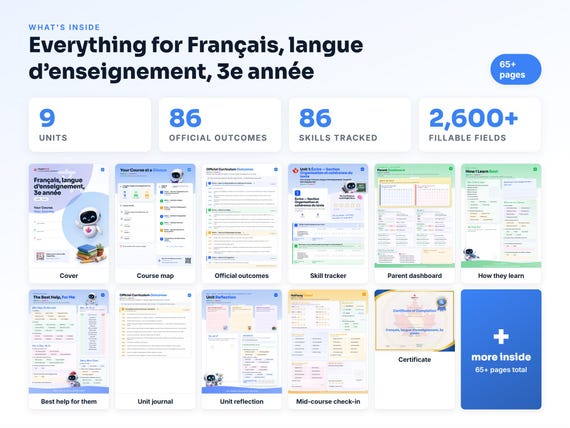
A Français, langue d’enseignement, 3e année workbook worth keeping
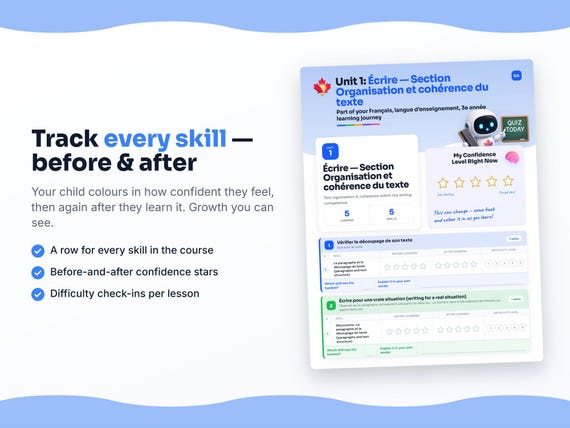
Built from the same official curriculum as this page. Before and after each skill above, your student colours in how sure they feel — so the two of you can see, on one page, what's clicking and what needs another look. It's a quiet way to follow how the year is really going.
By June it's full of their own handwriting: units worked through, confidence grown, a mid-year check-in, notes from parent-teacher night, and a certificate at the end. Less a worksheet, more a record of the year worth keeping on the shelf.
Instant download · see every page, reviews and the full description · five or more workbooks are $2.99 each
What it looks like in the app



Common questions
Can MapleMind help my child with Français, langue d’enseignement, 3e année?
Yes. MapleMind's AI tutor covers all 86 skills in Quebec's Français, langue d’enseignement, 3e année — your child picks the exact skill, and the tutor teaches it step by step: a short lesson, a worked example, solving together, then a skill check to show it stuck.
Is MapleMind aligned to Quebec's official curriculum?
Yes. Every skill in this course maps to an official outcome code from Quebec's Grade 3 French curriculum, and the ministry's own wording is quoted under each unit on this page — with the official government source linked so you can check it yourself.
What does MapleMind cost?
It's free to start — 5 tutoring chats and a practice quiz every day, no credit card. A Pro subscription ($9.99/month or $49.99/year CAD, 7-day free trial) unlocks unlimited tutoring, practice, and exam simulations.
What if my child is stuck on just one topic?
That's the point of skill-level tutoring: open Français, langue d’enseignement, 3e année in the app, tap the exact skill from the list on this page, and the tutor teaches just that — no wading through lessons your child doesn't need.
Does MapleMind work in French or other languages?
Yes — 14 languages, including French. Both the app and the tutor's explanations switch to the language your child chooses.
Where can I see the official Quebec curriculum for Français, langue d’enseignement, 3e année?
The official source is linked on this page — Québec's official education program. The outline here follows it: every MapleMind skill carries its official outcome code, and the ministry's own wording is quoted under each unit.
Keep exploring
Ready when you are
Pick a skill from this page and see it taught properly — free, in the browser, in under a minute.