Get help with English as a Second Language (Core), Secondary Cycle Two — Year 1
Most tutoring makes you sit through material you already know. MapleMind flips that: pick the exact skill that's causing trouble — any of the 21 below — and the tutor teaches just that one, step by step, as many times as it takes. Ask questions in plain words, any time of day, in English, French, or 12 other languages.
The official Quebec English as a Second Language (Core), Secondary Cycle Two — Year 1 curriculum
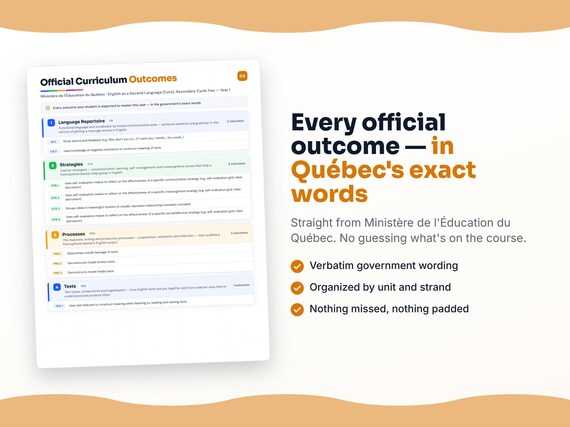
Quebec defines English as a Second Language (Core), Secondary Cycle Two — Year 1 by strands and outcomes. MapleMind teaches the same curriculum reorganized for one-skill-at-a-time tutoring — the table shows exactly where every official strand lands, and the ministry's own wording is quoted under each unit below.
Official source Québec's official education programRead it on the government site — quebec.ca ↗| Official strand | Outcomes | Where MapleMind teaches it |
|---|---|---|
| Course outcomes | 21 | Language Repertoire · Strategies · Processes · Texts |
Every skill below, taught one on one.
 Try the first session free
How MapleMind teaches English as a Second Language (Core), Secondary Cycle Two — Year 1 — every unit, lesson, and skill
Every skill below runs as a short session: a plain-words lesson, a worked example, solving it together, then a five-question skill check that earns up to three stars. Guided Mode keeps it teaching instead of answer-handing — turning it off needs a parent's password.
Unit 1Language Repertoire
Functional language and vocabulary by broad communicative area — sentence patterns and grammar in the service of getting a message across in English.
Language for interacting with others
- Using English: Gives advice and feedbackLR-A.15.a — Mastery of “Gives advice and feedback” (Language for interacting with others) at English as a Second Language (Core), Secondary Cycle Two — Year 1 ESL (A2→B1).
- Using English: Asks for advice and feedbackLR-A.15.b — Mastery of “Asks for advice and feedback” (Language for interacting with others) at English as a Second Language (Core), Secondary Cycle Two — Year 1 ESL (A2→B1).
- Using English: Asks information questionsLR-A.19.a — Mastery of “Asks information questions” (Language for interacting with others) at English as a Second Language (Core), Secondary Cycle Two — Year 1 ESL (A2→B1).
- Using English: Uses discourse markers to link ideasLR-A.24.a — Mastery of “Uses discourse markers to link ideas” (Language for interacting with others) at English as a Second Language (Core), Secondary Cycle Two — Year 1 ESL (A2→B1).
- Discover: Sets short- and long-term learning goalsLR-A.25.a — Guided introduction of “Sets short- and long-term learning goals” (Language for interacting with others) at English as a Second Language (Core), Secondary Cycle Two — Year 1 ESL (A2→B1).
Language for expressing ideas and opinions
- Using English: Uses knowledge of mechanics to construct meaningLR-C.2.a — Mastery of “Uses knowledge of targeted mechanics to construct meaning of” (Language for expressing ideas and opinions) at English as a Second Language (Core), Secondary Cycle Two — Year 1 ESL (A2→B1).
- Using English: Uses targeted mechanics to write and produce textsLR-C.2.b — Mastery of “Uses targeted mechanics to write and produce texts” (Language for expressing ideas and opinions) at English as a Second Language (Core), Secondary Cycle Two — Year 1 ESL (A2→B1).
The official wording — 7 outcomes in this unit
- LR-A.15.a
Gives advice and feedback (e.g. Why don’t you try…, If I were you, I would…, You could…)
- LR-A.15.b
Asks for advice and feedback (e.g. What would you do? Could you give me your feedback on this? Would you have a look at …?)
- LR-A.19.a
Asks information questions (e.g. Who/What/Where/When/Why/How...? Does he…? Can they…? Are you...?)
- LR-A.24.a
Uses discourse markers to link ideas (e.g. Then…, Next…, On the other hand…)
- LR-A.25.a
Sets short- and long-term learning goals (e.g. I will watch an English TV program tonight. By the end of the year, I will…, This year, I want to improve…)
- LR-C.2.a
Uses knowledge of targeted mechanics to construct meaning of texts
- LR-C.2.b
Uses targeted mechanics to write and produce texts
Unit 2Strategies
Learner strategies — communication, learning, self-management and metacognitive moves that help a francophone learner keep going in English.
Communication strategies
- Using English: Uses self-evaluation means to reflect on the effectiveness oS-A.2.a — Mastery of “Uses self-evaluation means to reflect on the effectiveness o” (Communication strategies) at English as a Second Language (Core), Secondary Cycle Two — Year 1 ESL (A2→B1).
- Discover: selects which ones to use for a given taskS-A.2.b.ii — Guided introduction of “selects which ones to use for a given task” (Communication strategies) at English as a Second Language (Core), Secondary Cycle Two — Year 1 ESL (A2→B1).
Learning strategies
- Using English: Uses self-evaluation means to reflect on the effectiveness oS-B.2.a — Mastery of “Uses self-evaluation means to reflect on the effectiveness o” (Learning strategies) at English as a Second Language (Core), Secondary Cycle Two — Year 1 ESL (A2→B1).
Self-management strategies
- Using English: Groups ideas in meaningful clusters to visually represent reS-C.1.12.a — Mastery of “Groups ideas in meaningful clusters to visually represent re” (Self-management strategies) at English as a Second Language (Core), Secondary Cycle Two — Year 1 ESL (A2→B1).
- Using English: Uses self-evaluation means to reflect on the effectiveness oS-C.2.a — Mastery of “Uses self-evaluation means to reflect on the effectiveness o” (Self-management strategies) at English as a Second Language (Core), Secondary Cycle Two — Year 1 ESL (A2→B1).
Metacognitive strategies
- Using English: Uses self-evaluation means to reflect on the effectiveness oS-D.2.a — Mastery of “Uses self-evaluation means to reflect on the effectiveness o” (Metacognitive strategies) at English as a Second Language (Core), Secondary Cycle Two — Year 1 ESL (A2→B1).
- Discover: Tries to communicate with someone who speaks English; learnsS-D.1.4.a — Guided introduction of “Tries to communicate with someone who speaks English; learns” (Metacognitive strategies) at English as a Second Language (Core), Secondary Cycle Two — Year 1 ESL (A2→B1).
The official wording — 7 outcomes in this unit
- S-A.2.a
Uses self-evaluation means to reflect on the effectiveness of a specific communication strategy (e.g. self-evaluation grid, class discussion)
- S-A.2.b.ii
selects which ones to use for a given task
- S-B.2.a
Uses self-evaluation means to reflect on the effectiveness of a specific metacognitive strategy (e.g. self-evaluation grid, class discussion)
- S-C.1.12.a
Groups ideas in meaningful clusters to visually represent relationships between concepts
- S-C.2.a
Uses self-evaluation means to reflect on the effectiveness of a specific cognitive strategy (e.g. self-evaluation grid, class discussion)
- S-D.2.a
Uses self-evaluation means to reflect on the effectiveness of a specific social/affective strategy (e.g. self-evaluation grid, class discussion)
- S-D.1.4.a
Tries to communicate with someone who speaks English; learns about English- language cultures and practises English with others
Unit 3Processes
The response, writing and production processes — preparation, realisation and reflection — that scaffold a francophone learner’s English output.
The response process
- Using English: Determines overall message of textsP-A.1.2.b — Mastery of “Determines overall message of texts” (The response process) at English as a Second Language (Core), Secondary Cycle Two — Year 1 ESL (A2→B1).
- Using English: Answers guiding questions individually and expands on promptP-A.2.a — Mastery of “Answers guiding questions individually and expands on prompt” (The response process) at English as a Second Language (Core), Secondary Cycle Two — Year 1 ESL (A2→B1).
The writing process
- Discover: Deconstructs model written textsP-B.1.b — Guided introduction of “Deconstructs model written texts” (The writing process) at English as a Second Language (Core), Secondary Cycle Two — Year 1 ESL (A2→B1).
The production process
- Discover: Deconstructs model media textsP-C.1.b — Guided introduction of “Deconstructs model media texts” (The production process) at English as a Second Language (Core), Secondary Cycle Two — Year 1 ESL (A2→B1).
The official wording — 6 outcomes in this unit
- P-A.1.2.b
Determines overall message of texts
- P-A.1.3.c
Shares understanding of texts with others to verify, adjust and deepen understanding
- P-A.2.a
Answers guiding questions individually and expands on prompts to make personal connections with texts
- P-A.2.b
Shares personal connections to texts with others to deepen understanding
- P-B.1.b
Deconstructs model written texts
- P-C.1.b
Deconstructs model media texts
Unit 4Texts
Text types, components and organisation — how English texts are put together and how a learner uses that to understand and produce them.
Text features
- Discover: Uses text features to construct meaning when listening to, rT-C.0.a — Guided introduction of “Uses text features to construct meaning when listening to, r” (Text features) at English as a Second Language (Core), Secondary Cycle Two — Year 1 ESL (A2→B1).
The official wording — 1 outcome in this unit
- T-C.0.a
Uses text features to construct meaning when listening to, reading and viewing texts
Printable workbook · A keepsake of the year
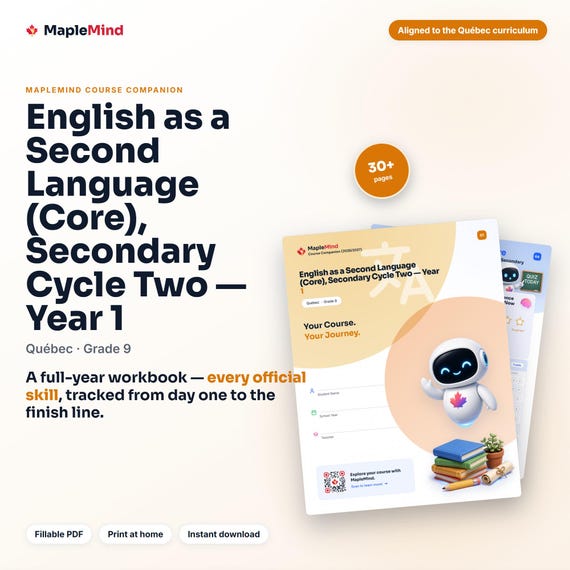
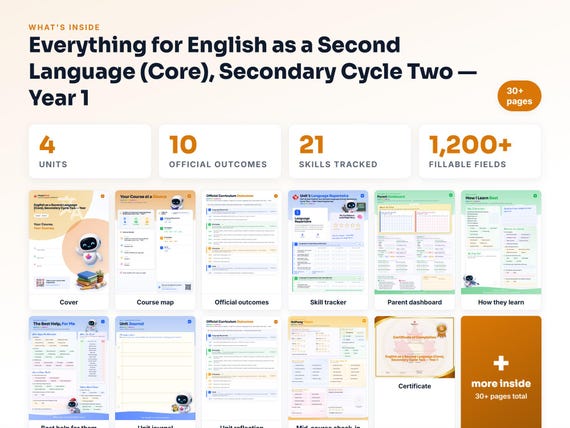
A English as a Second Language (Core), Secondary Cycle Two — Year 1 workbook worth keeping
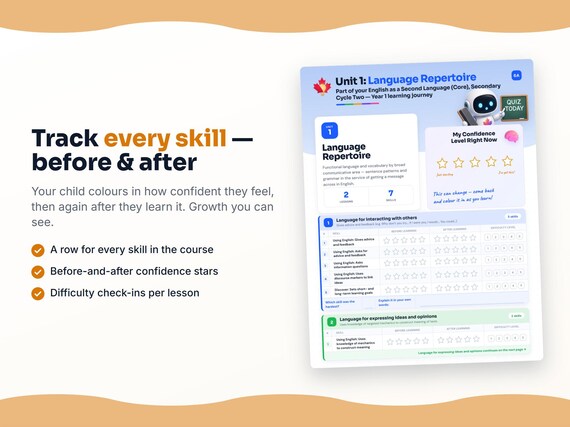
Built from the same official curriculum as this page. Before and after each skill above, your student colours in how sure they feel — so the two of you can see, on one page, what's clicking and what needs another look. It's a quiet way to follow how the year is really going.
By June it's full of their own handwriting: units worked through, confidence grown, a mid-year check-in, notes from parent-teacher night, and a certificate at the end. Less a worksheet, more a record of the year worth keeping on the shelf.
Instant download · see every page, reviews and the full description · five or more workbooks are $2.99 each
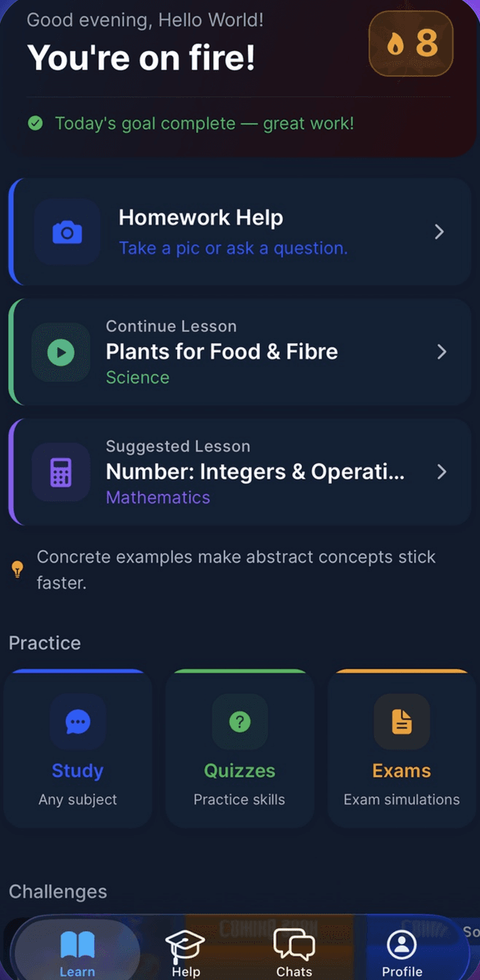
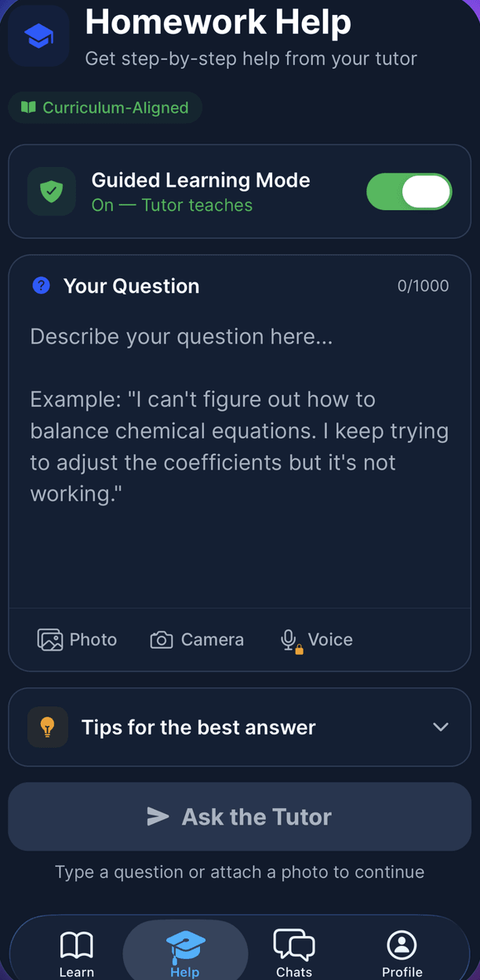
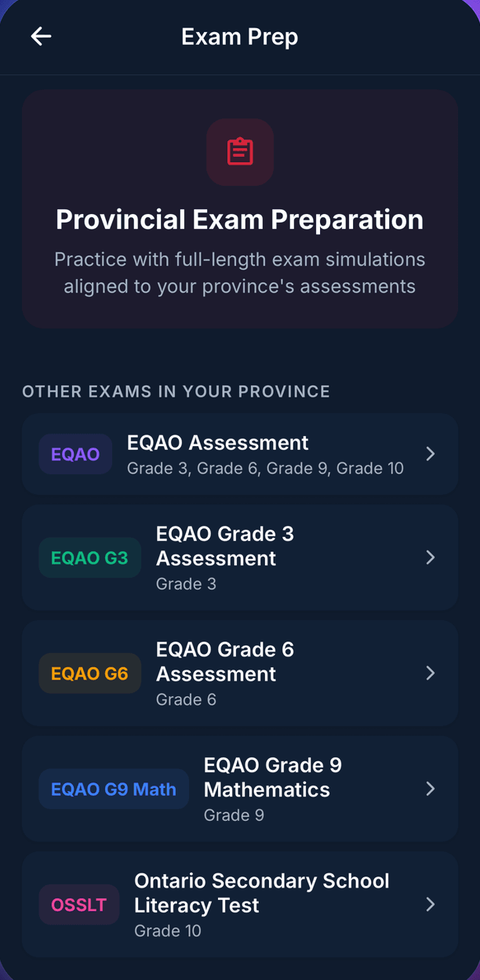
What it looks like in the app
Common questions
Can MapleMind help me with English as a Second Language (Core), Secondary Cycle Two — Year 1?
Yes. MapleMind's AI tutor covers all 21 skills in Quebec's English as a Second Language (Core), Secondary Cycle Two — Year 1 — you pick the exact skill, and the tutor teaches it step by step: a short lesson, a worked example, solving together, then a skill check to show it stuck.
Is MapleMind aligned to Quebec's official curriculum?
Yes. Every skill in this course maps to an official outcome code from Quebec's Grade 9 English as an Additional Language curriculum, and the ministry's own wording is quoted under each unit on this page — with the official government source linked so you can check it yourself.
What does MapleMind cost?
It's free to start — 5 tutoring chats and a practice quiz every day, no credit card. A Pro subscription ($9.99/month or $49.99/year CAD, 7-day free trial) unlocks unlimited tutoring, practice, and exam simulations.
What if I'm stuck on just one topic?
That's the point of skill-level tutoring: open English as a Second Language (Core), Secondary Cycle Two — Year 1 in the app, tap the exact skill from the list on this page, and the tutor teaches just that — no wading through lessons you don't need.
Does MapleMind work in French or other languages?
Yes — 14 languages, including French. Both the app and the tutor's explanations switch to the language you choose.
Where can I see the official Quebec curriculum for English as a Second Language (Core), Secondary Cycle Two — Year 1?
The official source is linked on this page — Québec's official education program. The outline here follows it: every MapleMind skill carries its official outcome code, and the ministry's own wording is quoted under each unit.
Keep exploring
Ready when you are
Pick a skill from this page and see it taught properly — free, in the browser, in under a minute.