Get help with English as a Second Language (Core), Secondary Cycle One — Year 2
Most tutoring makes you sit through material you already know. MapleMind flips that: pick the exact skill that's causing trouble — any of the 27 below — and the tutor teaches just that one, step by step, as many times as it takes. Ask questions in plain words, any time of day, in English, French, or 12 other languages.
The official Quebec English as a Second Language (Core), Secondary Cycle One — Year 2 curriculum
Quebec defines English as a Second Language (Core), Secondary Cycle One — Year 2 by strands and outcomes. MapleMind teaches the same curriculum reorganized for one-skill-at-a-time tutoring — the table shows exactly where every official strand lands, and the ministry's own wording is quoted under each unit below.
Official source Québec's official education programRead it on the government site — quebec.ca ↗| Official strand | Outcomes | Where MapleMind teaches it |
|---|---|---|
| Course outcomes | 27 | Language Repertoire · Strategies · Processes · Texts |
Every skill below, taught one on one.
 Try the first session free
How MapleMind teaches English as a Second Language (Core), Secondary Cycle One — Year 2 — every unit, lesson, and skill
Every skill below runs as a short session: a plain-words lesson, a worked example, solving it together, then a five-question skill check that earns up to three stars. Guided Mode keeps it teaching instead of answer-handing — turning it off needs a parent's password.
Unit 1Language Repertoire
Functional language and vocabulary by broad communicative area — sentence patterns and grammar in the service of getting a message across in English.
Language for interacting with others
- Using English: Begins/ends telephone exchanges and uses voice mailLR-A.1.d — Mastery of “Begins/ends telephone exchanges and uses voice mail” (Language for interacting with others) at English as a Second Language (Core), Secondary Cycle One — Year 2 ESL (A2).
- Using English: Asks about people, animals, objects, placesLR-A.4.b — Mastery of “Asks about people, animals, objects, places” (Language for interacting with others) at English as a Second Language (Core), Secondary Cycle One — Year 2 ESL (A2).
- Using English: States opinionsLR-A.9.a — Mastery of “States opinions” (Language for interacting with others) at English as a Second Language (Core), Secondary Cycle One — Year 2 ESL (A2).
- Using English: Asks about capabilitiesLR-A.10.b — Mastery of “Asks about capabilities” (Language for interacting with others) at English as a Second Language (Core), Secondary Cycle One — Year 2 ESL (A2).
- Using English: Asks about others’ interests, tastes and preferencesLR-A.12.b — Mastery of “Asks about others’ interests, tastes and preferences” (Language for interacting with others) at English as a Second Language (Core), Secondary Cycle One — Year 2 ESL (A2).
- Using English: Asks about others’ decision/indecisionLR-A.13.b — Mastery of “Asks about others’ decision/indecision” (Language for interacting with others) at English as a Second Language (Core), Secondary Cycle One — Year 2 ESL (A2).
- Using English: Asks about needs, wants and obligationsLR-A.18.b — Mastery of “Asks about needs, wants and obligations” (Language for interacting with others) at English as a Second Language (Core), Secondary Cycle One — Year 2 ESL (A2).
- Using English: Asks for suggestionsLR-A.21.b — Mastery of “Asks for suggestions” (Language for interacting with others) at English as a Second Language (Core), Secondary Cycle One — Year 2 ESL (A2).
Language for informing and describing
- Using English: Uses targeted vocabulary tied to student interestsLR-B.0.b — Mastery of “Uses targeted vocabulary related to students’ interests and ” (Language for informing and describing) at English as a Second Language (Core), Secondary Cycle One — Year 2 ESL (A2).
Language for expressing ideas and opinions
- Using English: Uses rising and falling voice pitch to convey meaningLR-C.1.a — Mastery of “Uses rising and falling voice pitch to convey meaning” (Language for expressing ideas and opinions) at English as a Second Language (Core), Secondary Cycle One — Year 2 ESL (A2).
- Using English: Uses appropriate stress and pronunciation for words frequentLR-C.1.b — Mastery of “Uses appropriate stress and pronunciation for words frequent” (Language for expressing ideas and opinions) at English as a Second Language (Core), Secondary Cycle One — Year 2 ESL (A2).
The official wording — 11 outcomes in this unit
- LR-A.1.d
Begins/ends telephone exchanges and uses voice mail (e.g. Hello, I’m calling about…,Thank you for calling. Please leave a message after the beep.)
- LR-A.4.b
Asks about people, animals, objects, places (e.g. Who are they? Where is it? What’s your…?)
- LR-A.9.a
States opinions (e.g. In my opinion…, I think that…, I’m for/against…)
- LR-A.10.b
Asks about capabilities (e.g. Do they know how to…? Can it…? Are you good at…?)
- LR-A.12.b
Asks about others’ interests, tastes and preferences (e.g. Which would you prefer? What’s your favourite…? Why do you like. . .?)
- LR-A.13.b
Asks about others’ decision/indecision (e.g. What have you decided? Have you made up your mind? What’s your decision?)
- LR-A.18.b
Asks about needs, wants and obligations (e.g. What do they need? What does she want? What do we have to do?)
- LR-A.21.b
Asks for suggestions (e.g. Should I…? What do you suggest? Do you have a suggestion?)
- LR-B.0.b
Uses targeted vocabulary related to students’ interests and needs such as leisure activities, relationships, jobs (e.g. sports equipment)
- LR-C.1.a
Uses rising and falling voice pitch to convey meaning (e.g. rising voice pitch to express surprise: It’s snowing?_ ↑)
- LR-C.1.b
Uses appropriate stress and pronunciation for words frequently used to participate in classroom life (e.g. Wednesday: \' wenz-day\)
Unit 2Strategies
Learner strategies — communication, learning, self-management and metacognitive moves that help a francophone learner keep going in English.
Self-management strategies
- Using English: Constructs a meaningful sentence by putting together known wS-C.1.7.a — Mastery of “Constructs a meaningful sentence by putting together known w” (Self-management strategies) at English as a Second Language (Core), Secondary Cycle One — Year 2 ESL (A2).
- Using English: Writes down relevant information in an organized wayS-C.1.10.a — Mastery of “Writes down relevant information in an organized way” (Self-management strategies) at English as a Second Language (Core), Secondary Cycle One — Year 2 ESL (A2).
Metacognitive strategies
- Using English: Makes positive statements during a task and congratulates seS-D.1.5.a — Mastery of “Makes positive statements during a task and congratulates se” (Metacognitive strategies) at English as a Second Language (Core), Secondary Cycle One — Year 2 ESL (A2).
- Using English: Reduces stress by focusing on goals and progressS-D.1.6.a — Mastery of “Reduces stress by reminding self of goals, progress made and” (Metacognitive strategies) at English as a Second Language (Core), Secondary Cycle One — Year 2 ESL (A2).
- Using English: Pushes oneself to experiment with language and ideas withoutS-D.1.7.a — Mastery of “Pushes oneself to experiment with language and ideas without” (Metacognitive strategies) at English as a Second Language (Core), Secondary Cycle One — Year 2 ESL (A2).
The official wording — 5 outcomes in this unit
- S-C.1.7.a
Constructs a meaningful sentence by putting together known words and expressions in a new way
- S-C.1.10.a
Writes down relevant information in an organized way (e.g. graphic organizers, guiding questions, prompts)
- S-D.1.5.a
Makes positive statements during a task and congratulates self and others upon completion
- S-D.1.6.a
Reduces stress by reminding self of goals, progress made and resources available
- S-D.1.7.a
Pushes oneself to experiment with language and ideas without fear of making errors
Unit 3Processes
The response, writing and production processes — preparation, realisation and reflection — that scaffold a francophone learner’s English output.
The response process
- Using English: Uses strategies, prompts and guiding questionsP-A.1.1.a — Mastery of “Uses strategies, guiding questions, prompts and knowledge of” (The response process) at English as a Second Language (Core), Secondary Cycle One — Year 2 ESL (A2).
- Using English: Identifies important details of textsP-A.1.2.a — Mastery of “Identifies important details of texts” (The response process) at English as a Second Language (Core), Secondary Cycle One — Year 2 ESL (A2).
The writing process
- Using English: Identifies text components in model written textsP-B.1.a — Mastery of “Identifies text components in model written texts” (The writing process) at English as a Second Language (Core), Secondary Cycle One — Year 2 ESL (A2).
- Using English: Researches topicP-B.2.b — Mastery of “Researches topic” (The writing process) at English as a Second Language (Core), Secondary Cycle One — Year 2 ESL (A2).
- Using English: Selects appropriate languageP-B.2.d — Mastery of “Selects appropriate language” (The writing process) at English as a Second Language (Core), Secondary Cycle One — Year 2 ESL (A2).
- Using English: Writes down ideas, opinions, thoughts and feelings while refP-B.3.a — Mastery of “Writes down ideas, opinions, thoughts and feelings while ref” (The writing process) at English as a Second Language (Core), Secondary Cycle One — Year 2 ESL (A2).
The production process
- Using English: Identifies text components in model media textsP-C.1.a — Mastery of “Identifies text components in model media texts” (The production process) at English as a Second Language (Core), Secondary Cycle One — Year 2 ESL (A2).
- Using English: Targets purpose, audience and cultureP-C.2.f — Mastery of “Targets purpose, audience and culture” (The production process) at English as a Second Language (Core), Secondary Cycle One — Year 2 ESL (A2).
- Using English: Constructs outline of media textP-C.2.h — Mastery of “Constructs outline of media text” (The production process) at English as a Second Language (Core), Secondary Cycle One — Year 2 ESL (A2).
The official wording — 9 outcomes in this unit
- P-A.1.1.a
Uses strategies, guiding questions, prompts and knowledge of text components to prepare to respond to texts
- P-A.1.2.a
Identifies important details of texts
- P-B.1.a
Identifies text components in model written texts
- P-B.2.b
Researches topic
- P-B.2.d
Selects appropriate language (e.g. vocabulary, level of formality)
- P-B.3.a
Writes down ideas, opinions, thoughts and feelings while referring to outline
- P-C.1.a
Identifies text components in model media texts
- P-C.2.f
Targets purpose, audience and culture
- P-C.2.h
Constructs outline of media text (e.g. storyboard)
Unit 4Texts
Text types, components and organisation — how English texts are put together and how a learner uses that to understand and produce them.
Text components
- Using English: Uses text components to construct meaning when listening to,T-B.0.a — Mastery of “Uses text components to construct meaning when listening to,” (Text components) at English as a Second Language (Core), Secondary Cycle One — Year 2 ESL (A2).
- Using English: Applies knowledge of text components to write and produce teT-B.0.b — Mastery of “Applies knowledge of text components to write and produce te” (Text components) at English as a Second Language (Core), Secondary Cycle One — Year 2 ESL (A2).
The official wording — 2 outcomes in this unit
- T-B.0.a
Uses text components to construct meaning when listening to, reading and viewing texts
- T-B.0.b
Applies knowledge of text components to write and produce texts
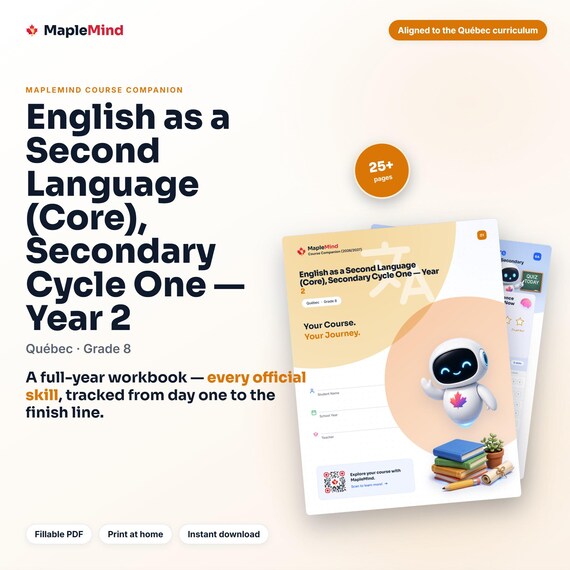
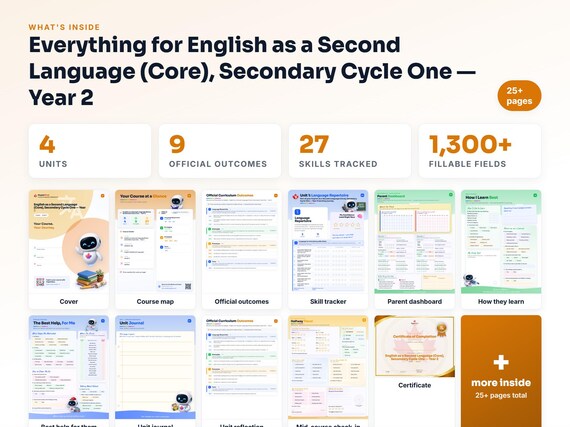
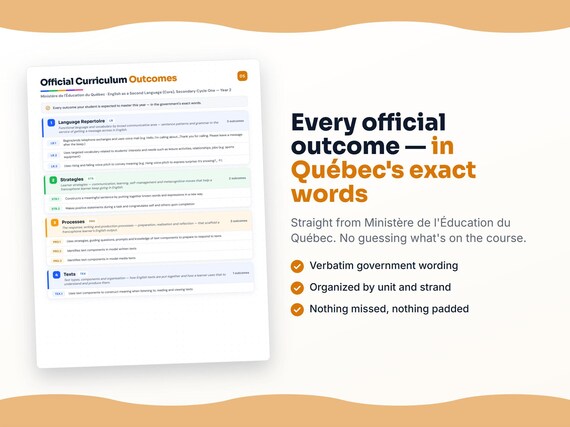
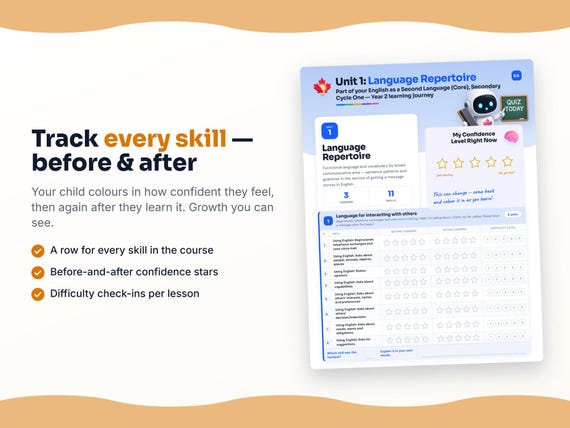
Printable workbook · A keepsake of the year
A English as a Second Language (Core), Secondary Cycle One — Year 2 workbook worth keeping
Built from the same official curriculum as this page. Before and after each skill above, your student colours in how sure they feel — so the two of you can see, on one page, what's clicking and what needs another look. It's a quiet way to follow how the year is really going.
By June it's full of their own handwriting: units worked through, confidence grown, a mid-year check-in, notes from parent-teacher night, and a certificate at the end. Less a worksheet, more a record of the year worth keeping on the shelf.
Instant download · see every page, reviews and the full description · five or more workbooks are $2.99 each
What it looks like in the app
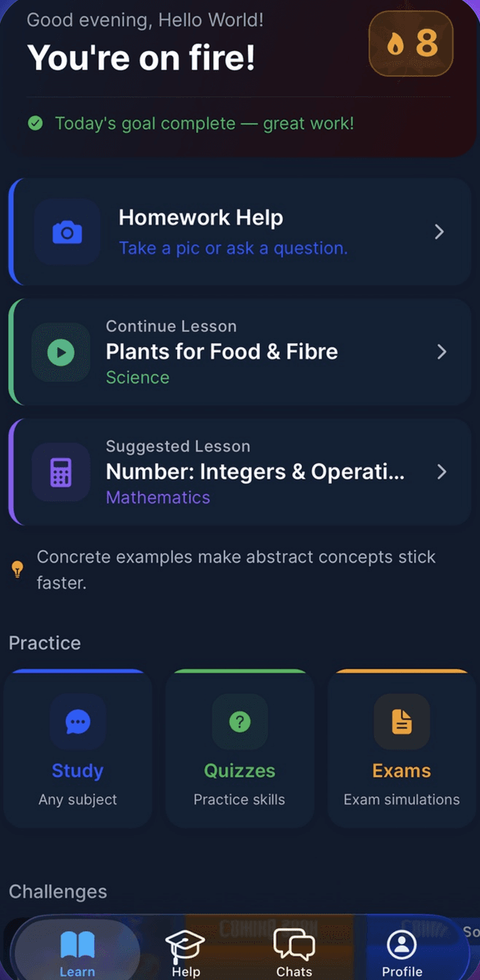
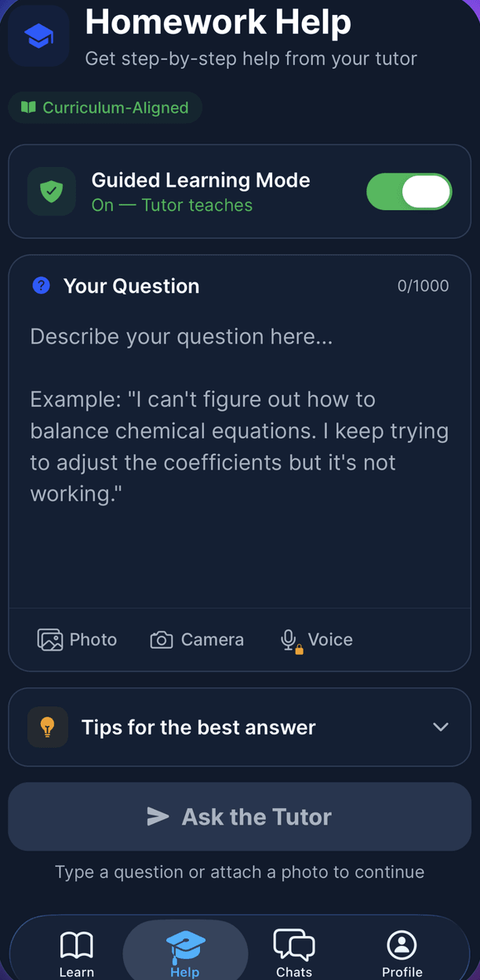
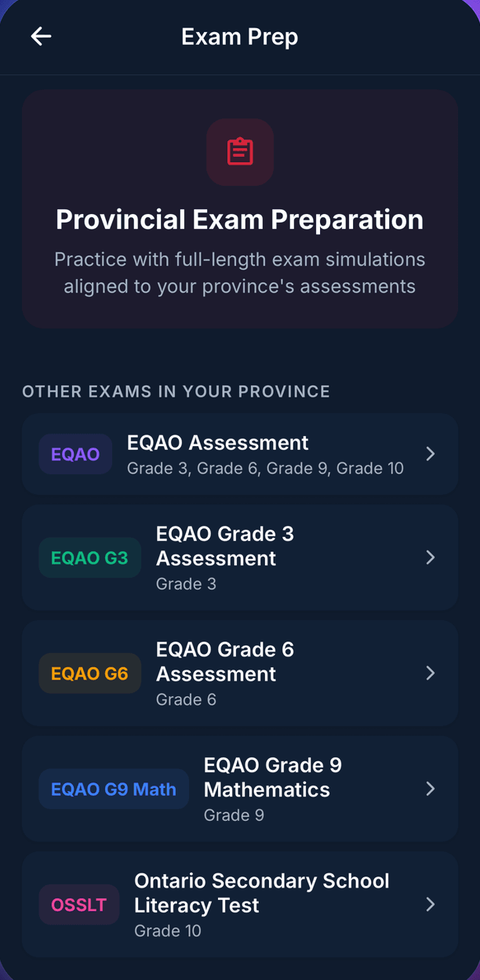
Common questions
Can MapleMind help me with English as a Second Language (Core), Secondary Cycle One — Year 2?
Yes. MapleMind's AI tutor covers all 27 skills in Quebec's English as a Second Language (Core), Secondary Cycle One — Year 2 — you pick the exact skill, and the tutor teaches it step by step: a short lesson, a worked example, solving together, then a skill check to show it stuck.
Is MapleMind aligned to Quebec's official curriculum?
Yes. Every skill in this course maps to an official outcome code from Quebec's Grade 8 English as an Additional Language curriculum, and the ministry's own wording is quoted under each unit on this page — with the official government source linked so you can check it yourself.
What does MapleMind cost?
It's free to start — 5 tutoring chats and a practice quiz every day, no credit card. A Pro subscription ($9.99/month or $49.99/year CAD, 7-day free trial) unlocks unlimited tutoring, practice, and exam simulations.
What if I'm stuck on just one topic?
That's the point of skill-level tutoring: open English as a Second Language (Core), Secondary Cycle One — Year 2 in the app, tap the exact skill from the list on this page, and the tutor teaches just that — no wading through lessons you don't need.
Does MapleMind work in French or other languages?
Yes — 14 languages, including French. Both the app and the tutor's explanations switch to the language you choose.
Where can I see the official Quebec curriculum for English as a Second Language (Core), Secondary Cycle One — Year 2?
The official source is linked on this page — Québec's official education program. The outline here follows it: every MapleMind skill carries its official outcome code, and the ministry's own wording is quoted under each unit.
Keep exploring
Ready when you are
Pick a skill from this page and see it taught properly — free, in the browser, in under a minute.