Get help with English as a Second Language (Core), Secondary Cycle One — Year 1
Most tutoring makes you sit through material you already know. MapleMind flips that: pick the exact skill that's causing trouble — any of the 49 below — and the tutor teaches just that one, step by step, as many times as it takes. Ask questions in plain words, any time of day, in English, French, or 12 other languages.
The official Quebec English as a Second Language (Core), Secondary Cycle One — Year 1 curriculum
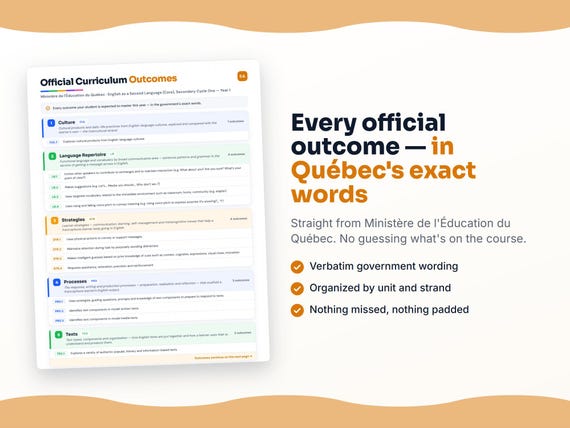
Quebec defines English as a Second Language (Core), Secondary Cycle One — Year 1 by strands and outcomes. MapleMind teaches the same curriculum reorganized for one-skill-at-a-time tutoring — the table shows exactly where every official strand lands, and the ministry's own wording is quoted under each unit below.
Official source Québec's official education programRead it on the government site — quebec.ca ↗| Official strand | Outcomes | Where MapleMind teaches it |
|---|---|---|
| Course outcomes | 49 | Culture · Language Repertoire · Strategies · Processes · Texts |
Every skill below, taught one on one.
 Try the first session free
How MapleMind teaches English as a Second Language (Core), Secondary Cycle One — Year 1 — every unit, lesson, and skill
Every skill below runs as a short session: a plain-words lesson, a worked example, solving it together, then a five-question skill check that earns up to three stars. Guided Mode keeps it teaching instead of answer-handing — turning it off needs a parent's password.
Unit 1Culture
Cultural products and daily-life practices from English-language cultures, explored and compared with the learner’s own — the intercultural strand.
Exploring and comparing English-language cultures
- Discover: Explores cultural products from English-language culturesA.a.a — Guided introduction of “Explores cultural products from English-language cultures” (Exploring and comparing English-language cultures) at English as a Second Language (Core), Secondary Cycle One — Year 1 ESL (A2).
- Discover: Explores communication conventions from English-language culA.c.a — Guided introduction of “Explores communication conventions from English-language cul” (Exploring and comparing English-language cultures) at English as a Second Language (Core), Secondary Cycle One — Year 1 ESL (A2).
The official wording — 2 outcomes in this unit
- A.a.a
Explores cultural products from English-language cultures
- A.c.a
Explores communication conventions from English-language cultures
Unit 2Language Repertoire
Functional language and vocabulary by broad communicative area — sentence patterns and grammar in the service of getting a message across in English.
Language for interacting with others — expressing yourself
- Using English: Invites other speakers to contribute to exchanges and to maiLR-A.6.a — Mastery of “Invites other speakers to contribute to exchanges and to mai” (Language for interacting with others) at English as a Second Language (Core), Secondary Cycle One — Year 1 ESL (A2).
- Using English: Asks if others are in agreement/disagreementLR-A.8.b — Mastery of “Asks if others are in agreement/disagreement” (Language for interacting with others) at English as a Second Language (Core), Secondary Cycle One — Year 1 ESL (A2).
- Using English: Expresses capabilitiesLR-A.10.a — Mastery of “Expresses capabilities” (Language for interacting with others) at English as a Second Language (Core), Secondary Cycle One — Year 1 ESL (A2).
- Using English: Expresses feelingsLR-A.11.a — Mastery of “Expresses feelings” (Language for interacting with others) at English as a Second Language (Core), Secondary Cycle One — Year 1 ESL (A2).
- Using English: Expresses interests, tastes and preferencesLR-A.12.a — Mastery of “Expresses interests, tastes and preferences” (Language for interacting with others) at English as a Second Language (Core), Secondary Cycle One — Year 1 ESL (A2).
- Using English: Gives/refuses permissionLR-A.14.b — Mastery of “Gives/refuses permission” (Language for interacting with others) at English as a Second Language (Core), Secondary Cycle One — Year 1 ESL (A2).
- Using English: Expresses needs, wants and obligationsLR-A.18.a — Mastery of “Expresses needs, wants and obligations” (Language for interacting with others) at English as a Second Language (Core), Secondary Cycle One — Year 1 ESL (A2).
Language for interacting with others — inviting, helping, agreeing
- Using English: Makes suggestionsLR-A.21.a — Mastery of “Makes suggestions” (Language for interacting with others) at English as a Second Language (Core), Secondary Cycle One — Year 1 ESL (A2).
- Using English: Invites othersLR-A.22.a — Mastery of “Invites others” (Language for interacting with others) at English as a Second Language (Core), Secondary Cycle One — Year 1 ESL (A2).
- Using English: Accepts or refuses invitationsLR-A.22.b — Mastery of “Accepts or refuses invitations” (Language for interacting with others) at English as a Second Language (Core), Secondary Cycle One — Year 1 ESL (A2).
- Using English: Contributes to teamwork and harmonious exchangesLR-A.23.a — Mastery of “Contributes to teamwork and harmonious exchanges” (Language for interacting with others) at English as a Second Language (Core), Secondary Cycle One — Year 1 ESL (A2).
- Discover: Describing and giving opinionsLR-A.4.c — Guided introduction to describing events and experiences, backing up an opinion, and asking about others' interests — receptive, with support.
- Discover: Getting and giving helpLR-A.15.a — Guided introduction to the give-and-take of help in English — offering and accepting/declining help, giving advice, and asking for clarification.
Language for informing and describing
- Discover: Uses informationLR-B.0.e — Guided introduction of “Uses information” (Language for informing and describing) at English as a Second Language (Core), Secondary Cycle One — Year 1 ESL (A2).
- Discover: Health and Well-BeingLR-B.c.i — Guided introduction of “Health and Well-Being” (Language for informing and describing) at English as a Second Language (Core), Secondary Cycle One — Year 1 ESL (A2).
- Discover: Citizenship and Community LifeLR-B.c.v — Guided introduction of “Citizenship and Community Life” (Language for informing and describing) at English as a Second Language (Core), Secondary Cycle One — Year 1 ESL (A2).
- Discover: Uses creativityLR-B.d.iv — Guided introduction of “Uses creativity” (Language for informing and describing) at English as a Second Language (Core), Secondary Cycle One — Year 1 ESL (A2).
- Discover: Cooperates with othersLR-B.d.viii — Guided introduction of “Cooperates with others” (Language for informing and describing) at English as a Second Language (Core), Secondary Cycle One — Year 1 ESL (A2).
Language for expressing ideas and opinions
- Discover: Uses rising and falling voice pitch to convey meaningLR-C.1.a — Guided introduction of “Uses rising and falling voice pitch to convey meaning” (Language for expressing ideas and opinions) at English as a Second Language (Core), Secondary Cycle One — Year 1 ESL (A2).
- Discover: Uses targeted mechanics to write and produce textsLR-C.2.b — Guided introduction of “Uses targeted mechanics to write and produce texts” (Language for expressing ideas and opinions) at English as a Second Language (Core), Secondary Cycle One — Year 1 ESL (A2).
The official wording — 22 outcomes in this unit
- LR-A.6.a
Invites other speakers to contribute to exchanges and to maintain interaction (e.g. What about you? Are you sure? What’s your point of view?)
- LR-A.8.b
Asks if others are in agreement/disagreement (e.g. Do you agree? Who disagrees? Are you okay with…?)
- LR-A.10.a
Expresses capabilities (e.g. He’s good at…, They are unable to…, I can/can’t…)
- LR-A.11.a
Expresses feelings (e.g. I’m thrilled. She feels…, They're happy.)
- LR-A.12.a
Expresses interests, tastes and preferences (e.g. They like…, I can’t stand…, She prefers…)
- LR-A.14.b
Gives/refuses permission (e.g. Yes, go ahead. No you can’t. Sure, no problem.)
- LR-A.18.a
Expresses needs, wants and obligations (e.g. They need…, I really want…, We must…)
- LR-A.21.a
Makes suggestions (e.g. Let’s…, Maybe you should…, Why don’t we…?)
- LR-A.22.a
Invites others (e.g. Let’s go to…, Would you like to…? Do you want to join us?)
- LR-A.22.b
Accepts or refuses invitations (e.g. Yes, I’d love to! I can’t make it. Sounds good to me.)
- LR-A.23.a
Contributes to teamwork and harmonious exchanges (e.g. Do you want to be on our team? Interesting idea! Good work!)
- LR-A.1.a
Greets and responds to greetings (e.g. How are you? Not so bad, and you? What’s new?)
- LR-A.4.c
Describes events, experiences, ideas and issues (e.g. This is about…, It was the best day of my life because...)
- LR-A.15.a
Gives advice and feedback (e.g. Why don’t you try…, If I were you, I would…, You could…)
- LR-B.0.a
Uses targeted vocabulary related to the immediate environment such as classroom, home, community (e.g. stapler)
- LR-B.0.e
Uses information (e.g. source) Solves problems (e.g. solution) Exercises critical judgment (e.g. viewpoints) Uses creativity (e.g. trial and error) Adopts effective work methods (e.g. process) Uses information and communications technologies (e.g. networks) Achieves his/her potential (e.g. autonomy) Cooperates with others (e.g. teammates) Communicates appropriately (e.g. audience) E Uses targeted vocabulary related to communication and learning strategies (e.g. skim: quick read)
- LR-B.c.i
Health and Well-Being (e.g. hygiene)
- LR-B.c.v
Citizenship and Community Life (e.g. democracy)
- LR-B.d.iv
Uses creativity (e.g. trial and error)
- LR-B.d.viii
Cooperates with others (e.g. teammates)
- LR-C.1.a
Uses rising and falling voice pitch to convey meaning (e.g. rising voice pitch to express surprise: It’s snowing?_ ↑)
- LR-C.2.b
Uses targeted mechanics to write and produce texts
Unit 3Strategies
Learner strategies — communication, learning, self-management and metacognitive moves that help a francophone learner keep going in English.
Communication strategies
- Discover: Uses physical actions to convey or support messagesS-A.1.1.a — Guided introduction of “Uses physical actions to convey or support messages” (Communication strategies) at English as a Second Language (Core), Secondary Cycle One — Year 1 ESL (A2).
- Discover: Replaces unknown words with simpler expressionsS-A.1.5.a — Guided introduction of “Uses less precise words or expressions to replace unknown on” (Communication strategies) at English as a Second Language (Core), Secondary Cycle One — Year 1 ESL (A2).
- Discover: uses them appropriatelyS-A.2.b.iii — Guided introduction of “uses them appropriately” (Communication strategies) at English as a Second Language (Core), Secondary Cycle One — Year 1 ESL (A2).
Learning strategies
- Discover: Maintains attention during task by purposely avoiding distraS-B.1.1.a — Guided introduction of “Maintains attention during task by purposely avoiding distra” (Learning strategies) at English as a Second Language (Core), Secondary Cycle One — Year 1 ESL (A2).
- Discover: Assesses own progress by reflecting on what has been learnedS-B.1.5.a — Guided introduction of “Assesses own progress by reflecting on what has been learned” (Learning strategies) at English as a Second Language (Core), Secondary Cycle One — Year 1 ESL (A2).
- Discover: Manages an inventory of metacognitive strategies:S-B.2.b — Guided introduction of “Manages an inventory of metacognitive strategies:” (Learning strategies) at English as a Second Language (Core), Secondary Cycle One — Year 1 ESL (A2).
Self-management strategies
- Using English: Makes intelligent guesses based on prior knowledge of cues sS-C.1.4.a — Mastery of “Makes intelligent guesses based on prior knowledge of cues s” (Self-management strategies) at English as a Second Language (Core), Secondary Cycle One — Year 1 ESL (A2).
- Using English: Makes hypotheses based on prior knowledge, topic, task at haS-C.1.6.a — Mastery of “Makes hypotheses based on prior knowledge, topic, task at ha” (Self-management strategies) at English as a Second Language (Core), Secondary Cycle One — Year 1 ESL (A2).
- Discover: Links new information to what is already knownS-C.1.1.a — Guided introduction of “Links new information to what is already known” (Self-management strategies) at English as a Second Language (Core), Secondary Cycle One — Year 1 ESL (A2).
- Discover: Constructs a meaningful sentence by putting together known wS-C.1.7.a — Guided introduction of “Constructs a meaningful sentence by putting together known w” (Self-management strategies) at English as a Second Language (Core), Secondary Cycle One — Year 1 ESL (A2).
- Discover: Uses a newly learned item in a new contextS-C.1.11.a — Guided introduction of “Uses a newly learned item in a new context” (Self-management strategies) at English as a Second Language (Core), Secondary Cycle One — Year 1 ESL (A2).
Metacognitive strategies
- Discover: Requests assistance, reiteration, precision and reinforcemenS-D.1.1.a — Guided introduction of “Requests assistance, reiteration, precision and reinforcemen” (Metacognitive strategies) at English as a Second Language (Core), Secondary Cycle One — Year 1 ESL (A2).
- Discover: Reduces stress by focusing on goals and progressS-D.1.6.a — Guided introduction of “Reduces stress by reminding self of goals, progress made and” (Metacognitive strategies) at English as a Second Language (Core), Secondary Cycle One — Year 1 ESL (A2).
The official wording — 13 outcomes in this unit
- S-A.1.1.a
Uses physical actions to convey or support messages
- S-A.1.5.a
Uses less precise words or expressions to replace unknown ones
- S-A.2.b.iii
uses them appropriately
- S-B.1.1.a
Maintains attention during task by purposely avoiding distracters
- S-B.1.5.a
Assesses own progress by reflecting on what has been learned and how
- S-B.2.b
Manages an inventory of metacognitive strategies:
- S-C.1.4.a
Makes intelligent guesses based on prior knowledge of cues such as context, cognates, expressions, visual clues, intonation
- S-C.1.6.a
Makes hypotheses based on prior knowledge, topic, task at hand, text components or glancing through a text
- S-C.1.1.a
Links new information to what is already known
- S-C.1.7.a
Constructs a meaningful sentence by putting together known words and expressions in a new way
- S-C.1.11.a
Uses a newly learned item in a new context
- S-D.1.1.a
Requests assistance, reiteration, precision and reinforcement
- S-D.1.6.a
Reduces stress by reminding self of goals, progress made and resources available
Unit 4Processes
The response, writing and production processes — preparation, realisation and reflection — that scaffold a francophone learner’s English output.
The response process
- Discover: Uses strategies, prompts and guiding questionsP-A.1.1.a — Guided introduction of “Uses strategies, guiding questions, prompts and knowledge of” (The response process) at English as a Second Language (Core), Secondary Cycle One — Year 1 ESL (A2).
- Discover: Answers guiding questions individually and expands on promptP-A.1.3.a — Guided introduction of “Answers guiding questions individually and expands on prompt” (The response process) at English as a Second Language (Core), Secondary Cycle One — Year 1 ESL (A2).
The writing process
- Discover: Identifies text components in model written textsP-B.1.a — Guided introduction of “Identifies text components in model written texts” (The writing process) at English as a Second Language (Core), Secondary Cycle One — Year 1 ESL (A2).
- Discover: Selects appropriate languageP-B.2.d — Guided introduction of “Selects appropriate language” (The writing process) at English as a Second Language (Core), Secondary Cycle One — Year 1 ESL (A2).
- Discover: Writes final copyP-B.5.c — Guided introduction of “Writes final copy” (The writing process) at English as a Second Language (Core), Secondary Cycle One — Year 1 ESL (A2).
The production process
- Discover: Identifies text components in model media textsP-C.1.a — Guided introduction of “Identifies text components in model media texts” (The production process) at English as a Second Language (Core), Secondary Cycle One — Year 1 ESL (A2).
- Discover: Writes a focus sentenceP-C.2.g — Guided introduction of “Writes a focus sentence” (The production process) at English as a Second Language (Core), Secondary Cycle One — Year 1 ESL (A2).
- Discover: Uses appropriate media conventionsP-C.3.b — Guided introduction of “Uses appropriate media conventions” (The production process) at English as a Second Language (Core), Secondary Cycle One — Year 1 ESL (A2).
The official wording — 10 outcomes in this unit
- P-A.1.1.a
Uses strategies, guiding questions, prompts and knowledge of text components to prepare to respond to texts
- P-A.1.3.a
Answers guiding questions individually and expands on prompts that deal with the literal meaning of texts
- P-A.2.b
Shares personal connections to texts with others to deepen understanding
- P-B.1.a
Identifies text components in model written texts
- P-B.2.d
Selects appropriate language (e.g. vocabulary, level of formality)
- P-B.4.a
Shares draft with others for feedback
- P-B.5.c
Writes final copy
- P-C.1.a
Identifies text components in model media texts
- P-C.2.g
Writes a focus sentence
- P-C.3.b
Uses appropriate media conventions
Unit 5Texts
Text types, components and organisation — how English texts are put together and how a learner uses that to understand and produce them.
Text types
- Discover: Explores a variety of authentic popular, literary and informT-A.0.a — Guided introduction of “Explores a variety of authentic popular, literary and inform” (Text types) at English as a Second Language (Core), Secondary Cycle One — Year 1 ESL (A2).
Text components
- Discover: Uses text components to construct meaning when listening to,T-B.0.a — Guided introduction of “Uses text components to construct meaning when listening to,” (Text components) at English as a Second Language (Core), Secondary Cycle One — Year 1 ESL (A2).
The official wording — 2 outcomes in this unit
- T-A.0.a
Explores a variety of authentic popular, literary and information-based texts
- T-B.0.a
Uses text components to construct meaning when listening to, reading and viewing texts
Printable workbook · A keepsake of the year
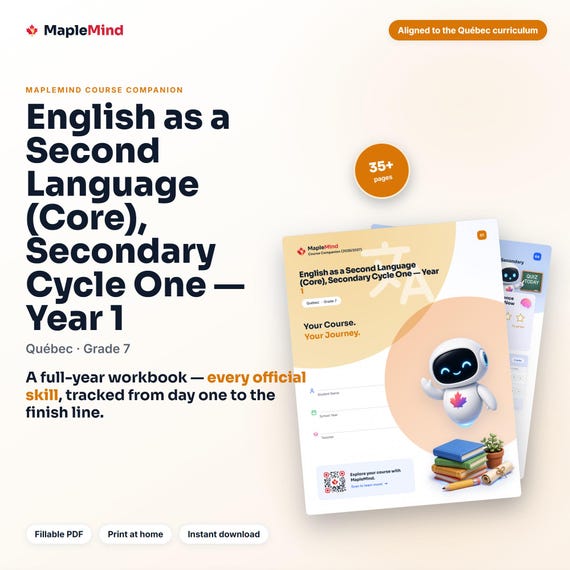
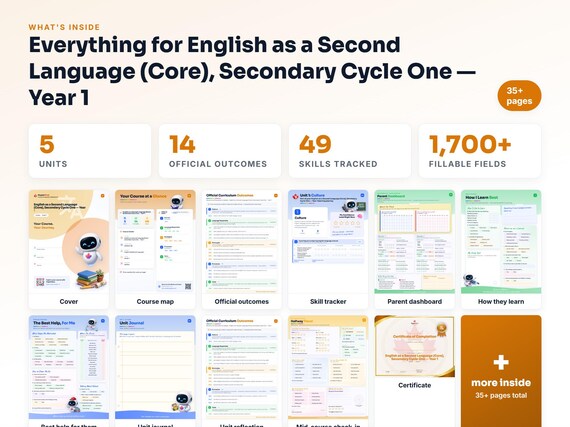
A English as a Second Language (Core), Secondary Cycle One — Year 1 workbook worth keeping
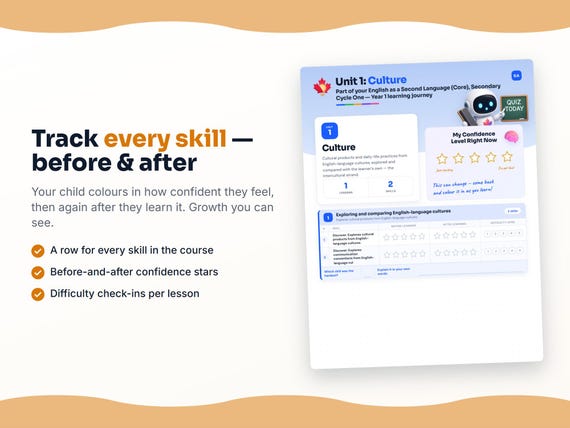
Built from the same official curriculum as this page. Before and after each skill above, your student colours in how sure they feel — so the two of you can see, on one page, what's clicking and what needs another look. It's a quiet way to follow how the year is really going.
By June it's full of their own handwriting: units worked through, confidence grown, a mid-year check-in, notes from parent-teacher night, and a certificate at the end. Less a worksheet, more a record of the year worth keeping on the shelf.
Instant download · see every page, reviews and the full description · five or more workbooks are $2.99 each
What it looks like in the app
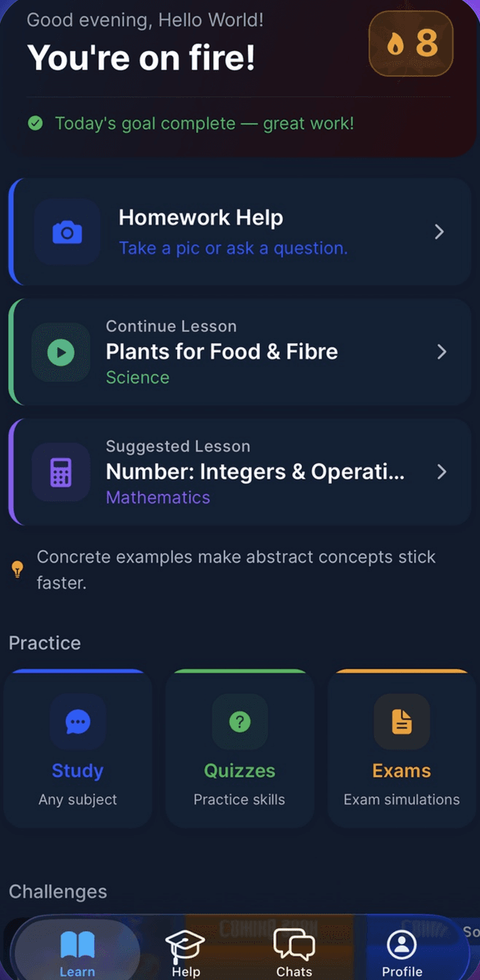
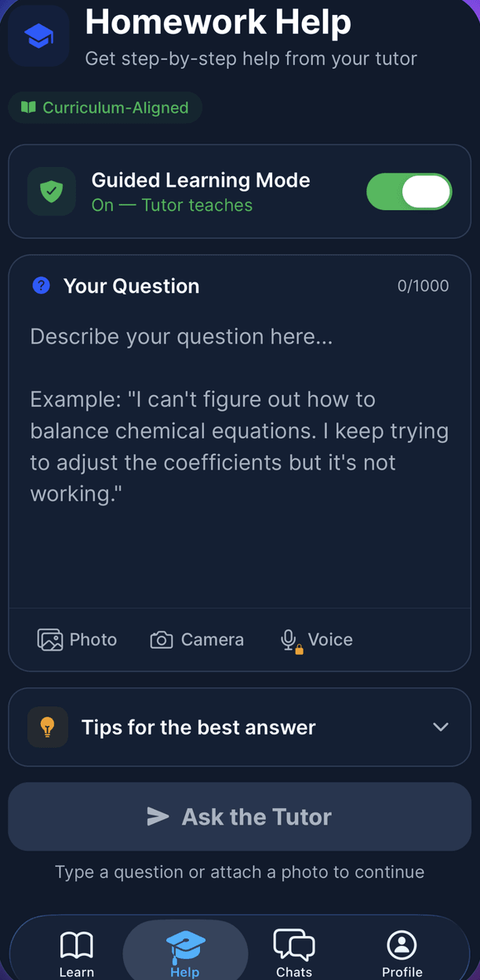
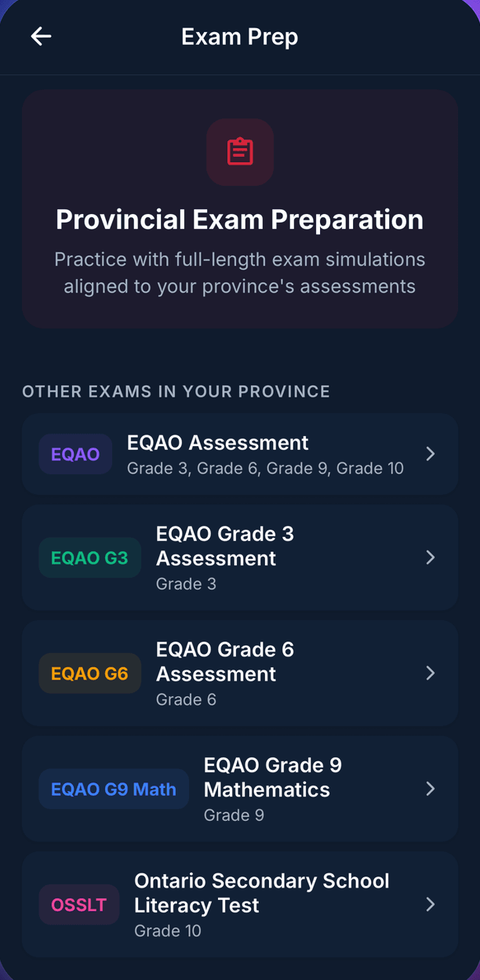
Common questions
Can MapleMind help me with English as a Second Language (Core), Secondary Cycle One — Year 1?
Yes. MapleMind's AI tutor covers all 49 skills in Quebec's English as a Second Language (Core), Secondary Cycle One — Year 1 — you pick the exact skill, and the tutor teaches it step by step: a short lesson, a worked example, solving together, then a skill check to show it stuck.
Is MapleMind aligned to Quebec's official curriculum?
Yes. Every skill in this course maps to an official outcome code from Quebec's Grade 7 English as an Additional Language curriculum, and the ministry's own wording is quoted under each unit on this page — with the official government source linked so you can check it yourself.
What does MapleMind cost?
It's free to start — 5 tutoring chats and a practice quiz every day, no credit card. A Pro subscription ($9.99/month or $49.99/year CAD, 7-day free trial) unlocks unlimited tutoring, practice, and exam simulations.
What if I'm stuck on just one topic?
That's the point of skill-level tutoring: open English as a Second Language (Core), Secondary Cycle One — Year 1 in the app, tap the exact skill from the list on this page, and the tutor teaches just that — no wading through lessons you don't need.
Does MapleMind work in French or other languages?
Yes — 14 languages, including French. Both the app and the tutor's explanations switch to the language you choose.
Where can I see the official Quebec curriculum for English as a Second Language (Core), Secondary Cycle One — Year 1?
The official source is linked on this page — Québec's official education program. The outline here follows it: every MapleMind skill carries its official outcome code, and the ministry's own wording is quoted under each unit.
Keep exploring
Ready when you are
Pick a skill from this page and see it taught properly — free, in the browser, in under a minute.